Evil eye? Google’s vision for the future.

pay-per-gaze creepy disturbingTo understand where Google is heading next in the world of advertising, consider this:  The company has just been granted a patent on its “pay-per-gaze” eye-tracking system.

You might wonder what that might be.

Pay-per-gaze is an ad system that utilizes Google Glass for tracking the ads that consumers see online and elsewhere.  The gaze-tracking capability comes from another Google innovation:  a head-mounted tracking device that communicates with a server.

According to the patent documentation, the tracking devices includes eyeglasses with side-arms that engage the ears of the user … a nose bridge that engages the nose of the user … and lenses through which the user views the external scenes wherein the scene images are captured in real-time.

And it need not be limited to tracking online advertising, either; pay-per-gaze functionality could potentially extend to billboards, magazines, newspapers and other printed media, Google notes.

But the idea is even more revolutionary than that:  Not only does it aim to measure how long an individual looks at an ad, but also how “emotionally invested” the consumer is by virtue of measuring pupil dilation.

So the tracking system not only will show how long someone looks at an ad, but also will measure the emotional response.  The patent also covers a provision for “latent pre-searching” which would display search results over a user’s field of vision using Google Glass or another wearable computer.

If all of this seems like “Big Brotherism” at its worst … you may well be correct.  But Google is doing its best to downplay such sinister connotations.  It’s emphasizing that users can opt out of “pay-per-gaze” tracking, and that all data will be anonymized.

But let’s get this straight:  The world’s biggest search engine was just granted a patent for the most “sticky” form of advertising possible – ads that literally flash in front of someone’s eyes.

And when we add in aspects like measuring pupil dilation, it won’t be long before Google will be able to determine how good eats, or good looks, are affecting our emotional response.

One wonders how much farther we can go with measuring advertising engagement and buying intent. 

Then again, we already have an answer, of sorts.  As early as 2000, experiments with electromagnetic brainwaves have shown that people can literally “think” instructions and thereby cause an action.

Imagine combining Google’s pay-per-gaze and pay-per-emotion with electromagnetic brainwave tracking.  Add in a credit card number, and there’s no telling what could happen just with a fleeting thought or two!

If all of this sounds creepy and disturbing … get used to it.  With the likes of Google and the NSA at the helm, “creepy and disturbing” may well become the “new normal” for society.

Google finds that in hiring practices, what’s old is new again.

Google hiring practices
Google Gone Retro: Its hiring practices look more familiar than different today.

Has Google made an about-face when it comes to the way it hires staff?

Over the years, there have been numerous articles written about Google’s unorthodox and highly selective recruitment and interviewing process

The company seemed to take a certain delight in the degree to which it subjected job candidates to mind-bending suitability tests and humiliating proctology-like HR examinations.

So I was a bit surprised to read this June 19, 2013 article in the New York Times, in which staff business reporter Adam Bryant published excerpts from an interview he had with Laszlo Bock, senior vice president of people operations at Google.

A major objective of the interview was to determine to what degree so-called “Big Data” can be used to help find the right candidates fill leadership and managerial positions in companies.

Instead of giving us all sorts of ways in which Big Data is helping to do that, Mr. Bock focused instead on the limitations.  And in the process, he revealed that Google has made attempts to harness more experiential data to come up with more effective hiring practices.  Here’s what he said:

“We’ve done some interesting things to figure out how many job candidates we should be interviewing for each position, who are better interviewers than others, and what kind of attributes tend to predict success at Google.

On the leadership side, we’re looking at what makes people successful leaders and how we can we cultivate that.”

And what about some of the more infamous Google hiring practices, such as looking at college transcripts from a million years ago or asking people to solve impossible “challenge questions” or equations?  Bock revealed these learnings:

“We found that brainteasers are a complete waste of time.  How many golf balls can you fit into an airplane?  How many gas stations in Manhattan?  A complete waste of time.  They don’t predict anything.  They serve primarily to make the interviewer feel smart.”

And about GPA stats, Bock revealed that after all of the data crunching, Google’s HR department came to this conclusion:

“GPAs are worthless as a criteria for hiring, and test scores are worthless – no correlation at all, except for brand-new college grades where there’s a slight correlation … we found that they don’t predict anything.

After two or three years, your ability to perform at Google is completely unrelated to how you performed when you were in school, because the skills you required in college are very different.  You’re also fundamentally a different person.  You learn and grow.  You think about things differently.”

So now Google has reverted to the tried-and-true formula of structured behavioral interviews, consistently applied across all applicants. 

This includes using standardized behavioral questions to listen to open-ended responses, which then makes it possible to see how candidates actually interacted in real-world situations, as well as what they consider to be “easy” or “difficult” situations in which they found themselves.

Regarding leadership qualifications, according to Bock, Google has found that these are ambiguous or amorphous characteristics:

“For leaders, it’s important that people know you are consistent and fair in how you think about making decisions, and that there’s an element of predictability.  If a leader is consistent, people on their teams experience tremendous freedom because then they know that within certain parameters, they can do whatever they want.”

Where “big data” comes in to play here is in twice-a-year employee surveys that Google conducts on all of its managers, evaluating a variety of factors. 

Those factors are the fundamental ones — things like sharing information, treating all team employees fairly, and providing clear goals and performance standards.

But Bock cautions that leadership success is highly dependent on the context; what works at one company isn’t necessarily right for another firm.  “I don’t think you’ll ever replace human judgment and human inspiration and creativity,” he notes.

I was pleased to read these comments, because I always felt that attempting to develop a radically new paradigm for job hiring, while being an interesting and novel endeavor, was also somewhat presumptuous on the part of Google. 

At the end of the day, human nature is what it is:  fickle, unpredictable, fallible.  No amount of “re-engineering” is going to change that.

Personal rights and liberties: Have we reached a tipping point?

Bill of Rights, being chipped away?As many of you know, I live in Maryland.  Around here, we’re well-familiar with the process by which Chesapeake Bay blue crabs are turned into the delicacy for which our state is so famous.

It’s simple:  We place the live crabs in a pot of water and slowly turn up the heat.  This “slow cooking” does the trick every time … and the hapless crabs are none the wiser.

I wonder if something similar is happening to us right now when it comes to our rights and liberties?

Consider these recent news developments:

And let’s not forget this other news shocker:  “The Supreme Court upholds Maryland legislation allowing law enforcement officials to collect DNA from any person detained or arrested – even before they’re charged with anything.”

Sometimes it’s easier to see what’s happening from the vantage of distance.  My brother, Nelson Nones, writes me the following from outside the United States:

It’s time for Americans of all political stripes to stand up and put a stop to this. 

Conservatives should be alarmed over the plainly obvious violations of our Constitution, the supreme law of our land:

  • Amendment 1:  “Congress shall make no law … abridging the freedom of speech …”
  • Amendment 4:  “The right of the people to be secure in their … papers, and effects, against unreasonable searches and seizures, shall not be violated, and no Warrants shall issue, but upon probable cause, supported by Oath or affirmation, and particularly describing the place to be searched, and the … things to be seized.”

Non-conservatives should be just as alarmed.  In fact, every citizen should be alarmed.

Anyone who thinks Chinese censorship and the Great Chinese Firewall are bad things, but supports what our government is doing as described in recent news on account of “security,” is a complete hypocrite.

Resorting to legalistic “workarounds” is no less hypocritical.  For example, some might claim that governments have unfettered legal power to engage in surveillance of electronic data because it doesn’t violate the “right of people to be secure in their … papers.”  However, any such interpretation is plainly contrary to the framers’ intent:  Intellectual property existed only on paper in 1791, when the Bill of Rights came into effect!

Others might maintain that warrantless government surveillance, backed up by gag orders to keep the surveillance secret, is “reasonable” in national security situations involving either domestic subversion or foreign intelligence operations.

This was the argument the Executive Branch put forward to the Supreme Court in Katz v. United States (1967).  But the Supreme Court unanimously overruled the Executive Branch by holding that, at least in cases of domestic subversive investigations, compliance with the warrant provisions of the Fourth Amendment was required.  

Justice Lewis Powell, writing for the Court, said that whether or not a search was reasonable was a question which derived much of its answer from the warrant clause; except in a few narrowly circumscribed classes of situations, only those searches conducted pursuant to warrants were reasonable (refer to Warrantless “National Security” Electronic Surveillance, http://constitution.findlaw.com/amendment4/annotation05.html#1).

In other words, the government attempted to legitimatize warrantless electronic surveillance through the courts, but lost. Case closed.

To Nelson’s comments, I would add that the Supreme Court’s upholding of Maryland’s sweeping DNA law (on a 5-4 decision), means that your and my DNA can be collected and kept on file with the government for the rest of our lives — and who knows what they could do with that information.  Dissenting Justice Antonin Scalia’s arguments in this case are strong, persuasive – and withering.

The question now before us is … what are we going to do about it?  My brother proposes civil disobedience, if necessary, to wipe away these blemishes – even going so far as leaking the contents of National Security Letters.

Would anyone care to offer alternative ideas – ones that work more within the system?  Your thoughts and comments are welcomed – and you can keep them anonymous if you wish!

Move Over, Howard Stern: Now Google’s the “King of All Media”

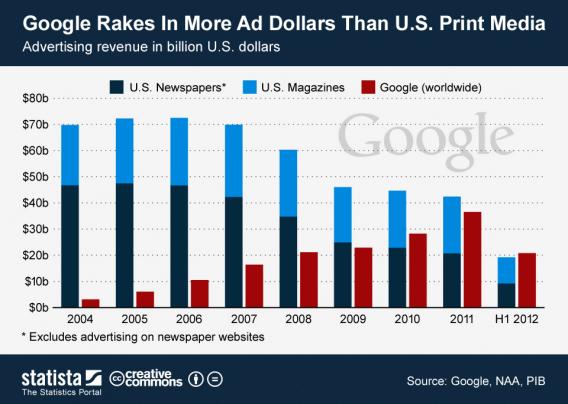
Google and Print Advertising Revenue Trends, 2004-2012It’s official. With nearly $21 billion in ad revenue generated during the first half of 2012, Google now attracts more advertising business than all U.S. print media combined.

That is correct:  German-based statistics portal Statista reports that Google garnered ~$20.8 billion in total ad revenues over the period, while all U.S. newspapers and magazines took in only about $19.2 billion.

Never mind that the comparison isn’t completely apples-to-apples … in that print revenues are for the United States only, while Google generates ad revenues worldwide. Still, it’s a dramatic milestone, and it says a lot about the fortunes (and future) of print versus online advertising.

Statista has helpfully published trend charts that show how quickly the ad picture has changed (see above). Only a few years ago, print advertising dominated the scene, but the trajectories of it and Google have been on opposite paths ever since.

It was inevitable that the lines would eventually cross, but how many could have foreseen it happening as early as 2012?

As if on cue, Advance Publications, a company that owns a number of venerable newspapers in New Orleans, Cleveland and elsewhere, has just announced that it is likely to cut the publication frequency of the Plain Dealer newspaper from its current seven days a week.

If Advance follows through on its intentions, it will join the New Orleans Times Picayune as a daily newspaper that’s no longer a daily.

The publisher’s letter to Plain Dealer readers described the newspaper’s future in lofty terms, noting that changes were coming as the paper seeks to “embrace dynamic shifts in the way information is consumed.”  And other such language.

It also noted that the pending changes are “not about cost-cutting.” But who believes that?

And in fact, the publisher’s letter states also that “if we maintain the status quo, we risk doing what everyone – our employees, advertisers and the community – wants to avoid: disappearing.”

If people don’t see a correlation between the Statista data and what the Plain Dealer has in store for its readers … they’re living on another planet. 

Google Gone Wild: Has its AdWords pay-per-click program become too costly for businesses?

Google advertisingNo one should be surprised by the huge success of Google’s AdWords pay-per-click advertising program. Almost single-handedly, that service has vaulted the company into the top ranks of U.S. corporations.

And why not? As an advertising concept, pay-per-click has no peer. Capturing the attention of customers when they’re in the midst of searching for specific goods and services is the ultimate in effective targeting.

What’s more, Google’s pioneering advertising model, where advertisers set their own bid pricing and pay only when someone clicks on a link to their web landing pages, made the program affordable for everyone – from the biggest national brands down to the neighborhood store.

Google also offered all sorts of geographic and time-of-day filters to make it easier for businesses to target people at the right time and the right place … yet another boon to smaller businesses that otherwise couldn’t hope to compete against the big national players.

Many advertisers were able to participate in pay-per-click programs at a fraction of the cost of traditional display advertising, where advertisers pay significant fees up-front for “wait and wish for” customer engagement.

A few years back, it wasn’t unusual to be able to conduct a lucrative AdWords program bidding, with clickthrough pricing running well below $1 per click.

Because Google continues to possess the lion’s share of search activity (two-thirds or more of all search volume despite the best efforts of Bing/Yahoo and others to chip away at it), it was only natural for more and more advertisers to gravitate to Google’s AdWords program as the best venue for pay-per-click advertising.

But the temptation to get in the game has had the predictable result: pay-per-click bid rates have been climbing steadily.

Whereas before, an advertiser could expect to get good exposure on search results pages with a modest bid, it’s not possible to accomplish that anymore without bidding $5, $10, $15 or even more per click.

That’s beginning to drive some businesses away – particularly smaller ones without the deep pockets of the big firms.  For for many of them, it’s simply not sustainable to pay that much money just to get someone to visit their website.

AdGooroo, a search intelligence database firm that studies the pay-per-click market, reports that ~96% of pay-per-click advertisers spend less than $10,000 per month on such programs. That compares to millions of dollars spent by the largest companies.

Richard Stokes, AdGooroo’s founder, states this: “The only way for smaller advertisers to get an edge is to spend a lot of time improving the quality and relevance of their ads. The problem is that everyone else is doing that as well.”

So where does this leave us now? We’re beginning to get some hints that Google may have tapped out on advertiser demand. Some companies are dropping pay-per-click programs altogether, while others are scaling back while redirecting resources to other forms of promotion – traditional and social.

We have additional proof of this in the earnings report filed by Google just last week. The company reported that advertising sales continue to grow, but at a slowing rate.

And even more interestingly, average cost-per-click rates have declined by ~15%. That’s the first-ever decline since the AdWords program was launched.

Here’s another development:  heightened interest and focus on obtaining better natural search rankings by optimizing websites for content relevance.

Imagine that:  companies looking for ways to make their websites more relevant to viewers as well as search engine bots!

The heightened SEO emphasis has worked for many companies – at least up until now. Google may want to increase advertising revenues, but it also wants to ensure that its search functionality continues to deliver the most relevant and quality results so that users don’t begin to migrate to other search platforms.

But some advertisers may be wondering if the “Chinese wall” between advertising and natural search is as high or as airtight as it once was. They contend that their natural search rankings seem to perform better when they’re also actively engaged in pay-per-click advertising campaigns … and perform less well when they’re not.

Whether there’s any actual proof of this happening is mere conjecture. After all, the same company that runs AdWords is also running the search algorithms. So there’s really no way to prove this from the outside looking in.

Rude Awakening: Google to Cut Jobs

Google is cutting 4,000 jobs at MotorolaNow here’s some interesting news: Google is downsizing – the first time it’s ever done so.

More precisely, it’s cutting ~20% of the workforce of its Motorola subsidiary, which it acquired earlier this year. And most of those job cuts are happening in the United States.

While Google is known for being a money machine, the fate of its Motorola subsidiary has been far less stellar. In fact, Motorola hasn’t turned a profit in 14 of its last 16 quarters.

Motorola proves how dicey the world of hardware is compared to the search advertising realm where Google makes more than 90% of its revenues and profits.

The fact is, despite Motorola’s strong lineup of smartphone models like the Droid RAZR and RAZR HD, it’s just very difficult to turn a profit on the hardware side — especially in the entry-level mass market where Motorola has also attempted to compete.

But more to the point: Motorola’s subsidiary is one industry sector where Google isn’t in the driver’s seat. By contrast, it’s easy to be a veritable profit machine when you control 65%+ of the billions that make up the search marketing world.

Recently, it’s clear that Google has been sniffing around to add other products and services and not be so dependent on one silver-bullet business category.

The big question is … what does Motorola’s experience portend for future forays by Google into new segments where the company doesn’t command an overwhelming advantage?  Or, will it spend more of its capital on search-related acquisitions, like the just-announced absorption of Frommer’s travel-related media properties?

Welcome to the real-world competition, Google.

Goodbye Hotmail … Hello Outlook

Hotmail becomes OutlookMicrosoft has finally bitten the bullet and acknowledged the catch-up ball it needs to play in the e-mail space.

Last week, Microsoft announced that it’s unveiling a completely revamped version of its Hotmail free online e-mail service.

Dubbed “Outlook” in a bid to transfer some of the goodwill from Microsoft’s popular Office email application to the free e-mail space, the successor product to Hotmail incorporates functionalities designed to make it more directly competitive with Google Gmail, which has been growing by leaps and bounds in recent times.

You may not realize it from the persistent dearth of industry press coverage about Hotmail, but it’s actually held the rank of the world’s largest online mail service, owning more than a third of the world market share (~325 million users), according to June 2012 reporting from cyber-statistics firm comScore.

But Microsoft’s margin over rivals has shrunk considerably, with Gmail hard on its tail at ~31% market share of users and Yahoo holding a similar percentage (~32%).

It may be surprising to learn that in the ever-changing digital space … but prior to this revamp Microsoft hadn’t updated any of the features or functionality of Hotmail in nearly a decade.

“A lot has changed in the last eight years, and we think it’s time for a fresh look at e-mail,” Chris Jones, a Microsoft exec, stated in a blog post that has to be the understatement of the decade.

Here’s some of what’s in store for users when they switch from Hotmail to Outlook:

  • A clean, uncluttered look – just like Gmail.
  • Tasteful, unobtrusive advertisements appearing in the right column of the screen – just like Gmail.
  • Users can link up with all major social media accounts to view the latest updates from their contacts and friends – just like Gmail.

Is this beginning to sound a bit repetitive?

But there is one feature that may give Outlook a bit of a leg up on its free online competitors: The service will automatically detect mass messages like sales notices, daily deals, newsletters and social updates and place them in separate folders. Users can customize this functionality to sort incoming e-mail any way they wish.

I haven’t used Hotmail in the past … although I might be tempted to consider Outlook now that these newest innovations have been added.

But the long-term success of Outlook – and any free e-mail platform – is going to be how effectively they can connect various online assets together to provide “one-stop convenience” for users.

One thing’s certain: There’s no way Microsoft can let another eight years go by before making more enhancements to its free e-mail service offering, considering the always-aggressive posture of Google and its Olympian competitive spirit.

Coming Attractions: A Newly Sanitized YouTube

YouTube Cleaning up its ActThe YouTube phenomenon has been one of the biggest success stories of all in cyberspace.

Over the years, YouTube has gone from being a weird corner of the web made up of curious, strange and often forgettable video clips, to a site that attracts millions of viewers every day – some of whom have essentially ditched all other forms of video viewing in favor of mining the vast trove of material YouTube carries on its platform.

In the years since Google acquired YouTube, traffic and usage have exploded, even as the video fare has become more varied (and also more professional).

But there’s one holdover from the early years that continues to bedevil Google: YouTube is a repository of some of the most inflammatory, puerile and downright disgusting commentary that passes for “discourse,” posted by all manner of rabble.

But now, Google is signaling a strategy that has the potential to clean up the crude comments on YouTube – and in a big way.

YouTube is now strongly encouraging users to post their YouTube comments using the name identity associated with their Google+ account.

In fact, if you decline to do so after being prompted, you’ll be asked to state a reason why, underscoring the nudge away from “screen name anonymity” and towards “real-name identity.”

The notion is that people will be less likely to post flaming comments when their “true” web identity is known – that people will exude good behavior in “polite cyber-company,” as it were.

Of course, one needs to possess a Google+ account in order to link his or her identity on YouTube. But that’s for today only; some observers see YouTube’s move as just the first step toward hiding – and eventually eliminating – all comments coming from anonymous accounts.

So the new bargain will be something closer to this: “Open a Google+ account and link your YouTube account to your Google+ account … or else forfeit your ability to post any comments at all on YouTube.”

The likely result will be a much more “sanitized” YouTube – less edgy, but also less red-faced embarrassing. And that’s just what many brands, businesses and advertisers would like to see happen.

Of course, YouTube’s moves may well spur the launch of an alternative site that seeks to preserve the (nearly) anything-goes environment of the YouTube of yore.

Perhaps it could be called “YouCrude,”  But, as it happens, that handle’s already been nabbed — by a fellow WordPress blogger!

Revenge of the Nerds: Microsoft will make “Do Not Track” the Default Setting for IE 10.

Do Not TrackIs it just me, or has Microsoft seemed to be the quiet wallflower in recent months? Meanwhile, Facebook and Google have been getting all the attention – good and bad.

But now, here comes this announcement: Microsoft will make the “do not track” feature in the next version of its Internet Explorer browser the “default” option when it ships.

This move poses a threat to the efforts of online advertising giants – including arch-rival Google – to track browsing behaviors and serve up relevant advertising – you know, the high-priced kind.

Could it be that Microsoft is doing a Monty Python “I fart in your general direction” number on Google? And how does this move affect the evolving privacy standards in the online realm?

It should be remembered that the “do not track” feature doesn’t actually block tracking cookies. But it does send a message to every website visited, stating the preference not to track.

It’s a request, not a command, but more sites are now honoring the request. Including, importantly, Twitter … which announced in May that it would embrace the emerging privacy standard.

The Federal Trade Commission also backs the new privacy standard, even as the agency has become more hostile to the online advertising industry’s tracking practices. In fact, the FTC has been threatening to advocate for privacy legislation.

Indeed, online advertisers are now walking a fine line in all of this. Ostensibly, they’re supporting privacy policies … but the ones they’re advocating aren’t too onerous on their ability to collect behavioral data.

What’s most concerning to advertisers is the possibility that they may eventually need to change the way they build profiles of users in order to sell premium-priced targeted ads.  That’s a nightmare scenario they’re attempting to avoid at all costs.

In this environment, how much of a threat is Microsoft’s move? Potentially big, since it’s likely that ~25% or more of web users will upgrade to the IE 10 product over time – with all of them having the “do not track” feature “on” by default.

Microsoft claims that it’s making the change “to better protect user privacy.” That seems logical on its face – and in keeping with Microsoft’s recent moves to incorporate privacy technologies in its browser products.

But one has to wonder if it’s also one of those “nyah” moments directed squarely at Google.

Because as we all know, there’s absolutely no love lost between these two behemoths.