Is Telephone Landline Usage Doing a Disappearing Act?

phoneIt may be a surprise to some people, but we’re getting pretty close to half of all households in America that are now without any sort of telephone landline.

[Actually, it’s not quite there yet – the percentage is ~44%.  But the trend is clear, and it’s accelerating.]

The latest statistics come to us courtesy of GfK Mediamark Research.  And GfK’s consumer survey findings align with other published survey data from U.S. government sources.

Just five years ago, only about one in four American adults lived in cellphone-only households.  But since then, the cellphone-only population has jumped by ~70%.

And when we look at a breakdown by age demographics, it becomes even more obvious that we’re in the midst of a transformation.

Here are the stark figures:

  • Pre-Boomers (born before 1946): ~13% live in cellphone-only households
  • Baby Boomers (born from 1946 to 1965): ~32% live in cellphone-only HHs
  • Generation X (born from 1965 to 1976): ~45% live in cellphone-only HHs
  • Millennials (born from 1977 to 1994): ~64% live in cellphone-only HHs

Mirroring the age statistics are ownership rates for smartphones:  very high among millennials down to very low among pre-Boomers:

  • Millennials: ~88% own a smartphone
  • Generation X: ~79 own a smartphone
  • Baby Boomers: ~56 own a smartphone
  • Pre-Boomers: ~20% own a smartphone

[Additional topline findings from the GfK research can be viewed here.]

Based on the trends we’re seeing, how soon will it be that telephone landlines become a thing of the past?  I’d be interested in hearing your perspectives.

Going up against Goliath: The latest privacy tussle with Facebook.

Is that Maria Callas?  Check with Facebook -- they'll know.
Is that Maria Callas? Check with Facebook — they’ll know.

It had to happen eventually:  Facebook’s “faceprints” database activities are now the target of a lawsuit.

The suit, which has been filed in the state of Illinois, alleges that Facebook’s use of its automatic photo-tagging capability to identify people in images is a violation of Illinois’ state law regarding biometric data.

Facebook has been compiling faceprint data since 2010, and while people may choose to opt out of having their images identified in such a way, not surprisingly, that option is buried deep within the Facebook “settings” area where most people won’t notice it.

Moreover, the “default” setting is for Facebook to apply the automatic photo-tagging feature to all users.

Carlo Licata, the lead individual in the class-action complaint filed in Illinois, contends that Facebook’s practices are in direct conflict with the Illinois Biometric Information Privacy Act.  That legislation, enacted in 2008, requires companies to obtain written authorization from persons before collecting any sort of “face geometry” or related biometric data.

The Illinois law goes further by requiring the companies gathering biometric data to notify people about the practice, as well as to publish a schedule for destroying the information.

Here’s how the lawsuit states its contention:

“Facebook doesn’t disclose its wholesale biometrics data collection practices in its privacy policies, nor does it even ask users to acknowledge them.  With millions of users in the dark about the true nature of this technology, Facebook [has] secretly amassed the world’s largest privately held database of consumer biometrics data.”

The response from Facebook has been swift – and predictable.  It contends the lawsuit is without merit.

As much as I’m all for of individual privacy, I suspect that Facebook may be correct in this particular case.

<em>Brave New World:</em>  Biometrics
Brave New World: Biometrics

For one thing, the Illinois law doesn’t reference social networks at all.  Instead, it focuses on the use of biometrics in business and security screening activities — citing examples like finger-scan technologies.

As Eric Goldman, a professor of law at Santa Clara University notes, the Illinois law is “a niche statute, enacted to solve a particular problem.  Seven years later, it’s being applied to a very different set of circumstances.”

And there’s this, too:  The Illinois law deals with people who don’t know they’re giving data to a company.  In the case of Facebook, it’s commonly understood user data is submitted with consent.

That may not be a particularly appealing notion … but it’s the price of gaining access to the fabulous networking functionality that Facebook offers its users – all at no expense to them.

And of course, millions of people have made that bargain.

That being said, there’s one nagging doubt that I’m sure more than a few people have about the situation:  The folks at Facebook now aren’t the same people who will be there in the future.  The use of faceprint information collected on people may seem quite benign today, but what about tomorrow?

The fact is, ultimately we don’t have control over what becomes the “tower of power” or who resides there.  And that’s a sobering thought, indeed.

What’s your own perspective?  Please share your thoughts with other readers here.

What are the latest trends in the popularity of different marketing communications channel tactics?

The DMA’s 2015 Response Rate Report provides answers.

marketing channelsPeriodically, the Direct Marketing Association conducts field research to take the pulse of marketers and the various channels they’re employing to support their marketing campaigns.

In the DMA’s most recent survey, conducted online this past December and January, marketers were asked which one of seven channels they utilize in their campaigns.  The seven choices listed were the following:

  • Direct mail marketing
  • E-mail marketing
  • Mobile marketing
  • Online display advertising
  • Paid search advertising
  • Social media advertising
  • Telemarketing

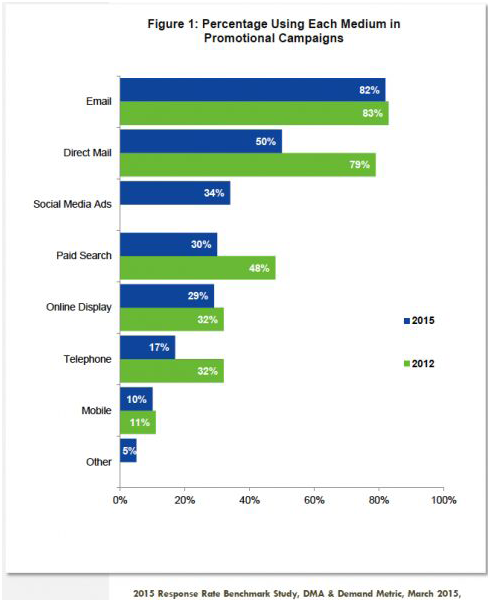
The results of the survey show that e-mail marketing remains King of the Hill when it comes to its popularity as a MarComm channel, with more than four in five marketers including the tactic as part of their promotional campaigns:

  • E-mail: ~82% use as a medium in promotional campaigns
  • Direct mail: ~50% use
  • Social media advertising:  ~34% use
  • Paid search: ~30% use
  • Online display advertising:  ~29% use
  • Telemarketing: ~17% use
  • Mobile marketing: ~10% use

Clearly, the research findings show that marketers are using multiple channels in their campaigns:  Two-thirds of the survey respondents use more than one channel, and around 45% of them reported that they’re using three or more channels in their promotional campaigns.

Social media advertising is a new entrant on the list in the DMA research.  It wasn’t even included in the DMA’s 2012 survey, yet today appears to be an important part of the channel mix.

On the other hand, mobile marketing remains a channel that isn’t being utilized by very many marketers — at least not yet.  In a similar survey conducted by the DMA in 2012, its adoption rate was similar to what the 2015 survey has found.

The graph below compares 2015 and 2012 survey results.  Aside from the lack of movement with mobile marketing, another interesting trend is the significant decline in the utilization of direct mail marketing.  Back in 2012, it rivaled e-mail marketing in popularity.  Today, only half of the marketers surveyed continue to use it as a marketing channel.

And a third big trend is the utter collapse of telemarketing as a popular MarComm channel — likely happening under the twin weight of high costs and massive phone message filtering.

DMA chart

In terms of future anticipated usage, the DMA research found that marketers are, in fact, warming to mobile marketing.  It and social media advertising are the two channels that have the best prospects for new adoption, based on the future intentions reported by these respondents.

The 2015 DMA report is available for purchase here.

Hotel brands and social media: Leading and following at the same time?

If you want to see an industry that’s using social media to best advantage, you needn’t look any further than the hotel trade.

hotels on FBMore than any other industry segment, hotel brands seem to have gotten a very good handle on the whole “local/global” concept.

Hotel properties that are part of a large chain or group originate from the main brand, of course.  And yet, the nature of the business means that they are individual entities as well, across the country and around the world.

For this reason, many local hotels that are part of larger chains have established their own individual social profiles.  That’s turned out to be a great way to attract more consumer engagement compared to social pages that are focused on global hotel branding.

Moreover, the social profiles of hotel properties are the perfect vehicle for promoting programs aimed at generating more bookings via local special offers, vacation deals and the like.

Recently, social media analytics firm Socialbakers researched some of the world’s largest hotel brand groups to determine the extent of their social media presence by looking at the seven most important platforms (Facebook, Twitter, Instagram, Google+, Tumblr, Pinterest and LinkedIn).

hilton logoAs it turns out, seven hotel brand groups have at least 1,000 separate social profiles on these platforms.  In the case of Hilton, it’s nearly 2,000:

  • Hilton Worldwide: ~1,850 separate profiles across the top seven social networks
  • InterContinental Hotels Group:  ~1,550 profiles
  • Marriott International:  ~1,300
  • Starwood Hotels & Resorts Worldwide: ~1,250
  • Wyndham Hotel Group: ~1,250
  • Accor: ~1,200
  • Best Western International:  ~1,000

In looking deeper at the extent of the social profiles these giant brands, Socialbakers found some interesting details that may point to certain individual strategic differences.  Among the findings were these:

.  Facebook is the most popular social platform for everyone – no question – with at least 50% of each brands’ social profiles housed there.

.  Twitter is the next most popular network, with profiles there representing between 20% and 40% of all social profiles for each brand.

.  Starwood Hotels and Accor are somewhat less Facebook-centric than the others – and they also have a more significant presence on Instagram and LinkedIn than the other brands.

.  Pinterest appears to be the least attractive major social platform for individual hotel profiles.

.  Hilton and Marriott have the largest number of social profiles in North America. 

It would seem that the big hotel brands are both leading and following when it comes to their social media presence.

While they may be ahead of the curve compared to many other industries, they are also following the lead of their own consumers – so many of whom rely on conducting their own online research and consulting user reviews to determine where they want to stay – not to mention the best room rates and deals they can find in order to do so.

How about you?  Like me, do you follow certain individual hotel properties on social media, or instead do you focus on hotel brands more broadly?  Please share your perspectives with other readers here.

Online customer care: Is retailer responsiveness going in opposite directions at once?

waiting for a responseAn interesting shift is happening in online customer care:  Response times are improving on social media while they’re getting worse in e-mail communications.

That’s what a new analysis by customer interactive software provider Eptica, as outlined in its 2015 Multichannel Customer Experience Study, is showing.

What Eptica has found is that retailers’ response times to answer customer queries posted on Twitter have improved dramatically in the past year.

Today, a customer query is being answered in an average time of a little over 4 hours.

That’s more than twice fast as in Eptica’s 2014 study, when the average response time clocked in at just over 13 hours.

In addition, the number of tweets successfully handled by retailers stands at around 43%, which is a full ten percentage points higher than what Eptica found in its 2014 study.

While more improvement is needed, the trend line is looking pretty good.  And it makes sense, since the “immediacy” of social media platforms is where many people believe a quick response should be forthcoming.

Crossing Lines

lines crossingBut while customer care response times via social media are improving, the opposite appears to be the case in e-mail customer service – and startlingly so.

Eptica’s evaluation shows that the average time it takes to respond to customer service queries submitted via e-mail is significantly longer than just a year ago.

Then, the average response time was ~36 hours.  Now, it’s nearly 44 hours – or nearly two days.

And while more e-mail customer service queries are successfully handled via e-mail when compared to tweets (~58% versus ~43%), that figure is worsening as well.  Last year, the percentage of e-queries successfully handled was ~63%.

More broadly, there continues to be a pretty significant disconnect between the “ideal” and the “reality” when it comes to online customer care and service.

Nearly all retailers provide an e-mail channel through which consumers may contact them.  But … less than three-fourths of them actually answer the e-mail messages they receive.  Moreover, the responses they provide – often automatically generated – don’t answer the customer’s question.

For a consumer with an issue or a concern, there’s little difference between getting no answer at all and receiving one that’s a “non-response response” in answer to a specific query.  Both seem to convey this message, “We don’t much care, because your issue just isn’t that important to us.”

Turning to social media, nearly 90% of major retailers have a presence on Twitter.  There, the “ignore” factor is even bigger than with e-mail:  ~45% don’t respond to their customers’ queries.

So while the social media figures certainly look better now than they did a year ago, it turns out there’s still a good ways needed to go.

Burgeoning social activity is no reason for retailers to take their foot off the gas pedal when it comes to supporting their customers via e-mail.  E-mail may not be the most exciting channel, but it’s the way millions of consumers prefer to communicate with retailers, companies and brands.  It’s counterproductive and foolish to diss them or treat them like second-class citizens.

In my own personal experience I’ve experienced the exact dynamics as described by Eptica at work – and I’m not afraid to name names.  TruGreen® Lawn Care did a stellar job of avoiding responding to my e-mail and phone queries … but it took less than two hours to get a response from someone at the firm after I posted a not-so-happy tweet about the company’s (lack of) responsiveness.

For me, the “public shaming” aspects of Twitter turned out to be far more of a squeaky wheel than the “private pleading” of an e-mail or phone message.

Do you have personal anecdotes of your own about the dynamics of online customer care?  Please share your thoughts and experiences with other readers here.

Banking on Facebook: The social media giant makes its first moves into the credit-card payments business.

untitledRecently, I blogged about how Google’s efforts to expand its business activities beyond pay-per-click advertising — thereby diversifying its revenue stream — haven’t borne much fruit.

In 2011, ~96% of Google’s revenues came from PPC advertising.  In 2014, it’s ~97%.

But Google isn’t the only behemoth whose income is completely tied to advertising.  Over at Facebook, ~93% of the company’s more than ~12 billion in revenues come from advertising as well.

Compared to Google, Facebook is a relative newcomer to the advertising game.  But once it got in on the action, its growth was very robust.

In 2014 alone, Facebook’s advertising revenues were up 58% over the previous year.

But … there’s a bit of a problem.  In a world where advertising revenues are tied to “eyeballs,“ Facebook’s user growth isn’t on the right trajectory.  When the network has nearly 1.5 billion active users already, there’s not a lot of room for expansion.

This is reflected in Facebook’s Q4 year-over-year percentage growth stats as published by Mediassociates, a media planning and buying agency:

  • 2009: ~260% year-over-year growth
  • 2010: ~69% growth
  • 2011: ~39% growth
  • 2012: ~25% growth
  • 2013: ~16% growth
  • 2014: ~13% growth

One can easily imagine 2015’s growth figure dipping into the single digits, giving Facebook all the hallmarks of being a mature company in a maturing market.

But the always-enterprising folks at Facebook have had something up their sleeve which they’re rolling out to the market now:  getting into the multi-billion credit-card payments business.

Facebook send money appThey’re starting small:  introducing a “send-friends-money” functionality to Facebook’s Messenger app.  But this rather innocuous addition hardly does justice to Facebook’s end-game strategy.

When you think about it, Facebook’s aims make a lot of sense.  With nearly 1.5 billion active users around the world, Facebook’s accounts make PayPal’s ~162 million active accounts seem pretty paltry by comparison.

But revenue from PayPal’s transaction tolls isn’t chump change at all:  nearly $8 billion last year alone.

Without doubt, Facebook is also looking at the huge amount of business done by American Express and VISA; think of the billions of dollars those companies earn by charging merchants between 2% and 3.5% on the value of each credit-card transaction.

Facebook’s entry into the business can be facilitated neatly through its Messenger mobile app, making it just as easy (or easier) to pay for goods and services as with a credit card.

Considering that Facebook’s users with mobile phones are already spending time on the network an average of an hour per day, it’s pretty easy to see how people could make the transition from traditional credit and debit card payments to using their Facebook app for precisely the same purposes.

And Facebook could sweeten the pot by working with retailers and marketers to offer real cash loads that would likely juice participation even more – sort of a cash rebate in advance of the purchase rather than afterward.

So we shouldn’t think of Facebook’s new “send-friends-money” feature as a one-off function.

Instead, it’s just the tip of the iceberg.  If I were a manager at VISA or AmEx, I’d be thinking long and hard about the real motivations – and real implications – of Facebook’s latest moves.

Tripping the E-Mail Spam Alarm

Today, it’s more than just the “usual suspect” keywords that are landing e-mails in the junk folder.

se-mMost of us are aware of the kinds of words that trip spam alarms and cause e-mails to be sent straight to the junk folder – or not to be delivered at all.

How about these for starters:

  • Cash
  • Congratulations
  • Discount
  • Free
  • Income
  • Make Money
  • Urgent
  • Viagra
  • $$ / $$$

But research done by MailJet, an international e-mail service provider, looked at more than 14 billion e-mail communiqués and found that a bunch of other keywords are setting off alarm bells nearly as often as terms like “Urgent” or “Viagra.”

… Especially when considering the business categories that are so active in e-mail communications — retail goods, pharmaceuticals, providers of personal services, and the like.

Some of the other terms MailJet has found to be nearly as “toxic” are these:

  • bdcstDear Friend
  • FedEx
  • Increase Sales
  • Increase Traffic
  • Internet Marketing
  • Invoice
  • Lead Generation
  • Lose Weight
  • Marketing Solutions
  • Online Degree
  • Online Pharmacy
  • Order
  • PayPal
  • Search Engine Optimization
  • Sign Up
  • Trial Offer
  • Visa/Mastercard
  • Winning

… And there are more, of course – including various permutations of the words and phrases above.

The inevitable conclusion:  It’s becoming more difficult all the time to use the most common phrases in “subject” lines and “from” lines that’ll land your e-mail in someone’s inbox successfully.

And getting into the inbox just the first step, of course.  The next is motivating the recipient to actually open your e-mail and engage with it, which are additional hurdles in themselves.

What words or phrases have you found to be surprisingly problematic in getting your e-mails delivered to your customers’ inboxes?  How have you dealt with it?  Please share your experiences with other readers here.

Google and the multi-billion dollar pay-per-click money tree.

moneyIt’s no secret that Google has been trying to diversify its revenue stream away from clickthrough advertising, which historically has accounted for the overwhelming majority of its income.

How else to explain Google’s shopping spree over the past decade, scooping up a veritable smorgasbord of industry players like these:

  • AdMob (mobile)
  • Adometry (attribution)
  • Channel Intelligence (product feeds)
  • DoubleClick (display)
  • Invite Media (programmatic creative and media buying)
  • Teracent (programmatic creative and media buying)
  • YouTube (video)
  • Wildfire (social)

So the next question is, “How much have these acquisitions and investments done to diversify Google’s sources of revenue?”

The answer:  Hardly anything.

Consider this statistic:  In 2011, nearly all of Google’s revenue came from online pay-per-click advertising, as reported by SEO firm WordStream.

Now let’s look at 2014 figures:  WordStream reports that the percentage of Google revenues from pay-per-click advertising is actually higher than in 2011, at 97%.

So much for the “diversifying effects of diversity.”

Within PPC advertising, a number of keyword terms are continuing to haul in the big bucks for Google.  A few years back, the priciest keyword term of all was mesothelioma, at more than $100 a click.

Mesothelioma continues to attract a lot of ad dollars, but it’s no longer commanding $100 a pop as it once did.  In fact, it’s no longer on the Top 10 most expensive keywords list.

That list looks like this now (in descending order of bid pricing, starting at over $50 per click and dropping to “only” around $45 for the #10 keyword):

  • Insurance
  • Loans
  • Mortgage
  • Attorney
  • Credit
  • Lawyer
  • Donate
  • Degree
  • Hosting
  • Claim

In developing the ranking, WordStream determined which keywords reside in the stratosphere by compiling data from its own large keyword dataset and the Google Keyword Tool (over a 90-day period) to determine the 10,000 most expensive keywords.

These were then organized into categories like “credit” and “insurance” by weighting the number of keywords in each category, estimating the monthly search volume as well as the average cost-per-click for each keyword.

Notice the preponderance of financial and legal terms – both of them key to sectors that attract and manage a ton of money.

The word degree is right up there, too, underscoring how important the educational complex has become to the ad business.

It must be pretty unappealing to be active in these industries and have to pony up such big dollars to participate in the pay-per-click advertising space.  But how else do we think Google racks up annual advertising revenues that are north of $32 billion?

How does the market sort out which keywords are worthy of commanding $40 or $50 per click?  Essentially, it boils down to this:  Invariably, the most expensive niches paying for the most costly keywords are ones with very high lifetime customer value – where the customer pay-off is high.

Think about it:  The amount of money an insurance company gets from an individual signing up for coverage makes the high cost-per-click rates – even at $50 a pop — worth it.

Business observers point to long-range trends that may make search engine marketing increasingly irrelevant as the growth of multichannel, multi-device marketing picks up steam.

But don’t hold your breath; Google will likely be earning billions off of pay-per-click advertising for years to come.

Bird dropping: Instagram overtakes Twitter in the social media derby.

Instagram logo

It seems like the jockeying for position among social networks is never-ending.

The latest case in point:  Instagram, which is presently the fastest growing social media network in the United States.

According to the latest figures released by digital market research company eMarketer, as of February 2015 Instagram now has over 64 million users in America.

That’s a ~60% increase in just one year, and it puts Instagram in third place among all social networks, surpassing Twitter for the first time.

Not only that, eMarketer forecasts that Instagram will add more than 10 million additional users in the United States this year:

  • Facebook: ~157 million U.S. users forecast in 2015
  • LinkedIn: ~115 million
  • Instagram: ~78 million
  • Twitter: ~53 million
  • Pinterest: ~47 million
  • Tumblr: ~20 million

       (Source:  eMarketer and LinkedIn, February 2015.)

eMarketer also forecasts that Twitter will continue to fall further behind Instagram in the upcoming years, since Twitter’s annual growth is expected to be in only the single digits throughout the rest of the decade.

Based on the overall American population, Instagram has now a market penetration of nearly 25%.  Of course, that’s well behind Facebook, which has nearly 50% penetration.

Untitled-1But Instagram’s user base is skewed heavily towards teens and millennials – people between the ages of 12 and 34.  This makes Instagram a bit more of a threat to LinkedIn and even Facebook than you might think at first.

Facebook’s user base has been skewing older in recent years.  If those trends continue, we could see a measurable drop-off in Facebook’s share of users, with a corresponding rise in Instagram’s penetration.

Of course, we mustn’t forget that Facebook was the social media network of choice for younger people at one time, too.  After all, it got its start on college campuses.  But now that Facebook has solid adoption among older Americans (age 40 and over), no longer does it seem like a “cool” network for some millennials and teens.

So it would be foolish to assume that Instagram is a slam-dunk to continue to be the “network of choice” for younger people in the years hence.  One never knows what new network might suddenly appear on the horizon and capture their hearts.

Still, Instagram’s rise has been noteworthy.  And it certainly puts the lie to the notion that there wasn’t room for a new network to enter the increasingly crowded social media space and make a big splash.

Personally as an “aging boomer,” I don’t have an Instagram account, and neither do most of my acquaintances.  What about your own personal experience or professional experiences with this network?

The Affordable Care Act: Still unpopular with physicians after all these years.

ACAOne of the predictions we’ve heard about the admittedly controversial Affordable Care Act is that acceptance of it will grow over time, as people become more familiar and comfortable with its provisions.

So far at least, we haven’t seen this happening in the public polling about the law.

And now we’re seeing similar dynamics playing out in the all-important physician community.

In fact, the latest findings are that the ACA is more unpopular than ever, if the results of a new survey of physicians are to be believed.

The survey was conducted in January 2015 by LocumTenens, a physician staffing firm and online job board.

The headline finding must be this:  While ~44% of the survey respondents reported that they had been opposed to the Affordable Care Act legislation prior to its implementation, now ~58% are opposed to it after a year of working under the confines of the law.

R. Shane Jackson, president of LocumTenens, had this to say about the key finding:

“After a year in the trenches trying to help patients understand this legislation, physicians by and large feel the law hasn’t done a lot to help improve healthcare.”

More specifically, Jackson noted,

“Physicians feel the ACA has made serving patients and running their businesses much harder.  A year after implantation – and years after the political debate started – doctors are still passionate about how this law should have been designed, and would still like to see changes made that will make it simpler for their staffs and patients to understand.”

Among the negatives physicians see with the current ACA law are these aspects:

  • Lower reimbursement rates to hospitals and physicians
  • Increased compliance burdens for physician practices
  • Higher patient debt due to high-deductible plans

ACA healcare premium changesAlso faulted are the insurance companies for not doing more to inform newly insured patients about their premiums, deductibles and coverage limits.

It isn’t all poor marks for the ACA, however.  Physicians in the LocumTenens survey do credit the legislation for a number of positive outcomes including:

  • Helping more people gain access to healthcare
  • Expanding coverage to more children and young adults
  • Eliminating coverage denials due to pre-existing health conditions
  • Placing more focus on preventive healthcare measures
  • Decreasing the costs of end-of-life care

So what is the “net-net” on all of this?

Two-thirds of the physician respondents want the ACA law repealed (and three-fourths think it will be, incidentally).  But physicians want it replaced by something else that retains the positive aspects of the ACA while doing away with the negatives.

That’s the same message we’ve been hearing from politicians, too.  So the bigger question is how to unscramble the ACA egg … and whether anything actually better can come out of the effort.

Would anyone care to weigh in with their thoughts and ideas in this never-ending debate?