Getting Our “Just Rewards” in Airline and Hotel Loyalty Programs

If you think your airline or hotel rewards program is “merely mediocre” … you’re likely not alone.

Rewards ProgramsU.S. News & World Report’s just-published annual listing of the best and worst rewards programs in the airline and hotel industries is confirming what many people already suspect: some of America’s biggest loyalty programs are also some of the least liked.

Let’s start with the airlines. USN&WR ranked the ten largest programs on a variety of attributes including the ease of redeeming points for free flights and hotel stays.

Best Airline RewardsThe three best performing airline rewards programs do include two with high participation rates — American and Southwest:

  • #1: Alaska Airlines Mileage Plan
  • #2: American Airlines AAdvantage
  • #3: Southwest Rapids Rewards

But three other programs, including two of the biggest ones — United and Delta — bring up the rear:

  • #8: United MileagePlus
  • #9: Delta SkyMiles
  • #10: FREE SPIRIT

Ranked in between are four other airline rewards programs, generally ones with fewer participants because of the smaller size and narrower geographic reach of the airlines involved:

  • #4: JetBlue TrueBlue
  • #5: HawaiianMiles
  • #6: Virgin America Elevate
  • #7: Frontier EarlyReturns

As for which airline rewards programs experienced significant changes in their rankings between this report and last year’s, the biggest shift was JetBlue, which fell from the top-ranked position in 2014 to fourth place in the latest ranking.

Hotel Rewards Programs

Best Hotels RewardsUSN&WR took the same approach with hotel rewards programs, but evaluated a larger group of 18 programs. The five best-ranked hotel programs are the following ones:

  • #1: Marriott Rewards
  • #2: Wyndham Rewards
  • #3 (tie): Best Western Rewards and Club Carlson
  • #5: IHG Rewards Club

Marriott’s top ranking is a repeat from the 2014 USN&WR rankings, and it’s due to maintaining high strength in the three-legged stool of critical factors: having an extensive hotel network; a relatively lower requirement for earning and redeeming free hotel stays; and generous “extras” as part of its membership perks.

Also noteworthy was Wyndham Rewards ascent to the #2 position from #7 a year earlier.  Its dramatic improvement was attributable to changing its program policies to allow members to redeem a night’s hotel stay for a flat rate of 15,000 points across the board.

At the other end of the scale were these low-ranked rewards programs:

  • #14:  Kimpton Karma Rewards
  • #15: Le Club Accorhotels
  • #16: Fairmont President’s Club
  • #17: iPrefer
  • #18: Loews YouFirst

The worst programs score that way because in comparative terms, they lack easy ways to earn points.  Also, in many cases their geographic coverage and/or property diversity is lacking.

[Perhaps the bottom-ranked program will need to change its name to Loews YouLast …]

For the record, the hotel rewards programs that came in the middle of the pack are these:

  • #6: Leaders Club
  • #7: La Quinta Returns
  • #8: Starwood Preferred Guest
  • #9: Hilton HHonors
  • #10: Hyatt Gold Passport
  • #11: Choice Privileges
  • #12: Stash Hotel Rewards
  • #13: Omni Select Guest

More information about the USN&WR rewards program rankings for both industries can be found here.

What about your personal experience with various airline and hotel programs? Do you have one or two particular favorites? Or ones you’ve decided to stay away from at all costs? Please share your perspectives with other readers.

In case you’re wondering … consumers don’t really care about brands all that much.

branding“I don’t want a ‘relationship’ with my brands.  I want the best products at the best price.” — Jane Q. Public

In the era of interactive marketing and social media, there’s often a good deal of talk about how certain brands are successfully engaging their customers and creating an environment of “brand love” — or at least “brand stickiness.”

It’s not only consumer brands like Chipotle and Under Armour, but also B-to-B and hybrid brands like Intel, Apple and Uber.

As a person who’s been involved in marketing and advertising for well over a quarter-century, I tend to treat these pronouncements with a little less open-mouthed awe than others.

I get how when a brand is particularly admired, it becomes the “go-to” one when people are in the market for those particular products and services.

But the idea that there’s real “brand love” going on — in a sense similar to people forging close relationships with the people in their lives — to me that’s more far-fetched.

The marketing research I’ve encountered appears to refute the notion as well.

Case in point: In an annual index of “meaningful brands” published by the Havas MarComm agency, the research finds that very few consumers cite brands they “can’t live without.”

The 2015 edition of the Havas Meaningful Brands Index has now been released … and the results are true to form. Among U.S. consumers, only about 5% of the 1,000 brands evaluated by Havas across a dozen industries would be truly missed if they were no longer available.

It’s a big survey, too:  Havas queried ~300,000 people across 34 countries in order to build the 2015 index. Broadly speaking, the strength of brands is higher in countries outside the United States, reflecting the fact that trust levels for leading brands in general are higher elsewhere — very likely because lesser known brands or “generics” have a greater tendency to be subpar in their performance.

But even considering the brand scores globally, three out of four consumers wouldn’t miss any brands if they suddenly disappeared from the market.

What are the exceptions? Looking at the brands that scored highest gives us clues as to what it takes to be a brand that people truly care about in their lives.

Samsung is ranked the #1 brand globally. To me, it makes perfect sense that the manufacturer of the most widely sold mobile device on the planet would generate a strong semblance of “brand love.”

Even in the remotest corners of the world, Samsung has made the lives of countless people easier and better by placing a powerful computer in their pocket. It’s only logical that Samsung is a brand many people would sorely miss if it disappeared tomorrow.

The second strongest brand in the Havis index is Google. No surprise there as well, because Google enables people to research and find answers on pretty much anything that ever crosses their minds. Again, it’s a brand that most people wouldn’t want to do without.

But beyond these, it’s plain to see that nearly all brands just aren’t that consequential to people’s lives.

With this in mind, are companies and brands spending too much energy and resources attempting to get customers to “care” about them more than simply to have a buying preference when the time comes to purchase products and services?

Brand-LoyaltyRelated to that, is adding more “meaning” to a brand the answer to getting more people to express brand love? Or does it have far more to do with having products that meet a need … work better than competitors’ offerings … and are priced within the means of more people to purchase?

Havas — and common sense — suggests it’s the latter.

Do that stuff right, and a company will earn brand loyalty.

All the rest is just froth on the beer … icing on the cake … good for the psychological bennies.


The mouse that roared: Smartphones take on bigger screens – and they’re winning.

The key takeaway message from MarketLive’s latest e-commerce statistics is that smartphones are where the go-go action is in e-commerce.

SmartphonesIf there’s any lingering doubt that smartphones are really on the march when it comes to e-commerce activity, the latest user stats are erasing all vestiges of it.

MarketLive’s 2nd Quarter e-commerce stats for 2015 reveal that mass-market consumers purchased ~335% more items via their smartphones than they did during the comparable quarter last year.

MarketLive’s report covers the buying activity of millions of online consumers. And the uptick it’s showing is actually more like a flood of increased activity.  That’s plain to see in these year-over-year 2nd Quarter comparative figures for smartphones:

  • Catalog merchandise: +374%
  • Merchandise sold by brick-and-mortar establishments’ online stores: +207%
  • Furnishings and houseware items: +163%

The critical mass that’s finally been reached is most likely attributable to these factors:

  • The growing number of “responsive-design” websites that display and work equally well on any size device
  • One-click purchasing functionality that simplify and ease e-commerce procedures

Interestingly, the dramatic growth in smartphone usage for online shopping appears to be skipping over tablets. Smartphones now account for more than twice the share of online traffic compared to tablets (~30% versus ~13%).

Total e-commerce dollar sales on tablets have also fallen behind smartphones for the first time ever.

Evidently, some people are now gravitating from desktops or laptops straight to smartphones, with nary a passing glance at tablets.

Another interesting data point among the MarketLive stats is the fact that traffic emanating from search (paid as well as organic), is actually on the decline.  By contrast, growth in traffic from e-mail marketing continues on its merry way, increasing ~18% over the same quarter last year.

One aspect remains a challenge in online commerce, however: The cart abandonment rate actually ticked up between 2014 and 2015. And conversion rates aren’t improving, either.

Marketlive logoFor the bottom line on what these new findings mean, I think Ken Burke, CEO of MarketLive, has it correct when he contends:

“Shoppers are seeking out their favorite brick-and-mortar brands online and expecting their websites to work on any device. We’re calling this trend ‘Commerce Anywhere the Customer Wants It.’ The more agile retailers and category leaders are outpacing their competitors by constantly adapting to – and embracing – a retail landscape where technology, consumers and markets are evolving at breakneck speed.” 

Details on MarketLive’s statistics can be accessed here.

“Harbingers of Failure”: When Early Adopters Spell Doom Rather than Boon for a New Product

shop

There’s an interesting new perspective about certain early adopters of new products:  Rather than being a predictor of success, they could well be a harbinger of failure.

Four researchers – Eric Anderson of Northwestern University along with Duncan Simester, Song Lin and Catherine Tucker from MIT – have come to this conclusion after analyzing actual purchase transaction data collected from consumers.

Their findings were published in the January 2015 edition of the American Marketing Association’s Journal of Marketing Research.

Specifically, the researchers mined a comprehensive dataset of purchase transaction information collected by a large retail chain that sells consumer packaged goods.

What the four researchers discovered was that there are certain customers whose decisions to adopt a new product are a signal that the product will likely fail rather than succeed.

Moreover, their analysis revealed that because these early adopters have preferences that aren’t representative of other consumers in the market, these adoption patterns can be isolated from those of other customers, enabling a company to predict the propensity of a new product to succeed or fail.

These “harbingers of failure,” as the researchers dub them, are consumers who fall into two categories:

  • They purchase products that are “flops” – the ones that end up failing and being removed from the market.
  • They purchase products that, while remaining available in the market, are “niche” offerings that few other customers buy.

Either way, the consumers exhibit purchase behaviors that are an “unrepresentative” subset of purchasers.

The study suggests caution when looking at aggregate positive sales figures in product test markets. Instead of considering sales figures in the aggregate, companies should drill down and study the characteristics of the buyers – whether they are ones who typically back winners or losers.

The report draws ties to several “historical” brand introductions in which purchasers of the Swiffer® mop correlated with Arizona Iced Tea® – both winning product introductions – as compared to purchasers of Diet Crystal Pepsi® and Frito-LayTM Lemonade – both of which bombed.

According to the researchers, the success of the second product (Arizona Iced Tea) could have been foretold by analyzing the sales behavior of the first (Swiffer).

Similarly, the failure of Frito Lay Lemonade could have been foretold by looking at the disappointing sales behavior of the first (Diet Crystal Pepsi).

Because of the extensive database of transactions tied to individuals that is available today thanks to bar-code scanning, loyalty programs and the like, many large consumer product firms have access to a wealth of granular data. The study contends that more people should use these data to improve their share of product introduction successes.

The full report, including research methodology and statistical analysis, can be viewed here.

State of the States: CNBC’s take on the best ones for business.

In CNBC’s recently published scorecard, don’t look to the Northeast or California to find the states that are best ones for business.

CNBC State Rankings for Business
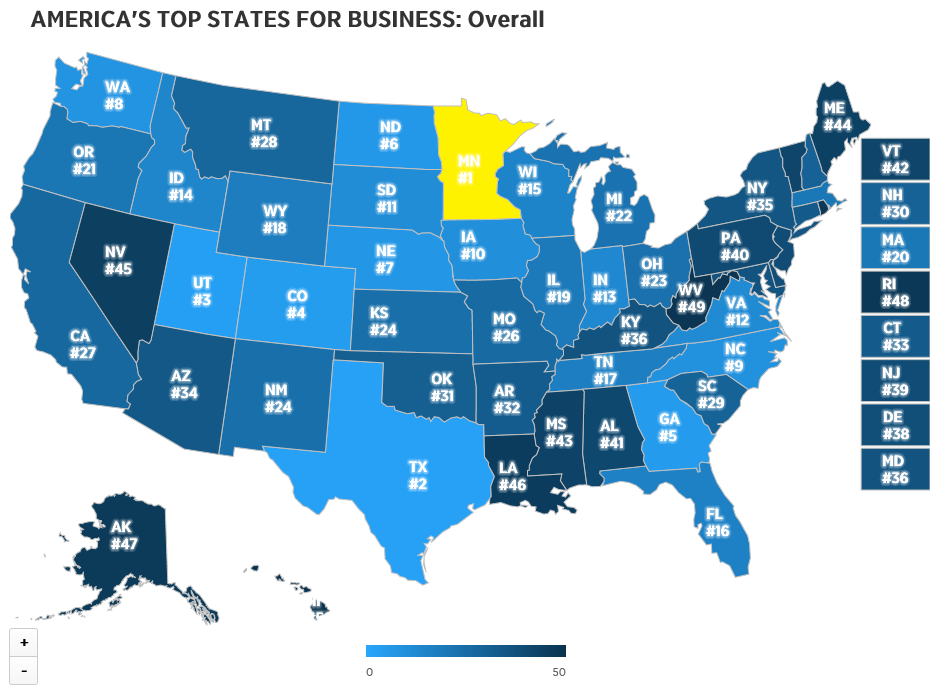
L’Etoile du nord: Just as in its state motto “Star of the North,” Minnesota is the stellar performer in CNBC’s 2015 state ranking of business competitiveness. (Click on the map for a larger view.)

State and city rankings are a source of fascination for many people. Of course, there are many ways to fashion them to place nearly any state or city you like at the top of the heap.  Some of the lists use criteria that are so convoluted, it stretches credulity.

Since when is Baltimore the best city in America for single men?  Since it was ranked #1 in this evaluation, evidently.  Many of us who know the city’s innards really well would disagree heartily, of course.

But I think the CNBC 2015 scorecard on state business climates, published earlier this month, is based on a more solid set of criteria.

CNBC created it by scoring all 50 states on approximately 60 separate measures of competitiveness – a list that was developed with input from an array of business and policy experts, official government sources, and CNBC’s own Global CFO Council, and that uses government-generated data.

CNBC then grouped these measures into ten broader categories, weighting the results based on how often each is used as “selling point” in state economic development marketing and promotional efforts. This was done in order to rank the states based on the criteria they themselves use to showcase their attractiveness to businesses considering expansion or relocation.

Here are the ten broad categories in the CNBC evaluation, and which states ranked first and last within them:

  • Access to capital: #1 North Carolina … #50 Wyoming
  • Business friendliness: #1 North Dakota … #50 California
  • Cost of doing business: #1 Indiana … #50 Hawaii
  • Cost of living: #1 Mississippi … #50 Hawaii
  • Economy: #1 Utah … #50 Mississippi
  • Education: #1 Massachusetts … #50 Nevada
  • Infrastructure: #1 Texas … #50 Rhode Island
  • Quality of life: #1 Hawaii … #50 Tennessee
  • Technology/innovation: #1 Washington … #50 West Virginia
  • Workforce: #1 North Dakota … #50 Maine

Do we see any surprises here?  To my mind, the high and low rankings look pretty well-aligned with the anecdotal information we hear all the time.

Perhaps we might consider several other states besides Nevada to be “bottoms” in education. And personally, I am pretty shocked to see Tennessee ranked last in quality of life. Having lived there during my college years at Vanderbilt University, I never considered the state to be substandard when it came to that attribute.

But It’s when CNBC amalgamates all of the rankings to come up with its overall state ranking that a few surprises emerge.

Such as … Minnesota notches first place overall. I’m sure some people are genuinely surprised to see that.

For the record, here is CNBC’s list of the Top 10 states for business in 2015:

  • #1 – Minnesota
  • #2 – Texas
  • #3 – Utah
  • #4 – Colorado
  • #5 – Georgia
  • #6 – North Dakota
  • #7 – Nebraska
  • #8 – Washington
  • #9 – North Carolina
  • #10 – Iowa

We see that four of the ten top states are in the Midwest … three are in the South … three are in the West … but none are in the Northeast.

CNBC study on business competitiveness
The center holds: According to CNBC, most of the most competitive states for business are in the Mid-Continent region.

By contrast, for the most part the Bottom 10 states are clustered in other areas of the country … including four Northeastern states plus Alaska and Hawaii, two states that clearly have unique locational circumstances:

Hawaii lacks business competitiveness
Not so sunny: Hawaii’s bad business climate.
  • #40 – Pennsylvania
  • #41 – Alabama
  • #42 – Vermont
  • #43 – Mississippi
  • #44 – Maine
  • #45 – Nevada
  • #46 – Louisiana
  • #47 – Alaska
  • #48 – Rhode Island
  • #49 – West Virginia
  • #50 – Hawaii

CNBC has issued a raft of charts and maps providing details behind how their ratings were formulated, and the results for each of the major categories. You can view the data here.

Speaking for yourselves, in what ways would you challenge the rankings? What strikes you here as different from your own personal experience in doing business in various states? Please share your perspectives with other readers.

What’s happening with the Apple Watch these days?

Not all that much, it turns out.

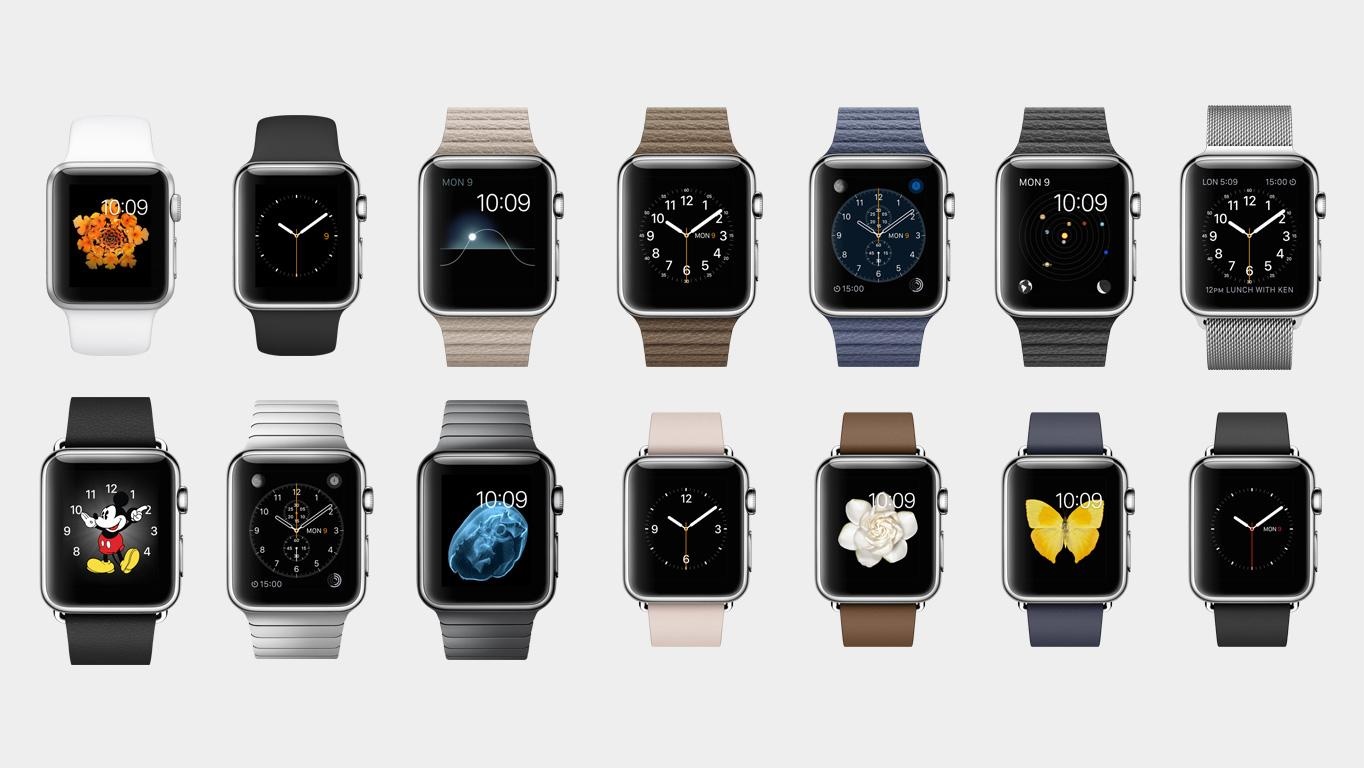
Apple Watch LineWhen is the last time you heard about a product introduction where initial sales were off by 90% barely three months after coming on the market?

If you’re thinking the Blackberry 10 … you’re wrong.

It’s the Apple Watch. Its introduction in April was made with a big amount of fanfare, promoted before and after the launch by PR, TV and online advertising, and even outdoor billboards.

But the hard truth is that aside from the tech community, few people are buying the Apple Watch.

According to Slide Intelligence, weekly Apple Watch sales have plummeted from around 200,000 per day at launch to fewer than 20,000 per day now. Moreover, most sales have been of the least expensive Sport model ($349).

Even worse, of those who have purchased an Apple Watch, fewer than four in ten would recommend the device to others.

You know there’s a problem when a new product engenders ridicule such as this brief, highly dismissive video review.

It may be too soon to write off the Apple Watch introduction as an abject failure. But I know one thing: The market’s (lack of) receptivity so far can’t be what Apple execs were hoping for.

It must be quite a comedown for a company that experienced the dizzying popularity of the iPod, iPhone and iPad right out of the box — and where those product sales continued to climb at an increasing rate for months or years after their debut.

google-glass-fashionSome people are comparing the Apple Watch introduction to what happened to Google Glass – likewise the victim of tepid sales to the point where Google quietly removed the product from the market after making a go of it for about two years.

Actually, I’m not quite sure the comparison is completely apt.

For starters, Google Glass didn’t come on the market backed by a ginormous PR and advertising campaign. In fact, it wasn’t really presented as a full-blown product – but more like a project with a beta test component.

Also, it was never made available in wide release; some people I know who wanted to “kick the tires” with Google Glass had difficulty finding out how they could do so.

But besides the very different rollout strategies, another factor might explain a more fundamental difference – and which has hugely negative potential impact on the Apple Watch.

Whereas Google Glass offered its wearers some truly new functionality, what does the Apple Watch deliver besides being merely a miniature version of an iPhone?

When something is less user-friendly (too miniature for many) … doesn’t offer any new functionality over alternative products … and is pretty expensive to boot, is it any wonder that the Apple Watch’s debut has had all the pizzazz of a cold mashed potato sandwich?

Speaking personally, I don’t consider a multipurpose device about an inch square in size as a “must-have” gadget, and I’m pretty sure others would agree with me.

Technology writer and CRM specialist Gene Marks cautions that the Apple Watch’s future isn’t likely to be much brighter than its less-than-impressive performance to date because of this fundamental liability: “The Apple Watch is not making people or companies quicker, better or wiser,” he contends.

In the world of technology and gadgets, that’s not recipe for success. Just ask Blackberry.

Now … let’s hear from Apple Watch users.  What’s your take?

Uber über alles? Ride-hailing services are coming on stronger than ever.

Business travelers have spoken with their wallets.

Uber logoIt looks as if a major milestone has been reached in the battle between “old world taxis” and “new world Uber.” An expense report study covering the second quarter of 2015 is showing that Uber and other ride-hailing services have overtaken the use of taxis – at least when it comes to business travelers.

The quarterly report was released by Certify, an expense management system provider. It reveals that Uber accounted for ~55% of ground transportation receipts, whereas taxi services accounted for only ~43% of receipts.

That’s a big jump from previous quarters; taxi services long dominated, staying well above 50% as recently as the first quarter of this year.

And this report isn’t based on some small data set, either. Certify’s stats are derived from millions of trip receipts submitted by its North American client base – nearly 30 million receipts over the course of a single year.

Clearly, Uber and other services that connect travelers through smartphone apps have succeeded beyond many people’s expectations.

But not everyone is pleased – beginning with taxicab services and their political allies.  Understandably, they’re frightened by the prospects of seeing the most fundamental tenets of their “business protection plan” melt away before their very eyes.

Depending on how people come down on the issue, opinions can be particularly passionate. Consider these responses prompted by a recent AP article on the topic published by ABC News:

Pro-Taxi Reader: Uber is breaking laws and evading taxes and municipal dues on a mass scale. How do you “adapt” to that? How to adapt to this unfairness and criminality? I personally suggest stop paying taxes, or start a strike like they did in Paris. It seems that in [the] U.S., Uber’s lobbyists and endless BS-PR campaigns control the country.

Pro-Uber Reader: Is it really “fair” for a city to charge one million dollars to have a taxi license (New York City)? Most of the taxi BS is from mafia-run business[es] who have fought for the last 70 years to keep competition out.

Another Pro-Uber Reader: The current system of licensing taxis should be reconsidered.  This system smacks of monopolies, with barriers to entry that are impossible.  There is no free market when you can’t get a license to operate.

Certain national politicians are even getting into the game, finding fodder for campaign rhetoric aimed at constituents who are frightened by the implications of the new work paradigm.

Here’s an excerpt from a speech by Hillary Clinton:

“Many Americans are making extra money renting out a small room, designing websites, selling products they design themselves at home, or even driving their own car. … This on-demand, or so-called ‘gig economy,’ is creating exciting opportunities and unleashing innovation. But it’s also raising hard questions about workplace protections and what a good job will look like in the future.”

These are good points to raise, and it’s certainly fine to weigh the pros and cons of the so-called “new economy.”

At the same time, it’s pretty ironic to see how people supporting a candidate who questions ride-hailing services are so “onboard” with Uber – at least in practice if not in their rhetoric.

To illustrate, take a look at these Federal Election Commission filings from the Ready PAC (the pro-Clinton SuperPAC formerly known as Ready for Hillary PAC) here and here and here.  There’s a “whole lotta Uber” going on!

Getting back to the real world of business travel, in nearly every city, Uber is offering better pricing than taxi services – at least when it comes to services like UberX which typically involve transport in smaller cars like a Honda Civic or Toyota Camry.

SUVs and limo cars are pricier, of course, and may not represent a major cost improvement. And Uber’s prices charged also rise during periods of “surge” usage.

taxi cabBut considering the comparative cost as well as the quality of service, in some markets Uber beats out taxis by a city mile.

How else to explain results in the most recent quarter where ~60% of rides in Dallas expensed through Certify were for Uber vehicles rather than taxis. In San Francisco, Uber’s share was even higher:  nearly 80%.

No wonder taxi services are running off to local elected officials, boards and commissioners to try to shore up their faltering business model.

It’s worth noting that some employers harbor reservations about ride-hailing services — particularly concerns about lack of regulation, safety and liability. But even in non-regulated locations, protections exist. Uber as well as Lyft, another industry participant, provide driver insurance during paid rides, and they require drivers to carry their own personal auto insurance as well.

It would be interesting to hear the views of people who have used Uber or other ride-hailing services. Do you see them as the wave of the future? Or are there drawbacks? Please share your experiences and observations with other readers here.

TV’s Disappearing Act

Television viewing among 18- to 24-year-olds reaches its lowest level yet. 

TV watchingThe latest figures from Nielsen are quite telling:  The decline in TV watching by younger viewers is continuing – and it’s doing so at an accelerating pace.

Looking at year-over-year numbers and taking an average of the four quarters in each year since 2011, we see that the average number of hours younger viewers (age 18-24) spend watching television has been slipping quite dramatically:

  • 2011: ~24.8 hours spent watching TV weekly
  • 2012: ~22.9 hours
  • 2013: ~22.0 hours
  • 2014: ~19.0 hours

It’s nearly a 25% decline over just four years.  More significantly, the most recent yearly decline has been at a much faster clip than Nielsen has recorded before:

  • 2011-12 change: -7.7%
  • 2012-13 change: -3.9%
  • 2013-14 change: -13.6% 

So far this year, the trend doesn’t appear to be changing.  1st quarter figures from Nielsen peg weekly TV viewing by younger viewers at approximately 18 hours.  If this level of decline continues for the balance of the year, watching TV among younger viewers will be off by an even bigger margin than last year.

There’s no question that the “great disappearing television audience” is due mainly because of the younger generation of viewers.  By contrast, people over the age of 50 surveyed by Nielsen watch an average of 47.2 hours of television per week — nearly three times higher.

picLest you think that the time saved by younger viewers is going into outdoor activities or other recreational pursuits and interests, that’s certainly not the case.  They’re spending as much time using digital devices (smartphones, tablets and/or PCs) as they are watching TV.

So, it’s a classic case of shifting within the category (media consumption), rather than moving out of it.

I don’t think very many people are surprised.

… And then there were two: Facebook is nipping at YouTube’s heels.

Facebook “grows up great” to challenge YouTube for video supremacy online.

FB vs YTOnly few years ago, YouTube was pretty much the only game in town when it came to online video.  And Facebook wasn’t even in the picture.

Today, the online video landscape looks far different.

In fact, Facebook is on track to deliver more than two-thirds as many video views as YouTube this year.  And both services have a comparable number of monthly users overall.

Recently, market forecasting firm Ampere Analysis surveyed ~10,000 consumers in North America and Europe.  Approximately 15% of them had watched at least one video clip on Facebook within the past month.

While Facebook hasn’t exactly caught up with YouTube, its rise has been pretty stunning — especially when you consider the massive head-start YouTube had.  More than five years, in fact, which is a lifetime in the cyberworld.

Undoubtedly, one reason for Facebook’s success in video is its “autoplay” feature which snags viewers who might otherwise scroll by video postings.  Facebook reports that it has experienced a ~10% increase in engagement as a result of adding this functionality.

And there’s another big advantage for advertisers that Facebook possesses.  Since its viewers are always logged in, Facebook has the potential to collect far more demographic and behavioral data on its viewers that advertisers can tap into to target specific demographics.

For now at least, Facebook doesn’t offer the option for ads to run before video clips begin playing (the ads appear after the content).  Also, Facebook’s ad charges kick in after just three seconds of the ad being shown, compared to YouTube which sets the bar higher for ad charges to take effect.

[Incidentally, Twitter has the same 3-second policy as Facebook, whereas Hulu charges only for ads viewed all the way through.]

Another difference is that Facebook charges for every ad view, so if a viewer watches a video twice — even if it’s the same video in the same viewer session — Facebook counts it as two views.  On YouTube, that would be considered one view, regardless of how many times the video is watched.

Of course, these kinds of differences can be adjusted — and there’s no reason to think that Facebook won’t do just that if it determines that making those changes are in their best business interest.

Besides, advertising rates are already similar between the two platforms, which suggests that advertisers have come to place a high value on Facebook’s robust audience targeting.

Autoplay features have raised some questions as to what constitutes a true video “view.”  If video ads are being autoplayed, views are easier to get, but are they worthwhile?  Also, the fact that autoplay videos are running without sound until such time as the viewer chooses to engage is causing some advertisers to create content that “make sense” even on mute.

But the bottom line on Facebook’s foray into video seems to be that the demographic and psychographic audience targeting Facebook can deliver is of important value to advertisers.

Add the fact that YouTube is no longer the only major online video platform, and it’s easy to see how significant competition from Facebook risks the loss of advertising dollars for YouTube, along with damaging YouTube’s growth prospects over time.

This is getting interesting …

Copywriting by computer: Wave of the future? … or wild-ass pipe dream?

persado logoIn recent years, computers have upended many a job category.  And they include quite a few positions involving “language” – from foreign language translators to medical transcriptionists.

And now, it looks like copywriting itself may be the next domino to fall.

Earlier this year, The Wall Street Journal published a story about Persado, a company which has developed a software algorithm that enables it to write copy without the human element.

David Atlas, the company’s chief marketing officer, refers to it as “algorithmic copywriting.”  The process creates sentences with a maximum length of 600 characters that are used for e-mail subject lines and other short persuasive copy.

Persado builds the copy by sending thousands of different e-mail subject lines to the e-databases of its clients, which include large retailers and financial services firms such as Overstock.com, AMEX and Neiman Marcus.  Response rates are measured and used to refine the subject lines to narrow them down to just the most effective.

Company PR spokesperson Kirsten McKenna explains the Persado edge further:

“Typical A/B testing will send out only a few messages – then go with the one that gives the best response.  Persado can send out thousands of permutations of the same message to determine which would be the most successful.”

Alex Vratskides
“We have never lost to a human.” — Alex Vratskides of Persado

Comparing Persado’s machine-generated results with traditional copywriting, “We have never lost to a human,” Alex Vratskides, the company’s president, claimed to The Wall Street Journal.

Those results would suggest that Persado is doing things right.  And here’s another positive indicator of success:  The company raised over $20 million in venture capital earlier this year.

The bigger question is whether Persado will be able to scale its simple and short-sentence copywriting into persuasive copy for longer-form marketing materials such as sales letters and brochures – which would make it an even bigger threat and seriously threaten to upend the traditional copywriting field.

For the answer to that question, I’d never want to take issue with the views of veteran copywriter Bob Bly, whose perspectives I respect a great deal.  In writing on this topic, he states:

Bob Bly
Bob Bly

“I do think that either already or very soon, software will equal or surpass the performance of human writers in both simple content and short copy.  We have to prepare for the eventuality that computers may someday beat human direct response copywriters in long-form copy, just as Deep Blue beat Kasparov in chess and Watson clobbered Ken Jennings in Jeopardy.  Ouch.”

What do you think?  Is computer copywriting the wave of the future?  Let’s hear your own perspectives.