Gallup puts the Kibosh on Social Media’s Marketing Hype

“Social media are not the powerful and persuasive marketing force many companies hoped they would be.”Gallup, Inc. 

social media verdictThat’s one of several key conclusions from a report issued this past summer by research firm Gallup, Inc. The report examined the influence of social media on consumer purchase decision-making.

The Gallup findings are based on web and mail polling it conducted with ~18,000 American consumers during 2013.

When asked about the influence of social media on buyer behaviors, ~62% of the respondents reported that social media has “no influence at all” on their purchasing decisions.

By contrast, ~30% stated that social media has “some influence,” while only ~5% reported that social media has “a great deal of influence” over their purchasing decisions.

Compare these middling results with the fact that U.S. companies spent well over $5 billion on social media advertising in 2013, and the two figures seem out of proportion.

Actually, the disconnect between “people and products” on social media shouldn’t be too surprising, in that ~94% of the Gallup respondents reported that the reason they go on social media platforms is to connect with friends and family members.

The percentage of people who use social media to follow trends and/or to find reviews or other information on products is far lower: ~29% according to the Gallup survey.

But it’s the magnitude of the difference that may be surprising.

And here’s another thing: In its report, Gallup states that “consumers are highly adept at tuning out brand-related Facebook and Twitter content.”

It’s yet another data point supporting the growing realization that social media has failed to live up to its early marketing hype. So it should come as little surprise that more companies have been refining their strategies to stress quality over quantity when it comes to both fan acquisition and to published content.

More findings from the Gallup report can be viewed here.

Organic Search: Still King of the Hill in Generating Web Traffic

online searchingIn recent years, the focus on “content marketing” has become stronger than ever: the notion of attracting traffic via the inherent relevance of the content contained on a website rather than through other means.

It seems eminently logical.  But content marketing is also relatively labor-intensive to build and to maintain. So there’s always been an effort to drive web traffic through “quicker and easier” methods as well.

But the newest findings on web traffic really do demonstrate how fundamental good content is to meeting the challenge of generating web traffic.

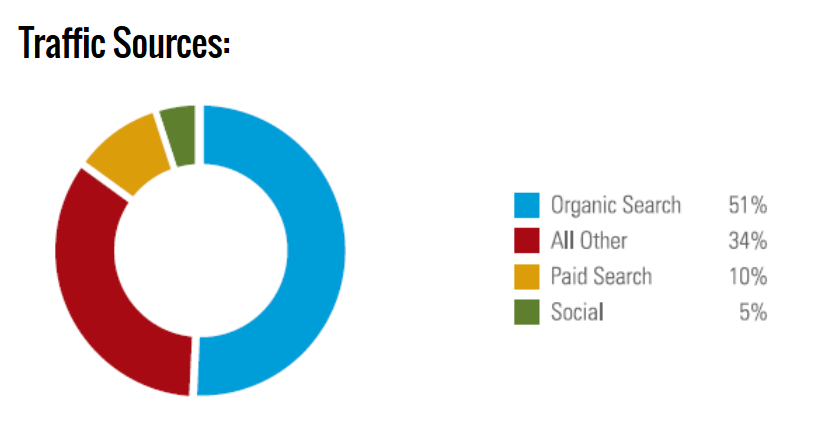
An analysis by web analytics and measurement firm BrightEdge reveals that organic search (SEO) drives over half of all traffic to websites (both business-to-business and business-to-consumer).

By contrast, paid search (SEM) accounts for only one-fifth of SEO’s result, and social is lower still:

  • Organic search: Generates ~51% of all web traffic
  • Paid search: ~10%
  • Social media: ~5%
  • All other methods (e.g., display advertising, e-mail and referred): ~34%

Web traffic driversSource:  BrightEdge, 2014. 

In other words, all forms of advertising put together don’t drive as much traffic as organic search.

The BrightEdge statistics also remind us that social media, however popular it may be to millions of people, isn’t a highly effective traffic generator like search. Here are some of the key reasons why:

  • Social shares are fleeting and can get drowned out easily.
  • Most users don’t go on a social platform, only then to click on different links that take them away from social.
  • Not everyone uses social media, whereas everyone uses a search engine of some kind when they’re in “investigative” mode.

That’s the thing:  People use SEO when they’re seeking answers and solutions — often in the form of a product or a service.  Unlike in social or online display advertising, there’s no need to “disrupt” the user’s intended activity.

And if you’re in the B-to-B realm, organic search even more prevalent:  Organic search drives ~73% of all web traffic there.

Even consumer categories like retail, entertainment and hospitality find that organic search is responsible for attracting 40% or more of all web traffic.

The takeaway for companies is that any marketing strategy that doesn’t adopt “content development” as a core tactic instead of an “ornamentation” is probably destined to fall well-short of its full potential.

The “App Gap”: Mobile Apps Overtake All Others in Digital Media Consumption

Mobile apps overtaking other digital media consumptionIt was bound to happen.

The bulk of time Americans are spending on digital media … is now happening on mobile applications.

According to data released this past week by Internet and digital analytics firm comScore, the combined time that people expend using digital media breaks down as follows:

  • Mobile apps: ~52% of all time spent online
  • Mobile web surfing: ~8%
  • Desktop: ~40%

Apps are clearly in the driver’s seat – particularly in the mobile realm.  In fact, comScore estimates that apps account for 7 out of every 8 minutes spent on mobile devices.

On smartphones, the app usage is ~88% of all time spent, whereas on tablets, it’s ~82%.

This doesn’t mean that app usage is spread evenly throughout the population of people who are online.  Far from it.  Only about one-third of people download one app per month or more.  (The average smartphone user is downloading about three apps per month.)

The inevitable conclusion:  App usage is highly concentrated among a subset of the population.

Indeed, the 7% most active smartphone owners account for almost half of all the download activity during any given month.

But even if most users aren’t downloading all that many apps … they are certainly engaged with the ones they do have on their devices:  comScore reports that nearly 60% are using apps every day.

Here again, the data show that usage levels are much higher among smartphone users than they are with tablet users (where only about one quarter of the people use apps daily).

Where they’re spending their time is also interesting.  Well over 40% of all app time spent on smartphones is with a user’s single most used app.  (Facebook takes top honors — of course.)

And if you combine social networking, games and Internet radio, you’ve pretty much covered the waterfront when it comes to app usage.

When you think about it, none of this should come as much surprise.  We’re a mobile society – hourly, daily, monthly and yearly.  It only makes sense that most online time is going to be happening when people are away from their home or their desk, now that it’s so easy to be connected so easily from even the tiniest mobile devices.

And speaking of “easy” … is it really any wonder why people would flock to apps?  It’s less hassle to open up an app for news or information rather than searching individual sites via mobile.  People simply don’t have the patience for that anymore.

Pinterest: Will it ever become a male hangout?

Pinterest logoHere’s a statistic about social media platform Pinterest that will probably surprise few people:  As of June 2014 statistics reported by digital analytics firm comScore, its user base is more than 70% female.

… Which means that Pinterest remains the most “gender imbalanced” of all the major social media platforms.

For the record, other social platforms have far more gender balance among their user bases – with at least 45% being male:

  • SnapChat:  52% male
  • Tumblr:  52%
  • Twitter:  48%
  • Facebook:  47%
  • Instagram:  45%
  • Pinterest:  28%

But here’s the thing:  Pinterest has been trying mightily hard to attract more male participants, but the proportional figures have yet to budge.

This points to a fundamental challenge.  It’s very difficult to change the image and atmospherics of a social platform once they’ve become so firmly entrenched.

And it’s not just a question of image.  The platform’s content says it all.

Jill Sherman, vice president of social and content strategy at marketing communications firm DigitasLBi, puts it this way:

“If you pull up Pinterest and go into any content section, you will see purses, dresses and women’s shoes — because women are the user base.  When 70% of the users are female, then 70% of the content is going to be female-oriented.” 

Pinterest for menHope springs eternal, however.  Pinterest is continuing its effort to attract more men.

Or at least … to make the site more “guy friendly” when a new member goes there signs up.  This means making sure to show items more stereotypically catering to men’s interests rather than things like women’s fashion items.

But how to get men to the stage of even signing up?  That challenge falls to Pinterest’s new “head of brand” – who just happens to be a man.

David Rubin
David Rubin

He’s David Rubin, erstwhile senior vice president of marketing at Unilever, where he worked on marketing the Axe brand of men’s body care products.

Mr. Rubin might wish to start his tenure by asking himself what would bring him to engage with Pinterest more … because according to news reports, Rubin had posted only 22 items on Pinterest prior to joining the company.

DigitasLBi’s Jill Sherman sees a challenge for Pinterest that is fundamentally basic.  “They haven’t cracked the motivation code:  How to attract men and keep them using the platform beyond saving things that pique their interest.”

I agree – and I’d go a step further.  Convincing people to visit Pinterest to find or view something of interest “feels” like a function a search engine such as Google Images is doing quite well already.  Who needs “yet another place” to tap into that functionality?  Especially if one is a male of the species?

In order for Pinterest to evolve beyond where it is today, perhaps it needs to look at what Facebook and others have been doing to create communities and interaction beyond just pretty pictures and videos.

It could be a tall order.

PR Firms at Loggerheads with Bloggerheads

PR mistakes with bloggersTime was, we could get a chuckle out of television commercials where unsuspecting consumers were surprised to find out that the restaurant coffee was really Folgers®, or the day spa’s skin moisturizer treatment for their hands was actually Palmolive® dish detergent.

There was something rather endearing about those consumer reactions – and they were uniformly positive ones as well.

But to show how far removed we are from those halcyon days, consider this recent attempt to pull a fast one on unsuspecting dinner guests at a “faux” restaurant in Midtown Manhattan: Cooked up by the Ketchum public relations unit of Omnicom Group for its client, ConAgra Foods, New York-based food bloggers and “mommy” bloggers were invited to dine at “Sotto Terra,” an underground restaurant supposedly run by Chef George Duran of TLC’s Ultimate Cake Off cable program.

But Sotto Terra, far from being the “intimate Italian restaurant” of the invitation, was nothing more than an elaborate set-up – hidden cameras and all – to get bloggers to sample ConAgra’s newest offerings in the Marie Callender’s line of frozen entrees and desserts … and presumably to extol the virtues of the cuisine.

In fact, no such restaurant even exists. Rather, it was all a staged scene in a Greenwich Village brownstone. The invitation promised a “delicious four-course meal” accompanied by Chef Duran’s “one-of-a-kind sangria” … along with a talk by famed food industry expert Phil Lempert on new taste trends in food.

The invitation also promised a “special surprise” for those who attended the dinner on one of five evenings.

The special surprise, of course, was revealing the actual provenance of the food items being served. “The twist at the end was not dissimilar to what brands like Pizza Hut and Domino’s have done in the recent past, with success,” noted Stephanie Moritz, a public relations flack at ConAgra.

The plan was to use the video footage captured at the dinners for promotional clips on ConAgra’s website and on YouTube … as well as for the bloggers who attended to generate cyber-buzz about being pleasantly surprised at the revelation.

But this is 2011, not 1981 or 1991. And bloggers are also quite different from the average consumer. Ketchum and ConAgra apparently forgot about the “90-9-1 rule” of online content: 1% create content … 9% comment on that content … and 90% simply lurk.

Not only are bloggers part of the 1%, they take their role seriously and certainly don’t appreciate being fooled. So instead of the food taking center stage, the event itself became the topic of (uniformly negative) conversation on the blogs. A few examples:

 “We discussed with the group the sad state of chemical-filled foods. And yet, you still fed me the exact thing I said I did not want to eat.” (Lon Binder, FoodMayhem Blog)

 “[I] pointed out that the reason I ate organic, fresh and good food was because my calories are very precious to me, so I want to use them wisely. Yet they were serving us a frozen meal, loaded with sodium. I’m NOT their target consumer, and they were totally off by thinking I would buy or promote their highly processed frozen goods after tricking me to taste it.” (Cindy Zhou, Chubby Chinese Girl Blog)

 “Our entire meal was a SHAM! We were unwitting participants in a bait-and-switch for Marie Callender’s new frozen three-cheese lasagna and there were cameras watching our reactions.” (Suzanne Chan, Mom Confessionals Blog)

I loved reading the PR personnel’s “spin” of the events the way they transpired: “Once we sensed it was not meeting attendees’ expectations, that’s where we stopped, we listened and we adjusted,” Stephanie Moritz remarked.

… By which she means the remaining dinner evenings were canceled.

Looking back is 20/20 hindsight, of course. But it does seem like most PR professionals could have seen this negative reaction coming from a mile away. PR agencies exist to provide not only publicity for their clients, but also counsel. Sure, the event sounds like a fun lark with a bit of a twist – and I can just picture the breathlessly animated PR brainstorming session at Ketchum that produced this idea.

But is duping bloggers and making them out to be fools the correct tactic? … Especially considering that their megaphone, augmented by the viral nature of social media, is much more effective and far-reaching than ConAgra’s corporate website ever could hope to be.

When the Public Relations Society of America was contacted by the New York Times for comment, Deborah Silverman, chairperson of the PRSA’s Board of Ethics and Professional Standards, responded by stating that the Ketchum/ConAgra PR stunt was “unfortunate” and “not quite where they should be in terms of honesty.”

Ya think?