The Affordable Care Act: Still unpopular with physicians after all these years.

ACAOne of the predictions we’ve heard about the admittedly controversial Affordable Care Act is that acceptance of it will grow over time, as people become more familiar and comfortable with its provisions.

So far at least, we haven’t seen this happening in the public polling about the law.

And now we’re seeing similar dynamics playing out in the all-important physician community.

In fact, the latest findings are that the ACA is more unpopular than ever, if the results of a new survey of physicians are to be believed.

The survey was conducted in January 2015 by LocumTenens, a physician staffing firm and online job board.

The headline finding must be this:  While ~44% of the survey respondents reported that they had been opposed to the Affordable Care Act legislation prior to its implementation, now ~58% are opposed to it after a year of working under the confines of the law.

R. Shane Jackson, president of LocumTenens, had this to say about the key finding:

“After a year in the trenches trying to help patients understand this legislation, physicians by and large feel the law hasn’t done a lot to help improve healthcare.”

More specifically, Jackson noted,

“Physicians feel the ACA has made serving patients and running their businesses much harder.  A year after implantation – and years after the political debate started – doctors are still passionate about how this law should have been designed, and would still like to see changes made that will make it simpler for their staffs and patients to understand.”

Among the negatives physicians see with the current ACA law are these aspects:

  • Lower reimbursement rates to hospitals and physicians
  • Increased compliance burdens for physician practices
  • Higher patient debt due to high-deductible plans

ACA healcare premium changesAlso faulted are the insurance companies for not doing more to inform newly insured patients about their premiums, deductibles and coverage limits.

It isn’t all poor marks for the ACA, however.  Physicians in the LocumTenens survey do credit the legislation for a number of positive outcomes including:

  • Helping more people gain access to healthcare
  • Expanding coverage to more children and young adults
  • Eliminating coverage denials due to pre-existing health conditions
  • Placing more focus on preventive healthcare measures
  • Decreasing the costs of end-of-life care

So what is the “net-net” on all of this?

Two-thirds of the physician respondents want the ACA law repealed (and three-fourths think it will be, incidentally).  But physicians want it replaced by something else that retains the positive aspects of the ACA while doing away with the negatives.

That’s the same message we’ve been hearing from politicians, too.  So the bigger question is how to unscramble the ACA egg … and whether anything actually better can come out of the effort.

Would anyone care to weigh in with their thoughts and ideas in this never-ending debate?

What are the short- and long-term implications of self-driving automobiles?

McKinsey’s take:  In a world where people don’t take charge of the wheel themselves … we’ll all be better off.

The Google Driverless Car

From Google’s fleet of driverless cars to the Mercedes-Benz Robo-Car concept, self-driving automobiles are stepping off the pages of science fiction and into real life.

But how many of us have really stopped to think about how the adoption of self-driving vehicles will change everyday life as we know it?

Consulting firm McKinsey & Co. has done so, and a recently released report predicts some pretty major changes – most of them very fine, indeed.  Here’s a sampling:

  • The number of car crashes will plummet.
  • “Drivers” will become “riders,” with more time for working, leisure and interaction with others.
  • “Dead time” in commuting will decrease, and productivity will increase as a result.
  • The ubiquity of the multi-car household will change.

And it’s not just McKinsey that is looking at self-driving cars with such optimism.

Even the normally dour and scolding National Highway Traffic Safety Administration predicts that consumer adoption of self-driving vehicles will usher in “completely new possibilities for improving highway safety, increasing environmental benefits, expanding mobility, and creating new economic opportunities for jobs and investment.”

But self-driving cars won’t overtake conventional automobiles in one fell swoop.  The McKinsey report outlines a timeline for adoption of self-driving features — and it’s pretty drawn-out.

Within the next three to five years, McKinsey anticipates that cars will self-handle highway cruising and traffic jams.

The more difficult challenges of driving in urban areas and dealing with variables like pedestrians, cyclists and so forth will be tackled over the coming 25 years.

Thus, the impact of “autonomous” technology will be limited until about 2020.  McKinsey figures that the technology will experience growing pains in the years 2020-2035 as driverless cars go more mainstream.

During this period, there will be numerous issues that will need to be resolved, with clear hub-and-spoke implications:

  • The development of comprehensive rules regarding how self-driving cars are developed, tested, approved and licensed (on an international basis)
  •  Changes in insurance practices – migrating from individual coverage to automaker policies that cover technical failures
  •  The growth of remote diagnostics and over-the-air updates
  •  The decline in importance of independent automotive repair shops
  •  The reduced need for taxi drivers and long-haul carrier jobs

The McKinsey report takes us beyond the year 2040, too, which is the point when McKinsey predicts that autonomous cars will become the primary means of transport in the United States.

The implications of this are guesstimates more than anything else, but McKinsey speculates on the following long-term effects:

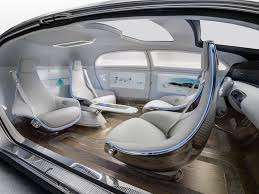
Mercedes-Benz "car of the future":  Seats facing every which-way.
Mercedes-Benz “car of the future”: Seats facing every which-way.
  • Car designs will change dramatically – no more need for mirrors and pedals … and car seats will face any direction.
  • Space savings on streets, roadways and parking lots from more efficient vehicle use.
  •  Fewer cars will be needed compared to today, with one autonomous car doing the job of two conventional vehicles in the typical household. The vehicles will be more expensive but fewer of them will be needed, for net savings for consumers.

As for the economic impact, the figures are difficult to quantify as some sectors of the economy will be up and others down.  But with a projected 90% drop in car crashes, the savings in auto repair and healthcare bills alone are project to be around $180 billion.

If we accept the McKinsey report’s bottom-line findings, it seems the “brave new world” of self-driving cars can’t come soon enough.  But what are your thoughts?  Are there negative implications  or “unintended consequences” that will be part of the revolution?  Please share your perspectives here.

Social media and marketing: Is the honeymoon over?

social mediaIt’s no secret that companies large and small have been putting significant energy into social media marketing and networking in recent years.

It’s happened for a variety of reasons – not least as a defensive strategy to keep from losing out over competitors who might be quicker to adopt social media strategies and leverage them for their business.

And yet …

Now that the businesses have a good half-decade of social media marketing under their belt, it’s pretty safe to say that social tactics aren’t very meaningful sales drivers.

That’s not just me talking.  It’s also Forrester Research, which as far back as 2011 and 2012 concluded this after analyzing the primary sales drivers for e-commerce.  Forrester found that less than 1% was driven by social media.

And in subsequent years, it’s gotten no better.

A case in point:  IBM Smarter Commerce, which tracks sales generated by 500 leading retail sites, has reported that Facebook, LinkedIn, YouTube and Twitter combined represent less than 0.5% of the sales generated on Black Friday in the United States.

Those dismal results aren’t to say that social media doesn’t have its benefits.  Generating “buzz” and building social influence certainly have their place and value.

But considering what some businesses have put into social media in terms of their MarComm resources, a channel that contributes less than 1% of sales revenues seems like a pretty paltry result – and very likely a negative ROI, too.

Going forward, it would seem that more companies should pursue social media marketing less out of a fear of losing out to competitors, and more based on whether it proves itself as an effective marketing tactic for them.

Consider the points listed below.  They’ve been true all along, but they’re becoming even more apparent with the passage of time:

1.  Buying “likes” isn’t worth much beyond the most basic tactical “bragging rights” aspects, because “likes” have little intrinsic value and can’t be tied directly to an increased revenue stream.

2.  A great social media presence doesn’t trump having good products and service; even dynamite social media can’t camouflage shortcomings of this kind for long.

3.  Audiences tend to “discount” the value of content that comes directly from a company.  This means publishing compelling content that clears that hurdle requires more skill and expertise than many companies have been willing to allocate to social media content creation.

Calibrating the way they look at social media is the first step companies can take to establish the correct balance between social media marketing activities and expected results.  Instead of treating social media as the connection with customers, view it as a tool to connect with customers.

It’s really just a new link in the same chain of engagement that successful companies have forged with their customers for decades.  In working with my clients, I’ve seen this scenario play out the same basic way time and again; it matters very little what type of business or markets they serve.

What about you?  Have your social media experiences been similar to this — or different?  I welcome hearing your perspectives.

World brands: Who’s up … Who’s down?

brand finance logoEach year, the brand valuation consulting firm Brand Finance produces a report on the strength of the world’s Top 500 brands.

It’s an interesting study in that Brand Finance calculates the values of brands using the so-called “royalty relief” approach – calculating a royalty rate that would be charged for the use of the brand name if it weren’t already owned by the company.

In the 2015 report, just issued, Apple remains the world’s most valuable brand based on this criterion.  The Top 10 listing of world brands is as follows:

brand finance global 500 2015#1  Apple

#2  Samsung

#3  Google

#4  Microsoft

#5  Verizon

#6  AT&T

#7  Amazon

#8  GE

#9  China Mobile

#10 Walmart

Of these, all but China Mobile were in the Top 10 listing in Brand Finance’s 2014 rankings.  Of the others, all maintained their rank except for AT&T and Amazon, which rose, and GE and Walmart, which fell.

The most valuable brands differ by region, however.  In fact, Apple is tops only in North America:

Most valuable brand in North America:  Apple

… in Europe:  BMW

… in Asia/Pacific:  Samsung

… in the Middle East:  Emirates Air

… in Africa:  MTN (M-Cell)

… in South America:  Banco Bradesco

As for which brand’s value is growing the fastest, top honors goes to … Twitter?

That is correct:  According to Brand Finance, Twitter’s value has mushroomed from $1.5 billion in early 2014 to nearly $4.5 billion now.

Other social platform firms that have experienced big growth are Facebook (up nearly 150%) and the Chinese-based Baidu (up over 160%).

What about in non-tech or social media sectors?  There, Chipotle racked up the biggest growth in brand value:  nearly 125%.  At the other end of the scale, the McDonald’s brand has lost about $4 billion in value over the past year.

Most Powerful Brands 

In addition to its brand value analysis, Brand Finance also publishes a ranking of most powerful brands based on its “brand strength index” (BSI).  This index focuses on factors more easily influenced by marketing and brand management activities — namely, marketing investment and brand equity/goodwill.

In this analysis, Brand Finance comes up with a very different set of “top brands” – led by Lego:

Lego logo#1  Lego:  BSI = 93.4

#2  PWC (PricewaterhouseCoopers):  91.8

#3  Red Bull:  91.1

#4 (tie)  McKinsey:  90.1

#4 (tie)  Unilever:  90.1

#6 (tie)  Burberry:  89.7

#6 (tie)  L’Oréal:  89.7

#6 (tie)  Rolex:  89.7

#9 (tie)  Coca-Cola:  89.6

#9 (tie)  Ferrari:  89.6

#9 (tie)  Nike:  89.6

#12 (tie) Walt Disney:  89.5

According to Brand Finance, Lego’s brand power stems from it being a “creative, hands-on toy that encourages creativity in kids and nostalgia in their parents, resulting in a strong cross-generational appeal.”  Lego also has a big consumer marketing presence, thanks to its brand activities in film, TV and comics.

Last year’s top brand was Ferrari, which has now slipped in the rankings.  Brand Finance cited the brand’s 1990s-era “sheen of glory” as wearing a bit thin 20 years on.

For more details on these brands and other aspects of the 2015 evaluation, you can review Brand Finance’s 2015 report here.

Do any of the results come as a surprise to you?  Please share your observations with other readers as to why certain specific brands are coming on strong while others may be fading.

Doing Well by Doing Good: The Panera Bread Experience

Panera Cares

It was an idea that seemed pretty novel back in 2009 – and it was introduced with more than a little fanfare.

Panera Bread, the fast-casual bakery-café chain long known for its corporate citizenship, opened a series of stores in urban areas that touted a “pay what you can” pricing model.

The company’s charitable foundation opened these “Panera Cares” community cafés in five locations:  metro St. Louis, Chicago, Detroit, Boston and Portland, OR.

It was the next logical step for a company that had already set up its Operation Dough-Nation initiative in the 1990s.  Those activities included operating Community Breadbox cash collection boxes and donating unsold bread and baked goods to local hunger relief charities – to the tune of $100 million+ in retail value each year.

As for Panera Cares, the difference between these outlets and other Panera stores is that they operate only on suggested prices with donation boxes.  Each outlet serves approximately 3,500 people weekly.

What’s been the experience of these locations?

Interestingly, Panera chose to open them in thriving urban zones rather than in inner city districts with borderline neighborhoods.

For example, the Lakeview (Chicago) location sits amongst million-dollar townhomes along with people on the street, meaning that there are customers who can help support the café as well as those who can benefit from having a free meal.

SAME Cafe Denver
SAME Café, Denver, Colorado

The idea of Panera’s foundation was to deliver an experience that was profoundly different from a community soup kitchen or similar locations, which can have an institutional feel (as well as serving institutional-type food).

In this regard, the company’s chairman, Ron Shaich, got the idea from viewing an NBC News profile of SAME Café in Denver, CO, a restaurant founded in 2006 that also operates on a “pay what you can” model.

To make the concept work, consumers who have extra funds are asked to donate them … those who are short of funds can pay less … and those who can’t pay anything can volunteer for an hour and eat for no charge.

One way for the business model to work is operating the stores under the Panera Bread Foundation – a tax-exempt operation.  That enables the business model to be successful even though these stores bring in only about 70% of a conventional Panera outlet’s typical revenue.

Panera Bread logoBut Panera’s attempt to expand the concept beyond its five community cafés and into its regular stores wasn’t as successful.

In 2013, Panera pulled the plug on an experimental “pay what you want” turkey chili menu offering at around 50 St. Louis-area stores.  Customers could pay the $5.89 “suggested” price … they could pay more … pay less … or pay nothing.

The company reported that after an initial burst of publicity and interest, customers stopped realizing the option existed — hence the program’s termination.

But there may be a bit more to it than that.  Ayelet Gneezy, a marketing and behavioral sciences professor at the University of California San Diego, has studied the “psychological dynamics” of offering “pay what you want” systems and finds that consumer behaviors are different depending on the way the offers are communicated.

Ayelet Gneezy
Ayelet Gneezy

Here’s what Dr. Gneezy has found in her research:

●     When people can pay what they want and they also know that half of the price is going to charity, payments and donations rise well beyond what is collected if just one of these two options is offered.

●     It helps to offer a suggested price that is close to what consumers think is fair in relation to the inherent value.  Too far off that mark means that consumer reluctance – and participation – are liable to kick in. 

●     When people are asked to think about how much they wish to pay before doing so … they tend to pay less. 

●     Asking people to pay at least something is more likely to generate sustainable revenues, because laziness tends to win out over a sense of responsibility. 

The bottom line on pay-what-you-want systems appears to be this:  It’s probably not a good idea to adopt the program if you can’t afford to risk losing a good deal of money.  It is possible to minimize or manage the risk, but a lot can go wrong, too.

Fortunately for Panera Bread, its overall organization is large enough and financially strong enough to be able to absorb any misfires regarding its initiatives.

Plus, they’re able to display their social consciously bona fides in the process.

I haven’t encountered “pay-what-you-want” pricing personally.  I wonder if any readers have – and if so, how you responded.  Please share your experiences with other readers.

Gallup’s CEO Calls the Official U.S. Unemployment Rate a “Big Lie”

American consumersI’ve blogged before about how the American public doesn’t seem to be responding to the news that the country has been out of its economic recession for a number of years now.

It’s not for lack of trying.  From the White House and other politicians to government agencies, financial industry practitioners and news media articles, there’s been a steady stream of speeches, announcements, news items and commentary lamenting the disconnect between the perception and the reality.

Plus … I’m reminded often by my business counterparts who work in Europe and Asia that the situation is much better in America than in many other countries.  I consider it advice to “count our blessings,” as it were.

With this as backdrop, it’s easy to fall into the paradigm of thinking that the American public is simply being unrealistic in its expectations for economic recovery — and the recovery’s ability to reach into all strata of society.

But then … along comes a commentary by Jim Clifton, chairman and CEO of the Gallup polling organization.

Jim Clifton Gallup CEO
Jim Clifton

In addition to heading what is arguably America’s most famous polling company, Mr. Clifton is a keen observer of economics and public policy.  He is also the author of the book The Coming Jobs War (published in 2011).

The gist of Clifton’s commentary is that the official unemployment rate, as reported by the U.S. Department of Labor, is very misleading.

Moreover, it’s Clifton’s contention that the very way the Department of Labor calculates the unemployment rate goes straight to the heart of the disconnect between the experts and the “person on the street.”

Here’s what Clifton wrote in a column released earlier this month:

“If a family member or anyone is unemployed and has subsequently given up on finding a job — if you are so hopelessly out of work that you’ve stopped looking [for work] over the past four weeks — the Department of Labor doesn’t count you as unemployed. 

That’s right:  While you are as unemployed as one could possibly be, and tragically may never find work again, you are not counted in the [unemployment] figure we see relentlessly in the news — currently 5.6%.”  

official U.S. unemployment rate
The official U.S. unemployment rate as reported by the United States Department of Labor’s Bureau of Labor Statistics.

In Clifton’s estimation, right now as many as 30 million Americas are either out of work or severely unemployed.  That would equate to an unemployment rate far higher than the reputed 5.6% figure.

But it goes even beyond that.  Clifton points out another clue as to why the perception gulf between the “statisticians” and the “street” seems so wide — and he puts it in the form of two examples:

“Say you’re an out-of-work engineer or healthcare worker or construction worker or retail manager.  If you perform a minimum of one hour of work in a week and are paid at least $20 — maybe someone pays you to mow their lawn — you’re not officially counted as unemployed in the much-reported 5.6% [figure]  

Few Americans know this. 

Yet another figure of importance that doesn’t get much press:  those working part time but wanting full-time work.  If you have a degree in chemistry or math and are working 10 hours part time because it is all you can find — in other words, you are severely unemployed — the government doesn’t count you in the 5.6%.   

Few Americans know this.”

Clifton doesn’t mince words in his characterization of the official unemployment rate; he calls it a “Big Lie” — one which has consequences that go well-beyond simply the stats being arguably wrong.

Here’s how he puts it:

“… It’s a lie that has consequences because the Great American Dream is to have a good job — and in recent years, America has failed to deliver that dream more than it has in any other time in recent memory.   

A good job is an individual’s primary identity — their very self-worth, their dignity.  It establishes the relationship they have with their friends, community and country.  When we fail to deliver a good job that fits a citizen’s talents, training and experience, we are failing the American Dream.”

Statisticians and economic policy experts can and do disagree about what constitutes a “good job” in America.  The Gallup organization defines it as working 30 or more hours per week for an organization that provides a regular paycheck, with or without other benefits.

That’s actually a pretty low-bar for what defines a “good job.”  But however jobs are defined, the U.S. economy is currently delivering at a rate of just 44%, which equates to the number of full-time jobs as a percent of the adult population (age 18 and over).

It would seem that the 44% figure would need to be significantly higher to really solve the challenge of available jobs.

Clifton concludes his commentary by issuing this challenge:

“I hear all the time that ‘unemployment is greatly reduced, but the people aren’t feeling it.’  When the media, talking heads, the White House and Wall Street start reporting the truth — the percent of Americans in good jobs; jobs that are full time and real — then we will quit wondering why Americans aren’t ‘feeling’ something that doesn’t remotely reflect the reality in their lives. 

And we will quit wondering what hollowed out the middle class.”

I’ve devoted significant space in this blog post to quoting Jim Clifton’s words verbatim, so as not to change their tenor or dilute them in any way.

What do you think?  Is Clifton speaking truth to power?  Or is he painting an overly negative view of things?  I welcome your thoughts and comments.

The world of social media: Facebook here, there and everywhere.

If you think that Facebook has a hammerlock on social media across the world … you’re not off by much.

Facebook NetworkSocial media strategist Vincenzo Cosenza publishes a periodic world map of social networks in which he identifies the social networks that are the most popular in each of the 137 countries he tracks.

His evaluation is facilitated by a combination of website tracking data as aggregated by Alexa and other similar tools.

In viewing how the social media map has changed over time, what we see is that “Facebook blue” now dominates to such a major extent that the world map is looking more and more like a map of the British Empire – with the Spanish and Portuguese Empires thrown in for good measure.

In fact, according to Cosenza’s latest map, Facebook is the dominant social network in no fewer than 130 of the 137 countries being tracked.

That’s ~95% of them.

Not surprisingly considering their large populations, Facebook boasts the most members in the United States, followed by Brazil and then India.  (Brazil overtook India in the rankings in 2012.)

Each year, a few new counties are added to the Facebook column.  Sometimes the shifts are small (Moldova and Latvia are the latest), but this comparison between 2009 and 2014 maps certainly shows the overall trend towards Facebook, including such high-population countries as India, Brazil, Mexico and the Philippines:


global map of social media networks

Of course, a few of the non-Facebook countries are home to a big chunk of the world’s population:

  • China is dominated by QZone
  • VKontakte is the social platform of choice in Russia
  • Iran remains closed to Facebook or any other Western social media, although long-dominant Cloob has been replaced by Facenama as the largest social network there.

As for which social networks are vying for the #2 position after Facebook – in most cases, it’s LinkedIn, Badoo and Twitter.

But when it comes to true competition, it’s really just Facebook and then … all the rest.

B-to-B Buyers: Who’s Engaging with What Content?

Different Types of ContentIn my work with manufacturing companies and other B-to-B firms, I’m often asked what type of informational content is the most worthwhile and valuable from a marketing standpoint and for attracting and converting customers.

The question is relevant for most companies because there are limits on marketing resources (both time and dollars), while the methods companies can use to communicate with their target audiences are far more extensive and varied than they were in the not-too-distant past.

The answer to the question about the best information content is always one of “degree” … because the most valuable piece of content for any single prospect or customer is the one that sparks him or her to buy.

And that one piece of critical content could be one of many things.

Helpfully, we now have a new survey that can help with a bit more quantification.  The research, which was conducted by content marketing firm Eccolo Media, surveyed technical buyers (engineers, managers and directors).

It’s a relatively small sample (fewer than 200 respondents), but the directional results are worth consideration.  I also think that the results can be applied to other B-to-B buyer types as well.

One finding that came as a bit of a surprise to me was that most buyers read just two to five pieces of content before making their decisions.

What kind of content do they consult most often?  Here’s what these respondents reported:

  • Product brochures and data sheets: ~57% consult this type of content
  • E-mail communiqués: ~52% consult
  • White papers: ~52%
  • Competitive vendor worksheets: ~42%
  • Case studies/success stories: ~42%
  • Technical guides: ~35%
  • Custom magazines/publications: ~35%
  • Video content: ~35%
  • Social media content: ~34%
  • Webinars: ~34% 

As for which of these types of content are considered the most worthwhile and influential to buyers, the ranking is somewhat different:

  • Product brochures and data sheets: ~39% rate as highly influential content (top five resources)
  • White papers: ~33%
  • Case studies/success stories: ~31%
  • Technical guides: ~23%
  • Competitive vendor worksheets: ~22%
  • Videos:  ~17%
  • E-mail communiqués: ~15% 
  • Social media content:  ~14%
  • Custom magazines/publications:  ~14%

The Eccolo Media report draws this conclusion from its research:

“Marketers have been good at producing large volumes of content, but not quality content and not the right type of content … The more content we produce, the more likely it is to fail.”

One thing the research clearlyshows is that companies need to spend more effort in collecting and publishing customer case examples and success stories, because those appear to have a disproportionately higher degree of influence over potential buyers — if only they are available to consult.

More broadly, the types of content that are of greater value to buyers tend to be the ones that require more time and effort to prepare.  The adage that “success is 20% inspiration and 80% perspiration” appears to apply to marketing content development as well.

More summary findings from Eccolo Media’s 2015 B2B Technology Content Survey Report can be accessed here.

What are your thoughts as to the relative merits of different types of content?  Whether you’re a B-to-B marketer or a B-to-B buyer, please share your thoughts with other readers here.

The 2015 Marketing Buzz-Meter Kicks into Gear

We’re only a few weeks into 2015, and already the marketing buzz-meter is operating at full force.

amplificationThe latest marketing buzz phrases are always interesting because, while they surely relate to trends and tactics that are taking on greater importance, they can also be short-hand references that “everyone” uses but “no one” really understands.

Consider one popular buzz-phrase example from 2014:  “Big Data.”

I don’t think I’ve heard the same definition of what “big data” is from any two people.  Yet it’s a term that was bandied about throughout the entire year.

No doubt, “big data” will continue to be a popular buzz phrase in 2015 as well.  But you can be sure it’ll be joined by a number of others.  As Natasha Smith, editor of Direct Marketing News magazine reports, get ready to hear many of mentions of these buzz terms as well this year:

Dark Social:

This references online content, information or traffic that’s hard to measure because it occurs in messaging apps, chat and e-mail communications.  Purportedly first coined by Atlantic magazine, it’s a term whose very name conjures up all sorts of mysterious and vaguely sinister connotations about behaviors that are at work below the surface – thereby making it an irresistible phrase for some people to use.

Viewability:

This term is becoming increasingly popular due to people’s concerns that much of what makes up “viewed” online content turns out to be hardly that.  For instance, there’s a difference between a simple video impression (merely an open) and a “viewable” one (opened and staying open for at least a few seconds).

More than likely, over the coming year the Interactive Advertising Bureau and other “great experts” will be debating over what actually constitutes a “viewable” impression.  All the while, you can be sure that marketers will be referencing the term with abandon.

Attention Metrics:

Dovetailing “viewability” is the idea that traditional online marketing metrics such as unique visitors, clickthroughs, and page views are too shallow in that they don’t really measure the true consumption of content.

Enter the buzz term “attention metrics.”  No doubt, marketers will be all over this one in 2015 as they focus more on the time and attention people are spending with content, not merely the fact that some form of engagement happened.

The Internet of Things:

This term started appearing on the radar screen in 2014 but is really coming into its own now.  It even has its own Wikipedia page entry.  While the commercialization of data-collecting devices such as wearable sensors and sensors embedded in appliances and other electronics is an undeniably significant development, this term has to be one of the most pretentious-sounding phrases ever coined.

… Which makes it an irresistible entry in the buzz-meter lexicon, of course.

Conscious Capitalism:

Rounding out the 2015 list – at least for now – is a buzz phrase that captures the essence of what every socially aware marketer wishes his or her company to be.  “Conscious capitalism” refers to companies and brands that are purportedly socially responsible and “in sync” with the needs of the community and the world.

This is considered important because so much survey research shows that people respond positively to companies that “do well by doing good.”

what's all the buzz aboutExpect many people to embrace this approach – and the accompanying buzz phrase – because it sounds so perfect.

[Never mind that things often come crashing down to earth if and when consumers are asked to pay more for the “socially responsible” products and services, or to make unpleasant or unexpected adjustments to their routine in the event.]

Do you have any other examples of marketing buzz terms that you think are poised for stardom (or notoriety) in 2015?  Please share your thoughts with other readers here.

E-mail response time expectations: “The faster the better.”

e-mail inbox managementEver since the advent of e-mail communications, there’s tended to be a feeling that correspondence sent via this mode of delivery is generally more “pressing” than correspondence delivered the old-fashioned way via postal mail.

After all, people don’t call postal mail “snail mail” for nothing.

At the same time, one would think that the proliferation of e-mail volumes and the today’s reality of groaning inboxes might be causing an adjustment of thinking.

Surely, most of the e-mail doesn’t need a quick response, does it?

If 80% or more of today’s e-mail is the equivalent of the junk mail that used to fill our inbox trays in the office in the “bad old days,” why wouldn’t we begin to think of e-mail in the same terms?

But a new survey of workers appears to throw cold water on that notion.

The survey of ~1,500 adults was conducted by MailTime, Inc., the developer of a smartphone e-mail app of the same name.  The survey found that a majority of respondents (~52%) expect a response to their work-related e-mail communiqués within 24 hours of hitting the send button.

Moreover, nearly 20% expect a response in 12 hours or less.

While the survey encompassed just users of MailTime’s app, the findings are likely not all that different for office workers as a whole.

Why is that?  I think it’s because, in recent years, the e-mail stream has become more “instant” rather than less.

Back in the early days of e-mail, I can recall that many of my work colleagues checked their e-mail inboxes three times during the day:  early in the morning, over the lunch hour, and as they were wrapping up their workday.

That’s all out the window now.  Most people have their e-mail alerts set for “instantaneous” or for every five or ten minutes.

With practices like that being so commonplace, it’s little wonder that people expect to hear a response in short order.

And if a response isn’t forthcoming, it’s only natural to think one of three things:

  • The e-mail never made it to the recipient’s inbox.
  • The recipient is on vacation, out sick, or otherwise indisposed.
  • The recipient is ignoring you.

I think there’s an additional dynamic at work, too.  In my years in business, I’ve seen e-mail evolve to becoming the “first line of contact” — even among colleagues who are situated in the same office.  Younger workers especially eschew personal interaction — and even phone contact — as modes of communication that are needlessly inefficient.

Of course, I can think of many instances where e-communications can actually contribute to inefficiencies, whereas a good, old-fashioned phone call would have cut to the chase so much more easily and quickly.

But even with that negative aspect, there’s no denying the value of having a record of communications, which e-mail automatically provides.

And here’s another thing:  MailTime estimates that around two-thirds of all e-mails are first opened on a smartphone or tablet device — so message deliverability is just as easy “on the go” as it is in the office.

It’s yet another reason why so many people expect that their communiqués will be opened and read quickly.

I agree that e-mails are easy and convenient to open and read on a mobile device.  But sometimes the response isn’t nearly so easy to generate without turning to a laptop or desktop computer.

So as a courtesy, I’ll acknowledge receipt of the message, but a “substantive” response may not be forthcoming until later.

… And then, when others don’t show a similar kind of courtesy, I think many of us notice!

Some larger companies with employees who are more geographically far-flung have actually adopted guidelines for e-mail etiquette, and they’ve applied them across every level of the company.

It seems like a good idea to get everyone’s expectations on the same page like that.

Incidentally, the preferred scenario for responding to personal e-mails isn’t really all that different from work-related expectations, even though personal communiqués aren’t usually as time-sensitive.  Respondents in the MailTime survey said that they expect to receive a response to a personal e-mail within 48 hours.  For nearly everyone, waiting a week is far too long.