Google businesses: One big star and a bunch of perpetual understudies?

Alphabet or no Alphabet, when it comes to anything beyond its core search and display advertising business, Google’s performance is pretty ‘meh.’

canHere’s an interesting news byte: Morgan Stanley estimates that Google has lost between $8 billion and $9 billion on its so-called “side projects.”

So reported the Barron’s blog this past week.

It’s the strongest signal yet that Google’s vaunted business model is spectacularly successful for its core business … but that it’s as ineffective as most other companies when it comes to building the next silver-bullet product or service.

Even Google’s YouTube business unit is likely only a break-even proposition, despite years of concentrated attention, enhancements and tweaking. According to Morgan Stanley’s Brian Nowak:

“We estimate YouTube runs at a 0% profit margin … YouTube’s profitability could [actually] be lower than we estimate, but since it likely varies significantly from quarter to quarter, and until we have more visibility into the business, we believe break-even is a safe assumption.”

umbrellaIt’s likely we wouldn’t have even these clues were it not for the recently announced creation of Alphabet, a new umbrella structure for Google’s various business segments:  search, which is an estimated 96%+ of its business volume, and then everything else.

This development is providing more “transparency” that enables investment houses like Morgan Stanley to come up with back-of-the-napkin rough figures like this:

Google Revenue and operating profit Morgan Stanley

As time goes on, it will be interesting to see if Alphabet can demonstrate that the corporation is more than a one-trick pony.

Regardless of that outcome, the way that Google has cornered a ginormous $60 billion+ chunk of the advertising business is amazing – and laudable. Fair dues on that.

The mouse that roared: Smartphones take on bigger screens – and they’re winning.

The key takeaway message from MarketLive’s latest e-commerce statistics is that smartphones are where the go-go action is in e-commerce.

SmartphonesIf there’s any lingering doubt that smartphones are really on the march when it comes to e-commerce activity, the latest user stats are erasing all vestiges of it.

MarketLive’s 2nd Quarter e-commerce stats for 2015 reveal that mass-market consumers purchased ~335% more items via their smartphones than they did during the comparable quarter last year.

MarketLive’s report covers the buying activity of millions of online consumers. And the uptick it’s showing is actually more like a flood of increased activity.  That’s plain to see in these year-over-year 2nd Quarter comparative figures for smartphones:

  • Catalog merchandise: +374%
  • Merchandise sold by brick-and-mortar establishments’ online stores: +207%
  • Furnishings and houseware items: +163%

The critical mass that’s finally been reached is most likely attributable to these factors:

  • The growing number of “responsive-design” websites that display and work equally well on any size device
  • One-click purchasing functionality that simplify and ease e-commerce procedures

Interestingly, the dramatic growth in smartphone usage for online shopping appears to be skipping over tablets. Smartphones now account for more than twice the share of online traffic compared to tablets (~30% versus ~13%).

Total e-commerce dollar sales on tablets have also fallen behind smartphones for the first time ever.

Evidently, some people are now gravitating from desktops or laptops straight to smartphones, with nary a passing glance at tablets.

Another interesting data point among the MarketLive stats is the fact that traffic emanating from search (paid as well as organic), is actually on the decline.  By contrast, growth in traffic from e-mail marketing continues on its merry way, increasing ~18% over the same quarter last year.

One aspect remains a challenge in online commerce, however: The cart abandonment rate actually ticked up between 2014 and 2015. And conversion rates aren’t improving, either.

Marketlive logoFor the bottom line on what these new findings mean, I think Ken Burke, CEO of MarketLive, has it correct when he contends:

“Shoppers are seeking out their favorite brick-and-mortar brands online and expecting their websites to work on any device. We’re calling this trend ‘Commerce Anywhere the Customer Wants It.’ The more agile retailers and category leaders are outpacing their competitors by constantly adapting to – and embracing – a retail landscape where technology, consumers and markets are evolving at breakneck speed.” 

Details on MarketLive’s statistics can be accessed here.

TV’s Disappearing Act

Television viewing among 18- to 24-year-olds reaches its lowest level yet. 

TV watchingThe latest figures from Nielsen are quite telling:  The decline in TV watching by younger viewers is continuing – and it’s doing so at an accelerating pace.

Looking at year-over-year numbers and taking an average of the four quarters in each year since 2011, we see that the average number of hours younger viewers (age 18-24) spend watching television has been slipping quite dramatically:

  • 2011: ~24.8 hours spent watching TV weekly
  • 2012: ~22.9 hours
  • 2013: ~22.0 hours
  • 2014: ~19.0 hours

It’s nearly a 25% decline over just four years.  More significantly, the most recent yearly decline has been at a much faster clip than Nielsen has recorded before:

  • 2011-12 change: -7.7%
  • 2012-13 change: -3.9%
  • 2013-14 change: -13.6% 

So far this year, the trend doesn’t appear to be changing.  1st quarter figures from Nielsen peg weekly TV viewing by younger viewers at approximately 18 hours.  If this level of decline continues for the balance of the year, watching TV among younger viewers will be off by an even bigger margin than last year.

There’s no question that the “great disappearing television audience” is due mainly because of the younger generation of viewers.  By contrast, people over the age of 50 surveyed by Nielsen watch an average of 47.2 hours of television per week — nearly three times higher.

picLest you think that the time saved by younger viewers is going into outdoor activities or other recreational pursuits and interests, that’s certainly not the case.  They’re spending as much time using digital devices (smartphones, tablets and/or PCs) as they are watching TV.

So, it’s a classic case of shifting within the category (media consumption), rather than moving out of it.

I don’t think very many people are surprised.

… And then there were two: Facebook is nipping at YouTube’s heels.

Facebook “grows up great” to challenge YouTube for video supremacy online.

FB vs YTOnly few years ago, YouTube was pretty much the only game in town when it came to online video.  And Facebook wasn’t even in the picture.

Today, the online video landscape looks far different.

In fact, Facebook is on track to deliver more than two-thirds as many video views as YouTube this year.  And both services have a comparable number of monthly users overall.

Recently, market forecasting firm Ampere Analysis surveyed ~10,000 consumers in North America and Europe.  Approximately 15% of them had watched at least one video clip on Facebook within the past month.

While Facebook hasn’t exactly caught up with YouTube, its rise has been pretty stunning — especially when you consider the massive head-start YouTube had.  More than five years, in fact, which is a lifetime in the cyberworld.

Undoubtedly, one reason for Facebook’s success in video is its “autoplay” feature which snags viewers who might otherwise scroll by video postings.  Facebook reports that it has experienced a ~10% increase in engagement as a result of adding this functionality.

And there’s another big advantage for advertisers that Facebook possesses.  Since its viewers are always logged in, Facebook has the potential to collect far more demographic and behavioral data on its viewers that advertisers can tap into to target specific demographics.

For now at least, Facebook doesn’t offer the option for ads to run before video clips begin playing (the ads appear after the content).  Also, Facebook’s ad charges kick in after just three seconds of the ad being shown, compared to YouTube which sets the bar higher for ad charges to take effect.

[Incidentally, Twitter has the same 3-second policy as Facebook, whereas Hulu charges only for ads viewed all the way through.]

Another difference is that Facebook charges for every ad view, so if a viewer watches a video twice — even if it’s the same video in the same viewer session — Facebook counts it as two views.  On YouTube, that would be considered one view, regardless of how many times the video is watched.

Of course, these kinds of differences can be adjusted — and there’s no reason to think that Facebook won’t do just that if it determines that making those changes are in their best business interest.

Besides, advertising rates are already similar between the two platforms, which suggests that advertisers have come to place a high value on Facebook’s robust audience targeting.

Autoplay features have raised some questions as to what constitutes a true video “view.”  If video ads are being autoplayed, views are easier to get, but are they worthwhile?  Also, the fact that autoplay videos are running without sound until such time as the viewer chooses to engage is causing some advertisers to create content that “make sense” even on mute.

But the bottom line on Facebook’s foray into video seems to be that the demographic and psychographic audience targeting Facebook can deliver is of important value to advertisers.

Add the fact that YouTube is no longer the only major online video platform, and it’s easy to see how significant competition from Facebook risks the loss of advertising dollars for YouTube, along with damaging YouTube’s growth prospects over time.

This is getting interesting …

Amazon turns the page on yet another publishing maxim.

The publishing industry’s “primary disruptor” will start paying authors based on pages read, not e-books purchased. 

AmazonBeginning next month, Amazon is ushering in its next big change in the world of publishing … and it’s a pretty fundamental shift.

Instead of paying royalties to authors based on how many e-books have been sold, Amazon will start paying authors based on how many pages of their books consumers have read.

For now, the program applies just to self-published authors who are on Amazon’s KDP Select Program — but you can bet that if the experiment plays out well, it’ll likely expand.

Currently, Amazon remunerates its native authors on a monthly bases based on the number of times their e-books are accessed through two Kindle service programs:

The new change will shift away from paying authors based on each book accessed, and instead pay based on each page that readers access (and that remains on the screen long enough to be parsed).

Who will be the winners and losers in this new approach to compensation?  Certainly, some people have criticized the current payment scheme for benefiting authors of smaller books more than those who write longer tomes.  The change may improve matters for the latter because of the additional pages that make up their e-books.

But is that really the case?  Many large volumes are reference-oriented book or fall into other non-fiction categories, such that a reader may be interested in accessing only a few pages within the books in any case.

But on the fiction side, authors may find themselves attracted to writing the kind of “cliffhanger” story lines that keep readers turning the pages.

However it shakes out, one thing seems destined to change.  The old saw that “it doesn’t matter how many people read a book — only how many purchase it” may well be on the way out.

What are your thoughts about Amazon’s new remuneration policy?  On balance, is it good for authors — or for the world of books in general?  Feel free to share your comments with other readers.

(Still) Too Much Irritating Online Advertising

online advertisingTime was, the online experience was blissfully free of annoying advertising.  (Of course, that was back in the very early days of the Internet.)

Then things got pretty bad pretty quickly, as publishers became forced to find ways to make up for lost advertising revenues from their print vehicles.

One of the most egregious examples of the explosion in online advertising were pop-up and pop-under ads.

So infamous, in fact, that an entire industry of ad blocking software sprang up, eventually providing the ability to eradicate most of them.

Not all of them, of course, but enough so that for those who use the programs, those ads are no longer quite as pernicious as before.

And yet … the arsenal of publisher’s revenue-generating ad tricks is still quite large — and pretty irritatingly effective, too.  Here are the most pervasive ones:

Slideshows – Some publishers use a picture slideshow format at every opportunity as a way of increasing page views and ad impressions.  Each click to view the next slide means more opportunities to collect revenue from serving up more display ads.  Using this scheme, publishers can end up with ten times the ad volume compared to if they had presented the information and images on a single page.

Pagination – Related to the slideshow scheme is the idea of publishing an online news story on two or three pages, whereas it could easily have been presented on just one.  If you ask people, most would be quite happy simply scrolling down the page to read the entire story.  On the other hand, publishers love this tactic because it enables them to double or triple their ad impressions.

Autoplay video – Even though most viewers hate autoplay videos, publishers think this tactic is great because they can gain revenue from video serves without having to wait until a user clicks on it to play.

Autopage refreshing – The obnoxious practice of refreshing and reloading a web page every 30 or 60 seconds has little to do with fresh new content being added to the page – unless that “fresh new content” is new advertising impressions.  And that’s precisely why it happens – so that publishers can get credit and revenues from significantly more ad impressions than they would otherwise.

Add to these techniques the age-old practice of attracting attention via “cheesecake” or other questionable images – no matter that they have nothing to do with the product or service being promoted – and you have a veritable rogues gallery of obnoxious “tips and tricks” – all designed to serve up as many ads as possible and generate Potemkin Village-like “engagement” along with the heightened ad revenues.

And who’s surprised?  After all, it’s only “mere money” we’re talking about …

If you find certain advertising practices particularly detrimental to your online experiences, I’m sure other readers would love to hear about them.  Please share your thoughts in the comment section below — and what you’ve done about it in response.

The needle finally moves in changing TV viewership habits.

graphDespite the many changes we’ve seen in the way people can consume media today, one thing that has remained pretty consistent has been the dynamics of TV viewership.

Things have taken so long to evolve, to some observers it’s seemed as if TV was effectively immune to all of the changes happening around it.

But now we’re finally seeing some pretty fundamental shifts happening in the way content on TV sets is consumed.  Two new surveys chart what’s changing.

A recently released report from Accenture, which surveyed nearly 25,000 online consumers during the 4th quarter of 2014, notes that viewership of long-form video content (television and movies on a TV screen) is now in decline across all demographic categories – not merely among younger viewers.

The decline amounts to ~11% over the previous year among American viewers.  It’s even bigger (a ~13% decline) when looking at worldwide figures.

Not surprisingly, the drop is less pronounced among viewers aged 55+ (for them it’s closer to a 5% reduction) than with young viewers age 14-17 (a decline in excess of 30%).  But the fact that declines are now occurring across the board is what’s noteworthy.

At the same time, the Accenture survey found that consumers who watch long-form video on connected devices rather than on TVs aren’t all that enamored with the experience:

  • About half find that watching online video isn’t a great experience because of Internet connectivity issues.
  • Approximately 40% complain of too much advertising. 
  • Around one-third encounter problems with video buffering … and an equal portion report problems with audio distortion or dropouts.

More highlights from the Accenture research are available for download here.

time-shifted TV

Another study – this one from Hub Entertainment Research – has found that viewers who have broadband and watch at least five hours of TV per week are actually watching more time-shifted TV than they are watching live broadcasts.

On average, participants in this study reported that ~47% of the TV shows they watch are live and ~53% are time-shifted.

Among younger viewers (age 16-34), time-shifted viewing is even more prevalent (around 60%).

Most time-shifted viewing is still happening through a set top box:  DVRs (~34%) and video-on-demand from a pay TV provider (~19%).

For consumers, being able to watch TV on their own schedule isn’t just more convenient; it has also made back catalogue material more accessible.

Survey respondents noted the following reasons for watching shows at a different time:

  • Can watch when it’s more convenient to do so: ~60% of respondents
  • Can see missed episodes:  ~37%
  • Can skip ads: ~37%
  • Can pause or rewind the program:  ~34%
  • It takes less time to watch the show: ~33%
  • Not available to watch the show during live airing: ~29%
  • Can watch show episodes back-to-back: ~19%

Notice that ad avoidance isn’t at the top of the list.  Nonetheless, for the industry this is a mixed bag.  Time-shifting has clearly put pressure on the business model and how the TV business traditionally makes money – namely, shows watched live, with ads.

Additional details on the Hub Entertainment Research report can be accessed here.

What are the latest trends in the popularity of different marketing communications channel tactics?

The DMA’s 2015 Response Rate Report provides answers.

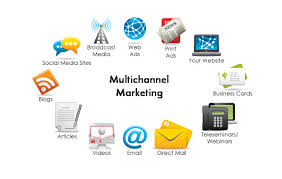
marketing channelsPeriodically, the Direct Marketing Association conducts field research to take the pulse of marketers and the various channels they’re employing to support their marketing campaigns.

In the DMA’s most recent survey, conducted online this past December and January, marketers were asked which one of seven channels they utilize in their campaigns.  The seven choices listed were the following:

  • Direct mail marketing
  • E-mail marketing
  • Mobile marketing
  • Online display advertising
  • Paid search advertising
  • Social media advertising
  • Telemarketing

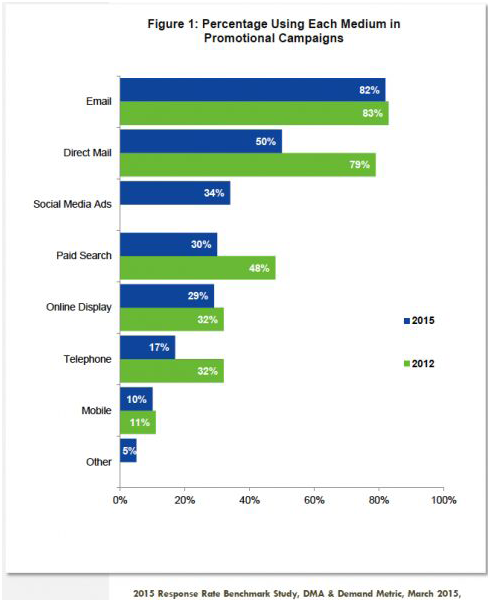
The results of the survey show that e-mail marketing remains King of the Hill when it comes to its popularity as a MarComm channel, with more than four in five marketers including the tactic as part of their promotional campaigns:

  • E-mail: ~82% use as a medium in promotional campaigns
  • Direct mail: ~50% use
  • Social media advertising:  ~34% use
  • Paid search: ~30% use
  • Online display advertising:  ~29% use
  • Telemarketing: ~17% use
  • Mobile marketing: ~10% use

Clearly, the research findings show that marketers are using multiple channels in their campaigns:  Two-thirds of the survey respondents use more than one channel, and around 45% of them reported that they’re using three or more channels in their promotional campaigns.

Social media advertising is a new entrant on the list in the DMA research.  It wasn’t even included in the DMA’s 2012 survey, yet today appears to be an important part of the channel mix.

On the other hand, mobile marketing remains a channel that isn’t being utilized by very many marketers — at least not yet.  In a similar survey conducted by the DMA in 2012, its adoption rate was similar to what the 2015 survey has found.

The graph below compares 2015 and 2012 survey results.  Aside from the lack of movement with mobile marketing, another interesting trend is the significant decline in the utilization of direct mail marketing.  Back in 2012, it rivaled e-mail marketing in popularity.  Today, only half of the marketers surveyed continue to use it as a marketing channel.

And a third big trend is the utter collapse of telemarketing as a popular MarComm channel — likely happening under the twin weight of high costs and massive phone message filtering.

DMA chart

In terms of future anticipated usage, the DMA research found that marketers are, in fact, warming to mobile marketing.  It and social media advertising are the two channels that have the best prospects for new adoption, based on the future intentions reported by these respondents.

The 2015 DMA report is available for purchase here.

Banking on Facebook: The social media giant makes its first moves into the credit-card payments business.

untitledRecently, I blogged about how Google’s efforts to expand its business activities beyond pay-per-click advertising — thereby diversifying its revenue stream — haven’t borne much fruit.

In 2011, ~96% of Google’s revenues came from PPC advertising.  In 2014, it’s ~97%.

But Google isn’t the only behemoth whose income is completely tied to advertising.  Over at Facebook, ~93% of the company’s more than ~12 billion in revenues come from advertising as well.

Compared to Google, Facebook is a relative newcomer to the advertising game.  But once it got in on the action, its growth was very robust.

In 2014 alone, Facebook’s advertising revenues were up 58% over the previous year.

But … there’s a bit of a problem.  In a world where advertising revenues are tied to “eyeballs,“ Facebook’s user growth isn’t on the right trajectory.  When the network has nearly 1.5 billion active users already, there’s not a lot of room for expansion.

This is reflected in Facebook’s Q4 year-over-year percentage growth stats as published by Mediassociates, a media planning and buying agency:

  • 2009: ~260% year-over-year growth
  • 2010: ~69% growth
  • 2011: ~39% growth
  • 2012: ~25% growth
  • 2013: ~16% growth
  • 2014: ~13% growth

One can easily imagine 2015’s growth figure dipping into the single digits, giving Facebook all the hallmarks of being a mature company in a maturing market.

But the always-enterprising folks at Facebook have had something up their sleeve which they’re rolling out to the market now:  getting into the multi-billion credit-card payments business.

Facebook send money appThey’re starting small:  introducing a “send-friends-money” functionality to Facebook’s Messenger app.  But this rather innocuous addition hardly does justice to Facebook’s end-game strategy.

When you think about it, Facebook’s aims make a lot of sense.  With nearly 1.5 billion active users around the world, Facebook’s accounts make PayPal’s ~162 million active accounts seem pretty paltry by comparison.

But revenue from PayPal’s transaction tolls isn’t chump change at all:  nearly $8 billion last year alone.

Without doubt, Facebook is also looking at the huge amount of business done by American Express and VISA; think of the billions of dollars those companies earn by charging merchants between 2% and 3.5% on the value of each credit-card transaction.

Facebook’s entry into the business can be facilitated neatly through its Messenger mobile app, making it just as easy (or easier) to pay for goods and services as with a credit card.

Considering that Facebook’s users with mobile phones are already spending time on the network an average of an hour per day, it’s pretty easy to see how people could make the transition from traditional credit and debit card payments to using their Facebook app for precisely the same purposes.

And Facebook could sweeten the pot by working with retailers and marketers to offer real cash loads that would likely juice participation even more – sort of a cash rebate in advance of the purchase rather than afterward.

So we shouldn’t think of Facebook’s new “send-friends-money” feature as a one-off function.

Instead, it’s just the tip of the iceberg.  If I were a manager at VISA or AmEx, I’d be thinking long and hard about the real motivations – and real implications – of Facebook’s latest moves.

Google and the multi-billion dollar pay-per-click money tree.

moneyIt’s no secret that Google has been trying to diversify its revenue stream away from clickthrough advertising, which historically has accounted for the overwhelming majority of its income.

How else to explain Google’s shopping spree over the past decade, scooping up a veritable smorgasbord of industry players like these:

  • AdMob (mobile)
  • Adometry (attribution)
  • Channel Intelligence (product feeds)
  • DoubleClick (display)
  • Invite Media (programmatic creative and media buying)
  • Teracent (programmatic creative and media buying)
  • YouTube (video)
  • Wildfire (social)

So the next question is, “How much have these acquisitions and investments done to diversify Google’s sources of revenue?”

The answer:  Hardly anything.

Consider this statistic:  In 2011, nearly all of Google’s revenue came from online pay-per-click advertising, as reported by SEO firm WordStream.

Now let’s look at 2014 figures:  WordStream reports that the percentage of Google revenues from pay-per-click advertising is actually higher than in 2011, at 97%.

So much for the “diversifying effects of diversity.”

Within PPC advertising, a number of keyword terms are continuing to haul in the big bucks for Google.  A few years back, the priciest keyword term of all was mesothelioma, at more than $100 a click.

Mesothelioma continues to attract a lot of ad dollars, but it’s no longer commanding $100 a pop as it once did.  In fact, it’s no longer on the Top 10 most expensive keywords list.

That list looks like this now (in descending order of bid pricing, starting at over $50 per click and dropping to “only” around $45 for the #10 keyword):

  • Insurance
  • Loans
  • Mortgage
  • Attorney
  • Credit
  • Lawyer
  • Donate
  • Degree
  • Hosting
  • Claim

In developing the ranking, WordStream determined which keywords reside in the stratosphere by compiling data from its own large keyword dataset and the Google Keyword Tool (over a 90-day period) to determine the 10,000 most expensive keywords.

These were then organized into categories like “credit” and “insurance” by weighting the number of keywords in each category, estimating the monthly search volume as well as the average cost-per-click for each keyword.

Notice the preponderance of financial and legal terms – both of them key to sectors that attract and manage a ton of money.

The word degree is right up there, too, underscoring how important the educational complex has become to the ad business.

It must be pretty unappealing to be active in these industries and have to pony up such big dollars to participate in the pay-per-click advertising space.  But how else do we think Google racks up annual advertising revenues that are north of $32 billion?

How does the market sort out which keywords are worthy of commanding $40 or $50 per click?  Essentially, it boils down to this:  Invariably, the most expensive niches paying for the most costly keywords are ones with very high lifetime customer value – where the customer pay-off is high.

Think about it:  The amount of money an insurance company gets from an individual signing up for coverage makes the high cost-per-click rates – even at $50 a pop — worth it.

Business observers point to long-range trends that may make search engine marketing increasingly irrelevant as the growth of multichannel, multi-device marketing picks up steam.

But don’t hold your breath; Google will likely be earning billions off of pay-per-click advertising for years to come.