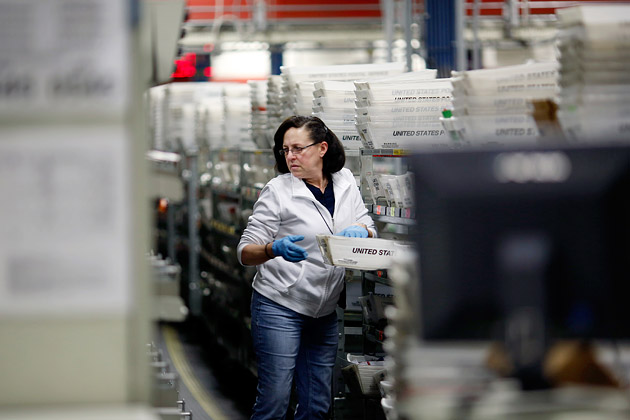
Considering the many dire predictions about the perils of the out-of-date business model of the United States Postal Service, one might surmise that its very future is in doubt.
But then we read the following news about the upcoming holiday mail season:
15 billion+ pieces of mail are expected to be processed by the USPS this holiday season.
That represents an increase of ~10.5% compared to last year.
Of the 15 billion items processed, more than 500 million will be packages.
There’s a new benefit being offered to USPS customers, too. Ahead of the holiday season, the USPS is now offering real-time delivery notification. People who register will receive real-time e-mail alerts when delivery scans are made by postal workers.
That new function may well be why the new USPS slogan has been unveiled as “One more reason this is our season.”
Normally, all of the additional volume would be cause for celebration – tapping unused capacity while growing revenues during this busy time of year.
But here’s the rub: In order to handle the added volume, the USPS needs to hire ~30,000 temporary workers.
This could mean that substantially all of the added revenues are immediately sucked out of the USPS’s coffers in order to pay for the added labor resources.
Time was, once a person left a company – for whatever reason – the likelihood that they’d ever come back to work there was pretty slim.
Perhaps to be re-engaged as a consultant or a contract worker … but as a return employee? Not likely at all.
That mindset appears to be changing. Data accumulated from a recent survey by HR research and advisory firm Workplace Trends from ~1,800 human resources executives, managers of staff, and employees provide the following clues:
Half of the HR professionals responding to the survey claimed that their organization once had formal policies against rehiring former employees (even if the employee had departed in good standing).
Three-fourths of the HR respondents reported that they are more accepting of hiring boomerang employees today. More than half of the respondents who are people managers felt the same way.
The actual incidence of returning to work at a former company isn’t all that common. Of the employees who took part in the survey, fewer than 15% of them fell into this category.
Still, 15% is way up from where it has been traditionally — and the current percentage is higher than I would have guessed.
What’s more, nearly 40% of employee respondents reported that they would consider going back to an employer where they had once worked.
There are distinct differences in employee attitudes based on age demographics: More than 45% of Millennials would consider returning to work for a former employer … but the percentage is just 29% for Baby Boomer respondents.
As for why boomerang employees are becoming more common, a number of factors are at play:
Intense competition for certain technically advanced employees who may be in short supply makes poaching more common … and also intensifies the need for companies to respond in kind. In fields were strong talent is hard to come by, often the pool of workers is too small to summarily omit former employees from consideration.
Familiarity with a company’s organization, culture and ways of doing business reduces “ramp-up” requirements and the amount of training needed, when compared to bringing on a brand-new employee.
The “devil you know” factor: Even if a former employee possesses a few characteristics that are less-than-ideal, at least these are known quantities, as compared to a brand-new employee who may or may not be all that she or he seems to be on paper.
Going forward, I suspect that boomerang employees will become even more prevalent than they are today.
To do well at that, companies might wish to look into maintaining open lines of communication with select former employees. It seems like a good way to keep choice workers “in the loop” and potentially available — and interactive/social media makes it easier to keep those channels open.
As things stands now, the results of this survey suggest that such channels are, at best, ad hoc rather than being part of a formal “alumni” communications strategy.
Addressing this point, Dan Schawbel, head of WorkplaceTrends, had this to say:
“In previous research we’ve done, we’ve found that Millennials are switching jobs every two years because they are searching for the job – and organization – of best fit. But this new study indicates that this younger generation is more likely to boomerang back when they’ve experienced other company cultures and realized what they’ve missed.”
Schawbel’s prediction? “We’ll see the boomerang employee trend continue in the future as more employees adopt a ‘free agent’ mentality – and more organizations create a stronger alumni ecosystem.”
What about you? Are you a boomerang employee? Or do you know colleagues who have done this? What are the pluses and minuses? Please share your thoughts with other readers here.
The scandal involving the security risk to U.S. State Department e-mails is just the latest in a long list of news items that are bringing the potential dangers of cyber-hacking into focus.
In the realm of marketing and public relations, recent breaches of PR Newswire and Business Wire data gave hackers access to pre-release earnings and financial reports that have been used to enrich nefarious insider traders around the world to the tune of $100 million or more in ill-gotten gains.
These and other events are occurring so regularly, it seems that people have become numb to them. Every time one of these news items breaks, Instead of sparking outrage, it’s a yawner.
But Jane LeClair, COO of the National Cybersecurity Institute at Excelsior College, is pleading for an organized effort to thwart the continuing efforts — one of which could end up being the dreaded “Cyber Pearl Harbor” that she and other experts have warned us about for years.
“We certainly can’t go on this way — waiting for the next biggest shoe to drop when hundreds of millions — perhaps billions — will be looted from institutions … It’s time we stopped making individual efforts to build cyber defenses and started making a collective effort to defeat … the bad actors that have kept us at their mercy,” LeClair contends.
I think that’s easier said than done.
Just considering what happened with the newswire services is enough to raise a whole bevy of questions:
Financial reports awaiting public release were stored on the newswires’ servers … but what precautions were taken to protect the data?
How well was the data encrypted?
What was the firewall protection? Software protection?
What sort of intruder detection software was installed?
Who at the newswire services had access to the data?
Were the principles of “least privilege access” utilized?
How robust were the password provisions?
In the case of the newswire services, the bottom-line explanation appears to be that human error caused the breaches to happen. The attackers used social engineering techniques to “bluff” their way into the systems.
Mining innocuous data from social media sites enabled the attackers to leverage their way into the system … and then use brute force software to figure out passwords.
Once armed with the passwords, it was then easy to navigate the servers, investigating e-mails and collecting the relevant data. The resulting insider trading transactions, made before the financial news hit the streets, vacuumed up millions of dollars for the perpetrators.
Now the newswire services are stuck with the unenviable task of attempting to “reverse engineer” what was done — to figure out exactly how the systems were infiltrated, what data was taken, and whether malicious computer code was embedded to facilitate future breaches.
Of course, those actions seem a bit like closing the barn door after the cows have left.
I, for one, don’t have solutions to the hacking problem. We can only have faith in the experts inside and outside the government for determining those answers and acting on them.
But considering what’s transpired in the past few months and years, that isn’t a particularly reassuring thought.
Would anyone else care to weigh in on this topic and on effective approaches to face it head-on?
For a long time, “market forces” didn’t really apply to institutions of higher learning — at least not in the classic sense.
In a social environment where nearly everyone buys into the notion that more education is good, government and educators fostered policies where no one need be prevented from getting a college education because of lack of funding.
Accordingly, in the past several decades, loans and grants became easier to obtain than ever.
Unfortunately, one of the consequences of easy money in education was that tuitions rose at a faster rate than the economy as a whole. After all, the third-party money spigot seemed never-ending.
For a good while tuition spikes weren’t a particular concern, because it still seemed as though a college-level education was a great way to earn substantially more money in one’s career — even if racking up student loans at the outset.
But in recent years, we no longer see an automatic positive correlation between a higher education degree and the ability to earn increased income.
In the sluggish economy of the 2000s, a college diploma in the right field may well be a good investment. But with many college majors, oftentimes it isn’t.
The situation is even dicier for the many students who attend community colleges or four-year institutions but who never graduate. The chasm between their educational loans and their earning power is even more deep.
Saddled with student debt, stuck with degrees or half-completed courses of study of dubious value, and with school credits unlikely to be transferred to other schools in order to finish their education, the situation for those unlucky students can only be described as dire.
How did we get to this place?
One big reason is that over the years, many colleges got into the habit of simply expecting sufficient numbers of students to enroll in their institutions regardless of the sticker price to attend. If anything, high tuition “list prices” were a badge of honor.
At the same time, substantial grants (essentially discounts off of the published tuition rates), together with irresistible financial aid packages, continued to attract students to private as well as public institutions of all stripes.
Running in parallel with this were lavish, ongoing projects involving the construction of fancy new dorms, state-of-the-art athletic facilities, and all sorts of other creature-comfort-like amenities to lure students to campus.
And let’s not forget another not-so-welcome outcome of this fantasyland of higher education economics – call it “degree inflation.” With so many students obtaining undergraduate degrees, their “worth” became devalued.
In this high-stakes derby, a BS degree in business is no longer enough – it has to be an MBA. A BS degree in engineering isn’t nearly as prestigious as a Master’s degree or a PhD. There’s really no end to it.
The convergence of these sobering economic and social trend lines makes it pretty clear that the “old” business model is no longer working for colleges and universities. With the economic realities of today, college administrators are discovering that, sooner or later, market forces work. And the resulting picture isn’t very pretty.
So now we’re witnessing the lowest percentage increases in tuition sticker prices we’ve seen in years, across private institutions and even some public ones as well. Bloated administrative staffs — their numbers dwarfing the number of teachers at some colleges — have finally plateaued or even begun to decline.
Being the parent of two children who graduated from college within the past five years, naturally I’ve been quite interested in these trends – and I’ve viewed them pretty close-up.
What I’ve determined is that for years, administrators at many colleges and universities didn’t see themselves as working within a market system — having to compete where market forces were at work. The often-unappealing business of being disciplined by market forces didn’t pertain to them — or so they thought.
That’s certainly not the case anymore.
And there’s another huge factor looming on the horizon: Distance learning. I’ll be here big-time before we know it … and it promises to upend the college education business model as never before.
What are your thoughts on this topic? Please share them with other readers here.
Managing multiple vendors has become nearly a full-time job for some marketers.
Managing channel communications isn’t very easy for marketers these days, that’s for sure. It’s because so many companies are using multiple outbound channels to connect with their customers.
The results of that survey revealed that more than half of the marketers are using at least six outbound channels to connect with customers. And another 20% use more than ten channels.
Guess what this means? Nearly 30% of these marketers report that they’re managing (or more likely juggling) seven or more technology vendors and service providers as part of their MarComm duties.
More to the point, many marketers are devoting huge chunks of their week just coordinating all of these tech and service providers.
For an unlucky ~20% of the respondents, the time commitment is upwards of 15 hours each week – more than a third of the time that makes up a 40-hour week. (“What’s a 40-hour week in marketing?” one might ask, of course.)
Even for marketers who are using a smaller number of vendors to support their media and communications channel efforts, the involvement of various internal stakeholders is high – more than seven, on average, during the vendor selection process. So the coordination responsibilities just keep adding up.
What this means …
The Yes Lifecycle Marketing Survey found a correlation between the “choreography” demands of managing multiple vendors and the fact that other marketing activities suffer as a result — namely, market strategizing, business operations and customer relationship-building.
And even with those duties getting shorter shrift, the marketers surveyed still complained about having too many vendors to coordinate … significant challenges with properly integrating the various functions … insufficient budgets … and above all, a lack of adequate staffing.
To top it off, the typical tenure of a Chief Marketing Officer at a company isn’t exactly lengthy — ~45 months at last count. It’s enough to make one wonder if a job in marketing is worth it.
The answer to that question can be summed up this way (with credit to Oscar Wilde and apologies for the riff): “The only thing worse than being busy is … not being busy.”
I’ve blogged before about how the American public doesn’t seem to be responding to the news that the country has been out of its economic recession for a number of years now.
Plus … I’m reminded often by my business counterparts who work in Europe and Asia that the situation is much better in America than in many other countries. I consider it advice to “count our blessings,” as it were.
With this as backdrop, it’s easy to fall into the paradigm of thinking that the American public is simply being unrealistic in its expectations for economic recovery — and the recovery’s ability to reach into all strata of society.
In addition to heading what is arguably America’s most famous polling company, Mr. Clifton is a keen observer of economics and public policy. He is also the author of the book The Coming Jobs War (published in 2011).
The gist of Clifton’s commentary is that the official unemployment rate, as reported by the U.S. Department of Labor, is very misleading.
Moreover, it’s Clifton’s contention that the very way the Department of Labor calculates the unemployment rate goes straight to the heart of the disconnect between the experts and the “person on the street.”
Here’s what Clifton wrote in a column released earlier this month:
“If a family member or anyone is unemployed and has subsequently given up on finding a job — if you are so hopelessly out of work that you’ve stopped looking [for work] over the past four weeks — the Department of Labor doesn’t count you as unemployed.
That’s right: While you are as unemployed as one could possibly be, and tragically may never find work again, you are not counted in the [unemployment] figure we see relentlessly in the news — currently 5.6%.”
The official U.S. unemployment rate as reported by the United States Department of Labor’s Bureau of Labor Statistics.
In Clifton’s estimation, right now as many as 30 million Americas are either out of work or severely unemployed. That would equate to an unemployment rate far higher than the reputed 5.6% figure.
But it goes even beyond that. Clifton points out another clue as to why the perception gulf between the “statisticians” and the “street” seems so wide — and he puts it in the form of two examples:
“Say you’re an out-of-work engineer or healthcare worker or construction worker or retail manager. If you perform a minimum of one hour of work in a week and are paid at least $20 — maybe someone pays you to mow their lawn — you’re not officially counted as unemployed in the much-reported 5.6% [figure].
Few Americans know this.
Yet another figure of importance that doesn’t get much press: those working part time but wanting full-time work. If you have a degree in chemistry or math and are working 10 hours part time because it is all you can find — in other words, you are severely unemployed — the government doesn’t count you in the 5.6%.
Few Americans know this.”
Clifton doesn’t mince words in his characterization of the official unemployment rate; he calls it a “Big Lie” — one which has consequences that go well-beyond simply the stats being arguably wrong.
Here’s how he puts it:
“… It’s a lie that has consequences because the Great American Dream is to have a good job — and in recent years, America has failed to deliver that dream more than it has in any other time in recent memory.
A good job is an individual’s primary identity — their very self-worth, their dignity. It establishes the relationship they have with their friends, community and country. When we fail to deliver a good job that fits a citizen’s talents, training and experience, we are failing the American Dream.”
Statisticians and economic policy experts can and do disagree about what constitutes a “good job” in America. The Gallup organization defines it as working 30 or more hours per week for an organization that provides a regular paycheck, with or without other benefits.
That’s actually a pretty low-bar for what defines a “good job.” But however jobs are defined, the U.S. economy is currently delivering at a rate of just 44%, which equates to the number of full-time jobs as a percent of the adult population (age 18 and over).
It would seem that the 44% figure would need to be significantly higher to really solve the challenge of available jobs.
Clifton concludes his commentary by issuing this challenge:
“I hear all the time that ‘unemployment is greatly reduced, but the people aren’t feeling it.’ When the media, talking heads, the White House and Wall Street start reporting the truth — the percent of Americans in good jobs; jobs that are full time and real — then we will quit wondering why Americans aren’t ‘feeling’ something that doesn’t remotely reflect the reality in their lives.
And we will quit wondering what hollowed out the middle class.”
I’ve devoted significant space in this blog post to quoting Jim Clifton’s words verbatim, so as not to change their tenor or dilute them in any way.
What do you think? Is Clifton speaking truth to power? Or is he painting an overly negative view of things? I welcome your thoughts and comments.
Ever since the advent of e-mail communications, there’s tended to be a feeling that correspondence sent via this mode of delivery is generally more “pressing” than correspondence delivered the old-fashioned way via postal mail.
After all, people don’t call postal mail “snail mail” for nothing.
At the same time, one would think that the proliferation of e-mail volumes and the today’s reality of groaning inboxes might be causing an adjustment of thinking.
Surely, most of the e-mail doesn’t need a quick response, does it?
If 80% or more of today’s e-mail is the equivalent of the junk mail that used to fill our inbox trays in the office in the “bad old days,” why wouldn’t we begin to think of e-mail in the same terms?
But a new survey of workers appears to throw cold water on that notion.
The survey of ~1,500 adults was conducted by MailTime, Inc., the developer of a smartphone e-mail app of the same name. The survey found that a majority of respondents (~52%) expect a response to their work-related e-mail communiqués within 24 hours of hitting the send button.
Moreover, nearly 20% expect a response in 12 hours or less.
While the survey encompassed just users of MailTime’s app, the findings are likely not all that different for office workers as a whole.
Why is that? I think it’s because, in recent years, the e-mail stream has become more “instant” rather than less.
Back in the early days of e-mail, I can recall that many of my work colleagues checked their e-mail inboxes three times during the day: early in the morning, over the lunch hour, and as they were wrapping up their workday.
That’s all out the window now. Most people have their e-mail alerts set for “instantaneous” or for every five or ten minutes.
With practices like that being so commonplace, it’s little wonder that people expect to hear a response in short order.
And if a response isn’t forthcoming, it’s only natural to think one of three things:
The e-mail never made it to the recipient’s inbox.
The recipient is on vacation, out sick, or otherwise indisposed.
The recipient is ignoring you.
I think there’s an additional dynamic at work, too. In my years in business, I’ve seen e-mail evolve to becoming the “first line of contact” — even among colleagues who are situated in the same office. Younger workers especially eschew personal interaction — and even phone contact — as modes of communication that are needlessly inefficient.
Of course, I can think of many instances where e-communications can actually contribute to inefficiencies, whereas a good, old-fashioned phone call would have cut to the chase so much more easily and quickly.
But even with that negative aspect, there’s no denying the value of having a record of communications, which e-mail automatically provides.
And here’s another thing: MailTime estimates that around two-thirds of all e-mails are first opened on a smartphone or tablet device — so message deliverability is just as easy “on the go” as it is in the office.
It’s yet another reason why so many people expect that their communiqués will be opened and read quickly.
I agree that e-mails are easy and convenient to open and read on a mobile device. But sometimes the response isn’t nearly so easy to generate without turning to a laptop or desktop computer.
So as a courtesy, I’ll acknowledge receipt of the message, but a “substantive” response may not be forthcoming until later.
… And then, when others don’t show a similar kind of courtesy, I think many of us notice!
Some larger companies with employees who are more geographically far-flung have actually adopted guidelines for e-mail etiquette, and they’ve applied them across every level of the company.
It seems like a good idea to get everyone’s expectations on the same page like that.
Incidentally, the preferred scenario for responding to personal e-mails isn’t really all that different from work-related expectations, even though personal communiqués aren’t usually as time-sensitive. Respondents in the MailTime survey said that they expect to receive a response to a personal e-mail within 48 hours. For nearly everyone, waiting a week is far too long.
I’ve blogged before about the propensity for Americans to forego using all of their allotted vacation time in a given year.
But that was back in 2012, in the waning months of the “Great Recession,” so perhaps one reason for those dynamics was leaner workforces and the need for “all hands on deck.”
A few years have gone by since then, and … very little has changed in these dynamics.
What the survey found was that 40% of workers fail to take all of their allotted paid time-off.
When asked why this was the case, look at the reasons that were cited:
Taking time off will cause my work to pile up: ~40% cited
Nobody else can do my job while I’m on vacation: ~35%
I can’t afford to take time off: ~33%
I don’t want to be seen as “replaceable”: ~22%
The study characterizes the atmospherics surrounding the phemonemon as a “work martyr complex.”
As U.S. Travel’s chief executive puts it, “busyness” is something Americans wear as a “badge of honor.”
But there may be a bit more to it than that.
The survey also found that two-thirds of the respondents feel that their employer sends mixed messages about taking vacation … says nothing at all about it … or actually discourages people from taking paid time off.
What appears to motivate workers to take their full allotted vacation time is the implementation of “use it or lose it” policies. When such policies are in place, ~84% of workers take all of their allotted time.
By contrast, for companies that offer the ability for workers to roll over vacation time, bank it, or be paid for time not taken, only about half of their employees (~48%) use all of their time.
The big question is whether most companies truly buy into the notion that taking vacation time is important for overall employee health, well-being and relationships – because the survey found that only a distinct minority of companies (one in four) maintain a “use it or lose it” PTO policy.
Of course, the members of the U.S. Travel Association would certainly benefit if more Americans took paid time off and used it to travel to vacation destinations. Still, Roger Dow’s contention that “it’s time to start a conversation and reclaim the benefits we work so hard to earn” makes sense to me. The full report can be viewed here.
At our company, we’ve a “use it or lose it” PTO policy in place for years. What’s your own situation?
It may be the year 2014, but many people continue to wander gracelessly through the gender minefield when it comes to the workplace.
We saw this in spades two weeks ago, when the Today Show’s Matt Lauer asked General Motors Chief Executive Mary Barra how she successfully balanced her role as CEO of a large corporation with that of being a Mom.
Mr. Lauer was excoriated for asking the question, with criticism coming from all quarters (left and right). He was accused of sexist questioning. Several commentators pointed out that he had never asked such a question of the male top executives he had interviewed earlier at GM and Chrysler.
Still, the fact that a flurry of controversy was stirred up at all reminds us how emotionally charged questions about gender roles continue to be, several generations after the birth of the feminist movement.
In point of fact, gender roles have been evolving pretty rapidly in the past two or three decades. Sparked by economic and employment forces as well as changes in social norms, more men than ever are choosing to stay home with family, even as the participation of women in the workforce has reached all-time highs.
And field research conducted in May 2014 by consulting firm Insights in Marketing suggests that it’s men more than women who now feel that they’re facing struggles and stigmas associated with achieving a good work/family balance. To wit:
Among men surveyed who have children under the age of 18, ~35% report that they are “feeling more torn between work and family” … whereas with women with children under the age of 18, only ~26% report the same feelings.
Here’s another result from the same survey: By a 57% to 41% margin, men are more likely than women to agree with the following statement: “A man’s primary duty is to financially provide for his family.”
Those figures may not come as a surprise.
By contrast, nearly the same percentages of men (78%) and women (74%) disagree with the statement that “A woman’s primary duty is to be a full-time caretaker for her family.”
According to the research summary issued by Insights in Marketing, these findings suggest that certain gender stereotypes are no longer accurate: Society truly accepts (and even expects) women to be a part of the workforce, while expecting men to care only about their careers.
Instead, the survey reveals much more similarities than differences in how women and men see their family and work roles:
~81% of women surveyed feel that their first obligation is to their home and family … and ~75% of the men surveyed feel the same way.
~48% of men surveyed feel that their career gives their lives purpose … but ~40% of the women surveyed also reported the same feeling.
Even though real change is happening on the ground, it’ll probably take more time before we start seeing the change being reflected in popular culture — and so that Matt Lauer can ask a question without incurring the wrath of a thousand baying wolves.
Remember that, too, the next time you see a TV commercial for laundry detergent. You know — the one where Dad is some doofus who puts way too much soap in the washing machine and then can’t figure out when to add the fabric softener …
More findings from the Insights in Marketing report are available here.
When it comes to which characteristics people consider the most important for being successful in the working world, we hear same traits cited so often, it becomes like a litany.
A recent survey of ~500 business managers in the communications and technology fields, conducted by digital education company Hyper Island, confirms it yet again.
When the survey respondents were asked to identify which traits were most important, here were their top answers:
A winning personality(e.g., creative, open-minded, positive): ~78% identified as among the most desirable traits.
Cultural alignment(making decisions that reflect the values shared with their organization): ~53% identified as among the most desirable traits.
The skill-sets of the worker: Only ~39% identified this as the most important trait.
Regarding skill-sets, it seems that despite the inexorable increase in technical expertise and acumen required of workers in nearly every business discipline, many people continue to believe that personality, attitude and a team mentality trump capabilities and expertise.
In other words, it’s the notion that it’s easier to educate someone with a positive attitude than it is to work with someone who really knows his or her stuff, but has a bad attitude, is a wet dishrag, or whatever.
Well, hold that thought. Because now we have new research from analysts at the University of Pennsylvania and the University of Illinois which is giving us another angle to consider.
In their studies, these researchers have found that workers with “net-negative” personality traits appear to be more efficient in their jobs than those who possess “net-positive” personalities.
What’s going on?
To come to this conclusion, the university researchers had their study participants meticulously document all of their activities over a prescribed period of time, along with completing a survey that measured attitudes about their jobs, their workplace and their colleagues.
As it turns out, it’s not that one group puts in more time than the other at the office. It’s that workers with “sunnier” dispositions are more open to performing tasks that may be outside of their comfort zone.
They’re more inclined to “have a go” at different activities, because they’re naturally more curious … and more willing to step in and support the larger work team.
… Especially if their boss requests it.
By contrast, grumpier employees are less open to novelty … more suspicious of taking on other tasks … and more likely to put up subtle (or not-so-subtle) psychological barriers when it comes to being approachable about taking on those tasks.
By their behavior and body language, they may often be successful in dissuading their superiors from even asking them to take on new and different job tasks.
And if they’re asked, they’re less likely to acquiesce.
As a result, these employees tend to spend more time on a fewer variety of tasks – the ones they already know. Which, in turn, makes them more likely to further hone their skills in those areas.
I don’t think these new findings challenge the underlying idea that employees with a positive attitude are a strong asset to companies.
But perhaps a smidgeon more credit may be due to the employees who are on the other end of the scale. When you find them sitting alone in the break room, or avoiding gathering around the water cooler, they may be investing more amount of time in their work tasks — and developing a higher level of skill as a result.

 Considering the many dire predictions about the perils of the out-of-date business model of the United States Postal Service, one might surmise that its very future is in doubt.











 Nones Notes