OSHA names the Top 10 most frequent workplace violations — some of which may surprise you.

fpWhat hazards represent the biggest threats to employees at worksites across America? We all may have our own suspicions … but the federal government has been keeping records about them for years.

In fact, this week the Occupational Safety & Health Administration (OSHA) has published its annual list of the Top Ten most frequently cited violations it has found following inspections of worksites its officials undertake on a regular (and unannounced) basis.

The OSHA listing shines a light on the types of safety issues that are most pronounced in the workplace. Here’s OSHA’s latest list, based on the 12-month period from October 2014 through September 2015.  It’s headlined by fall protection, which is the most frequent OSHA standards violation:

  1. Fall protection violations (construction standard)
  2. Hazard communication (general industry standard)
  3. Scaffolding (construction)
  4. Respiratory protection (industry)
  5. Control of hazardous energy (lockout/tagout) (industry)
  6. Powered industrial trucks (industry)
  7. Ladders (construction)
  8. Electrical (wiring methods, components and equipment)
  9. Machine guarding
  10. Electrical (general requirements)

olOSHA publishes the list once per year to alert U.S. employers about the most common violations being cited so that they’ll take precautions to fix similar hazards in their own companies before OSHA officials show up to carry out an inspection.

Reviewing the list, some of the categories fall into the “everyone knows” category. Who doesn’t think that fall protection, scaffolding and ladders are major contributors to injuries in the workplace?

But then there are other OSHA violations like electrical systems and industrial trucks; it’s a little surprising to me to find them among the most frequently cited violations.

Which workplace threats do you think represent the biggest safety hazards to workers? Share your thoughts with other readers here.

High-performance sales personnel: They excel in the same ways they always have …

spUnquestionably, technology has had a major impact on the way salespeople in the B-to-B arena go about doing their daily jobs.

Technology platforms and tech-oriented work practices have leeched into every aspect of sales management — from planning and execution to data mining and reference … sales call and results tracking … and compensation.

fall 2015 survey of U.S. business executives conducted by Brainshark and Forbes Insights confirms the degree to which technology investments are occurring as companies make efforts to improve sales productivity.

Here’s what the survey, which included U.S.-based executives from over 200 companies with annual revenues exceeding $50 million, found in terms of the types of investments that are being made:

  • Sales enablement technologies: ~55% are investing in these tools
  • Analytics: ~54%
  • CRM systems: ~53%
  • Learning technologies: ~45%
  • Mobile sales support technologies: ~44%
  • Social platforms: ~32%

And yet … when those same business executives were asked to identity the #1 most important characteristic of their strongest sales team members, technology-related characteristics don’t show up all that much.

As it turns out, tech adoption is a relatively minor part of being a high-performing salesperson. Instead, this survey found that the most important key characteristic of high-performing salespeople is “the ability to sell value over price.”

Here is the relative importance of five characteristics evaluated in the research – and where tech adoption fits among them:

  • The ability to sell value over price: ~81% identify as a key characteristic of high-performing salespeople
  • Consistency of execution: ~74%
  • Time spent with clients: ~48%
  • Leveraging marketing and sales content assets: ~26%
  • Adoption of technology: ~22%

The takeaway is that even though technology tools are helpful, there’s no substitute for the time-honored selling behaviors that separate the star sales performers from all the others.

For more information on the study findings, follow this link.

The Sanders/Trump phenomenon: A view from outside the United States.

photo1This past Tuesday evening as I watched Bernie Sanders and Donald Trump vanquish their rivals handily in the New Hampshire presidential primary election, I received an e-mail from my brother, Nelson Nones, with his observations on “what it all means.”

As someone who has lived and worked outside the United States for years, Nelson’s views are often quite perceptive — perhaps because he is able to look at things from afar and can see the “landscape” better than those of us who are much closer to the action.

Call it a “forest versus trees” perspective.

And when it comes to the 2016 presidential election, it is Nelson’s view that the Sanders/Trump phenomenon is absolutely real and not something based on personality or celebrity — for good or for ill.

Shown below is what Nelson wrote to me.

… On the Underlying Dynamics

For context into what’s happening in the United States, the Pew Research Center’s recent report on the wealth gap in the United States is instructive.

In a nutshell, over the past 30 years Pew’s data points reveal: 

  • Upper-income families currently represent ~20% of the total, and their wealth (measured by median net worth) has doubled. 
  • Middle-income families represent 46% of the total. Their wealth barely changed (up 2%). 
  • Lower-income families therefore represent ~34% of the total, but their wealth fell 18%.

Now, after the end of the Cold War in 1992 until the onset of the Great Recession in 2007, the wealth of all three groups did rise, albeit by varying degrees: 

  • Upper-income by 112%
  • Middle-income by 68%
  • Lower-income by 30%

Here’s how they fared during the Great Recession (2007-10): 

  • Upper-income wealth declined by 17%
  • Middle-income wealth fell by 39%
  • Lower-income wealth fell by 42%

And after the Great Recession:

  • Upper-income families recovered 36% of their wealth lost during the Great Recession
  • Middle-income families recovered none
  • Lower-income families lost an additional 7% relative to their wealth in 2007

So, if we assume wealth to be a proxy for the feeling of well-being, then one could surmise that ~80% of American families feel like victims today — of which nearly half feel they are still being victimized.  

… On “Anger”

Are people feeling angry about this? You bet.   

Who are they going to blame? The other ~20% and foreigners, of course. 

Never mind the exculpatory hard data proffered by defenders of the nation’s elites revealing that big banks paid back all the bailout money they received during the Great Recession, or that bankers cannot be jailed for their alleged misdeeds unless and until proven guilty by jurors in courts of law (like anyone else), or that pharmaceutical companies’ margins on $45 billion of profit, at 12%, aren’t “quite” as obscene as they appear at first glance.   

None of those facts can ever restore wealth that’s been lost and never recovered, or is still falling. When you feel like a victim, such hard data are utterly and completely irrelevant.  

Both Bernie Sanders and Donald Trump are tapping into this anger with great success. As I watched both Sanders’s and Trump’s victory speeches, to vastly oversimplify, here is what I heard.  Sanders essentially said:

“It’s not fair that most Americans can’t get ahead or are falling behind. I’ll expropriate money from the rich by taxing Wall Street bankers and give it to you in the form of free tuition, student debt restructuring, lower healthcare costs and single-payer healthcare!” 

Trump essentially said:

“Political hacks are negotiating bad deals, letting China, Japan and Mexico take our money away from us every day. As the world’s greatest businessman, I’ll negotiate great deals fast to give you universal healthcare, and beat these countries so you get your money back – without having to share it with all those illegal immigrants!”

Photo2In my view, what both Sanders and Trump recognize is that ~80% of American families may have lost 40% of their wealth since 2007 with little or no hope of recovering it … but they haven’t lost any of their voting power.  

It makes no difference that the prescriptions offered by Sanders and Trump – squeezing money from Wall Street, China, Japan and Mexico, for example – are nonsense. As a lawyer I once knew always said, “Winning isn’t everything; it’s the only thing.”  To have any chance of accomplishing something useful (or not) as President, you have to win first.   

… On Populism being the Winning Ticket

In this election, under present circumstances, populism is a sure winner. 

The wealthiest ~20% of families (Democrats as well as Republicans) who represent the “establishment” in the eyes of the angry Sanders and Trump crowds, don’t quite smell the coffee yet.  

The angry crowds are out for money this election cycle, and I believe they hold enough votes to elect one of the two populist candidates (Sanders or Trump) who is promising “money.”   

… Not “experience,” “pragmatism,” “conservativism,” “liberalism,” “socialism,” “limited government,” “feminism,” “pro-life,” “pro-choice,” “pro-LGBT,” “hope,” “change,” or whatever.  But money.

To protect as much of their wealth and status as they can, the elites have little choice but to scuttle their aspirational platitudes and learn to deal with it.

So there you have it — a view of the presidential election from the outside looking in. I think there’s food for thought here — and very possibly a look at where we’ll be in another nine months.

What do other readers think? Agree or disagree?  Please share your observations here.

A nation of “haves” vs. “have-nots”? Gallup tests the perceptions.

pictureIn any presidential political season, there’s always plenty of rhetoric about the American economy, how well it’s performing for the average voter, and people’s perceptions of how they’re doing socioeconomically.

As it turns out, the Gallup Survey has been testing this issue annually for years now — going all the way back to 1988.

The question posed to Americans in Gallup’s surveys is a simple one: Do you consider yourself personally to be part of the “haves” or “have-nots” in America?

Gallup’s latest survey was fielded in July 2015.  Nearly 2,300 U.S. adults aged 18 and older were part of the research.

In response to the “haves vs. have-nots” question, ~58% of respondents considered themselves to be “haves” in U.S. society, while ~38% placed themselves in the “have-nots” segment. (The remaining ~14% see themselves borderline between the two, or they don’t have an opinion.)

Over time, Gallup has found that the percentage of Americans who perceive themselves to be part of the “have-nots” in society rose pretty steadily from 1988 to 1998, but since that time the percentages have leveled off — even during the worst years of the Great Recession from 2009-2011.

And so, the “haves” percentage has fluctuated in a tight band between 57% and 60% in each year since the late 1990s.

It seems that heightened discussions about social inequality in America haven’t resulted in a higher percentage of people thinking that they are on the less fortunate side of the country’s socioeconomic divide.

However, considering that the latest Gallup survey was conducted in July 2015 — and that since that time there have been more news events drawing attention to the issues of social justice — one wonders if we may be on the cusp of some changing thinking on the subject.

Another persistent finding in Gallup’s surveys is this:  Even among families of quite modest means (annual household incomes of $35,000 or lower), only a little more than half in that segment consider themselves to be part of the “have-nots” group.

Education-wise, the survey findings are similar, with fewer than half of the respondents who don’t possess college degrees considering themselves part of the “have-nots” segment.

In reporting on the Gallup survey results, an article published in the November 2015 issue of Quirk’s Marketing Research Review magazine stated:

“The stratification of U.S. society into unequal socioeconomic groups has long been a fixture of philosophic, political and cultural debate. It appears to have remained or even expanded as a fairly dominant leitmotif in the ongoing 2016 election, particularly among the Democratic presidential candidates. 

[Nevertheless,] the results … in this analysis show that a majority of U.S. adults do not think of American society as being divided along economic lines, and a slightly higher percentage say that if society is divided, they personally are on the ‘haves’ side of the equation rather than the ‘have-nots.'”

More information about the Gallup survey results can be viewed here.

What are your thoughts? Do the perceptions Americans have of socioeconomic inequality — or the lack of it — match the reality?  Or are we poised to see some new significant shifts in the way Americans view socioeconomic divisions in this country?

Organizational Management: Zappos Meets Reality

ZLIt’s always interesting to read about the concept of flattened or “matrix” organizational structures for companies, and how they offer a much more creative and fulfilling environment for employees when compared to working within a more traditional hierarchical organizational structure.

… And then you read about a company that actually tries to implement such an organizational model — and gets thrown against the rocks in the process.

The latest example is Zappos, the online shoe and clothing retailer which has built its business and reputation on exquisite customer service. For years it’s also been known as a company willing to experiment with nontraditional human resources models.

The most famous of these is known as “the offer,” where new hires are given the opportunity to take a $2,000 stipend in lieu of remaining on the job – the idea being that it’s a practical as well as humane way to ensure that Zappos employees are the best “fit” for the company.

The company’s latest endeavor has been to introduce a new management structure known as a “holocracy.” This structure, adopted by Zappos in 2014, aims to facilitate (or codify, actually) collaboration among workers by essentially eliminating workplace hierarchies – as in no titles and no direct-report bosses.

In Zappos’ holocracy environment, employees now work through their job responsibilities, strategies and tactics via a web-based app known as the “Glass Frog.”

I think you might know where this is headed: Self-governance isn’t a tidy business, and there’s a good dose of mixed signals and even confusion that comes along with it.

When structures are flattened and titles eliminated, it causes disruption in ways big and small:

  • How do strategic initiatives and tactical tasks get done efficiently?
  • Who is responsible for what? 
  • How do co-workers (as well as outsiders) know what each employee “does”?
  • How are employees monitored and evaluated on their work performance and contribution to the success of the enterprise?

And how about this: Try determining salaries for existing and prospective new employees after titles have been eliminated.

Guess what happens when confusion reigns in any organization? Attrition rates rise.

As reported this month by Bourree Lam in The Atlantic, in the case of Zapppos, nearly one in five employees have taken buyouts since last spring, resulting in an annual turnover rate of ~30%.  That’s dramatically higher than the typical attrition rate at companies.

Weeding out less productive workers is a staple in managing for business efficiencies, productivity and profits. But when nearly one-third of your entire staff is leaving the company within a 12-month period, you’re getting into territory where “institutional knowledge” is in serious danger of being lost.

Research by Stanford University’s Graduate School of Business and other institutions shows that the more “egalitarian” an organizational structure is, the more unpredictable and potentially disorienting it is to workers. Simply put, most people prefer a defined “pecking order.”  They might grumble about corporate hierarchies, but those structures are more “predictable” and many workers find them to be more psychologically comfortable.

hoThe reality is that holocracries, flattened and matrix organizational structures are often less efficient than hierarchical ones. They may well spur more innovation and creative thinking, but the price paid in lost efficiency may be too high for many companies.

In my personal experience working with a matrix organization (not as an employee but as a person providing business support services to the company), I’ve seen where a matrix structure can actually work. It certainly helps if the business has strong, industry-leading products that are protected by patents and that benefit from being able to command high prices and correspondingly high product margins.

Zappos isn’t operating in any such marketplace. It has little or no protection against aggressive market competitors entering its space.  Profit margins in retail are famously tight.  It’s just not clear that any company can operate successfully in that space for any length of time without keeping very tight controls over operating expenses and also squeezing as much productivity out of each employee as possible.

Despite the challenges, it appears that Zappos is doubling down on its holocracy structure. Here’s what CEO Tony Hsieh wrote in 2014 to his employees:

“Self-management and self-organization is not for everyone, and not everyone will necessarily want to move forward in the direction of the … strategy statements that were recently rolled out. Therefore, there will be a special version of “the offer” on a companywide scale, in which each employee will be offered at least 3 months’ severance … if he/she feels that self-management, self-organization and our … strategy statement as published in Glass Frog are not the right fit.”

With a pronouncement like that coupled with a big financial carrot, it’s understandable why so many employees have taken up Zappos’ severance package offer.

The next question is this: Will Zappos emerge as a stronger, more creative and more nimble company as a result of its transition to a holocracy structure?  Or will the initiative turn out to have been a massive miscalculation?

If you work in a flattened or matrix organization structure and have observations to share about its positive and negative aspects, please leave comments. I’m sure other readers would be quite interested to read them.

Suddenly, GoPro isn’t so “Go-Go” …

untitled2Most likely, I’ll never be a GoPro customer.

The only direct interaction I’ve had with the maker of action cameras was several years ago during the Great Target Credit Card Breach of 2013, when suddenly a half-dozen GoPro purchases mysteriously appeared on my card statement.

But other than that, my connection with GoPro and its line of cameras has been nonexistent — which isn’t at all surprising considering that at my age, I’m hardly an “action adventurer.”

Unfortunately for GoPro, many other people aren’t, either – and it’s one reason why the company’s financial results have been pretty ugly coming off of the most recent holiday season.

This past week, GoPro announced that it is cutting nearly 10% of its workforce (more than 100 people) because of weak sales during the 4th Quarter.

In a holiday quarter when product purchases should have grown revenues considerably, the weaker-than-expected sales volume of ~$435 million meant that GoPro’s revenues were far short of the $510 million originally projected.

From the financial market’s perspective, this news was sufficiently negative that trading of GoPro shares had to be halted briefly this past Wednesday.

untitled
GoPro shares over the past six months.

The company promises to divulge more information about its financial results in early February, but some observers are already beginning to paint the picture of what’s out of kilter:

  • GoPro misjudged the price consumers were willing to pay for its Hero4 Session cube cam, introduced in July 2015, resulting in two dramatic drops of the sticker price in September and December down to $199. 
  • Competitors are entering the field, putting further downward pressure on pricing. 
  • There’s a ceiling on the demand for action cameras because “action adventurer” consumers are such a small slice of the general population.

But does any of this come as a particular surprise?

Like in any other consumer electronics product category, the trajectory of high growth among early adopters leads to new market entrants, followed by the hardware becoming essentially a commodity.

… And the whole process is as swift as it is inevitable.

GoPro is branching into newer segments like camera drones — and not a moment too soon. But the reality is that in a product segment like action cameras, any supplier will always be just one step ahead of commoditization.  And for this reason, product mix reinvention has to be happening continuously.

The disappearing American middle class? The Pew Research Center weighs in.

mcIn this political season in the United States — when is it ever not, one wonders? — we hear many of the presidential candidates refer to the so-called “crisis” of the middle class.

It matters not the political party nor ideological stripe of the candidate, we hear copious references to “the disappearing middle class” … the “middle class squeeze” … and that the middle class is “just getting by.”

Considering that the middle class income group represent the single largest block of voters in the country, it isn’t at all surprising that the presidential contenders would talk about middle class issues — and to middle class voters — so frequently.

The question is … is the hand-wringing warranted?

PewWell, if one believes a new Pew Research study on the subject, it may well be the case.

Based on its most recent analysis of government data going back nearly 50 years, Pew reports that there are now fewer Americans in the “middle” of the economic spectrum than at the lower and upper ends.

This is a major development, and it is new.

Pew defines a middle class household as one with annual income ranging from ~$42,000 to ~$126,000 during 2014. Using that definition, Pew calculates that there are now 120.8 million adults living in middle class households, but 121.3 million who are living in either upper- or lower-income households.

Pew characterizes this new set of figures as a kind of tipping point. And it helps to underscore the narrative wherein certain presidential candidates — you-all know which ones — are tapping into a collective “angst” about the decline in middle-income families, and the notion that they are falling behind compared to upper-income adults while unable to access many of the support services available to lower-income households.

Looking at things in a bit more depth, however, one can find explanations — as well as other data points that go against the “narrative” to some degree. Consider the following:

  • Senior citizens have done quite well shifting into the upper category since the 1970s — their share increasing by well over 25% in the upper-income bracket.
  • African-Americans have experienced the largest increase in income status over the same period, meaning that their lower-income category share is lower today.
  • The rapid rise in the number of immigrants in the late 20th century has pushed down median incomes because those new arrivals, on average, make less in income.

I suspect the Pew study findings will be fodder for more discussion — and perhaps some additional sloganeering — in the upcoming weeks and months. But you can judge for yourself whether that’s warranted by reviewing more findings from Pew’s report here.

If you have your own perspectives about what’s happening with (or to) the middle class, I’m sure other readers would be quite interested in hearing them.  Please share your comments here.

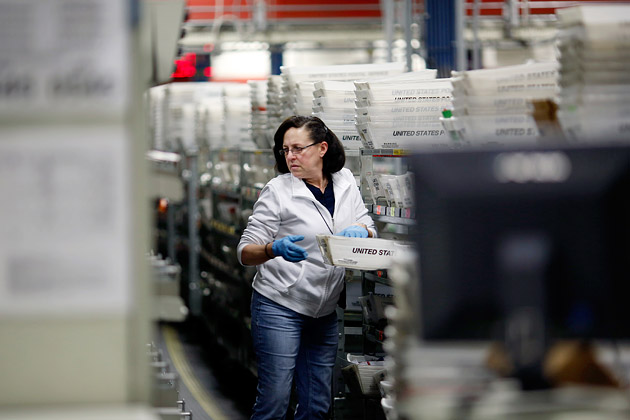
As the U.S. Postal Service girds for processing 15 billion pieces of mail this holiday season …

workerConsidering the many dire predictions about the perils of the out-of-date business model of the United States Postal Service, one might surmise that its very future is in doubt.

But then we read the following news about the upcoming holiday mail season:

  • 15 billion+ pieces of mail are expected to be processed by the USPS this holiday season.
  • That represents an increase of ~10.5% compared to last year.
  • Of the 15 billion items processed, more than 500 million will be packages.

There’s a new benefit being offered to USPS customers, too. Ahead of the holiday season, the USPS is now offering real-time delivery notification.  People who register will receive real-time e-mail alerts when delivery scans are made by postal workers.

That new function may well be why the new USPS slogan has been unveiled as “One more reason this is our season.”

Normally, all of the additional volume would be cause for celebration – tapping unused capacity while growing revenues during this busy time of year.

But here’s the rub: In order to handle the added volume, the USPS needs to hire ~30,000 temporary workers.

This could mean that substantially all of the added revenues are immediately sucked out of the USPS’s coffers in order to pay for the added labor resources.

“It’s always something …”

Marketing Technology: Is “Implosion” Where We’re Headed?

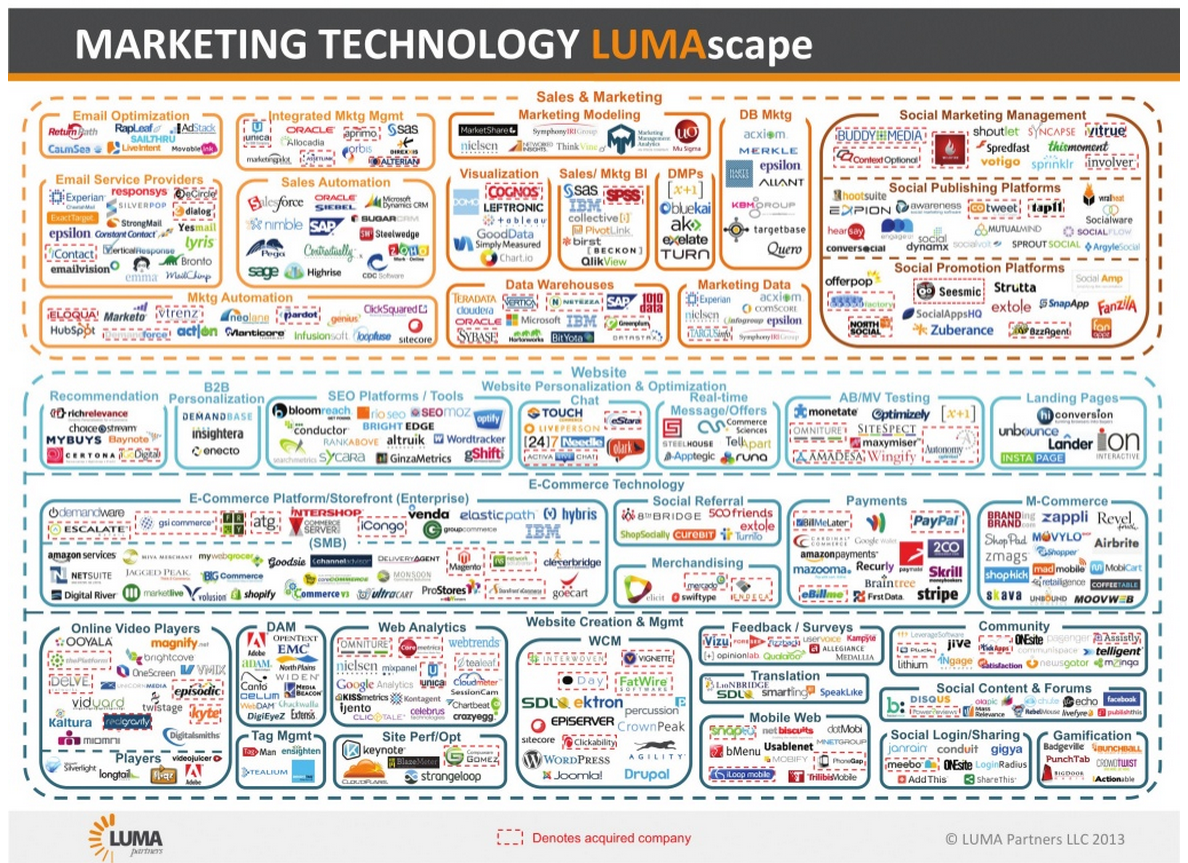
A chart of just some of the major marketing technology platforms -- and this is as of 2013!
A chart of just some of the major marketing technology platforms — and this was in 2013!

It seems that with each passing day, one or two new technology products are announced by MediaPost and other publishers in the marketing field.

The numbers tell the story. The marketing technology industry website chiefmartec.com lists nearly 1,900 marketing technology vendors in more than 40 categories.

That’s nearly double last year’s tally of around 950 vendors.

Software clearinghouse Capterra lists even more: a whopping 3,000+ marketing technology products across 30 categories.

These firms account for well over $20 billion in financing – the dollars that can be tracked, that is – including around 30 companies that are valued at $1 billion or more each.

That’s a lot of companies and vendors. Of course, there are many customers who are looking for tech-driven marketing solutions as well.  The question is whether things have gotten out of balance.

Business writer and marketing tech specialist Malcom Friedberg thinks so. He’s Chief Marketing Officer at CleverTap, and he also publishes columns on a variety of business topics.

In Friedberg’s view, the sheer number of marketing technology vendors and products means that the segment may now be on the brink of an implosion.

Friedman references a recent CMO Council document that reports that more than 80% of marketers are using as many as ten different marketing-related technologies or cloud solutions.

And as new technologies are added, the problem is finding educated staff – and enough hours in the day – to cover all of these products well. In many instances, users may be just scratching the surface of what these products can provide; the “multiple hat” dynamics of many marketing departments mean that very few people qualify as being “advanced” users.

The problems boil down to this: Even if a department has two or three marketing people devoted exclusively to tech-related responsibilities (at tall order in most companies) – this assumes that those people can work equally well on multiple different platforms.

The reality is quite different. It’s more like a big jumble – with consultants brought in to sort things out.  It may get the job done, but it isn’t pretty – and it’s hardly a recipe for “the best of best practices.”

Survey work by the CMO Council supports this hypothesis. The Council has found that fewer than on in ten of the marketers it surveyed reported that they possess a highly evolved digital marketing model that has a proven, clear path of evolution.

Malcolm Friedberg
Malcolm Friedberg

Friedman thinks he knows where things are heading. Not to more choices, but rather to less:

“In my opinion, we’ll start to see massive consolidation and uber-marketing systems. Think super-integrated marketing and advertising clouds … the preoccupation with ‘best-of-breed’ in every category will be replaced by a ‘tree-and-branch’ model, with one core technology and a few ‘good enough’ complementary ones.”

Friedman calls it “an expensive French meal” instead of “a Vegas buffet.” While there will always be new products promising incremental improvements, he predicts that by 2020, the common business model will be super-integrated marketing and advertising clouds as we see already with the likes of Marketo and Hubspot.

What do you think? Is Friedman onto something … or is the orgy of new marketing technology products going to continue unabated?  Please share your thoughts with other viewers here.

“Boomerang employees”: No longer such a rarity in the corporate world.

Time was, once a person left a company – for whatever reason – the likelihood that they’d ever come back to work there was pretty slim.

Perhaps to be re-engaged as a consultant or a contract worker … but as a return employee? Not likely at all.

That mindset appears to be changing.  Data accumulated from a recent survey by HR research and advisory firm Workplace Trends from ~1,800 human resources executives, managers of staff, and employees provide the following clues:

  • Half of the HR professionals responding to the survey claimed that their organization once had formal policies against rehiring former employees (even if the employee had departed in good standing).
  • Three-fourths of the HR respondents reported that they are more accepting of hiring boomerang employees today. More than half of the respondents who are people managers felt the same way.

The actual incidence of returning to work at a former company isn’t all that common.  Of the employees who took part in the survey, fewer than 15% of them fell into this category.

Still, 15% is way up from where it has been traditionally — and the current percentage is higher than I would have guessed.

What’s more, nearly 40% of employee respondents reported that they would consider going back to an employer where they had once worked.

There are distinct differences in employee attitudes based on age demographics: More than 45% of Millennials would consider returning to work for a former employer … but the percentage is just 29% for Baby Boomer respondents.

As for why boomerang employees are becoming more common, a number of factors are at play:

  • Intense competition for certain technically advanced employees who may be in short supply makes poaching more common … and also intensifies the need for companies to respond in kind. In fields were strong talent is hard to come by, often the pool of workers is too small to summarily omit former employees from consideration.
  • Familiarity with a company’s organization, culture and ways of doing business reduces “ramp-up” requirements and the amount of training needed, when compared to bringing on a brand-new employee.
  • The “devil you know” factor: Even if a former employee possesses a few characteristics that are less-than-ideal, at least these are known quantities, as compared to a brand-new employee who may or may not be all that she or he seems to be on paper.

chairGoing forward, I suspect that boomerang employees will become even more prevalent than they are today.

To do well at that, companies might wish to look into maintaining open lines of communication with select former employees. It seems like a good way to keep choice workers “in the loop” and potentially available — and interactive/social media makes it easier to keep those channels open.

As things stands now, the results of this survey suggest that such channels are, at best, ad hoc rather than being part of a formal “alumni” communications strategy.

Addressing this point, Dan Schawbel, head of WorkplaceTrends, had this to say:

“In previous research we’ve done, we’ve found that Millennials are switching jobs every two years because they are searching for the job – and organization – of best fit. But this new study indicates that this younger generation is more likely to boomerang back when they’ve experienced other company cultures and realized what they’ve missed.”

Schawbel’s prediction? “We’ll see the boomerang employee trend continue in the future as more employees adopt a ‘free agent’ mentality – and more organizations create a stronger alumni ecosystem.”

What about you? Are you a boomerang employee? Or do you know colleagues who have done this? What are the pluses and minuses? Please share your thoughts with other readers here.