Inked in stone: One societal trend that’s going off the charts.

ttWhat’s one of the biggest societal trends in America nowadays? Believe it or not, it’s the rapidly growing popularity of tattoos.

Once the province of just a slim slice of the American population, today we’re smack in the middle of dramatic changes in attitudes about tattoos.

Let’s begin with figures published by the Harris Poll recently, based on its survey or more than 4,000 American conducted in late 2015. That survey finds that nearly one in three Americans age 18 or older have at least one tattoo (29%, to be exact).

Not only did that percentage surprise me, but also the increase that represents over a similar Harris Poll conducted just four years ago. In that survey, ~21% reported having a tattoo … which means that the nearly 40% more people have tattoos today than in 2010.

Pretty amazing, I thought.  And the surprises don’t stop there, either. Of those people who are tattooed, more than two-thirds report that they have more than one tattoo.

What isn’t surprising at all is that the tattoo craze is most prevalent among younger Americans:

  • Millennials: ~47% report having at least one tattoo
  • GenX: ~36%
  • Baby Boomers: ~13%
  • Matures: ~10%

There are also some locational differences, with rural and urban Americans somewhat more likely to be tattooed than those people who reside in suburbia:

  • Rural folks: ~35% have at least one tattoo
  • Urban dwellers: ~33%
  • Suburbanites: ~25%

[There’s no discernible difference at all between people of differing partisan/political philosophies, according to Harris.]

With such a big increase in tattooing, the next question is, what’s behind the trend? For clues, we can see how respondents described what their tattoo(s) mean to them personally:

  • Makes me feel more sexy: ~33% of tattooed Americans cited
  • Makes me feel more attractive: ~32%
  • Makes me feel more non-conformist/rebellious: ~27%
  • Makes me feel more spiritual: ~20%

[Far smaller percentages felt that their tattoo(s) made them feel more intelligent, more employable, more respected or more healthy.]

But what about regrets? Are there people who wish they hadn’t taken the plunge?  The Harris survey found that approximately one in four respondents do feel at least some regrets about having a tattoo.  The reasons why are varied — yet all pretty obvious:

  • Personality changes … doesn’t fit my present lifestyle
  • The tattoo includes someone’s name I’m no longer with
  • The tattoo was poorly done … doesn’t look professional
  • The tattoo is no longer meaningful to me
  • I was too young when I got the tattoo

In conclusion, I think it’s safe to conclude that tattoos are a generational thing. Those of us north of age 50 don’t have any tattoos — and likely will never get one.

But for the younger generations, not only have tattoos gone “mainstream,” for many they’re a decidedly aspirational thing.  And that, of course, means ever widening acceptance of tattoos along with encountering more of them than ever before.

Comments … thoughts anyone?

Offline America: Pew’s latest research shows that 15% of American adults don’t use the Internet at all.

Internet usageFor those of us who spend practically every living minute of our day online, it seems almost unbelievable that there are actually some people in the United States who simply never go online.

The Pew Research Center has been researching this question for the past 15 years. And today, the percentage of “offline American adults” (people age 18 or over who don’t use the Internet) remains stuck at around 15% — a figure that has been stubbornly consistent for the past three years or so:

Pew Research Center Americans Not Online 2000-2015 survey results

But up until then, the percentage had been declining, as can be seen in these milestone Pew survey years:

  • 2000: ~48% of American adults not using the Internet
  • 2005: ~32% not using
  • 2010: ~24% not using
  • 2015: ~15% not using

Part of the long-term shift has been new people interfacing with the Internet.  But another factor is simply the “aging out” of older populations as they pass from the scene.

The demographic dynamics Pew finds on Internet usage show relatively little difference in behavior based on ethnicity — except that only about 5% of Asian-Americans never go online.

Rather, it’s differences in age particularly — but also in income levels and education levels — that are more telling.

offline AmericansThe age breakdown is stark, and shows that at some point, we are bound to have near-total adoption of the Internet:

  • Age 18-29: ~3% don’t use the Internet
  • Age 30-49: ~6% don’t use
  • Age 50-64: ~19% don’t use
  • Age 65+: ~39% don’t use

Income levels are also a determining factor when it comes to Internet usage:

  • Less than $30,000 annual household income: ~25% don’t use the Internet
  • 30,000 – 50,000 annual HH income: ~14% don’t use
  • $50,000 – $75,000 annual HH income: ~5% don’t use
  • Over $75,000 annual HH income: ~3% don’t use

And Pew also finds significant differences based on the amount of formal education:

  • Some high-school level education: ~33% don’t use the Internet
  • High school degree: ~23% don’t use
  • Some college: ~9% don’t use
  • College graduate or post-graduate education: ~4% don’t use

Lastly, while no difference in Internet usage has been found between urban and suburban Americans, the adoption rate in rural areas continues to lag behind:

  • Urban dwellers: ~13% don’t use the Internet
  • Suburban residents: ~13% don’t use
  • Rural areas: ~24% don’t use

One reason for the lower adoption rate in rural areas may be limited Internet access or connectivity problems — although these weren’t one of the key reasons cited by respondents as to why they don’t go online. Pew’s research has found these points raised most often:

  • Have no interest in using the Internet / lack of relevance to daily life: ~34%
  • The Internet is too difficult to use: ~32%
  • The expense of Internet service and/or owning a computer: ~19%

The results of Pew’s latest survey, which queried ~5,000 American adults, can be viewed here. Since the research is conducted annually, it will be interesting to see if Internet usage resumes its drive towards full adoption, or if the ~85% adoption rate continues to be a “ceiling” for the foreseeable future.

Higher education choices in America: A distinction without (much of) a difference?

The cost differential is huge. But what about the education itself?

13According to the College Board, the average annual cost of college, including tuition and books, varies widely depending on the type of institution:

  • Private colleges and universities: ~$31,200
  • Public colleges and universities (out-of-state residents): ~$23,000
  • Public colleges and universities (in-state residents): ~$9,100
  • Community colleges: ~$3,300

In fact, the difference between the highest and lowest cost averages comes out to a factor of ten.

Averages are more difficult to calculate for online college institutions, where the annual cost ranges widely from as low as $5,000 all the way up to $25,000 or so, according to The Guide to Online Schools.

With such a disparity in college education costs, one might think that public perceptions of the value of the degrees granted by them would likewise show differences based on the type of institution.

But a recently completed national opinion study tells us otherwise. A telephone research survey conducted in June 2015 by the Gallup organization queried ~1,500 Americans age 18 or over about their attitudes toward college education.

Among the most interesting findings is the perception of community colleges: Two-thirds of the respondents rate the quality of education that community colleges offer as “excellent” or “good.”

For four-year colleges, the percentage figure for excellent/good quality was only slightly higher: ~70%.

Considering the vast difference in the financial outlay required to attend a four-year school, community college education is looking mighty attractive, indeed.

Tempering this finding are the Gallup survey’s respondents who possessed advanced degrees themselves.  They’re more likely to rate four-year institutions higher than community colleges on quality (a nine percentage point difference).

And of course, community colleges do face challenges such as their track record on lower graduation rates, plus the sometimes challenging process and procedures in successfully transitioning students from two-year to four-year schools.

Still, the perception of near-parity in education quality is striking — and it’s not very different from the findings Gallup has observed since beginning to survey the American public on this topic two years ago.

I don’t doubt that some families will be sharpening their pencils and doing new cost/benefit calculations based on the results of this Gallup survey.

But where a perceived difference in quality continues to persist is in online education. Survey respondents were about half as likely to rate the quality of Internet-based college programs as “excellent” or “good.”

While respondents don’t fault online programs for lacking a broad curriculum, or even for the value provided for the cost of enrolling, online education is seen as lacking strength in three key areas:

  • Reliable testing and grading
  • The quality of instruction
  • The value of the degree to prospective employers

But there’s another way to look at it.  Internet-based higher education is slipping through the door and becoming “mainstream” not just because of the online programs such as those offered by Capella University and the University of Phoenix, but because of the burgeoning online coursework being offered by traditionally brick-and-mortar institutions.

With that growing practice, I predict it’s only a matter of time before the perception of online higher learning will match the higher ratings that are already being given to community colleges, public and private institutions.

Let’s see how things look in another five years.

State of the States: CNBC’s take on the best ones for business.

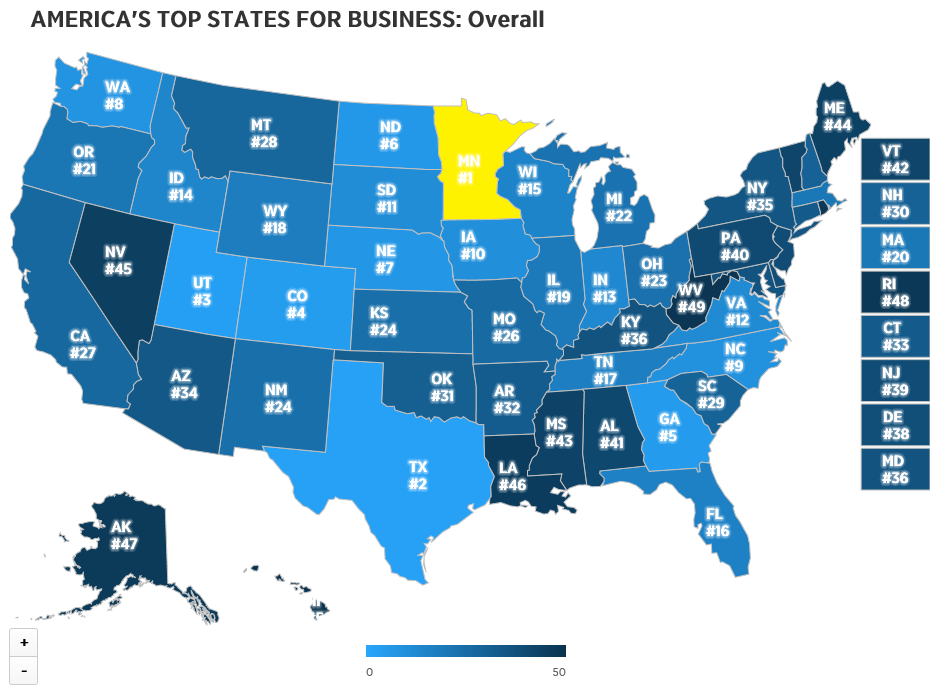
In CNBC’s recently published scorecard, don’t look to the Northeast or California to find the states that are best ones for business.

CNBC State Rankings for Business
L’Etoile du nord: Just as in its state motto “Star of the North,” Minnesota is the stellar performer in CNBC’s 2015 state ranking of business competitiveness. (Click on the map for a larger view.)

State and city rankings are a source of fascination for many people. Of course, there are many ways to fashion them to place nearly any state or city you like at the top of the heap.  Some of the lists use criteria that are so convoluted, it stretches credulity.

Since when is Baltimore the best city in America for single men?  Since it was ranked #1 in this evaluation, evidently.  Many of us who know the city’s innards really well would disagree heartily, of course.

But I think the CNBC 2015 scorecard on state business climates, published earlier this month, is based on a more solid set of criteria.

CNBC created it by scoring all 50 states on approximately 60 separate measures of competitiveness – a list that was developed with input from an array of business and policy experts, official government sources, and CNBC’s own Global CFO Council, and that uses government-generated data.

CNBC then grouped these measures into ten broader categories, weighting the results based on how often each is used as “selling point” in state economic development marketing and promotional efforts. This was done in order to rank the states based on the criteria they themselves use to showcase their attractiveness to businesses considering expansion or relocation.

Here are the ten broad categories in the CNBC evaluation, and which states ranked first and last within them:

  • Access to capital: #1 North Carolina … #50 Wyoming
  • Business friendliness: #1 North Dakota … #50 California
  • Cost of doing business: #1 Indiana … #50 Hawaii
  • Cost of living: #1 Mississippi … #50 Hawaii
  • Economy: #1 Utah … #50 Mississippi
  • Education: #1 Massachusetts … #50 Nevada
  • Infrastructure: #1 Texas … #50 Rhode Island
  • Quality of life: #1 Hawaii … #50 Tennessee
  • Technology/innovation: #1 Washington … #50 West Virginia
  • Workforce: #1 North Dakota … #50 Maine

Do we see any surprises here?  To my mind, the high and low rankings look pretty well-aligned with the anecdotal information we hear all the time.

Perhaps we might consider several other states besides Nevada to be “bottoms” in education. And personally, I am pretty shocked to see Tennessee ranked last in quality of life. Having lived there during my college years at Vanderbilt University, I never considered the state to be substandard when it came to that attribute.

But It’s when CNBC amalgamates all of the rankings to come up with its overall state ranking that a few surprises emerge.

Such as … Minnesota notches first place overall. I’m sure some people are genuinely surprised to see that.

For the record, here is CNBC’s list of the Top 10 states for business in 2015:

  • #1 – Minnesota
  • #2 – Texas
  • #3 – Utah
  • #4 – Colorado
  • #5 – Georgia
  • #6 – North Dakota
  • #7 – Nebraska
  • #8 – Washington
  • #9 – North Carolina
  • #10 – Iowa

We see that four of the ten top states are in the Midwest … three are in the South … three are in the West … but none are in the Northeast.

CNBC study on business competitiveness
The center holds: According to CNBC, most of the most competitive states for business are in the Mid-Continent region.

By contrast, for the most part the Bottom 10 states are clustered in other areas of the country … including four Northeastern states plus Alaska and Hawaii, two states that clearly have unique locational circumstances:

Hawaii lacks business competitiveness
Not so sunny: Hawaii’s bad business climate.
  • #40 – Pennsylvania
  • #41 – Alabama
  • #42 – Vermont
  • #43 – Mississippi
  • #44 – Maine
  • #45 – Nevada
  • #46 – Louisiana
  • #47 – Alaska
  • #48 – Rhode Island
  • #49 – West Virginia
  • #50 – Hawaii

CNBC has issued a raft of charts and maps providing details behind how their ratings were formulated, and the results for each of the major categories. You can view the data here.

Speaking for yourselves, in what ways would you challenge the rankings? What strikes you here as different from your own personal experience in doing business in various states? Please share your perspectives with other readers.

Economic Reality Comes to College Campuses

Finally, colleges get schooled in Economics 101.

Sweet Briar College (1901-2015?)

For a long time, “market forces” didn’t really apply to institutions of higher learning — at least not in the classic sense.

In a social environment where nearly everyone buys into the notion that more education is good, government and educators fostered policies where no one need be prevented from getting a college education because of lack of funding.

Accordingly, in the past several decades, loans and grants became easier to obtain than ever.

Unfortunately, one of the consequences of easy money in education was that tuitions rose at a faster rate than the economy as a whole.  After all, the third-party money spigot seemed never-ending.

For a good while tuition spikes weren’t a particular concern, because it still seemed as though a college-level education was a great way to earn substantially more money in one’s career — even if racking up student loans at the outset.

But in recent years, we no longer see an automatic positive correlation between a higher education degree and the ability to earn increased income.

In the sluggish economy of the 2000s, a college diploma in the right field may well be a good investment.  But with many college majors, oftentimes it isn’t.

The situation is even dicier for the many students who attend community colleges or four-year institutions but who never graduate.  The chasm between their educational loans and their earning power is even more deep.

Corinthian Colleges
Corinthian Colleges (1995-2015)

And for those students unlucky enough to attend for-profit institutions like those run by Corinthian Colleges, Inc., which is in the process of closing the last two dozen of its schools across the country, the situation is even worse.

Saddled with student debt, stuck with degrees or half-completed courses of study of dubious value, and with school credits unlikely to be transferred to other schools in order to finish their education, the situation for those  unlucky students can only be described as dire.

How did we get to this place?

One big reason is that over the years, many colleges got into the habit of simply expecting sufficient numbers of students to enroll in their institutions regardless of the sticker price to attend.  If anything, high tuition “list prices” were a badge of honor.

At the same time, substantial grants (essentially discounts off of the published tuition rates), together with irresistible financial aid packages, continued to attract students to private as well as public institutions of all stripes.

Running in parallel with this were lavish, ongoing projects involving the construction of fancy new dorms, state-of-the-art athletic facilities, and all sorts of other creature-comfort-like amenities to lure students to campus.

And let’s not forget another not-so-welcome outcome of this fantasyland of higher education economics – call it “degree inflation.”  With so many students obtaining undergraduate degrees, their “worth” became devalued.

In this high-stakes derby, a BS degree in business is no longer enough – it has to be an MBA.  A BS degree in engineering isn’t nearly as prestigious as a Master’s degree or a PhD.  There’s really no end to it.

The convergence of these sobering economic and social trend lines makes it pretty clear that the “old” business model is no longer working for colleges and universities.  With the economic realities of today, college administrators are discovering that, sooner or later, market forces work.  And the resulting picture isn’t very pretty.

So now we’re witnessing the lowest percentage increases in tuition sticker prices we’ve seen in years, across private institutions and even some public ones as well.  Bloated administrative staffs  — their numbers dwarfing the number of teachers at some colleges — have finally plateaued or even begun to decline.

Being the parent of two children who graduated from college within the past five years, naturally I’ve been quite interested in these trends – and I’ve viewed them pretty close-up.

What I’ve determined is that for years, administrators at many colleges and universities didn’t see themselves as working within a market system — having to compete where market forces were at work.  The often-unappealing business of being disciplined by market forces didn’t pertain to them — or so they thought.

That’s certainly not the case anymore.

And there’s another huge factor looming on the horizon:  Distance learning.  I’ll be here big-time before we know it … and it promises to upend the college education business model as never before.

What are your thoughts on this topic?  Please share them with other readers here.