Relying on Key Performance Indicators has become the norm in many business operations. And why not? Properly defined and managed, KPIs help businesses focus on the right priorities and chart progress towards their goals.
But even well-designed KPIs have their limitations. By their nature, they’re not greatly insightful (they’re indicators, after all). The problem is that very often, KPIs are used as if they are.
One of the attractions of focusing on KPIs is their simplicity. Managers love boiling things down to concise, action-oriented statements and phrases. We hear it all the time from senior leadership. “Give us the bottom-line finding,” they emphasize.
“Business by bullet-point,” if you will.
But here’s the thing: Because of their distilled simplicity, KPIs can lure many a businessperson into overestimating the insights that they’re able to provide.
KPIs do provide a jumping-off point, but the underlying “why” is often still conjecture or a hypothesis. It takes discipline to look for deeper insights and corroborating evidence to really understand what KPIs are saying to us.
Addressing this issue, Shiv Gupta, data analytics specialist par excellence and head of Quantum Sight, has noted:
“Anyone who has worked on developing KPIs knows that it is a game of balance and compromise based on business objectives. The need for actionable information battles with the desire for simple metrics.”
“We all have seen many “death by KPI” [situations] when organizations look at things the wrong way. When someone is lost while driving, [to] keep looking at the dashboard of the car won’t get the driver out of trouble. In a time like that, one must turn on a navigator. Different solutions call for different analytics, and popular KPIs – no matter how insightful they may have been – often do not lead to solutions.”
What have been your experiences in working with KPIs in your business? How have they helped … or not? Please share your thoughts and perspectives with other readers here.
Not all-smiles at the moment … Chinese leader Xi Jinping.
In China, it’s difficult to discern where private industry ends and the government begins. At some level, we’ve been aware of that conundrum for decades.
Still … opportunities for doing business in the world’s largest country have been a tempting siren call for American companies. And over the past 15+ years, conducting that business has seemed like the “right and proper” thing to do — what with China joining the G-8+5 economic powers along with incessant cheerleading by the U.S. Department of Commerce, abetted by proactive endeavors of other quasi-governmental groups promoting the interests of American commerce across the globe.
But it’s 2019 and circumstances have changed. It began with a change in political administrations in the United States several years ago, following which a great deal more credence has been given to the undercurrent of unease businesspeople have felt about the manner in which supposedly proprietary engineering and manufacturing technologies have suddenly popped up in China as if by magic, pulling the rug out from under American producers.
Nearly three years into the new presidential administration, we’re seeing evidence of this “new skepticism” begin to play out in concrete ways. One of the most eye-catching developments – and a stunning fall from grace – is Huawei Technologies Co., Ltd. (world headquarters: Shenzhen, China), one of the world’s largest makers of cellphones and high-end telecom equipment.
As recounted by NPR’s Weekend Edition reporter Emily Feng a few days ago, Huawei stands accused of some of the most blatant forms of technology-stealing. Recently, the Trump administration banned all American companies from using Huawei equipment in its 5G infrastructure and is planning to implement even more punitive measures that will effectively prevent U.S. companies from doing any business at all with Huawei.
Banning of Huawei equipment in U.S. 5G infrastructure isn’t directly related to the theft of intellectual property belonging to Huawei’s prospective U.S. suppliers. Rather, it’s a response to the perceived threat that the Chinese government will use Huawei equipment installed in U.S. 5G mobile networks to surreptitiously conduct espionage for military, political or economic purposes far into the future.
In other words, as one of the world’s largest telecom players, Huawei is perceived as a direct threat to non-Chinese interests not just on one front, but two: the demand side and the supply side. The demand-side threat is why the Trump administration has banned Huawei equipment in U.S. 5G infrastructure, and it has also publicly warned the U.K. government to implement a similar ban.
As for the supply side, the Weekend Edition report recounts the intellectual property theft experience of U.S.-based AKHAN Semiconductor when it started working with Huawei. AKHAN has developed and perfected an ingenious form of diamond-coated glass – a rugged engineered surface perfectly suited for smartphone screens.
Huawei expressed interest in purchasing the engineered glass for use in its own products. Nothing wrong with that … but Huawei used product samples provided by AKHAN under strict usage-and-return guidelines to reverse-engineer the technology, in direct contravention of those explicit conditions – and in violation of U.S. export control laws as well.
AKHAN discovered the deception because its product samples had been broken into pieces via laser cutting, and only a portion of them were returned to AKHAN upon demand.
When confronted about the matter, Huawei’s company officials in America admitted flat-out that the missing pieces had been sent to China. AKHAN enlisted the help of the FBI, and in the ensuing months was able to build a sufficient case that resulted in a raid on Huawei’s U.S. offices in San Diego.
The supply side and demand side threats are two fronts — but are related. One of the biggest reasons why Huawei kit has been selected, or is being considered, for deployment on 5G mobile networks worldwide is due to its low cost. The Chinese government, so the thinking goes, “seduces” telecom operators into buying the Huawei kit by undercutting all competitors, thereby gaining access to countless espionage opportunities. To maintain its financial footing Huawei must keep its costs as low as it can, and one way is to avoid R&D expenses by stealing intellectual property from would-be suppliers.
AKHAN is just the latest – if arguably the most dramatic – example of Huawei’s pattern of technology “dirty tricks” — others being a suit brought by Motorola against Huawei for stealing trade secrets (settled out of court), and T-Mobile’s suit for copying a phone-testing robot which resulted in Huawei paying millions of dollars in damages.
The particularly alarming – and noxious – part of the Huawei saga is that many of its employees in the United States (nearly all of them Chinese) weren’t so keen on participating in the capers, but found that their concerns and warnings went unheeded back home.
In other words – the directive was to get the technology and the trade secrets, come what may.
This kind of behavior is one borne from something that’s far bigger than a single company … it’s a directive that’s coming from “China, Inc.” Translation: The Chinese government.
The actions of the Trump administration regarding trade policy and protecting intellectual property can seem boorish, awkward and even clumsy at times. But in another sense, it’s a breath of fresh air after decades of the well-groomed, oh-so-proper “experts” who thought they were the smartest people in the room — but were being taken to the cleaners again and again.
What are your thoughts about “yesterday, today and the future” of trade, industrial espionage and technology transfer vis a vis China? Are we in a new era of tougher controls and tougher standards, or is this going to be only a momentary setback in China’s insatiable desire to become the world’s most important economy? Please share your thoughts and perspectives with other readers here.
Debris field from the Ethiopian Airlines plane crash (March 10, 2019).
It’s been exactly two months since the crash of the Ethiopian Airlines 737 Max 8 Boeing plane that killed all 157 passengers and crew on board. But as far as Boeing’s PR response is concerned, it might as well never ever happened.
Of course, sticking one’s corporate head in the sand doesn’t make problems go away — and in the case of Boeing, clearly the markets have been listening.
Since the crash, Boeing stock has lost more than $27 billion in market value — or nearly 15% — from its top value of $446 per share.
The problem is, the Ethiopian incident has laid bare stories of whistle blowers and ongoing maintenance issues regarding Boeing planes. But the company seems content to let these stories just hang out there, suspended in the air.
With no focused corporate response of any real coherence, it’s casting even greater doubt in the minds of the air traveling public about the quality and viability of the 737 planes — and Boeing aircraft in general.
Even if just 20% or 25% of the air traveling public ends up having bigger doubts, that would have (and is having) a big impact on the share price of Boeing stock.
And so the cycle of mistrust and reputational damage continues. What has Boeing actually done in the past few months to reverse the significant market value decline of the company? Whatever the company may or may not be undertaking isn’t having much of an impact on the “narrative” that’s taken shape about Boeing being a company that doesn’t “sweat the small stuff” with proper focus.
For an enterprise of the size and visibility of Boeing, being reactive isn’t a winning PR strategy. Waiting for the next shoe to drop before you develop and launch your response narrative doesn’t cut it, either.
Far from flying below radar, Boeing’s “non-response response” is actually saying something loud and clear. But in its case, “loud and clear” doesn’t seem to be ending up anyplace particularly good for the Boeing brand and the company’s
What are your thoughts about the way Boeing has handled the recent news about its mode 737 aircraft? What do you think could have done better? Please share your thoughts with other readers here.
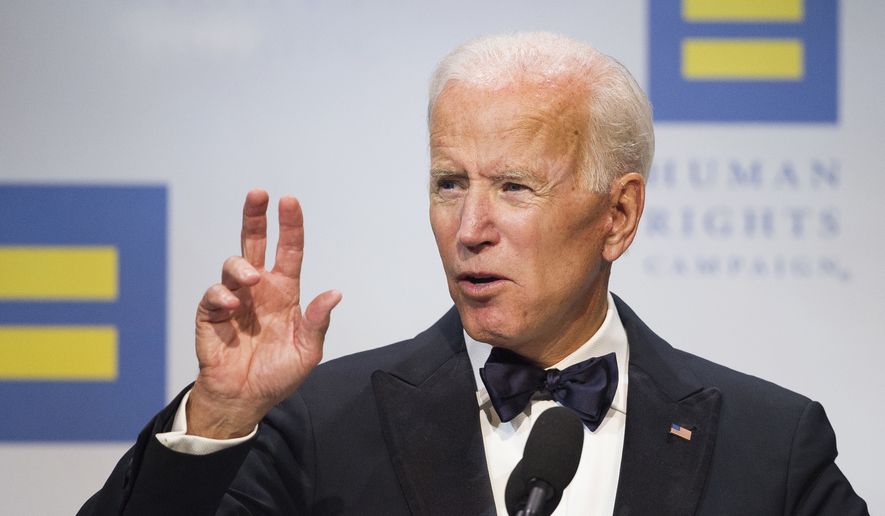
Astonishingly tone-deaf and factually questionable: “China is going to eat our lunch? Come on, man … they can’t even figure out how to deal with the fact that they have this great division between the China Sea and the mountains … in the west. They can’t figure out how they’re going to deal with the corruption that exists within the system. I mean, you know, they’re not bad folks, folks. But guess what? They’re not competition for us.” (Former Vice President Joe Biden, May 1, 2019)
In recent months, we’ve been hearing a wide range of views about China’s economic and political aspirations and their potential implications for the United States.
Some of the opinions being expressed seem to be polar opposites — such as President Donald Trump’s pronouncements that the United States has been “ripped off” by China for decades. Contrast this with former Vice President Joe Biden’s dismissive contention that China represents no competition for the United States at all.
The column is titled Trump Is Waging (and Winning) a Peaceful World War III Against China. My curiosity aroused, I decided to get in touch with my brother, Nelson Nones, who has lived and worked in the Far East for the past 20+ years. Being an American “on the ground” in countries like China, Taiwan, South Korea, Thailand and Malaysia gives Nelson an interesting perspective from which to be a “reality check” on the views we’re hearing locally.
I sent Nelson a link to the Morris op-ed and asked for his reaction. Here is what he communicated back to me:
I think Dick Morris is correct to contend that the Chinese government’s long-term vision is bigger than just accumulating more wealth and power. In fact, I wrote about this topic in the book I co-authored with Janson Yap, when describing China’s “Belt and Road” initiatives as a geographic positioning threat to Singapore.
I wrote:
“As a land-based strategy, the SREB [Silk Road Economic Belt] promises greater long-term rewards for China than the MSR [Maritime Silk Road]; these would echo the impact of the completion of the first transcontinental railroad in 1869, which marked the beginning of the ascendancy of the U.S. to becoming one of the preeminent economic empires of all time.”
The context here is, if you look back through history, the world’s most dominant economic empires were either terrestrial or maritime — but not both — until the U.S. came along. As I further wrote in the book:
“After gaining control over both strategic land and maritime trade routes with the completion of the Panama Canal in 1913, America became the first land-based and maritime economic empire in history; its dominance has spanned over a century, from 1916 to the present. Uncoincidentally, the American economic empire began when the Panama Canal was completed, but the Panama Canal has arguably contributed far less to America’s GDP than the country’s investments in transcontinental rail and road transportation infrastructure.”
In short, I am absolutely sure China’s government aspires to overtake the U.S. as the world’s dominant terrestrial and maritime economic empire, and to hold that position for at least a century if not longer. But this would not be the first time in history that China has held such a position.
For the historical context, refer to: http://fortune.com/2014/10/05/most-powerful-economic-empires-of-all-time/. There you will see that the U.S. produced half the world’s economic output in circa 1950. China’s Song Dynasty was the world’s preeminent economic empire in circa 1200 AD, producing 25% to 30% of global output. Only the U.S. and the Roman Empire have ever matched or exceeded that marker.
I can tell you from my considerable experience on the ground in China that the strategic vision of its leaders is grounded in much more than just backward-looking grievance and necessity. Although the 19th Century Opium Wars (which were fought during the Qing Dynasty against the British Empire, and occurred during the period of the British Empire’s economic ascendancy) are often trotted out in China’s government-controlled English language dailies, the Chinese people I know have little or no knowledge of the Opium Wars or the colonial victimization China allegedly suffered a century and a half ago.
But they are acutely aware, and genuinely proud, of China’s emergence as a leading economic powerhouse; and this is how the Chinese government maintains its legitimacy.
China’s ambitions, in other words, have much more to do with reinstating its former glory (the Song Dynasty economic empire) than with righting wrongs (dominance by colonial powers), and are fundamental props for maintaining the Chinese Communist Party’s grip on power.
This view renders many of Dick Morris’ comments unnecessarily hyperbolic; for example “[China’s] goal is to reduce the rest of the world to colonial or dominion status, controlled politically, socially, intellectually, and economically by China. In turn, China is run by a handful of men in Beijing who need not pay the slightest attention to the views of those they govern or the nations they dominate.”
No, China’s goal is to become the world’s dominant economic empire but, just as the Americans before them, they don’t have to exert the same degree of control over the rest of the world as they do within their own territory to achieve this goal.
And no, they require constant support from the Chinese population to achieve this goal, even though they run an authoritarian state. Why else would they devote so many resources to the “Great Chinese Firewall” if there is no need to “pay the slightest attention to the views of those they govern”?
Yes, Trump’s trade war with China is important but his motive is to reverse the flow of jobs and capital out of the U.S. to China, which is not the same thing as launching an “economic World War III.” At a more practical and mundane level, it’s to fulfil a pile of campaign promises which Trump made when he was running for President, and to secure the loyalty of his base.
_______________________________
So there you have it: the perspectives of someone “on the scene” in the Far East — holding a view that is more nuanced than the hyperbole of the alarmists, but also clear-eyed and miles apart from the head-in-the-sand naiveté of other politicians like Joe Biden.
Let’s also hope for a more meaningful and reality-based discourse on the topic of China in the coming months and years.
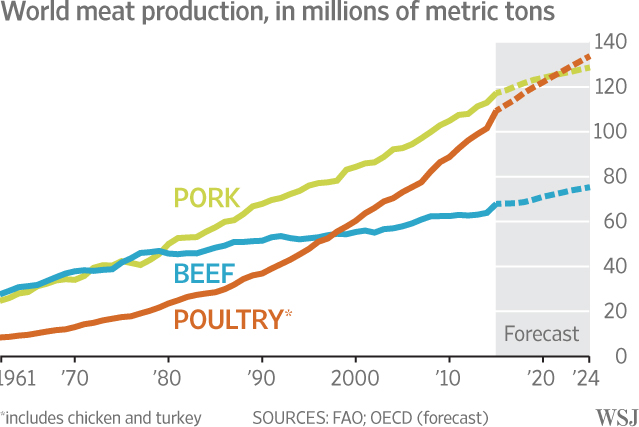
This 2015 projection of protein production published by The Wall Street Journal has been upended by the spread of African swine flu; poultry will overtake pork this year instead.
In the United States it seems hardly news that poultry is the most-consumed protein. In recent years poultry consumption in America has grown while beef consumption has stagnated, weighed down by high prices at the consumer level.
At the same time, the National Pork Board committed an unforced error earlier in this decade when it abandoned its longstanding (and doubtless highly effective) tagline “The Other White Meat” in favor of the mealy-mouthed platitude “Pork: Be inspired” – a slogan that convinces no one of anything.
Persistent reports from the medical community that red meat is less healthy than consuming poultry and fish products haven’t helped, either.
But poultry’s prominence in the American market hasn’t necessarily extended to many parts of the rest of the world. But that’s now changing.
In fact, according to reporting from a recently-concluded International Poultry Council meeting in the Netherlands, poultry is poised to become the most consumed meat protein in 2019.
The precipitating factor is African swine fever, which is now affecting pig herds in 15 countries on three continents. Pork production losses this year are expected to represent ~14% of the world’s pork supply – and that’s just the minimum forecast; the losses could go higher.
Interestingly, African swine fever’s most significant initial outbreaks were in Russia and Eastern Europe, but now East Asia is being affected most significantly. The first cases were found in China beginning in August 2018 but now have spread rapidly throughout the country. For a country that is responsible for nearly half of the world’s supply of pigs, that’s a very big deal.
The swine fever is spreading to the nearby country of Viet Nam as well – which is the world’s fifth largest producer of pork.
The problem for pig growers is that African swine fever is the quintessential death sentence: The disease has a 100% mortality rate, and no vaccine has been developed to guard against its spread.
According to global food and agriculture financing firm Rabobank, China is expected to experience a ~30% drop in pork supplies this year, which in turn will mean a decline in total world protein supplies. The twin results of these development: an increase in prices for all proteins … and poultry will overtake pork this year as the world’s most consumed protein.
Until such time when an effective vaccine against African swine fever is developed, we can expect that production of other proteins like poultry, eggs, beef and seafood will rise. So, it seems as though poultry’s presence as the world’s most-consumed protein will likely endure. Poultry’s position as the protein leader may have stemmed from a different impetus in the United States than in the rest of the world, but everyone has ended up in the same place.
It happens all the time because it’s part of human nature.
In the business world as in any other realm, it can be frustrating when emails that need a reply languish in a state of suspended animation.
And it happens a lot. A workplace study conducted recently by Dr. Bahareh Sarrafzadeh of the Cheriton School of Computer Science at the University of Waterloo in Canada, in concert with several Microsoft co-researchers, has found that putting off responding to incoming emails that need a reply happens in more than a third of the cases.
Titled Characterizing and Predicting Email Deferral Behavior, the research was compiled from interviews with Microsoft employees involved in product development, product management, software development and administrative management. All participants in the research used the Microsoft Outlook platform on a daily basis.
Dubbing it “email triage,” the study defines the phenomenon as “the process of going through unhandled email and deciding what to do with it.”
Email deferral (as opposed to moving an email message to the trash folder), occurs because “people have insufficient time to take an immediate action, or they need to gather information before they can act on a message,” the study states.
Among the factors typically weighed during triage include these questions that people ask themselves:
Do I know the answer?
Does it require any task to be done?
What is the level of complexity involved?
Can I handle it independently?
So, the reasons for putting off a reply are perfectly reasonable ones. The problem comes after the fact, because delaying an immediate reply can sometimes turn into complete inaction.
The reasons for this are understandable as well — even if they are inconsiderate to the person who sent the original e-communique:
If other people are copied on the incoming email, the recipient may assume that someone else is handling the issues raised.
Emails that contain attachments – particularly larger documents – are often put off for scrutiny at a later time, thereby delaying a response.
Emails that don’t specify a deadline for receiving a response can easily get pushed to the bottom of the pile.
Thus, a delayed response often means procrastination — or simply “out of sight/out of mind” forgetfulness as other business tasks intervene.
The published research paper can be viewed in its entirety here. Bear in mind that the University of Waterloo research studied email triage behaviors in a business- and project-management environment. It’s even more dicey when we think of sales- and marketing-oriented communications. If more than one-third of business management emails aren’t getting timely attention, we can be pretty certain that the engagement with other e-communications is lower still.
But there’s a cost to all of this delayed action (or inaction). In the “business of business,” putting off providing a response contributes to a loss of project or organizational momentum. Sometimes all it takes is inaction on the part of one or two pivotal players to make an important project initiative grind to a complete halt.
That doesn’t work well for anyone.
Sitting on my desk now, I have no fewer than five projects that have limped along for the better part of two years, simply because at too many points along the way, email responses that should have taken days (or mere hours) to be received have taken weeks or even months instead. Recurring queries to see if the projects are still active or relevant are answered in the affirmative … but then the waiting game continues.
What about your experiences? Does email triage hurt your own personal productivity or that of your office? What have you done to get around the hurdles?
Soldier, firefighter and police officer positions are obvious, but jobs in media are right up there, too.
It’s human nature to complain about workplace stress. But which jobs are the ones that actually carry the most stress?
If you ask most people, they’d probably cite jobs in the military, police and firefighting as particularly stressful ones because of the inherent dangers of working on the job. Airline pilots would be up there as well.
And yes, those jobs do rank the highest among the many jobs surveyed about by employment portal CareerCast in its newest research on the topic. But of the other jobs that make the “Top 10 most stressful” list, several of them might surprise you:
Most Stressful: CareerCast Stress Scores by Profession (2019)
#1. Enlisted military personnel (E3, 4 years experience): 73
#2. Firefighter: 72
#3. Airline pilot: 61
#4. Police officer: 52
#5. Broadcaster: 51
#6. Event coordinator: 51
#7. News reporter: 50
#8. PR executive: 49
#9. Senior corporate executive: 49
#10. Taxi driver: 48
According to the CareerCast research findings, based on an evaluation of 11 potential stress factors including meeting deadlines, job hazards, physical demands and public interaction requirements, more than three-fourths of respondents in the 2019 survey rated their job stress at 7 or higher on a 10-point scale.
The most common stress contributors cited were “meeting deadlines’ (~38% of respondents) and “interacting with the public” (~14%).
Upon reflection, it’s perhaps understandable why workers in media positions feel like they are under particular stress – what with “fake news” claims and a constant barrage of criticism from both the left and the right which can go beyond being simply irritants into some much more stress-inducing.
What if someone wanted to make a career change and switch to a job that’s at the opposite end of the stress scale? CareerCast has identified those positions, too. Here are the “least stressful” jobs as found in its 2019 research results:
Least Stressful: CareerCast 2019 Stress Score by Profession
#1. Diagnostic medical sonographer: 5
#2. Compliance officer: 6
#3: Hair stylist: 7
#4. Audiologist: 7
#5. University professor: 8
#6. Medical records technician: 9
#7. Jeweler: 9
#8: Operations research analyst: 9
#9. Pharmacy technician: 9
#10. Massage therapist: 10
Interestingly, one might assume that the most stressful jobs in America would carry a commensurate salary premium, but that doesn’t turn out to be the case. The average median salary for the Top 10 “most stressful” jobs in America is hardly distinguishable from those of the Top 10 “least stressful” jobs – differing by only around 4%. It seems like those latter workers are onto something!
More information about the CareerCast findings can be viewed here.
During the Great Recession of 2008-10, it was no surprise to see an increase in private label product sales – not just in food products but also in apparel, cosmetics and other consumer categories.
That was then …
It was much like a similar recessionary time in the United States history — back in the 1970s — when some supermarkets began selling “generic” packaged and canned goods. Those offerings celebrated their generic status by emphasizing their lack of branding – ostensibly to demonstrate that by cutting back on marketing and advertising costs, product pricing to the consumer could be kept lower.
The generic movement didn’t last. When the economic go-go times returned in the mid-1980s, consumers were more than happy to forego the cheaper offerings and go back to their favorite brands.
But the situation is different today. The Great Recession may now be a decade in the rearview mirror, but the private label brands they spawned are going strong. In fact, they’re thriving as never before – and in some ways are eating the legacy brands’ lunch.
… This is now.
Several factors are fundamentally different from before. For one, products that compete on price are no longer being marketed as “generics” but rather as brands in their own right. Brand names like Kirkland, Archer Farms and Essential Everyday look and feel like Kraft, Kellogg’s and other longstanding brands – and for the most part their quality is indistinguishable as well.
Equally important is that fact that there’s no longer any particular stigma associated with shopping “cheap” private label brands. It turns out that consumers in every income category appreciate a bargain; no one wants to feel like they’re being ripped off when there are good quality “best-value” alternatives available.
Consider these eyebrow-raising statistics: Costco’s Kirkland house brand notched sales of $39 billion in 2018, which is substantially higher than Kraft-Heinz’s total brand sales of $26 billion.
Indeed, the consumer foods industry is witnessing this happening all over the place. Amazon may not be developing its own private brands like Costco or Target have done, but it is working diligently with food and beverage manufacturers to develop private label offerings to sell exclusively on Amazon’s own website.
Looking at the macro environment, the United States is running at historically low unemployment rates today, but that hasn’t stunted the phenomenal growth of discount grocery chains like Aldi and Lidl. Aldi has come from practically nowhere several years ago to threaten becoming America’s 3rd place grocery retailer, behind only Walmart and Kroger. Aldi has done so by pursuing an über-aggressive private label strategy that’s targeting younger, middle-income shoppers in particular.
Note that Aldi is training their sights on more than just budget-conscious consumers, which have traditionally been the narrower audience for private label brands. It turns out that the “stigma” some might have attributed to the “cheap” image of private label foods isn’t there any longer.
For younger consumers especially, such “status” concerns are of no pertinence at all. Whereas the typical grocery cart today contains ~25% private label products, among millennials the proportion is more like one-third.
And while the growth of private label products is most pronounced in the food, paper goods and household supplies sectors — and has had the most disruptive consequences there — other sectors like apparel and cosmetics are seeing similar developments.
[Let’s not forget private label pharmaceuticals, too, where price differences are often dramatically lower than just the 15-20% differential we see in the food sector.]
The bottom line is this: Recession or no, cheap has become chic. It’s a trend that’s here to stay. The legacy brands won’t be able to wait this one out and expect better days to come along again.
The trucking services industry is a fascinating field right now. On the one hand, demand for trucking services has never been higher – thanks to fundamental shifts in the way consumers shop for and purchase merchandise.
On the other hand, we may be on the cusp of fundamental changes in the way trucking services are handled as a result.
Thanks to data compiled by the Thomas Index Report, we can see that sourcing activity for trucking services is growing at a substantially faster rate than its historical average – to the tune of ~10% higher demand above the norm.
There’s no question that a key reason for this demand growth is because of changes in how consumers shop – with much less reliance on brick-and-mortar retail and more emphasis on online purchasing.
According to freight exchange services provider DAT Solutions (aka Dial-a-Truck), for every 12 loads needed to be moved, just one truck was available during 2018.
That ratio is unsustainable over time. And it doesn’t help that there’s been a persistent shortage of long-haul truck drivers. That’s actually a 25-year trend, but it’s been becoming more acute with every passing year.
And fundamental change is happening – even if you may not have seen it “up close and personal” yet. A group of manufacturers are working on developing self-driving (autonomous) semi-trailer trucks. Among the companies committed to this initiative are GM, Volvo, Daimler and Tesla.
Driverless trucks are already on the road, including ones developed by Waymo that began delivering freight for Google’s data centers last year. Amazon is hauling cargo via autonomous trucks produced by Embark, another self-driving truck developer.
The rapid pace of development means that it’s quite likely self-driving trucks will become mainstreamed during the 2020s. If that happens, we could then be looking at another set of issues – how to channel sidelined truckers into jobs in other fields.
Perhaps some of those people can find employment in several ancillary industry segments that are benefiting equally well because of shifts in how consumers shop and buy. Naturally, demand is robust and growing in the freight-related categories of crates, pallets and containers.
… On the other hand, it’s probably best if the displaced workers don’t try to get new jobs working at a shopping center …
There’s no question that the U.S. economy has been on a roll the past two years. And yet, we’re not seeing similar momentum in the restaurant industry.
What gives?
As it turns out, the challenges that restaurants face are due to forces and factors that are a lot more fundamental than the shape of the economy.
It’s about demographics. More specifically, two things are happening: Baby boomers are hitting retirement age … and millennials are having children. Both of these developments impact restaurants in consequential ways.
Baby boomers – the generation born between 1946 and 1964 – total nearly 75 million people. They’ve been the engine driving the consumer economy in this country for decades. But this big group is eating out less as they age.
The difference in behavior is significant. Broadly speaking, Americans spend ~44% of their food dollar away from home. But for people under the age of 25 the percentage is ~50% spent away from home, whereas for older Americans it’s just 38%.
Moreover, seniors spend less money on food than younger people. According to 2017 data compiled by the federal government, people between the age of 35 and 44 spend more than $4,200 each year in restaurants, on average. For people age 65 and older, the average is just $2,500 (~40% less).
Why the difference? The generally smaller appetites of people who are older may explain some of it, but I suspect it’s also due to lower disposable income.
For a myriad of reasons, significant numbers of seniors haven’t planned well financially for their retirement. Far too many have saved exactly $0, and another ~25% enter retirement with less than $50,000 in personal savings. Social security payments alone were never going to support a robust regime of eating out, and for these people in particular, what dollars they have in reserve amount to precious little.
Bottom line, restaurateurs who think they can rely on seniors to generate sufficient revenues and profits for their operations are kidding themselves.
As for the millennial generation – the 75 million+ people born between 1981 and 1996 – this group just barely outpaces Boomers as the biggest one of all. But having come of age during the Great Recession, it’s also a relatively poorer group.
In fact, the poverty rate among millennials is higher than for any other generation. They’re majorly in debt — to the tune of ~$42,000 per person on average (mostly not from student loans, either). In many places they’ve had to face crushingly high real estate prices – whether buying or renting their residence.
Millennials are now at the prime age to have children, too, which means that more of their disposable income is being spent on things other than going out to eat.
If there is a silver lining, it’s that the oldest members of the millennial generation are now in their upper 30s – approaching the age when they’ll again start spending more on dining out. But for most restaurants, that won’t supplant the lost revenues resulting from the baby boom population hitting retirement age.

 Relying on Key Performance Indicators has become the norm in many business operations. And why not? Properly defined and managed, KPIs help businesses focus on the right priorities and chart progress towards their goals.











 Nones Notes