Yet another knock on business travel.

“Don’t let the bed bugs bite” becomes harder to do …

Recently, an article in Meetings & Conventions magazine caught my eye – and not in a good way.  The big headline blared that Baltimore has kept its title as the “Bed Bug Capital of the United States.”

Seeing as how Baltimore is the big city closest to where I live, this didn’t come as particularly welcome news. No one wants to be singled out for such a dubious “honor.”

Adding insult to injury, nearby Washington, DC came in second on the list, which was compiled based on metropolitan area statistics of the national pest control service provider Orkin, and where that company has performed the most bed bug treatments over the past year.

For the record, making up the Top Ten bed bug infestation listing are the following metro areas:

  1. Baltimore
  2. Washington, DC
  3. Chicago
  4. Los Angeles
  5. Columbus, OH
  6. New York
  7. Cincinnati
  8. Detroit
  9. Atlanta
  10. Philadelphia

For Baltimore, it was the third year in a row landing on top of the metro area list.  Meanwhile, several others made it onto the list that weren’t there previously (Atlanta and Philadelphia).

On the other hand, Dallas and San Francisco have now dropped out of the Top Ten.

Entomologist Chelle Hartzer, an Orkin spokesperson, was quick to point out that being on the Top Ten list shouldn’t be viewed as a reflection of general lack of sanitation or cleanliness, stating:

“Bed bugs are the #1 urban pest in many cities today. They are master hitchhikers, so no one is immune.  Sanitation has nothing to do with prevention; from public transit to 5-star resorts, bed bugs have been and can be found everywhere humans are.”

When you think of it in that context, it’s actually little wonder that Baltimore and DC have so many incidences of bed bug infestations requiring treatment, considering the amount of travel to and from the National Capital region from all over the world.

[I’m completely clueless as to how and why Columbus, OH should come to outrank New York City, however.]

The bigger question is … what to do about it?

For its part, Orkin has come up with some suggested personal “dos” and “don’ts” for travelers regarding managing their exposure to beg bugs.

Among the precautions Orkin recommends that people take are these when checking into your hotel or motel room:

  • Lift and look around typical hiding spots including the mattress, box spring, behind baseboards, pictures, and torn(!) wallpaper.
  • Check carefully for tiny, ink-colored stains on mattress seams, in soft furniture and behind headboards.
  • Avoid placing your luggage on beds, and also avoid proximity to walls and carpeted surfaces(!). Whenever possible, keep luggage elevated, such as on a hard-surface counter.
  • The safest location is placing your luggage in the bathroom(!).

Reading the ways Orkin recommends limiting exposure to bed bugs while on a trip seems designed to take all the pleasure out of traveling. Maybe it’s time to consider Plan B:  staying home!

Speaking personally, I have yet to be subjected to a bed bug infestation — either on the road or “hitchhiked home.” But I know several people who have – and their stories weren’t pretty.  Do you have any personal experiences of your own to share?

Chief Marketing Officer: The most thankless job in the corporate world?

Few people I know would claim that being the Chief Marketing Officer of a company is a job without risks. Indeed, numerous articles in the business press point to an average length of tenure in a CMO position that is often measured in months rather than in years – indeed, the shortest length of time among all C-level jobs.

And now, a recently completed survey of CMOs  underscores just how wide-ranging the reasons are for those employment characteristics. Branding consulting firm Brand Keys tested a number of issues to see which are the ones that keep CMOs “awake at night.”

Three-quarters or more of the respondents to the Brand Keys survey reported that every factor presented was significant enough to cause them to lose sleep.  Leading the list with near-universal high-alert concern is ROI factors. Other factors of concern to nearly every respondent in the survey are big tech and data security issues.

Listed below is how each of the factors tested by Brand Keys turned out with CMOs in terms of “losing sleep” over them.

90%+ lose sleep worrying about:

  • ROI/ROMI factors
  • Big data, big tech and big security issues
  • Establishing trust with customers
  • Innovation, AI, technology and marketing automation developments
  • Consumer expectations regarding privacy and transparency

80%-90% lose sleep worrying about:

  • Managing social networking
  • Creating relevant advertising content
  • Successfully deploying predictive consumer behavior analytics/technologies
  • Dealing with consumer advocacy and social activism
  • Developing long-term strategies that align with corporate growth goals
  • Having the ability to engage with audiences – not just find them

At the “bottom” of the pile … 75%-80% lose sleep worrying about:

  • “Democratization” of the digital world and protecting brand equity within it
  • “Political tribalism” and its effect on brand reputation
  • Being relevant when tweeted about
  • Keeping consumers engaged with the brand
  • Creating better cross-platform synergies for marketing campaigns
  • Creating an “unlearning curve” to move away from legacy marketing metrics
  • Creating marketing synergies among different generational/age cohorts
  • Being replaced by the chief revenue officer

This last worry factor – losing their job – seems almost preordained given the tenuous circumstances more than a few CMOs deal with in their positions.

… and likely made more so because CMO’s are quick to be blamed when things don’t go well, even if they aren’t in the strongest position to effect the changes that may be needed. “Responsibility without authority” is the stark reality for too many of them.

What are your thoughts about the dynamics faced by CMOs in their companies?  Whether you speak from personal experience or not, I’m sure other readers would be interested in hearing your views.


Facebook’s bad publicity in 2018 lands it at the top of the “least-trusted technology company” list.

The trust is gone …

One has to assume it’s a citation Facebook CEO Mark Zuckerberg has tried mightily to avoid receiving. But with a massive data breach last year and poor marketing decision-making accompanied by a wave of bad publicity, it shouldn’t come as a major shock that Facebook is now considered the least trusted major technology brand by consumers.

The real surprise is by how much it outscores everyone else. Really, Facebook’s in a class by itself.

Recently, online survey research firm Toluna conducted a poll of ~1,000 adults age 18 or older in which it asked respondents to identify their “least trusted” technology company.

The results of the survey show the degree to which Facebook has become the “face” of everything that’s wrong with trust in the world of technology.

Here’s what Toluna’s found when it asked consumers to name the technology company they trusted least with their personal information:

  • Facebook: ~40% of respondents trust least
  • Amazon: ~8%
  • Twitter: ~8%
  • Uber: ~7%
  • Google (Gmail): ~6%
  • Lyft: ~6%
  • Apple: ~4%
  • Microsoft: ~2%
  • Netflix: ~1%
  • Tesla: ~1%

The yawning gap between Facebook’s unflattering perch at the top of the listing and the next most-cited companies — Amazon and Twitter — says everything anyone needs to know about the changing fortunes of company image and how fast public opinion can turn against it.

About the only thing worse is not showing up on the Top 10 list at all – which is the case for Oath (the parent of Yahoo and AOL).  That entity has become so inconsequential, it doesn’t even enter into the conversation anymore.  That’s a “diss” on a completely different level, of course. As Oscar Wilde once said, “The only thing worse than being talked about is … not being talked about.”

What about you? Do you think that Facebook should be tops on this list?  Let us know your opinion below.

No End in Sight to the Challenge of Email Deliverability

When it comes to e-mail communications in the B-to-B world, yet another study is underscoring just how challenging it is to reach corporate inboxes.

A new report by cyber-security firm FireEye, Inc. reveals that fewer than one-third of e-mails sent are actually making it into corporate inboxes. The FireEye analysis was based on tracking more than a half-billion e-mails sent between January and June of 2018.

The majority of those e-mails were deemed to be spam or malicious in their intent. Nearly 60% were blocked by threat intelligence and around 10% more were halted by attack prevention tactics such as URL inspection and attachment detonation.

E-mails were deemed suspicious because they triggered one or more of the following “red-light” cautions:

  • Malware-less impersonations
  • Malware viruses
  • Phishing attacks
  • Ransomware
  • Spyware
  • Trojan horses
  • Worms

Interestingly however, it turns out that only a small fraction of the e-mails actually had malicious intent, meaning that the super-strict filters being employed by companies are capturing a huge number of perfectly legitimate e-mail messages in their dragnet and rejecting them out of hand.

On the other hand, the FireEye analysis also determined that impersonation attacks have undergone a shift from domain name spoofing to “friendly” domain name scams – ones in which an e-mail address is manipulated to impersonate a trusted source.

As the study cautions:

“This shift in tactics may be driven by how easily cyber criminals can ‘spoof’ the display name and username potion of an e-mail header. Instead of having to go through the process of buying and registering a domain similar to – or one that sounds like – the recipient’s domain, they can simply change the display/user name.”

The FireEye analysis is a reminder that because of its sheer pervasiveness, e-mail communications are also the most popular conduit for potentially significant cyberattacks. No wonder companies have their guard up.

The problem is, clearly a whole lot of wheat is being thrown out with the chaff.  And that makes e-communications hardly the slam-dunk communications tactic that many people assume it to be.

For PCs, a new lease on life.

There are some interesting results being reported so far this year in the world of “screens.” While smartphones and tablets have seen lackluster growth — even a plateauing or a decline of sales — PCs have charted their strongest growth in years.

As veteran technology reporter Dan Gallagher notes in a story published recently in The Wall Street Journal, “PCs have turned out to be a surprising bright spot in tech’s universe of late.”

In fact, Microsoft and Intel Corporation have been the brightest stars among the large-cap tech firms so far this year. Intel’s PC chip division’s sales are up ~16% year-over-year and now exceed $10 billion.

The division of Microsoft that includes licensing from its Windows® operating system plus sales of computer devices reports revenues up ~15% as well, nearing $11 billion.

The robust performance of PCs is a turnaround from the past five years or so. PC sales actually declined after 2011, which was the year when PC unit sales had achieved their highest-ever figure (~367 million).  Even now, PC unit sales are down by roughly 30% from that peak figure.

But after experiencing notable growth at the expense of PCs, tablet devices such as Apple’s iPad and various Android products have proven to be unreservedly solid replacements for PCs only at the bottom end of the scale — for people who use them mainly for tasks like media consumption and managing e-mail.

For other users — including most of the corporate world that runs on Windows® — tablets and smartphones can’t replace a PC for numerous tasks.

But what’s also contributing to the return of robust PC sales are so-called “ultra-mobile” devices — thin, lightweight laptops that provide the convenience of tablets with all of the functionality of a PC.  Those top-of-the-line models are growing at double-digit rates and are expected to continue to outstrip rates of growth in other screen segments including smartphones, tablets, and conventional-design PCs.

On top of this, the continuing adoption of Windows 10 by companies who will soon be facing the end of extended support by Microsoft for the Windows 7 platform (happening in early 2020) promises to contribute to heightened PC sales in 2019 and 2020 as well.

All of this good news is being reflected in the share prices of Intel and Microsoft stock; those shares have gone up following their most recent earnings reports, whereas all of the other biggies in the information tech sector — including Alphabet, Amazon, Apple, Facebook, IBM, Netflix and Texas Instruments — are down.

It’s interesting how these things ebb and flow …

Programmatic ad buying in the B-to-B sector: The adoption rate grinds to a halt.

Each year, Dun & Bradstreet publishes its Data-Driven Marketing & Advertising Outlook report.  The report’s findings are based on a survey of marketers in the business-to-business sector.  Among the questions asked of marketers is about the advertising tactics they utilize in support of their sales and business objectives.

A look at D&B’s annual outlook reports over the past several years, an interesting trend has emerged: The adoption rate of B-to-B companies being involved in programmatic ad buying has plateaued at somewhat below 65% of firms.

In fact, you have to go back to 2015 in D&B’s reports to find the proportion of companies involved in programmatic advertising running significantly below where it is now.

That being said, those firms that are involved in programmatic ad buying are planning on allocating additional funds to the effort. The most recent survey finds that ~60% of the respondents involved in programmatic advertising plan to increase their spending in 2019.  That includes ~20% who plan to allocate a significant dollar increase of 25% or greater.

Another interesting finding from the 2018 survey is that there appears to be slightly less interest in display and video programmatic ad placements – although display remains the most commonly run ad type.

Where heightened interest lies includes one category that should come as no surprise – mobile advertising – as well as several that might be more unexpected. Social media advertising seems like it wouldn’t be a very significant part of most B-to-B ad buyers’ bag of tricks, but two-thirds of respondents reported that programmatic advertising in that sector will be increasing.

Another interesting development is that ~17% of the respondents reported that they’re stepping up their programmatic buying for TV advertising – which may be an interesting portent of the future.

Lastly, the survey revealed little change in the types of challenges respondents face about programmatic ad buying – namely, how to target the right audiences more effectively, how to measure results, and the need for better technical and operational knowledge for those charged with overseeing programmatic ad efforts inside their companies.

More information and findings from the 2018 D&B report can be viewed here.

Rough commutes are taking a toll on employees.

I wonder how many people chafe at the long commutes they face to-and-from work each day?

In my case, the work commute is a little lengthy, but at least I’m in the car, moving.  Other people I know deal with traffic gridlock, which is as frustrating as it can be soul-crushing.

Several others brave the elements with public transportation — transferring across several bus routes in hour-long commutes that could otherwise be completed in one-third the time.

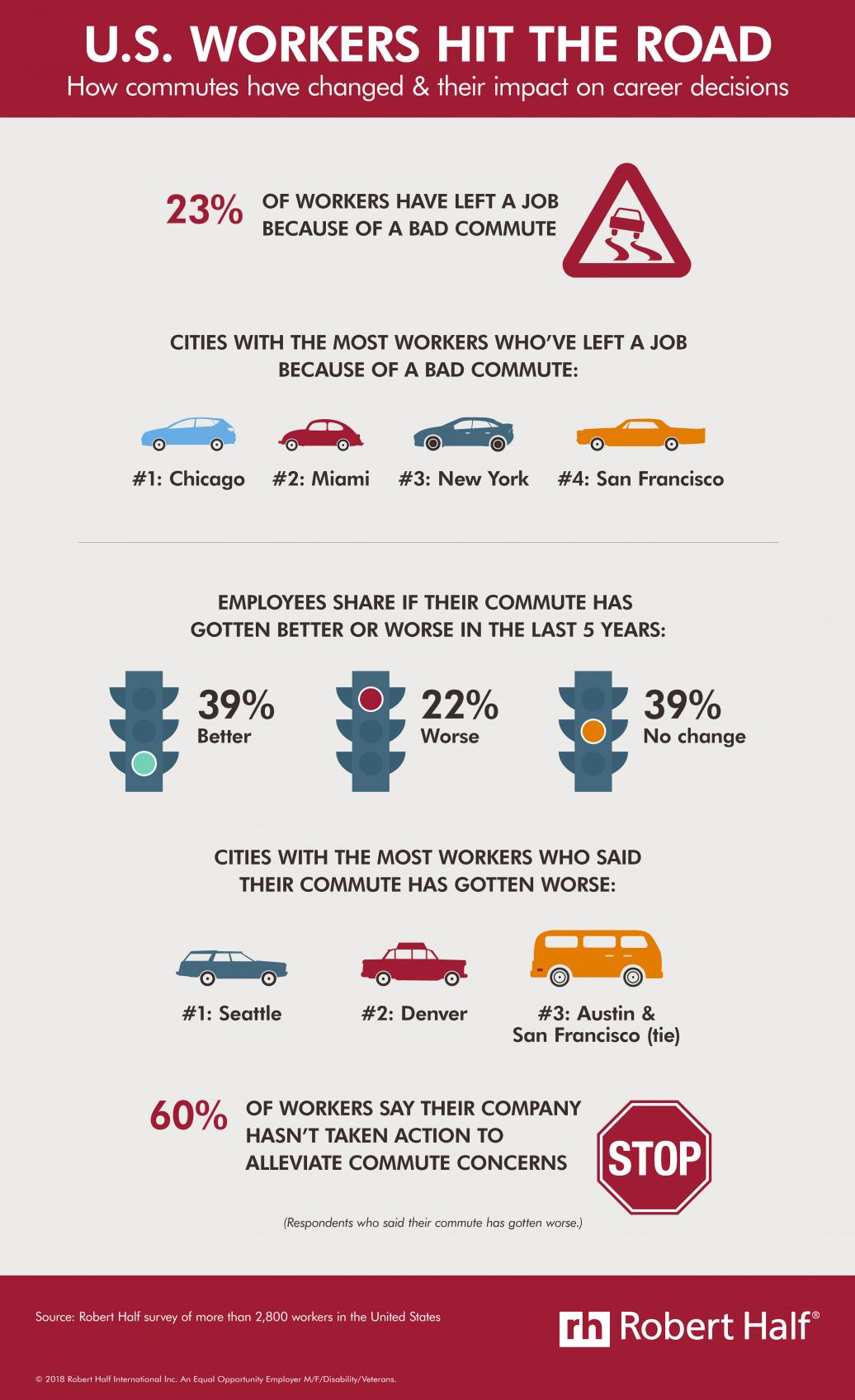
As it turns out, there’s a good deal of restiveness when it comes to work commutes. Employment and staffing firm Robert Half Associates found this out when it surveyed ~2,800 working adults earlier this year across 28 U.S. urban markets.

Robert Half discovered that nearly one in four of the workers surveyed have quit at least one job during the course of their careers because of inordinately long or difficult commuting times. And among the 28 urban markets studied, the highest incidence of changing jobs because of a problem commute were for workers residing in the Chicago, Miami, New York and San Francisco metro areas.

Interestingly, it’s younger workers (those between the ages of 18 and 35) who are the most likely to have left jobs because of a bad commute. Is it because of raising young families, or simply wanting more unfettered free time?

As for commuting trends in these urban markets, about one in five of the respondents surveyed report that their commute has become worse in the past five years. On the positive side, twice that percentage report that their commute has actually improved, while the balance report little or no change in their commuting conditions.

San Francisco and Austin residents report worsening work commutes, whereas workers in Miami, Los Angeles, New York and Charlotte are most likely to report that their commutes have improved over the past five years.

The Robert Half survey results underscore the view that rough commutes can have a major negative impact on morale – and ultimately, on employees’ decisions to stay with or leave their place of employment.

No wonder a growing number of companies are offering nontraditional employment programs — where showing up at the office daily is no longer the only way to be on the payroll.  We’ll probably see more of these arrangements in the years ahead.

When companies and brands take a stand on “issues,” here’s a quick way to weigh the potential implications.

In recent years, companies and brands have found it increasingly difficult to navigate the PR waters in a politically polarized environment.

On the one hand, companies want to be seen as progressive and inclusive organizations.  On the other, there is concern about coming off as too controversial.

The environment is about as toxic as it’s ever been. In the “good old days,” companies were able to merrily avoid controversy by supporting universally agreed-upon “benign” causes.  But whereas in the 1970s or 1980s, celebrating Christmas or financially supporting the city’s symphony orchestra or fine art gallery was never faulted, today the situation is different.

Acknowledging a religious holiday risks criticism about offending non-believers or shortchanging people of other spiritual faiths. And dishing out dollars in support of “high culture” invites barbs about the need to divert those resources to more “socially woke” initiatives and away from “high culture” pursuits that speak to only a small slice of the general public.

The recent controversy with Nike and its Colin Kaepernick-inspired “Just Do It” campaign is another case in point. It may be a bit of a coin toss, but the conventional view is that Nike’s campaign was, on balance, a modest victory for the company in that more of the public was favorably disposed to it than put off by it.  And after a momentary dip in Nike’s share price, the stock recovered and ended up higher.

Less successful was Target’s move to direct its employees to forego wishing customers “Merry Christmas,” and instead use the more generic “Happy Holidays” greeting. Target decided to be “out front” with this issue compared to competitors like Wal-Mart.  But after several years of gamely attempting to enforce this guideline in the wake of negative customer reaction and a barrage of bad press on the talk shows, Target finally relented, quietly reverting to the traditional Xmas greeting.

Simply put, in the current cultural environment there are more risk-and-reward issues for brands than ever — and what actually happens as a result is often unpredictable.

And yet … surveys show that many consumers want brands to take overt stands on hot-button issues of the day.  Sometimes brands are just as criticized for not taking a stand on those very same hot-button issues — such as whether to adopt gun-free zones in office and retail spaces or deciding what kind of gun-related merchandise will be prohibited from being sold in their stores.

To deal with this increasingly gnarly challenge, recently the marketing technology company 4C Insights developed a “decision tree” exercise that’s elegantly simple. It’s a great “back of the napkin” way for a company to weigh the potential upside and downside factors of taking a stand on a socio-political issue that could potentially impact product sales, corporate reputation, or the company’s share price.

Here’s the 4C Insights cheat-sheet:

To my mind, the 4C Insights decision tree can be applied equally well to weighing a potentially controversial social or cultural issue in addition to a political one.

Indeed, it should be a ready-reference for any PR and marketing professional to pull out whenever issues of this kind come up for discussion.

In this environment, my guess is that it would be referenced quite frequently.

Sears Holdings’ bankruptcy filing: the worst-kept secret in the business world.

Reports that Sears Holdings is filing for Chapter 11 bankruptcy have to be the least surprising news of the week.

Paralleling that announcement came the one about the pending closure of nearly 200 stores by the end of the year.

Who’s surprised? It seems as though this retail dinosaur has been on its last legs for years now.  Even when Sears merged with Kmart in the early 2000s, I recall one of my business colleagues remarking that it was “one dog of a company buying another dog of a company to create this really big bowser enterprise.”

“Most. Useless. Merger. Ever.” was how another person I know described it.

Indeed, it seems as though Sears’ biggest contributor to its financial bottom-line in recent years has been its real estate holdings. Sales of Sears commercial properties have contributed mightily to the company’s balance sheet, while retail sales seem almost like an afterthought.

Even as the National Retail Federation is forecasting holiday sales to rise nearly 4% this year – a hefty jump in comparative terms – Sears was destined to share in precious little of it.

According to MediaPost columnist Laurie Sullivan, everyone should have seen the handwriting on the wall when Adthena released its latest online retail activity reporting.  Tellingly, Amazon and Walmart collectively account for nearly 45% of all online retail clicks.

“Old school” department store firms such as Macys and Kohls do significantly worse, typically taking between 3% and 4% of clicks apiece.

But Sears has been a poor performer compared even to the weak showing of traditional department stores; Adthena reports that Sears accounts for just 0.7% of online retail clicks.

To add the final nail in the coffin, anyone looking closely at what’s been happening with Sears’ print and online display advertising expenditures can see that the company was busily rearranging the deck chairs on the Titanic. Media measurement firm Statista reports that Sears/Kmart decreased the dollar amount it spent on such advertising from ~$1.5 billion in 2013 to just ~$415 million in 2017.  That’s more than a 70% drop during a period of economic recovery.

When the numbers between market growth and advertising decline cross like that, you know exactly where things are headed …

Will Sears or Kmart even be brand names in another decade? It’s difficult to see how.