Tom Goodwin Sounds Off: Five Big Myths about Advertising Today

Tom Goodwin
Tom Goodwin

It’s so common to hear weighty pronouncements about the changing world of advertising and how the ground is shifting under the discipline.

It seems that we get one of these “new horizons” commentaries about every other week or so.

That’s why it’s refreshing to hear a few countervailing voices among the breathless babble. These are the voices of reason that move past the hyperbole and provide some sober grounding.

One such person is former advertising industry exec Jeremy Bullmore. His recent commentary on the “big data” craze is a good case in point — and well-worth reading.

Another industry specialist whose comments are always worth noting is Tom Goodwin, head of Tomorrow Innovation, a digital marketing consultancy. He’s identified five big myths about today’s advertising environment which need “calling out,” as he puts it.

What are Goodwin’s myths? They’re shown below, along with Goodwin’s “quasi-contrarian” views about them.

“TV is dead.

Nope. More people are watching television than ever before — and that’s looking at just the mature USA and UK markets.  Goodwin contends that TV advertising has never been more valuable — and most commercials are viewed rather than skipped over.  But they’re viewed on many kinds of devices, of course.

Goodwin’s take: “TV is here to stay … [but] the notion of ‘television’ generates false boundaries to what’s possible with video advertising when [people] consume video in so many new ways.”

“Consumers want conversations with brands.” 

Ignore ButtonNo they don’t, Goodwin contends: “The conversations I most often see are those of disgruntled customers, given the microphone to complain that Twitter provides. It strikes me overwhelmingly, with remarkably few exceptions, that for most brands, people want an outcome or resolution or perhaps information — and not a conversation.”

“Brands must create good content.” 

Goodwin acknowledges that content delivered by brands needs to be inherently valuable. But it’s more complicated than just that:  “Branded content is not meritocratic — you can’t say any one piece of content is ‘better’ than another. Perhaps the best real test of content is when it’s served, how, and who it reaches and the value it provides.”

“Advertising is about storytelling.”

Goodwin contends that advertising people are buying their own hype with this whopper. “Let’s not delude ourselves that advertising is not about selling stuff,” he emphasizes.

“Advertising dollars should correlate with consumers’ time spent with media.”

Goodwin claims that advertising industry players feel a compulsion to “be where the people are,” under the assumption that people will engage with advertising in similar ways whether they’re online or offline, on a mobile device or a desktop, and so on.

Because of this thinking, media spend projections looking into the future “bear no resemblance” to what’s working or not working — or how it’s even possible to spend that much money advertising in the channels like mobile.

How have these myths of Goodwin’s taken hold in the first place? Is it because talking about them seems so much more interesting and important than contending that advertising is continuing on a more familiar trajectory?

Goodwin thinks this may be part of it. Certainly, he acknowledges that times are changing dramatically in advertising — as they have been for some time.  But he makes a plea for more wisdom and nuance:

“While nobody gets famous (or a promotion) saying things are complex or largely unchanged … it’s closer to the truth.”

Personally, having spent a quarter century years in the marketing communications field, I feel that Tom Goodwin has raised some very interesting and valid points.

Where do you come down on them?  Do you agree or disagree with the five “myths” Goodwin has identified in modern advertising?  Leave a comment and share your thoughts for the benefit of other readers.

Where Print Advertising Still Reigns

city-and-regional-magazine-survey-2014-FOLIOPrint advertising may be atrophying, but it’s still important enough to be the overwhelming revenue stream for city and regional magazine publishers.

According to the latest annual survey of media in this category, conducted by FOLIO last month, most publishing titles continue to rely on print for the vast bulk of the revenues they generate.

But before we look at FOLIO’s figures today, let’s see what’s happened over the past decade or so.

Print advertising revenues in this segment of the publishing industry represented over 95% of overall revenue as late as 2005. It’s dropped since then – but it hasn’t declined all that much, all things considered.

Here’s what FOLIO’s research findings are showing today:

  • Print advertising: Represents ~75% of all revenues
  • Paid subscriptions: ~6%
  • Custom publishing: ~6%
  • Digital media: ~5%
  • Events: ~3%
  • Mobile products: ~1%
  • Mercantile data (e.g., list rental): Less than 1%

Compared to Folio’s 2013 survey, print advertising has declined slightly (from ~77% of overall revenues in 2013), but paid subscription revenues are down sharply (from about 10%).

Within this publication category, there are some differences between large and small publishers. Larger brands (those generating more than $5 million in revenues) rely less on print advertising; it’s only about 65% of their earnings.

With smaller publication titles, it’s been significantly more challenging to diversify away from print. They’re still relying on print ad sales to generate more than 80% of their revenue.  And that percentage hasn’t changed in five years.

Right now, digital media accounts for only about 9% of total revenues generated by the larger media properties in this segment. But managers at these publications anticipate that revenue from digital platforms will continue to grow at a faster clip.

In fact, they foresee a jump of nearly 30% in digital media revenues this year alone.

The FOLIO report notes that the increase in digital revenues is coming from better monetization strategies for existing products, rather than the introduction of new ones.

City and Regional MagazinesConsidering why publishers in the city and regional magazine category continue to rely on print versus other revenues, I think it goes back to the idea that consumers don’t consider these properties strong sources for “instant” or “breaking” news.

Behaviorally, there’s more of a propensity to browse through story topics in a more “linear” fashion. The emphasis on human interest and region-centric news also aligns more with a more traditional approach to journalism, where most every news story tends to have some sort of a “human” dimension.

Quite a few stories are long-form journalism, or ones that feature high-quality photography.  Far fewer of them are time-sensitive.  They lend themselves to a more leisurely perusal.

Even so, it would seem that broader trends regarding the way consumers are interacting with media — and the platforms they’re using to consumer them — destined to overtake the city/regional magazine category.

Eventually.

More details on the FOLIO research results can be found here.

Consumers complain about marketing-oriented e-mails — yet they still read them.

e-mail ambivalenceFace it, there are always going to be complaints about marketing-oriented e-mails. Just as in the “bad-old-days” of junk postal mail, consumers are conditioned to pass negative judgment on the volume of promotional-oriented e-mails that flood their inboxes.

True to form, according to a new study by global business, technology and marketing advisory firm Forrester Research, consumer attitudes about e-mail marketing are pretty negative.

Here’s what a sampling of U.S. respondents age 18 or older reported on the “minus” side of the ledger:

  • I delete most e-mail advertising without reading it: ~42% of respondents reported
  • I receive too many e-mail offers and promotions: ~39%
  • There’s nothing of interest: ~38%
  • I have unsubscribe from unsolicited lists: ~37%
  • I wonder how companies get my e-mail address: ~29%
  • It’s difficult to unsubscribe from e-lists: ~24%

There’s far less to show on the “plus” side:

  • It’s a great way to discover new products and promotions: ~24% of respondents reported
  • I read e-mails “just in case”: ~19%
  • I forward marketing e-mails to friends sometimes: ~12%
  • I purchase items advertised through e-mail: ~7%

I wasn’t surprised at all by these finds.

What’s interesting, however, is that the attitudes of consumers are actually trending a bit better than they were in previous Forrester field studies.

Specifically, respondents exhibited improved attitudes in the following areas:

  • Fewer respondents are deleting most marketing-oriented e-mail promos without reading them (~42% vs. ~44% in 2012 and ~59% in 2010).
  • Fewer respondents report that marketing e-mails offer “nothing of interest” (~38% vs. ~41% in 2012).

The percentages are also slightly better for the consumers today who consider e-mails as a good way to discover new products and promotions.  Additionally, the percentages are lower on complaints about receiving too many e-mail offers.

The bottom line on these results:  It looks as if consumers have come to terms with the pluses and minuses of e-mail marketing. As they once did with postal mail, they recognize the negative attributes as a fact of life — something that just “comes with the territory” for anyone who is online.

Click here to view summary highlights from the Forrester study, or here to purchase the full report.

Security blind spots: It turns out they’re everywhere on the web.

sbsIt seems like there’s a story every other day about security breaches affecting e-commerce sites and other websites where consumers congregate.

And now we have quantification of the challenge. Ghostery, a provider of apps that enable consumers to identify and block company tracking on website pages, has examined instances of non-secure digital technologies active on the websites of 50 leading brands in key industry segments like news, financial services, airlines and retail.

More specifically, Ghostery was looking for security “blind spots,” which it defines as non-secure tags that are present without the permission of the host company.

What it found was that 48 of the 50 websites it studied had security blind spots.

And often  it’s not just one or two instances on a website. The analysis found that retail web pages host a high concentration of non-secure technologies:  438 of them on the Top Ten retail sites it analyzed (companies like Costco, Kohls, Overstock.com, Target and Walmart).

Financial services sites are also hit hard, with 382 blind spots identified, while airline websites had 223 instances. And they’re often present on the pages described as “secure” on these websites.

Scott Meyer, who is Ghostery’s chief executive officer, had this to say about the situation:

“Companies have very little understanding of what’s happening on their websites. The problem is not with any of the company’s marketing stacks, it’s with their own tech stacks.  What these companies have now is marketing clouds, not websites, and they’ve gotten complicated and hard to manage.”

Scott Meyer, Ghostery CEO
Scott Meyer, CEO of Ghostery (formerly The Better Advertising Project and Evidon).

There was one leading brand web site that came off looking squeaky clean compared to the others: Amazon.  “Amazon is incredibly sophisticated; others are not,” Meyer noted.

The implications of avoiding addressing these security blind spots could be seriously negative. Bot networks often use non-secure technologies to gain entry to websites.  Google is indexing company websites higher in search engine results based on their security ratings.

It makes it all the more important for companies to audit their websites and set up system alerts to identify the non-secure tags.

For the leading brands in particular, they just need to suck it up and do it for the benefit of their millions of customers.

Considering the Ramifications of the Emerging “Metaphysical Corporation”

Gord Hotchkiss
Gord Hotchkiss

The articles of business thinker and writer Gord Hotchkiss are some of my favorite “go-to” columns on the web because they’re invariably thought-provoking pieces to read.

In one recent column, Hotchkiss poses an interesting set of questions and points surrounding what he dubs the emerging “metaphysical corporation.” He notes that more business today is being conducted in non-physical markets.

As he points out, “Businesses used to produce stuff.  Now they produce ideas.”

To illustrate this claim, Hotchkiss cites a recent evaluation issued by intellectual property merchant bank Ocean Tomo, which reports that the asset mix of companies has undergone a massive shift over the past 40 years.

In 1975, tangible assets — equipment, buildings, inventory and land — made up more than 80% of the asset market value of the S&P 500 companies.

In just 35 years, that ratio has flipped completely. Intangible assets — patents, trademarks, goodwill, brand equity — now make up 80% of the S&P 500’s asset market value.

To Hotchkiss, this trend promised to have major implications on the future structure of corporations. He notes:

  • Historically, companies that made physical products needed a supply chain. Vertical integration was the common way to remove physical “transactional friction” from the manufacturing process. And vertical integration was best managed through hierarchical management styles.


  • On the other hand, companies that sell ideas or intangible products need to have a network. By their very nature, these networks don’t have physical friction, so supply chains aren’t required. In fact, attempting to control a network via a centralized organizational structure tends to be counterproductive, as branches of the network are prone to wither under such constraints.

Zero Marginal Cost Society by Jeremy RifkinEconomic and social theorist Jeremy Rifkin takes this point even further. In his new book The Zero Marginal Cost Society, Rifkin contends that capitalism as we know it is dying a slow death, to be replaced by a new “collaborative common market” made possible by the shrinkage of marginal costs.

Building on this notion, Hotchkiss concludes:

“As we move from the physical to the metaphysical, the cost of producing consumable services or digital concept-based products … drops dramatically. Capital was required to overcome physical transactional friction.  If that friction disappears, so does the need for capital.”

Like other big trends, this transformation won’t happen overnight.  But it will happen by degrees in the coming years and decades, according to Hotchkiss.

… So much so that the corporates structure we know today will be all-but-unrecognizable to workers 50 years from now.

I find this theory pretty fascinating, and I certainly recognize the logic behind it. What are your thoughts about it?  Are Hotchkiss and Rifkin onto something?  Please share your thoughts with other readers here.

Google Glass: Far-sighted … or fuzzy?

Google Glass fashionI’ve been blogging about Google Glass forever, it seems — or at least as far back as 2009 when the early conception of the product, then known as “Google Goggles,” was in its preliminary stage of development.

The Google Glass product was “soft-launched” in 2012, but it’s only become available to the broader consumer marketplace since the spring of this year — at about $1,500 a pair.

So … how has Google Glass done so far?

“Underwhelming” might be one way of putting it.

As it turns out, there are a number of key factors that are hindering consumer acceptance of this new piece of electronic gadgetry. Consider these points:

  • Substandard quality of images and video compared to a ~$200 smartphone:  oversaturated colors, lack of depth and dimension and all.
  • Battery life in normal use that is far less than promised: only about three hours instead of a full day.
  • Although somewhat streamlined compared to the beta versions of the product, it remains a somewhat “clunky” wearable device — or as Forbes magazine puts it, a “fashion failure.”
  • The general “creep-out factor” of constant surveillance remains a psychological barrier to many consumers.

Indeed, the jokes haven’t abated about the kind of people who make up the cadre of Google Glass “early adopters.”

“Glassholes” is one of the not-so-nice monikers they’re being called.

Going forward, Google Glass faces even more competition in the “wearables” category as computer power migrates into watches, jewelry and clothing in addition to eyeglasses. Even as these concepts become more mainstream, I suspect that Google Glass will continue to lag behind other products which seem to be harnessing the “high-tech-meets-high-fashion” concept more effectively.

We saw clear evidence of that this past week with the introduction of the Apple Watch.

Whereas Google has taken a “brute force” approach in the technological aspects of Google Glass (with design playing second fiddle), Apple has taken its technological innovation and packaged it in a way that resonates with the marketplace at a more visceral level.

If you glance quickly at someone wearing Apple’s watch, you’d be hard-pressed to think it’s anything much different from an analog version.  If Google hopes to have the same kind of success that Apple is poised to have, it needs to start thinking along those lines, too.

But one wonders if Google is “hard-wired” that way …

Organic Search: Still King of the Hill in Generating Web Traffic

online searchingIn recent years, the focus on “content marketing” has become stronger than ever: the notion of attracting traffic via the inherent relevance of the content contained on a website rather than through other means.

It seems eminently logical.  But content marketing is also relatively labor-intensive to build and to maintain. So there’s always been an effort to drive web traffic through “quicker and easier” methods as well.

But the newest findings on web traffic really do demonstrate how fundamental good content is to meeting the challenge of generating web traffic.

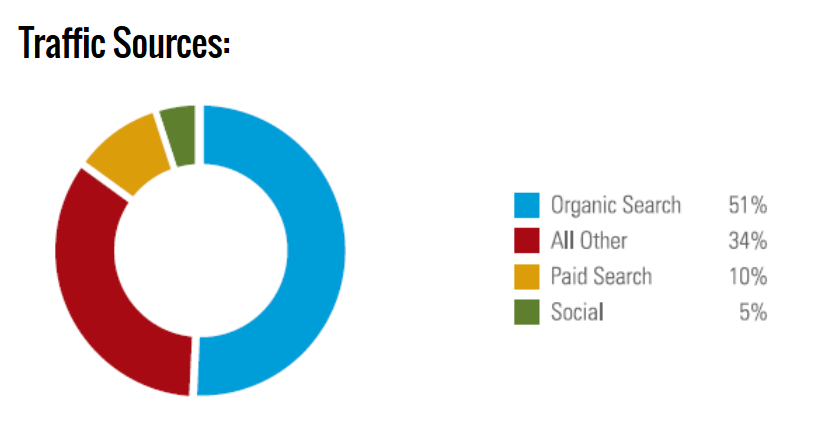
An analysis by web analytics and measurement firm BrightEdge reveals that organic search (SEO) drives over half of all traffic to websites (both business-to-business and business-to-consumer).

By contrast, paid search (SEM) accounts for only one-fifth of SEO’s result, and social is lower still:

  • Organic search: Generates ~51% of all web traffic
  • Paid search: ~10%
  • Social media: ~5%
  • All other methods (e.g., display advertising, e-mail and referred): ~34%

Web traffic driversSource:  BrightEdge, 2014. 

In other words, all forms of advertising put together don’t drive as much traffic as organic search.

The BrightEdge statistics also remind us that social media, however popular it may be to millions of people, isn’t a highly effective traffic generator like search. Here are some of the key reasons why:

  • Social shares are fleeting and can get drowned out easily.
  • Most users don’t go on a social platform, only then to click on different links that take them away from social.
  • Not everyone uses social media, whereas everyone uses a search engine of some kind when they’re in “investigative” mode.

That’s the thing:  People use SEO when they’re seeking answers and solutions — often in the form of a product or a service.  Unlike in social or online display advertising, there’s no need to “disrupt” the user’s intended activity.

And if you’re in the B-to-B realm, organic search even more prevalent:  Organic search drives ~73% of all web traffic there.

Even consumer categories like retail, entertainment and hospitality find that organic search is responsible for attracting 40% or more of all web traffic.

The takeaway for companies is that any marketing strategy that doesn’t adopt “content development” as a core tactic instead of an “ornamentation” is probably destined to fall well-short of its full potential.

Coming Up: A Labor Shortage?

The coming labor shortageIt may seem fanciful, but a new report published last week by The Conference Board concludes that the United States and other advanced economies will actually face significant labor shortages over the coming decade and a half.

This forecast has been made primarily based on the Baby Boomer workforce departing the labor market over this period.

The Baby Boomer phenomenon is what makes things different in now compared to the decades previously:  For the first time since World War II, working age populations will actually be declining in mature markets.

Conference Board logoAs Dr. Gad Levanon, director of macroeconomics at The Conference Board reported, “The global financial crisis and its aftermath – stubbornly high unemployment in many countries – have postponed the onset of this demographic transformation, but will not prevent it from taking hold.”

According to The Conference Board’s analysis, several countries have already begun to see this happen, as their natural rates of employment have now fallen below their pre-recession levels:  Japan, Germany, South Korea and Canada.

The same thing is expected to happen in the United States and the United Kingdom by 2015 … and in the Scandinavian countries, the Benelux countries plus Australia by 2016 or 2017.

Other mature economies like those of Spain, France, Portugal, Italy and Greece won’t experience this until the years further out – but The Conference Board predicts that it will happen there as well.

U.S. market sectors that are expected to experience the most severe labor shortages include healthcare occupations, STEM occupations (science, technology, engineering and mathematics), as well as skilled trades that don’t require a college degree but that do require specialist training.

Among the challenges The Conference Board envisions in these three major categories are the following:

  1. Skilled labor occupations like construction, transportation and utility plant operations are going to be adversely affected by many more retirements happening than new job seekers coming in to fill the void.
  2. STEM occupations won’t be as stressed as some might imagine, because higher productivity will alleviate the pressure on hiring more workers in IT and high-tech manufacturing segment. That being said, certain sub-segments such as information security, environmental and agricultural engineering, and applied mathematics are expected to face severe labor shortages.
  3. The numbers of new entrants in various healthcare occupations are constrained by high barriers to entry such as extensive education and experience requirements, along with accreditation requirements.

The Conference Board report has constructed a Labor Shortage Index covering 32 countries.  The index combines current labor-market tightness with future demographic trends to predict the likelihood of the different countries experiencing labor shortages.

The bottom line on the index:  with the exception of the Mediterranean countries, all of the labor markets in developed economies are expected to be squeezed pretty tightly starting within the next few years.

It’s been quite a while since we’ve been hearing about pending labor shortages … but that’s exactly what The Conference Board is predicting.  Here’s a link to more details about the report, which is appropriately titled From Not Enough Jobs to Not Enough Workers.

If you have thoughts or personal observations to share on the job markets on the domestic scene or internationally, please share them with other readers here.

Couponing Practices: Tradition Trumps Technology

couponingWith big changes happening every day in the way that consumers are interacting with brands and products, a big question is how quickly they’re changing their habits when it comes to the use of coupons.

Perhaps surprisingly, the results of a new 2014 Simmons National Consumer Study conducted by Experian show that “traditional” couponing activities remain far and away the most prevalent consumer activity.

First of all, the proportion of U.S. households that uses coupons of any sort is right around three-fourths (~74% according to the recent Simmons survey).

And we all know the single biggest reason why people use coupons:  to save money.  That rationale dwarfed any other among the survey respondents:

  • I use coupons to save money: ~64% of respondents mentioned
  • I use coupons to try new products: ~23%
  • Coupons incent me to try new stores: ~7%

But then the data points begin to deviate from where marketers may think their consumers’ minds are at (or where they might wish them to be).

Consider how many of the following popular couponing practices are distinctly “old school”:

  • I use coupons from in-store/on-shelf coupon machines: ~55% of respondents cited
  • I take advantage of rebates on products: ~50%
  • I use free-standing inserts from newspapers: ~46%
  • I use on-package coupons: ~37%

coupons on smartphoneCompare that to the far-lower engagement levels with “new school” couponing practices:

  • I use coupons delivered by Internet or e-mail: ~30% of respondents cited
  • I use my smartphone to redeem coupons at the store: ~17%
  • I have used a smartphone coupon app in the last 30 days: ~9%

These results show that if companies decide to embrace coupons as part of their marketing effort, they’ll need to pay as much attention (if not more) to traditional couponing methods than to newer practices.

Old habits die hard … at least in this arena.