There’s no question that Spotify has been an up-and-comer in the music streaming business. Speaking anecdotally, over time more and more of my friends and family members have been signing up for the service.
And now, Spotify is pushing forward with an even more aggressive growth strategy … and it’s not aiming low at all.
In fact, the company is seeking backers at an eye-popping valuation level of $5.3 billion.
And to top it off, the company’s co-founders (Daniel Ek and Martin Lorentzon) intend to raise the funds not through equity investment, but through loans.
It seems neither person wishes to give up any more of the company to investors than has already happened.
What makes the $5.3 billion valuation so startling is not just the amount – big though it is. It’s because that the last business valuation of Spotify, done less than 12 months ago, pegged the company’s value at just $3 billion.
That time around, a number of institutional investors stepped up to the plate (including Coca Cola, Fidelity and Goldman Sachs). But don’t look for more institutional investment in this round of funding.
In the case of Spotify, being second or third in the music streaming market segment has turned out to be a good thing. Pandora and others were the pioneers, laboring in the vineyards for many long years before proving out the business model.
Then along comes Spotify and cleans up in a market space that people now understand fully.
At the moment, Spotify has around 6 million paying users in 28 countries — along with several times that number of people who use Spotify’s free, ad-funded services. Spotify streams music across desktops and mobile devices along with other music gear.
The company reports that it pays approximately 70% of total revenues back to music rights-holders. It’s not profitable yet … but how many years was Pandora bleeding red ink? The better part of a decade, certainly.
There continues to be some low-level grumbling about how Spotify handles payouts to the “bigger name” performers in the music industry.
According to some reports, Spotify pays only about $0.005 per stream. That means only big stars (the likes of Beyoncé and others) can make any meaningful money from the service.
But for anyone who thinks that $5 billion+ is a tad rich when it comes to the valuation of a business property like Spotify … remember that Skype was sold to Microsoft for $8.5 billion in 2011, after having been valued at just $2.75 billion two short years before.
So maybe the whole thing isn’t so far-fetched after all.
The most recently published Temkin Web Experience Ratings of more than 200 companies across 19 industries reveals continuing widespread disappointment with the quality of the “web experience.”
The Temkin Web Experience Ratings are compiled annually by Temkin Group, a Newton, MA-based customer experience research and consulting firm. The ratings are based on consumer feedback when asked to rate their satisfaction when interacting with each company’s website.
Temkin ratings are established for companies garnering responses from 100 or more of the ~10,000 randomly selected participants in an online survey conducted by the research firm in January 2013.
Rankings are calculated via a “net satisfaction” score based on a 7-point rating scale from “completely satisfied” to “completely dissatisfied” by taking the percentage of consumers selecting the two highest ratings and subtracting the percentage who selected the bottom three ratings.
Just 6% of the brands earned strong or very strong “net” trust ratings, while ten times as many (~63%) were given weak or very weak scores.
And there’s this, too: Not much improvement is happening. More than half of the ~150 companies that were included in both the 2012 and 2013 Temkin evaluations earned lower scores this year than last.
Managing partner Bruce Temkin summarized it succinctly: “The web is a key channel, but online experiences aren’t very good – and are heading in the wrong direction.”
The latest Temkin ratings give Amazon the top-rank position with a 77% overall rating score. Other companies ranked near the top include Advantage Rent A Car, U.S. Bank and QVC.
At the other end of the scale, MSN, EarthLink and Cablevision earned the lowest ratings – MSN worst of all.
Indeed, the following industries had composite company ratings that ended up in the “very weak” column:
Airlines
Health plans
Internet service providers
TV service providers
Wireless carriers
Do any of these industries seem like ones that shouldn’t be on this list?
I didn’t think so, either.
Which ones are the industries that score best in the Temkin analysis? By order of rank, they are as follows:
Banks
Investment firms
Retailers
Credit card issuers
Hotel chains
Come to think of it, I haven’t encountered problems online with companies or bands in any of these five industries.
It’s also interesting to consider which companies have improved the most over time. When comparing year-over-year results for the ~150 companies that were included in both the 2012 and 2013 studies, eight of them showed double-digit improvements in their scores:
Blue Shield of California
Citibank
Humana
Old Navy
Safeway
Toyota
TriCare
U.S. Bank
On the other hand, a much bigger contingent of 21 companies saw their ratings decline by at least 10 points; the six firms that dropped by 15 points of more were these:
If you notice any rankings that seem surprising – or that don’t comport with your own online experiences – please share your thoughts and perspectives below.
According to J. D. Power, hotel guest satisfaction ratings in North America are up for the first time in years.
One of the industry segments that took the biggest beating in customer satisfaction during the recent recession was the hotel sector.
Annual surveys conducted by J. D. Power charted a continuing decline in satisfaction rates. In everything from reservations and the check-in process to the cost of stay, hotel customers have been giving “thumbs down” for the past half-decade.
Until now.
Marketing information services company J. D. Power & Associates, part of McGraw Hill, has just released the results of its latest annual survey, based on responses from more than 68,700 hotel guests in the United States and Canada collected between July 2012 and May 2013.
J.D. Power has conducted these hotel industry surveys annually for the past 17 years.
According to the 2013 North America Hotel Guest Satisfaction Index Study, the overall guest satisfaction rating index is 77.7 on a 100-point scale.
That may seem like a “Gentleman’s C,” but it’s an increase from last year’s 75.7 score.
More to the point, it’s the first time in quite a few years in which the aggregate rating has gone up.
Where has satisfaction increased? Pretty much in every category surveyed, with the largest gains coming in the reservations process, check-in/check-out procedures, and hotel costs and fees.
Other categories included in the study were guest room satisfaction, food and beverage service, other hotels services, and hotel faciliites.
The largest area of continuing discontent is in Internet usage. Customer complaints are all across the board — ranging from spotting connectivity and slow speeds to usage charges.
Other areas where improvements are sought are in HVAC comfort and controlling noise levels.
What about customer reaction to rising hotel rates? After all, they’ve gone up by about 5% over the past two years.
But the J. D. Power survey found little concern about rate increases. Rick Garlick, director of the survey, suggests that pulling out of the economic downturn might explain this lack of concern. “The economy may be playing a part in price satisfaction because people have a little more to spend,” he noted.
The people who appear to be the least satisfied with their stay experience are the ones who chose to stay at a hotel based on price alone. It’s like the adage says: “You get what you pay for.”
On the other hand, the most satisfied guests weren’t necessarily people who stayed at 5-star properties. Instead, they’re ones who evaluated hotels carefully beforehand using online tools such as third-party hotel reviews and ratings. The “eyes wide open” strategy, as it were.
Such evaluation tools have made it easier to know what to expect from a hotel stay, contributing to overall satisfaction ratings because there’s less likelihood of a “rude awakening.”
The J. D. Power surveys also ask respondents to rate hotel brands. I was interested to see which hotels scored highest in the various different categories in this year’s survey:
Luxury category:Ritz-Carlton
Upscale:Hyatt
Midscale Full Service:Holiday Inn
Midscale:Drury
Economy/Budget:Microtel (Wyndham)
Extended Stay:TownePlace Suites
Come to think of it, none of these results is particularly surprising. In fact, three of the brands (Ritz-Carlton, Holiday Inn and Drury) have been tops in their category for three or more consecutive years of the J. D. Powers studies.
Ex-Cong. and New York City mayoral candidate Anthony Weiner hasn’t been the only one misbehaving on social media.
Chipotle Mexican Grill also gets a time-out to sit in the corner for its social media hi-jinks.
It turns out that a supposed hacking of Chipotle’s Twitter account in mid-July was nothing more than a ploy to grab attention and gain more Twitter followers.
For those who haven’t heard, Chipotle’s Twitter stream appeared to have been hacked as a series of bizarre and nonsensical tweets were posted over the span of several hours – until the company claimed to have solved the problem.
As it turned out … the whole thing was completely manufactured – all of those crazy tweets published by the company itself.
A few days later, a Chipotle spokesperson came clean, admitting that the whole episode was actually a carefully orchestrated effort to gain more Twitter followers, in concert with the company’s 20th anniversary.
Did it work? Evidently yes … because Chipotle had ~4,000 more Twitter followers at the end of the campaign than it did at the beginning.
But some marketing professionals were critical of the ploy. Here are a few representative comments:
“Chipotle is a brand about honesty and authenticity; faking a hack if off-brand.” (Rick Liebling, Y&R Creative Culturalist)
“Most of these stunts … strike me as being pretty lazy. It’s like making your CEO do a press conference drunk and then apologizing for it once he sobers up.” (Ian Schafer, Deep Focus CEO)
“Chipotle’s pico de gallo was more ‘weak sauce’ than ‘muy caliente.’”(Saya Weissman, Digiday Editor)
On second thought, perhaps it’s not such a good idea to “mess with the market” when upside is a few additional social media contacts (that probably won’t stick around), and the downside is brand irritation or even humiliation.
After all, Chipotle’s net gain in Twitter followers represented an uptick of just 1.7%.
That seems a bit paltry considering the potential blowback and reputation risk.
Many people I speak with have set up personal or corporate Google+ accounts for the sake of having a full presence in social media, but Google+ represents very little (in some cases none) of their activity.
Speaking personally, I don’t have a Google+ account, nor do I have any future plans to establish one.
Why? “So many platforms … So little time …”
And now, a new analysis has been published that reinforces the perception that Google+ isn’t all that consequential in the social media realm.
The evaluation comes in the form of a report by Gigya, a developer of social media plugins, gamification and other services. Its findings reveal that only about 2% of social sharing happened on Google+ during the second quarter of 2013 (April through June).
Instead, social sharing is far more “happening” in three other social zones: Facebook (50% of all share activity); Twitter (24% of share activity) and Pinterest (16% of activity).
These same three social sites are the top sharing destinations from e-commerce sites as well as publishing/media sites, too – whereas Google+ is stuck at the same 2% level.
If anything, Pinterest is the “breakout star” in this constellation.
What does Google have to say about these rather sorry-looking statistics, more than three years after the debut of its Google+ social platform?
Google argues that a significant degree of sharing on Google+ happens “privately,” making the activity invisible to data crawling.
But that’s not how Gigya has captured the data; it’s measuring clicks via social tools that are embedded on its client sites (Gigya serves more than 700 brands including ones like ABC, Verizon, Nike and Toyota).
And under that scenario, it’s still clear that very few visitors are clicking to share any Google+ content.
Searchmetrics and other groups have posited that Google+ sharing might overtake Facebook by 2016. But upon closer examination, it appears that these predictions are the result of questionable definitions: +1 clicks on Google+ aren’t the same thing as “shares” on Facebook. A more fitting comparison would be Facebook “likes.”
Viewed on that basis, Google appears to pose no threat at all – short- or long-term – for overtaking Facebook in the social media marathon.
Are any readers using Google+ for the majority of their social media interactions? If so, I’m interested to hear what you like best about the platform – and why you might prefer it to the alternatives. Certainly, if the rest of us are missing something, we want to learn about it!
On the other hand, if you’re like me and giving Google +1 pretty wide berth, let us know why as well. Please feel free to leave a comment.
A marketing analytics firm is claiming that the average tweet on branded Twitter sites is worth a little over $25.
Yep, you read that correctly; $25.62, to be precise.
The revenue estimate comes to us courtesy of SumAll, a data visualization and analytics firm. It reached that conclusion after reviewing more than 900 of its customers’ social media program efforts. SumAll published its findings last week in an infographic.
To those who might look at the ~$25 figure and scoff (that may be most readers), it should be noted that once the total number of people who see an individual tweet is taken into consideration, the amount of revenue gained per impression is only about one half of one penny, on average.
To put this into context, $0.005 revenue-per-impression is lower than most other marketing tools and about on par for AdWords revenues-per-impression.
The imputed revenue from tweets amounts to about 1%-2% in incremental revenues, according to SumAll’s study group.
Not surprisingly, this announcement was met with questions … and some skepticism. Asked to explain further how SumAll came up with its results, a SumAll spokesperson replied on the company’s blog:
“… Our data comes from our own user base of over 30,000 people. We anonymize the data first and then aggregate all the data to derive new, interesting insights from a broad population. For this infographic, we collected data from all users who have a Twitter stream and commerce stream, and conducted some calculations to derive the value of each tweet.”
There, that should clear up matters nicely, right?
As if pre-anticipating the muffled sniggers or raised eyebrows in reaction to this “non-response response,” the blog response continued:
“This is obviously a little overgeneralized, but I hope that [it] clears some things up.”
The experience of our clients hasn’t approached what SumAll is reporting … but I’m interested in hearing what kind of results other companies may have experienced using Twitter as a social marketing platform. Any particularly positive stories (or negative ones) to report? Please share you observations here.
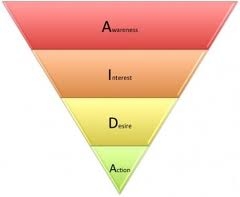
For most marketing professionals over the age of 30, the purchase funnel was one of the fundamental staples of their business training.
In fact, the famous “AIDA” model – which stands for awareness, interest, desire and action – was first posited as far back as 1898 by Elias St. Elmo Lewis, an American sales and advertising professional and business writer.
“AIDA” was also the inspiration behind the classic purchase funnel – an orderly, simple path consumers take on the way to selecting and purchasing a product or service.
AIDA has had a good run, because for more than a century, the AIDA purchase funnel has meshed neatly with the various advertising and MarComm tactics that have come along the pike – print advertising, direct mail marketing, radio, television – and even the Internet.
While some people might contend that the advent of the Internet disrupted traditional buying processes, the greater reality is that it brought certain aspects of the buying process into sharper relief. Search engine optimization and search engine marketing stepped in to play nicely within the “interest, desire and action” steps.
Even better, Internet marketing made ineffective “soft” attitudinal metrics less important; all of a sudden, it became much easier to make educated decisions about sales and marketing programs based on hard evidence.
But with social media taking center stage, everything is now scrambled. The tidy “linear” purchase process just doesn’t reflect what’s happening now that “interactivity all over the place” is the thing.
But what exactly is the new “thing” when it comes to the purchase process? There’s a lot of discussion … lots of thinking … but not much in the way of conclusions.
McKinsey’s new model has been described as a “purchase cycle,” a “customer journey,” and various other alternative explanations — you can take your pick.
But what exactly is that? When you look at how McKinsey attempts to graph it … it may be the proverbial “big ol’ mess.” I’ve pictured it here so you can try and have some fun with it.
The “McKinsey Whatever” may be hard to grasp pictorially, but there’s one thing’s about it: it’s surely not linear.
There are two circles (kind of). Consumers can go around within the circles forwards or backwards. They can also go sideways between the two (sort of).
Truth be told, the “McKinsey Thingamabob” is fairly difficult to untangle. At least that’s the claim of some business observers such as Jon Bond, a marketing specialist and cofounder of branding agency Kirschenbaum Bond Senecal. He writes this:
“I’ve been in 20 meetings where the ‘McKinsey Frankenfunnel’ has come up , and not once has anyone had the courage to admit that they didn’t have a clue what to do with it.”
Bond goes on to posit that introducing this new model was a masterstroke on the part of McKinsey (wittingly or unwittingly) because it’s become a boon to its consulting business: Companies have to hire McKinsey so the consulting firm can explain it, he notes wryly.
Whether it’s the McKinsey diagram or any other one that’s been proffered recently in an attempt to illustrate the new purchasing paradigm (one being a Google model with the eyebrow-raising acronym “ACID”) – what’s clear is that the purchase process is more complex then ever before. And in that process, the number of touchpoints has also grown dramatically.
Perhaps the best thing to do is to jump out of the funnel (or box, or circles, or whatever the purchase cycle is today). Instead of focusing on impressions or touchpoints, let’s remember the big thing that interactivity has placed in the hands of purchasers: far more opportunity to see and hear what trusted influencers are saying about products, services and brands.
It’s like going back to traditional, pre-1900 word-of-mouth advertising — and putting it on steriods.
Jon Bond contends that this new riff on WOM may be the smarter way of looking at the purchase journey a customer takes today. Instead of the “old AIDA” or the “new interactivity,” he suggests focusing more on three degrees of “trust“:
Before trust: Even if the brand is known, it’s not yet trusted because no credible third party has validated the brand in the eyes of the buyer.
Trust exists: An interaction happens with a trusted influencer who recommends the brand or has positive things to say about it.
Advocacy: Nirvana for companies, wherein a highly satisfied customer also becomes a brand advocate, providing third-party validation and attracting additional new customers because of the resulting brand credibility.
Incidentally, the above scenario is particularly effective in the B-to-B world, where credibility and the “CYA” impulse have always played big roles in guiding business buyers to make purchase decisions they won’t regret later.
Consider it the IBM principle, writ large: You’ve probably heard the adage that “nobody ever got fired for recommending IBM.” Now, in the “Age of Interactivity,” that principle can apply across the board.
In my most recent blog post, I reported on equity analysis firm 24/7 Wall Street and its take on the “most damaged” brands in the United States.
While there was pretty universal agreement among readers on most of the nine brands that had the dubious honor to make it on the list, there were several cases where some readers disagreed — Apple and J.P. Morgan Chase in particular.
Of the 100 major brands included in the Ipsos survey and rated by respondents, here are the ten brands cited as most influential in the 2013 survey (in descending order of score):
Google
Amazon
Apple
Microsoft
Facebook
VISA
Wal-Mart
Yahoo!
Proctor & Gamble
eBay
Google leads the pack – and it’s hardly a surprise. But an important (and perhaps surprising) thing we notice is how pervasive technology, media and web-based brands are on the list.
Clearly, these are the types of companies that are increasingly influential in the lives of everyday Americans.
In fact, just three brands in the “Top 10 Most Influential” predate the personal computer era: VISA, Wal-Mart and Proctor & Gamble. And they rank relatively low on the list at #6, #7 and #9.
Moreover, let’s not forget that all three of these more “legacy-type” brands have actually been quite active in online and social media activities. Clearly, their senior management personnel realize that a good measure of future brand health lies in the same space where the other leading brands are active.
Another interesting point that jumps out is when we compare the Ipsos “most influential” with the 24/7 Wall Street “most damaged” rankings. One brand stands out on both lists: Apple.
How can this be?
But on second thought, is it reall all so surprising? The 24/7 Wall Street inclusion was based on stock analysts’ reading of the company’s recent missteps and related share price declines … whereas the Ipsos list is based on the findings from a survey of “ordinary Americans.”
Applying the same comparative measures, I’m pretty sure the public’s view of General Motors stayed right up there long after the financial analysts had fled the stock and relegated GM’s brand reputation to the basement.
But in the end, public opinion eventually followed the analysts, in part because GM’s efforts to turn around company performance proved spectacularly ineffective. It just took more time for that knowledge to seep into the collective consciousness.
For Apple, the big question is: Will its future actions mean that it stabilizes its brand reputation? Or, will its effort fall short, leading to a loss of consumer confidence?
Let’s check in again after 18-24 months and find out.
If you were to ask people to identify the brands that they view in negative terms, chances each one would readily name at least one.
The reasons why a brand loses its reputation can be varied: a botched product introduction … bad corporate leadership … a poor response to a crisis.
But the net effect is usually the same: The damage takes only a short time to occur, and it can take years for the brand to recover (if ever).
Which brands are viewed as the “most damaged” in the United States right now? Recently, the staff at equity analysis firm 24/7 Wall Street put their collective heads together and came up with a group of nine brands that they feel qualify for the dubious “top honors.” They are:
Apple
Best Buy
Blackberry/Research in Motion
Boeing
Groupon
Hyundai
JCPenney
J.P. Morgan Chase
Martha Stewart
I find this list pretty much spot on. Most of them would probably be on anyone’s list:
Best Buy – Its big box stores function well as a place to “showroom” appliances and electronics for consumers … who then head home to purchase the same products online at lower prices.
Blackberry– Speaking personally as an owner of a Blackberry smartphone, is there any brand whose products have been more disappointing to its loyal users than this one? I doubt it.
Boeing – The highly touted Dreamliner 787 passenger jet has been delayed for years. Many consumers appear to be nervous about the model’s design, and recent developments portend … more delays.
Groupon– Groupon’s place in business history may be as the ultimate example of a dotcom-era “glorious failure.” Its business model, wherein merchants sign up for a scheme that’s guaranteed to lose them money, had to be “too bad to be true.”
JCPenney– I’ve blogged before about the predicament of this department store brand. In a stunning series of missteps, attempting to attract a completely different demographic of shopper while simultaneously dissing its loyal customer base turned out to be a sure recipe for damaging the Penneys brand – possibly irreparably. The odds are better than 50/50 that this store chain will now follow Montgomery Wards into retail oblivion.
Martha Stewart– Take an iconic business celebrity and send her to prison for insider trading. Meanwhile, her lifestyle media company is hammered by social media (Pinterest and all the rest), while television programming is splintering into more and more micro-segments thanks to the Internet and an explosion of new programming options for viewers. Is this brand even relevant anymore?
The remaining brands – Apple, Hyundai, J.P. Morgan – are ones that I feel have more inherent strengths and should be able to bounce back from recent setbacks. Provided, of course, that they make all the right moves and avoid any new pitfalls.
What are your thoughts? Would you nominate any other “damaged” brands for inclusion on the 24/7 Wall Street list? (I thought of Sears for one …) Feel free to share your thoughts here.
Time was, we could get a chuckle out of television commercials where unsuspecting consumers were surprised to find out that the restaurant coffee was really Folgers®, or the day spa’s skin moisturizer treatment for their hands was actually Palmolive® dish detergent.
There was something rather endearing about those consumer reactions – and they were uniformly positive ones as well.
But to show how far removed we are from those halcyon days, consider this recent attempt to pull a fast one on unsuspecting dinner guests at a “faux” restaurant in Midtown Manhattan: Cooked up by the Ketchum public relations unit of Omnicom Group for its client, ConAgra Foods, New York-based food bloggers and “mommy” bloggers were invited to dine at “Sotto Terra,” an underground restaurant supposedly run by Chef George Duran of TLC’s Ultimate Cake Off cable program.
But Sotto Terra, far from being the “intimate Italian restaurant” of the invitation, was nothing more than an elaborate set-up – hidden cameras and all – to get bloggers to sample ConAgra’s newest offerings in the Marie Callender’s line of frozen entrees and desserts … and presumably to extol the virtues of the cuisine.
In fact, no such restaurant even exists. Rather, it was all a staged scene in a Greenwich Village brownstone. The invitation promised a “delicious four-course meal” accompanied by Chef Duran’s “one-of-a-kind sangria” … along with a talk by famed food industry expert Phil Lempert on new taste trends in food.
The invitation also promised a “special surprise” for those who attended the dinner on one of five evenings.
The special surprise, of course, was revealing the actual provenance of the food items being served. “The twist at the end was not dissimilar to what brands like Pizza Hut and Domino’s have done in the recent past, with success,” noted Stephanie Moritz, a public relations flack at ConAgra.
The plan was to use the video footage captured at the dinners for promotional clips on ConAgra’s website and on YouTube … as well as for the bloggers who attended to generate cyber-buzz about being pleasantly surprised at the revelation.
But this is 2011, not 1981 or 1991. And bloggers are also quite different from the average consumer. Ketchum and ConAgra apparently forgot about the “90-9-1 rule” of online content: 1% create content … 9% comment on that content … and 90% simply lurk.
Not only are bloggers part of the 1%, they take their role seriously and certainly don’t appreciate being fooled. So instead of the food taking center stage, the event itself became the topic of (uniformly negative) conversation on the blogs. A few examples:
“We discussed with the group the sad state of chemical-filled foods. And yet, you still fed me the exact thing I said I did not want to eat.” (Lon Binder, FoodMayhem Blog)
“[I] pointed out that the reason I ate organic, fresh and good food was because my calories are very precious to me, so I want to use them wisely. Yet they were serving us a frozen meal, loaded with sodium. I’m NOT their target consumer, and they were totally off by thinking I would buy or promote their highly processed frozen goods after tricking me to taste it.” (Cindy Zhou, Chubby Chinese Girl Blog)
“Our entire meal was a SHAM! We were unwitting participants in a bait-and-switch for Marie Callender’s new frozen three-cheese lasagna and there were cameras watching our reactions.” (Suzanne Chan, Mom Confessionals Blog)
I loved reading the PR personnel’s “spin” of the events the way they transpired: “Once we sensed it was not meeting attendees’ expectations, that’s where we stopped, we listened and we adjusted,” Stephanie Moritz remarked.
… By which she means the remaining dinner evenings were canceled.
Looking back is 20/20 hindsight, of course. But it does seem like most PR professionals could have seen this negative reaction coming from a mile away. PR agencies exist to provide not only publicity for their clients, but also counsel. Sure, the event sounds like a fun lark with a bit of a twist – and I can just picture the breathlessly animated PR brainstorming session at Ketchum that produced this idea.
But is duping bloggers and making them out to be fools the correct tactic? … Especially considering that their megaphone, augmented by the viral nature of social media, is much more effective and far-reaching than ConAgra’s corporate website ever could hope to be.
When the Public Relations Society of America was contacted by the New York Times for comment, Deborah Silverman, chairperson of the PRSA’s Board of Ethics and Professional Standards, responded by stating that the Ketchum/ConAgra PR stunt was “unfortunate” and “not quite where they should be in terms of honesty.”

 There’s no question that Spotify has been an up-and-comer in the music streaming business. Speaking anecdotally, over time more and more of my friends and family members have been signing up for the service.














 Nones Notes