Advertising that’s really on a roll.

Toilet Paper Roll Advertising
Here’s advertising that’s really on a roll — in more ways than one.

One definition of good advertising is how effectively it reaches the most people and engages its audience for longer periods of time.

According to that definition, placing advertisements on toilet paper rolls is a brilliant move that should “wipe away” competing promotional tactics, correct?

[On the other hand, you might think this advertising idea “stinks.”] 

But it’s just what two young entrepreneurial brothers are up to. They’ve formed a business – Star Toilet Paper – that supplies toilet paper to public bathrooms.  And the TP features advertisements printed right on the roll.

According to brothers Bryan and Jordan Silverman, Star’s toilet paper is made from environmentally friendly materials, with coupons and ads printed on them using a soy-based ink.

Their company sells space on the rolls for a half-penny per ad.  Coupons printed on the TP can be redeemed through the company’s own website.

Reportedly, some big-name advertisers like Ben & Jerry’s ice cream have signed on … as have some smaller businesses like physicians offices.  (No word on whether the doctors specialize in gastroenterological medicine.)

How are the Silverman brothers enticing restaurants, bars and other venues to stock their toilet paper? They’re providing the ad-filled rolls to these establishments at no charge.

Not surprisingly, this idea came to the brothers while they were students in college.

After patenting the concept in 2010, they’ve since formed their company, developed a business plan, and have already lined up approximately 50 advertisers.

How successful is the endeavor so far? No official word on whether the brothers are “cleaning up” in the business and “flush” with cash yet.

But Jordan Silverman notes that bathroom stall visitors are the very definition of a captive audience. “It’s an unmatched active audience. A person looks at the average advertisement for two to five seconds. People will look at ours for a lot longer,” he notes.

One of the customer segments considered to be highly lucrative for the company is movie theaters.

Come to think of it, this newfangled TP would be perfectly suited for the next Star Trek movie.

… You know, the one where the Starship Enterprise circles Uranus and wipes out the Klingons …

America’s “Summer of Funk”

Consumers are in a funk in the Summer of 2012.

How much do American consumers spend in an average day? According to a July 2012 Gallup Poll, they spend about $70 per day in stores, gas stations, restaurants and online. (Housing, utility costs and vehicle purchases are extra.)

It turns out that this figure is a pretty big drop from the average daily spend of $104 Gallup found in 2008.

That meme we’re hearing on the campaign trail about people’s livelihoods having shrunk over the past three or four years? Evidently, it’s a fact.

And Gallup is also finding that upper-income Americans have undergone the same degree of spending reduction as everyone else. Their spending is now down to about $116 per day.

Evidently, confidence in the U.S. economy and the stock market’s uneven performance have taken their toll on the psyche of even the affluent classes in America. And Gallup isn’t the only organization charting this. Ipsos MediaCT is finding a similar story in its surveys.

Last week, Stephen Kraus, an Ipsos senior vice president and author of several books on the upper-income sector of society, wrote: “Widespread uncertainty plays a role in a fundamental fact of today’s “affluent” marketplace. For the most part, affluents today simply don’t feel affluent.”

Krauss continues, “This feeling isn’t new; for most, it is part of the lingering hangover of The Great Recession. But it is particularly pronounced in the summer of uncertainty.

Krauss concludes his remarks with this rather gloomy observation: “It’s a summer of uncertainty indeed – about the economy, about the future, and even about one’s own standing in today’s financial hierarchy.”

Reading these very latest reports on the level of uncertainty – even resignation – that people have about the economy, it underscores the collective funk the American people seem to be in as the 2012 presidential campaign grinds on inexorably to its conclusion.

Perhaps once Election Day has come and gone, Americans will “snap out of it” and begin to feel brighter about the future.

Perhaps. But don’t hold your breath. 

Social media: All that glitters is … what?

Fake followers, fans, friends on social mediaChances are, you haven’t heard of Anthony Gemma, and I hadn’t either. 

Unless you live in Rhode Island, that is.  Mr. Gemma is a businessman who’s running for U.S. Congress there. And despite the fact that he has yet to win his own political party’s primary, he has already amassed nearly 1 million Twitter followers.

That’s more followers than presidential candidate Mitt Romney.

According to various social media monitoring services, Gemma’s Twitter account added ~400,000 followers in February 2012 alone.

And how about this stunning statistic: Between January and February of this year, the number of friends on Mr. Gemma’s personal Facebook page jumped some 5,600% to nearly 170,000 people.

How is this possible? For clues, we can start by noting that Mr. Gemma has described himself as a “social media guru.” In addition to owning a regional plumbing business, he’s also headed up a concern called Mediapeel, which bills itself as a providing “media strategy advice” to companies.

And therein lie clues to the sudden surge of “interest” in Mr. Gemma and his Congressional campaign in the social media sphere.  One can only imagine the lengths to which Mr. Gemma and his campaign staff are going in order to show off the candidate’s “obvious” fame and notoriety.

But are Mr. Gemma’s social media followers for real? Or are they of the same ilk of the famed digital “Potemkin Villages” that have sprung up all over the Internet?

Consider a few telltale signs about Anthony Gemma and his fantabulous social media presence:

  • Fewer than 1% of Gemma’s Twitter follows are based in Rhode Island … but nearly 15% are in Canada. You’ll find another 2% from London, England, plus thousands of others from places all over the globe.  I’m not sure how far afield Mr. Gemma takes his regional plumbing business, but this geographic map is intriguing to say the least.
  • Gemma’s Twitter “fans” are an unusually  inactive bunch. On February 24, 2012 – the same day Mr. Gemma’s Twitter account picked up a tidy 87,000 new followers in one fell swoop – he asked his Twitter audience to retweet a photo. A whopping six people chose to do so.
  • Earlier this year, after the progressive organization Rhode Island’s Future questioned the validity of Mr. Gemma’s burgeoning bevy of Facebook friends and noted that the most popular origin of his friends, followers and fans was an unlikely location — Frankfurt, Germany — all of the names referenced in the RIFuture blog post mysteriously disappeared from Gemma’s social sites.  Interestingly, however, the most prevalent place of origin for Gemma’s personal Facebook page’s friends is another foreign city: Moscow.  I guess Mr. Gemma’s international interests range from the Germanic to the Slavic.

Although it’s impossible to know for sure, these signs suggest that there’s precious little “there there” when it comes to the extent of Mr. Gemma’s true social media footprint.

And in fact, just last week the political website Politico made the latest attempt to get to the bottom Anthony Gemma’s questionable social media presence.

Politico took note of this tweet from Mr. Gemma’s account, posted on July 24, 2012:  “Don’t add up your troubles, count your blessings. RETWEET to pass it on!”

Of Gemma’s nearly 1 million “followers”, only 17 did so.

And while one of them actually appears to be a Rhode Islander, the others include followers from Sydney, Calcutta, the Baltic States, Indonesia …

… But none from Potemkin Village.

Coming Attractions: A Newly Sanitized YouTube

YouTube Cleaning up its ActThe YouTube phenomenon has been one of the biggest success stories of all in cyberspace.

Over the years, YouTube has gone from being a weird corner of the web made up of curious, strange and often forgettable video clips, to a site that attracts millions of viewers every day – some of whom have essentially ditched all other forms of video viewing in favor of mining the vast trove of material YouTube carries on its platform.

In the years since Google acquired YouTube, traffic and usage have exploded, even as the video fare has become more varied (and also more professional).

But there’s one holdover from the early years that continues to bedevil Google: YouTube is a repository of some of the most inflammatory, puerile and downright disgusting commentary that passes for “discourse,” posted by all manner of rabble.

But now, Google is signaling a strategy that has the potential to clean up the crude comments on YouTube – and in a big way.

YouTube is now strongly encouraging users to post their YouTube comments using the name identity associated with their Google+ account.

In fact, if you decline to do so after being prompted, you’ll be asked to state a reason why, underscoring the nudge away from “screen name anonymity” and towards “real-name identity.”

The notion is that people will be less likely to post flaming comments when their “true” web identity is known – that people will exude good behavior in “polite cyber-company,” as it were.

Of course, one needs to possess a Google+ account in order to link his or her identity on YouTube. But that’s for today only; some observers see YouTube’s move as just the first step toward hiding – and eventually eliminating – all comments coming from anonymous accounts.

So the new bargain will be something closer to this: “Open a Google+ account and link your YouTube account to your Google+ account … or else forfeit your ability to post any comments at all on YouTube.”

The likely result will be a much more “sanitized” YouTube – less edgy, but also less red-faced embarrassing. And that’s just what many brands, businesses and advertisers would like to see happen.

Of course, YouTube’s moves may well spur the launch of an alternative site that seeks to preserve the (nearly) anything-goes environment of the YouTube of yore.

Perhaps it could be called “YouCrude,”  But, as it happens, that handle’s already been nabbed — by a fellow WordPress blogger!

What does e-mail engagement mean to consumers? Getting a discount.

e-mail engagement is all about providing discounts to customersIf you suspect that most people opt in to receive commercial e-mails so that they can receive discounts on the products want … you’re absolutely right.

The latest proof of this is in a survey of ~1,000 consumers conducted earlier this year by BlueHornet, a San Diego-based e-mail marketing services company.

That survey found that the percentage of consumers signing up to receive commercial e-mails in order to receive discounts is a whopping 95%.

So while marketers may want to believe that “engagement” with consumers is all about brand affinity and excitement … all that is much less important to them than simply getting a good deal on the product or service.

There will always be a desire for companies to nurture personalized, relevant conversations with customers via their e-mail communications.

After all, a highly engaged customer base that sees a brand as tops in its field … perhaps leader in innovation and technology … and above all, a brand that makes a true difference in the customer’s personal or business life.

All of these objectives represent Holy Grail of marketing. By all means, marketers can and should strive for this level of brand engagement – however hard to attain it may be.

But to make it a whole lot easier easier, offer a coupon or discount as well.  Preferably big.

Klout and Klouchebag: Action and Reaction.

Klout scoreIt had to happen: The combination of social media measurement capabilities and ego gratification has brought forth attempts to “quantify” a person’s influence level in social media.

One of the better-known of these endeavors is run by Klout, a San Francisco-based entity launched in September 2009 that applies social media analytics to measure people’s influence across their social network.

Underscoring the company’s sense of self-importance is its proclaimed tagline/slogan:  “The Standard for Influence.”

Klout purportedly accomplishes this by analyzing data mined from Twitter, Facebook and other social sites – information such as the size of a person’s network, the content created, and how others interact with that content.

Klout profiles built from these bits of information include a “score” ranging from 1 to 100 – the higher a score representing a higher assessment of the breadth and depth of a person’s online influence.

Reportedly, more than 100 million of such profiles have been built by Klout over the past two years. And how is Klout building these scores? It’s using Twitter data points such as:

  • “Follower” and “following” volumes
  • The incidence of “spam” or “dead” following accounts
  • List memberships
  • Retweet activity
  • Unique mentions

Somehow, it doesn’t seem surprising at all that Klout’s rating and ranking activities have come under attack. And the criticism is not just coming from people who are questioning the methodology behind the analysis and rating. Some social critics contend that scoring devalues authentic online communication.

Movie critic, writer and novelist John Scalzi has written that Klout’s very premise is “socially evil” in that it exploits the “status anxiety” of social media participants. Charles Stross, a tech writer and sci-fi author, goes even further: He labels Klout “the Internet equivalent of herpes.”

But perhaps the most biting criticism comes in the form of satire, courtesy of Tom Scott, a freelamce web developer and humorist who has launched “Klouchebag.”

What’s Klouchebag? According to Scott, it measures “how much of an asshat you are on Twitter.”

In the same fashion as Klout, Klouchebag establishes a rating score. But this one is based on the ARSE rating system, an eyebrow-raising acronym that stands for:

  • Anger (“profanity and rage”)
  • Retweets
  • Social Apps (“every useless check-in on Foursquare or similar location-based social platform”)
  • English Usage (“exclamation marks!!! … ALL CAPS … or no capitalization at all … will definitely raise this score”)

For Tom Scott, Klouchebag satirizes what he considers to be a “pseudo-scientific” effort to create a social media hierarchy. He hopes its emergence will contribute to a backlash against Klout and other similar ventures.

When it comes to Klout, Scott is merciless: “I’d been annoyed with the idea of Klout for a while … [which] is one of the worst ideas ever put online. Klout annoys me for the same reason that search engine optimization annoys me: It’s an enormous amount of effort designed to game an arbitrary and often-changing system. Imagine if all that time went into actually making interesting things, or caring about the people around you.”

Maybe Tom Scott has forgotten a thing or two about human nature: People are often smitten by vanity and pride – and the desire for fame. It’s been that way ever since the dawn of time. Why should we expect anything different from people today?

[One can only imagine what Andy Warhol would have said about people and their “15 minutes of fame” had he lived in our era of social media!]

Amazon continues to push the envelope … while pushing books right off the table.

Amazon Kindle continues to push the envelope in book publishingIt’s hard to deny that the growth and success of Amazon has had a huge impact on the book industry. The liquidation of Borders Books is just the latest evidence of that.

But other market moves by Amazon demonstrate that the company has set its sights on far more than just owning the traditional retail book and recorded music segments. The introduction of the Kindle e-reader and release of subsequent newer, cheaper models proves that Amazon seeks to dominate the “information” space no matter what form it takes.

Two recent developments show how this is continuing to happen. First, the company announced that it is launching a new public-library feature that gives the Kindle the same library-borrowing abilities as competing e-reader devices like the Nook offer.

Public libraries have taken notice of the announcement, because Kindle so dominates the e-reader market. According to Forrester Research, an estimated 7.5 million Kindles are being used in America; that’s about two-thirds of all e-readers in the country.

Already, large public library systems such as those in Chicago and New York offer free digital-book lending. A trip to the library is not needed. Instead, patrons simply use their library card ID numbers to download books from the library’s website.

As with conventional “paper and glue” books (I love that new term!), there are “lending periods” for e-books usually ranging 2-3 weeks. Libraries purchase the e-books from publishers as they do bound books, and only one borrower can check out an e-title at a time.

How are Amazon’s latest e-lending developments affecting book publishers? For one thing, e-books never wear out, which means publishers (and authors) can’t benefit from reorders of popular titles due to book wear. Partially for this reason, several major publishers such as Simon & Schuster and Macmillan don’t sell their digital works to libraries … yet.

Adam Rothberg, senior vice president and director of corporate communications at Simon & Schuster, commented, “We value libraries for their work of encouraging literacy and the habit of reading, but we haven’t yet found a business model we’re comfortable with.”

Another publisher, HarperCollins, decided to set a checkout limit for each title of 26 times, after which a library would need to repurchase the book in order to continue lending it out.

Not surprisingly, that policy has been greeted with hoots and catcalls by the library industry.

Regardless of the selling policies under consideration, one wonders how much longer the major publishers can continue to hold out, as the entry of market-dominant Kindle should significantly raise consumer demand for library e-titles.

And in another move that is sure to shake up another segment of the book world – educational textbooks – Amazon announced several weeks ago that it has opened up a “textbook store” for the Kindle platform. That store is already offering thousands of textbook titles for rental, with many more in the offing.

Here’s how it works: Amazon will allow buyers to acquire textbooks at a deep-discount off of the standard print pricing. The charge will be based on the amount of time the student plans to hold the book – with a minimum rental period of 30 days (which can be extended, if desired).

And to further sweeten the pot, borrowers will be able to access any “notes” and “highlights” they’ve made to their texts even after they’ve “returned” the textbooks.

I’ve blogged before about the college textbook publishing segment — a niche some see as an unholy alliance between book publishers and college bookstores that more resembles a “racket” than a fair business model.

Charging ridiculously high textbook prices along with releasing suspiciously frequent “updated” new editions that change perhaps 2% or less of a book’s content have been all too common.

Moves by Amazon – along with similar programs introduced by smaller providers like Chegg, Inkling and Kno – may finally usher in an end to the indefensibly high prices of textbooks that have long been the bane of students (and their parents). And no one is mourning that.

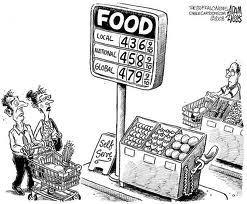
Move over, energy costs … Here come higher food prices.

Higher food prices like higher energy pricesIf it seems as if food prices have been increasing at a faster clip in recent months, you’re not dreaming.

Despite an overall inflation rate that seems low (although the federal government’s controversial exclusion of certain key components like gasoline makes its stats suspicious at best), we now have solid evidence that worldwide food cost increases are happening across the board.

Here’s a list of some of the most dramatic cost increases for key foodstuffs recorded since May 2010:

 Coconut oil: +134%
 Corn/maize: +111%
 Wheat: +75%
 Coffee: +70%
 Sugar: +55%
 Soybeans: +45%
 Palm oil: +42%
 Orange juice: +35%
 Beef and pork: +20%

Considering that this represents a time period of just a little over a year, these increases are some the largest recorded in decades.

What caused it to happen? Poor weather and bad harvests are two of the reasons. But high demand from developing countries – particularly China – is another important factor.

“This is a pretty sustainable increase … A number of factors have been building over time in terms of the commodity increase: world economic growth, rising crude oil prices, increased Chinese import demand have all conspired,” is how Bill Lapp, president of commodity analytical company Advanced Economic Solutions, puts it.

Unfortunately, the problem promises to persist, since many of the items above are ingredients that go into other prepared food items. Initially, packaged food makers that had locked in purchases for some items over certain time periods were able to delay delay passing on cost increases because of those hedges. But the bulk of those contracts have run their course by now.

So, even if commodity prices don’t go any higher, we’re likely to see the ripple effects in pass-along price increases all throughout the “food chain” in the months to come.

This isn’t news anyone wants to hear, considering how fragile (non-existent?) the economic recovery is here in the U.S. and in many other countries as well.

The sober truth is, high food costs coupled with increased energy prices have a chokehold on the world economy that is more consequential than many would care to admit.

Fasten your seatbelts, folks. We may be in for yet another wild ride on the economic roller-coaster …

The Twitter Machine: Keeping Hype Alive

Americans' Twitter usage isn't getting anywhere near Facebook'sI’ve blogged before about Twitter’s seeming inability to break out of its “niche” position in communications. We now have enough time under our belt with Twitter to begin to draw some conclusions rather than simply engage in speculation.

Endlessly hyped (although sometimes correctly labeled as a revolutionary communications tool – see the North African freedom movements) the fact is that Twitter hasn’t been adopted by the masses like we’ve witnessed with Facebook.

The Pew Research Center’s Internet & American Life Project estimates that fewer than 10% of American adults who are online are Twitter users. That equates to about 15 million Americans, which is vastly lower than Twitter’s own claims of ~65 million users.

But whether you choose to believe the 15 million or the 65 million figure, it’s a far cry from the 150+ million Americans who are on Facebook – which represents about half of the entire American population.

You can find a big reason for Pew’s discrepancy by snooping around on Twitter a bit. It won’t take you long to find countless Twitter accounts that are bereft of any tweet activity at all. People may have set their acount up at one time, but long ago lost interest in using the platform – if indeed they ever had any real Twitter zeal beyond “follow-the-leader.” (“Everybody’s going on Twitter … shouldn’t I sign up, too?”)

This is the purest essence of hype: generating a flurry of interest that quickly dissipates as the true value (or lack thereof) is discerned by users.

Of course, Twitter does have its place. Some brands find the platform to be a good venue for announcing new products and sales deals. And it doesn’t take long for the best of those deals promoted on Twitter to leech their way into the rest of the online world.

Other companies – although far fewer – are using Twitter as a kind of customer service discussion board.

And as we all know, celebrities l-o-v-e their Twitter accounts. What a great, easy way to generate an endless stream of sound-bite information about their favorite topic: themselves.

Analyses of active Twitter accounts have shown that a sizable chunk of the activity is made up of media properties and brands tweeting each other … a lot of inside-the-park baseball.

What’s missing from the equation is the level of “real people” engagement one can find on Facebook in abundance … and maybe soon on Google+ as well. That’s real social interaction – in spades.

Actually, you mightn’t be too far off the mark if you deduced that Twitter is the digital equivalent of a bunch of industry insiders at a cocktail party … saying little of real importance while trying to appear “impressive” and “hip” at the same time.

But who’s being fooled by that?

Home Ownership as an Investment Comes Under Fire

Home ownership isn't quite the financial investment many think it is.
Home ownership as a foolproof way to financial well-being? Think again.
Here’s an interesting statistic: Market observers including Deloitte and Oxford Economics estimate that there are ~10.5 million households in the United States that have a net worth of $1 million or more. (The number is calculated including the primary home.)

I for one was a bit surprised by the number, figuring it might be higher.

But here’s another interesting number – and one that explains a lot: There were ~12.7 million such “millionaire households” in America back in 2006.

The difference? Housing property values, of course. They’ve declined by ~15% since 2006 … which makes it little surprise that the number of millionaire households in the country has dropped by a similar percentage.

Over past several years we’ve witnessed millions of homeowners become upside down in their home mortgages. For this reason alone, it would be nice if more people’s net worth wasn’t so tied up in houses.

It’s as if we’re all farmers, the ultimate “land poor” demographic group.

Many people have an aversion to other types of investment, pointing to a stock market that has seen little net upward movement over the past decade. Others simply prefer a solid asset like owning property – or maybe gold.

But if the past few years have taught us anything, it’s that home ownership isn’t always the road to financial well-being.

In fact, real estate specialist and Wall Street Journal editor David Crook wrote an article recently (“Why Your Home Isn’t the Investment You Think It Is“) which spells out a pretty convincing argument that home ownership doesn’t work as the best investment vehicle.

And that’s not just by looking over the past few years … but over the past several decades.

It’s a thought-provoking article that’s well worth a read.