U.S. Green Energy: Sizzle? … or Fizzle?

Impending doom for Green Energy?  The economic model isn't working.Tempting as it may be to dismiss Solyndra, Solar Power, Beacon Energy, SpectraWatt and other recent horror stories regarding “energy subsidies gone bad” as just examples of governmental ineptitude resulting from overly exuberant ideological thinking coupled with political favoritism … it turns out that these events are also emblematic of a much more fundamental challenge to green energy prospects.

A report released last week warning of problems on the horizon for green energy bears this out. The report, titled “Beyond Boom and Bust,” is a collaborative effort between the Brookings Institution, the Breakthrough Institute and the World Resources Institute (WRI), and was authored by six researchers associated with these organizations.

According to the report, the federal government’s involvement in the renewable energy marketplace has led to an unsustainable system. Among the study’s key conclusions are these eye-opening points:

 Nearly all “clean” tech segments in the U.S. remain reliant on production and deployment subsidies or other policies designed to facilitate gaining an expanding foothold in today’s energy market.

 Many of the nearly 100 individual policies and subsidies that undergird clean energy – grants, tax credits, loan guarantees and the like – are getting ready to expire, with the potential for dire consequences. To illustrate: Total federal spending on the clean tech sector was more than $44 billion in 2009, but would shrink to only ~$11 billion in 2014.

 In the absence of legislation to extend or replace current green energy subsidies, America’s clean tech policy system will be largely dismantled as of the beginning of 2015 because of the scheduled expiration of ~70% of the policy provisions.

In the current political and legislative climate, it’s doubtful that many of the current policies can be expanded or replaced. And even if this could happen, the report sheds doubt on whether such policies can be successful:

“The maintenance of perpetual subsidies is not a sustainable solution to the new challenges facing the U.S. clean tech industry. Clean tech markets in America have lurched from boom to bust for decades, and the root cause remains the same: the higher costs and risks of emerging U.S. clean tech products relative to either incumbent fossil energy technologies or lower-cost international competitors, which makes U.S. clean tech sectors dependent on subsidy and policy support.”

The report makes a number of recommendations for ushering in a “new era” of clean energy policy. Among these are:

 Foster establishment of a competitive market – development policies should create market opportunities for advanced clean energy technologies while fostering competition between technology firms.

 Create market incentives that demand and reward continuing improvement in technology performance and cost.

 Avoid technology lockout and promote a diverse energy portfolio.

Also, the authors emphasize the need for a “new national conversation” to determine the best route forward to accelerate technology improvements and cost reductions in clean tech sectors.

It would be nice if that conversation could start right now. But in an election year … don’t bank on it.

What people say: More believable than what brands say.

Word of mouth and review/ratings sites trump branding activityWord of mouth has always been a powerful influencer over the success or failure of a product in the market. So when surveys show that consumers value the opinion of their friends most when it comes to the value of a product, there’s nothing particularly unusual about that news.

But consider the explosion in the popularity of review sites like Angie’s List and Yelp, plus other sources of information and opinion in cyberspace over the past few years. These have made it possible to access the opinions of significantly more people than ever before.

Nielsen’s most recent Global Trust in Advertising Survey, which queried ~28,000 consumers around the world in late 2011, found that ~92% of respondents trust word-of-mouth recommendations from friends and family members.

Interestingly, that percentage is actually up from 2007, when Nielsen found ~75% of respondents trusting their friends as a good source of information.

What about online consumer reviews written by complete strangers? Consumers’ trust levels in those information sources has also gone up; it’s ~70% today compared to ~55% back in 2007.

The picture is different with branding and advertising, however. Trust in traditional advertising (TV, radio, magazines and newspapers) has dropped in recent years. Today, only about 47% of Nielsen survey respondents say they trust those sources of information.

Online advertising has actually improved its standing with consumers, but trust levels are still mired in the 30s: 36% trust online video ads … ~33% trust online banner ads … ~39% trust paid search engine advertising.

And when it comes to branded content like company websites, consumer trust in these “owned media” is running below 60%, while e-mail communiqués are scoring even lower on the trust scale (around 50%).

The Nielsen survey results underscore why developing a robust social media presence has become such an important strategy for so many brands. Clearly, recommendations and reviews from friends and strangers alike is having the strongest impact on the purchase decisions that are being made.

Of course, building a social media presence is only half the battle: Whether the content is positive, neutral or negative has huge implications as well. A few negative reviews or ratings can stop a purchaser dead in his or her tracks. Just ask anyone in the hospitality industry, whose establishments are in some senses almost held hostage by TripAdvisor and other rating sites.

Vacation time? What’s that?

Americans not taking their vacation daysIf you’ve been wondering if you’re the only chump in the business world who never takes advantage of all the vacation days you’re due … it turns out you’ve got lots of company.

We have three separate surveys conducted within the past six months that point to the same conclusion: American workers are the great ones for skipping their vacation time.

In a survey conducted by Kelton Research for the Radisson hotel chain, American workers reported that they are granted an average of 18 vacation days per year. But in 2011, nearly half of the ~1,000 survey respondents took 50% or fewer of their allotted vacation days.

A startling finding for sure. But Harris Interactive discovered a similar result in its American Travel Behavior Survey conducted for Hotwire.com. That survey of ~2,000 adult workers fielded in late 2011 found that the average American employee left more than six days of paid vacation “on the table” at the end of the year.

Lastly, a survey conducted for JetBlue Airlines in September 2011 found that nearly 60% of the ~1,100 workers polled didn’t use all of their allotted paid vacation days.

The average number of days not taken? In this survey, it was a whopping 11 days.

Why are so many people taking so few vacation days? Especially when it’s something nearly every social psychologist says is important for a healthy balance between work and social life?

The survey findings give us tantalizing clues: It’s a combination of “taking one for the team” and just plain “fear”:

 Excessive workload raises the “guilt level” for taking vacation time.

Concern about asking for vacation days even when the time is due, because of lean office staffing and how the time off will affect work colleagues.

 Reluctance to play “catch-up” in the workplace following a vacation. Overstuffed e-mail inboxes are just the beginning.

 Concern about job security in a time of high unemployment.

Looking ahead, will workers will start taking more of the vacation days they’re due? If these surveys are a correct barometer, the answer is a firm “No.”

U.S. Government Driving Pecan Growers and Pecan Buyers Nuts

Pecan harvestingThose who contend that the Federal government has no business managing the nation’s healthcare system because it can’t even manage its way out of a paper bag got fresh ammunition this past week.

The Wall Street Journal published an article chronicling how incorrect government data has wreaked havoc in the pecan industry. Evidently, the government vastly overstated the amount of pecan exports to Asian countries and other destinations in 2010 and 2011.

The relatively small size of the U.S. pecan industry (just shy of $700 million production) means that there isn’t a futures market for the crop. Instead, pecan buyers look at trade statistics to determine whether demand will be strong or weak – and lock in purchase contracts accordingly.

When U.S. trade stats purported to show heavy overseas shipments – and with the Chinese market ramping up purchases for the Lunar New Year celebrations – pecan buyers locked in their purchases early. And pecan growers in the Eastern U.S., where the crop is harvested first, did well with supplying the product at these lucrative prices.

But when the “phantom demand” from overseas failed to materialize, pecan prices tumbled. Growers in the Midwest and West found themselves facing pecan prices nearly half the levels of just a few weeks earlier.

The culprit? The Federal government, which published the completely bogus trade figures based on “a computer malfunction” at the Census Bureau’s foreign trade division.

“There were internal processing errors,” division chief Nick Orsini reported.

When and how did the government find this out? Not until one of the industry’s buying firms questioned the figures and reported its concerns to the agency.

The foreign trade division’s “internal processing errors” have since been fixed. But in its wake is a trail of debris that reaches into every corner of the pecan industry.

Some buyers are miffed because they were led to lock in purchases when the market was at its peak, wasting hundreds of thousand of dollars on high-priced buying.

Midwestern and Western growers who harvest later in the season found themselves having to sell their crop at a deep loss, the market having crashed. So they’re not happy campers, either.

One thing’s for certain: Everyone in the pecan industry now knows what it’s like to be burned. And because it’s the government … there’s nothing anyone can do about it.

Oh sure, the National Pecan Shellers Association sent an official letter to Federal officials outlining its concens with the faulty data … but that promises to have as much impact as a pecan tree falling in the forest.

And from the Federal officials’ point of view, what’s the big whoop, anyway? What sort of political clout to these people have?

After all, it’s just a ~$680 million industry.

About on par with Solyndra.

Gut Check for the American People

Heartland-Monitor-PollAfter being whipsawed by sharp economic headwinds over the past few years, how exactly do “regular people” see their position in the grand scheme of things?

We now have a reading in the form of the “Heartland Monitor” poll, a field study commissioned by Allstate Insurance Company and conducted by National Journal magazine, which queried ~1,200 middle-income Americans on a variety of topics pertaining to the U.S. economy and family finances.

The findings are an interesting blend of persistent optimism tempered by cold, hard reality. On the “sober” side of things:

 Nearly two-thirds of respondents feel that they face more economic risks today than their parents did at the same age.

 Nearly half reported that they’ve made significant reductions in spending over the past year, including putting off major purchases.

 About one-third have withdrawn funds from savings or pension funds to make ends meet.

 Approximately one-fourth have reduced contributions to their pension or retirement funds.

Beyond this, only about one-quarter of the respondents reported that they haven’t faced significant negative changes in their lifestyle or financial security.

But on the other hand, even fewer (15%) have reported falling behind on mortgage or rent payments.

Now for some viewpoints that reflect the perennial optimism of middle-class Americans:

 Nearly 9 in 10 respondents feel that America is still a land of opportunity.

 More than 55% believe that the U.S. economy will improve over the coming year (versus around 35% who believe it will worsen).

 Nearly three-fourths of respondents believe that owning a home helps rather than hinders living the American dream.

When it comes to retirement, middle-class Americans seem to be looking at things with harsh realism. Respondents who are near retirement age expect to retire six years later than those who are already retired. And a clear majority believe that they’ll retire at a later age than their parents did.

Here’s an even more interesting finding from the survey: Even in retirement, about three-fourths of the respondents anticipate that they’ll continue to work.

By that forecast alone, we can see that the very definition of retirement is changing.

More results from the Allstate/National Journal Heartland Monitor poll can be found here. It’s an interesting read.

Is our hyper-connected world changing us for the better, or the worse? Pew looks for answers.

One of the great questions about the digital and interactive age is how it may be affecting the way people fundamentally think and behave.

The Pew Research Center’s Internet & American Life Project has been studying this question, too. In late 2011, Pew queried a group of technology experts and stakeholders and asked them to prognosticate on the impact of hyper-connectivity on today’s younger generation.

It is the fifth in a series of surveys conducted by Pew on “The Future of the Internet.”

The question posed to these experts was: Looking out to the year 2020, will the younger generation’s “always-on” connection to people and information turn out to be a net positive or a net negative?

And the consensus response to this question is … no consensus at all. In fact, the experts broke down in roughly equal camps on either side of the issue.

The optimists believe that:

 The brains of teens and young adults will be “wired” differently from their older counterparts … but this will yield positive results.

 They will not suffer any notable shortcomings as they cycle quickly through work-related and personal tasks.

 They will be more adept at finding answers to questions, and will be learning more precisely because they can search effectively and access collective information in cyberspace.

An equal proportion of experts holds a decidedly less optimistic view of the future. Their opinion is closer to this:

 Even though teens and young adults will be “wired” differently than their older counterparts, they will not become more knowledgeable as a result.

 They will use cyberspace not to become better informed, but to be “faster” informed.

 Instead of becoming better educated and better informed, they will depend on the Internet and mobile devices to deliver quick results, with little retention, introspection or further study.

 They will spend most of their energy sharing short social messages, being entertained, and being distracted away from a deep engagement with knowledge and with people.

Here’s a link to the Pew report summary, and the results are well worth reviewing.

As for my own view, it seems to me that the environment we’ll see in 2020 is probably somewhere in between these two posts.

It’s true that many people will interact with digital technology in ways that have little to do with any sort of hard, intellectual labor. But is that so different from what we’ve seen in society in general over the past half-century?

There are thought leaders. There are thought consumers. And then there are the clueless. The digital tools and techniques people choose to use just make it easier to play in whatever league they wish.

It reminds me of that old adage about the three types of people found in the world: Those who make things happen … those who watch things happen … and those who wonder what happened. (And there are precious few people who fall into the first group.)

The fact is, no degree of Internet connectivity and social interactivity is going to change fundamental human nature. It doesn’t matter whether we’re hyper-connected or not.

… But let’s hear some different perspectives from others …

When “Push” Comes to “Pull” in Marketing

Push versus pull marketing.  "Push" has the upper hand now.
"Push" vs. "pull" marketing: Does "pull" have the upper hand now?
It’s clear that social media is delivering a wide range of interesting and beneficial online experiences for people. One that’s among the most highly valued is the ability to “vet” products, services and brands through reading reviews posted by “real people.”

According to a survey of ~3,330 consumers conducted in late 2011 by Deloitte’s Global Consumer Products Group, a large majority of consumers report that they rely on user reviews to guide their purchase decisions, rather than merely being influenced by brand advertising.

The Deloitte survey found that nearly two-thirds of consumers read consumer-written product reviews online. Of that group, 82% report that their purchase decisions have been directly influenced by these reviews – either confirming their decision to buy or causing them to switch to an alternative product or service.

Because of the perceived value of these consumer reviews, most people begin their search for information via a search engine query or by going to blogs, e-commerce sites such as Amazon that also feature consumer reviews, or review sites like TripAdvisor and Yelp.

By contrast, the incidence of people beginning their information quest at a company or brand website is far lower.

These dynamics are part of the reason why so many companies and brands are looking to increase their engagement with the online public. They’re particularly keen on ferreting out their natural allies – people who have a strong positive opinions about their brand – and turning them from armchair advocates into vocal cheerleaders.

For many marketers, this means going well-beyond collecting “likes” and similar “trophy counts.” They’re also continually monitoring comments in the social sphere concerning the quality of their products and customer service in order to make sure they deal with any issues or complaints expeditiously in order to minimize negative fallout in the “review” environment.

There’s also a powerful impulse for brands to offer “incentives” to customers in exchange for posting positive reviews. Those incentives can range from the small or innocuous – offering discount coupons or inexpensive product samples – all the way to incentives that seem more like bribes. (Here’s the latest example of this, courtesy of Honda.)

The keen attention companies are paying to social platforms reminds us that we’re in the midst of a migration away from traditional “push” marketing into a land of “pull” marketing.

There have always been “push” and “pull” aspects to marketing, advertising and PR, of course. But the balance of energy these days appears to be shifting quite sharply in the direction of “pull.”

There’s no reason to think that pattern will change anytime soon.

Amazon continues to push the envelope … while pushing books right off the table.

Amazon Kindle continues to push the envelope in book publishingIt’s hard to deny that the growth and success of Amazon has had a huge impact on the book industry. The liquidation of Borders Books is just the latest evidence of that.

But other market moves by Amazon demonstrate that the company has set its sights on far more than just owning the traditional retail book and recorded music segments. The introduction of the Kindle e-reader and release of subsequent newer, cheaper models proves that Amazon seeks to dominate the “information” space no matter what form it takes.

Two recent developments show how this is continuing to happen. First, the company announced that it is launching a new public-library feature that gives the Kindle the same library-borrowing abilities as competing e-reader devices like the Nook offer.

Public libraries have taken notice of the announcement, because Kindle so dominates the e-reader market. According to Forrester Research, an estimated 7.5 million Kindles are being used in America; that’s about two-thirds of all e-readers in the country.

Already, large public library systems such as those in Chicago and New York offer free digital-book lending. A trip to the library is not needed. Instead, patrons simply use their library card ID numbers to download books from the library’s website.

As with conventional “paper and glue” books (I love that new term!), there are “lending periods” for e-books usually ranging 2-3 weeks. Libraries purchase the e-books from publishers as they do bound books, and only one borrower can check out an e-title at a time.

How are Amazon’s latest e-lending developments affecting book publishers? For one thing, e-books never wear out, which means publishers (and authors) can’t benefit from reorders of popular titles due to book wear. Partially for this reason, several major publishers such as Simon & Schuster and Macmillan don’t sell their digital works to libraries … yet.

Adam Rothberg, senior vice president and director of corporate communications at Simon & Schuster, commented, “We value libraries for their work of encouraging literacy and the habit of reading, but we haven’t yet found a business model we’re comfortable with.”

Another publisher, HarperCollins, decided to set a checkout limit for each title of 26 times, after which a library would need to repurchase the book in order to continue lending it out.

Not surprisingly, that policy has been greeted with hoots and catcalls by the library industry.

Regardless of the selling policies under consideration, one wonders how much longer the major publishers can continue to hold out, as the entry of market-dominant Kindle should significantly raise consumer demand for library e-titles.

And in another move that is sure to shake up another segment of the book world – educational textbooks – Amazon announced several weeks ago that it has opened up a “textbook store” for the Kindle platform. That store is already offering thousands of textbook titles for rental, with many more in the offing.

Here’s how it works: Amazon will allow buyers to acquire textbooks at a deep-discount off of the standard print pricing. The charge will be based on the amount of time the student plans to hold the book – with a minimum rental period of 30 days (which can be extended, if desired).

And to further sweeten the pot, borrowers will be able to access any “notes” and “highlights” they’ve made to their texts even after they’ve “returned” the textbooks.

I’ve blogged before about the college textbook publishing segment — a niche some see as an unholy alliance between book publishers and college bookstores that more resembles a “racket” than a fair business model.

Charging ridiculously high textbook prices along with releasing suspiciously frequent “updated” new editions that change perhaps 2% or less of a book’s content have been all too common.

Moves by Amazon – along with similar programs introduced by smaller providers like Chegg, Inkling and Kno – may finally usher in an end to the indefensibly high prices of textbooks that have long been the bane of students (and their parents). And no one is mourning that.

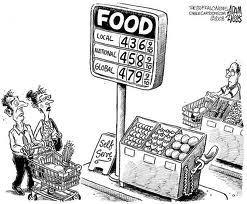
Move over, energy costs … Here come higher food prices.

Higher food prices like higher energy pricesIf it seems as if food prices have been increasing at a faster clip in recent months, you’re not dreaming.

Despite an overall inflation rate that seems low (although the federal government’s controversial exclusion of certain key components like gasoline makes its stats suspicious at best), we now have solid evidence that worldwide food cost increases are happening across the board.

Here’s a list of some of the most dramatic cost increases for key foodstuffs recorded since May 2010:

 Coconut oil: +134%
 Corn/maize: +111%
 Wheat: +75%
 Coffee: +70%
 Sugar: +55%
 Soybeans: +45%
 Palm oil: +42%
 Orange juice: +35%
 Beef and pork: +20%

Considering that this represents a time period of just a little over a year, these increases are some the largest recorded in decades.

What caused it to happen? Poor weather and bad harvests are two of the reasons. But high demand from developing countries – particularly China – is another important factor.

“This is a pretty sustainable increase … A number of factors have been building over time in terms of the commodity increase: world economic growth, rising crude oil prices, increased Chinese import demand have all conspired,” is how Bill Lapp, president of commodity analytical company Advanced Economic Solutions, puts it.

Unfortunately, the problem promises to persist, since many of the items above are ingredients that go into other prepared food items. Initially, packaged food makers that had locked in purchases for some items over certain time periods were able to delay delay passing on cost increases because of those hedges. But the bulk of those contracts have run their course by now.

So, even if commodity prices don’t go any higher, we’re likely to see the ripple effects in pass-along price increases all throughout the “food chain” in the months to come.

This isn’t news anyone wants to hear, considering how fragile (non-existent?) the economic recovery is here in the U.S. and in many other countries as well.

The sober truth is, high food costs coupled with increased energy prices have a chokehold on the world economy that is more consequential than many would care to admit.

Fasten your seatbelts, folks. We may be in for yet another wild ride on the economic roller-coaster …

The Twitter Machine: Keeping Hype Alive

Americans' Twitter usage isn't getting anywhere near Facebook'sI’ve blogged before about Twitter’s seeming inability to break out of its “niche” position in communications. We now have enough time under our belt with Twitter to begin to draw some conclusions rather than simply engage in speculation.

Endlessly hyped (although sometimes correctly labeled as a revolutionary communications tool – see the North African freedom movements) the fact is that Twitter hasn’t been adopted by the masses like we’ve witnessed with Facebook.

The Pew Research Center’s Internet & American Life Project estimates that fewer than 10% of American adults who are online are Twitter users. That equates to about 15 million Americans, which is vastly lower than Twitter’s own claims of ~65 million users.

But whether you choose to believe the 15 million or the 65 million figure, it’s a far cry from the 150+ million Americans who are on Facebook – which represents about half of the entire American population.

You can find a big reason for Pew’s discrepancy by snooping around on Twitter a bit. It won’t take you long to find countless Twitter accounts that are bereft of any tweet activity at all. People may have set their acount up at one time, but long ago lost interest in using the platform – if indeed they ever had any real Twitter zeal beyond “follow-the-leader.” (“Everybody’s going on Twitter … shouldn’t I sign up, too?”)

This is the purest essence of hype: generating a flurry of interest that quickly dissipates as the true value (or lack thereof) is discerned by users.

Of course, Twitter does have its place. Some brands find the platform to be a good venue for announcing new products and sales deals. And it doesn’t take long for the best of those deals promoted on Twitter to leech their way into the rest of the online world.

Other companies – although far fewer – are using Twitter as a kind of customer service discussion board.

And as we all know, celebrities l-o-v-e their Twitter accounts. What a great, easy way to generate an endless stream of sound-bite information about their favorite topic: themselves.

Analyses of active Twitter accounts have shown that a sizable chunk of the activity is made up of media properties and brands tweeting each other … a lot of inside-the-park baseball.

What’s missing from the equation is the level of “real people” engagement one can find on Facebook in abundance … and maybe soon on Google+ as well. That’s real social interaction – in spades.

Actually, you mightn’t be too far off the mark if you deduced that Twitter is the digital equivalent of a bunch of industry insiders at a cocktail party … saying little of real importance while trying to appear “impressive” and “hip” at the same time.

But who’s being fooled by that?