Chief Marketing Officers and the revolving door.

If it seems to you that chief marketing officers last only a relatively short time in their positions, you aren’t imagining things.

The reality is, of all of the various jobs that make up senior management positions at many companies, personnel in the chief marketing officer position are the most likely to be changed most often.

To understand why, think of the four key aspects of marketing you learned in business school: Product-Place-Price-Promotion.

Now, think about what’s been happening in recent times to the “4 Ps” of the marketing discipline. In companies where there are a number of “chief” positions – chief innovation officers, chief growth officers, chief technology officers, chief revenue officers and the like – those other positions have encroached on traditional marketing roles to the extent that in many instances, the CMO no longer has clear authority over them.

It’s fair to say that of the 4 Ps, the only one that’s still the clear purview of the CMO is “Promotion.”

… Which means that the chief marketing officer is more accurately operating as a chief advertising officer.

Except … when it comes to assigning responsibility (or blame, depending on how things are going), the chief marketing officer still gets the brunt of that attention.

“All the responsibility with none of the authority” might be overstating it a bit, but one can see how the beleaguered marketing officer could be excused for thinking precisely that when he or she is in the crosshairs of negative attention.

Researcher Debbie Qaqish at The Pedowitz Group, who is also author of the book The Rise of the Revenue Marketer, reports that as many as five C-suite members typically share growth and revenue responsibility inside a company … but the CMO is often the one held responsible for any missed targets.

With organizational characteristics like these, it’s no wonder the average CMO tenure is half that of a CEO (four years versus eight). Research findings as reported by Neil Morgan and Kimberly Whitler in the pages of the July 2017 issue of the Harvard Business Review give us that nice little statistic.

What to do about these issues is a tough nut. There are good reasons why many traditional marketing activities have migrated into different areas of the organization.  But it would be nice if company organizational structures and operational processes would keep pace with that evolution instead of staying stuck in the paradigm of how the business world operated 10 or 20 years ago.

Rapid change is a constant in the business world, and it’s always a challenge for companies to incorporate changing responsibilities into an existing organizational structure.  But if companies want to have CMOs stick around long enough to do some good, a little more honesty and fairness about where true authority and true responsibility exist would seem to be in order.

Employee churn rates underscore the volatile nature of e-mail contact databases.

Most marketers are well-familiar with the challenges of e-mail list maintenance. In the business-to-business world in particular, e-mail databases can become pretty stale pretty quickly, due to the horizontal and vertical movement of employees inside organizations as well as jumping to other companies.

Whether they’re moving up or out, often they’re no longer good prospects.

Based on my experience, my personal rule of thumb has been that approximately one-fifth of any given list of B-to-B names will “churn” within a 12-month period, meaning that any such contact database will rapidly lose its effectiveness unless assiduously maintained.

And now we have a new report from Salesforce Research that confirms this basic rule of thumb.

Salesforce looked to LinkedIn, exploring this social platform’s data from more than 7 million records over a 48-month period to gauge the lifecycle of the typical “persona.”

The research considered not only changes that result in the deactivation of an e-mail address, but also circumstances where individuals may keep the same e-mail address but still should be removed as a target because a horizontal or vertical change within the same organization places them in a different employee function.

What the new research found was that the average annual B-to-B churn rate for such “personas” is ~17%.

That figure turns out to be fairly close to my basic rule of thumb based on years of observing not only e-mail contact databases, but also the postal mail databases we’ve worked with in my company or with our clients.

Beyond the broad average, there are some small but meaningful differences in the B-to-B churn rate depending on the product focus and on the type of employee function.

In high-tech fields, the average annual churn rate is higher than the average. And it’s across the board, too:  23% churn in marketing … 20% in sales and in HR personnel … 19% in IT, and 18% in finance.

People employed in the retail and consumer products industries also clock in at or higher than the overall churn average, but the annual churn rate is a tad lower in the medical and transportation fields.

Another interesting finding from the Salesforce evaluation is that annual churn rates are somewhat lower than the average for personnel at director levels and higher in companies (around 15%). For managers, the churn rate matches the overall average, while “worker bees” have a higher churn rate averaging around 20%.

Considering the critical importance of e-mail marketing efforts in the B-to-B environment, Salesforce’s finding that it takes only 4.2 years for an e-mail database to churn completely means that the value of these marketing assets will decline dramatically unless cultivated and maintained on an ongoing basis.

The volatile nature of e-mail contact databases also helps explain why so many companies have adopted a multi-channel approach to marketing, including interacting on social media platforms. Yes, those platforms do have their place in the B-to-B world …

The full report of the Salesforce findings can be downloaded here.

Suddenly, smartphones are looking like a mature market.

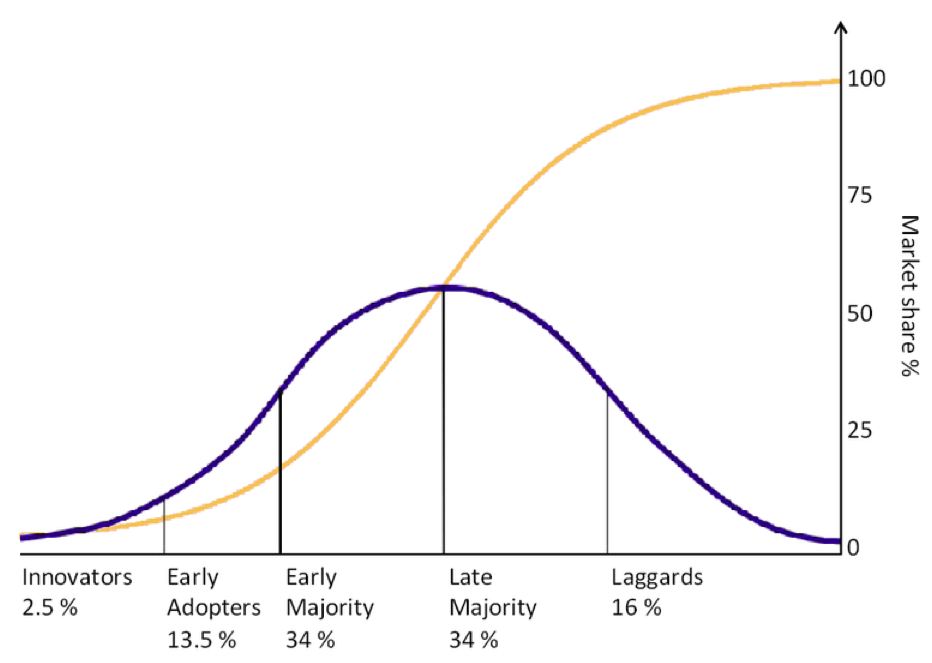
The smartphone diffusion curve. (Source: Business Insider)

In the consumer technology world, the pace of product innovation and maturation seems to be getting shorter and shorter.

When the television was introduced, it took decades for it to penetrate more than 90% of U.S. households. Later, when color TVs came on the market, it was years before the majority of households made the switch from black-and-white to color screens.

The dynamics of the mobile phone market illustrate how much the pace of adoption has changed.

Only a few years ago, well-fewer than half of all mobile phones in the market were smartphones. But smartphones rapidly eclipsed those older “feature phones” – so that now only a very small percentage of cellphones in use today are of the feature phone variety.

Now, in just as little time we’re seeing smartphones go from boom to … well, not quite bust.  In fewer than four years, the growth in smartphone sales has slowed from ~30% per year (in 2014) to just 4%.

That’s the definition of a “mature” market.  But it also demonstrates just how successful the smartphone has been in penetrating all corners of the market.

Consider this:  Market forecasting firm Ovum figures that by 2021, the smartphone will have claimed its position as the most popular consumer device of all time, when more than 5 billion of them are expected to be in use.

It’s part of a larger picture of connected smart devices in general, for which the total number in use is expected to double between now and 2021 – from an estimated 8 billion devices in 2016 to around 15 billion by then.

According to an evaluation conducted by research firm GfK, today only around 10% of consumers own either an Amazon Echo or Google Home device, but digital voice assistants are on the rise big-time. These interactive audio speakers offer a more “natural” way than smartphones or tablets to control smart home devices, with thousands of “skills” already perfected that allow them to interact with a large variety of apps.

There’s no question that home devices are the “next big thing,” but with their ubiquity, smartphones will continue to be the hub of the smart home for the foreseeable future.  Let’s check back in another three or four years and see how the dynamics look then.

United Airlines’ four miscalculations — and the $200 million impact.

Just how many mistakes did United Airlines make in “re-accommodating” four of its booked passengers recently? Oh, let us count the ways …

Miscalculation #1

Despite some reports to the contrary, technically United Airlines wasn’t in an overbooking or oversold situation. The flight boarded full; then some crew assigned to a future flight from the destination city turned up suddenly.

The airline’s first mistake was failure by its managers or staff to correctly anticipate the crew that needed to travel on this flight.

 Miscalculation #2

Their second mistake was to implement an operating procedure which gives crew higher priority than paying customers.

Because all customers had already taken their seats on the airplane, and no more seats were available, this meant that the airline’s staff had to ask — or coerce — some seated customers to leave.

Miscalculation #3

United’s third mistake was management’s failure to empower the airline’s gate agents to offer higher compensation in order to entice customers to leave voluntarily.

This miscalculation guaranteed that the victims would be “paying customers” who had done nothing wrong, rather than the airline’s managers and staff who had made all the mistakes.

Miscalculation #4

When choosing its victims, everything else being equal apparently, United Airlines and its regional partners like United Express go after the lowest-paying customers first. That too is a miscalculation.

Let’s explore this a bit further. According to the latest published data I could find, on average around 40% of passengers on the typical flight are traveling using heavily-discounted tickets.  Most of those tickets are non-refundable, and prepaid.  They can be changed ahead of time, but only if the customer pays change fees which can be very costly.

This means:

  • If the passenger doesn’t change his or her booking early enough, and doesn’t show up for the flight, the airline keeps all the revenue – and has the possibility of re-selling the seat to a different passenger.
  • Otherwise, the airline keeps the original revenue, plus the change fee. For United, this amounted to $800 million of additional revenue in the year 2015 alone.

Phony Risk?

Airlines justify their overbooking and overselling tactics as a way of reducing the risk of revenue lost from no-shows. Published data indicates that approximately 15% of confirmed reservations are no-shows. Assuming that the airline bears the full risk of revenue lost from no-shows, overbooking mitigates that risk by allowing other passengers to claim and pay for seats that would otherwise fly empty.

Airlines typically overbook about 12% of their seats, counting on no-shows to match load-to-seats, or later cancellations to reduce bookings. (Failure to correctly anticipate the number of no-shows would also qualify as a mistake by the airline’s management or staff.)

All that being said, however, in most discounting situations there is no “risk” to reduce, because most customers who buy discounted tickets already bear all the financial risks from a failure to show up for flights. If passengers are unable to fly when originally planned, they must either pay steep change fees … or they forfeit the entire fare paid.

The Real Risk

In fact, the airlines’ biggest risk of revenue loss from no-shows arises from passengers paying first class, business class or full-fare economy.

These types of tickets account for approximately 25% of passengers and 50% of ticket revenues.  Yet those passengers typically incur few if any cancellation fees or penalties if or when they don’t show up.

When enterprises like United try to have it both ways – by putting themselves ahead of their customers and gaming the system to maximize revenues without incurring any apparent financial risks – is it any wonder the end result is ghastly spectacles like passengers being forcibly dragged off airplanes?

Scenes like that are the predictable consequences of greed overtaking sound business management and ethics. You don’t have to think too hard to come up with other examples of precisely the same thing — Wells Fargo’s “faux” bank account setups being another recent corporate black-eye.

I’m sure if United Airlines had it to do all over again, it would have cheerfully offered up to $10,000 per ticketed passenger to get its four flight crew members off to Louisville, rather than suffer more than a $200 million net loss in share value of its company stock over the past week.

But instead, United Airlines decided on a pennywise/pound-foolish approach.

How wonderful that turned out to be for everyone.

In copywriting, it’s the KISS approach on steroids today.

… and it means “Keep It Short, Stupid” as much as it does “Keep It Simple, Stupid.”

Regardless of the era, most successful copywriters and ad specialists have always known that short copy is generally better-read than long.

And now, as smaller screens essentially take over the digital world, the days of copious copy flowing across a generous preview pane area are gone.

More fundamentally, people don’t have the screen size – let along the patience – to wade through long copy. These days, the “sweet spot” in copy runs between 50 and 150 words.

Speaking of which … when it comes to e-mail subject lines, the ideal length keeps getting shorter and shorter. Research performed by SendGrid suggests that it’s now down to an average length of about seven words for the subject line.

And the subject lines that get the best engagement levels are a mere three or four words.

So it’s KISS on steroids: keeping it short as well as simple.

Note: The article copy above comes in at under 150 words …!

Some good news for the U.S. Postal Service for a change …

psThe U.S. Postal Service has just implemented a price adjustment on first class letter mail – the first rate increase in quite a few years. Some other pricing adjustments have been implemented as well, but on the whole they are modest.

Hopefully the rate increases won’t throw water on the good news that the USPS experienced over the holiday season. According to a Rasmussen Reports consumer survey of ~1,000 American adults age 18 and over conducted at the end of December, Americans used the USPS more in the most recent holiday than in the 2015 season.

The public also continues to give the USPS higher marks than its major competitors – FedEx and UPS – on the way it handles their packages.

For the record, ~21% of the respondents surveyed by Rasmussen reported that they used the U.S. Postal Service more this holiday season than they have in previous years, while ~18% reported they used it less. The remaining ~61% kept their USPS usage at around the same level of activity.

On the commercial side, for many businesses who do not have the kind of high volume shipping needs to qualify for special pricing from FedEx or UPS, the USPS also appears to be a far more lucrative choice from a price-to-value relationship.

usIn mid-2015, FitSmallBusiness.com undertook apple-to-apples comparisons of the three big package delivery firms, and found some startling differences.  For example, to ship a 3-lb. package overnight-delivery from New York City to Los Angeles, using FedEx would set the sender back $83.  UPS was even worse, at $84.

The USPS price?  Just $24.99.

Comparing short-haul rates as well as heavier 10-lb. packages found similar major discrepancies — all in favor of using the U.S. Postal Service. On top of that, the USPS provides free packaging materials, complimentary pick-up service, free insurance and tracking — not to mention flat-rate boxes for packages that weigh up to 70 lbs.

feSealing the deal further, while FedEx’s 50,000+ and UPS’s 63,000+ locations worldwide are certainly nice to rely on, the number of USPS locations dwarfs those figures by a country mile. Those myriad USPS locations also mean that packages can be shipped to P.O. boxes in addition to physical addresses – something that’s out of the reach of either FedEx or UPS.

People love to beat up on the United States Postal Service.  But say what you will about the USPS, its problems and its financial challenges, they’re still a major-league bargain for many consumers and businesses.

Fitbit aims to become the “check engine” light for the body.

… But first it needs to convince consumers that wearables are a “need-to-have” versus a “nice-to-have” product.

fb

Between Fitbits, Apple Watches and other “wearables,” I suspect the holiday season this year will be full of gift-giving of these and other types of interactive gadgetry.

The question is – how many of these items will still be being used by the end of the next year?

According to a recent online survey of ~9,600 consumers in the United States, the United Kingdom and Australia conducted by market research firm Gartner, many of these wearable devices will be destined for the dresser drawer.

The abandonment rate for smartwatches is expected to be ~29%, while for fitness trackers, it’s forecast to be nearly the same at ~30%.

Part of the problem is that while most people typically purchase these products for themselves, more than one-third of fitness trackers and more than a quarter of smartwatches are given as gifts.

When gadgets like these are gifted, often it’s “easy-come, easy-go.”

The Fitbit company knows about these dynamics all-too well. According to an article earlier this month in The Wall Street Journal, the company is struggling to develop its next generation of products and to attract new users.

While that’s going on, for this holiday season, Fitbit’s sales are forecast to grow only in the 2% to 5% range, as compared to double-digit increases in prior quarters.

Essentially, what Fitbit and other brands need to do is to move consumers to start considering wearables as “need-to-have” rather than “nice to have” products — and to avoid the dreaded “fad” moniker (as in “for-a-day”).

This imperative helps explain Fitbit’s attempts to position its products as ones that measure long-term health conditions rather than being simply fitness trackers.

The notion is that physicians could start prescribing Fitbit devices to track patients’ vital signs in heart health, or physical therapists doing the same to help monitor their patients’ at-home exercise routines.

Fitbit is also working on developing trackers that can detect and diagnose long-term health conditions. To that end, what’s critical is to come up with defining functions that other gadgets can’t perform.

Otherwise, consumers are less likely to be interested — figuring that they can get the same kind of functionality out of other devices they already own.

In the meantime, look for wearables to be under the tree this holiday season … and then for many of them to be stuffed in a drawer someplace by next summer.

Yahoo’s Terrible, Horrible, No-Good Month

ybb

Aren’t you glad you don’t work at Yahoo?

Where to begin … For starters, the Associated Press is reporting that Yahoo disabled its e-mail forwarding service effective the beginning of October.

Yahoo has a rather benign statement in its Help Center “explaining” why the service has been disabled:

“Automatic forwarding sends a copy of incoming messages from one account to another. The feature is under development.  While we work to improve it, we’ve temporarily disabled the ability to turn on Mail Forwarding for new forwarding addresses.  If you’ve already enabled Mail Forwarding for new forwarding addresses in the past, your e-mail will continue to forward to the address you previously configured.”

This hardly passes the snicker test, of course.

Disabling the auto-forwarding feature for new forwarding addresses came at the same time it was revealed that a 2014 hack of Yahoo’s platform resulted in the theft of ~500 million e-mail accounts including information on addresses, phone numbers, passwords, security questions and answers, plus birthdays.

It doesn’t take a genius to conclude that the reason Yahoo disabled its automatic forwarding function for new forwarding addresses was to deter concerned or frightened Yahoo Mail users from making a mass exodus to rival services.

But this is only the latest in a string of stumbles by the company in just the past few weeks.

For one, Yahoo is now defending a class-action lawsuit accusing the company of security negligence in the wake of 2014’s half-billion e-mail accounts theft.

There’s also a report from Reuters that for the past 18 months, Yahoo has been scanning all incoming Yahoo Mail messages for a wide range of keyword phrases — all on behalf of our friends in the federal government.

And if those weren’t enough, the much-ballyhooed announcement this past summer that Verizon was planning to acquire Yahoo for $4.8 billion has devolved to this: Verizon is now asking Yahoo for a $1 billion discount on the purchase.

It’s little wonder some people are calling the company “Whowee” instead of “Yahoo” these days …

Twitter is looking more and more like the old, hidebound player in social platforms.

tWe’ve been hearing for a while now that Twitter’s go-go-days might be in the rear-view mirror.

But even so, the latest growth forecast for the company still seems pretty shocking for a “new media” participant.

In its most recent forecast of Twitter usage in the United States, eMarketer has lowered its projections of Twitter growth in usage to essentially “treading water” status.

More specifically, digital data research company eMarketer forecasts that by the end of the year, ~52 million U.S. consumers will be accessing their Twitter accounts at least once per month.

That will represent just a 2% increase for the year.

Long-term growth prospects for Twitter don’t look any better. At one point, eMarketer was forecasting growth estimates of nearly 14 million new Twitter users by 2020.  But today, that forecast has been downgraded significantly to only about 3.5 million new users.

In the world of social media platforms, such paltry growth expectations mean that Twitter’s share of domestic social network users will continue to decline. (It’s at around 28% now, which is already a bit of a drop from last year.)

What’s making Twitter seem like such a “passé player” in the go-go world of social media? Oscar Orozco, an analyst at eMarketer, sums up its challenges succinctly:

“Twitter continues to struggle with growing its user base because new users often find the product unwieldy and difficult to navigate, which makes it challenging to find long-term value in being an active user. Also, [Twitter’s] new product initiatives have had little impact in attracting new users.”

Who’s eating into Twitter’s market presence? How about Snapchat and Instagram, for starters.  A host of other messaging apps are also hurting Twitter’s growth prospects.

It hasn’t helped that Twitter has been struggling mightily to monetize its service offering. While it has made valiant efforts to do so, Facebook and LinkedIn have done a more effective job of leveraging their massive user data into attracting advertising dollars.

Facebook is a cash machine … LinkedIn does a respectable job … while Twitter seems almost hopeless by comparison.

After flying high for so long – even to the degree that many companies still speak about social media as one mashup term “Facebook-Twitter-LinkedIn,” Twitter’s decline is all the more surprising.  Poignant, even.

Are self-driving cars finally set to become the breakout stars of the highway?

Uber's first self-driving fleet of cars arrives in Pittsburgh in August, 2016.
Uber’s first self-driving fleet of cars arrives in Pittsburgh in August, 2016.

It looks as if self-driving cars are poised to make the leap from “stuff of science fiction” to “regular sight on the roads” within the coming half-decade.

In the past few weeks, CEO Mark Fields and other senior leadership people at Ford Motor Company have stated as much. They’re giving their predictions on what’s going to happen with self-driving cars, along with explaining what their own company has been doing to move the ball forward.

Here are some key takeaways from the Ford pronouncements:

  • Rather than being a novelty, self-driving cars will start being a regular sight on the highways by 2021.
  • Most of the first self-driving automobiles will be conventional cars or hybrids, rather than full electric vehicles.
  • The first self-driving cars on the road will be heavily geared towards ride-sharing fleets and package-delivery services, rather than vehicles sold to the general consumer market.
  • Self-driving technology will be too expensive for individual ownership – at least until 2025 or beyond.

Several additional predictions from other industry observers are also worth noting:

  • Johana Bhuiyan of Vox Media’s Recode predicts that the price of ride-hailing services like Lyft or Uber will decline because of lower human resources requirements (drivers), thanks to self-driving vehicles.
  • Brian Johnson, an analyst at Barclays, believes that once self-driving vehicles are in widespread use, auto sales will decline precipitously (as in nearly 40%), as more people come to rely on ride-hailing services that are priced significantly more affordably than taxi or ride-hailing services have been up to now.

If these predictions are accurate, it means that the biggest advancement in consumer transportation since the inception of the automobile itself is right on our doorstep.