What’s the Latest Forecast on U.S. Ad Spending?

ad forecastingMost observers agree that 2015 will be a decent-or-better year for ad spending.  But how will it break down by media segment?

Industry and market forecasting firm Strategy Analytics has just released its latest U.S. advertising spend forecast, which it expects to total almost $190 billion.  That’s about a 3% increase over 2014.

But there are wide variations in the growth expectations depending on the media type.

Digital advertising leads the pack, with an expected growth increase in double digits, while at the other end of the scale, print advertising is forecast to drop by approximately 8%:

  • Digital advertising: 13.0% increase in 2015 U.S. ad spend
  • Outdoor advertising: +4.8%
  • Cinema advertising: +3.4%
  • Radio advertising: +1.8%
  • TV advertising: +1.7%
  • Print advertising: -7.9%

Of course, “digital advertising” is a broad category, and within it Strategy Analytics expects certain sub-categories to grow at a faster clip:  Social media advertising looks to be the star in 2015 (+31%), followed by video advertising (+29%) and mobile advertising (+20%).

Even with these lucrative growth expectations, search advertising (SEM) will continue to represent the lion’s share of digital ad revenues – around 45%.

Also, despite the dramatic growth of digital, the segment isn’t expected to break 30% of all U.S. advertising in 2015.  The more traditional TV ad segment continues to lead all others, although it has fallen below the 50% share of all advertising in recent years.

Here’s what Strategy Analytics is forecasting for ad expenditures by media segment for 2015:

  • TV advertising: ~$79 billion in 2015 U.S. ad spending
  • Digital advertising: ~$53 billion
  • Print advertising: ~$28 billion
  • Radio advertising: ~$18 billion
  • Outdoor advertising: ~$9 billion
  • Cinema advertising: ~$1 billion

Strategy AnalyticsLeika Kawasaki, a digital media analyst and one of the Strategy Analytics Advertising Forecast report’s co-authors, notes that  looking ahead to 2018, TV’s share of advertising revenue is expected to fall further to ~40%, while digital advertising’s share will reach ~35%.

However, it’s not that TV’s volume will be declining — it’s more that digital will be robbing more funds from other segments (particularly radio and print).

Additional details on the 2015 forecast can be viewed here — if you wish to shell out $7,000 for the report, that is.

Online user reviews: People trust their own motives for posting … but not others’.

user reviewsOne of the most important uses of the web today is for people to seek out user reviews of products and services before they buy.

Research shows that people place a high value on these user reviews, and they are more likely to influence purchase decisions than brand advertising and other forms of promotion.

The famous 90-9-1 rule — of every 100 people, 1 creates content, 9 respond to created content and 90 simply are just lurkers — may no longer be accurate.  But even if the rule still holds, that still means quite a few people are engaging in the practice of posting customer reviews and comments.

For most people who post reviews, their reasons for doing so are positive, if the results from a recent YouGov survey of U.S. consumers are any guide.  The research was conducted in November 2014 among American respondents age 18 or older.

When asked why they post consumer reviews online, the survey respondents cited the following reasons:

  • To help other people make better purchase decisions: ~62% cited as a reason why they post
  • It’s polite to leave feedback: ~35% of respondents cited
  • It’s a way to share a positive experience: ~27%
  • To make sure good vendors get more business: ~25%
  • To warn others about a bad experience: ~13%
  • To expose bad vendors: ~12%

Interestingly, the older the age of reviewers, the more likely it is that they upload reviews for the reasons listed above:  Respondents age 55 or older cited all but one of the six reasons in greater percentages than the average for all age groups.

What about the flip side of the equation?  Do those who post feel that others are posting reviews for the same reason?

thumbs up and downThat’s where the picture gets a bit murkier.  It appears that those who post do so for positive reasons … but they don’t necessarily think others are posting for similarly positive purposes.

In fact, about two-thirds of the survey respondents felt that some reviews are written by people who haven’t actually purchased the product or service.

A large portion — 80% — think that businesses write positive online review about themselves.

And nearly 70% believe that businesses post negative feedback about competitors’ products.

So it’s interesting:  People see themselves participating in online ratings and reviews for the right reasons, yet they suspect that other posters may not be playing fairly — or maybe even gaming the system.

It’s an indication that while user reviews are welcomed in practice, there are also nagging doubts about the veracity of what people are reading.

Still, surveys find that many consumers cast those doubts to the side, and continue to read user reviews and be influenced by them.

B-to-B Buyers: Who’s Engaging with What Content?

Different Types of ContentIn my work with manufacturing companies and other B-to-B firms, I’m often asked what type of informational content is the most worthwhile and valuable from a marketing standpoint and for attracting and converting customers.

The question is relevant for most companies because there are limits on marketing resources (both time and dollars), while the methods companies can use to communicate with their target audiences are far more extensive and varied than they were in the not-too-distant past.

The answer to the question about the best information content is always one of “degree” … because the most valuable piece of content for any single prospect or customer is the one that sparks him or her to buy.

And that one piece of critical content could be one of many things.

Helpfully, we now have a new survey that can help with a bit more quantification.  The research, which was conducted by content marketing firm Eccolo Media, surveyed technical buyers (engineers, managers and directors).

It’s a relatively small sample (fewer than 200 respondents), but the directional results are worth consideration.  I also think that the results can be applied to other B-to-B buyer types as well.

One finding that came as a bit of a surprise to me was that most buyers read just two to five pieces of content before making their decisions.

What kind of content do they consult most often?  Here’s what these respondents reported:

  • Product brochures and data sheets: ~57% consult this type of content
  • E-mail communiqués: ~52% consult
  • White papers: ~52%
  • Competitive vendor worksheets: ~42%
  • Case studies/success stories: ~42%
  • Technical guides: ~35%
  • Custom magazines/publications: ~35%
  • Video content: ~35%
  • Social media content: ~34%
  • Webinars: ~34% 

As for which of these types of content are considered the most worthwhile and influential to buyers, the ranking is somewhat different:

  • Product brochures and data sheets: ~39% rate as highly influential content (top five resources)
  • White papers: ~33%
  • Case studies/success stories: ~31%
  • Technical guides: ~23%
  • Competitive vendor worksheets: ~22%
  • Videos:  ~17%
  • E-mail communiqués: ~15% 
  • Social media content:  ~14%
  • Custom magazines/publications:  ~14%

The Eccolo Media report draws this conclusion from its research:

“Marketers have been good at producing large volumes of content, but not quality content and not the right type of content … The more content we produce, the more likely it is to fail.”

One thing the research clearlyshows is that companies need to spend more effort in collecting and publishing customer case examples and success stories, because those appear to have a disproportionately higher degree of influence over potential buyers — if only they are available to consult.

More broadly, the types of content that are of greater value to buyers tend to be the ones that require more time and effort to prepare.  The adage that “success is 20% inspiration and 80% perspiration” appears to apply to marketing content development as well.

More summary findings from Eccolo Media’s 2015 B2B Technology Content Survey Report can be accessed here.

What are your thoughts as to the relative merits of different types of content?  Whether you’re a B-to-B marketer or a B-to-B buyer, please share your thoughts with other readers here.

It’s Official: Cyber Monday 2014 was the Biggest e-Commerce Day in U.S. History

Cyber Monday ShoppingIn the days following Black Friday this year, we heard reports that consumer purchase volumes at stores were down more than 10% compared to 2013.

A number of explanations for the decline were given, among them the notion that Black Friday sales are less of a draw this year, since merchandise sales now begin before Thanksgiving and tend to run the entire month of December.

But some observers speculated as to whether soft Black Friday revenue figures presage an equally soft holiday shopping season overall.

Well … now that we have sales figures from Cyber Monday (the Monday following Black Friday weekend), I think it’s safe to say that any concerns about a tepid holiday buying season are unfounded.

Custora E-Commerce Pulse, a customer relationship management firm which tracked more than 100 million online shoppers and over $40 billion in e-commerce revenue over the full Thanksgiving Holiday weekend, has just reported that Cyber Monday e-commerce revenues were up over 15% compared with Cyber Monday 2013.

That makes Cyber Monday 2014 the single biggest day in U.S. online shopping ever in history.

Other days of the Thanksgiving weekend also showed robust gains in online shopping:  Black Friday online sales were up ~21% over 2013, and online shopping on Thanksgiving Day itself were up nearly 18% over Thanksgiving Day in 2013.

The strong growth was fueled by mobile shopping, e-mail marketing, plus online product searches on Google and other search engines.

In particular, mobile shopping accounted for ~22% of orders on Cyber Monday, significantly higher than the ~16% of orders recorded last year.

On Black Friday itself, mobile shopping accounted for around 30% of all orders — yet another dramatic increase over 2013 when mobile shopping account for just shy of 23% of orders.

This year’s Cyber Monday stats put the lie to the notion that e-mail marketing is losing its luster.  In fact, e-mail marketing drove nearly one in four online shopping orders, outstripping natural search (at ~19% of all orders) and paid search (~16% of orders).

Much ado about (practically) nothing: Social media and Cyber Monday.

And guess which channels weren’t a meaningful part of the holiday shopping experience this year?

If you guessed social media … you’re absolutely correct.

Taken together, Facebook, Twitter, Pinterest and Instagram accounted for only about 1.5% of online e-commerce orders on Cyber Monday.  (For the weekend as a whole, it was only slightly better at ~1.7%.)

This year’s statistics just add more confirmation of several truisms about online consumer marketing:

  • Targeted e-mail still works the best.
  • Online search is important.
  • Social media is like Lucy and the football.

Google Comes Clean on Ad Viewability (or Non-Viewability?)

clear view or no clear viewThere have been quite a few reports in recent times pointing to the lack of viewability of online display advertising, and I’ve blogged about this topic before.

And now, we have the $55-billion “advertising vacuum-cleaner company” Google itself admitting as much.

It comes in a study that Google has just released.  The report presents findings from its analysis of display ad programs using its “active view” technology (like DoubleClick) to determine which factors are affecting the viewability of ads.

The results aren’t pretty; more on that below.

But first … why is Google doing this?

I suspect it’s because more advertisers are now insisting on paying only for their ads that have been actually viewed, as compared to those simply served.

Now, to what Google is reporting.  It turns out that fewer than half of all ad impressions served on Google’s display platforms are ever seen, because they’re served outside of the viewer’s browser window.

That is correct:  A huge chunk of Google’s billions in ad revenues that it collects come from ads that no one ever saw.

What digital advertising platforms love to remind us is that their programs are superior to “bad old television and radio advertising” because of their sophisticated targeting capabilities and their superior measurement metrics.

That may be.  But how is it all that different for TV viewers to miss an ad because they took a kitchen or bathroom break, compared to people who never even had the opportunity to see an ad that was “served” in a dead zone?

The next question is, “What can advertisers do to help minimize the incidence of phantom online advertising?”

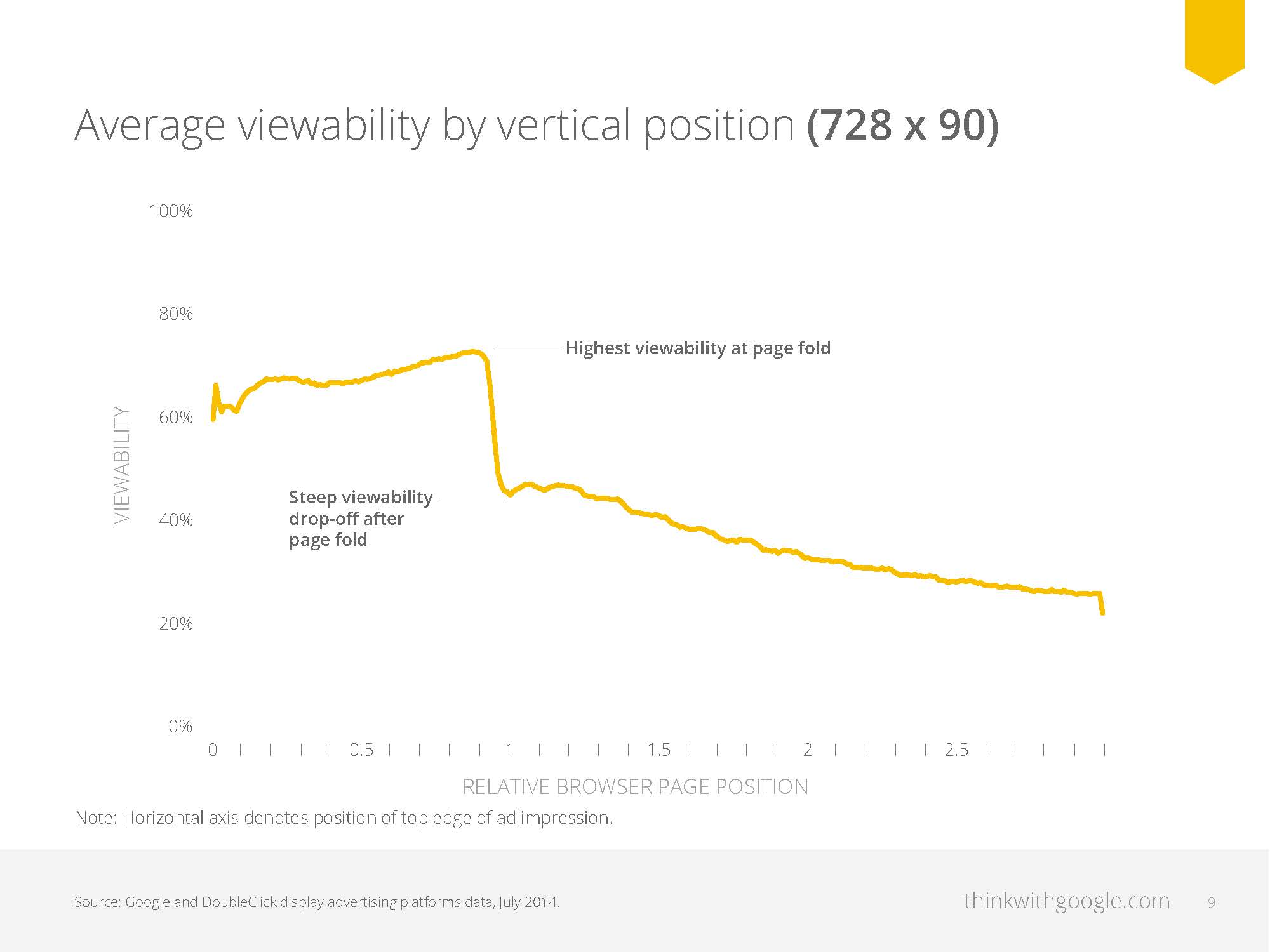
Helpfully, Google provides some clues in its report.  For instance, the highest viewability for ads is immediately above the “fold” – in other words, at the point where the viewer must begin to scroll down to see the rest of the page.

Surprisingly, viewability right above the fold is slightly higher than at the very top of the page.  But it’s massively less so just below that magic spot.  Google pressented five charts in its report to illustrate this drop-off phenomenon; the one reproduced below shows viewability of vertical position ads sized 728 x 90 pixels:

Average viewability by vertical position on online ads


Less surprising, perhaps, is the fact that vertical ads have higher viewability than horizontal or block ads, for the simple reason that they stay on the page longer:

Most viewable online display ad sizes


By publishing this data, Google purports to want to help their advertisers understand high- and low-value inventory better so they can target their campaigns more appropriately and effectively.

Google is also encouraging publishers to strive for delivering viewability rates in excess of 50% by offering ad inventory that will perform more effectively in its respective positions.

My only question is … why has it taken Google so long to set these standards and to publicize them in the first instance?

Sure, Google’s only the middleman between publishers and their viewers.  But it’s a pivotally important one.

The Quiet Revolution in Automotive Advertising

New Car ShowroomA new milestone is set to be reached in 2014.  For the first time, digital advertising will represent over half of all ad spending in the U.S. automotive sector.

That means that TV, radio, outdoor, newspaper and other print advertising, taken together, will represent only a minority of the roughly $36 billion advertising industry, the second largest advertising category in the United States (behind general merchandise stores).

This is great news for all of us who have suffered through high-decibel radio advertising, TV ads with sophomoric production values, and “carnival barking” poster-like print ads that have been so ubiquitous in the automotive category for so many decades.

A just-released report from media research company Borrell Associates, titled 2014-2015 Automotive Advertising Outlook, notes the following key factors that have influenced the “drive towards digital” in the automotive advertising category:

•     Over the past decade, the number of franchise auto dealers has dropped by ~3,500 (18%), even as the number of new vehicles sold per dealer has grown by ~18%. Fewer-and-larger dealerships reduce marketplace clutter and the clamor for audience attention.

•     Also contributing to reduced clutter, six major car brands have disappeared from the market over the past 10 years: Hummer, Mercury, Plymouth, Pontiac, Oldsmobile and Saturn.

•    The per-vehicle cost of advertising for a new car has declined ~20%.  No it’s only about $500.

•     More than 90% of auto purchases begin with consumer online research. This change in behavior has transformed auto dealerships from acting like showrooms to being more like fulfillment centers.

•     As their “media channel,” dealerships are able to use the Internet to offer special customer deals in the form of rebates, incentives and loyalty programs. These marketing schemes now amount to ~$2,400 per vehicle sold — dwarfing the amount spent on advertising.

Automotive print advertising is declining -- thankfully.
The end of an era? Thankfully, yes.

Thanks to these major trends and developments, we’re now spared the volume and intensity of intrusive automotive advertising that was so common before.

Instead, car dealerships are ready and waiting for us when we’re in the market to purchase a new automobile by using online ads, search engine marketing, social media and other digital platforms to be easily accessible and available when we go online.

According to Borrell, nearly $300 per vehicle will be spent on online advertising this year, whereas just a little over $200 will be spent on traditional advertising.

Five years ago, online ad spending was about one third the amount of traditional advertising.

The information-rich web is also changing another aspect of the car buying experience:  It’s making the job of automotive sales easier rather than more difficult.

Here’s proof:  Only a few years ago, more than half of all car shoppers would end up not buying a vehicle.  Today, that proportion has now dropped to just 25%.

When customers come into the showroom today, they’re better informed, they know what they want to purchase, and they’re up on various the options and pricing deals.  In short, they’re ready to buy.

Fewer intrusive ads … better educated consumers … less stress on sales personnel … satisfied buyers.  It seems like a win-win for everyone, doesn’t it?

From Consumer Reports: The MarComm Tactics People Dislike the Most

imagesMost of us have a few “pet peeves” when it comes to the advertising and promotional tactics we find obtrusive or just plain irritating.

Recently, Consumer Reports studied this issue.  In June 2014, it published an article citing the marketing tactics Americans say they like the least.  The findings were collected via its own survey of a cross-section of U.S. adults age 18 or over.

Of the tactics covered in the survey, some might be considered only mildly irritating … but others are horribly intrusive.

Let’s start with the marketing tactics that the survey respondents roundly disliked:

#1. Telemarketing robocalls:  ~77% dislike

#2. False claims of winning a prize:  ~74%

#3. “Official” direct mail that appears to be an invoice or a check:  ~71%

#4. Pop-up ads on websites:  ~70%

#5. Ads for nutritional supplements making exaggerated claims:   ~70%

#6. Videos that play before viewers can view their desired web content:  ~66%

#7. TV advertising that plays louder than the program itself:  ~63%

Another three marketing tactics were also disliked, but by a smaller proportion of respondents:

#8. Fast-talking disclaimers on broadcast ads:  ~50%

#9. Infomercials:  ~42%

#10. Ads for sensitive personal medical conditions:  ~38%

Wrapping up the list were these four tactics which respondents considered least objectionable:

#11. Products advertised as “American made” that actually aren’t

#12. “Free” offers – but with strings attached

#13. Targeted online ads that show based on viewer purchases, behavior or demographics

#14. Product placement in TV programs and movies

#15. Billboard advertising 

Of all the 15 MarComm tactics evaluated, my own “Top 2” personal dislikes are #4 and #6.

I’m in the marketing field myself, so I guess I should be tolerant of these techniques … but I think my time online is way more valuable than that!

How about you?

Many online banner ads are “invisible” — just like all the other kinds of advertising.

poor online display ad clickthrough ratesI’ve blogged before about the dismal performance of web banner ads, with their miniscule clickthrough rates resulting from “banner blindness.”

The situation has caused more than a few marketers to shy away from engaging in any sort of banner advertising online — and it’s not hard to understand why.

But as Ben Kunz, a vice president at media buying and planning agency Mediassociates likes to point out, other forms of display advertising have similar challenges.

The fact that omnibus marketing information resource eMarketer has predicted that digital ad spending will increase to ~$132 billion this year is proof that many advertisers continue to see the value in online display advertising.

So what is Kunz’s major argument? Simply this:  Digital ads have the same challenges that television, radio and print advertising have as well.  In Kunz’s view, there’s huge waste in advertising because of advertising’s very nature.

He is correct. The vast majority of ad impressions that are “served” are never really seen or heard — regardless of the ad medium.

Ad visibility online is an issue for sure. Proving the point, internet analytics company comScore evaluated some 290 billion ad impressions on thousands of web sites … and found that ~54% of them weren’t visible.

There was some differentiation the comScore detected between different types of sites. Ads served up on “Ppemium” web publisher sites performed better (only ~39% of theirs weren’t visible).

Ads that aren’t visible occur for a variety of reasons, one of which is fraud (fake web traffic). But more often, it’s because of slow load times on digital devices or because the ads fall outside a viewable browser window or further down that page, necessitating scrolling that many viewers simply don’t do.

The Swedish firm Sticky has investigated banner blindness from another angle — studying the eyeball movements of ~500 subjects. Its research found that of the digital ads that do appear within a viewable window, only ~51% of them are actually “seen” by the viewer.

Mashing it all up, it means that roughly three out of four online ads are “invisible” to viewers. It’s a lot of waste for sure.

But then … what’s the alternative? Do other advertising tactics and channels actually do better?

Nope. According to Kunz, at least three out of four newspaper ads aren’t seen, either.

Ben Kunz
Ben Kunz

Here’s how he arrives at that conclusion. The average U.S. newspaper has ~60 pages, with an average number of ads per page of around 20 (this includes large ads and smaller classifieds).  Around half of the pages are unopened when someone reads the paper, meaning that those ads are “unviewable.”  If half of the remaining ads are ignored as well, the viewability stats are effectively tied.

Kunz also contends that ~30% of radio advertising is “invisible,” citing an Arbitron study that quantified the extent to which listeners switch stations when advertising came on, then flip back later.

The findings were such that Arbitron started recommending that media planners change their measurement from 100 GRPs to 70 GRPs, reflecting the fact that ~30% of radio ads paid for never make it human ears.

TV advertising? It’s the same phenomenon.

Trips to the refrigerator or the bathroom abound during commercial breaks — not to mention channel flipping or TiVo-ing.  Kunz contends that such ad-dodging techniques reduce TV ad viewability by as much as 75%.

The bottom line on all of this: Waste in digital advertising is a significant issue … but it’s a similar issue with other ad vehicles as well.

Add to this the fact that digital advertising offers the best metrics (accountability for every click and conversion action), and it should come as little surprise that digital ad spending continues to grow (and why eMarketer expects it to reach about a quarter of all ad spending this year).

Does Kunz have a point about offline and online advertising sharing similar “blindness” characteristics? What are your thoughts?  Please share your perspectives with other readers.

Tom Goodwin Sounds Off: Five Big Myths about Advertising Today

Tom Goodwin
Tom Goodwin

It’s so common to hear weighty pronouncements about the changing world of advertising and how the ground is shifting under the discipline.

It seems that we get one of these “new horizons” commentaries about every other week or so.

That’s why it’s refreshing to hear a few countervailing voices among the breathless babble. These are the voices of reason that move past the hyperbole and provide some sober grounding.

One such person is former advertising industry exec Jeremy Bullmore. His recent commentary on the “big data” craze is a good case in point — and well-worth reading.

Another industry specialist whose comments are always worth noting is Tom Goodwin, head of Tomorrow Innovation, a digital marketing consultancy. He’s identified five big myths about today’s advertising environment which need “calling out,” as he puts it.

What are Goodwin’s myths? They’re shown below, along with Goodwin’s “quasi-contrarian” views about them.

“TV is dead.

Nope. More people are watching television than ever before — and that’s looking at just the mature USA and UK markets.  Goodwin contends that TV advertising has never been more valuable — and most commercials are viewed rather than skipped over.  But they’re viewed on many kinds of devices, of course.

Goodwin’s take: “TV is here to stay … [but] the notion of ‘television’ generates false boundaries to what’s possible with video advertising when [people] consume video in so many new ways.”

“Consumers want conversations with brands.” 

Ignore ButtonNo they don’t, Goodwin contends: “The conversations I most often see are those of disgruntled customers, given the microphone to complain that Twitter provides. It strikes me overwhelmingly, with remarkably few exceptions, that for most brands, people want an outcome or resolution or perhaps information — and not a conversation.”

“Brands must create good content.” 

Goodwin acknowledges that content delivered by brands needs to be inherently valuable. But it’s more complicated than just that:  “Branded content is not meritocratic — you can’t say any one piece of content is ‘better’ than another. Perhaps the best real test of content is when it’s served, how, and who it reaches and the value it provides.”

“Advertising is about storytelling.”

Goodwin contends that advertising people are buying their own hype with this whopper. “Let’s not delude ourselves that advertising is not about selling stuff,” he emphasizes.

“Advertising dollars should correlate with consumers’ time spent with media.”

Goodwin claims that advertising industry players feel a compulsion to “be where the people are,” under the assumption that people will engage with advertising in similar ways whether they’re online or offline, on a mobile device or a desktop, and so on.

Because of this thinking, media spend projections looking into the future “bear no resemblance” to what’s working or not working — or how it’s even possible to spend that much money advertising in the channels like mobile.

How have these myths of Goodwin’s taken hold in the first place? Is it because talking about them seems so much more interesting and important than contending that advertising is continuing on a more familiar trajectory?

Goodwin thinks this may be part of it. Certainly, he acknowledges that times are changing dramatically in advertising — as they have been for some time.  But he makes a plea for more wisdom and nuance:

“While nobody gets famous (or a promotion) saying things are complex or largely unchanged … it’s closer to the truth.”

Personally, having spent a quarter century years in the marketing communications field, I feel that Tom Goodwin has raised some very interesting and valid points.

Where do you come down on them?  Do you agree or disagree with the five “myths” Goodwin has identified in modern advertising?  Leave a comment and share your thoughts for the benefit of other readers.

Where Print Advertising Still Reigns

city-and-regional-magazine-survey-2014-FOLIOPrint advertising may be atrophying, but it’s still important enough to be the overwhelming revenue stream for city and regional magazine publishers.

According to the latest annual survey of media in this category, conducted by FOLIO last month, most publishing titles continue to rely on print for the vast bulk of the revenues they generate.

But before we look at FOLIO’s figures today, let’s see what’s happened over the past decade or so.

Print advertising revenues in this segment of the publishing industry represented over 95% of overall revenue as late as 2005. It’s dropped since then – but it hasn’t declined all that much, all things considered.

Here’s what FOLIO’s research findings are showing today:

  • Print advertising: Represents ~75% of all revenues
  • Paid subscriptions: ~6%
  • Custom publishing: ~6%
  • Digital media: ~5%
  • Events: ~3%
  • Mobile products: ~1%
  • Mercantile data (e.g., list rental): Less than 1%

Compared to Folio’s 2013 survey, print advertising has declined slightly (from ~77% of overall revenues in 2013), but paid subscription revenues are down sharply (from about 10%).

Within this publication category, there are some differences between large and small publishers. Larger brands (those generating more than $5 million in revenues) rely less on print advertising; it’s only about 65% of their earnings.

With smaller publication titles, it’s been significantly more challenging to diversify away from print. They’re still relying on print ad sales to generate more than 80% of their revenue.  And that percentage hasn’t changed in five years.

Right now, digital media accounts for only about 9% of total revenues generated by the larger media properties in this segment. But managers at these publications anticipate that revenue from digital platforms will continue to grow at a faster clip.

In fact, they foresee a jump of nearly 30% in digital media revenues this year alone.

The FOLIO report notes that the increase in digital revenues is coming from better monetization strategies for existing products, rather than the introduction of new ones.

City and Regional MagazinesConsidering why publishers in the city and regional magazine category continue to rely on print versus other revenues, I think it goes back to the idea that consumers don’t consider these properties strong sources for “instant” or “breaking” news.

Behaviorally, there’s more of a propensity to browse through story topics in a more “linear” fashion. The emphasis on human interest and region-centric news also aligns more with a more traditional approach to journalism, where most every news story tends to have some sort of a “human” dimension.

Quite a few stories are long-form journalism, or ones that feature high-quality photography.  Far fewer of them are time-sensitive.  They lend themselves to a more leisurely perusal.

Even so, it would seem that broader trends regarding the way consumers are interacting with media — and the platforms they’re using to consumer them — destined to overtake the city/regional magazine category.

Eventually.

More details on the FOLIO research results can be found here.