Downsizing hits America’s most prestigious business media properties.

bwsjThis past week, the business media world was buzzing about the inadvertent release of information concerning pending layoffs at Barron’s magazine, thanks to editor-in-chief Ed Finn mistakenly hitting “reply all” on a message intended for just one person.

But the more interesting news is what’s happening right now with two of America’s most important national print publishing properties: Barron’s and The Wall Street Journal.

Up until now, it was thought that a select handful of America’s largest and most pervasive publications with national reach and reputation would be the ones least susceptible to problems befalling the industry regarding declining advertising revenues and changing news consumption habits.

At or near the top of the list of those rarefied properties were these two publications for sure.

But now we know a different reality — or at least a more complicated one. WSJ editor-in-chief Gerard Baker announced last week that the publication is seeking a “substantial number” of employee buyouts to limit the extent of involuntary layoffs that will need to happen otherwise.

The WSJ buyout offer been extended to all news employees worldwide – managerial and non-managerial – and includes a lucrative voluntary severance benefit that’s 1.5 times larger than the company’s standard buyout package.

WSJ employees will need to make up their minds quickly, as the buyout offer is good only until the end of October.

wsjbAs for Barron’s, its situation became public only after the Ed Finn memo was received in the New York City newsroom of The Wall Street Journal in error.  The Finn memo, which had been intended for Dow Jones Media Group publisher Almar Latour, speculates on how The Wall Street Journal’s announcement might affect an upcoming round of layoffs at Barron’s.

That bit was “new news” to pretty much everyone.

Aside from the “drama” of news scoops happening because of unintentional actions, the bigger question is this: What do these layoffs and buyouts portend?  Is it the end of the adjustments – or just the beginning?

Clues to that answer come in Gerard Baker’s memo, where he reveals that The Wall Street Journal has “begun an extensive review of operations as part of a broader transformation program.”

Let’s see what kind of “silver bullet” business strategy they end up devising – and whether it will have its intended effect.
The ad blocking phenomenon: It’s all about human nature.

noadThe rapid rise in consumer adoption of ad blocking software is threatening the traditional advertising model for publishers. For some, it seems like a topsy-turvy world where none of the old assumptions or the old rules apply.

But author and MarComm über-thought leader Gord Hotchkiss reminds us that the consumer behaviors we are witnesses are as old as the hills.

In a recent MediaPost column titled “Why Our Brains Are Blocking Ads,” Hotchkiss points out that the environment for online ads is vastly different from the environment where traditional advertising flourished for decades – primarily in magazines, newspapers and television.

Gord Hotchkiss
Gord Hotchkiss

He notes that in the past, the majority of people’s interaction with advertising was done while our brains were in “idling” mode – meaning that they had no specific task at hand. Instead, people were looking for something to capture their attention within a TV program, a newspaper or magazine article.

Hotchkiss contends that in such an environment, the brain is in an “accepting” state and thus is more open to advertising messages:

“We were looking for something interesting, we were primed to be in a positive frame of mind, and our brains could easily handle the contextual switches required to consider an ad and its message.”

Contrast this to the delivery of most digital advertising in today’s world, which is happening when people are in more of a “foraging” mode – involved in a task to find information and answers with our attention focused on that task.

In such an environment, advertising isn’t only a distraction; often, it’s a source of frustration. As Hotchkiss notes:

“The reason we’re blocking [digital] ads is that in the context those ads are being delivered, irrelevant ads are – quite literally – painful. Even relevant ads have a very high threshold to get over.”

Hotchkiss concludes that the rapid rise of ad blocking adoption isn’t about the technology per se.  It has to do with the hardwiring of our brains.  New technologies haven’t caused fundamental changes in human behavior – they’ve simply enabled new behaviors that weren’t an option before.

adbAs is becoming increasingly obvious, the implications for the advertising business are huge:  Ad blocking software is projected to lower digital ad revenues by more than $40 billion in 2016 alone, according to estimates by digital data research firm eMarketer.

Looking back on it, actually it seems like it was all so inevitable.

Ad fraud: It’s worse than you think.

It isn’t so much the size of the problem, but rather its implications.

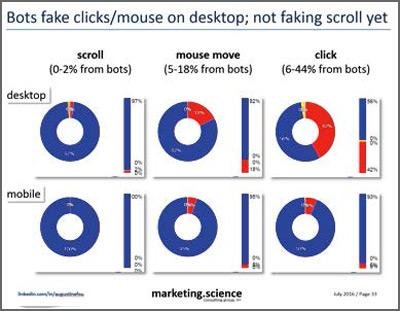
affaA recently published report by White Ops, a digital advertising security and fraud detection company, reveals that the source of most online ad fraud in the United States isn’t large data centers, but rather millions of infected browsers in devices owned by people like you and me.

This is an important finding, because when bots run in browsers, they appear as “real people” to most advertising analytics and many fraud detection systems.

As a result, they are more difficult to detect and much harder to stop.

These fraudulent bots that look like “people” visit publishers, which serve ads to them and collect revenues.

faaf

Of course, once detected, the value of these “bot-bound” ads plummets in the bidding markets.  But is it really a self-correcting problem?   Hardly.

The challenge is that even as those browsers are being detected and rejected as the source of fraudulent traffic, new browsers are being infected and attracting top-dollar ad revenue just as quickly.

It may be that only 3% of all browsers account for well over half of the entire fraud activity by dollar volume … but that 3% is changing all the time.

Even worse, White Ops reports that access to these infected browsers is happening on a “black market” of sorts, where one can buy the right to direct a browser-resident bot to visit a website and generate fraudulent revenues.

… to the tune of billions of dollars every year.  According to ad traffic platform developer eZanga, advertisers are wasting more than $6 billion every year in fraudulent advertising spending.  For some advertisers involved in programmatic buying, fake impressions and clicks represent a majority of their revenue outlay — even as much as 70%.

The solution to this mess in online advertising is hard to see. It isn’t something as “simple and elegant” as blacklisting fake sites, because the fraudsters are dynamically building websites from stolen content, creating (and deleting) hundreds of them every minute.

They’ve taken the very attributes of the worldwide web which make it so easy and useful … and have thrown them back in our faces.

Virus protection software? To these fraudsters, it’s a joke.  Most anti-virus resources cannot even hope to keep pace.  Indeed, some of them have been hacked themselves – their code stolen and made available on the so-called “deep web.”  Is it any wonder that so many Internet-connected devices – from smartphones to home automation systems – contain weaknesses that make them subject to attack?

The problems would go away almost overnight if all infected devices were cut off from the Internet. But we all know that this is an impossibility; no one is going to throw the baby out with the bathwater.

It might help if more people in the ad industry would be willing to admit that there is a big problem, as well as to be more amenable to involve federal law enforcement in attacking it.  But I’m not sure even that would make all that much difference.

There’s no doubt we’ve built a Frankenstein-like monster.  But it’s one we love as well as hate.  Good luck squaring that circle!

Digital display advertising: (Still) looking like the weakest online promo tactic.

untitledI’ve blogged before about the lack of engagement with online banner advertising, and as time goes on … the picture doesn’t change much at all.

When you break it down, online banner advertising is a bust on several levels:


  • As of the most recent stats, clickthrough rates on online banner advertising are running about 0.08%. That translates to fewer than one click for every 1,000 times the ad is served.


  • Based on current pricing for online banner ads, that one click might be costing anywhere from $5 to $10 (and it might have even been an accidental click).


Despite these “inconvenient truths,” nearly two-thirds of digital ad spending continues to go to online banner advertising based on a “cost per impression” pricing model. Why?

One answer is that it’s an easy way to advertise a product or service. Simply supply ad creative to the publisher and let it be served online.

Another may be that advertisers consider banner advertising to be a basic component of any promotional campaign: prepare a mix of direct marketing, some search engine marketing, some print advertising and some digital display advertising, and you’re off to the races.

A third reason — related to the one above and I suspect one big reason why so much digital display advertising persists in the B-to-B realm in particular — is that publishers who offer a suite of promo tactics as part of a specially priced integrated program always throw in digital display advertising as part of the mix. It becomes the default option for advertisers as they approve bundled programs and the discount rates that come along with them.

Here’s a suggestion for advertisers going forward: Push back a bit and ask publishers to come up with alternative program options that don’t include digital display advertising.  The revised program might not look as promising at first blush, but then remember the stats above and you may well see the attributes of the alternative program in a more positive light.

Ad blocking goes big-time.

Adblock-PlusA new milestone of sorts has been reached in the ad blocking realm. Adblock Plus, the leading ad blocking tool, has just announced that it’s just passed the 100 million marker in active installations.

An earlier milestone – 500 million downloads – was reached at the beginning of this year. That means the active user base has now doubled in less than half a year.

If these figures are accurate – and there’s little reason to think that they aren’t – it’s a pretty big deal. No longer is ad blocking an exotic functionality that’s the exclusive preserve of techies or other geeky subgroups.  It’s gone majorly mainstream.

What’s driving the ad blocking business is the ubiquity of online advertising. For many viewers, it’s nothing short of intolerable:  obtrusive, irritating, and sometimes creepy (hello, retargeting).

So once a well-functioning and reputable tool like Adblock came along, it was only a matter of time before it would take on “snowball-rolling-down-a-mountainside” proportions.

AdBlock Plus promises “annoyance-free web surfing.”  But as with most any innovation, there are one or two hitches. For Adblock Plus, it’s something called “Acceptable Ads.”

untitled“What’s that?” you might ask. It’s a white-list program that allows certain advertisers through Adblock’s screen.  The company receives a cut of publishers’ revenues through that program.

Fundamentally, it’s how Adblock Plus makes money. But it’s also how advertisers can do an end-run around the very service Adblock provides.

AdBlock goes to great pains to “explain” its rationale and why the Acceptable Ads program makes sense for everyone.

But it isn’t difficult to see where this might end up.  Larger advertisers will see fit to exempt themselves from ad blocking by paying for the privilege of their ads being served.

Which gets us right back to where we were with advertising in the first place, doesn’t it? Pay to play.

What’s old is new again, I guess. And meanwhile, the online ads just keep coming …

Bing Plays the Bouncer Role in a Big Way

untitledMicrosoft Bing has just released stats chronicling its efforts to do its part to keep the Internet a safe space. Its 2015 statistics are nothing short of breathtaking.

Bing did its part by rejecting a total of 250 million ad impressions … banning ~150,000 advertisements … and blocking around 50,000 websites outright.

It didn’t stop there. Bing also reports that it blocked more than 3 million pages and 30 million ads due to spam and misleading content.

What were some of the reasons behind the blocking? Here are a few clues as to where Bing’s efforts were strongest (although I don’t doubt that there are some others that Bing is keeping closer to its vest so as not to raise any alarms):

  • Healthcare/pharma phishing attacks: ~2,000 advertisers and ~800,000 ads blocked in 2015
  • Selling of counterfeit goods: 7,000 advertisers and 700,000+ ads blocked
  • Tech support scams: ~25,000 websites and ~15 million ads blocked
  • Trademark infringement factors: ~50 million ad placements rejected

Bing doesn’t say exactly how it identifies such a ginormous amount of fraudulent or otherwise nefarious advertising, except to report that the company has improved its handling of many aspects based on clues ranging from toll-free numbers analysis to dead links analysis.

According to Neha Garg, a program manager of ad quality at Bing:

“There have even been times our machine learning algorithms have flagged accounts that look innocent at first glance … but on close examination we find malicious intent. The back-end machinery runs 24/7 and used hundreds of attributes to look for patterns which help spot suspicious ads among billions of genuine ones.”

We’re thankful to Bing and Google for all that they do to control the incidence of advertising that carries malicious malware that could potentially cause many other problems above and beyond the mere “irritation factor.”

Of course, there’s always room for improvement, isn’t there?

Momentous milestone? U.S. advertising dips below 1% of GDP for the first time in living memory.

sdThe advertising industry has often been characterized as “boring.”  This 2014 analytical article from Bloomberg encapsulates the argument pretty succinctly.

Still, the “lay of the land” in the late 2000s and early 2010s represents a bit of a changeup from the previous decades of predictability.

During the period beginning the late 2000s when the “advertising recession” hit in an even bigger way than the overall U.S. economic recession, I’ve heard various industry insiders posit that there was more than merely a retrenchment happening due to overall economic conditions.

Beyond that, it was suggested that a migration was happening away from traditional advertising methods to more measurable ones.

Now we have more than just hunches to go on — and the results appear to be aligning with those suspicions.

The new evidence comes in the form of statistics released this week and reported on by MediaPost.

According to an analysis of ad spending trends published by Sanford Bernstein Research and Magna Global, for the first time in modern history U.S. advertising industry revenues have dropped below 1% of total U.S. Gross Domestic Product.

During the period 1999 to 2010, total advertising averaged 1.25% of GDP, but since then the percentage has stagnated or fallen. The 2014 total advertising estimate of $165 billion is 0.95% of GDP.  (The Bernstein/Magna research covers U.S. advertising revenues up through the year 2014.)

tbThe decline in advertising’s share of GDP is primarily due to the diminishing importance of two key traditional media categories: broadcast TV and cable TV.

Broadcast TV advertising’s annual revenue growth averaged around 3% per year between 1990 and 2010.  Since 2011, it’s been flat.

Cable TV has done somewhat better – but even there what had been around 12% growth per year has slowed to just a ~3% annual increase.

With such big baseline numbers for broadcast and cable TV, the behavior of these two broadcast categories have been key drivers of the advertising sector’s overall performance.

But we mustn’t forget another category that’s been performing pretty miserably of late: newspaper advertising.  It’s experienced a ~10% decline on a compound annual basis from 2010 to 2014.

That decline is even steeper than earlier projections had suggested.

Todd Juenger, a vice president and senior analyst at Sanford Bernstein, made a key takeaway observation about the newly published figures, noting:

“Our original piece theorized [that] advertising would recover to prior levels. Instead, it has remained deflated, suggesting the perhaps the Internet really has enabled marketers to eliminate waste.”

He’s right, of course.

For authenticity in advertising … perhaps it’s time to stop making it “advertising.”

AT

Take a look at the interesting data in the chart above, courtesy of Nielsen.

Among the things it tells us is this: If there’s one thing that’s universally consistent across all age ranges – from Gen Z and Millennials to the Silent Generation – it’s that nothing has a more positive impact on buying decisions than the recommendation of a family member, a friend or a colleague.

Not only is it true across all age ranges, it’s equally true in business and consumer segments.

The chart also shows us that, broadly speaking, younger people tend to be more receptive to various advertising formats than older age segments.

this isn’t too surprising because with age comes experience – and that also means a higher degree of cynicism about advertising.

Techniques like the “testimonials” from so-called “real people” (who are nonetheless still actors) can’t get past the jaundiced eye of veteran consumers who’ve been around the track many more times than their younger counterparts.

Someone from the Boomer or Silent Generation can smell these things out for the fakery they are like nobody else.

But if friends and colleagues are what move the buy needle the best, how does advertising fit into that scenario? What’s the best way for it to be in the mix?

One way may be “influencer” advertising. This is when industry experts and other respected people are willing to go on record speaking positively about a particular product or service.

Of course, influencers have the best “influence” in the fields where they’re already active, as opposed to endorsements from famous people who don’t have a natural connection to the products they are touting. Such celebrity “testimonials” rarely pass the snicker test.

But if you think about other people like this:

  • An industry thought leader
  • A prominent blogger or social networker in a particular field or on a particular topic
  • A person with a genuine passion for interacting with a particular product or service

… Then you have a person who advocates for your brand in a proactive way.

That’s the most genuine form of persuasion aside from hearing recommendations from those trusted relatives, friends and colleagues.

Of course, none of that will happen without the products and services inspiring passion and advocacy at the outset. If those fundamental factors aren’t part of the mix, we’re back to square one with ineffective faux-testimonials that feel about as genuine as AstroTurf® … and the (lack of) results to match.

Our Visual World

vcThe old adage that a picture is worth a thousand words has ever-greater resonance as time goes on. And when visuals come up against text – it’s really no contest at all.

Marcel Just, PhD, who directs the Center for Cognitive Brain Imaging at Carnegie Mellon University in Pittsburgh, PA, states the case plainly:

“Processing print isn’t something the human brain was built for. The printed word is a human artifact.  It’s very convenient and it’s worked very well for us for 5,000 years, but it’s an invention of human beings.   

By contrast, Mother Nature has built into our brain our ability to see the visual world and interpret it. Even the spoken language is much more a ‘given’ biologically than reading written language.”

So it’s fundamental that photos, other pictorial graphics and videos are effective with audiences across the board – not just with certain demographics. This universality makes the visual world so much more universal than the world as seen through an “education level” or a “language” prism.

3M Company has done research to attempt to measure this impact quantitatively. It has found that ~90% of all information transmitted to the brain is visual.  And now, the growth of digital communications has provided all sorts of ways to gauge the effectiveness of those visual communications.

Consider these points:

  • Visual content is processed 60,000 times faster than text.
  • Humans retain only about 20% of what they read … just ~10% of what they hear … but ~80% of what they see.
  • ~80% of the text on most pages of content doesn’t get read.
  • Twitter tweets containing images generate ~20 more clickthroughs … ~90% more “favorites” … and ~150% more re-tweets.
  • Social media posts including video clips do dramatically better – outstripping text-only posts by a factor of ten times.

The implications for advertisers couldn’t be clearer. The explosion in digital content only makes it that much more important to catch the audience’s attention, because typically advertisers have only seconds to do so.

And that attention-getting content is going to be visual.

Twitter’s Continuing Monetization Challenge

Press reports have been pretty consistent over the past year or so about the underwhelming financial performance of Twitter.  Here’s the trend line for Twitter shares of stock since the beginning of 2014:


Twitter share price trend


… And beyond the financial performance, I’ve been writing about Twitter’s fundamental business challenges off and on for well over five years now.

While Twitter undoubtedly has its place in the social realm — its place in “breaking news” is a biggie — it remains a frustrating platform for advertisers, which is one reason Twitter’s business model has turned out to be less effective than Facebook’s.

Recent stats from eMarketer reveal that over 50 million Internet users in the United States are accessing their Twitter accounts via any device at least monthly.

That equates to about fifth of U.S. Internet users — and nearly three in ten people active on social networks.

So … this means that many people are seeing ads on Twitter. And that’s confirmed through an evaluation conducted by Cowen & Company which finds that well over half of U.S. adult Twitter users are e encountering ads on their Twitter feed at least every 10 or 20 tweets.

Predictably, most of the advertising pertains to retail, app installations and travel. Those are pretty relevant as broad advertising categories.

It’s just … many Twitter users aren’t finding the ads effective.  Here’s what Cowen’s findings show in terms of user feelings about Twitter advertising:

  • Ads on Twitter are relevant and/or insightful: ~3%
  • Ads are OK: ~26%
  • Ads are not really relevant: ~45%
  • Ads are usually a poor fit: ~14%

These results suggest that advertisers need to improve their targeting capabilities significantly if they wish to reach the right audience segments with relevant messages.

More fundamentally, current attitudes about Twitter advertising pose continuing challenges for Twitter as it attempts to further-monetize its platform. The tepid performance of Twitter shares since the beginning of 2014 underscores how the company continues to cast about for answers to that fundamental challenge.  I wonder when (or if) the company will ever figure it all out.