Another for-profit higher educational institution bites the dust …

it

Last week, ITT Technical Institute, a for-profit higher educational institution enrolling ~40,000 students on more than 130 campuses across the country, announced that it is shutting down, while also laying off the lion’s share of its more than 8,000 employees.

This development comes hard on the heels of the closure of Corinthian Colleges last year. Together, it raises the question as to whether such “glorified trade schools” are doing any kind of service to students who seek to better themselves but who don’t have the scholastic record – or the money – to attend traditional two-year or four-year colleges.

tlpThere’s no question of the pent-up demand for higher learning. Guidance counselors push continued schooling as the next logical step for high school students, and society in general promotes a college education as the ticket to the good life.

For-profit colleges have benefited greatly from an environment which prizes higher education as the next logical step for high school graduates, and during the Great Recession beginning eight years ago, these schools continued to promote their curricula heavily while churning out more students into what was a very weak job market.

Students graduating from not-for-profit institutions had a hard enough time landing employment in their chosen fields … and for graduates of ITT, Corinthian and other such schools it was even worse.

corinthian_colleges_logoThe U.S. Department of Education had had its eye on both ITT and Corinthian for a number of years. Becoming alarmed at the inability of graduates to pay off their federally funded student loans, the Department ultimately banned both schools from enrolling any new students who rely on federal financial aid – which was nearly all of them, of course.

An angry ITT Technical Institute pronounced the sanctions unwarranted, inappropriate and unconstitutional – amounting to a death sentence.

A news release from the school stated, “These unwarranted actions, taken without proving a single allegation, are a lawless execution.”

As is often the case in such situations, there’s more than meets the eye. At the same time, ITT Technical Institute is also facing fraud charges from the SEC plus a lawsuit from the Consumer Financial Protection Bureau.

Not only that, the institution has been under investigation at the state level in 19 different jurisdictions.

Academic accreditation is also an issue, as the ACICS (Accrediting Council for Independent Colleges & Schools) determined that the school was not in compliance with ACICS’ accreditation criteria.  ACICS cited a whole range of questionable practices in admissions, recruitment standards, retention, job placement and institutional integrity.

The school itself, using aggressive and pervasive advertising while pushing its “power packed studies” in fields such as IT, electronics, CAD design and health services, also informed prospective enrollees that credits earned at ITT Technical Institute would be “unlikely to transfer.”

This sorry state of affairs at ITT-TI now makes it that much more difficult for ~40,000 students to pursue their career goals. It’s yet another example of how a laudatory mission can lead to negative consequences for the very people who need help in launching their working lives the most.

Ben Miller, who is a director for post-secondary education at the Center for American Progress, puts the blame nowhere but on the school:

“Years of mismanagement by ITT leadership put it in a position where the Education Department’s action was necessary.”

In the coming years, it will be interesting to see the degree to which other for-profit institutions with far-flung operations – Brightwood/Tesst, Capella, Strayer, the University of Phoenix and others – will fare under the klieg lights of heightened scrutiny.

Cutting Some Slack: The “College Bubble” Explained

huThere are several “inconvenient truths” contained among the details of a recently released synopsis of college education and work trends, courtesy of the Heritage Foundation. Let’s check them off one-by-one.

The Cost of College

This truth is likely known to nearly everyone  who has children: education at four-year educational institutions isn’t cheap.  Here are the average annual prices for higher education in the United States for the current school year (includes tuition, fees, housing and meals):

  • 4-year public universities (in-state students): ~$19,550
  • 4-year public universities (out-of-state students): ~$34,000
  • 4-year private colleges and universities: ~$43,900

These costs have been rising fairly steadily for years now, seemingly without regard to the overall economic climate. But the negative impact on students has been muted somewhat by the copious availability of student loans — at least in the short term until the schedule kicks in.

The other important mitigating factor is the increased availability of community college education covering the first two years of higher education at a fraction of the cost of four-year institutions.  Less attractive are “for-profit” institutions, some of which have come under intense scrutiny and negative publicity concerning the effectiveness of their programs and how well students do with the degrees they earn from them.

Time Devoted to Education Activities

What may be less understood is the degree to which “full-time college” is actually a part-time endeavor for many students.

According to data compiled by the Bureau of Labor Statistics over the past decade, the average full-time college student spends fewer than three hours per day on all education-related activities (just over one hour in class and a little over 1.5 hours devoted to homework and research).

It adds up to around 19 hours per week in total.

In essence, full-time college students are devoting 10 fewer hours per week on educational-related activities compared to what full-time high school students are doing.

Lest this discrepancy seem too shocking, this is this mitigating aspect:  When comparing high-schoolers and full-time college students, the difference between educationally oriented time spent is counterbalanced by the time spent working.

More to the point, for full-time college students, employment takes up ~16 hours per week whereas with full-time high school students, the average time working is only about 4 hours.

Full-Time Students vs. Full-Time Workers

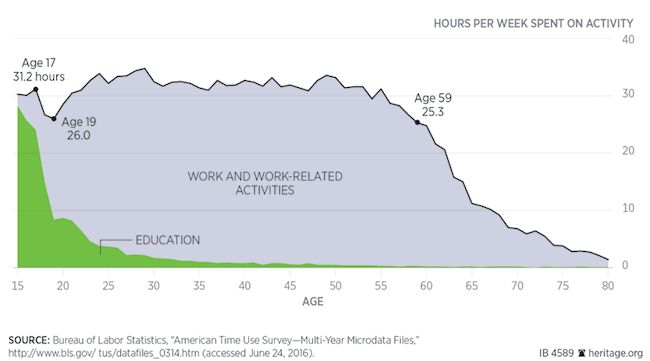
Here’s where things get quite interesting and where the whole idea of the “college bubble” comes into broad relief. It turns out that full-time college students spend far less combined time on education and work compared to their counterparts who are full-time workers.

Here are the BLS stats:  Full-time employees work an average of 42 hours per week, whereas for full-time college students, the combined time spent on education and working adds up to fewer than 35 hours per week.

This graph from the Heritage Foundation report illustrates what’s happening:

CT

Interestingly, the graph insinuates that full-time college students have it easier than many others in society:

  • On average, 19-year-olds are spending significantly fewer hours in the week on education and work compared to 17-year-olds.
  • It isn’t until age 59+ that people are spending less time on education and work than the typical 19-year-old.

No doubt, some social scientists will take these data as the jumping off spot for a debate about whether a generation of “softies” is being created – people who will struggle in the rigors of the real world once they’re out of the college bubble.

Exacerbating the problem in the eyes of some, student loan default rates aren’t exactly low, and talk by some politicians about forgiving student loan debt is a bit of a lightning rod as well.  The Heritage Foundation goes so far as to claim that loan forgiveness programs are leaving taxpayers on the hook for “generous leisure hours,” since ~93% of all student loans are originated and managed by the federal government.

What do you think? The BLS stats don’t lie … but are the Heritage Foundation’s conclusions off-target?  Please share your thoughts with other readers here.

Are U.S. warehouse jobs destined to go the way of manufacturing employment?

Even as manufacturing jobs have plateaued or fallen in certain communities, one of the employment bright spots has been the rise of distribution centers and super warehouses constructed by Amazon and other mega retailers to accommodate the steady rise of online shopping.

In my own region, the opening of Amazon distribution centers in Maryland and Delaware were met with accolades by local business development officials, who figured that new employment opportunities for entry level workers would soon follow.

And they have … to a degree. But what many people might not have expected was the rapid rise of robotics usage in warehouse operations.

In just the past few years, Amazon has quietly gone about purchasing and introducing more than 30,000 Kiva robots for many of its warehouses, where the equipment has reduced operating expenses by approximately 20%, according to Dave Clark, Amazon’s senior vice president of worldwide operations and customer service.

An analysis by Deutsche Bank estimates that adding robots to a new Amazon warehouse saves approximately $22 million in fulfillment expenses, which is why Amazon is moving ahead with plans to introduce robots in the remaining 100 or so of its distribution centers that are still without them.

Once in place, it’s estimated that Amazon will save an additional $2.5 billion in operating expenses at these 100 facilities.

Of course, robots aren’t exactly inexpensive pieces of equipment. But with the operational savings involved, it’s clear that adding this kind of automation to warehousing is kind of a slam-dunk decision.

Which helps explain another move that Amazon made in 2012. It decided to purchase the company that makes Kiva robots — for a cool $775 million.  And then it did something else equally noteworthy:  it ceased the sale of Kiva robots to anyone outside the Amazon family.

Because Kiva was pretty much the only game in town when it came to robotics designed for warehouse pick-and-ship functions, Amazon’s move put all other warehouse operations at a serious disadvantage.

That in turn created a stampede to develop alternative sources of supply for robots. It’s taken about four years, but today there are credible alternatives to Kiva brand robots now entering the market.  Amazon’s uneven playing field is getting ready to become a lot more level now.

But the other result of this “robotics arms race” is the sudden plenteous availability of new robot equipment, which companies like Macy’s, Target and Wal-Mart are set to exploit.

The people who are slated to be the odd people out are … warehouse workers.

The impact could well be dramatic. According to the Bureau of Labor Statistics, there are nearly 860,000 warehouse workers in the United States today, and they earn an average wage of approximately $12 per hour.

Not only is the rise of robot usage threatening these jobs, thanks to the sharp increase of minimum wage rates in areas near to some major urban centers is putting the squeeze on hiring from a wholly different direction. It’s a perfect storm the seems destined to blow a hole in warehouse employment levels in the coming years.

Thinking back to what happened to manufacturing jobs in this country, it’s seems we’ve seen this movie before …

Journalism’s Slow Fade

jjLate last month, the 2016 Lecture Series at the Panetta Institute for Public Policy in Carmel, CA hosted a panel discussion focusing on the topic “Changing Society, Technology and Media.”

The panelists included Ted Koppel, former anchor of ABC News’ Nightline, Howard Kurtz, host of FAX News’ Media Buzz, and Judy Woodruff, co-anchor and managing editor of the PBS NewsHour show.

During the discussion, Ted Koppel expressed his dismay over the decline of journalism as a professional discipline, noting that the rise of social media and blogging have created an environment where news and information are no longer “vetted” by professional news-gatherers.

One can agree or disagree with Koppel about whether the “democratization” of media represents regression rather than progress, but one thing that cannot be denied is that the rise of “mobile media” has sparked a decline in the overall number of professional media jobs.

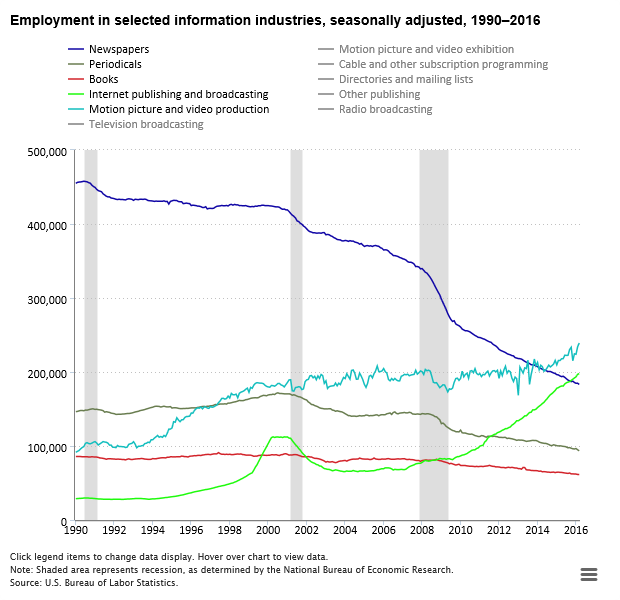
Data from the Bureau of Labor Statistics can quantify the trend pretty convincingly. As summarized in a report published in the American Consumers Newsletter, until the introduction of smartphones in 2007, the effect of the Internet on jobs in traditional media, newspapers, magazines and book had been, on balance, rather slight.

To wit, between 1993 and 2007, U.S. employment changes in the following segments looked like this:

  • Book Industry: Net increase of ~700 jobs
  • Magazines: Net decline of ~300 jobs
  • Newspapers: Net decline of ~79,000 jobs

True, the newspaper industry had been hard hit, but other segments not nearly so much, and indeed there had been net increases charted also in radio, film and TV.

But with the advent of the smartphone, Internet and media access underwent a transformation into something personal and portable. Look how that has impacted on jobs in the same media categories when comparing 2007 to 2016 employment:

  • Book Industry: Net loss of ~20,700 jobs
  • Magazines: Net loss of ~48,400 jobs
  • Newspapers: Net loss of ~168,200 jobs

Of course, new types of media jobs have sprung up during this period, particularly in Internet publishing and broadcasting. But those haven’t begun to make up for the losses noted in the segments above.

According to BLS statistics, Internet media employment grew by ~125,300 between 2007 and 2016 — but that’s less than half the losses charted elsewhere.

All told, factoring in the impact of TV, radio and film, there has been a net loss of nearly 160,000 U.S. media jobs since 2007.

employment-trends-in-newspaper-publishing-and-other-media-1990-2016

You’d be hard-pressed to find any other industry in the United States that has sustained such steep net losses over the past decade or so.

Much to the chagrin of old-school journalists, newspaper readership has plummeted in recent years — and with it newspaper advertising revenues (both classified and display).

The change in behavior is across the board, but it’s particularly age-based. These usage figures tell it all:

  • In 2007, ~33% of Americans age 18 to 34 read a daily newspaper … today it’s just 16%.
  • Even among Americans age 45 to 64, more than 50% read a daily newspaper in 2007 … today’s it’s around one third.
  • And among seniors age 65 and up, whereas two-thirds read a daily paper in 2007, today it’s just 50%.

With trends like that, the bigger question is how traditional media have been able to hang in there as long as they have. Because if it were simply dollars and cents being considered, the job losses would have been even steeper.

Perhaps we should take people like Jeff Bezos — who purchased the Washington Post newspaper not so long ago — at their word:  Maybe they do wish to see traditional journalism maintain its relevance even as the world around it is changing rapidly.

Are there mixed feelings about the value of product innovation centers?

icIn my line of work in industrial and B-to-B marketing, it’s common to encounter manufacturing companies – particularly larger entities – that are seeking ways to spur greater creativity and innovation in their approach to product design and development.

One manifestation of such a commitment is the building of an “innovation center.”

It may be a single room, a suite of rooms, or even a standalone facility situated within the larger corporate campus.  However they’re configured, these centers are designed to become the focal point of product research, product design and related activities.

Often, product training is also part of the mission of these centers, too.

Product innovation centers seem to be growing in popularity. Speaking personally, in the past 18 months, three of my firm’s marketing clients have opened new centers, often accompanied by a good deal of PR hoopla and so forth.

The question is, how well do these centers actually measure up to the lofty expectations senior company managers have for them?

It’s a fair question. And along those lines, I saw a news piece recently that summarized the results of an online mini-survey of medical device manufacturers, wherein the survey respondents were asked to share their views about the effectiveness of the innovation centers within their companies.

The survey was administered to readers of Qmed (aka Medical Product Manufacturing News] magazine, and the results were a little surprising, I felt.

To begin with, only about one-third of the respondents reported that their firms actually have formal, dedicated product design centers or innovation centers.

Moreover, the commentary from those who do have access to them was, on balance, not positive; for every complimentary comment about innovation centers, where were two negative ones recorded.

We can let the respondents speak for themselves:

  • “Great idea – won’t last. Most large corporations are run by pathological control freaks [who] stifle creativity. This is what made these design centers necessary in the first place.” 
  • “I’m creative at my own desk.” 
  • “Not used. I’m over it.” 
  • “Passing fad. No true innovation has come [out] of it in several years. But it is an interesting place to relax – [a] horrible room for meetings.” 
  • “Passing fad, especially at large companies. We consistently see companies standing up ‘innovation centers’ but not changing the fundamental way they handle product development. You can’t just drop R&D teams into a snazzy new office space and have them innovate.” 
  • “Quirky fad that’s useless without an accompanying company culture of creativity and commitment to innovation – the latter in terms of freedom, resources, incentive, etc.” 
  • “Romper Room.” 
  • “This is yet another wacky, management-mandated passing fad in the tradition of others such as Quality Management, Six Sigma and open office [floor-plans].”

I guess one takeaway from the Qmed research is that unless a company already has an effective or otherwise well-established culture of nurturing and rewarding innovation, simply introducing a dedicated design facility won’t do very much to improve matters.

What’s behind Microsoft’s $26 billion purchase of LinkedIn?

LI MCAt first blush, it appears almost ludicrous that Microsoft Corporation is offering an eye-popping $26 billion+ to acquire LinkedIn Corporation.

The dollar figure far eclipses any previous Microsoft acquisition — including the $9 billion+ it paid for Nokia Corporation in 2014, not to mention what the company paid for Yammer and Skype.

What’s also acknowledged is that none of those earlier acquisitions did all that much to further Microsoft’s digital and social credentials — and in the case of Nokia, the financial write-downs Microsoft has recorded have actually exceeded Nokia’s purchase price.

So what’s different about LinkedIn — and why does Microsoft feel that the synergies will work to its advantage better this time?

In a recent Wall Street Journal column, technology journalist Christopher Mims noted that such synergies do exist — and in a much bigger way.

That includes Microsoft Office, the productivity suite that’s now delivered almost exclusively online. And then there’s LinkedIn’s database of over 400 million subscriber professionals.

Put those two elements together with a strong strategic vision, and you have the potential for some pretty amazing synergies.

When you think about it, LinkedIn’s users are essentially Microsoft’s core demographic. And it isn’t something that’s replicated anywhere else in Cyberspace.  Here’s Microsoft’s CEO Satya Nadella talking:  “It’s really the coming together of the professional cloud and the professional network.”

Acting on its own, LinkedIn hasn’t been all that successful in leveraging what is arguably the most comprehensive and powerful database of business professionals ever compiled in the history of mankind.

While it consists of self-contributed information that hasn’t been “vetted” by outside parties, it’s still the single most comprehensive and valuable repository of information about business professionals — anywhere in the world.

I view the dynamics of LinkedIn as something like the Wikipedia. Wikipedia has become so pervasive, it has driven traditional encyclopedias from the scene.  And while we all know that there can be misstatements of fact — or omissions of facts — from Wikipedia entries, it’s also become the quickest and easiest place to go for information that’s “accurate enough and complete enough” for most any type of informational query.

In similar fashion, LinkedIn is making personnel databases like Dun & Bradstreet that are less robust and accessible only by subscription increasingly obsolete.

And yet … with all of this powerful data at its fingertips, up to now LinkedIn hasn’t been all that effective in leveraging its vast trove of data in way that goes much beyond using it as a personnel recruitment tool.

Try as LinkedIn might to create “stickiness” by offering communities of users based on job function, shared industry involvement and the like, to this day only about one-fourth of LinkedIn’s ~400 million users come to the site on a monthly basis.

The reality is that the vast majority of people continue to access LinkedIn only when they’re in the job market — either as a seeker of talent or seeking a new position for themselves.

In the wake of the pending Microsoft acquisition, those dynamics could change quickly — and in a big way.

One way is in how LinkedIn could begin to provide a big boost to Microsoft’s CRM services. Many companies use such products to identify and track sales leads; in fact, having such a tool is almost a prerequisite for any successful business of any size at all.

As of today, Microsoft languishes behind three other CRM software providers (Salesforce.com, SAP and Oracle). LinkedIn’s own product (LinkedIn Sales Navigator) is essentially an also-ran in the category.

But bringing together LinkedIn’s extensive personnel database with Microsoft’s CRM capabilities looks to deliver data and reach that would be the envy of anyone in the market.

So … it is certainly possible to understand why Microsoft might see LinkedIn as its strategic “ticket to ride” in the coming decades. But two questions remain:

  • Does the acquisition business potential match with the $26 billion+ Microsoft is paying for the buying LinkedIn?
  •  Will Microsoft do a better job of integrating LinkedIn with its other products and services when compared to the disappointing results resulting from its other acquisitions?

We’ll need to check back over the coming months to see how things are come together.

Are France’s New “Right to Disconnect” Regulations Based on a Big “Disconnect” as well?

mcThe country of France has just enacted labor reform legislation that prohibits the use of work e-mails after-hours.

That is correct: For companies with 50+ employees operating in France, the entities must now define a set of hours when employees are not allowed to send any e-mails.

The legislation, which is part of an omnibus law titled “The Adaptation of Work Rights to the Digital Era,” also stipulates that employees are barred from interacting with work e-mail communications on holidays and on weekends.

To me, this seems like an issue worthy of consideration that’s been taken to an extreme – using a heavy-handed blunt force object when perhaps a scalpel is what’s really required.

Let’s first acknowledge that the French legislation is borne out of real concerns. Few in the business world would argue that the pervasiveness of work-related e-mails has a big downside as it’s crept steadily into every aspect of life.

Stress, fatigue, burnout.  Call it what you will — there’s little doubt that for many people, life in the 24/7 business lane has become distinctly unappealing.

The American Psychological Association cites a litany of problems that go beyond just stress and fatigue, too. It counts high blood pressure, depression, and even elevated cholesterol levels as among the collateral damage of the “always on” business culture.

People’s online behaviors aren’t helping matters, either. Consumer research routinely shows that ~80% of smartphone users check their devices within 15 minutes of waking up.  A similar percentage keep their devices with them at least 22 hours a day or longer.

Clearly, we’re doing it to ourselves as much as any dictates coming from “The Man.”

But like so much else in the realm of social engineering, these new French regulations seem set to result in all sort of unintended consequences.

What about global companies that engage with personnel across a myriad of time zones?  Are those organizations supposed to shut down mission-critical functions when France is “off limits” – jeopardizing the timely transaction of their business activities?

More likely, it will be their French business operations that shut down, rather than the rest of the world sucking it up and catering to the French regulations.

As one MediaPost reader commented after reading about the new law:

“Maybe the Dumbest. Law. Ever. Yet.

If you’re in France working, but your customer is in the U.S., how in the world are you supposed to communicate?  Stay up late and have a phone call with them instead?  Talk about turning people into criminals for no reason.”

Which bring up another point. From Prohibition then to zoning provisions today, “dumb” laws just encourage people to break them.

I can’t see this legislation being a long-term success – but you might disagree. Please share your perspectives with other readers here.

Rising credit card balances: A double-edged sword?

Sure, it signifies growing economic strength and confidence … but what about the downside?

WPRAccording to the latest estimates, U.S. credit card balances are expected to hit $1 trillion by the end of 2016.

It’s a milestone of sorts.  After all, the last time Americans’ total credit card balances exceeded $1 trillion was in 2008, just before the onset of the “Great Recession” as the housing/financial crisis intensified.

Does this new peak herald the end of the frugal consumer spending habits which transpired in the wake of the recession?

Perhaps so … but a good deal of the explanation reflects on the financial institutions themselves, who began opening the spigot by relaxing restrictions on signing up subprime consumers.

They’ve also begun raising credit limit amounts.

All this is a change from before, when credit-tightening was the name of the game from 2009 onwards.

Part of what’s driving the new policies is the fact that credit cards represent one of the few bright spots in consumer finance at the moment.

To illustrate the point, large credit-card issuer Capital One reports a year-over-year gain of nearly 15% in the 1st quarter of 2016 compared to a year earlier.  Other major issuers — Citigroup, J.P. Morgan Chase and Discover Financial Services among them — also have experienced significant gains.

By contrast, other consumer lending activities are far less lucrative, because low interest rates make margins on traditional lending very low.

I wonder if the rush to ply subprime borrowers with new general-purpose credit cards is a smart long-term proposition, however. Nearly 11 million such cards were issued in 2015.  That’s ~25% higher than in 2014 and the highest number of such cards issued annually since 2007.

Couldn’t the next bout of economic turbulence put us right back into a bevy of defaults as before?  And aren’t we seeing hints of this already?

Here’s a clue:  defaults rates appear to be rising along with the issuing activity — including a steady uptick in each of the first four months of this year.

And let’s not forget automobile loans, either.  They’re up significantly as well — along with delinquency rates.

I think history can help guide us here — and with a lot more caution than was the case back in those halcyon days of 2007.  If there are problems, no one can say that we weren’t forewarned, based on recent history.

What are your thoughts?  Please share them for the benefit of other readers.

The Ugly Other Side of Entrepreneurship

mA few years ago, I recall seeing a film made in India called Three Idiots. It’s a comedy about the college experience in India.  But there’s a serious undertone in that one of the issues dealt with in the movie is the pressure that many students feel about competing for precious few slots in top universities — as well as the pressure to excel once enrolled there.

In one scene, one of the students attempts suicide by jumping from a fourth floor dorm window.

The extreme pressures to succeed aren’t limited to India, of course. For years we’ve been reading articles about equally competitive environments in other countries like China.  Even the United States isn’t immune if one thinks about the elite private colleges and top public universities.

Unfortunately, the drive to succeed often follows students into the professional world in unhealthy ways. Several weeks ago, it was reported that a 33-year-old entrepreneur from Hyderabad, India named Lucky Gupta Agarwal took his own life after an app he had been developing failed to achieve the user acceptance and popularity he had anticipated.

The venture had started promisingly enough. After working for a number of years as a software engineer in a large Mumbai-based company, Mr. Agarwal developed a social networking app he named KQingdom that enables users to chat and photo-blog on the same app while earning rewards points for content created.

Mr. Agarwal believed that the features of his app were ones that were missing from Facebook and other social networking options.  He did many things right: He tested the app with fellow techies and social network users.  The app went through two years of development and alpha/beta testing to ensure that it worked smoothly.

When the app was listed on the Google Play store, it earned a 4.8 out of a possible 5.0 rating.

But Agarwal fell victim to over-rosy projections. He claimed to his family, friends and industry colleagues that the app would become more popular than WhatsApp.  He hired a staff of five to assist in the launch of the product.

As it turned out, after being launched in mid-2014 the app failed to garner the publicity or the engagement levels that Agarwal had anticipated. His financial situation deteriorated.  After having to lay off staff and downsize his operations, the entrepreneur sank into a depression that lasted for months before he ended his life several weeks ago.

In the wake of the news story, in the social commentary I’ve been reading on LinkedIn and elsewhere it seems that Mr. Agarwal’s situation isn’t an isolated one — even if the measures he ultimately took were unusually drastic. Clearly there are many, many other entrepreneurs who encounter a mismatch between their start-up expectations and the harsh reality.

Simply put, too many entrepreneurs don’t plan for failure even as they work for success. Even if a new product sufficiently fills a market need (whereas many of them fail for this fundamental reason), there’s still the challenge of implementing effective marketing and sales strategies, forging an efficient team of employees working together towards a common goal, and fending off nimble competitors who quickly react to new market moves with countermoves of their own.

And one other thing: Looking out from the safety of a job inside an established business, it’s very easy for a would-be entrepreneur to sense the shortcomings of staying in such an environment.  The siren call of becoming the head of one’s very own business is strong.

Unfortunately, many people are ill-prepared temperamentally to be entrepreneurs; it’s a big reason why so few ventures succeed. For every successful entrepreneur, there must be hundreds who fail — or whose efforts never even remotely achieve the level of success anticipated and hoped for.

Tragic incidents like the Agarwal news story remind us of the potentially tragic consequences.

Tax filing: Is there a better way to do it here in the United States?

untitledTax filing day has come and gone, and for millions of Americans, it’s another reminder of how complicated and convoluted our current tax collection system is.

For some of us, it means setting aside a couple evenings or an entire weekend to collect receipts and other relevant documentation, work through the filing documents and prepare tax information — most of which the federal government already possesses.

For many others, trepidation — or just the sheer irritation of preparing their tax returns — means paying another person or a tax preparation service to do it for them.

The amount of hours and dollars spent on tax preparation is rather astounding; according to a White House estimate published as far back as 2010, collectively it amounts to over 7.5 billion hours and ~$140 billion each year.

Thus, the current lay of the land should make considering new alternatives just the thing to do.

Along those lines, in a recent article in The Atlantic, senior economics editor Derek Thompson posited a “third way”:  Why not receive a document from the government with the relevant information already filled in, and all the taxpayer needs to do is confirm the documentation?

It seems like a cross between Pollyanna and a pipe dream … until one begins to realize how neatly this approach aligns with the financial lives many people lead.

According to the Atlantic article, about half of American taxpayers earn all of their earned income from a single employer’s wages along with interest income from just one financial institution.  This is information the government already collects, which would make it possible for the IRS to send nearly completed tax forms to these individuals.

Some Scandinavian and Baltic countries have been doing this for years.

In fact, a full decade ago economist Austan Goolsbee proposed this very thing for the USA.  In a paper published by the Brookings Institution, Goolsbee advocated adoption of a “simple return” that would involve sending out pre-filled documents to those taxpayers who have the most straightforward taxes.

Those who qualify would include approximately 9 million single, lower income taxpayers who work for a living and don’t itemize their deductions.

An additional 17 million taxpayers have returns that are nearly as simple — including married couples who don’t itemize deductions.

Alas, as with any problem, there is a solution that’s “simple, elegant … and wrong.” Barriers preventing the adoption of a new, streamlined tax filing process include three big ones:

  • The current federal income tax system is not just complex, but also riddled with special interest protections. While in theory, a powerful argument for simplification falls on receptive ears, ultimately it fails when people begin to realize how the reform will reduce their own personal tax benefits. Too often, it’s “Tax simplification for three but not for me.”


  • The cost to overhaul the tax collection system isn’t chicken feed — and as we all know the IRS isn’t exactly swimming in excess funds after having raised the ire of Congress through its targeting of not-for-profit entities (not to mention the not-so-trivial cost of implementing Obamacare compliance enforcement).


  • Resistance is also coming from two other quarters. Tax preparation services are fundamentally opposed to simplification of the process because their very raison d’être depends on the continuation of a complex system that most people cannot or will not deal with on their own.

[On this last point, unlikely allies of the tax preparation services are political conservatives who may hate the current tax code, but who are suspicious of any remedies that might make tax collection become any “easier” for the government.]

Still … it would seem that any serious effort at rethinking the current tax filing system should be given all due consideration, as I have yet to meet anyone who is satisfied with the way things are today.

Where do you come down on the issue? Please share your observations with other readers here.