What are the latest trends in the popularity of different marketing communications channel tactics?

The DMA’s 2015 Response Rate Report provides answers.
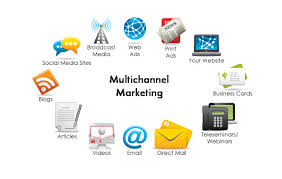
marketing channelsPeriodically, the Direct Marketing Association conducts field research to take the pulse of marketers and the various channels they’re employing to support their marketing campaigns.

In the DMA’s most recent survey, conducted online this past December and January, marketers were asked which one of seven channels they utilize in their campaigns.  The seven choices listed were the following:

  • Direct mail marketing
  • E-mail marketing
  • Mobile marketing
  • Online display advertising
  • Paid search advertising
  • Social media advertising
  • Telemarketing

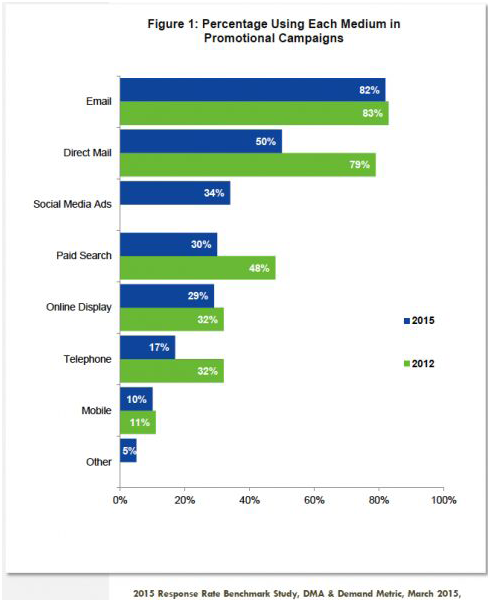
The results of the survey show that e-mail marketing remains King of the Hill when it comes to its popularity as a MarComm channel, with more than four in five marketers including the tactic as part of their promotional campaigns:

  • E-mail: ~82% use as a medium in promotional campaigns
  • Direct mail: ~50% use
  • Social media advertising:  ~34% use
  • Paid search: ~30% use
  • Online display advertising:  ~29% use
  • Telemarketing: ~17% use
  • Mobile marketing: ~10% use

Clearly, the research findings show that marketers are using multiple channels in their campaigns:  Two-thirds of the survey respondents use more than one channel, and around 45% of them reported that they’re using three or more channels in their promotional campaigns.

Social media advertising is a new entrant on the list in the DMA research.  It wasn’t even included in the DMA’s 2012 survey, yet today appears to be an important part of the channel mix.

On the other hand, mobile marketing remains a channel that isn’t being utilized by very many marketers — at least not yet.  In a similar survey conducted by the DMA in 2012, its adoption rate was similar to what the 2015 survey has found.

The graph below compares 2015 and 2012 survey results.  Aside from the lack of movement with mobile marketing, another interesting trend is the significant decline in the utilization of direct mail marketing.  Back in 2012, it rivaled e-mail marketing in popularity.  Today, only half of the marketers surveyed continue to use it as a marketing channel.

And a third big trend is the utter collapse of telemarketing as a popular MarComm channel — likely happening under the twin weight of high costs and massive phone message filtering.
DMA chart

In terms of future anticipated usage, the DMA research found that marketers are, in fact, warming to mobile marketing.  It and social media advertising are the two channels that have the best prospects for new adoption, based on the future intentions reported by these respondents.

The 2015 DMA report is available for purchase here.
Tripping the E-Mail Spam Alarm

Today, it’s more than just the “usual suspect” keywords that are landing e-mails in the junk folder.

se-mMost of us are aware of the kinds of words that trip spam alarms and cause e-mails to be sent straight to the junk folder – or not to be delivered at all.

How about these for starters:

  • Cash
  • Congratulations
  • Discount
  • Free
  • Income
  • Make Money
  • Urgent
  • Viagra
  • $$ / $$$

But research done by MailJet, an international e-mail service provider, looked at more than 14 billion e-mail communiqués and found that a bunch of other keywords are setting off alarm bells nearly as often as terms like “Urgent” or “Viagra.”

… Especially when considering the business categories that are so active in e-mail communications — retail goods, pharmaceuticals, providers of personal services, and the like.

Some of the other terms MailJet has found to be nearly as “toxic” are these:

  • bdcstDear Friend
  • FedEx
  • Increase Sales
  • Increase Traffic
  • Internet Marketing
  • Invoice
  • Lead Generation
  • Lose Weight
  • Marketing Solutions
  • Online Degree
  • Online Pharmacy
  • Order
  • PayPal
  • Search Engine Optimization
  • Sign Up
  • Trial Offer
  • Visa/Mastercard
  • Winning

… And there are more, of course – including various permutations of the words and phrases above.

The inevitable conclusion:  It’s becoming more difficult all the time to use the most common phrases in “subject” lines and “from” lines that’ll land your e-mail in someone’s inbox successfully.

And getting into the inbox just the first step, of course.  The next is motivating the recipient to actually open your e-mail and engage with it, which are additional hurdles in themselves.

What words or phrases have you found to be surprisingly problematic in getting your e-mails delivered to your customers’ inboxes?  How have you dealt with it?  Please share your experiences with other readers here.

It’s Official: Cyber Monday 2014 was the Biggest e-Commerce Day in U.S. History

Cyber Monday ShoppingIn the days following Black Friday this year, we heard reports that consumer purchase volumes at stores were down more than 10% compared to 2013.

A number of explanations for the decline were given, among them the notion that Black Friday sales are less of a draw this year, since merchandise sales now begin before Thanksgiving and tend to run the entire month of December.

But some observers speculated as to whether soft Black Friday revenue figures presage an equally soft holiday shopping season overall.

Well … now that we have sales figures from Cyber Monday (the Monday following Black Friday weekend), I think it’s safe to say that any concerns about a tepid holiday buying season are unfounded.

Custora E-Commerce Pulse, a customer relationship management firm which tracked more than 100 million online shoppers and over $40 billion in e-commerce revenue over the full Thanksgiving Holiday weekend, has just reported that Cyber Monday e-commerce revenues were up over 15% compared with Cyber Monday 2013.

That makes Cyber Monday 2014 the single biggest day in U.S. online shopping ever in history.

Other days of the Thanksgiving weekend also showed robust gains in online shopping:  Black Friday online sales were up ~21% over 2013, and online shopping on Thanksgiving Day itself were up nearly 18% over Thanksgiving Day in 2013.

The strong growth was fueled by mobile shopping, e-mail marketing, plus online product searches on Google and other search engines.

In particular, mobile shopping accounted for ~22% of orders on Cyber Monday, significantly higher than the ~16% of orders recorded last year.

On Black Friday itself, mobile shopping accounted for around 30% of all orders — yet another dramatic increase over 2013 when mobile shopping account for just shy of 23% of orders.

This year’s Cyber Monday stats put the lie to the notion that e-mail marketing is losing its luster.  In fact, e-mail marketing drove nearly one in four online shopping orders, outstripping natural search (at ~19% of all orders) and paid search (~16% of orders).

Much ado about (practically) nothing: Social media and Cyber Monday.

And guess which channels weren’t a meaningful part of the holiday shopping experience this year?

If you guessed social media … you’re absolutely correct.

Taken together, Facebook, Twitter, Pinterest and Instagram accounted for only about 1.5% of online e-commerce orders on Cyber Monday.  (For the weekend as a whole, it was only slightly better at ~1.7%.)

This year’s statistics just add more confirmation of several truisms about online consumer marketing:

  • Targeted e-mail still works the best.
  • Online search is important.
  • Social media is like Lucy and the football.

A Bombshell Forrester Finding? Brands are Wasting Time and Money on Facebook and Twitter

Forrester logo

This past week, marketing research firm Forrester published a new analytical report titled “Social Relationship Strategies that Work.”

The bottom-line conclusion of this report is that brand marketers are generally wasting their time and money focusing on social platforms that don’t provide either the extensive reach or the proper context for valuable interactions with customers and prospects.

In particular, Forrester’s research has determined that Facebook and Twitter posts from top brands are reaching only about 2% of their followers.

Engagement is far worse than even that:  A miniscule 0.07% of followers are actually interacting with those posts.

Much has been made of Facebook’s recent decision to reduce free-traffic posts on newsfeeds in favor of promoted (paid) posts.  But Forrester’s figures suggest that the lack of engagement on social platforms is about far more than just the reduction in non-promoted posts.

Nate Elliott Forrester
Nate Elliott

Nate Elliott, a Forrester vice president and principal analyst, believes that brand managers need to make major changes in how they’re going about marketing in the social sphere.  He notes:

“It’s clear that Facebook and Twitter don’t offer the relationships that marketing leaders crave.  Yet most brands still use these sites as the centerpiece of their social efforts, thereby wasting significant financial, technological and human resources on social networks that don’t deliver value.”

With Twitter and Facebook being such spectacular duds when it comes to social platforms, what does Forrester recommend that brand marketers do instead?

One option is to develop proprietary “branded communities” where fans can hang out in zones where brands can be their own traffic cops, instead of relying on a giant social platform to do the work (or not do the work) for them.

e-mailEven better is to return to greater reliance on an old standby tactic: e-mail marketing.

If this seems like “back to the future,” Forrester’s Elliott reminds us how e-mail can work quite elegantly as the centerpiece of a brand’s social marketing effort:

“Your e-mails get delivered more than 90% of the time, while your Facebook posts get delivered 2% of the time — and no one’s looking over your shoulder telling you what you can and can’t say in your e-mails.  If you have to choose between adding a subscriber to your e-mail list and gaining a new Facebook fan, go for e-mail every time.”

I can’t say that I disagree with Nate Elliott’s position.

Now it’s time to hear from the rest of you marketing professionals.  How successful have you been in building engagement on social platforms like Twitter, Facebook and LinkedIn?  Have your efforts in social paid off as well as in your e-mail marketing initiatives?  Let us know.

From Consumer Reports: The MarComm Tactics People Dislike the Most

imagesMost of us have a few “pet peeves” when it comes to the advertising and promotional tactics we find obtrusive or just plain irritating.

Recently, Consumer Reports studied this issue.  In June 2014, it published an article citing the marketing tactics Americans say they like the least.  The findings were collected via its own survey of a cross-section of U.S. adults age 18 or over.

Of the tactics covered in the survey, some might be considered only mildly irritating … but others are horribly intrusive.

Let’s start with the marketing tactics that the survey respondents roundly disliked:

#1. Telemarketing robocalls:  ~77% dislike

#2. False claims of winning a prize:  ~74%

#3. “Official” direct mail that appears to be an invoice or a check:  ~71%

#4. Pop-up ads on websites:  ~70%

#5. Ads for nutritional supplements making exaggerated claims:   ~70%

#6. Videos that play before viewers can view their desired web content:  ~66%

#7. TV advertising that plays louder than the program itself:  ~63%

Another three marketing tactics were also disliked, but by a smaller proportion of respondents:

#8. Fast-talking disclaimers on broadcast ads:  ~50%

#9. Infomercials:  ~42%

#10. Ads for sensitive personal medical conditions:  ~38%

Wrapping up the list were these four tactics which respondents considered least objectionable:

#11. Products advertised as “American made” that actually aren’t

#12. “Free” offers – but with strings attached

#13. Targeted online ads that show based on viewer purchases, behavior or demographics

#14. Product placement in TV programs and movies

#15. Billboard advertising 

Of all the 15 MarComm tactics evaluated, my own “Top 2” personal dislikes are #4 and #6.

I’m in the marketing field myself, so I guess I should be tolerant of these techniques … but I think my time online is way more valuable than that!

How about you?

Consumers complain about marketing-oriented e-mails — yet they still read them.

e-mail ambivalenceFace it, there are always going to be complaints about marketing-oriented e-mails. Just as in the “bad-old-days” of junk postal mail, consumers are conditioned to pass negative judgment on the volume of promotional-oriented e-mails that flood their inboxes.

True to form, according to a new study by global business, technology and marketing advisory firm Forrester Research, consumer attitudes about e-mail marketing are pretty negative.

Here’s what a sampling of U.S. respondents age 18 or older reported on the “minus” side of the ledger:

  • I delete most e-mail advertising without reading it: ~42% of respondents reported
  • I receive too many e-mail offers and promotions: ~39%
  • There’s nothing of interest: ~38%
  • I have unsubscribe from unsolicited lists: ~37%
  • I wonder how companies get my e-mail address: ~29%
  • It’s difficult to unsubscribe from e-lists: ~24%

There’s far less to show on the “plus” side:

  • It’s a great way to discover new products and promotions: ~24% of respondents reported
  • I read e-mails “just in case”: ~19%
  • I forward marketing e-mails to friends sometimes: ~12%
  • I purchase items advertised through e-mail: ~7%

I wasn’t surprised at all by these finds.

What’s interesting, however, is that the attitudes of consumers are actually trending a bit better than they were in previous Forrester field studies.

Specifically, respondents exhibited improved attitudes in the following areas:

  • Fewer respondents are deleting most marketing-oriented e-mail promos without reading them (~42% vs. ~44% in 2012 and ~59% in 2010).
  • Fewer respondents report that marketing e-mails offer “nothing of interest” (~38% vs. ~41% in 2012).

The percentages are also slightly better for the consumers today who consider e-mails as a good way to discover new products and promotions.  Additionally, the percentages are lower on complaints about receiving too many e-mail offers.

The bottom line on these results:  It looks as if consumers have come to terms with the pluses and minuses of e-mail marketing. As they once did with postal mail, they recognize the negative attributes as a fact of life — something that just “comes with the territory” for anyone who is online.

Click here to view summary highlights from the Forrester study, or here to purchase the full report.