What are the latest trends in the popularity of different marketing communications channel tactics?

The DMA’s 2015 Response Rate Report provides answers.
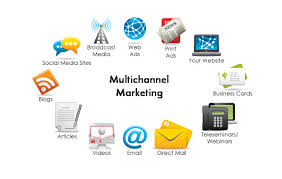
marketing channelsPeriodically, the Direct Marketing Association conducts field research to take the pulse of marketers and the various channels they’re employing to support their marketing campaigns.

In the DMA’s most recent survey, conducted online this past December and January, marketers were asked which one of seven channels they utilize in their campaigns.  The seven choices listed were the following:

  • Direct mail marketing
  • E-mail marketing
  • Mobile marketing
  • Online display advertising
  • Paid search advertising
  • Social media advertising
  • Telemarketing

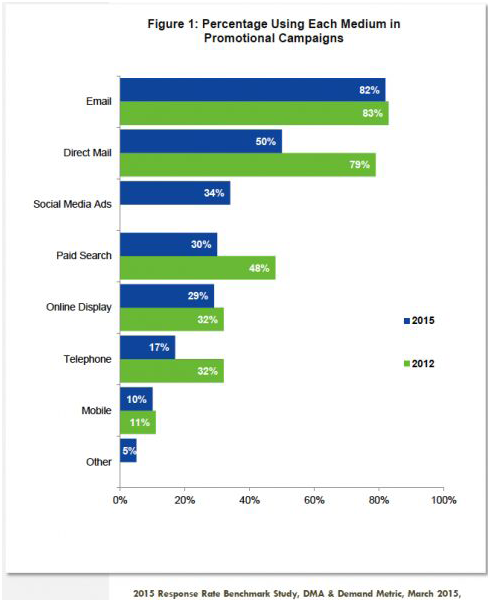
The results of the survey show that e-mail marketing remains King of the Hill when it comes to its popularity as a MarComm channel, with more than four in five marketers including the tactic as part of their promotional campaigns:

  • E-mail: ~82% use as a medium in promotional campaigns
  • Direct mail: ~50% use
  • Social media advertising:  ~34% use
  • Paid search: ~30% use
  • Online display advertising:  ~29% use
  • Telemarketing: ~17% use
  • Mobile marketing: ~10% use

Clearly, the research findings show that marketers are using multiple channels in their campaigns:  Two-thirds of the survey respondents use more than one channel, and around 45% of them reported that they’re using three or more channels in their promotional campaigns.

Social media advertising is a new entrant on the list in the DMA research.  It wasn’t even included in the DMA’s 2012 survey, yet today appears to be an important part of the channel mix.

On the other hand, mobile marketing remains a channel that isn’t being utilized by very many marketers — at least not yet.  In a similar survey conducted by the DMA in 2012, its adoption rate was similar to what the 2015 survey has found.

The graph below compares 2015 and 2012 survey results.  Aside from the lack of movement with mobile marketing, another interesting trend is the significant decline in the utilization of direct mail marketing.  Back in 2012, it rivaled e-mail marketing in popularity.  Today, only half of the marketers surveyed continue to use it as a marketing channel.

And a third big trend is the utter collapse of telemarketing as a popular MarComm channel — likely happening under the twin weight of high costs and massive phone message filtering.
DMA chart

In terms of future anticipated usage, the DMA research found that marketers are, in fact, warming to mobile marketing.  It and social media advertising are the two channels that have the best prospects for new adoption, based on the future intentions reported by these respondents.

The 2015 DMA report is available for purchase here.

Tripping the E-Mail Spam Alarm

Today, it’s more than just the “usual suspect” keywords that are landing e-mails in the junk folder.

se-mMost of us are aware of the kinds of words that trip spam alarms and cause e-mails to be sent straight to the junk folder – or not to be delivered at all.

How about these for starters:

  • Cash
  • Congratulations
  • Discount
  • Free
  • Income
  • Make Money
  • Urgent
  • Viagra
  • $$ / $$$

But research done by MailJet, an international e-mail service provider, looked at more than 14 billion e-mail communiqués and found that a bunch of other keywords are setting off alarm bells nearly as often as terms like “Urgent” or “Viagra.”

… Especially when considering the business categories that are so active in e-mail communications — retail goods, pharmaceuticals, providers of personal services, and the like.

Some of the other terms MailJet has found to be nearly as “toxic” are these:

  • bdcstDear Friend
  • FedEx
  • Increase Sales
  • Increase Traffic
  • Internet Marketing
  • Invoice
  • Lead Generation
  • Lose Weight
  • Marketing Solutions
  • Online Degree
  • Online Pharmacy
  • Order
  • PayPal
  • Search Engine Optimization
  • Sign Up
  • Trial Offer
  • Visa/Mastercard
  • Winning

… And there are more, of course – including various permutations of the words and phrases above.

The inevitable conclusion:  It’s becoming more difficult all the time to use the most common phrases in “subject” lines and “from” lines that’ll land your e-mail in someone’s inbox successfully.

And getting into the inbox just the first step, of course.  The next is motivating the recipient to actually open your e-mail and engage with it, which are additional hurdles in themselves.

What words or phrases have you found to be surprisingly problematic in getting your e-mails delivered to your customers’ inboxes?  How have you dealt with it?  Please share your experiences with other readers here.

From Consumer Reports: The MarComm Tactics People Dislike the Most

imagesMost of us have a few “pet peeves” when it comes to the advertising and promotional tactics we find obtrusive or just plain irritating.

Recently, Consumer Reports studied this issue.  In June 2014, it published an article citing the marketing tactics Americans say they like the least.  The findings were collected via its own survey of a cross-section of U.S. adults age 18 or over.

Of the tactics covered in the survey, some might be considered only mildly irritating … but others are horribly intrusive.

Let’s start with the marketing tactics that the survey respondents roundly disliked:

#1. Telemarketing robocalls:  ~77% dislike

#2. False claims of winning a prize:  ~74%

#3. “Official” direct mail that appears to be an invoice or a check:  ~71%

#4. Pop-up ads on websites:  ~70%

#5. Ads for nutritional supplements making exaggerated claims:   ~70%

#6. Videos that play before viewers can view their desired web content:  ~66%

#7. TV advertising that plays louder than the program itself:  ~63%

Another three marketing tactics were also disliked, but by a smaller proportion of respondents:

#8. Fast-talking disclaimers on broadcast ads:  ~50%

#9. Infomercials:  ~42%

#10. Ads for sensitive personal medical conditions:  ~38%

Wrapping up the list were these four tactics which respondents considered least objectionable:

#11. Products advertised as “American made” that actually aren’t

#12. “Free” offers – but with strings attached

#13. Targeted online ads that show based on viewer purchases, behavior or demographics

#14. Product placement in TV programs and movies

#15. Billboard advertising 

Of all the 15 MarComm tactics evaluated, my own “Top 2” personal dislikes are #4 and #6.

I’m in the marketing field myself, so I guess I should be tolerant of these techniques … but I think my time online is way more valuable than that!

How about you?

“Surprise & Delight” vs. “Tried & True” Branding

All the emphasis on having consumer-facing brands “surprise and delight” their customers isn’t what many people are looking for at all.

surprise surpriseIn the interactive age, what we hear often is that companies and brands need to go beyond simply offering a high-quality product.

Many companies and brands have the notion that they should strive to engender a kind of “personal” relationship with customers – so that consumers will develop the same kinds of feelings for brands as they have with their close friends.

How true is this?

One marketing company decided to find out.  Toronto-based virtual agent technology firm IntelliResponse surveyed ~1,000 online consumers in the United States earlier this year.

When asked what sort of relationship they would prefer to have with the companies whose products and services they purchase, here’s how the percentages broke for these respondents:

  • Prefer a “friendship” where they get personalized service:  ~24% 
  • Prefer a “transactional” relationship where they receive efficient service and that’s all:  ~59% 
  • Prefer both equally:  ~17% 

Evidently, “boringly consistently good” beats “surprisingly delightful” far more often – assuming the company is minding its Ps and Qs when it comes to product quality.

Here’s what else consumers are seeking:  They want to be able to get the same information and answers from a company’s desktop or mobile website … online portal … or social media sites as they do from speaking with company representatives over the phone.

The IntelliResponse survey found that two-thirds of the respondents will go to a company’s website first when seeking out information regarding a product or service – so the answers better be there or the brand risks consumer disappointment.

The takeaway is this:  No matter how much breathless reporting there is about this “surprising” social media campaign or that “delightful” interactive contest … the majority of consumers continue to view companies and brands the way they have for 100 years:  Companies are merely the vehicle by which they can acquire the goods they need.

Puzzle piecesRather than spending undue energy trying to make the interactive world “fun” or “sticky” for customers, companies should focus on the basic work of delivering products, information and answers that are easy to find, easy to understand, and easy to act on.

And related to that — make sure support systems (and support people) are in place so that customers can get any problems or issues solved with a minimum of time or hassle.

Do those things well, and companies will naturally please the vast majority of their current and future customers.

Everything else is just window-dressing.

Fade-to-black for movie film? Not quite so fast …

movie filmJust last week, I blogged about how print magazines are hanging in there, even in the face of relentless competition from “free and easy” digital media, with more new print magazines launching so far this year than folding.

And now come reports of renewed life in another reputed “dinosaur” medium in the communications arena:  movie film.

Journalist Ben Fritz reported in The Wall Street Journal that Eastman Kodak Company is close to inking an agreement with the top Hollywood movie studios to supply a set quantity of film over the next several years.

This, despite the fact that most motion pictures and TV shows are shot these days using digital video.

Because of the steep decline in film sales – Kodak’s movie-film sales are reportedly off by a whopping 96% compared to just 8 years ago, and are projected to amount to less than 450 million linear feet of output this year – Kodak had been mulling the possibility of closing down its film manufacturing capabilities.

If that were to happen, the last of the major movie film manufacturers would have exited the market.  (Fuji, the other major supplier, stopped producing movie film in 2013.)

As it turns out, however, there are a number of “name” film directors who remain quite keen on using film – among them J.J. Abrams, Judd Apatow, Christopher Noland, Lasse Hallström and Quentin Tarantino.

These and other movie directors lobbied the heads of the major film studios to commit to purchasing film in sufficient quantities to allow Kodak’s Rochester film manufacturing facility to remain open.

And now the major studios have reportedly decided to do just that – even though they don’t actually know how many movies will be shot using film versus the digital medium.

About the pending deal, Bob Weinstein, co-chairman of Weinstein Company said this:  “It’s a financial commitment, no doubt about it.  But I don’t think we could look some of our filmmakers in the eyes if we didn’t do it.”

The big challenge for movies shot on film is that very few younger film directors have any experience working in the medium.  That sort of filmmaking is hardly even taught in cinematic arts classes anymore.

Besides, post-production work is much easier and faster with digital.

Still, just like audiophiles are convinced of the superiority of analog recordings over those recorded digitally, some movie directors swear by film.  “I’m a huge fan of film, but it’s so much more convenient digitally,” film director Ian Bryce told reporter Ben Fritz.

Judd Apatow is another director who loves the film medium.  While he also recognizes the benefits of digital, “it would be a tragedy if suddenly directors didn’t have the opportunity to shoot on film,” he says.  “There’s a magic to the grain and the color quality that you get with film.”

By the way, Mr. Apatow is shooting his latest movie – Trainwreck – using film.  And the Lasse Hallström film The Hundred-Foot Journey, which just opened in theatres, was shot on film as well.

hundred food journey movie“Digital cameras are not able to capture all the subtleties of the forest,” Mr. Hallström reported.  His goal was to capture the lush landscape and greenery in the scenes of mushroom and wild berry picking that helps make The Hundred-Foot Journey such a feast for the eyes.

“We compared film and video, and the video simplified all the greens.  On film, you could see the nuances of all the shades,” Hallstrom emphasized.

With all the conflicting factors, what is the prognosis for the film medium?

Well, we now know that Kodak will continue to manufacture it for the next few years at least.  With set purchase commitments comes the ability to plan for operational efficiencies.

We also know that film remains the “medium of choice” for long-term preservation of all types of movies – including those shot digitally.

But practically all movie theatres have switched over to digital projection by now, whereas projection film used to represent a far bigger portion of product sales than preservation film.

So I think we can safely say that short-term, the prognosis is good.

Medium-term is iffy … and long-haul, it’s likely that the term “film” to describe “movies” will be accurate only from a historical perspective.

Do you feel differently?  If so, share your thoughts with other readers here.