The 2015 Marketing Buzz-Meter Kicks into Gear

We’re only a few weeks into 2015, and already the marketing buzz-meter is operating at full force.

amplificationThe latest marketing buzz phrases are always interesting because, while they surely relate to trends and tactics that are taking on greater importance, they can also be short-hand references that “everyone” uses but “no one” really understands.

Consider one popular buzz-phrase example from 2014:  “Big Data.”

I don’t think I’ve heard the same definition of what “big data” is from any two people.  Yet it’s a term that was bandied about throughout the entire year.

No doubt, “big data” will continue to be a popular buzz phrase in 2015 as well.  But you can be sure it’ll be joined by a number of others.  As Natasha Smith, editor of Direct Marketing News magazine reports, get ready to hear many of mentions of these buzz terms as well this year:

Dark Social:

This references online content, information or traffic that’s hard to measure because it occurs in messaging apps, chat and e-mail communications.  Purportedly first coined by Atlantic magazine, it’s a term whose very name conjures up all sorts of mysterious and vaguely sinister connotations about behaviors that are at work below the surface – thereby making it an irresistible phrase for some people to use.

Viewability:

This term is becoming increasingly popular due to people’s concerns that much of what makes up “viewed” online content turns out to be hardly that.  For instance, there’s a difference between a simple video impression (merely an open) and a “viewable” one (opened and staying open for at least a few seconds).

More than likely, over the coming year the Interactive Advertising Bureau and other “great experts” will be debating over what actually constitutes a “viewable” impression.  All the while, you can be sure that marketers will be referencing the term with abandon.

Attention Metrics:

Dovetailing “viewability” is the idea that traditional online marketing metrics such as unique visitors, clickthroughs, and page views are too shallow in that they don’t really measure the true consumption of content.

Enter the buzz term “attention metrics.”  No doubt, marketers will be all over this one in 2015 as they focus more on the time and attention people are spending with content, not merely the fact that some form of engagement happened.

The Internet of Things:

This term started appearing on the radar screen in 2014 but is really coming into its own now.  It even has its own Wikipedia page entry.  While the commercialization of data-collecting devices such as wearable sensors and sensors embedded in appliances and other electronics is an undeniably significant development, this term has to be one of the most pretentious-sounding phrases ever coined.

… Which makes it an irresistible entry in the buzz-meter lexicon, of course.

Conscious Capitalism:

Rounding out the 2015 list – at least for now – is a buzz phrase that captures the essence of what every socially aware marketer wishes his or her company to be.  “Conscious capitalism” refers to companies and brands that are purportedly socially responsible and “in sync” with the needs of the community and the world.

This is considered important because so much survey research shows that people respond positively to companies that “do well by doing good.”

what's all the buzz aboutExpect many people to embrace this approach – and the accompanying buzz phrase – because it sounds so perfect.

[Never mind that things often come crashing down to earth if and when consumers are asked to pay more for the “socially responsible” products and services, or to make unpleasant or unexpected adjustments to their routine in the event.]

Do you have any other examples of marketing buzz terms that you think are poised for stardom (or notoriety) in 2015?  Please share your thoughts with other readers here.

Native Advertising, Sponsored Content and “Truthiness”

There are just a few slight problems with sponsored content:  Readers consider it less trustworthy … and value it less.

Lack of trust in sponsored content
It’s really not that interesting — and I don’t trust you, anyway.

Here’s a behavioral statistic that should be a little disconcerting to marketers:  Only about one in four readers scroll down on sponsored content (native advertising) on publisher websites.

Compare that to ~70% of those same readers who scroll down on other types of news content.

That’s what the chief executive officer of Chartbeat, a developer and purveyor of real-time web analytics software for media publishers, has contended, leading others to try to probe these attitudes further and try to find out more about the dynamics that are at work.

One such effort is online field research conducted this past summer by Contently, a freelance writing services clearinghouse.  It discovered that the difference in engagement levels relates to “trust.”

Generally speaking, readers trust sponsored content a whole lot less than they do “normal” content.

More specifically, here’s what Contently’s research, which targeted ~550 U.S. adults ages 18 to 65, found in terms of trust attitudes:

  • I generally don’t trust sponsored content: ~54%
  • I trust the content only if I trust the brand already: ~22%
  • I trust the content only if I trust the publication: ~19%
  • I generally trust sponsored content:  ~5%

It gets even murkier when we consider that not all readers agree on the same definition of “sponsored content.”

While the largest proportion of people consider “sponsored content” on a news website to be an article that an advertiser paid to be created as well as had input into its content, it was only a plurality of respondents:

  •  A sponsor paid and influenced the article: ~48%
  • A news site wrote it, but a sponsor paid money for it to run: ~20%
  • A sponsor paid for its name to appear next to news content: ~18%
  • A sponsor wrote the article:  ~13%

And here’s a real kick in the gut:  More people in the Contently survey would rather be served “bad ol’ banner ads” than encounter sponsored news and other posts:

  • Would rather see banner ads:  ~57% of respondents
  • Prefer sponsored posts because banner ads are annoying: ~26%
  • Prefer sponsored posts because they’re more interesting than banner ads: ~18%

The findings aren’t much different based on the age or education levels of respondents, either.

If anything, more highly educated people (those with graduate degrees) are most likely to prefer banner ads over sponsored posts.  The reason boils down to concern over the issue of deception:  A large majority of respondents reported that they have ever “felt deceived” upon realizing an article was actually sponsored by an advertiser.

Considering the disapproving numbers collected in the survey, it’s not surprising that Contently also found that respondents are far prone to click on a piece of sponsored content compared to other content:

  • Less likely to click on sponsored content: ~66%
  • More likely: ~1%
  • Equally likely: ~33%

credible sourceLastly, publishers should take note that their credibility is being diminished in the eyes of many, based on the practice of publishing native advertising.  The Contently survey found that nearly 60% expressed the view that publishers lose credibility when they run such sponsored content.

Of course, native advertising and sponsored content isn’t going to go away.  It’s too wrapped up in today’s business models for successful publishing and successful brand engagement.

But it’s clear that publishers, advertisers and the brands they represent have a bigger hurdle to clear in order for their content to be considered worthy of their readers’ attention and engagement.

A Bombshell Forrester Finding? Brands are Wasting Time and Money on Facebook and Twitter

Forrester logo

This past week, marketing research firm Forrester published a new analytical report titled “Social Relationship Strategies that Work.”

The bottom-line conclusion of this report is that brand marketers are generally wasting their time and money focusing on social platforms that don’t provide either the extensive reach or the proper context for valuable interactions with customers and prospects.

In particular, Forrester’s research has determined that Facebook and Twitter posts from top brands are reaching only about 2% of their followers.

Engagement is far worse than even that:  A miniscule 0.07% of followers are actually interacting with those posts.

Much has been made of Facebook’s recent decision to reduce free-traffic posts on newsfeeds in favor of promoted (paid) posts.  But Forrester’s figures suggest that the lack of engagement on social platforms is about far more than just the reduction in non-promoted posts.

Nate Elliott Forrester
Nate Elliott

Nate Elliott, a Forrester vice president and principal analyst, believes that brand managers need to make major changes in how they’re going about marketing in the social sphere.  He notes:

“It’s clear that Facebook and Twitter don’t offer the relationships that marketing leaders crave.  Yet most brands still use these sites as the centerpiece of their social efforts, thereby wasting significant financial, technological and human resources on social networks that don’t deliver value.”

With Twitter and Facebook being such spectacular duds when it comes to social platforms, what does Forrester recommend that brand marketers do instead?

One option is to develop proprietary “branded communities” where fans can hang out in zones where brands can be their own traffic cops, instead of relying on a giant social platform to do the work (or not do the work) for them.

e-mailEven better is to return to greater reliance on an old standby tactic: e-mail marketing.

If this seems like “back to the future,” Forrester’s Elliott reminds us how e-mail can work quite elegantly as the centerpiece of a brand’s social marketing effort:

“Your e-mails get delivered more than 90% of the time, while your Facebook posts get delivered 2% of the time — and no one’s looking over your shoulder telling you what you can and can’t say in your e-mails.  If you have to choose between adding a subscriber to your e-mail list and gaining a new Facebook fan, go for e-mail every time.”

I can’t say that I disagree with Nate Elliott’s position.

Now it’s time to hear from the rest of you marketing professionals.  How successful have you been in building engagement on social platforms like Twitter, Facebook and LinkedIn?  Have your efforts in social paid off as well as in your e-mail marketing initiatives?  Let us know.

From Consumer Reports: The MarComm Tactics People Dislike the Most

imagesMost of us have a few “pet peeves” when it comes to the advertising and promotional tactics we find obtrusive or just plain irritating.

Recently, Consumer Reports studied this issue.  In June 2014, it published an article citing the marketing tactics Americans say they like the least.  The findings were collected via its own survey of a cross-section of U.S. adults age 18 or over.

Of the tactics covered in the survey, some might be considered only mildly irritating … but others are horribly intrusive.

Let’s start with the marketing tactics that the survey respondents roundly disliked:

#1. Telemarketing robocalls:  ~77% dislike

#2. False claims of winning a prize:  ~74%

#3. “Official” direct mail that appears to be an invoice or a check:  ~71%

#4. Pop-up ads on websites:  ~70%

#5. Ads for nutritional supplements making exaggerated claims:   ~70%

#6. Videos that play before viewers can view their desired web content:  ~66%

#7. TV advertising that plays louder than the program itself:  ~63%

Another three marketing tactics were also disliked, but by a smaller proportion of respondents:

#8. Fast-talking disclaimers on broadcast ads:  ~50%

#9. Infomercials:  ~42%

#10. Ads for sensitive personal medical conditions:  ~38%

Wrapping up the list were these four tactics which respondents considered least objectionable:

#11. Products advertised as “American made” that actually aren’t

#12. “Free” offers – but with strings attached

#13. Targeted online ads that show based on viewer purchases, behavior or demographics

#14. Product placement in TV programs and movies

#15. Billboard advertising 

Of all the 15 MarComm tactics evaluated, my own “Top 2” personal dislikes are #4 and #6.

I’m in the marketing field myself, so I guess I should be tolerant of these techniques … but I think my time online is way more valuable than that!

How about you?

Tom Goodwin Sounds Off: Five Big Myths about Advertising Today

Tom Goodwin
Tom Goodwin

It’s so common to hear weighty pronouncements about the changing world of advertising and how the ground is shifting under the discipline.

It seems that we get one of these “new horizons” commentaries about every other week or so.

That’s why it’s refreshing to hear a few countervailing voices among the breathless babble. These are the voices of reason that move past the hyperbole and provide some sober grounding.

One such person is former advertising industry exec Jeremy Bullmore. His recent commentary on the “big data” craze is a good case in point — and well-worth reading.

Another industry specialist whose comments are always worth noting is Tom Goodwin, head of Tomorrow Innovation, a digital marketing consultancy. He’s identified five big myths about today’s advertising environment which need “calling out,” as he puts it.

What are Goodwin’s myths? They’re shown below, along with Goodwin’s “quasi-contrarian” views about them.

“TV is dead.

Nope. More people are watching television than ever before — and that’s looking at just the mature USA and UK markets.  Goodwin contends that TV advertising has never been more valuable — and most commercials are viewed rather than skipped over.  But they’re viewed on many kinds of devices, of course.

Goodwin’s take: “TV is here to stay … [but] the notion of ‘television’ generates false boundaries to what’s possible with video advertising when [people] consume video in so many new ways.”

“Consumers want conversations with brands.” 

Ignore ButtonNo they don’t, Goodwin contends: “The conversations I most often see are those of disgruntled customers, given the microphone to complain that Twitter provides. It strikes me overwhelmingly, with remarkably few exceptions, that for most brands, people want an outcome or resolution or perhaps information — and not a conversation.”

“Brands must create good content.” 

Goodwin acknowledges that content delivered by brands needs to be inherently valuable. But it’s more complicated than just that:  “Branded content is not meritocratic — you can’t say any one piece of content is ‘better’ than another. Perhaps the best real test of content is when it’s served, how, and who it reaches and the value it provides.”

“Advertising is about storytelling.”

Goodwin contends that advertising people are buying their own hype with this whopper. “Let’s not delude ourselves that advertising is not about selling stuff,” he emphasizes.

“Advertising dollars should correlate with consumers’ time spent with media.”

Goodwin claims that advertising industry players feel a compulsion to “be where the people are,” under the assumption that people will engage with advertising in similar ways whether they’re online or offline, on a mobile device or a desktop, and so on.

Because of this thinking, media spend projections looking into the future “bear no resemblance” to what’s working or not working — or how it’s even possible to spend that much money advertising in the channels like mobile.

How have these myths of Goodwin’s taken hold in the first place? Is it because talking about them seems so much more interesting and important than contending that advertising is continuing on a more familiar trajectory?

Goodwin thinks this may be part of it. Certainly, he acknowledges that times are changing dramatically in advertising — as they have been for some time.  But he makes a plea for more wisdom and nuance:

“While nobody gets famous (or a promotion) saying things are complex or largely unchanged … it’s closer to the truth.”

Personally, having spent a quarter century years in the marketing communications field, I feel that Tom Goodwin has raised some very interesting and valid points.

Where do you come down on them?  Do you agree or disagree with the five “myths” Goodwin has identified in modern advertising?  Leave a comment and share your thoughts for the benefit of other readers.

Harris Poll: What Americans say they want in news coverage.

When it comes to the news, Americans say they’re tired of so much attention on celebrity gossip and scandal stories … but are they really?

news mediaExperience has shown that healthy foods on the menu at fast food establishments test well in consumer attitudinal surveys — only to bomb big time when actually introduced.

It seems as though many people answer the way they think they’re “supposed” to respond, even though they’ll never actually opt for the apple slices in lieu of the order of fries.

I wonder if the same dynamics are at work in a recent Harris Poll, which queried ~2,500 Americans age 18 or over about their preferences for news topics.  The online survey was conducted in August 2014, with the results released this past week.

For starters, three-fourths of the respondents felt that celebrity gossip and scandal stories receive too much coverage.

Indeed, many believe that entertainment news in general receives too much attention in the news:

  • Celebrity gossip and scandal stories: ~76% claim too much attention is paid in the news
  • Entertainment news in general: ~49%
  • Professional spectator sports: ~44%
  • Politics and elections: ~33%

And which topics do people feel aren’t covered sufficiently in the news? It’s everything that’s “good for you”:

  • Education topics: ~47% believe too little attention is paid in the news
  • Local/national humanitarian issues: ~47%
  • Science topics: ~45%
  • Government corruption and scandals: ~44%
  • Corporate corruption and white collar crime: ~42%
  • Global humanitarian issues: ~33%
  • Health topics: ~30%

I suspect that the “actual reality” is different from how the survey participants responded. If news organizations weren’t seeing keen interest generated by their celebrity, entertainment and sports stories, they would stop producing them.  Simple as that.

Harris Poll logoYou can view more findings from the Harris survey, including data tabulations, here. Among the interesting findings is the degree of trust people have for various different news media:  network TV news, local TV news, local newspapers, national newspapers, online news sources.

Hint: trust levels are nearly where they should be …

What are your thoughts about news topics? Which ones are getting proper coverage versus too much?  Please share your observations with other readers here.

Information, advertising and eye-tracking: Continuity among the chaos.

digital eyeIn the Western world, humans have been viewing and processing information in the same basic ways for hundreds of years. It’s a subconscious process that entails expending the most judicious use of time and effort to forage for information.

Because of how we Westerners read and write – left-to-right and top-to-bottom – the way we’ve evolved searching for information mirrors the same sort of behavior.

And today we have eye-scanning research and mouse click studies that prove the point.

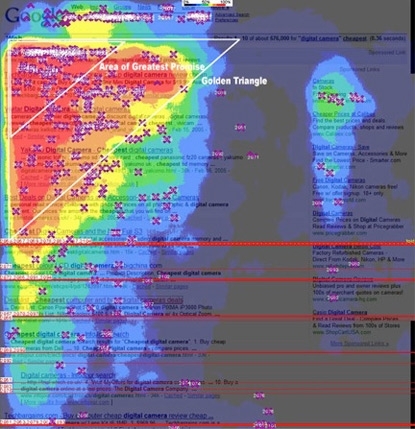
In conducting online searches, where we land on information is known variously as the “area of greatest promise,” the “golden triangle,” or the “F-scan diagram.”

However you wish to name it, it generally looks like this on a Google search engine results page (SERP):

F-scan diagram

It’s easy to see how the “area of greatest promise” exists. We generally look for information by scanning down the beginning of the first listings on a page, and then continue viewing to the right if something seems to be a good match for our information needs, ultimately resulting in a clickthrough if our suspicions are correct.

Heat maps also show that quick judgments of information relevance on a SERP occur within this same “F-scan” zone; if we determine nothing is particularly relevant, we’re off to do a different keyword search.

This is why it’s so important for websites to appear within the top 5-7 organic listings on a SERP – or within the top 1-3 paid search results in the right-hand column of Google’s SERP.

In recent years, Google and other search engines have been offering enhancements to the traditional SERP, ranging from showing images across the top of the page to presenting geographic information, including maps.

To what degree is this changing the “conditioning” of people who are seeking out information today compared to before?

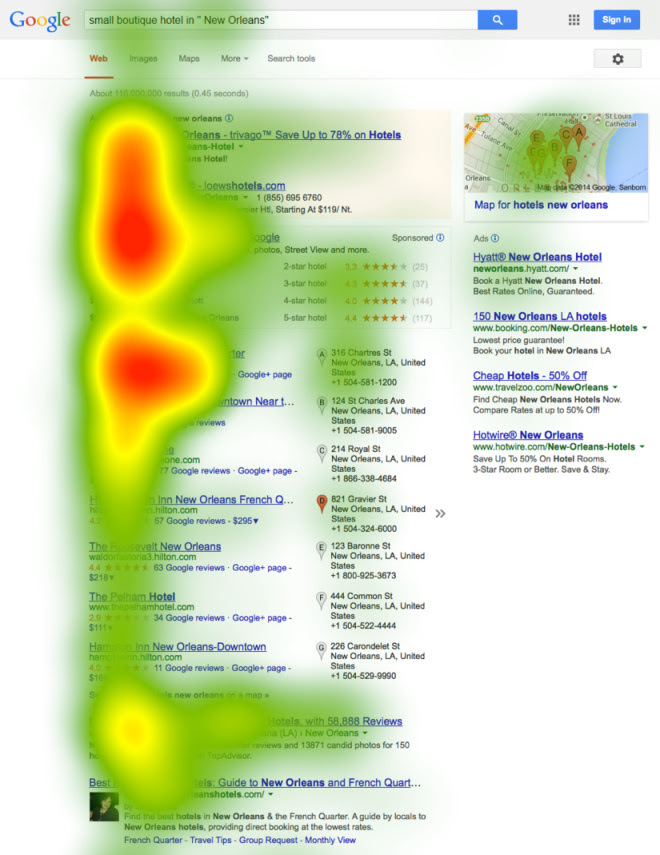
What new eye-tracking and heat maps are showing is that we’re evolving to looking at “chunks” of information first for clues as to the promising areas of results. But then within those areas, we revert to the same “F-scan” behaviors.

Here’s one example:

Eye-tracking Update

And there’s more:  The same eye-tracking and heat map studies are showing that this two-step process is actually more time-efficient than before.

We’re covering more of the page (at least on the first scan), but are also able to zero in on the most promising information bits on the page.  Once we find them, we’re quicker to click on the result, too.

So while Google and other search engines may be “conditioning” us to change time-honored information-viewing habits, it’s just as much that we’re “conditioning” Google to organize their SERPs in ways that are easiest and most beneficial to us in the way be seek out and find relevant information.

Bottom line, it’s continuity among the chaos. And it proves yet again that the same “prime positioning” on the page favored for decades by advertisers and users alike – above the fold and to the left – still holds true today.

Does Social Media Buzz Actually Win Elections?

social media politicsWes Green, one of the faithful readers of the Nones Notes Blog, posed a question as part of a comment on my recent post about the disconnect Gallup has observed between social media marketing promise and reality.

Wes’ question asked to what degree social media activity actually decides U.S. elections.

In other words, is social media “buzz” enabling campaigns to win elections that would have been won by a different candidate otherwise?

If you look at the sheer volume of YouTube posts, Facebook pages and sharing of breaking news on Twitter that’s being pushed out there by political campaigns, surely they must think that these social platforms are having an impact.

But what about a more scientific look into it?  I searched around for answers and found one such analysis.

Shortly before NM Incite, a social media intelligence joint venture of Nielsen and McKinsey, was shut down in 2013, it had looked at precisely these dynamics through the prism of the U.S. federal election campaigns of 2010 and 2012.

Here are two important pieces of data NM Incite uncovered:

  • Observation #1: In three out of four election campaigns, the candidate who was the most frequently mentioned on social media was the one who ultimately won the election.
  • Observation #2: The share of online “buzz” for each winning candidate was higher than the share of votes the winner actually won.

These two observations raise the next question: Is there a “causal” relation between social media presence and positive results on election night?  These findings don’t tell us that.

Instead, it may be that winning candidates are doing a better job at more than merely social media to win their races.  Their campaigns are just better organized and more adept at hitting on all cylinders.

Here’s one other finding from NM Incite’s evaluation that suggests that social may be an ornamentation and not the tree:  States with higher levels of voter turnout tend to be the ones with lower levels of online buzz about their candidates.

So there’s little evidence to suggest that social media buzz is generating higher voter participation.

I’d say we need more research on this topic. It’s a rapidly changing environment, no doubt.  An analysis that dates back to 2010 and 2012 is like a lifetime in online political campaigning.  Has anyone come across any newer research?

Gallup puts the Kibosh on Social Media’s Marketing Hype

“Social media are not the powerful and persuasive marketing force many companies hoped they would be.”Gallup, Inc. 

social media verdictThat’s one of several key conclusions from a report issued this past summer by research firm Gallup, Inc. The report examined the influence of social media on consumer purchase decision-making.

The Gallup findings are based on web and mail polling it conducted with ~18,000 American consumers during 2013.

When asked about the influence of social media on buyer behaviors, ~62% of the respondents reported that social media has “no influence at all” on their purchasing decisions.

By contrast, ~30% stated that social media has “some influence,” while only ~5% reported that social media has “a great deal of influence” over their purchasing decisions.

Compare these middling results with the fact that U.S. companies spent well over $5 billion on social media advertising in 2013, and the two figures seem out of proportion.

Actually, the disconnect between “people and products” on social media shouldn’t be too surprising, in that ~94% of the Gallup respondents reported that the reason they go on social media platforms is to connect with friends and family members.

The percentage of people who use social media to follow trends and/or to find reviews or other information on products is far lower: ~29% according to the Gallup survey.

But it’s the magnitude of the difference that may be surprising.

And here’s another thing: In its report, Gallup states that “consumers are highly adept at tuning out brand-related Facebook and Twitter content.”

It’s yet another data point supporting the growing realization that social media has failed to live up to its early marketing hype. So it should come as little surprise that more companies have been refining their strategies to stress quality over quantity when it comes to both fan acquisition and to published content.

More findings from the Gallup report can be viewed here.

Organic Search: Still King of the Hill in Generating Web Traffic

online searchingIn recent years, the focus on “content marketing” has become stronger than ever: the notion of attracting traffic via the inherent relevance of the content contained on a website rather than through other means.

It seems eminently logical.  But content marketing is also relatively labor-intensive to build and to maintain. So there’s always been an effort to drive web traffic through “quicker and easier” methods as well.

But the newest findings on web traffic really do demonstrate how fundamental good content is to meeting the challenge of generating web traffic.

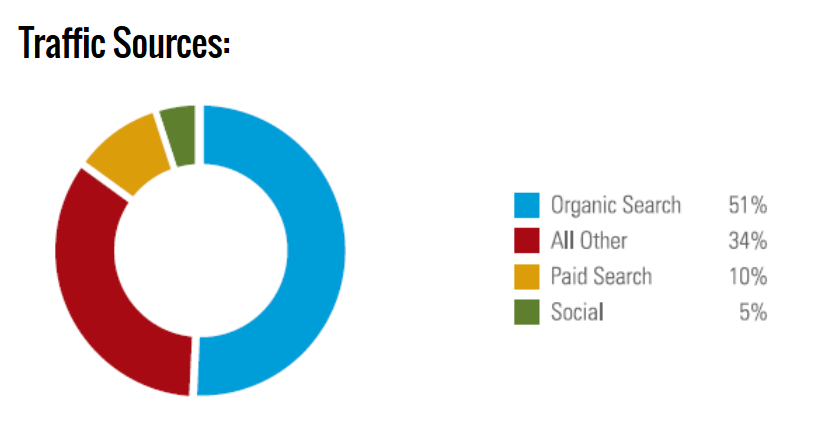
An analysis by web analytics and measurement firm BrightEdge reveals that organic search (SEO) drives over half of all traffic to websites (both business-to-business and business-to-consumer).

By contrast, paid search (SEM) accounts for only one-fifth of SEO’s result, and social is lower still:

  • Organic search: Generates ~51% of all web traffic
  • Paid search: ~10%
  • Social media: ~5%
  • All other methods (e.g., display advertising, e-mail and referred): ~34%

Web traffic driversSource:  BrightEdge, 2014. 

In other words, all forms of advertising put together don’t drive as much traffic as organic search.

The BrightEdge statistics also remind us that social media, however popular it may be to millions of people, isn’t a highly effective traffic generator like search. Here are some of the key reasons why:

  • Social shares are fleeting and can get drowned out easily.
  • Most users don’t go on a social platform, only then to click on different links that take them away from social.
  • Not everyone uses social media, whereas everyone uses a search engine of some kind when they’re in “investigative” mode.

That’s the thing:  People use SEO when they’re seeking answers and solutions — often in the form of a product or a service.  Unlike in social or online display advertising, there’s no need to “disrupt” the user’s intended activity.

And if you’re in the B-to-B realm, organic search even more prevalent:  Organic search drives ~73% of all web traffic there.

Even consumer categories like retail, entertainment and hospitality find that organic search is responsible for attracting 40% or more of all web traffic.

The takeaway for companies is that any marketing strategy that doesn’t adopt “content development” as a core tactic instead of an “ornamentation” is probably destined to fall well-short of its full potential.