A Strong Job Market and the “Gig” Economy

The two don’t go together very well.

It wasn’t so long ago that the so-called “gig” economy was all the rage. In the early 2010s, with a sizable portion of companies being skittish to commit to hiring full-time workers due to fresh memories of the economic downturn, many workers found opportunities to make money through various different gig economy service firms — companies like Uber, Lift, Postmates and others.

What those jobs offered workers were flexible schedules, reasonably decent pay, and the ability to cobble together a livelihood based on holding several such positions (while still being able to hunt around for full-time employment).

For employers, it was the ability to build a workforce for which they didn’t have to cover things like office expenses and various employee benefits — not to mentioning paying for payroll taxes like the employer social security contribution.

In the past few years, the environment has changed dramatically. With national unemployment hovering around 3.5% — and lower still in many larger urban areas — “gig” companies have found it more difficult to find workers.

What’s more, those workers who are hired are churning through the companies more even more quickly than before — many staying with these jobs for just a few months.

Tis is driving up worker recruitment costs to their highest levels ever.

In a May 2019 interview with The Wall Street Journal, Micah Rowland, COO of Fountain, a company that helps gig companies acquire new workers by streamlining the hiring process, puts it this way:

“It [strikes] me that in some of these markets, they’re processing thousands of job applicants every month — and these are not large cities.”

In Rowland’s view, gig companies in some markets may be burning through the entire available labor market of people willing to work in roles of this kind.

It isn’t as though turnover rates aren’t high in other service sectors in the more “traditional” economy. In the fast-food industry, for example, turnover is running as much as 150% annually these days. But in the case of gig employment markets, it’s even higher — sometimes dramatically so.

With the tight labor market showing little sign of loosening anytime soon, it may be that we see some firms looking at “regularizing” employment for at least some of their workers. If it makes economic sense to hire some actual employees in order to curb recruitment costs, some will likely go that route .
There’s another factor at work as well. More of these gig economy workers are becoming more vocal about pushing back on pay and working conditions. Noteworthy examples have been recent protests by rideshare company workers in cities like Los Angeles and San Francisco.  Others have done the envelope math and have determined that once driver-owned vehicle costs of gasoline and depreciation are calculated against declining fares that have dropped below $1 per mile in some markets like Los Angeles and Minneapolis-St. Paul, workers’ effective wages are significantly less than even $10 per hour.

Picking up on these worker concerns, a number of activist groups are making gig economy companies like Lyft and Uber into a “cause célèbre” (not in a good way), but loud, polarizing detractors such as these tend to muddy the water rather than bring fresh new insights to the debate.

As well, one wonders if the activism is even needed; I suspect what we’re seeing now is a pendulum swing which happens so often in economics — where an equilibrium is re-established as things come back into balance after going a bit too far in one direction. In the case of the gig economy, the low unemployment rate in many regions of the country appears to be helping that along.

Alternative communications tools abound, but email’s popularity remains undimmed.

Email has been with us for decades now — for such a long time that email could be considered as “mature” a communications tool as the conventional telephone.

And yet, even as some older tools decline in use as new communications techniques emerge, email continues to be as popular as ever.

The latest confirmation of this comes from a study of ~1,000 U.S. workers conducted in September 2019 by survey research firm Propeller Insights for app developer Spike. The topline result: of the respondents who use both email and messaging apps, nearly 80% prefer email, as compared to only around 20% who prefer the messaging apps.

Not surprisingly, older workers embrace e-mail more than younger ones do — both in terms of preference and usage. Even so, e-mail reigns supreme in terms of usage across all age groups, with messaging apps, the telephone, in-person conversations and video conferencing (in that order) lagging behind.

As for male versus female respondents; their usage and preferences are roughly similar, with perhaps a feather on the scale for males in favor of email communications.

Furthermore, what comes through loud and clear from the study is that people are tired of juggling multiple channels of communication, with nearly nine in ten respondents stating that switching between apps affects their productivity adversely in one or more ways.

The following reasons were cited as contributing to their reluctance to switch between various communication and collaboration tools:

  • Makes it harder to find information: ~21%
  • Creates too many mixed communications: ~21%
  • Slows down productivity: ~18%
  • Wastes time: ~17%
  • Is a major distraction: ~13%

Related to these downsides, more than two-thirds reported that they would welcome having an app that combines all emails and messaging.

Whether or not a combo app is something that becomes available, anyone expecting email to decline precipitously as a preferred method of communications in the coming years is likely to be disappointed.

What are your practices regarding email, messaging apps and other communications methods? Are they substantially different from the Propeller survey results? Please share your thoughts with other readers.

Drones Start Delivering

But will they really deliver the goods?

Drone deliveries just got real. We’ve been reading about them for a good while, along with the occasional news story about a prototype drone model making a product delivery to someone’s doorstep.

But drone deliveries have suddenly taken a major step into the commercial mainstream with the announcement that the first home deliveries of packages from Walgreens have started. They’re being handled by Wing, a subsidiary of Alphabet — the parent company of Google.

Wing itself received a special certification from the Federal Aviation Administration recently that allows it to make commercial air deliveries directly to homes in the United States. That’s a first.

In addition to the Walgreens account, Wing is also delivering OTC medication, gifts and other items on behalf of Sugar Magnolia, a Virginia-based retailer.

How do these deliveries work? Customers order products via a special app, and can opt in to receive their items via FedEx Express delivered by drone, which lowers the packages to a designated spot in a yard or driveway.

Wing, Walgreens and Sugar Magnolia aren’t the only people nosing around this method of delivery. Walmart has filed a patent application for a system for retrieving packages delivered by drone, and UPS is also getting into the mix.  The FAA has given approval to UPS’s new Flight Forward subsidiary that will allow it to fly an unlimited number of drones with an unlimited number of remote operations. And right on cue, the first Flight Forward agreement for drone delivery services has just been announced, with CVS pharmacies.

So it’s pretty clear that drones have finally broken through to the point where they can be serioiusly tested for consumer use and acceptance. Next, it will be interesting to gauge consumer reaction.  Will drone deliveries break out into the mainstream, or are they destined to remain more of a curiosity?  Here’s one early read from online business owner Mark Reasbeck:

“[It’s] nice that everybody … has nothing else to do but to order stuff from Walgreens and just sit there and wait for the delivery. What happens if you’re not home?  How much [cost] for that service?  They have to pay for a ‘shopper’ and then all the pilots watching the drone.  This is not needed on so many levels.”

What are your thoughts on this latest transport frontier? Is it a flash in the pan? … or poised for phenomenal success?

Why aren’t wages moving in lockstep with the improved employment picture?

If you’ve taken a look at September’s U.S. unemployment figure – 3.5% — you’re seeing the lowest level of unemployment in over 50 years. And for particular subgroups of the population, they’re enjoying their lowest employment percentages ever — at least since records have been kept.

It’s definitely something to cheer about. But at the same time, it’s become increasingly evident that wage growth isn’t happening in tandem with lower unemployment.  And that includes industrial wages as well.

In fact, September results show the first dip in wages – albeit slight – in the past two years.

What gives?

According to Zheng Liu and Sylvain Leduc, two economics researchers at the Federal Reserve Bank of San Francisco, the cause of stagnating wages in an otherwise robust economy can be laid at the doorstep of automation.

According to Liu and Leduc, as certain tasks move more toward automation, employees are losing bargaining power within their organizations. When people fear that they could lose their jobs to a robot or a machine, there’s a hesitation to ask for higher wages as that might hasten the eventuality.

The net result is a widening gap between productivity and pay.

But does this situation apply across all of industry? Perhaps not. Last year, manufacturing expert and Forbes magazine contributing writer Jim Vinoski noted that “huge swaths of industry remain decidedly low-tech and heavily manual.”

The reason? Complexity, volume and margins are often barriers to the implementation of automation in many applications.  Just because something can be automated doesn’t mean that there’s a compelling economic argument to do so – particularly if the production volumes aren’t in the league of “mass manufacturing.”

Jobs in engineering and R&D are even less likely to become automated. After all, probably the single most important attribute of employees in these positions is the ability to “think outside the box” – something artificial intelligence hasn’t come anywhere close to replicating (at least not yet).

What are your thoughts about automation and how it will affect employment and wage growth? Please share your perspectives with other readers.

LinkedIn’s Weak Link

On balance, most people would agree that the LinkedIn social media platform has been a positive development in the field of business. Until LinkedIn came along, often it was quite challenging to make and nurture connections with like-minded industry or professional colleagues, or to find relevant contacts deep within corporations or other organizations.

I’m old enough to remember the “bad old days” of fruitless searches through the Corporate Yellow Book, Hoover’s and Dun & Bradstreet mercantile listings to try to find good company contacts. Often the information was far too “upper-level,” out-of-date, or simply wrong.  Industry, state and regional directory listings were even worse.

Invariably, any data ferreted out needed to be vetted through phone calls made to beleaguered front-office receptionists who were understandably disinclined to spend much time being helpful.

Of course, as with Wikipedia all LinkedIn “data” is submitted information, and subject to varying degrees of accuracy. As well, the data are comprehensive and accurate only to the degree that each LinkedIn member keeps his or her employment and related information current and complete.

But as a crowd-sourcing database of information – and often with “deep-dive” data on members available to view – LinkedIn is miles ahead of where we were before.

That being said, there is one negative aspect about LinkedIn that seems to have become more pronounced over time — and that’s the burgeoning volume of LinkedIn connection requests that are happening.

Speaking for myself, I’ve spent an entire career nurturing my business relationships. That this has resulted in being one of the LinkedIn members who are in the “500+ connections” club speaks to a lifetime of establishing “real” connections with “real” people – not mindlessly sending out connection solicitations to just anyone.

But that’s what’s happening with many of the incoming requests-to-connect on LinkedIn. These days, I’m receiving requests daily from people I do not know personally and have never even heard of before.

These are the folks who take advantage of LinkedIn’s higher cost”premium membership” programs to gain access to the more detailed information contained in member profiles that is normally off-limits to all except first-degree connections.

In what ways are these people actually interested in connecting with me?  Are they simply sending out a rash of “spray-and-pray” requests in the hopes of getting a nibble … or perhaps making an effort to build their own network and look more like an “authority” in their line of work?

When I click through to view the profiles of those people requesting to connect, it turns out that most them are in fields that relate to my line of work, however tangentially. Likely they’ve identified my name based on shared professional organizations and vocational interests.

But their reasons for requesting to connect — if they even bother to give one — are so generic (or so lame) as to be laughable.

Early on, I did a bit of “empirical” research to see how a few of these connections might actually evolve after I accepted their request to connect. Big mistake, that was.  Recently, freelance copywriter extraordinaire Ed Gandia described something very similar about his own personal LinkedIn experience, characterizing the typical follow-up communiqué from a new LinkedIn connection as “the business equivalent of a marriage proposal” – to wit:

“I’d like to get on the phone with you about [marrying me/having kids/opening a joint bank account]. Here are three times I’m available to talk.  I’m so excited to hear what you can offer me as [my new husband].”

If ever we needed reminding about how not to engage in business development solicitations, these sorry LinkedIn communications are it.

The bright promise of LinkedIn is the ability to identify people with whom we can potentially work or collaborate.  In that regard, the platform can be very valuable.  It’s just too bad that so many people are now using it for ill-conceived (or perhaps desperate?) shotgun attempts to sell themselves, their products or their services.

It won’t work. Communications technology may have evolved but some fundamental things never change.  At the top of the list:  No one wants to be pestered by unsolicited pitches for products, consulting services, employment opportunities and the like.  Not then, not now, not ever.

Hopefully, LinkedIn can calibrate its business practices to ensure that the benefits of interacting with the social platform always outweigh the detriments. We all recognize that this is one way LinkedIn can monetize the data that’s valuable housed on its platform.  But LinkedIn needs to get this just right, lest they turn off their most consequential members – or worse, drive them away.

The Demise of the Urban Commuter Tabloids

The end of the line: The final edition of Express at the McPherson Square Metro stop in Washington, DC.

I’ve blogged before about the major struggles of the so-called alt-weekly press in recent times as the Internet has upended both the business model and the editorial mission of such papers.

But what about urban commuter publications? These are the tabloid freebies that sprang over the decades up to serve the daily public transit population in large urban areas, offering quick-read news and entertainment during subway, train and bus commutes.

Unlike the alt-weeklies with their often-edgy or otherwise counterculture editorial slant, the commuter tabloids were generally more conventional in their content — focusing less on controversial POV topics and instead on “what’s happening” in headline news and on the dining, arts and entertainment front.

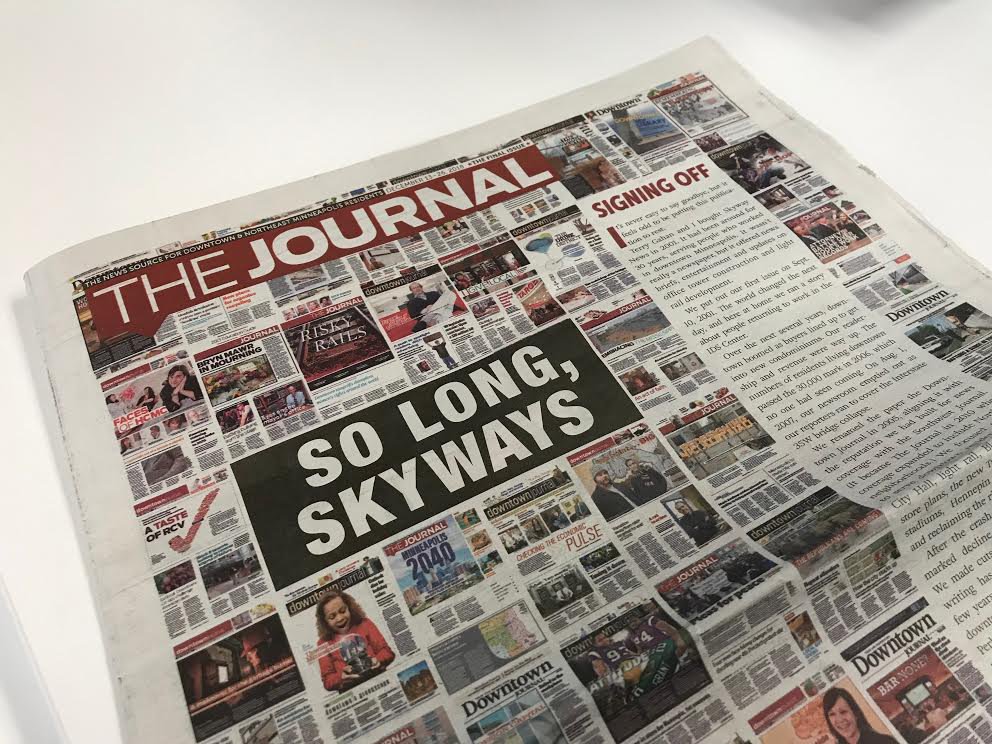
One such publication that I came to know quite well was Skyway News — named after the iconic skyway system in downtown Minneapolis — where professionals could grab a copy of the tabloid while dashing off to grab their public transport.  For me, reading Skyway News was a way to pass the time while taking my 35-minute bus commute (yes – it took that long to travel just three miles in the city during rush hour).

An amazing 48-year run: Skyway News / The Journal (Minneapolis, 1970-2018).

Alas, Skyway News, which debuted in 1970, eventually went the way of so many alt-weekly papers.  First it tried expanding its circulation (and editorial focus) to cover residential Northeast Minneapolis, changing its name to The Journal in the process … but finally shut down for good late last year.

Still, it was an amazing 48-year run for a paper that never had a circulation exceeding 30,000.

This week, we’re hearing news that one of the most successful of the urban commuter tabloid ventures has bitten the dust, too. In this case it’s Washington DC’s vaunted Express, a free commuter tabloid published by the Washington Post since 2003.

In his customary colorful way, Dan Caccavaro – the tabloid’s founding editor who remained in that position for the entire 16 years of the publication’s existence – explained to readers what was behind the paper’s demise:

The final edition of the Express tabloid paper (September 2019).

“When we launched in 2003, there was no such thing as an iPhone. It would be another year before Harvard students would start using a novel social network called Facebook to keep tabs on their classmates.  No one was tweeting anything – or Instagramming or Snapchatting.  And most of us still mocked our “CrackBerry”-addicted friends who just couldn’t wait until they got to work to check their email.   

How quaint.”

The headline of Caccavaro’s editorial says it all: “Hope you enjoy your stinkin’ phones.”

While circulation of the Express had been declining since its height of nearly 200,000 copies to around 130,000 today and while the paper’s finances had slipped into loss territory, the death knell came when the DC metro system introduced Wi-Fi service on its trains.  With that move, the ability for the Express to engage the attentions of DC’s metro commuters died.

Whereas at one time the Express and its quick-read news format was “an integral part of the morning commute for Washingtonians,” the ability for people to stay online during their commute effectively made the Express an irrelevance.

As Caccavaro explained in his final editorial salvo:

Express editor Dan Caccavaro then …

“It wasn’t unusual in [the] early days to see two-thirds of riders on a rush-hour train reading Express … The appetite for Express was so great, in fact, that we more than once considered printing an afternoon edition.  

This Monday morning as I rode the train to work, I was struck by a very different observation. Three people on my crowded Blue Line train were reading Express … one man had his nose in an old-fashioned book. Almost everyone else was staring at a phone.”

Express editor Dan Caccavaro now.

What’s particularly ironic is that the Express, with its lively, quick-read character and attractive, colorful layout, was the precursor to the kind of news and information that everyone expects to see continuously fed to them on their devices.  So as it acclimated a generation of readers to being quickly-informed, entertained and pleasantly distracted during their commutes, Express actually sowed the seeds for the wholesale shift to mobile screens to receive information in the same fashion.

With the closure of Express, there can’t be more than a handful of urban commuter tabloids left in existence in America.  I can’t think of single one.  But if you’re aware of any, please enlighten us – and let us know what might be the secret behind their continuing relevance.

The unintended “open book” company … opens a can of worms.

Transparency is usually considered a good thing. But when it means your company is an open book, it’s gone too far.

Unfortunately, some companies are making far too much of their information visible to the world without realizing it. Clean laundry, dirty laundry – the works.

One of these instances came to light recently when vpnMentor, a firm that bills itself as an “ethical hacking group,” discovered an alarming lack of e-mail protection and encryption during a web-mapping project regarding an international piping, valve and fitting manufacturing organization.

I’m going to shield the name of the company in the interest of “discretion being the better part of valor,” but the company’s data that was found to be visible is amazingly broad and deep. Reportedly it included:

  • Project bids
  • Product prices and price quotations
  • Discussions concerning suppliers, clients, projects and internal matters
  • Names of employees and clients
  • Internal e-mail addresses from various branch offices
  • Employee IDs
  • External/client e-mail addresses, full names and phone numbers
  • Information on company operations
  • Travel arrangements
  • Private conversations
  • Personal e-mails received via company e-mail addresses

Basically, this company’s entire business activities are laid out for the world to see.

The vpnMentor research team was able to view the firm’s “confidential” e-mail communications. Amusingly, the team saw its own e-mails it had sent to the firm warning about the security breach (that the company never answered).

“The most absurd part is that we not only know that they received an e-mail from one of the journalists we work with, alerting them to the leak in this report, but we [also] know they trashed it,” as one of the team members noted.

The company in question isn’t some small, inconsequential entity. It operates in 18 countries including the biggies like Germany, France, Germany, the United States, Canada and Brazil.  So the implications are wide-ranging, not just for the company in question but also for everyone with which they do business.

The inevitable advice from vpnMentor to other companies out there:

“Review your security protocols internally and those of any third-party apps and contractors you use. Make sure that any online platform you integrate into your operations follows the strictest data security guidelines.”

Are you aware of any security breaches that have happened with other companies that are as potentially far-reaching as this one? It may be hard to top this particular example, but if you have examples that are worth sharing, I’m sure we’d all find them interesting to to hear.

For meetings and events, the coasts still dominate.

Those of us who have been in the marketing field over the past three or four decades have witnessed some pretty fundamental changes in the role that professional meetings and events play in business.

“Way back when,” national trade shows and professional meetings were one of the most effective ways to interact with industry colleagues.  In terms of people gathered together in one place, it was difficult to top trade shows for the convenience of staying in touch on a personal level.

Things are much different now, with advances in communications technology and all. Today, webinars and virtual meetings are on my calendar far more frequently than events where I need to hop a plane to get there.

In-person meetings and events won’t ever go away, of course. There’s really no substitute for real-time pressing the flesh, and it’s still how some of the best business relationships are built and maintained.

This truism is underscored in reporting by Carlson Wagonlit Travel Meetings & Events. The Minneapolis-based firm – part of the Carlson Companies group of hospitality-sector businesses – analyzes proprietary and industry booking data each year to determine which cities are North America’s top locations for meetings and events.

CWT’s 2020 forecast has just been published, and what it shows is that despite the vicissitudes of the business cycle or economic uncertainties, meeting and event activity continues to grow.

And once again, cities on the coasts are the most popular meeting destinations.

As one who lives on the East Coast and who doesn’t particularly relish the idea of flying all the way across the country to attend a 2- or 3-day event, I would have thought that in today’s time-pressed environment, mid-continent locations such as Chicago, New Orleans, Dallas and Houston would be growing in popularity at the expense of East Coast and West Coast destinations.

Moreover, the cost of holding meetings and events in many coastal cities like New York, Boston, DC, LA and San Francisco is measurably higher than many locations in the middle of the continent that are simply more affordable.  Surely that must count for something, too.

The Carlson “Top Ten” meeting destination ranking tells us otherwise, however:

#1. New York City

#2. San Francisco

#3. Chicago

#4. Atlanta

#5. Toronto

#6. San Diego

#7. Seattle

#8. Orlando

#9. Dallas-Ft. worth

#10. Las Vegas

Of the Top Ten meeting destination cities, only two could be classified as truly “mid-continent” locations (Chicago and Dallas). And while it’s technically true that Toronto, Atlanta and Las Vegas aren’t “coastal,” they’re far enough east (or west) to make them almost as inconvenient to get to for people traveling from the other side of the country.

Going beyond the factor of travel inconvenience, there’s another issue I’ve had with certain meeting locations.  It seem that some are chosen due to their attraction as a recreation destination as much as for their appropriateness for a business event.

For a trade show exhibitor, an event held in Orlando (Disneyworld) or in Las Vegas (The Strip) often has the sorry result of an exhibit hall so empty that you can roll a bowling ball down the aisle and have it pick up speed. (And it isn’t just on the final day of the show.)

It may be a minority view, but speaking personally, give me more meetings in plain-Jane Chicago, Kansas City or St. Louis than in sunny California or Nevada. My travel time is more precious than that.

Click here to access more information from the most recent Carlson Wagonlit trends report.

The “woke” workplace? Employees vote thumbs-down.

Most of us have probably heard the old adage that one should never talk about politics or religion at a party (unless its an election party or at the social hour following religious services, I suppose).

But what about at work?

In the “old days” – like when I started in business some 40 years ago – a similar unspoken rule applied; at the office, it just wasn’t “seemly” for people to wear their partisan or “cause” labels on their sleeves.

But that was before the bitterly disputed presidential campaign of 2000. Ever since those fateful 35 days following that election, it’s been downhill in the decorum department pretty much nonstop.

And after the election campaign of 2016, it’s gotten even worse.

Now we read stories about employees revolting against their own employers for seemingly “cavorting with the devil” (Wayfair selling furnishings to border detention facilities), employees losing their jobs – or at the least feeing compelled to leave their place of employment – due to the unpopularity of their political viewpoints (Google), and the like.

Add to this the social “virtue signaling” of some companies and brands who have become involved in social action initiatives (Gillette’s “shaming” of purported male personality traits in its “toxic masculinity” ad campaign).

With the 2020 presidential election campaign on our doorstep and the prospects of continued “high dudgeon” on the part of many people we can charitably refer to as being “highly sensitized” to the campaign, it’s worth wondering what everyday employees think of all this socio-political drama.

If the results of a new survey are any indication, the answer is … “not much.”

Recently, Washington, DC-based business management consulting firm Clutch surveyed ~500 full-time employees working at a cross-section of American businesses ranging from small employers to enterprises with more than 1,000 workers. The breakdown of the research sample included respondents whose philosophical leanings mirror the country’s as a whole (34% conservative, 25% liberal, 21% moderate, 13% apolitical).

What these respondents said should make everyone want to go back to the standards of yesteryear — you know, when socio-political advocacy in the office was considered the height of boorishness.

Among the salient findings from the survey:

  • Most respondents (~60%) don’t know if their political beliefs align with those of their coworkers. What’s more, they don’t care to know what their coworkers think politically.
  • Money, not socio-political alignment, motivates where people choose to work. Whether or not their personal views align with their colleagues’ is of no (or very little) concern to the respondents.  What’s more, few care.
  • Less than one in ten of the survey respondents feel that a “dominant” political viewpoint in the office that doesn’t happen to align with theirs is a source of discomfort. But either way, they’d prefer that such discussions not happen in the first place.
  • Despite the well-intentioned actions of some companies and brands, the majority of respondents feel that engaging in political or similar “cause” expressions adds no value to a company’s culture – nor does it create a healthy exchange of ideas in the workplace. Only about one-third of the respondents think that airing differing views will have beneficial outcomes within the office, while for everyone else, such discussions are viewed as having a “net negative” effect, adding no incremental value to a company’s “culture.”
  • At the same time that respondents wish for a less politically charged atmosphere in the office, a majority of them disagree with the notion of “codifying” political expression and expected behaviors in an employee manual or some other formal written policy statement. In other words, what constitutes “being an adult” isn’t something that should have to be spelled out in so many words.
  • What do respondents think of company owners or leaders expressing their political opinions or taking stands on controversial issues? That’s frowned upon, too. A clear majority of employees (~60%) disagree that company leadership should take stances on political issues – even if they’re relevant to their company’s own products or services. Instead, employees expect leaders to foster a culture of respect at work, including setting a standard that discourages political conversations up and down the chain.

There’s an important side benefit to discouraging discussion of socio-political topics in the office setting. All it takes is for a few “loudmouth” employees to risk creating a hostile work environment – and thus the open up grounds for complaints that could ultimately result in enormous financial costs to the company.

And one important final point came out of the Clutch research: For many employees, a part of their identities as people is connected to where they work.  Often, being an employee means more than simply having a job that pays the bills.  Anything that companies and brands can do to make that identity “work” for the vast majority of their employees will go a good way towards keeping morale high and avoiding the kind of fraught “drama” that can make it onto social media or even the news broadcasts.

[More information about the Clutch survey results can be accessed here.]

What about you?  What’s been your personal experience with employers in the “woke” era? Is your workplace one that is tolerant of all viewpoints while avoiding showing explicit (or implicit) support for any one view?  How successful has your company been in the current environment?  Please share your thoughts with other readers here.

The promise — and peril? — of microchip implants for people.

In 2017, when employee volunteers at Three Square Market, a Wisconsin-based technology company, agreed to have microchips implanted in their wrists so that they could access the company’s lunchroom vending machines without exchanging money, some people tittered.

At best, it was viewed as a publicity effort to draw attention to the firm and its work in the microchip industry.

So where are we with human microchip implants two years later? Well … not so far along in some ways, and yet things may be poised for a sea change in the not-too-distant future.

And actually, it has less to do with human microchip implants as a convenience as it does with their potential to revolutionize health monitoring and medical diagnoses.

Biohax International, a Swedish-based company founded more than five years ago, is further along on the development curve than most other developers in the field. According to a report from Thomas Industry Insights, thousands of Swedes now have microchip implants, and the number is expected to continue growing at a robust pace.

At present, Biohax chip implants can house anything from emergency contact information to FOB and other access capabilities for cars, homes and even public transportation.

But the next frontier looks to be in healthcare. At present, prototype microchips are being developed that will enable continual monitoring of a person’s vital signs – things like glucose monitoring and blood pressure monitoring.

It isn’t difficult to imagine a day when certain patients are prescribed potentially lifesaving microchip implants that will serve as “early warnings” to nascent health emergencies.

Is this the future?

There could be a downside, of course – there nearly always is with these sorts of things, it seems. What does a world look like where physicians, insurance companies, employers or credit card companies make implants a mandatory condition for service or employment?

How far of a line is it to go from that to being part of a “surveillance state”?

And even if the situation never came to that, would people who demur from participating voluntarily in the “microchip revolution” be somehow walled off from the benefits microchips could deliver – thereby becoming “second-class citizens”?

The ethical questions about human microchip implants are likely to be with us for some time to come — and it’s certainly going to be interesting to see how it all plays out.

Do you have particular opinions about the “promise and peril” of microchip implants? Please share your thoughts with other readers here.