A Bombshell Forrester Finding? Brands are Wasting Time and Money on Facebook and Twitter

Forrester logo

This past week, marketing research firm Forrester published a new analytical report titled “Social Relationship Strategies that Work.”

The bottom-line conclusion of this report is that brand marketers are generally wasting their time and money focusing on social platforms that don’t provide either the extensive reach or the proper context for valuable interactions with customers and prospects.

In particular, Forrester’s research has determined that Facebook and Twitter posts from top brands are reaching only about 2% of their followers.

Engagement is far worse than even that:  A miniscule 0.07% of followers are actually interacting with those posts.

Much has been made of Facebook’s recent decision to reduce free-traffic posts on newsfeeds in favor of promoted (paid) posts.  But Forrester’s figures suggest that the lack of engagement on social platforms is about far more than just the reduction in non-promoted posts.

Nate Elliott Forrester
Nate Elliott

Nate Elliott, a Forrester vice president and principal analyst, believes that brand managers need to make major changes in how they’re going about marketing in the social sphere.  He notes:

“It’s clear that Facebook and Twitter don’t offer the relationships that marketing leaders crave.  Yet most brands still use these sites as the centerpiece of their social efforts, thereby wasting significant financial, technological and human resources on social networks that don’t deliver value.”

With Twitter and Facebook being such spectacular duds when it comes to social platforms, what does Forrester recommend that brand marketers do instead?

One option is to develop proprietary “branded communities” where fans can hang out in zones where brands can be their own traffic cops, instead of relying on a giant social platform to do the work (or not do the work) for them.

e-mailEven better is to return to greater reliance on an old standby tactic: e-mail marketing.

If this seems like “back to the future,” Forrester’s Elliott reminds us how e-mail can work quite elegantly as the centerpiece of a brand’s social marketing effort:

“Your e-mails get delivered more than 90% of the time, while your Facebook posts get delivered 2% of the time — and no one’s looking over your shoulder telling you what you can and can’t say in your e-mails.  If you have to choose between adding a subscriber to your e-mail list and gaining a new Facebook fan, go for e-mail every time.”

I can’t say that I disagree with Nate Elliott’s position.

Now it’s time to hear from the rest of you marketing professionals.  How successful have you been in building engagement on social platforms like Twitter, Facebook and LinkedIn?  Have your efforts in social paid off as well as in your e-mail marketing initiatives?  Let us know.

Misusing Marketing Research: There’s a Saying for That

How to Lie with Statistics by Darrell Huff (1954)
How to Lie with Statistics, Darrell Huff’s business classic, first published in 1954.

Personally, I have respect for marketing research as a discipline.  I think most business decisions are better when they’re backed by the power of marketing research.

Still, I recognize that research can also be used in misleading or otherwise improper ways.

Even worse, research results can be contorted to justify business decisions that have been predetermined.  All too often, “How can we produce results that justify our position?” is the impetus behind a research initiative.

It’s that “dirty little secret” of research that was brought to light decades ago in Darrell Huff’s business classic, How to Lie with Statistics.  First published in 1954, this book been published in countless editions and remains in print even today, 60 years later.

Quirk's Marketing Research ReviewRecently, Dan Quirk of Quirk’s Marketing Research Review, the American research industry’s leading practicum publication, asked subscribers to share their favorite research-related quotes — ones that point to the folly that can be part of the discipline at times.

Some of the reader contributions are great — and they certainly point to the downsides of the research field.  Consider these bon mots:

“Science is built of facts the way a house is built of bricks … but an accumulation of facts is no more science than a pile of bricks is a house.”  (attributed to Henri Poincaré)

“Don’t let the facts get in the way of the truth.”

“When research walks on the field, judgment does not walk off.”  (attributed to Richard Kampe)

“Don’t theorize before one has data:  One begins to twist facts to suit theories, instead of theories to suit facts.”  (attributed to Sir Arthur Conan Doyle)

“Precise forecasts masquerade as accurate ones.”  (attributed to Nate Silver)

“If you torture a data set long enough … it will confess.”

“There are three kinds of lies: lies, damned lies, and statistics.”  (attributed to Mark Twain)

“Statistics can be misleading; the average human has one breast and one testicle.”

“A little nonsense now and then is relished by the wisest men. (attributed to Roald Dahl)

And this one, which ties everything up in a neat little bow:  “No research is better than bad research.”

If you have other memorable research quotes to add to the list, please share them with other readers here.  It’ll be good for a chuckle at least!

Consumers complain about marketing-oriented e-mails — yet they still read them.

e-mail ambivalenceFace it, there are always going to be complaints about marketing-oriented e-mails. Just as in the “bad-old-days” of junk postal mail, consumers are conditioned to pass negative judgment on the volume of promotional-oriented e-mails that flood their inboxes.

True to form, according to a new study by global business, technology and marketing advisory firm Forrester Research, consumer attitudes about e-mail marketing are pretty negative.

Here’s what a sampling of U.S. respondents age 18 or older reported on the “minus” side of the ledger:

  • I delete most e-mail advertising without reading it: ~42% of respondents reported
  • I receive too many e-mail offers and promotions: ~39%
  • There’s nothing of interest: ~38%
  • I have unsubscribe from unsolicited lists: ~37%
  • I wonder how companies get my e-mail address: ~29%
  • It’s difficult to unsubscribe from e-lists: ~24%

There’s far less to show on the “plus” side:

  • It’s a great way to discover new products and promotions: ~24% of respondents reported
  • I read e-mails “just in case”: ~19%
  • I forward marketing e-mails to friends sometimes: ~12%
  • I purchase items advertised through e-mail: ~7%

I wasn’t surprised at all by these finds.

What’s interesting, however, is that the attitudes of consumers are actually trending a bit better than they were in previous Forrester field studies.

Specifically, respondents exhibited improved attitudes in the following areas:

  • Fewer respondents are deleting most marketing-oriented e-mail promos without reading them (~42% vs. ~44% in 2012 and ~59% in 2010).
  • Fewer respondents report that marketing e-mails offer “nothing of interest” (~38% vs. ~41% in 2012).

The percentages are also slightly better for the consumers today who consider e-mails as a good way to discover new products and promotions.  Additionally, the percentages are lower on complaints about receiving too many e-mail offers.

The bottom line on these results:  It looks as if consumers have come to terms with the pluses and minuses of e-mail marketing. As they once did with postal mail, they recognize the negative attributes as a fact of life — something that just “comes with the territory” for anyone who is online.

Click here to view summary highlights from the Forrester study, or here to purchase the full report.

Gallup puts the Kibosh on Social Media’s Marketing Hype

“Social media are not the powerful and persuasive marketing force many companies hoped they would be.”Gallup, Inc. 

social media verdictThat’s one of several key conclusions from a report issued this past summer by research firm Gallup, Inc. The report examined the influence of social media on consumer purchase decision-making.

The Gallup findings are based on web and mail polling it conducted with ~18,000 American consumers during 2013.

When asked about the influence of social media on buyer behaviors, ~62% of the respondents reported that social media has “no influence at all” on their purchasing decisions.

By contrast, ~30% stated that social media has “some influence,” while only ~5% reported that social media has “a great deal of influence” over their purchasing decisions.

Compare these middling results with the fact that U.S. companies spent well over $5 billion on social media advertising in 2013, and the two figures seem out of proportion.

Actually, the disconnect between “people and products” on social media shouldn’t be too surprising, in that ~94% of the Gallup respondents reported that the reason they go on social media platforms is to connect with friends and family members.

The percentage of people who use social media to follow trends and/or to find reviews or other information on products is far lower: ~29% according to the Gallup survey.

But it’s the magnitude of the difference that may be surprising.

And here’s another thing: In its report, Gallup states that “consumers are highly adept at tuning out brand-related Facebook and Twitter content.”

It’s yet another data point supporting the growing realization that social media has failed to live up to its early marketing hype. So it should come as little surprise that more companies have been refining their strategies to stress quality over quantity when it comes to both fan acquisition and to published content.

More findings from the Gallup report can be viewed here.

Google Glass: Far-sighted … or fuzzy?

Google Glass fashionI’ve been blogging about Google Glass forever, it seems — or at least as far back as 2009 when the early conception of the product, then known as “Google Goggles,” was in its preliminary stage of development.

The Google Glass product was “soft-launched” in 2012, but it’s only become available to the broader consumer marketplace since the spring of this year — at about $1,500 a pair.

So … how has Google Glass done so far?

“Underwhelming” might be one way of putting it.

As it turns out, there are a number of key factors that are hindering consumer acceptance of this new piece of electronic gadgetry. Consider these points:

  • Substandard quality of images and video compared to a ~$200 smartphone:  oversaturated colors, lack of depth and dimension and all.
  • Battery life in normal use that is far less than promised: only about three hours instead of a full day.
  • Although somewhat streamlined compared to the beta versions of the product, it remains a somewhat “clunky” wearable device — or as Forbes magazine puts it, a “fashion failure.”
  • The general “creep-out factor” of constant surveillance remains a psychological barrier to many consumers.

Indeed, the jokes haven’t abated about the kind of people who make up the cadre of Google Glass “early adopters.”

“Glassholes” is one of the not-so-nice monikers they’re being called.

Going forward, Google Glass faces even more competition in the “wearables” category as computer power migrates into watches, jewelry and clothing in addition to eyeglasses. Even as these concepts become more mainstream, I suspect that Google Glass will continue to lag behind other products which seem to be harnessing the “high-tech-meets-high-fashion” concept more effectively.

We saw clear evidence of that this past week with the introduction of the Apple Watch.

Whereas Google has taken a “brute force” approach in the technological aspects of Google Glass (with design playing second fiddle), Apple has taken its technological innovation and packaged it in a way that resonates with the marketplace at a more visceral level.

If you glance quickly at someone wearing Apple’s watch, you’d be hard-pressed to think it’s anything much different from an analog version.  If Google hopes to have the same kind of success that Apple is poised to have, it needs to start thinking along those lines, too.

But one wonders if Google is “hard-wired” that way …

Organic Search: Still King of the Hill in Generating Web Traffic

online searchingIn recent years, the focus on “content marketing” has become stronger than ever: the notion of attracting traffic via the inherent relevance of the content contained on a website rather than through other means.

It seems eminently logical.  But content marketing is also relatively labor-intensive to build and to maintain. So there’s always been an effort to drive web traffic through “quicker and easier” methods as well.

But the newest findings on web traffic really do demonstrate how fundamental good content is to meeting the challenge of generating web traffic.

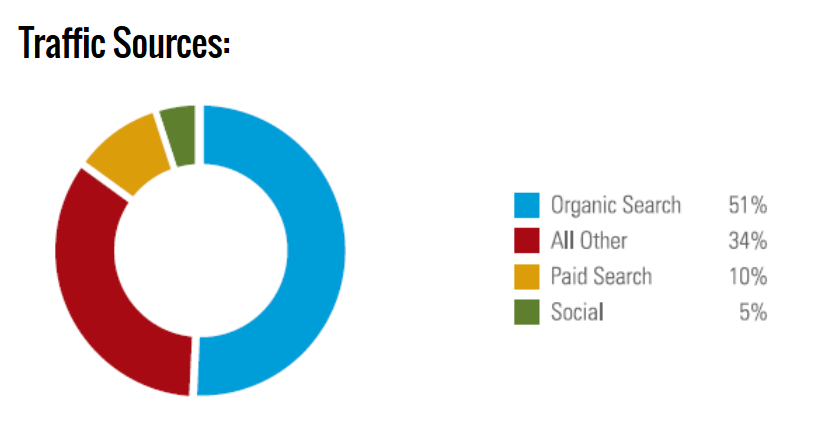
An analysis by web analytics and measurement firm BrightEdge reveals that organic search (SEO) drives over half of all traffic to websites (both business-to-business and business-to-consumer).

By contrast, paid search (SEM) accounts for only one-fifth of SEO’s result, and social is lower still:

  • Organic search: Generates ~51% of all web traffic
  • Paid search: ~10%
  • Social media: ~5%
  • All other methods (e.g., display advertising, e-mail and referred): ~34%

Web traffic driversSource:  BrightEdge, 2014. 

In other words, all forms of advertising put together don’t drive as much traffic as organic search.

The BrightEdge statistics also remind us that social media, however popular it may be to millions of people, isn’t a highly effective traffic generator like search. Here are some of the key reasons why:

  • Social shares are fleeting and can get drowned out easily.
  • Most users don’t go on a social platform, only then to click on different links that take them away from social.
  • Not everyone uses social media, whereas everyone uses a search engine of some kind when they’re in “investigative” mode.

That’s the thing:  People use SEO when they’re seeking answers and solutions — often in the form of a product or a service.  Unlike in social or online display advertising, there’s no need to “disrupt” the user’s intended activity.

And if you’re in the B-to-B realm, organic search even more prevalent:  Organic search drives ~73% of all web traffic there.

Even consumer categories like retail, entertainment and hospitality find that organic search is responsible for attracting 40% or more of all web traffic.

The takeaway for companies is that any marketing strategy that doesn’t adopt “content development” as a core tactic instead of an “ornamentation” is probably destined to fall well-short of its full potential.

Couponing Practices: Tradition Trumps Technology

couponingWith big changes happening every day in the way that consumers are interacting with brands and products, a big question is how quickly they’re changing their habits when it comes to the use of coupons.

Perhaps surprisingly, the results of a new 2014 Simmons National Consumer Study conducted by Experian show that “traditional” couponing activities remain far and away the most prevalent consumer activity.

First of all, the proportion of U.S. households that uses coupons of any sort is right around three-fourths (~74% according to the recent Simmons survey).

And we all know the single biggest reason why people use coupons:  to save money.  That rationale dwarfed any other among the survey respondents:

  • I use coupons to save money: ~64% of respondents mentioned
  • I use coupons to try new products: ~23%
  • Coupons incent me to try new stores: ~7%

But then the data points begin to deviate from where marketers may think their consumers’ minds are at (or where they might wish them to be).

Consider how many of the following popular couponing practices are distinctly “old school”:

  • I use coupons from in-store/on-shelf coupon machines: ~55% of respondents cited
  • I take advantage of rebates on products: ~50%
  • I use free-standing inserts from newspapers: ~46%
  • I use on-package coupons: ~37%

coupons on smartphoneCompare that to the far-lower engagement levels with “new school” couponing practices:

  • I use coupons delivered by Internet or e-mail: ~30% of respondents cited
  • I use my smartphone to redeem coupons at the store: ~17%
  • I have used a smartphone coupon app in the last 30 days: ~9%

These results show that if companies decide to embrace coupons as part of their marketing effort, they’ll need to pay as much attention (if not more) to traditional couponing methods than to newer practices.

Old habits die hard … at least in this arena.

The key to environmentally friendly products’ desirability? Deemphasize the green.

Selling green productsIt turns out that one key to the success of marketing so-called “green” products is actually to deemphasize the environmental messaging — at least when targeting consumers in the United States.

According to a number of surveys conducted by branding and marketing communications firm Landor, American consumers value possessing “green” attributes the least valuable of a series of brand attributes studied.

This despite years of social engineers and marketers of environmentally friendly brands attempting to “educate” consumers on environmental consciousness and the importance of sustainability.

At this point, it’s probably better for products to promote themselves based on other attributes besides “green” attributes … or at least to stop leading with that argument.

Instead, what are the values that resonate the most with American consumers?  According to Ted Page, a principal at content marketing firm Captains of Industry, there are three in particular — none of them having much to do with environmental issues — at least on the face of it:

  • Freedom
  • Independence
  • Saving money

But for green products, it’s possible to tie everything up in a nice bow by being able to lay claim all three of these attributes as brand attributes while not compromising the environment, either.

Nest Learning ThermostatAn example of this message strategy in action is the Nest Learning Thermostat, which promises saving energy in the context of achieving increased home efficiency, automated temperature management and lower energy bills.  The “green positioning” is nice — but it’s the other product attributes that really hit pay-dirt.

Tesla logoAnother example is Tesla electric automobiles.  Tesla is promoting the performance of its high-torque electric engine as superior to other sports cars manufactured by BMW, Lexus and Audi.

The fact that Tesla’s high-performance engine happens to be emissions-free is just icing on the cake.

Thanks in part to this messaging platform, sales of the Tesla Model S auto now outstrip those of the Mercedes S-Class, Lexus LS, BMW 7-Series, Porsche Panorama and the Audi AB.

One has to wonder if this would had happened had Tesla chose to lead with “green” messaging instead.

It would be nice to think so, but … probably not.

Pinterest: Will it ever become a male hangout?

Pinterest logoHere’s a statistic about social media platform Pinterest that will probably surprise few people:  As of June 2014 statistics reported by digital analytics firm comScore, its user base is more than 70% female.

… Which means that Pinterest remains the most “gender imbalanced” of all the major social media platforms.

For the record, other social platforms have far more gender balance among their user bases – with at least 45% being male:

  • SnapChat:  52% male
  • Tumblr:  52%
  • Twitter:  48%
  • Facebook:  47%
  • Instagram:  45%
  • Pinterest:  28%

But here’s the thing:  Pinterest has been trying mightily hard to attract more male participants, but the proportional figures have yet to budge.

This points to a fundamental challenge.  It’s very difficult to change the image and atmospherics of a social platform once they’ve become so firmly entrenched.

And it’s not just a question of image.  The platform’s content says it all.

Jill Sherman, vice president of social and content strategy at marketing communications firm DigitasLBi, puts it this way:

“If you pull up Pinterest and go into any content section, you will see purses, dresses and women’s shoes — because women are the user base.  When 70% of the users are female, then 70% of the content is going to be female-oriented.” 

Pinterest for menHope springs eternal, however.  Pinterest is continuing its effort to attract more men.

Or at least … to make the site more “guy friendly” when a new member goes there signs up.  This means making sure to show items more stereotypically catering to men’s interests rather than things like women’s fashion items.

But how to get men to the stage of even signing up?  That challenge falls to Pinterest’s new “head of brand” – who just happens to be a man.

David Rubin
David Rubin

He’s David Rubin, erstwhile senior vice president of marketing at Unilever, where he worked on marketing the Axe brand of men’s body care products.

Mr. Rubin might wish to start his tenure by asking himself what would bring him to engage with Pinterest more … because according to news reports, Rubin had posted only 22 items on Pinterest prior to joining the company.

DigitasLBi’s Jill Sherman sees a challenge for Pinterest that is fundamentally basic.  “They haven’t cracked the motivation code:  How to attract men and keep them using the platform beyond saving things that pique their interest.”

I agree – and I’d go a step further.  Convincing people to visit Pinterest to find or view something of interest “feels” like a function a search engine such as Google Images is doing quite well already.  Who needs “yet another place” to tap into that functionality?  Especially if one is a male of the species?

In order for Pinterest to evolve beyond where it is today, perhaps it needs to look at what Facebook and others have been doing to create communities and interaction beyond just pretty pictures and videos.

It could be a tall order.