For authenticity in advertising … perhaps it’s time to stop making it “advertising.”

AT

Take a look at the interesting data in the chart above, courtesy of Nielsen.

Among the things it tells us is this: If there’s one thing that’s universally consistent across all age ranges – from Gen Z and Millennials to the Silent Generation – it’s that nothing has a more positive impact on buying decisions than the recommendation of a family member, a friend or a colleague.

Not only is it true across all age ranges, it’s equally true in business and consumer segments.

The chart also shows us that, broadly speaking, younger people tend to be more receptive to various advertising formats than older age segments.

this isn’t too surprising because with age comes experience – and that also means a higher degree of cynicism about advertising.

Techniques like the “testimonials” from so-called “real people” (who are nonetheless still actors) can’t get past the jaundiced eye of veteran consumers who’ve been around the track many more times than their younger counterparts.

Someone from the Boomer or Silent Generation can smell these things out for the fakery they are like nobody else.

But if friends and colleagues are what move the buy needle the best, how does advertising fit into that scenario? What’s the best way for it to be in the mix?

One way may be “influencer” advertising. This is when industry experts and other respected people are willing to go on record speaking positively about a particular product or service.

Of course, influencers have the best “influence” in the fields where they’re already active, as opposed to endorsements from famous people who don’t have a natural connection to the products they are touting. Such celebrity “testimonials” rarely pass the snicker test.

But if you think about other people like this:

  • An industry thought leader
  • A prominent blogger or social networker in a particular field or on a particular topic
  • A person with a genuine passion for interacting with a particular product or service

… Then you have a person who advocates for your brand in a proactive way.

That’s the most genuine form of persuasion aside from hearing recommendations from those trusted relatives, friends and colleagues.

Of course, none of that will happen without the products and services inspiring passion and advocacy at the outset. If those fundamental factors aren’t part of the mix, we’re back to square one with ineffective faux-testimonials that feel about as genuine as AstroTurf® … and the (lack of) results to match.

Habits die hard … but there are ways to change buyer expectations.

What’s the easiest way to change time-honored expectations? With dollar signs.

Humans are creatures of habit. Even little kids gravitate towards the “patterns” of daily life such as bedtime rituals.

These forces are what make it so challenging for companies and brands to introduce changes that go against habit.

We’ve seen this play out recently in two segments of the travel industry: airlines and hotels.

Challenging in both cases … but the changes in one are being accepted, while summarily rejected in the other.

untitledLet’s start with the initiative that’s flamed out. This past November, Hilton Worldwide launched a pilot at a number of its hotel properties where it began charging guests a penalty of $50 if a reservation needed to be canceled any time after booking.

The rationale for the initiative was the notion that hotels should join the rest of the world when it comes to the way its products are sold. After all, for most any product, once someone purchases it they’ve committed to buy it.

Not so with hotel reservations, where über-flexible cancellation policies have been the modus operandi seemingly forever.

The way that some in the industry see it, the practice of hoteliers tying up inventory at no cost or penalty seems illogical.

It’s why some chains have introduced stricter 24-hour policies wherein the first night room cost is charged to customers who fail to cancel before midnight the day before their arrival, instead of the afternoon of their planned arrival.

hlBut Hilton’s pilot went even further than this, because the cancellation fee would be charged regardless of when the cancellation was requested – even if it was days or weeks before.

Predictably, customers totally hated it.

So much so, Hilton canned the policy less than three months in.

Putting the best spin on things, CEO Christopher Nassetta remarked that Hilton “did get some nuanced intelligence out of the experience.”

Perhaps that intelligence was not quite as nuanced as Nassetta infers! At the bottom of this customer fail is a fundamental axiom:  If you mess with time-honored practices that people have come to expect as the normal course of business, you do so at the risk of major blowback.

But we have another recent developing in the hospitality industry that points to a different result. In this case, it’s in the passenger airline segment.

last classDelta and a few other airlines have been successfully rolling out a new class of travel euphemistically called “basic economy” or “super economy” class.

[Others call it “economy minus” or “last class” air travel.]

Essentially, what the airlines are now offering are the lowest available airfares that will get travelers to their place of destination – and that’s it. All of the basic amenities available to traditional coach class travelers are missing.

If one chooses to travel “super economy,” here’s what’s in store for them:

  • Seats with less leg-room than coach (if that’s even possible)
  • No free snacks or drinks
  • No free in-flight entertainment
  • No free carry-on bags
  • No advance seat assignments
  • No itinerary changes or ticket refunds (even with a service charge)
  • No frequent flier miles

For giving up all of this, customers are being quoted prices for air travel that are so low, they rival ground transportation rates.

But for travelers who don’t have to worry about changes in their travel plans … don’t care about in-flight comforts … or don’t travel frequently and therefore find frequent flier programs irrelevant to their personal situation, the tradeoffs appear to be worth it.

Because the passenger airlines need to make physical adjustments to their planes in order to offer “super economy” class, a lot is riding on the consumers’ acceptance of these tradeoffs. So far, Delta Airlines has found sufficient success with its pilot program to plan for its expansion.  And United and American are now getting ready to offer their own programs.

The key difference between the airline and hotel pilots boils down to providing a price incentive.

Even with time-honored or habitual practices, if you make it financially lucrative enough, you’ll get the behavior changes you’re seeking. Bottom-line, that’s the bottom line.

Speaking personally, seeing as how I feel strapped for space on airline flights already, I doubt I’ll be traveling “super economy” class anytime soon, except perhaps on very short hauls.

But I know for a fact that I’ll never book a room that’s subject to a cancellation fee.

Suddenly, GoPro isn’t so “Go-Go” …

untitled2Most likely, I’ll never be a GoPro customer.

The only direct interaction I’ve had with the maker of action cameras was several years ago during the Great Target Credit Card Breach of 2013, when suddenly a half-dozen GoPro purchases mysteriously appeared on my card statement.

But other than that, my connection with GoPro and its line of cameras has been nonexistent — which isn’t at all surprising considering that at my age, I’m hardly an “action adventurer.”

Unfortunately for GoPro, many other people aren’t, either – and it’s one reason why the company’s financial results have been pretty ugly coming off of the most recent holiday season.

This past week, GoPro announced that it is cutting nearly 10% of its workforce (more than 100 people) because of weak sales during the 4th Quarter.

In a holiday quarter when product purchases should have grown revenues considerably, the weaker-than-expected sales volume of ~$435 million meant that GoPro’s revenues were far short of the $510 million originally projected.

From the financial market’s perspective, this news was sufficiently negative that trading of GoPro shares had to be halted briefly this past Wednesday.

untitled
GoPro shares over the past six months.

The company promises to divulge more information about its financial results in early February, but some observers are already beginning to paint the picture of what’s out of kilter:

  • GoPro misjudged the price consumers were willing to pay for its Hero4 Session cube cam, introduced in July 2015, resulting in two dramatic drops of the sticker price in September and December down to $199. 
  • Competitors are entering the field, putting further downward pressure on pricing. 
  • There’s a ceiling on the demand for action cameras because “action adventurer” consumers are such a small slice of the general population.

But does any of this come as a particular surprise?

Like in any other consumer electronics product category, the trajectory of high growth among early adopters leads to new market entrants, followed by the hardware becoming essentially a commodity.

… And the whole process is as swift as it is inevitable.

GoPro is branching into newer segments like camera drones — and not a moment too soon. But the reality is that in a product segment like action cameras, any supplier will always be just one step ahead of commoditization.  And for this reason, product mix reinvention has to be happening continuously.

Digiday ID’s the most “overhyped” marketing developments of 2015.

Digiday logoWhat were the most overhyped marketing stories in 2015? Media company Digiday‘s brand reporter Tanya Dua has come up with a list of four that she feels fits the bill.  See if you agree.

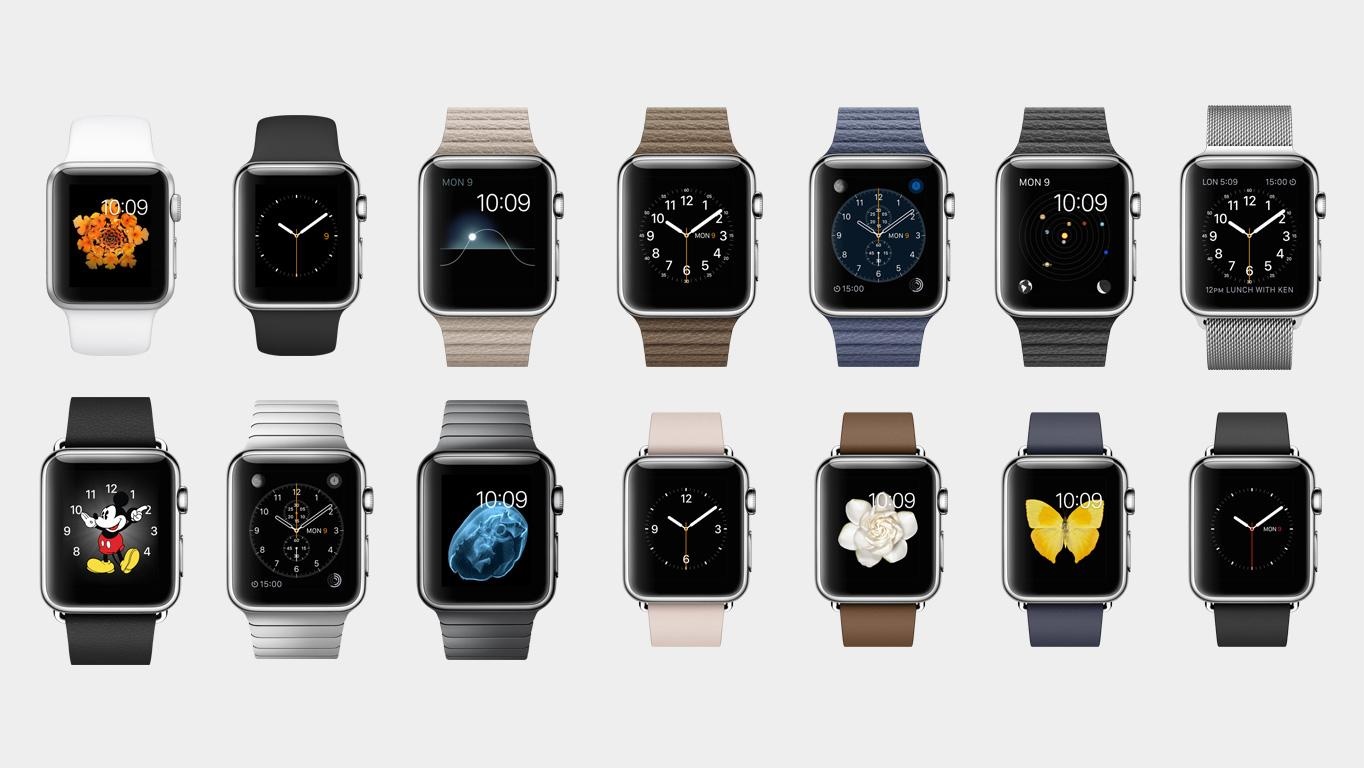
Apple Watch

Apple WatchDua notes that the Apple Watch was announced with so much fanfare that developers began making apps for it a half-year before the product hit the shelves — including big consumer players like Target and American Airlines.  But sales of the Apple Watch have been tepid at best.  There’s no way the marketplace performance of the product has come even remotely close to the company’s hopse for it.

Thom Gruhler, a CMO at Microsoft, says it well:

“When it [comes] down to the Apple Watch, one big question has still not been answered: Will anyone end up really ‘needing’ to engage with this shiny new technology?  What happened in 2015 was a disappointing start.”

Others appear to be even less charitable. A few are even equating the launch of the Apple Watch with that of another product that was similarly hyped:  Remember the Segway?  Everyone was supposed to end up having one of those — whereas the reality is closer to no one having them, with the exception of a few security cops and a few “trendy” businesses with long hallways.

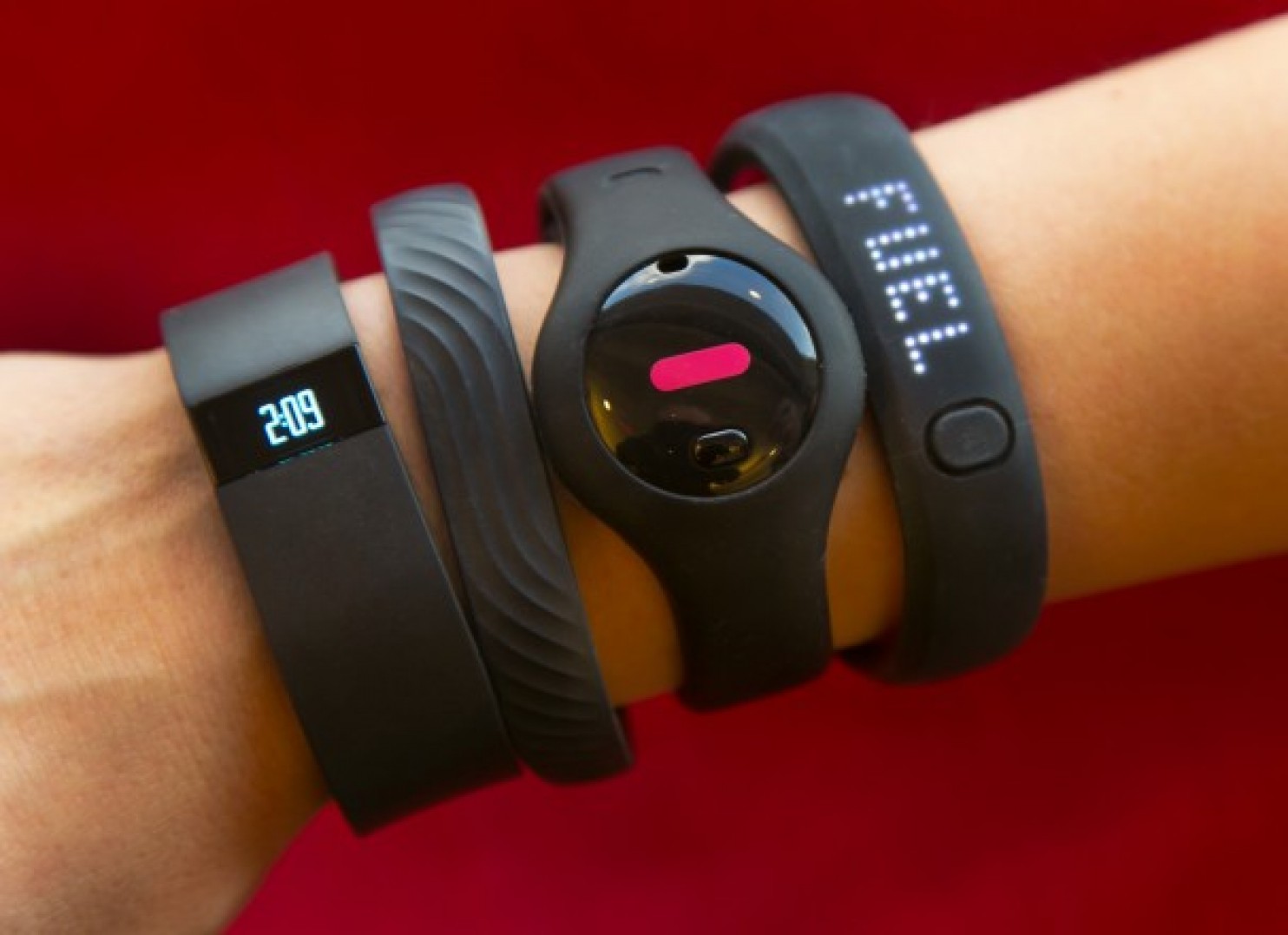
Wearable Tech

wearableMany prognosticators were expecting that the “big data” promise of using wearable technology for experiences that were predictive and personalized would be fulfilled in 2015.  That’s hardly what’s happened.  According to Dua, wearables have yet to deliver anything like that in any meaningful way.

She quotes Julie Lee, Managing Director of marketing communications firm Maxus USA’s Chicago office:

“Technology, design and user experiences still need to be worked out. Though many companies are making great strides, we continue to watch this space to see if ‘what’s possible’ can truly become possible.  Wearables still hold great potential, but we’ll need to address today’s obstacles before we can become a ‘wearables-first’ market.”

Tanya Dua cites two other developments she feels were overhyped in 2015: Influencer Partnerships and Virtual Reality.

The problem with influencer marketing is when there’s little natural synergy between brands seeking to connect with their consumers more directly. “Authenticity” matters — and too often influencers are rather awkwardly tied to products few people would ever associate with them.

As for virtual reality, the problem is one of practical implementation and adoption by consumers; it hasn’t been happening — mainly due to lack of content and available hardware. Without those pieces of the puzzle in place, marketers simply can’t justify the cost having their brands present in the mix.  Instead, look for this trend to gather more steam in 2017 and years further out, Dua contends.

What do you think? Is Tanya Dua correct in labeling these marketing trends as “overhyped”?  What else would you add to the list?  Please share your thoughts with other readers here.

Consumer E-Mail Marketing: Too Much of a Good Thing?

igAdvertisers often complain about the drawbacks of online display advertising — and it’s not hard to figure out why.

Online display ad viewability, which is defined by the Media Rating Council as at least 50% of an ad’s pixels being in-view for at least one continuous second, is running under 45% these days — meaning that fewer than half of online display ads meet the definition of being viewable.

That’s actually a lower percentage than before; viewability charted closer to 50% in 2014, according to the global media valuation platform Integral Ad Science.

Because of these middling viewability rates, many advertisers look to e-mail marketing as the panacea. Not only is e-mail marketing inexpensive, the rational goes, it’s also more likely to attract and engage recipients.

But here too, the evidence is that there is mediocre visibility, too. And in this case, it’s actual willful ignorance.

According to the results of a study conducted earlier this year by business technology research firm Technology Advice, ~40% of the ~1,300 U.S. adults surveyed reported that they completely ignore marketing-oriented e-mails.

Of the ~60% who reported that they do open marketing e-mails, only a little over 15% do so on a regular basis.

Here’s a breakdown of the underwhelming stats that were gathered by Technology Advice:

  • ~58% of recipients read from 0 to 25% of marketing-oriented e-mails sent to them
  • ~21% read 25% to 50% of the marketing e-mail sent to them
  • ~13% read 50% to 75% of them
  • Just ~8% read 75% to 100% of them

In an attempt to “juice” these figures, marketers are experimenting with robust personalization in e-mails that become evident even before anyone opens them (e.g., personalization showing in the subject line), along with offering clearly marked discounts and other promo attractions.

In this regard, consumers do expect businesses to provide “value” in exchange for their attention, which explains by ~40% of the survey’s respondents are responding to discounts and similar promotional offers above all other types of e-communiqués.

But with such modest levels of people interacting with any marketing-oriented e-mails at all, there’s a question as to how whether these ploys to improvement engagement are just nibbling around the edges.

Because the reality is, there’s a big portion of the market that’s become jaded about e-mail.

Another approach seems counter-intuitive but just might be working better: reducing the frequency of e-mail solicitations from advertisers.  That theory is supported by the Technology Advice research, which found that nearly 45% of respondents feel that businesses would improve their marketing effectiveness by actually sending them less frequent e-mails.

A case of “less is more”? Probably so.

Marketing Technology: Is “Implosion” Where We’re Headed?

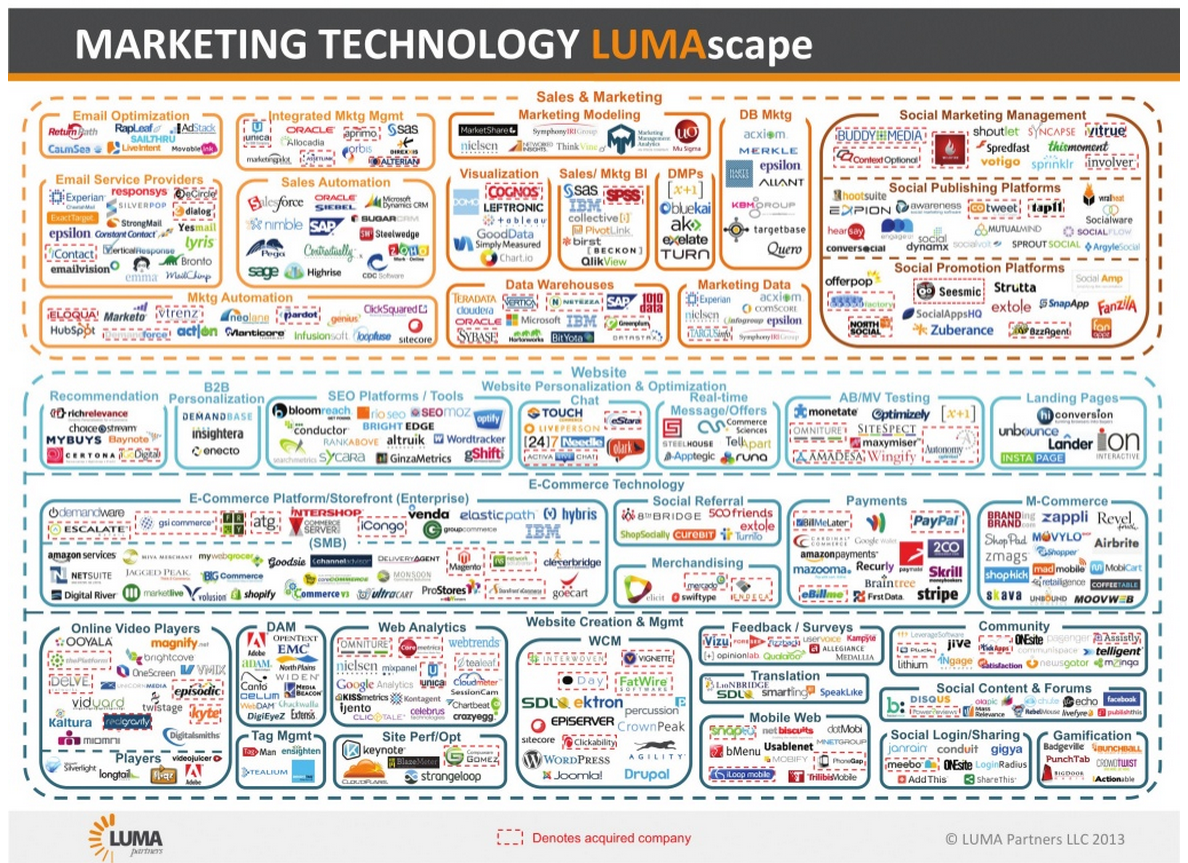
A chart of just some of the major marketing technology platforms -- and this is as of 2013!
A chart of just some of the major marketing technology platforms — and this was in 2013!

It seems that with each passing day, one or two new technology products are announced by MediaPost and other publishers in the marketing field.

The numbers tell the story. The marketing technology industry website chiefmartec.com lists nearly 1,900 marketing technology vendors in more than 40 categories.

That’s nearly double last year’s tally of around 950 vendors.

Software clearinghouse Capterra lists even more: a whopping 3,000+ marketing technology products across 30 categories.

These firms account for well over $20 billion in financing – the dollars that can be tracked, that is – including around 30 companies that are valued at $1 billion or more each.

That’s a lot of companies and vendors. Of course, there are many customers who are looking for tech-driven marketing solutions as well.  The question is whether things have gotten out of balance.

Business writer and marketing tech specialist Malcom Friedberg thinks so. He’s Chief Marketing Officer at CleverTap, and he also publishes columns on a variety of business topics.

In Friedberg’s view, the sheer number of marketing technology vendors and products means that the segment may now be on the brink of an implosion.

Friedman references a recent CMO Council document that reports that more than 80% of marketers are using as many as ten different marketing-related technologies or cloud solutions.

And as new technologies are added, the problem is finding educated staff – and enough hours in the day – to cover all of these products well. In many instances, users may be just scratching the surface of what these products can provide; the “multiple hat” dynamics of many marketing departments mean that very few people qualify as being “advanced” users.

The problems boil down to this: Even if a department has two or three marketing people devoted exclusively to tech-related responsibilities (at tall order in most companies) – this assumes that those people can work equally well on multiple different platforms.

The reality is quite different. It’s more like a big jumble – with consultants brought in to sort things out.  It may get the job done, but it isn’t pretty – and it’s hardly a recipe for “the best of best practices.”

Survey work by the CMO Council supports this hypothesis. The Council has found that fewer than on in ten of the marketers it surveyed reported that they possess a highly evolved digital marketing model that has a proven, clear path of evolution.

Malcolm Friedberg
Malcolm Friedberg

Friedman thinks he knows where things are heading. Not to more choices, but rather to less:

“In my opinion, we’ll start to see massive consolidation and uber-marketing systems. Think super-integrated marketing and advertising clouds … the preoccupation with ‘best-of-breed’ in every category will be replaced by a ‘tree-and-branch’ model, with one core technology and a few ‘good enough’ complementary ones.”

Friedman calls it “an expensive French meal” instead of “a Vegas buffet.” While there will always be new products promising incremental improvements, he predicts that by 2020, the common business model will be super-integrated marketing and advertising clouds as we see already with the likes of Marketo and Hubspot.

What do you think? Is Friedman onto something … or is the orgy of new marketing technology products going to continue unabated?  Please share your thoughts with other viewers here.

The “100% ad viewability” gambit: Gimmick or game-changer?

Say hello to the ad industry’s newest acronym: vCPM (viewable cost-per-thousand).

viewabilityA few weeks back, Google announced that it will be introducing 100% viewable ads in the coming months, bringing all online ad campaigns bought on a CPM basis into view across its Google Display Network.

The news comes as a relief to advertisers, who have long complained about the high percentage of ads that never have a chance to be viewed by “real people.”

The statistic that Google likes to reference is that approximately 55% of all display ads are never viewed due to a myriad of factors — such as appearing being below the fold, being scrolled out of view, or showing up in a background tab.

And the problem is only growing larger with the increased adoption of ad blocker software tools.

Google isn’t the only that’s one coming up with in-view advertising guarantees. Facebook recently announced that it will begin selling 100% viewable ads in its News Feed area.

But some are questioning how much of a better benefit 100% viewability will be in actuality. For one thing, ad rates for these program are sure to be higher than for conventional ad buying contracts.

For another, neither Facebook nor Google have stated how long an ad would need to remain in view before an advertiser gets charged. Whether it’s 1 second, 2 seconds or 5 seconds makes a huge difference in the real worth of that exposure to the consumer.

Then there’s the realm of mobile advertising. In a startling analysis conducted and reported on by The New York Times, a mix of advertising and editorial on the mobile home pages of the top 50 news sites was measured.  What the analysis found was that mobile airtime is being chewed up by advertising content far more than by the editorial content people are tuning in to view.

Boston.com mobile readers are a case in point. The analysis found that its readers spend an average of ~31 seconds waiting for ads to load versus ~8 seconds waiting for the editorial content to load.  That translates into a home page visitor paying $9.50 per month — just to view the ads.

ad blockerWhen there’s suddenly a cost implication in addition to the basic “irritation factor,” expect more smartphone and tablet users to avail themselves of ad blockers even more than they do today.

As if on cud, Apple is now allowing ad blockers on the iPhone, giving consumers the ability to conserve data, make websites load faster, and save on usage charges all in one fell swoop.

Sounds like a pretty sweet deal all-around.

Surprising statistic? One-third of American adults still aren’t on social media.

social mediaFor the many people who use social media on a daily basis, it may seem inconceivable that there are a substantial number of other Americans who aren’t on social media at all.

But that’s the case. The Pew Research Center has been tracking social media usage on an annual basis over the past decade or so, and it finds that about one-third of Americans still aren’t using any social networking sites.

To be sure, today’s ~65% participation rate is about ten times higher than the paltry ~7% participation rate Pew found the first time it surveyed Americans about their social media usage back in 2005.

According to Pew’s field research findings, here’s how the percentage of social media involvement has risen in selected years in the decade since. (The figures measure the percentage of Americans age 18 or over who use at least one social networking site.)

  • 2006: ~11% using at least one social networking site
  • 2008: ~25%
  • 2010: ~46%
  • 2012: ~55%
  • 2015: ~65%

In more recent years, the highest growth in social media participation rates has been among older Americans (over the age of 65), ~35% of whom are using social media today compared to just 11% five years ago.

That still pales in comparison to younger Americans (age 18-29), ~90% of whom use social media platforms.

While it’s a common perception that women are more avid users of social media than men, Pew’s research shows that the participation rate is actually not that far apart. Statistically it isn’t significant, in fact: a ~68% social media participation rate for women versus ~62% for men.

pew-research-centerSimilarly, there are more similarities than differences among the various racial and ethnic groups that Pew surveys — and the same dynamics are at work when it comes to differing education levels, too.

Regional differences in social media practice continue to persist, however, with rural residents less likely to use social media than suburban residents by a ten-point margin (58% versus 68%). City dwellers fall in between.

More details on Pew’s most recent field research on the topic of social media participation can be accessed here. See if you notice any surprising findings among them.

The lifetime value of a blog post: It’s more than you probably think.

bgHere’s an interesting factoid: In 2014, more than 550 million blog posts were uploaded on WordPress alone.

Add in Tumblr, and there are another 250 million blogs.

Considering the sheer volume of blogging activity, it’s surprising how little intelligence on the “value” of a blog post has been available. But now a study has been published that sheds light on the question.

The evaluation, which was commissioned by branding agency IZEA and conducted by research firm The Halverson Group, has determined that the lifespan of a blog post is far greater than the accepted measurement of 30 days.

The lifespan is more than 20 times longer, it turns out.

Let’s break down the research findings a bit more. The IZEA/Halverson study determined that by Day 700 (about two years), the typical blog post will have received ~99% of its impressions.

That’s a pretty long annuity, and it provides strong ammo for marketers who advocate for blog posts as an important way to maximize the return on their marketing spend.

According to the study, the typical blog post goes through three distinct phases in its useful life:

  • Shout: The initial spike in impressions that happens within the first 7 to 10 days, typically resulting in half of the total impressions the post will ever receive.
  • Echo: The period ending at 30 days, by which time the typical blog post will have racked up ~70% of its total impressions.
  • Reverb: The third phase that stretches from approximately Day 30 all the way to Day 700. This long-tail phase will typically generate the final ~30% of impressions.

Of course, the performance of individual blog posts will depend on the subject matter, the timeliness of the information, and other factors. But as a general rule of thumb, the Halverson findings show the potential value of a blog post as far greater than many marketers may have surmised up until now.

The Halverson study also provides a good rule of thumb for the lifetime impression value of a blog post. It can be calculated by multiplying a blog post’s 30-day monthly pageview total by a factor of 1.4.

In other words, by Day 30, marketers can know with a good deal of confidence how the blog post will perform overall.

Using this formula, marketers will be able to demonstrate the “evergreen” effect of blogging as a marketing tactic.

Certainly, the residual benefits of a blog post look very strong — particularly in contrast to volume-based media such as display or search advertising, which stop performing the instant the campaign investment ends.

The bottom line: Companies should continue to blog away … and if they haven’t started or if they’ve allowed their blogging program to flag, it’s time to get things back in gear!