Fast Fade: Unpaid brand posts on Facebook are getting rarer by the day.

Lower ReachIt was just a matter of time.

Once Facebook ramped up its advertising program in order to monetize its platform and mollify its investors, unpaid posts by companies and brands were sure to be the collateral damage.

Sure enough, the recent monthly stats show that the “organic reach” of unpaid content published on company and brand pages on Facebook has been cut in half from where it was just a short time ago.

To illustrate, look at these stark figures gathered in an analysis by Ogilvy of 100+ country-level brand pages measuring the average reach of unpaid posts:

  • October 2013: 12.2%
  • November 2013: 11.6%
  • December 2013: 8.8%
  • January 2014: 7.7%
  • February 2014: 6.2%

What these stats show is that within the span of less than six months, the average reach of unpaid brand posts dropped by nearly 50%

To go even further, an anonymous source familiar with Facebook’s long-term strategy is claiming that its new algorithm could ultimately reduce the reach of organic posts to 2% or less.

Actually, the reason for the squeeze is more than just Facebook’s desire to increase advertising revenue.

Here’s a dynamic that’s also significant:  A Pew Research study conducted in mid-2013 found that the typical adult American Facebook user has around 340 friends.

That average is up nearly 50% from approximately 230 friends in 2010.

Of course, more friends mean more status updates eligible for feeds … and Facebook’s not going to display them all to everyone — even if it wanted to.

Also, Facebook users “like” an average of 40 company, brand, group or celebrity pages each, according to a 2013 analysis done by Socialbakers, a social media analytics firm.  That translates into an average of ~1,440 updates every month.

Compare those figures to five years ago, when the average number of page “likes” was fewer than five … yielding fewer than 25 monthly updates on average.

Clearly, there’s no way Facebook is going to to be able to display all of these updates to followers.  So … the content is squeezed some more.

The final nail in the coffin is the rise in “promoted” posts – the ones that brands pay dollars to promote. It’s only natural that Facebook is going to give those posts priority treatment.

Thus, the hat-trick combination of more friends, more likes and more promoted posts is what’s causing “organic” brand posts to go the way of the dodo bird.

In retrospect, it was only a matter of time before a major social platform like Facebook would seek to monetize its program in a big way.

In some respects, it’s amazing that the free ride lasted as long as it actually did …

“Social Media Stress Syndrome”: Real or Fake?

Social Media Stress SyndromeThere’s no denying the benefits of social media in enabling people to make new friendships, reconnect with old acquaintances, and nurture existing relationships.

Facebook and other social platforms make it easier than ever to maintain “in the moment” connections with people the world over. 

Speaking for myself, my immediate relatives who live in foreign lands seem so much closer because of social media.

Plus, thanks to social media, I’ve met other relatives from several different countries for the very first time.  This would never have happened in the pre-Facebook era.

But there are downsides to social media, too – and I’ve written about them on this blog on occasion; for example, whether social media is a platform for narcissists.

Other negative consequences of social media have been noted by numerous observers of consumer online behaviors, including Canadian digital marketing company Mediative’s Senior Vice President and online marketing über-specialist Gord Hotchkiss.

Gord Hotchkiss
Gord Hotchkiss

In a recently published column by Hotchkiss headlined “The Stress of Hyper-Success,” he posits that self-regard and personal perspectives of “success” are relative.  Here’s a critical passage from what he writes:

“We can only judge it [success] by looking at others.  This creates a problem, because increasingly, we’re looking at extreme outliers as our baseline for expectations.”

Hotchkiss’ contention is that social media engenders feelings of stress in many people that would not occur otherwise.

Pinterest is a example.  A recent survey of ~7,000 U.S. mothers conducted by Today.com found that ~42% of respondents suffer from this social media-induced stress; it’s the notion that they can’t live up to the ideal suggested by the images of domestic bliss posted on the female-dominated Pinterest social network.

Facebook causes a similar reaction in many; Hotchkiss reports on a survey showing that one-third of Facebook users “feel worse” after visiting the site.

It may not be hard to figure out why, either, as visitors are often confronted with too-good-to-be-true photo galleries chronicling friends’ lavish vacations, social gatherings, over-the-top wedding ceremonies, etc.

Social Media EnvyIt’s only natural for people to focus their attention on the “extraordinary” posts of this type … and to discount the humdrum posts focusing on the mundane aspects of daily life. 

Just like in the national or local news, people tend to focus on personal news items that are exceptional – the activities that are set far apart from the average.

Wall Street Journal report Meghan McBride Kelly has come up with a pretty interesting way to address social media stress:  She quit Facebook earlier this year after a nine-year run.  McBride contends that “Aristotle wouldn’t ‘friend’ you on Facebook,” writing:

“Aristotle wrote that friendship involves a degree of love.  If we were to ask ourselves whether all of our Facebook friends were those we loved, we’d certainly answer that they’re not.  These days, we devote equal if not more time to tracking the people we have had very limited interaction with than to those whom we truly love.”

Likewise, Hotchkiss tries to head us off at the social media pass:

“Somewhere, a resetting of expectations is required before we self-destruct because of hyper-competitiveness in trying to reach an unreachable goal.  To end on a gratuitous pop culture quote, courtesy of Sheryl Crow:  ‘It’s not having what you want.  It’s wanting what you got.”

What are your thoughts about “social media stress disorder”?  Please share your observations with other readers here.

Is Social Media a Platform for Narcissists?

Narcissism on social mediaOver time, I’ve been seeing more articles and blog posts cropping up that broach the topic of social media and narcissism.  Here’s just one of the latest examples.

The issue boils down to this:

  • Do social media platforms cause people to become narcissistic?
  • Or is social media merely a conduit by which people who already possess narcissistic tendencies get to indulge in “self-referential behavior” on steroids?

One could probably start at the very beginning:  Is Mark Zuckerberg a narcissist?”    (Don’t answer that question!)

My own view is somewhat conflicted.  I see evidence of some people who cheerfully relish the bullhorn – and attention – that social media appears to give them.

But social media can be deceiving in that a “personal environment” can be built that seems like the whole world is watching and listening – but in reality it’s just a constructed edifice more akin to a Potemkin village.

How many people are actually reading anyone’s Twitter posts?    (Don’t answer that question!)

But I can also see clear evidence of some of the more “Type B” people I know who have made quite an impact on social media by virtue of some very impressive contributions – written information, videos, photography, etc.

In those cases, social media has been a way to extend influence well beyond a small circle of friends or colleagues – and far more than could ever be possible before.

How about you?  What are your thoughts on this topic and what have you observed?  Please share them here if you’re so inclined.

(Don’t worry, we won’t accuse you of narcissism!)

It’s Official: Instagram is in the Big Leagues Now

Thanksgiving Day 2012 on Instagram
Thanksgiving Day 2012 broke all records for Instagram’s photo sharing volume, with over 10 million photos shared and more than 225 per second at its peak.

Instagram, the mobile photo sharing service that came on the scene about two years ago, has been quietly building a following among many people who are attracted to its simplicity and ease of use, along with the enhanced image quality it offers. 

This past Thanksgiving proves how important Instagram has become within the social media fabric.  On Thanksgiving Day, fully 10 million photos were shared on Instagram.

At its peak time at 3:40 pm (Eastern Standard Time), photos were being shared at a rate of ~225 per second.  and throughout the the peak dinner hours from 1:00 pm to 6:00 pm EST, more than 200 photos per second were being shared.

According to Instagram’s statistics, Thanksgiving Day was the busiest in the service’s history, which normally has about 5 million photos uploaded per day.

Facebook, which acquired Instagram in September, sees far more photo uploads on its flagship social platform – around 300 million images per day – which makes Instagram a relative babe in the woods. 

But Facebook looks to have big plans for Instagram, including a goal of doubling the number of app users from ~100 million to ~200 million.

Clearly, Instagram is one social platform that merits following in the months ahead.  Now that it’s joined the rarified ranks of the other platforms that have broken through to the “big leagues,” it’ll be interesting to see where Instagram goes from here and how it monetizes itself.

The Free Lunch Ends on Facebook

Promoted posts on Facebook is the only way to get exposure anymore.
Promoted posts are the only way to ensure decent exposure on Facebook now.

It had to happen.  Suffering from a raft of unflattering news stories about its inability to monetize the Facebook business model and under withering criticism from investors whose post-IPO stock price has been battered, Facebook has been rolling out new policies aimed at redressing the situation.

The result?  No longer can companies or organizations utilize Facebook as a way to advance their brand “on the cheap.”

Under a program that began rolling out this summer and has snowballed in recent months, businesses must pay Facebook anywhere from a fiver to triple figures to “promote” each of their posts to the people who have “liked” their pages plus the friends of those users.

And woe to the company that doesn’t choose to play along or “pay along” … because the average percentage of fans who sees any given non-promoted post has plummeted to … just 16%, according to digital marketing intelligence firm comScore.

Facebook views this as a pretty significant play, because its research shows that Facebook friends rarely visit a brand’s Facebook page on a proactive basis. 

Instead, the vast degree of interaction with brands on Facebook comes from viewing newsfeed posts that appear on a user’s own Facebook wall.

What this means is that the effort that goes into creating a brand page on Facebook, along with a stream of compelling content, is pretty much wasted if abrand isn’t  willing to spend the bucks to “buy”exposure on other pages.

So the new situation in an ever-changing environment boils down to this:

  • Company or brand pages on Facebook are (still) free to create.  
  • To increase reach, companies undertake to juice the volume of “likes” and “fans” through coupons, sweepstakes, contests and other schemes that cost money.
  • And now, companies must spend more money to “promote” their updates on their fan’s own wall pages.  Otherwise, only a fraction of them will ever see them.

Something else seems clear as well:  The promotion dollars are becoming serious money

Even for a local or regional supplier of products or services that wishes to promote its brand to its fan base, a yearly budget of $5,000 to $10,000 is likely what’s required take to generate an meaningful degree of exposure.

Many small businesses were attracted to Facebook initially because of its free platform and potential reach to many people.  Some use Facebook as their de facto web presence and haven’t even bothered to build their own proprietary websites.

So the latest moves by Facebook come as a pretty big dash of cold water.  It’s particularly tough for smaller businesses, where a $10,000 or $20,000 advertising investment is a major budget item, not a blip on the marketing radar screen.

What’s the alternative?  Alas, pretty much all of the other important social platforms have wised up, it seems. 

For those businesses who may wish to scout around for other places in cyberspace where they can piggyback their marketing efforts on a free platform, they won’t find all that much out there anymore.  Everyone seems to be busily implementing “pay-to-play” schemes as well.

FourSquare now has “promoted updates” in which businesses pay to be listed higher in search results on its mobile app.  And LinkedIn has an entire suite of “pay-for” options for promoting companies and brands to target audiences.

It’s clearly a new world in the social sphere … but one that reverts back to the traditional advertising monetary model:  “How much money do you have to spend?”

Social media: All that glitters is … what?

Fake followers, fans, friends on social mediaChances are, you haven’t heard of Anthony Gemma, and I hadn’t either. 

Unless you live in Rhode Island, that is.  Mr. Gemma is a businessman who’s running for U.S. Congress there. And despite the fact that he has yet to win his own political party’s primary, he has already amassed nearly 1 million Twitter followers.

That’s more followers than presidential candidate Mitt Romney.

According to various social media monitoring services, Gemma’s Twitter account added ~400,000 followers in February 2012 alone.

And how about this stunning statistic: Between January and February of this year, the number of friends on Mr. Gemma’s personal Facebook page jumped some 5,600% to nearly 170,000 people.

How is this possible? For clues, we can start by noting that Mr. Gemma has described himself as a “social media guru.” In addition to owning a regional plumbing business, he’s also headed up a concern called Mediapeel, which bills itself as a providing “media strategy advice” to companies.

And therein lie clues to the sudden surge of “interest” in Mr. Gemma and his Congressional campaign in the social media sphere.  One can only imagine the lengths to which Mr. Gemma and his campaign staff are going in order to show off the candidate’s “obvious” fame and notoriety.

But are Mr. Gemma’s social media followers for real? Or are they of the same ilk of the famed digital “Potemkin Villages” that have sprung up all over the Internet?

Consider a few telltale signs about Anthony Gemma and his fantabulous social media presence:

  • Fewer than 1% of Gemma’s Twitter follows are based in Rhode Island … but nearly 15% are in Canada. You’ll find another 2% from London, England, plus thousands of others from places all over the globe.  I’m not sure how far afield Mr. Gemma takes his regional plumbing business, but this geographic map is intriguing to say the least.
  • Gemma’s Twitter “fans” are an unusually  inactive bunch. On February 24, 2012 – the same day Mr. Gemma’s Twitter account picked up a tidy 87,000 new followers in one fell swoop – he asked his Twitter audience to retweet a photo. A whopping six people chose to do so.
  • Earlier this year, after the progressive organization Rhode Island’s Future questioned the validity of Mr. Gemma’s burgeoning bevy of Facebook friends and noted that the most popular origin of his friends, followers and fans was an unlikely location — Frankfurt, Germany — all of the names referenced in the RIFuture blog post mysteriously disappeared from Gemma’s social sites.  Interestingly, however, the most prevalent place of origin for Gemma’s personal Facebook page’s friends is another foreign city: Moscow.  I guess Mr. Gemma’s international interests range from the Germanic to the Slavic.

Although it’s impossible to know for sure, these signs suggest that there’s precious little “there there” when it comes to the extent of Mr. Gemma’s true social media footprint.

And in fact, just last week the political website Politico made the latest attempt to get to the bottom Anthony Gemma’s questionable social media presence.

Politico took note of this tweet from Mr. Gemma’s account, posted on July 24, 2012:  “Don’t add up your troubles, count your blessings. RETWEET to pass it on!”

Of Gemma’s nearly 1 million “followers”, only 17 did so.

And while one of them actually appears to be a Rhode Islander, the others include followers from Sydney, Calcutta, the Baltic States, Indonesia …

… But none from Potemkin Village.

“Don’t Tread On Me”: Employees have strong feelings about employers gaining access to their social media profiles.

Social media privacyRecent news reports that some companies are asking their current employees or prospective new hires to grant them access to their private social media profiles haven’t set well with many people.

It seems that while people don’t mind publishing their personal information for friends and families to see, they’re not keen at all on employers having access as well.

This is borne out in the latest American Pulse survey from BIGinsight, a consumer information portal. In that survey, which queried nearly 3,600 American adults over the age of 18, respondents were asked how they would react to a request by an employer to hand over personal social media passwords, thereby gaining access to their profiles.

Approximately one in five of the survey respondents reported that they are not engaged in social media.  But among the remainder, most would resist the employer’s request … even to the extent of quitting their job:

  • Would quit a job or withdraw an employment application: ~52%
  • Would delete social media pages to prevent them from being seen: ~21%
  • Would go ahead and provide social media passwords to the employer: ~14%
  • Would edit social media profiles first … then provide passwords: ~13%

Based on the opinions of the respondents, it’s not at all surprising that the survey also found that ~85% think that when employers asking for access to social media profiles, it’s an invasion of privacy.  And only about 11% of respondents would be “comfortable” sharing their social media profiles with a potential employer.

There does seem to be a bit of altruism at work, because the preponderance of survey respondents (~72%) claim that they have “nothing to hide” on their social sites.

No doubt, Americans’ views about online privacy are borne out of the “live free or die … don’t tread on me” tradition of individualism in this country.  We love our ability to express ourselves … but spare us the KGB/Stasi routine!

Facebook’s Interesting Week

Facebook's_first_day_of_tradingBy now most people have heard all of the news reports about Facebook’s initial public offering, and how the world now has a new crop of instant millionaires and billionaires.

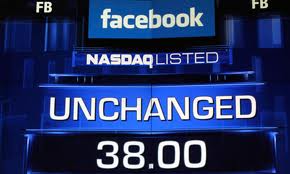
But the news last week wasn’t all roses for Facebook. For one thing, it became clear as Day 1 of trading ground on that Facebook shares weren’t going to increase in value. Indeed, it took the underwriters stepping in with institutional buying to keep the share price (barely) above the initial offering price of $38 per share.

And there was the news of GM dissing Facebook by announcing that it is dropping its paid advertising program with the social network … evidently due to Facebook’s failure to convince GM marketing execs of the effectiveness of its program.

But there was even more. Consider this news report: Facebook was hit with a $15 billion privacy lawsuit on the very first day of public trading. Filed on behalf of a number of Facebook’s users, the class action suit claims that Facebook invaded personal privacy by tracking users’ web usage.

The lawsuit cites a bevy of case law and regulations as part of the briefing documentation, including the Federal Wiretap Act, the Computer Fraud & Abuse Act, the Stored Communications Act, and various California statutes.

Consider the implications if this suit is at all successful:  Now that it is a public company, Facebook is under increased pressure to increase its advertising revenues rapidly – which means collecting yet more user data to help it target paid advertising effectively and thus command premium pricing.

But if the lawsuit is successful, it could prevent Facebook from collecting the very data it uses to serve up advertising based on relevant audience targets.

On the other hand, similar cases brought against Facebook in recent years have been thrown out of court because browser cookies haven’t been viewed as “wiretaps.” Moreover, plaintiffs have had difficulty in proving any “harm” as a result.

Of course, there was some additional very good news this past week for Facebook – at least for CEO Mark Zuckerberg: He got married.

… Which in the end may turn out to deliver far more happiness and fulfillment than all the money in the world ever could do.

Good marriages are like that … so let’s all hope for the very best for Mr. Zuckerberg.

“Fanning out” when it comes to brands and social media engagement.

Social media may well be taking the famous 90-9-1 principle of online engagement … and bringing it to new lows.

It’s hard not to come to this conclusion when reviewing the results of research conducted by the Ehrenberg-Bass Institute for Marketing Science. This Australian-based University think-tank studied the actual engagement levels of people who have “liked” the top 200 brands on Facebook by considering the degree to which fans actually shared posts or commented on the brand.

Over a six-week period of study, Ehrenberg-Bass found that fewer than one half of one percent of the brand fans actually “engaged” in any way at all.

The conclusion? It turns out that social media fan bases and actual engagement are two very different things.

Categories that do somewhat better in “engagement” are ones like alcohol, cars and electronics. But interestingly enough, the study also found that the so-called “passion” brands – such as Harley-Davidson, Porsche or Nike – don’t perform much better than “regular” brands: 0.66% engagement versus 0.35%.

In its report conclusions, Ehrenburg-Bass questions whether the Herculean efforts being made by some brands to “bribe” their way to thousands of “fans” and “likes” is really worth the cost in terms of the added product discounts, coupons and other goodies that are being proffered to entice consumers to become brand fans.

When you boil it down, the Ehrenburg-Bass research confirms yet again a basic truism about branding: Much as we would love to think otherwise, the marketplace isn’t nearly as enamored with our brands and products as we think they should be.

To us, the branding so important. To them … it’s just one big shrug of the shoulders.

Social Media Communities: Digital Potemkin Villages?

Social media stats riddled with fake accounts and cipher profilesMarketers like to talk about the 90-9-1 rule of web engagement: For every 100 people who are online, one person creates content … 9 people comment on that content … and the remaining 90 may lurk and read, but never participate in any other way.

The more we learn about social media engagement, the more we’re seeing the same phenomenon at work. To wit, studies of social networks like Twitter, Facebook and Google+ are finding far fewer numbers of “real” and “active” users than the gross statistics would suggest.

Alarmingly, these evaluations are finding that as many as half of social media accounts could be fake, or are ones that contain no user profiles.

And if there isn’t a user profile, of what value is a social media account to marketers? After all, it’s the information in these user profiles that provides the data for targeted advertising and marketing campaigns.

Just how extensive is the problem?

Let’s start with Google+, one of the latest entrants into the social media sweepstakes. Kevin Kelly, an industry specialist, published author and former editor of Wired magazine, recently conducted an analysis of the ~560,000 people who have him in their Google+ “circles.”

Reviewing a random sample of these ~560,000 users, he found that the majority of them had not made a single post … had not posted their image … and/or had never made a single comment.

More specifically, here’s what Kelly found:

Only ~30% had ever posted anything
 ~6% were “spammers”
 Fully ~36% were “ghosts” … accounts lacking even a user profile

Evidently, Google+ is taking “ghostwriting” to new heights.

What about Twitter?

Several editors at Popular Mechanics magazine reported recently that only ~25% of their Twitter followers were “real.” About half were identified as fake users or spammers.

Twitter may be tweeting away … but how many people are actually listening and who’s actually engaging?

Who’s gaming the system here? Clearly, there are reasons why people are trying to show higher social media engagement than is actually occurring. Marketing campaigns love to cite metrics where the number of followers and “likes” is high. It’s great for bragging rights … and sometimes financially beneficial, too, when performance goals are met and monetary payouts triggered.

And today there are plenty of ways for people to find services that will jumpstart campaigns by garnering thousands of followers or “likes” … all for a tidy fee, of course.

It would be nice if the social media platforms would step up to the plate and show some transparency in what’s going on. It’s highly likely that these platforms have developed sophisticated ways to pinpoint which of their accounts are real … versus those that are contrived.

But will they be publishing their findings anytime soon? Don’t hold your breath.

Until marketers can get a better handle on the “real facts” behind the elevated engagement numbers being hyped, it’s best to view any such stats with a jaundiced eye.

Here’s a suggestion: Take any stats you might hear about page “likes,” viral video views and the like … and discount them by a massive percentage – say, by 50%. Then, you might be approaching the reality.

Over time, we’ll probably learn more about “authenticity” when it comes to tracking true activity and engagement in the social realm. Marketers would do well to demand it. It’s just not clear how soon it’ll happen.

Until then, keep your antenna up and apply caveats all over the place.