
The Confluence of “Mature Marketing” and B-to-B MarComm

Conference attendees, mature marketing and B-to-B buyersIn recent years, a seemingly endless stream MarComm literature has been published focusing on how to communicate effectively with different target groups. 

Whether it’s seniors … baby boomers … Gen-X or Gen-Yers … minority populations … B-to-B or technical audiences, marketers have all sorts of helpful advice coming in from all sides.

The more I’ve been reading this material, the more I’m seeing confluence rather than divergence. 

For example, there’s a high degree of commonality between marketing to “mature” consumers and B-to-B audiences.  The overlap is huge, actually.

Consider these aspects of crafting strong MarComm messages that make good sense for both B-to-B and mature audiences:

  • Sticking to the facts about products or services.  Both audiences tend to make judgments and decisions based on “information and intelligence” rather than “emotions or peer pressure.”
  • Providing lots of content.  “More is more” with these audiences, which tend to be far more voracious in their reading habits and appreciate the availability of copious information.
  • Avoiding “hype” in MarComm messages.  These audiences have “seen it all” and aren’t easily bamboozled.
  • Avoiding “talking down” to these audiences.  They are experienced people (and experience is the best educator); they have good instincts, too.
  • Designing communications so that these audiences will stick around and absorb what marketers have to say.  This means avoiding small type, garish colors and gratuitous design elements … not to mention the slow-loading graphics or animated visual hi-jinks that pepper too many websites.

None of this is to contend that emotions don’t play a role in driving purchase decisions.  But the reasoning processes that mature audiences and B-to-B buyers use to filter and evaluate MarComm messages are far more consequential than any “creative” aspects of the message platform could possibly deliver.

It would be nice if more marketers would remember this when crafting campaigns that target the “thinking” audiences out there.
Move Over, Howard Stern: Now Google’s the “King of All Media”

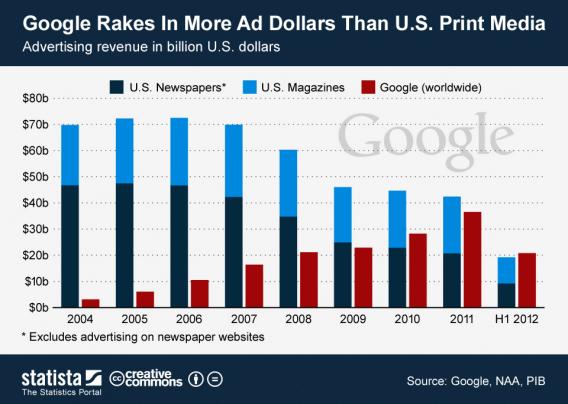
Google and Print Advertising Revenue Trends, 2004-2012It’s official. With nearly $21 billion in ad revenue generated during the first half of 2012, Google now attracts more advertising business than all U.S. print media combined.

That is correct:  German-based statistics portal Statista reports that Google garnered ~$20.8 billion in total ad revenues over the period, while all U.S. newspapers and magazines took in only about $19.2 billion.

Never mind that the comparison isn’t completely apples-to-apples … in that print revenues are for the United States only, while Google generates ad revenues worldwide. Still, it’s a dramatic milestone, and it says a lot about the fortunes (and future) of print versus online advertising.

Statista has helpfully published trend charts that show how quickly the ad picture has changed (see above). Only a few years ago, print advertising dominated the scene, but the trajectories of it and Google have been on opposite paths ever since.

It was inevitable that the lines would eventually cross, but how many could have foreseen it happening as early as 2012?

As if on cue, Advance Publications, a company that owns a number of venerable newspapers in New Orleans, Cleveland and elsewhere, has just announced that it is likely to cut the publication frequency of the Plain Dealer newspaper from its current seven days a week.

If Advance follows through on its intentions, it will join the New Orleans Times Picayune as a daily newspaper that’s no longer a daily.

The publisher’s letter to Plain Dealer readers described the newspaper’s future in lofty terms, noting that changes were coming as the paper seeks to “embrace dynamic shifts in the way information is consumed.”  And other such language.

It also noted that the pending changes are “not about cost-cutting.” But who believes that?

And in fact, the publisher’s letter states also that “if we maintain the status quo, we risk doing what everyone – our employees, advertisers and the community – wants to avoid: disappearing.”

If people don’t see a correlation between the Statista data and what the Plain Dealer has in store for its readers … they’re living on another planet. 

Consumer buying behaviors: The power of choice … or not?

Toothpaste Aisle -- too many choicesIf you were to poll consumers, most would probably tell you that they love to be given many choices or options when it comes to merchandise and services.

And why not? Everyone recalls hearing about the “bad old days” of the Soviet Union and Communist China, when people had the choice of one type of bread or one color of clothing.

In the United States and other Western economies, we’ve long provided consumers a vast array of selection — sometimes with very little actual differentiation.  And those choices have proliferated all the more in recent years. 

[Take a walk up the toothpaste aisle at your local retail store and you’ll see “product choice, circa 2012″  in action – and on steroids.]

From the mundane to the important in goods and services, we have more choices today than ever before. But how well are we coping with having all of these options?

Not well at all, according to Barry Schwartz, the author of an important book on the topic. His book, The Paradox of Choice: Why More is Less, was published back in 2005 but is still quite timely today – perhaps even more when considering what’s happened in the ensuing years to things like the latest range of satellite television viewing package offerings from DirecTV.

Dr. Schwartz, who is a professor of social theory at Swarthmore College, posits that people are often overwhelmed by everyday decisions that have become increasingly complex due to the burgeoning number of available choices and options.

This over-abundance of choice happens not merely in the realm of toothpaste, but also in big decision areas such as selecting a healthcare provider, making investment decisions, deciding whether to move to a new city or state, or selecting a college or other educational program.

According to Dr. Schwartz, this is what often happens when confronted by so many choices:

 People question their decisions before they even make them

 The myriad of choices can set up unrealistically high expectations

 Depending on the importance of the decision to be made, too many choices can actually lead to decision-making paralysis

At what point the lines of “too few choices à la Havana” and “too many choices à la Atlanta” cross, differs depending on the situation: What might be a beautiful array of options for one person may induce an unacceptable degree of stress for another.

Dr. Schwartz lays out a number of suggestions for people who find that the bevy of choices produces too much stress, too much anxiety, or simply too much “busyness” in their lives. In turn, Harvard Business Review bloggers Anna Bird, Karen Freeman and Patrick Spenner help by coming at it from the other side.

This trio of business writers tells marketers, “If customers ask for more choice, don’t listen.” Their advice, as paraphrased by search marketing über-specialist Gord Hotchkiss, is this:

“The harder consumers find it to make purchase decisions, the more likely they are to overthink the decision and repeatedly change their minds or give up on the purchase altogether. In fact, regression analysis points to decision complexity and resulting cognitive overload as the single biggest barrier to purchase.

“Provide them with fewer choices, and make them as relevant and compelling as possible. Ease the burden of risk by providing information that reassures.”

Hotchkiss offers a few additional words of wisdom as well:

“Realize that one of the components of risk is the degree of bias in the information we’re given. If that information reeks of marketing hyperbole, it will be discounted immediately.”

So the bottom line for marketers could be this:  Simplifying product and service offerings may deliver just what consumers actually need (as opposed to what they say) … while also making employees’ lives in the product management department a whole lot easier.

What’s the value of a consumer’s time spent online?

The value of a consumer's time onlineIf you’ve ever wondered what the “value” is of a consumer spending time online, we have some answers courtesy of SumAll, a data visualization company.

SumAll has tapped into Google Analytics data to study patterns across ~10,000 customers and nearly $1 billion worth of transactions. What it finds is that a minute of time spent by a consumer “e-window shopping” is worth an average of 43 cents.

SumAll also calculates that one full visit to an e-commerce site is worth ~$1.30.

The company has been tracking this sort of information for a number of years, so we have some comparative statistics we can observe. In 2012, SumAll finds that the average amount of time spent per site declined by approximately 14% — from 3 minutes, 16 seconds in 2011 to 2 minutes, 49 seconds today.

Despite that decrease in time spent per online visit, the revenue generated per visit actually grew by ~24%.

What’s the reason? “Buyers are more accustomed to buying online, so the hesitation is dropping,” Dane Atkinson, SumAll’s CEO claims.

The SumAll data also suggest that an average consumer spending 1 minute, 54 seconds on a site is the amount of time needed in order for the e-retailer to make a dollar in sales.

The SumAll report concludes that a balance needs to be struck on e-commerce sites between having enough depth to be interesting … but not so much as to be overwhelming, with too many products offered and/or undue difficulty in illuminating the payment path for buyers.

According to Atkinson, aiming for an average e-commerce visit of three to four minutes is a good goal for engaging customers without confusing them with too many options.

Finally, we see from the trend data that there has been a dramatic decrease in the amount of minutes spent on a site to result in a dollar sale: it was charted at over 5 minutes back in 2009, more than three times 2012’s findings.

I guess we’ve become more nimble than ever buying online.

TMI: The Seduction of Data

The Seduction of DataIt was the Roman philosopher Seneca who once remarked, “The abundance of books is a distraction.”

(He said it in Latin, of course.)

Fast-forward 2,000 years … and we’re dealing with the same phenomenon – on steroids.

Jonathan Spira, author of the book Overload: How Too Much Information is Hazardous to your Organization, calculates that “info-inundation” and the productivity inefficiencies that emanate from it costs the U.S. economy around $1 trillion per year.

But how can anyone combat the information explosion and not risk missing out on something important? After all, no one wants to be left behind when it comes to “knowing what needs to be known.”

But there are some small things you can do to help control your information environment. Spira and others suggest a few tips:

  • Skim and scan information first rather than digging deep from the get-go. More than 80% of it is likely dispensable.
  • Set aside some quality “thinking time” to properly digest what is truly important from what you just consumed.
  • Engage in more “real-time” interactions with colleagues rather than wasting energy over long e-communiqués and missed communications.

A related issue is whether “too much” information actually hinders good decision-making. That possibility was studied by psychologists at Princeton University and Stanford University more than a dozen years ago in research that seems even more pertinent and consequential today.

The researchers studied two groups of people. Each group was presented the same set-up: A person with a well-paying job and a solid credit history is applying for a bank loan. The issue facing the two groups is whether to reject the loan application because a background check has uncovered the fact that for the past three months the loan applicant has not paid on a debt to his charge card account.

Group A was informed that the amount of the card account charge was $5,000 … while Group B was told that the amount was either $5,000 or $25,000. Participants could decide to approve or reject the application immediately, or they could hold off making their decision until more information was available.

It was later revealed to Group B participants that the applicant’s debt was only $5,000 rather than $25,000. So eventually both sets of participants had the same information upon which to make their decision.

The experiment’s findings, published in a report titled On the Pursuit and Misuse of Useless Information, revealed the interesting final result: In what clearly should be a cut-and-dried decision to reject the loan application, more than 70% of Group 1 participants dutifully did just that. They rejected the loan application, properly protecting the bank from undue financial risk.

Group 2? Only about 20% rejected the application.

The Princeton/Stanford study concluded that even though both groups possessed the same exact information, Group 2 revealed an intriguing blind spot when it comes to the way many people make decisions: They’re passionately interested in filling information gaps.

But the compulsion to seek out the added information can actually lead people to delay making decisions for too long … or ultimately to make the wrong one.

Making the siren call of info-inundation all the more dangerous, the explosion of information that’s at our fingertips thanks to the Internet means there’s always “one more report” … ” one more evaluation” … “one more perspective” to seek out and consider.

It’s the seduction of data … where sometimes “more” can be “less.”

Newspaper Ad Revenues Plummet to a 60-year Inflation-adjusted Low

Newspaper advertising revenues decline to 1950 levels in inflation-adjusted dollars.Newspaper ad revenues have now collapsed to a level not seen since the 1950s in inflation-adjusted dollars. 

That’s the sobering conclusion from the Newspaper Association of America’s release of the most recent advertising revenue figures for the U.S. industry.

With these dismal statistics, the newspaper industry seems sure to contract even further, while getting precious little boost from their online advertising activities.

Clearly, when it comes to media, it’s “out with the old” and “in with the new” …

Plain as Day: The Labor Market Recovery is Non-Existent

The single most accurate indicator of labor-market health is the employment-to-population ratio.

Unfortunately for the United States, it’s not looking any good … and it hasn’t for over two years.

People say a picture is worth a thousand words.  In this case, a chart is worth many more.

[Actually, it would be nice if this chart got all of the politicians to stop blubbering away with their thousands of words, and instead take some time to truly ponder what the data is telling us!]

Employment-to-Population Ratio
Can politicians cut the B.S. and focus instead on what this chart is telling them? Don’t hold your breath.

Growth hits the skids in two key industry segments.

economic doldrumsAs further proof that the worldwide economy is sputtering in a pretty major way, here come two reports on stalling growth in two key industry segments: hospitality and mobile communications.

Technology research and advisory firm Gartner, Inc. has announced that it is revising its 2012 mobile growth projections downwards.

In fact, Gartner is reporting that worldwide sales of mobile phones actually declined nearly 3% during the second quarter of the year.  That’s a rude awakening for a market segment that’s been nearly impervious to downward economic pressures up to this time.

And on the hospitality front, industry research firm Hospitality Resource Group (HRG) is reporting that worldwide hotel rates during the first half of 2012 are essentially flat, following a significant rise charted throughout all of 2011.

While a smattering markets scattered around the world (Moscow, Mexico City, Dubai, San Francisco) have charted hotel rate increases in the 10%+ range, there were far more urban areas that experienced rate declines, led that dramatic drops in the following markets:

  • Bangalore, India: -30%
  • Barcelona, Spain: -26%
  • Munich, Germany: -20%
  • Bombay (Mumbai), India: -18%
  • Istanbul, Turkey: -16%

It may be comforting to hear the reassuring words of select politicians in Europe, Asia and North America as they reiterate that recovery is just around the corner.

But the facts on the ground are delivering an unmistakable message that’s far different – the commercial equivalent of a skunk at the garden party:  The economic doldrums aren’t going away anytime soon.

Password Pandemonium

Too many user names and passwords to remember ...It seems that many people have been heeding admonitions from seemingly everywhere that they should refrain from using the same user name and password for their various online accounts.

“Password creep” has been the result. Just how much so is revealed in a recently published research studied from social web SaaS provider Janrain, in concert with Harris Interactive.

The 2012 Online Registration & Password Study found that nearly 60% of online adults have five or more unique passwords associated with their online logins.

One-third of the respondents report that they maintain 10 or more passwords. And ~10% report having more than 20 individual passwords.

These figures are up significantly from the first Janrain study, which was conducted back in 2006.

Of course, when one considers the myriad of online activities many people engage in, it’s not hard to fathom how the number of passwords per user has become so large.  Consider all of these possibilities just for starters:

  • Retail sites and loyalty programs
  • TripAdvisor, Angie’s List, Yelp! and other review sites
  • Facebook, Twitter and other social networking sites
  • LinkedIn, Career Builder and other career-oriented sites
  • Google, Yahoo and other e-mail/search portals
  • PayPal and other payment, banking and financial sites
  • Hobby sites and discussion boards
  • Personal blogs

And the list goes on …

The Janrain/Harris study also uncovered several interesting findings based on age and gender demographics:

  • Older people (age 55+) are more likely to have a higher number of unique passwords than younger adults.
  • Men age 45-54 report having the highest average number of unique password (~10).

There’s no question that people have heeded the warnings about using passwords that are too easy to “game” … and thus are creating passwords that incorporate a combination of letters, numbers and other symbols.

But the downside is a considerable percentage of people forgetting their passwords frequently. 

In fact, more than one-third of the respondents reporte that they have had to ask for assistance on their user name or password at least once in the past month.

And another thing: The vast majority of people (~85%) dislike being asked to register to access information on a new website.

What did they dislike in particular? Half of the respondents complained about having to create and remember yet another user name and password. And ~45% believe that online registration forms are too long and time-consuming to complete.

Despite the irritations of “password pandemonium,” it’s doubtful many online consumers are going to be changing their behaviors very soon.

One alternative would be to create a few strong, secure passwords that are used across multiple sites but changed regularly.  But to many, that “cure” is no better than the “disease” they have already.

Twitter Followers: Fake, Faux or Farcical?

Fake followers:  They're all over Twitter
Fake followers: They’re all over Twitter.

I’ve blogged before about the nagging suspicions many people have about the true level of engagement on Twitter. Some have referred to Twitter accounts as “digital Potemkin Villages” and other (unprintable) characterizations.

And now we have the latest indications that Twitter’s “blue smoke and mirrors” extends to the most important global brands.

Status People, a purveyor of social media management platforms, has develop an analytical tool it calls the “Fake Follower Checker” that evaluates the characteristics of brand followers to determine to what extent they are “real people” as opposed to fakers.

According to Status People, up to half of the followers of the 20 most important global brands are either complete fakes, or inactive.

Of course, it is possible that some brand followers do nothing but follow … and rarely if ever post tweets of their own. But it’s also easy to surmise that the value of an inactive follower isn’t nearly as high as one who engages on the Twitter platform.

Details on how Status People conducts its Twitter follower analysis can be found here. In a nutshell, Status People sampled up to 1,000 records and assessed activity against a number of spam criteria. Those criteria included the degree to which Twitter accounts have few or no followers and few or no tweets … but that follow many other Twitter accounts.

For the record, here are the proportion of major brand followers on Twitter that Status People deems are “good” versus “inactive” or “fake,” ranked from highest to lowest percentage score:

  • Gillette: 64% “good” followers
  • GE: 61%
  • Oracle: 60%
  • Toyota: 60%
  • Cisco: 54%
  • IBM: 53%
  • Mercedes: 53%
  • H-P: 52%
  • Disney: 51%
  • McDonalds: 51%
  • Coca-Cola: 50%
  • Honda: 50%
  • Louis Vuitton: 50%
  • Samsung: 46%
  • Intel: 44%
  • BMW: 43%
  • Microsoft: 42%
  • Nokia: 37%
  • Google: 27%

And what about one of the biggest U.S. brands out there right now:  Brand Obama?  Of the President’s nearly 19 million followers on Twitter, the reports are that nearly three-fourths of them are fake, too. 

Some have questioned why Status People has gone to all of this effort shine a light on Twitter fakery. “What harm is done?” these folks seem to be asking.

In response, Status People contends that fake Twitter accounts exist to build status and power beyond what is legitimate, and that those behind them are gaming the system in an effort to burnish brand credentials unfairly.

But I think it’s actually worse than that.  Twitter fakers run the risk of turning the entire Twitter enterprise into one big farce. I know too many people who have completely turned away from Twitter in the past year, becoming convinced that the entire platform is simply an elaborate façade masking a “whole lot of nothing.”

This can’t be what the folks at Twitter want people to think of their own brand!