Living Life in Pictures

PhotographyYou know the old adage:  A picture is worth a thousand words.

Well, with the plethora of images being uploaded these days … we’re talking billions and billions of images and words.

Recently, Yahoo estimated that the number of images uploaded to the web is nearing 900 billion, which translates to nearly 125 photos for every person on the planet.

Facebook reports that it’s seeing more than 6 billion photos uploaded each month, on average.

And Instagram?  It’s reporting that nearly 28,000 photos are uploaded every minute.

Clearly, we love our photos.  And since digital technology makes it so easy to take good-quality photos and post them instantly, it seems people can’t get enough of doing so.

It’s an interesting twist — in a sense, taking us back to the cavemen days and illustrations on the walls.

Over the centuries, words and language have made it faster and easier to communicate, even as drawing, painting or developing photos using analog (film) technology was difficult and/or time-consuming.

In more recent times, Polaroid® photos gave us a more “instant” experience with images … but sharing them was no easlier than before.  (Plus, let’s be honest:  Most Polaroid shots were pretty lame in the quality department.)

Now that digital photography is as effortless as it is … it seems everyone is rushing back to pictures.

We’re even seeing it in the world of books.  Take Amity Shlaes’ book The Forgotten Man, about the Great Depression.  It came out in conventional form in 2008.

The Forgotten Man (Graphic Edition)But now, it’s being released in a picture book version:  The entire book has been re-imagined as an elaborate comic book, replete with illustrations by veteran graphic artist Paul Rivoche.

And based on the early indications, it looks like the new graphic version is going to outsell the original.

Is all of this some kind of regression to an earlier stage — a return to a sort of “collective adolescence writ large”?

I think not.  It’s more a function of “doing what’s possible.”

I think human beings have always gravitated to pictorial portrayals — which explains the immediate embrace of movies and television when those innovations came on the scene.

So when photography becomes so easy to produce and to share, it’s only natural that we’re going to have billions and billions of images swirling around as a result.

And why not?  Life’s all the richer because of it.

Patent Trolls: Is a Day of Reckoning Finally at Hand?

When the banks get involved … watch out.

patent holding companiesIn recent weeks, I’ve begun reading more news items about legislation being passed to limit the damage so-called “patent trolls” can do to unsuspecting businesses.

These are the bottom-feeding firms which exist only to collect royalty payments and fines from companies due to supposed infringement on patents the firms have purchased.

Many of the victims of these schemes are smaller businesses with fewer than $10 million in annual revenues.

The reasons they’re targeted are pretty obvious:  smaller companies are less able to defend themselves against such charges, and it’s often easier and less expensive to settle out of court — and avoid all the hassles that accompany litigation as well.

But the cumulative impact is pretty enormous.  Patent risk specialist RPX Corporation estimates that it’s nearly $13 billion in legal fees, settlements or judgments.

The University of California’s Hastings College of the Law has also been studying the numbers.  It finds that patent infringement claims against the portfolio companies of venture-capital firms cost an average of $100,000 each to settle.

Predictably, only a smidgeon of the monies collected by these patent-holding companies actually makes it back to the inventors.  The rest goes right in the deep pockets of the people trolling the business world for easy money.

And then …

come down hardThen some patent trolls made the mistake of sending demand notifications to banking firms, related to things like the software used in ATMs.

Oops.  Bad move.

Once the banking institutions got sensitized to the issue,  a lot of legislators did, too.  Funny how that works.

The results are now beginning to show.  In recent months, more states have enacted legislation curbing the ability of patent trolls to make “bad faith” assertions of patent claims.

What is a questionable patent claim?  It’s a claim that isn’t based on any clear evidence of infringement — but instead on vague accusations.

(In other words, these questionable claims represent the vast majority of the notifications delivered to the unsuspecting victims.)

States jumping on the “put the trolls on trial” bandwagon range from New York, Vermont to Oklahoma and Minnesota.  Twelve so far, and the tally will surely increase in the coming months.

One of the interesting twists is the fact that most of new legislation also allows targeted companies to strike back in state courts with their own litigation … against the patent-holding companies themselves.

I guess turnabout is fair play.

Another twist …

Here’s an interesting case where financial institutions – an industry not particularly loved in many quarters – is helping to rout a particularly pernicious and avaricious bunch of businesspeople.

This sort of activity, based not only on any sense of commercial fair play but instead on playing mercantile “gotcha” games, is reprehensible and gives “the business of business” a bad name.

Too, it has to have had a chilling effect on the activities of smaller businesses in particular – especially those who rely on established technologies to create and commercialize new products.

Constantly looking over one’s shoulder to make sure no one is coming after you for something as innocuous as using an e-mail tool on a FAX machine is hardly the kind of environment that fosters innovation.

So let the cheering begin … and no stopping until these trolls are banished back under the bridge.

Time spent online daily: 2.5 hours and growing.

Lots of time spent onlineIf you’re wondering what happened to all of the community volunteer activities people used to do – not to mention the popularity of participating in group social or recreational activities like softball or bowling leagues … you might look at the time Americans are spending online as one possible explanation.

The evidence comes in the form of research the Interactive Advertising Bureau did when they contracted with GfK Research to conduct an extensive online survey as part of a larger behavioral analysis of American adults.

Fielded in late 2013 with participation from ~5,000 adults between the ages of 18 and 65, the IAB/GfK survey revealed that Americans are spending an average of 2.5 hours of every day online.

Add that on to the average ~5 hours per day spent watching TV – a figure that’s hardly budged in years – and it’s little wonder that the Jaycees, Shriners’ and other service organizations are finding it more difficult to recruit new members … or that “old faithful” group social and recreational activities are in danger of becoming less relevant.

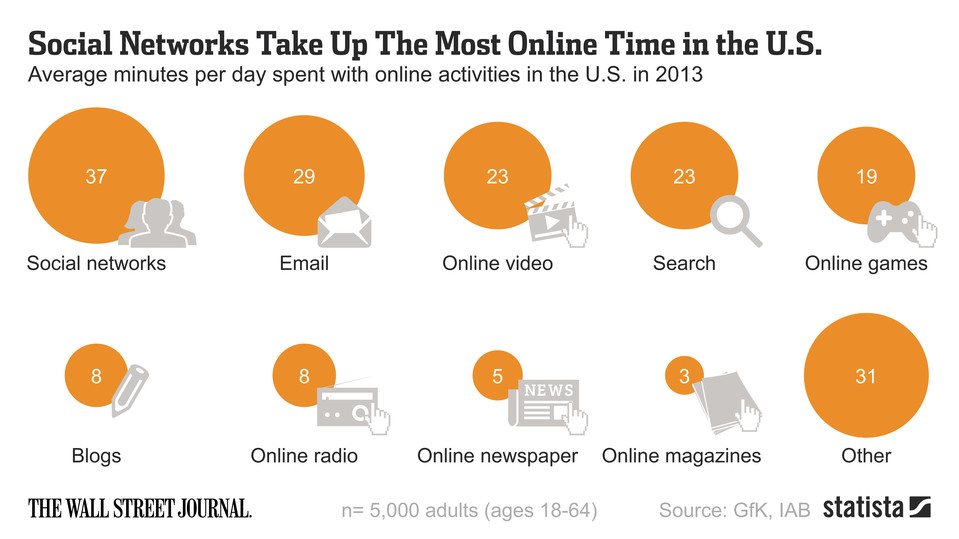
The IAB/GfK survey also revealed which types of online activities are engaged in the most.  The chart below, created by Statista from the IAB/GfK report’s data and published in The Wall Street Journal, gives us the lowdown:

Online Time (average per day)


I wasn’t surprised to discover that social networks chew up the most online minutes per day.  Online video viewing and search time seem about as expected, too.  And who doesn’t enjoy a nice game of Spider Solitaire or Internet Spades to wind down after a long day?

But at ~30 minutes per day, the e-mail average seems on the high side.  People must really be struggling with managing personal inboxes stuffed with marketing e-mails.  (But if work-related e-mails are part of the equation, the half-hour figure seems more expected.)

Comparing these results to similar research done in prior years, the most recent survey charts an increase in online video watching; it’s doubled over the past four years.

Other activities that are on the rise include online gaming, and listening to online radio.

Adding it all up, total time spent online is continuing its inexorable rise thanks to mobile connectivity and the “always-on” digital environment in which Americans now live.

Perhaps the way to stem reduced interest in group social activities and volunteerism lies in giving people free reign to “multitask” even as they participate in the local bowling league or Ruritan Club meetings …

What are your thoughts on the time people are spending online – and if it’s crowding out other forms of daily activities?  Please share your thoughts with other readers here.

Companies Continue to Increase their Investment in Social Media

InvestmentSocial media may have its share of nettlesome issues … but that doesn’t mean companies aren’t spending more effort and energy on these platforms.

To illustrate, a new online survey of ~1,060 business owners, senior management personnel and social strategists that was conducted in April 2014 by Social Media Marketing University finds that a clear majority of companies are investing more time and/or dollar resources on social media as compared to a year ago.

And three-fourths feel that this investment is worth it.

Here are some of the SMMU survey’s key findings:

  • ~74% of companies are devoting more time to social media.
  • ~54% are spending more dollars on social media.
  • Nearly 70% are managing four or more social profiles.

The most significant expenditures for social media programs fall into these four categories:

  • Compensation of in-house staff: ~37% of all social media program expenditures
  • Social media advertising: ~18% of program expenditures
  • Compensation of external staff: ~10% of expenditures
  • Content development: ~7% of expenditures

According to the SMMU survey, smaller businesses – those with fewer than 50 employees – face the biggest challenge in terms of the increased time and cost commitments to social media.

As SMMU Principal John Souza puts it:

“Because many small businesses don’t have the skill-set or the staff to properly manage social media, they are outsourcing their social, or spending an excessive amount of time on tasks as they learn social by trial-and-error.”

Not surprisingly, having some focused training on the “how-to” of social media can make a pretty big difference in the effectiveness of the people charged with planning and carrying out a company’s social media program.

The question is how many businesses actually feel the need for such training, seeing as how some of the recent press about social platforms hasn’t been all that positive.

The answer, based on my own personal interaction with numerous small and medium-sized firms is … not very many of them.

Ipsos Reid Poll: Female Execs Gauge Their Advances

women managers and executivesAn interesting Ipsos Reid poll of female executives conducted late last year sheds light on what the perceived career holdbacks are for women in the workforce these days.

The results of the online survey, which queried ~500 American women working in managerial or executive roles, suggest that women continue to face obstacles in advancing their careers to upper-level management and executive positions … although the disparities are less today – and hopefully continuing the trend toward parity.

An example of one perception which continues to show a big divide between women and men is this:  While ~37% the survey respondents feel that physical appearance and personal image are factors in career progression for men, nearly all (~90%) believe that they are for women.

On the other hand, the perceived differences are less stark when it comes to opportunities for career progression based on the gender of a female employee’s immediate superior.  When asked how gender affects the chances for women to obtain a managerial position, here’s how the respondents answered:

If the superior is a woman …

  • 26% better chance for advancement
  • 30% worse chance for advancement
  • 44% no difference

If the superior is a man …

  • 26% better chance for advancement
  • 25% worse chance for advancement
  • 49% no difference

… Which translates into trust levels that aren’t so very different at all:

  • ~22% would trust a man more for help with career advancement
  • ~18% would trust a woman more for help with career advancement
  • ~60% express no difference in trust levels

Positive Work Attributes

The Ipsos/Reid survey also found that nearly two-thirds of the respondents consider women to be better leaders than men, primarily for these five reasons:

  • Women are better communicators
  • They are more organized
  • They are more empathetic
  • They have a better understanding of the needs of their employees
  • They are more open to changing their approach

For the record, two attributes that respondents do not attribute to women over men are:

  • Women have better instincts than men
  • They are more invested in an organization’s success compared to men.

With a confident self-image and backed by positive work habits, what do these respondents see as the biggest continuing challenges to their career growth?  Here’s what the Ipsos Reid survey found:

  • The requirement for women to work harder and put in longer hours to prove themselves: ~77%
  • Managing work and family balance: ~61%
  • External factors (economic climate/job loss): ~56%
  • Being welcomed into an established senior management team:  ~48%
  • Dealing with outdated perceptions of women in managerial and executive roles: ~48%
  • Lack of female mentors: ~47%

Moreover, ~78% of respondents discern a “noticeable” different in salaries between men and women.

Asked what a company might “fear” about promoting women to senior managerial and executive posts, the respondents cited several probable factors:  the fear that an executive might want to start and maintain a family … and the fear of too many absences from work due to family obligations.

Bottom line, the Ipsos Reid survey reveals some continuing obstacles for women in the executive-level work force.  But there’s positive news, too.  Additional survey findings can be found here.

If you have additional observations or perspectives on this topic, please share them with other readers here.

Gallup: A prestigious college isn’t a clear ticket to career happiness or personal fulfillment.

collegesThe latest shoe to drop in the growing notion that a college education may not be all it’s cracked up to be comes in the form of a Gallup survey released this month that reveals that attending a prestigious institution of higher learning won’t make a person any happier in life or work when compared to graduating from a less selective one.

The Gallup survey of nearly 30,000 college graduates in all age groups, which was conducted in concert with researchers from Purdue University, asked respondents how they were doing in life across a range of factors such as income and “engagement” in their jobs.

Interestingly, the Gallup research was advocated by former Indiana Governor Mitch Daniels, now the president of Purdue University, who reported to The Wall Street Journal that he had encountered a lack of benchmarked data to measure the value of a college degree.

“There is a lot we don’t know about higher education, and there is a sense it’s skating on its reputation,” Mr. Daniels remarked.  “We needed to know with more rigor how well the experience is serving people.”

The resulting survey conducted by the Gallup organization found that fewer than 40% of the college graduates surveyed feel “engaged at work” — in that they enjoy what they do on a daily basis and are intellectually and emotionally connected to their work.

An even lower percentage – just 11% – thought of themselves as “thriving” in all of the major aspects of their lives such as financial stability, having a strong social network, and feeling a sense of purpose.

And how do graduates of the most “selective” institutions fare against others?  According to Gallup, there’s no discernable difference at all.

That is correct:  The survey found that graduating from a Top 100 school has no bearing on the level of future happiness or fulfillment in work or in life.

college debtWhat does have a big impact — in a negative way — is college debt.  Only about 2% of respondents who reported between $20,000 and $40,000 in student loan debt reported that they are “thriving.”

On the positive side of the ledger, what does seem to correlate with greater happiness and fulfillment is having had the experience of a professor take an interest in the student.  These teachers served as a mentor or helped make the learning experience exciting for the student.

The Gallup survey found that those kinds of experiences tend to translate into more optimism, curiosity and engagement in later life and careers — leading to greater fulfillment.

I have immediate family members who have attended all types of higher educational institutions — from Ivy League schools and “New Ivies” to private colleges, public universities and even community colleges.  Time and again, I’ve seen this phenomenon play out just as the Gallup survey suggests.

The fact is … broadly speaking, American higher education is quite good.  One can receive a good education almost anywhere, provided a student studies hard and takes advantage of the opportunities that are available (internships, work-study programs, exchange programs and and so forth).

It wasn’t so true a generation ago.  Back then, the prestigious schools had clear advantages in terms of their top educational staffs, great libraries, and worldwide connections in the educational and business communities.

Today, thanks to the Internet, distance learning and more people with PhDs, even the less selective schools have quality staffing, access to unlimited “virtual” library resources, and similarly stronger connections worldwide.

There continues to be a difference between the prestigious schools and the rest of the pack, of course.  At a place like Amherst or Williams, essentially all of the students are smart as a whip and highly motivated, whereas that’s not going to be the case at a state university.

But at all of the schools, the best students are actually very similar across the board … and they have similar opportunities available to apply to their advantage.

On top of this, there are many fields of study where the “best” education you can get isn’t going to be at an Ivy League school.  Think about the ag degrees at Iowa State University (Ames) or the structural engineering coursework at the Missouri University of Science & Technology (Rolla) as just two examples.

Bottom line, here’s where things stand:  If students want to learn and are willing to study hard … they can get a good education at pretty much any school they choose to attend in America.  And it will lead to a fulfilling professional and personal life later.  “Prestige” has very little to do with it.

Twitter: The social platform that’s less important today than it was yesterday.

Twitter losing lusterTwitter hasn’t mattered to very many people for a very long time.

Of course, for some it hasn’t mattered even from its inception. But when we start reading about Twitter’s most avid users and how they’ve begun to drift away from using the social platform like they’ve done in the past … you know that more than just the atmospherics are changing.

A case in point about this evolution is an article that was published in late April by The Atlantic titled “A Eulogy for Twitter.

The article’s authors, Adrienne LaFrance and Robinson Meyer, begin their piece by writing:

“We’ve been trying to figure out the moment Twitter turned, retracing tweets to see whether there was something specific that soured the platform.  

“Something is wrong on Twitter. And people are noticing. Or at least, the kind of people we hang around with on Twitter are noticing … audience-obsessed, curious, newsy … The thing is, its users are less active than they once were. Twitter says these changes reflect a more streamlined experience, but we have a different theory: Twitter is entering its twilight.”

Those are strong words. But the authors back up their assertions by noting that while people may still be using Twitter, many of them are no longer “hanging out” there. And that’s because there’s less “there there” to sustain once highly-engaged Twitter users.

The perceptions of Twitter’s value have been changing because of three key precepts which are now being proven out as “fictions,” according to LaFrance and Meyer.

What are those “fictions”?

  • The belief that other people in the “Twitterverse” are actually paying attention — or at least that a decent portion of one’s followers are seeing the tweets. 
  • The belief that competent and compelling tweeting will increase a person’s Twitter follower base. 
  • The confidence of knowing that there is a useful potential audience beyond current followers, so that the time and energy spent on the platform will pay dividends. 

None of these premises has turned out to be correct in the long-haul. Instead, the following stark realities fly in the face of all the hope (or hype):

  • Twitter is positively stuffed with “spam” accounts. In fact, the median number of followers for a Twitter account is … exactly one. Even if a few of those accounts are actually “legit,” of what value are they to anyone? 
  • Twitter’s year-over-year growth rate has fallen significantly since 2011.

And here’s another clear indication of how Twitter has morphed into something quite different from its original character. Today, Twitter is more likely to be merely a place to promote content published someplace else in cyberspace, simply providing quick links over to that content.

Whereas in the past, journalists and celebs and others were posting statements and opinions — and replying to or retweeting the posts of others — now it’s more likely to be canned promotion and little more.

… Which sets up a downward spiral, because followers aren’t seeing anything particularly new or interesting that they’re not already encountering elsewhere. So interest wanes … leading to reduced participation … leading to even less consideration of Twitter’s “worth” as a social platform.

This phenomenon of “professionalized accounts” means little more than being a bulletin board of scheduled tweets and broadcast links, resulting in collective yawns all over the place.

Of course, there’s one aspect of Twitter than continues its joyride unabated: hate speech and profanity. But that’s the sort of content many people would just as soon avoid encountering.

LaFrance and Meyer conclude that the world may have “outgrown” Twitter. They’re not happy by that turn of events, writing:

“For a platform that was once so special, it would be sad and a little condescending to conclude that Twitter is simply something we’ve outgrown. After all, the platform has always been shaped by the people who congregate there. So if it’s no longer any fun, surely we’re at least partly to blame.”

The authors go on to note:

“Twitter has done for social publishing what AOL did for e-mail. But nobody has AOL accounts anymore … [Today,] Twitter feels closed off — choked — in a way that makes us want to explore somewhere else for a while.”

It may not be time for Twitter’s eulogy. But there are many who don’t see much of a second act for the social platform, either.

By the way … where are those “somewhere elses” in social media that LaFrance and Meyer allude to? Try Snapchat, Instagram … even LinkedIn.  That’s where the interesting action is happening these days.

Less is less? What’s happening with customer loyalty programs.

CustomersWhen it comes to customer loyalty programs, here’s a sobering statistic: Only about 15% of consumers redeem loyalty rewards.

This finding comes from a report by Forrester Research, based on results from an in-depth survey it conducted last fall of 50 member companies of Loyalty360, a major loyalty marketing association.

What Forrester found is that fewer than half of the surveyed companies’ customers are enrolled in their loyalty programs. And of those customers, only about 35% of them are actually redeeming their loyalty awards.

Hence the 15% “effective” participation rate.

At first blush, the paltry participation makes one wonder what all the fuss is about when it comes to loyalty marketing.  But more than half of the companies surveyed by Forrester reported that they view their loyalty program as a strategic priority, not merely a marketing afterthought..

Clearly, there seems to be a bit of a “disconnect” between those lofty aims and the not-so-airborne reality. The question is how companies can encourage greater participation in their loyalty programs, thereby using them to improve consumer brand loyalty in addition to retaining customers over time.

Forrester offered several recommendations in its report:

1. Use advances in analytics to act on customer insights, rather than just relying on the purchase transactional history of loyalty program members. 

2. Balance the “reward mix” with personalized offers that present rewards program customers with unique experiences that are different from simply offering “more of the same.” (In many cases, offering discounts on more of the same merchandise a customer has already purchased won’t qualify as anything particularly special.) 

3. Break out from the traditional e-mail/web portal/call center communication vehicles to embrace more social media channels featuring two-way interaction. (Surprisingly, only about half of Forrester’s survey respondents reported that social media is an important part of their loyalty programs’ methods of communication.)

Speaking personally, I’m not particularly surprised at the relatively low engagement levels reported in this study. Many companies and brands have reached out to me over the years with offers to join loyalty programs, using various incentives – often purchase discounts or sign-on points as an incentive for joining.

apathyFor me, it’s a matter of “time” and “mindshare” as to which of these programs qualify for my participation. If a brand isn’t that important to me in terms of how I live my daily life, it – and its loyalty program – isn’t ever going to be big on my radar screen.

I suspect there are quite a few other consumers like me. But if you have different take, leave a comment and share your perspective with other readers.


Boomers and Millennials: Destined always to be different … or on the same trajectory?

NeuroWhen it comes to advertising, it turns out that the Baby Boomer generation sees things quite a bit differently than the Millennial generation.

In fact, based on neuromarketing research conducted last year by Nielsen NeuroFocus, generational differences account for some interesting neurological contrasts between Boomer and Millennial brains.

The research results also point to how companies might find it wise to tweak the design and presentation of their advertising based on the age levels of their audiences.

Consider these distinct differences found by Nielsen NeuroFocus in its research:

Brain Function: The Boomer Brain likes repetition. Boomers also tend to believe that information that is “familiar” is true. On the other hand, the Millennial brain is more stimulated by dynamic elements such as rich media, animation, and lighting that cuts through their “perception threshold.”

Distractions: Boomer brains are more easily distracted, whereas Millennials are adept at dealing with “bleeding-over” communications such as those found in dynamic banner ads and in contemporary magazine layouts.

Attention Spans: Boomers have a broader attention span and are open to processing more information, whereas Millennials prefer at-the-ready, multi-sensory communications. (And “impatience” is their middle name.)

Colors: In advertising, contrasts gain the attention of Boomers in advertising. With Millennials, it’s more the intensity of the color palette overall rather than contrasts within it that does the trick.

Humor: The Boomer generation prefers lighthearted, clever humor in advertising messages – positive and not mean-spirited. Boomers also like relatable characters that aren’t much younger than themselves. Millennials tend to prefer offbeat, sarcastic or slapstick humor – basically, the kind of humor that many Boomers find offputting or even offensive. Making special effects and other visual hi-jinks part of the shtick attracts the attention and interest of Millennials, too.

It turns out, there’s some real science behind these findings, too. Nielsen NeuroFocus reports that when people are in their mid-50s, distraction suppression mechanisms tend to weaken. Even as early as the mid-40s there are dramatic declines in neurotransmitter levels – particularly serotonin and dopamine.

How does that manifest itself in situations where we see “Boomers behaving badly?” Dopamine declines can lead to thrill-seeking behaviors to compensate. And a drop in serotonin levels can lead to the feeling that “something is missing” – thereby leading to classic midlife crisis behaviors affecting a person’s professional life and personal relationships.

… And as we know, that often doesn’t end up particularly well.

But here’s the more central takeaway from the research: Boomer-Millennial differences don’t turn out to be so much a function of differing world views; it’s more a function of the aging process itself.

So look for the Millennials to begin responding more like Boomers in the coming years.

Are comment sections on news websites on the way out?

Trying to tame “the world of horrible Internet awfulness.”  (David Tarp, CEO, Tumblr)

Online CommentsOne of the most empowering aspects of the Internet is its ability to foster online interaction and feedback, wherein “regular people” have a megaphone in addition to journalists and writers on publisher websites.

But there’s an ugly side to the public dialogue, unfortunately: There’s an awful lot of verbal “dirty laundry” that gets put on display.

It’s sort of like taking younger children to the state fair or a sporting event — and then trying to shield them from the loud profanity (and worse) that they overhear.

The fact is, you can’t get away from the coarseness on online comment sections – particularly if the news content pertains to political or socio-cultural topics.

It’s often a “drive to the bottom” where social norms and common decency fall by the wayside in the name of airing grievances or settling scores.

It extends to less potentially inflammatary zones beyond polarizing politics, too.  Researchers have found that people who read the same news story about a new technology, but who are exposed to different sets of coments — one set fair and the other nasty — have completely different responses to the news story itself.  In the research, commenter anonymity and the ability to strongly attack a news story without the need to back it up with facts, caused ill effects that were neither accurate or fair.

The researchers dubbed it “The Nasty Effect.”

For some time now, Internet news and information sites have tried to strike a balance between access and interactivity on the one hand … and civility and decorum on the other.

In many cases, the quest has been frustratingly difficult. Here’s what some publishers have said about the issue:

“There’s got to be a better [way] to interact without comments taking away from the article or denigrating the people who are reported on.”  — Craig Newman, Chicago Sun-Times

“One of the worst things about writing in public is fielding random ad hominem attacks … in the space in which you’ve poured out your precious thoughts.”  — Ev Williams, Medium

“Even a fractious minority wields enough power to skew a reader’s perception of a story.”  — Suzanne LeBarre, Popular Science

As a result, now we’re seeing more instances of publishers and bloggers killing their comment sections completely.  Consider these examples:

… As of this month, the Chicago Sun-Times has axed its comment capability for the foreseeable future.

… The much anticipated March 2014 launch of Vox (Ezra Klein’s news venture), doesn’t provide for feedback comments.

… The same goes for The Dish, Andrew Sullivan’s website.

Popular Science shut down its comment sections this past September.

… Atlantic Media’s Quartz business site hasn’t ever allowed comments on its site since its launch in 2012.

… And neither has Tumblr.

But it seems rather unrealistic to think that comments sections can be banned from the Internet outright. That would be like trying to put the genie back in the bottle.

Instead, a via media approach may be what the Huffington Post has done. This past December, it implemented a policy wherein commenters must use their Facebook accounts and real names in order to post a comment on Huffington Post stories.

Those who wished to continue posting comments under pseudonyms have had to “appeal” for the right to do.

The goal? To make people think twice before publishing strongly worded comments — the kind that say as much about the poster as they do about the object of their commentary.

Despite the predictable howls from some readers who feel that the right to express an opinion without fear of reprisal is a big part of the appeal of the Internet, four months later the Huffington Post sees the move in positive terms.

The publisher’s community director Tim McDonald reports that the number of “faux” accounts in its system has gone way down – and the quality of discourse is up.

With this approach, perhaps “shameless” needn’t upstage  “shame” after all — and the benefits of interactivity and debate can be preserved at the same time.