Does “generational marketing” really matter in the B-to-B world?

For marketers working in certain industries, an interesting question is to what degree generational “dynamics” enter into the B-to-B buying decision-making process.

Traditionally, B-to-B market segmentation has been done along the lines of the size of the target company, its industry, where the company’s headquarters and offices are located, plus the job function or title of the most important audience targets within these other selection criteria.

By contrast, something like generational segmenting was deemed a far less significant factor in the B-to-B world.

But according to marketing and copywriting guru Bob Bly, things have changed with the growing importance of the millennial generation in B-to-B companies.

These are the people working in industrial/commercial enterprises who were born between 1980 and 2000, which places them roughly between the ages of 20 and 40 right now.

There are a lot of them. In fact, Google reports that there are more millennial-generation B-to-B buyers than any other single age group; they make up more than 45% of the overall employee base at these companies.

Even more significantly, one third of millennials working inside B-to-B firms represent the sole decision-makers for their company’s B-to-B purchases, while nearly three-fourths are involved in purchase decision-making or influencing to some degree.

But even with these shifts in employee makeup, is it really true that millennials in the B-to-B world go about evaluating and purchasing goods and services all that differently from their older counterparts?

Well, consider these common characteristics of millennials which set them apart:

  • Millennials consider relationships to be more important than the organization itself.
  • Millennials want to have a say in how work gets done.
  • Millennials value open, authentic and real-time information.

This last point in particular goes a long way towards explaining the rise in content marketing and why those types of promotional initiatives are often more effective than traditional advertising.

On the other hand … don’t let millennials’ stated preferences for text messaging over e-mail communications lead you down the wrong path. E-mail marketing continues to deliver one of the highest ROIs of any MarComm tactic – and it’s often the highest by a long stretch.

Underscoring this point, last year the Data & Marketing Association [aka Direct Marketing Association] published the results of a comparative analysis showing that e-mail marketing ROI outstripped social media and search engine marketing (SEM) ROI by a factor of 4-to-1.

So … it’s smart to be continually cognizant of changing trends and preferences. But never forget the famous French saying: Plus ça change, plus c’est la même chose

Fewer brands are engaging in programmatic online advertising in 2017.

How come we are not surprised?

The persistent “drip-drip-drip” of brand safety concerns with programmatic advertising – and the heightened perception that online advertising has been showing up in the most unseemly of places — has finally caught up with the once-steady growth of economically priced programmatic advertising versus higher-priced digital formats such as native advertising and video advertising.

In fact, ad tracking firm MediaRadar is now reporting that the number of major brands running programmatic ads through the first nine months of 2017 has actually dropped compared to the same period a year ago.

The decline isn’t huge – 2% to be precise. But growing reports that leading brands’ ads have been mistakenly appearing next to ISIS or neo-Nazi content on YouTube and in other places on the web has shaken advertisers’ faith in programmatic platforms to be able to prevent such embarrassing actions from occurring.

For Procter & Gamble, for instance, it has meant that the number of product brands the company has shifted away from programmatic advertising and over to higher-priced formats jumped from 49 to 62 brands over the course of 2017.

For Unilever, the shift has been even greater – going from 25 product brands at the beginning of the year to 53 by the end of July.

The “flight to safety” by these and other brand leaders is easy to understand. Because they can be controlled, direct ad sales are viewed as far more brand-safe compared programmatic and other automated ad buy programs.

In the past, the substantial price differential between the two options was enough to convince many brands that the rewards of “going programmatic” outweighed the inherent risks.  No longer.

What this also means is that advertisers are looking at even more diverse media formats in an effort to find alternatives to programmatic advertising that can accomplish their marketing objectives without the attendant risks (and headaches).

We’ll see how that goes.

Advertisers “kinda-sorta” go along with FTC guidelines for labeling of native advertising placements.

In an effort to ensure that readers understand when published news stories represent “earned” rather than “unearned” media, in late 2015 the Federal Trade Commission established some pretty clear guidelines for news stories that are published for pay.

The rationale behind the guidelines is that the FTC wants advertisers to be prevented from presenting paid content in ways that mask the fact that it’s a form of advertising.  Essentially, it wants to avoid leaving the erroneous impression that the advertiser did not create — or influence the creation — of the content, or that it paid a fee in order for the news to be published.

But what native advertising content developer Polar has found is that the explicit disclosures the FTC wishes advertisers to include as part of their stories tend to have a negative impact on readership.

… Which is precisely what native advertising is trying to avoid, of course.

After all, the whole point of these articles is to appear that they’re published due to their inherent newsworthiness, rather than because advertisers wish to push a sales message disguised as “narrative” so strongly, they’re willing to fork over big bucks for the privilege.

In its evaluation, Polar analyzed ~140 native placements across 65 publishers, and found that only ~55% of them used the term “sponsored” as a way to label the content.

As for the term “advertisement” or “advertorial,” the incidence of usage was far lower; less than 5% of the native placements identified their content as such.

Correlated to these findings was that more euphemistic terms like “partner content” tend to perform better in terms of reader engagement than do more explicit disclosures of an advertiser relationship.

“Promoted” was found to be the best performing term, garnering a 0.19% clickthrough rate as compared to “sponsored,” with just a 0.16% clickthrough rate.

[Interestingly, on desktop devices “sponsored” marginal outperformed “promoted,” whereas on mobile devices it was just the opposite.]

More broadly, the Polar investigation also found that nearly one-third of the pay-to-play native advertising placements it evaluated failed to comply at all with the FTC guidelines (as in zip/zero/nada) – which brings up a whole other set of issues at a time of heightened awareness of the “fake news” phenomenon online.

Holiday shopping behaviors: Black Friday is losing some of its luster.

It’s the beginning of October – which means that the holiday shopping season will soon be upon us.

… If it isn’t already, based on the holiday displays we’re already seeing cropping up at some major retail chain stores.

Of course, U.S. retailing firms have been gearing up for the season for months now, in terms of building merchandise inventories and so forth. But what sort of consumer shopping dynamics will they be facing this year?

According to new research published by Euclid, Inc. in its 2017 Evolution of Retail report which covers holiday physical and digital retail trends, Cyber Monday has now overtaken all of the other holiday-season shopping days in terms of consumer excitement.

That finding is based on a survey of ~1,500 U.S. consumers age 18 and older. While majorities of respondents report that they are excited about each of the three biggest revenue days of the holidays, for the first time ever Cyber Monday heads the list in terms of consumer interest and excitement:

  • Cyber Monday: ~72% of consumers report being excited about this shopping day
  • Black Friday: ~62%
  • Day after Christmas: ~55%

Clearly, online shopping continues to build momentum year over year. But the Euclid research also reveals that physical stores continue to have a major role in the “buying journey.”  Even among consumers in the 18-34 age group, three out of four respondents report that they visit physical stores on a regular basis to see products “in the flesh” – even if they purchase them online later.

Not surprisingly, “price” remain the biggest driver in consumer shopping behaviors during the holiday season, but convenience is another factor as well. It isn’t simply a store’s location that matters, but also how quickly shoppers can get in and out of the store that affects their views of “convenience.”

Interestingly, when comparing just in-store shopping plans, more respondents in the Euclid survey expect to be shopping on the day after Christmas (63%) than on Black Friday (60%) this year.

Perhaps the decisions by some big retailers to curtail store hours on that traditional first day of the holiday shopping season are being driven by more than simply altruism …

The complete Euclid report for 2017 can be downloaded here.

The disappearing attention spans of consumers.

Today I was talking with one of my company’s longtime clients about how much of a challenge it is to attract the attention of people in target marketing campaigns.

Her view is that it’s become progressively more difficult over the past dozen years or so.

Empirical research bears this out, too. Using data from a variety of sources including Twitter, Google+, Pinterest, Facebook and Google, Statistic Brain Research Institute‘s Attention Span Statistics show that the average attention span for an “event” on one of these platforms was 8.25 seconds in 2015.

Compare that to 15 years earlier, when the average attention span for similar events was 12.0 seconds.

That’s a reduction in attention span time of nearly one-third.

Considering Internet browsing statistics more specifically, an analysis of ~60,000 web page views found these behaviors:

  • Percent of page views that lasted more than 10 minutes: ~4%
  • % of page views that lasted fewer than 4 seconds: ~17%
  • % of words read on web pages that contain ~100 words or less: ~49%
  • % of words read on an average web page (around ~600 words): ~28%

The same study discovered what surely must be an important reason why attention spans have been contracting. How’s this tidy statistic:  The average number of times per hour that an office worker checks his or her e-mail inbox is … 30 times.

Stats like the ones above help explain why my client – and so many others just like her – are finding it harder than ever to attract and engage their prospects.

Fortunately, factors like good content and good design can help surmount these difficulties. It’s just that marketers have to try harder than ever to achieve a level of engagement that used to come so easily.

More results from the Statistic Brain Research Institute study can be found here.

Facebook attempts to shake the “Fakebook” mantle.

There are a growing number of reasons why more marketers these days are referring to the largest social media platform as “Fakebook.”

Back last year, it came to light that Facebook’s video view volumes were being significantly overstated – and the outcry was big enough that the famously tightly controlled social platform finally agreed to submit its metrics reporting to outside oversight.

To be sure, that decision was “helped along” by certain big brands threatening to significantly cut back their Facebook advertising or cease it altogether.

Now comes another interesting wrinkle. According to Facebook’s statistics, the social network claims it can reach millions of Americans across several important age demographics, as follows:

  • 18-24 year-olds: ~41 million people
  • 25-34 year-olds: ~60 million people
  • 35-49 year-olds: ~61 million people

There’s one slight problem with these stats:  U.S. Census Bureau data indicates that the total number of people living in the United States falling in the 18-49 age grouping is 137 million.

That’s a substantially lower figure than the 162 million people counted by Facebook – 25 million (18%) smaller, to be precise.

What could be the reason(s) for the overcount? As reported by Business Insider journalist Alex Heath, a Facebook spokesperson has attributed the “over-counting” to foreign tourists engaging with Facebook’s platform while they’re in the United States.

That seems like a pretty lame explanation – particularly since U.S. tourism outside the country is a reciprocal activity that likely cancels out foreign tourism.

There’s also the fact that there are multiple Facebook accounts maintained by some people. But it stretches credulity to think that multiple accounts explain more than a small portion of the differential.

Facebook rightly points out that its audience reach stats are designed to estimate how many people in a given geographic area are eligible to see an ad that a business might choose to run, and that this projected reach has no bearing on the actual delivery and billing of ads in a campaign.

In other words, the advertising would be reaching “real” people in any case.

Still, such discrepancies aren’t good to have in an environment where many marketers already believe that social media advertising promises more than it actually delivers.  After all, “reality check” information like this is just a click away in cyberspace …

Free-speech “confusion-in-advertising” continues unabated.

Sparring over the guarantees and limits of free speech seems to be growing rather than abating.

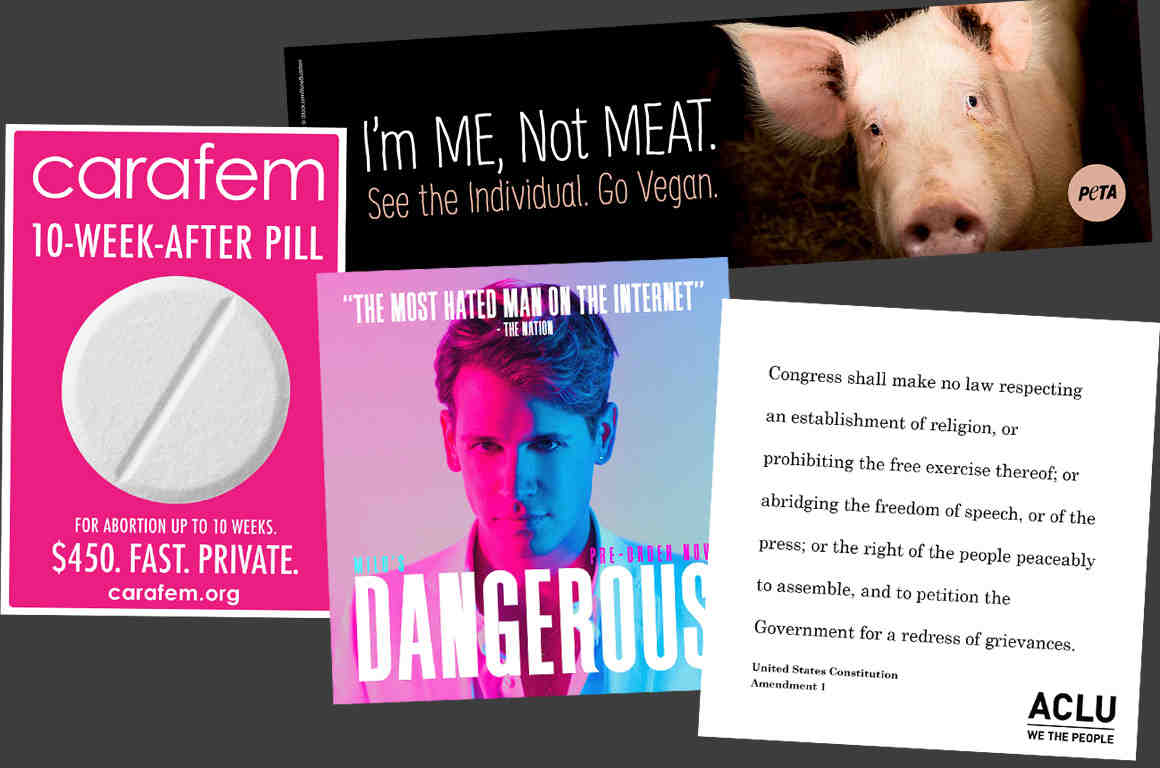
How controversial? The advertising rejected by the Washington Metropolitan Area Transit Authority as being too political for public display.

The most recent indication of just how much confusion there is on the topic of free speech comes in the form of a recently filed lawsuit brought by the American Civil Liberties Union against the Washington Metropolitan Area Transit Authority (WMATA) – a public agency popularly known as the DC Metro.

The issue sparking the lawsuit related to a number of ads which the WMATA refused to display due to concerns over the advertising content being “too political for public display.”

Countering WMATA’s efforts to avoid “offending” its customers, the ACLU chose to sue on behalf of itself as well as three companies and organizations that includes:

  • Carafem – a healthcare network specializing in birth control and medication abortion
  • Milo Worldwide, LLC – the corporate entity behind the libertarian political advocate and “extreme commentator” Milo Yiannopolous
  • PETA Foundation (aka FSAP – Foundation to Support Animal Protection) – an animal rights/welfare organization

The lawsuit claims that WMATA refused to display advertising from these organizations for fear of offending some of the people who use its transportation services.

In announcing its intention to defend itself against the ACLU suit, a WMATA spokesperson stated:

“In 2015, WMATA’s board of directors changed its advertising forum to a nonpublic forum and adopted commercial advertising guidelines that prohibit issue-oriented ads, including political, religious and advocacy ads. WMATA intends to vigorously defend its commercial advertising guidelines, which are reasonable and viewpoint-neutral.”

On the point of whether the advertising in question is “issues-oriented,” there is sharp disagreement.

Gabe Walters, manager of legislative affairs for the PETA Foundation, emphasizes that “the government cannot pick and choose who gets to speak based on their viewpoint – no matter how controversial.”

A spokesperson for Milo Yiannopoulos echoed the PETA Foundation statement: “On this issue we are united:  It is not for the government to chase so-called ‘controversial’ content out of the public square.”

Considering the ads that were rejected, a case could be made that they’re hardly “controversial” on their face:

  • The Milo Worldwide ads featured a photo of Milo Yiannopoulos.
  • The Carafem ad copy stated simply “for abortion up to 10 weeks.”
  • The PETA ad showed a pig with the caption, “I’m ME, not MEAT. See the Individual. Go Vegan.”
  • The ACLU ad stated the First Amendment language verbatim.

The ACLU suit contends that none of the advertising in question negates any kind of fundamental right to free speech. Moreover, the abortion pill provided by Carafem is FDA-approved as well as accepted by the American Medical Association.

Even more problematic for the WMATA’s defense, at the same time the agency was rejecting the PETA ad, it approved one from Chipotle promoting a menu item made with pork.

The only difference between them according to the ACLU? The Chipotle ad sends the message that it’s good to eat pork, whereas the PETA ad says the opposite.

Looking at the contours of the lawsuit and the facts of the case, I think the WMATA defense is on pretty shaky ground, and for this reason, I’m pretty sure that the ACLU lawsuit is going to succeed.

Indeed, it’s somewhat distressing that such a suit had to be filed at all, because its point is the First Amendment and what it’s all about: protecting everyone’s speech.

That people are having to re-litigate the issue of free speech in 2017 speaks volumes about the level of confusion that has been introduced into the public sphere in decent years.

It’s time to clear the air.

Consumers continue to grapple with what to do about spam e-mail.

Over the past decade or so, consumers have been faced with basically two options regarding unwanted e-mail that comes into their often-groaning inboxes. And neither one seems particularly effective.

One option is to unsubscribe to unwanted e-mails. But many experts caution against doing this, claiming that it risks getting even more spam e-mail instead of stopping the delivery of unwanted mail.  Or it could be even worse, in that clicking on the unsubscribe box might risk something even more nefarious happening on their computer.

On the other hand, ignoring junk e-mail or sending it to the spam folder doesn’t seem to be a very effective response, either. Both Google and Microsoft are famously ineffective in determining which e-mails actually constitute “spam.”  It isn’t uncommon that e-mail replies to the personal who originated the discussion get sent to the spam folder.

How can that be? Google and Microsoft might not even know the answer (and even if they did, they’re not saying a whole lot about how those determinations are made).

Even more irritating – at least for me personally – are finding that far too many e-mails from colleagues in my own company are being sent to spam – and the e-mails in question don’t even contain attachments.

How are consumers handling the crossed signals being telegraphed about how to handle spam e-mail? A recent survey conducted by digital marketing firm Adestra has found that nearly three-fourths of consumers are using the unsubscribe button – and that figure has increased from two-thirds of respondents in the 2016 survey.

What this result tells us is that the unsubscribe button may be working more times than not. If that means that the unwanted e-mails stop arriving, then that’s a small victory for the consumer.

[To access the a summary report of Adestra’s 2017 field research, click here.]

What’s been your personal experience with employing “ignore” versus “unsubscribe” strategies? Please share your thoughts with other readers.

Today’s Most Expensive Keywords in Search Engine Marketing

I’ve blogged before about the most expensive keywords in search engine marketing. Back in 2009, it was “mesothelioma.”

Of course, that was eight years and a lifetime ago in the world of cyberspace. In the meantime, asbestos poisoning has become a much less lucrative target of ambulance-chasing attorneys looking for multi-million dollar court settlements.

Today, we have a different set of “super-competitive” keyword terms vying for the notoriety of being the “most expensive” ones out there.  And while none of them are flirting with the $100 per-click pricing that mesothelioma once commanded, the pricing is still pretty stratospheric.

According to recent research conducted by online advertising software services provider WordStream, the most expensive keyword categories in Google AdWords today are these:

  • “Business services”: $58.64 average cost-per-click
  • “Bail bonds”: $58.48
  • “Casino”: $55.48
  • “Lawyer”: $54.86
  • “Asset management”: $49.86

Generally, the reasons behind these terms and other terms being so expensive is the dynamic of the “immediacy” of the needs or challenges people are looking to solve.

Indeed, other terms that have high-end pricing include such ones as “plumber,” “termites,” and “emergency room near me.”

Amusingly, one of the most expensive keywords on Google AdWords is … “Google” itself.  That term ranks 25th on the list of the most expensive keywords.

[To see the complete listing of the 25 most expensive keywords found in WordStream’s research, click here.]

WordStream also conducted some interesting ancillary research during the same study. It analyzed the best-performing ads copy/content associated with the most expensive key words to determine which words were the most successful in driving clickthroughs.

Running this textual analysis found that the most lucrative calls-to-action included ad copy that contained the following terms:

    • Build
    • Buy
    • Click
    • Discover
    • Get
    • Learn
    • Show
    • Sign up
    • Try

Are there keyword terms in your own business category or industry that you feel are way overpriced in relation to their value they deliver for the promotional dollar? If so, which ones?

Why are online map locations so sucky so often?

How many times have you noticed location data on Google Maps and other online mapping services that are out-of-date or just plain wrong? I encounter it quite often.

It hits close to home, too. While most of my company’s clients don’t usually have reason to visit our company’s office (because they’re from out of state or otherwise situated pretty far away from our location in Chestertown, MD), for the longest while Google Maps’s pin for our company pointed viewers to … a stretch of weeds in an empty lot.

It turns out, the situation isn’t uncommon. Recently, the Wawa gas-and-food chain hired an outside firm to verify its location data on Google, Facebook and Foursquare.  What Wawa found was that some 2,000 address entries had been created by users, including duplicate entries and ones with incorrect information.

Unlike a company like mine which doesn’t rely on foot traffic for business, for a company like Wawa, that’s the lifeblood of its operations. As such, Wawa is a high-volume advertiser with numerous campaigns and promotions going at once — including ones on crowdsourced driving and traffic apps like Google’s Waze.

With so much misleading location data swirling around, the last thing a company needs to see is a scathing review appearing on social media because someone was left staring at a patch of weeds in an empty lot instead being able to redeem a new digital coupon for a gourmet cookie or whatever.

Problems with incorrect mapping don’t happen just because of user-generated bad data, either. As in my own company’s case, the address information can be completely accurate – and yet somehow the map pin associated with it is misplaced.

Companies such as MomentFeed and Ignite Technologies have been established whose purpose is to identify and clean up bad map data such as this. It can’t be a one-and-done effort, either; most companies find that it’s yet another task that needs continuing attention – much like e-mail database list hygiene activities.

Perhaps the worst online map data clanger I’ve read about was a retail store whose pin location placed it 800 miles east of the New Jersey coastline in the middle of the Atlantic Ocean.  What’s the most spectacular mapping fail you’ve come across personally?