Most of us have a few “pet peeves” when it comes to the advertising and promotional tactics we find obtrusive or just plain irritating.
Recently, Consumer Reports studied this issue. In June 2014, it published an article citing the marketing tactics Americans say they like the least. The findings were collected via its own survey of a cross-section of U.S. adults age 18 or over.
Of the tactics covered in the survey, some might be considered only mildly irritating … but others are horribly intrusive.
Let’s start with the marketing tactics that the survey respondents roundly disliked:
#1. Telemarketing robocalls: ~77% dislike
#2. False claims of winning a prize: ~74%
#3. “Official” direct mail that appears to be an invoice or a check: ~71%
#4. Pop-up ads on websites: ~70%
#5. Ads for nutritional supplements making exaggerated claims: ~70%
#6. Videos that play before viewers can view their desired web content: ~66%
#7. TV advertising that plays louder than the program itself: ~63%
Another three marketing tactics were also disliked, but by a smaller proportion of respondents:
#8. Fast-talking disclaimers on broadcast ads: ~50%
#9. Infomercials: ~42%
#10. Ads for sensitive personal medical conditions: ~38%
Wrapping up the list were these four tactics which respondents considered least objectionable:
#11. Products advertised as “American made” that actually aren’t
#12. “Free” offers – but with strings attached
#13. Targeted online ads that show based on viewer purchases, behavior or demographics
#14. Product placement in TV programs and movies
#15. Billboard advertising
Of all the 15 MarComm tactics evaluated, my own “Top 2” personal dislikes are #4 and #6.
I’m in the marketing field myself, so I guess I should be tolerant of these techniques … but I think my time online is way more valuable than that!
I’ve blogged before about the dismal performance of web banner ads, with their miniscule clickthrough rates resulting from “banner blindness.”
The situation has caused more than a few marketers to shy away from engaging in any sort of banner advertising online — and it’s not hard to understand why.
But as Ben Kunz, a vice president at media buying and planning agency Mediassociates likes to point out, other forms of display advertising have similar challenges.
The fact that omnibus marketing information resource eMarketer has predicted that digital ad spending will increase to ~$132 billion this year is proof that many advertisers continue to see the value in online display advertising.
So what is Kunz’s major argument? Simply this: Digital ads have the same challenges that television, radio and print advertising have as well. In Kunz’s view, there’s huge waste in advertising because of advertising’s very nature.
He is correct. The vast majority of ad impressions that are “served” are never really seen or heard — regardless of the ad medium.
Ad visibility online is an issue for sure. Proving the point, internet analytics company comScore evaluated some 290 billion ad impressions on thousands of web sites … and found that ~54% of them weren’t visible.
There was some differentiation the comScore detected between different types of sites. Ads served up on “Ppemium” web publisher sites performed better (only ~39% of theirs weren’t visible).
Ads that aren’t visible occur for a variety of reasons, one of which is fraud (fake web traffic). But more often, it’s because of slow load times on digital devices or because the ads fall outside a viewable browser window or further down that page, necessitating scrolling that many viewers simply don’t do.
The Swedish firm Sticky has investigated banner blindness from another angle — studying the eyeball movements of ~500 subjects. Its research found that of the digital ads that do appear within a viewable window, only ~51% of them are actually “seen” by the viewer.
Mashing it all up, it means that roughly three out of four online ads are “invisible” to viewers. It’s a lot of waste for sure.
But then … what’s the alternative? Do other advertising tactics and channels actually do better?
Nope. According to Kunz, at least three out of four newspaper ads aren’t seen, either.
Ben Kunz
Here’s how he arrives at that conclusion. The average U.S. newspaper has ~60 pages, with an average number of ads per page of around 20 (this includes large ads and smaller classifieds). Around half of the pages are unopened when someone reads the paper, meaning that those ads are “unviewable.” If half of the remaining ads are ignored as well, the viewability stats are effectively tied.
Kunz also contends that ~30% of radio advertising is “invisible,” citing an Arbitron study that quantified the extent to which listeners switch stations when advertising came on, then flip back later.
The findings were such that Arbitron started recommending that media planners change their measurement from 100 GRPs to 70 GRPs, reflecting the fact that ~30% of radio ads paid for never make it human ears.
TV advertising? It’s the same phenomenon.
Trips to the refrigerator or the bathroom abound during commercial breaks — not to mention channel flipping or TiVo-ing. Kunz contends that such ad-dodging techniques reduce TV ad viewability by as much as 75%.
The bottom line on all of this: Waste in digital advertising is a significant issue … but it’s a similar issue with other ad vehicles as well.
Add to this the fact that digital advertising offers the best metrics (accountability for every click and conversion action), and it should come as little surprise that digital ad spending continues to grow (and why eMarketer expects it to reach about a quarter of all ad spending this year).
Does Kunz have a point about offline and online advertising sharing similar “blindness” characteristics? What are your thoughts? Please share your perspectives with other readers.
It’s so common to hear weighty pronouncements about the changing world of advertising and how the ground is shifting under the discipline.
It seems that we get one of these “new horizons” commentaries about every other week or so.
That’s why it’s refreshing to hear a few countervailing voices among the breathless babble. These are the voices of reason that move past the hyperbole and provide some sober grounding.
Another industry specialist whose comments are always worth noting is Tom Goodwin, head of Tomorrow Innovation, a digital marketing consultancy. He’s identified five big myths about today’s advertising environment which need “calling out,” as he puts it.
What are Goodwin’s myths? They’re shown below, along with Goodwin’s “quasi-contrarian” views about them.
“TV is dead.”
Nope. More people are watching television than ever before — and that’s looking at just the mature USA and UK markets. Goodwin contends that TV advertising has never been more valuable — and most commercials are viewed rather than skipped over. But they’re viewed on many kinds of devices, of course.
Goodwin’s take: “TV is here to stay … [but] the notion of ‘television’ generates false boundaries to what’s possible with video advertising when [people] consume video in so many new ways.”
“Consumers want conversations with brands.”
No they don’t, Goodwin contends: “The conversations I most often see are those of disgruntled customers, given the microphone to complain that Twitter provides. It strikes me overwhelmingly, with remarkably few exceptions, that for most brands, people want an outcome or resolution or perhaps information — and not a conversation.”
“Brands must create good content.”
Goodwin acknowledges that content delivered by brands needs to be inherently valuable. But it’s more complicated than just that: “Branded content is not meritocratic — you can’t say any one piece of content is ‘better’ than another. Perhaps the best real test of content is when it’s served, how, and who it reaches and the value it provides.”
“Advertising is about storytelling.”
Goodwin contends that advertising people are buying their own hype with this whopper. “Let’s not delude ourselves that advertising is not about selling stuff,” he emphasizes.
“Advertising dollars should correlate with consumers’ time spent with media.”
Goodwin claims that advertising industry players feel a compulsion to “be where the people are,” under the assumption that people will engage with advertising in similar ways whether they’re online or offline, on a mobile device or a desktop, and so on.
Because of this thinking, media spend projections looking into the future “bear no resemblance” to what’s working or not working — or how it’s even possible to spend that much money advertising in the channels like mobile.
How have these myths of Goodwin’s taken hold in the first place? Is it because talking about them seems so much more interesting and important than contending that advertising is continuing on a more familiar trajectory?
Goodwin thinks this may be part of it. Certainly, he acknowledges that times are changing dramatically in advertising — as they have been for some time. But he makes a plea for more wisdom and nuance:
“While nobody gets famous (or a promotion) saying things are complex or largely unchanged … it’s closer to the truth.”
Personally, having spent a quarter century years in the marketing communications field, I feel that Tom Goodwin has raised some very interesting and valid points.
Where do you come down on them? Do you agree or disagree with the five “myths” Goodwin has identified in modern advertising? Leave a comment and share your thoughts for the benefit of other readers.
Print advertising may be atrophying, but it’s still important enough to be the overwhelming revenue stream for city and regional magazine publishers.
According to the latest annual survey of media in this category, conducted by FOLIO last month, most publishing titles continue to rely on print for the vast bulk of the revenues they generate.
But before we look at FOLIO’s figures today, let’s see what’s happened over the past decade or so.
Print advertising revenues in this segment of the publishing industry represented over 95% of overall revenue as late as 2005. It’s dropped since then – but it hasn’t declined all that much, all things considered.
Here’s what FOLIO’s research findings are showing today:
Print advertising: Represents ~75% of all revenues
Paid subscriptions: ~6%
Custom publishing: ~6%
Digital media: ~5%
Events: ~3%
Mobile products: ~1%
Mercantile data (e.g., list rental):Less than 1%
Compared to Folio’s 2013 survey, print advertising has declined slightly (from ~77% of overall revenues in 2013), but paid subscription revenues are down sharply (from about 10%).
Within this publication category, there are some differences between large and small publishers. Larger brands (those generating more than $5 million in revenues) rely less on print advertising; it’s only about 65% of their earnings.
With smaller publication titles, it’s been significantly more challenging to diversify away from print. They’re still relying on print ad sales to generate more than 80% of their revenue. And that percentage hasn’t changed in five years.
Right now, digital media accounts for only about 9% of total revenues generated by the larger media properties in this segment. But managers at these publications anticipate that revenue from digital platforms will continue to grow at a faster clip.
In fact, they foresee a jump of nearly 30% in digital media revenues this year alone.
The FOLIO report notes that the increase in digital revenues is coming from better monetization strategies for existing products, rather than the introduction of new ones.
Considering why publishers in the city and regional magazine category continue to rely on print versus other revenues, I think it goes back to the idea that consumers don’t consider these properties strong sources for “instant” or “breaking” news.
Behaviorally, there’s more of a propensity to browse through story topics in a more “linear” fashion. The emphasis on human interest and region-centric news also aligns more with a more traditional approach to journalism, where most every news story tends to have some sort of a “human” dimension.
Quite a few stories are long-form journalism, or ones that feature high-quality photography. Far fewer of them are time-sensitive. They lend themselves to a more leisurely perusal.
Even so, it would seem that broader trends regarding the way consumers are interacting with media — and the platforms they’re using to consumer them — destined to overtake the city/regional magazine category.
Face it, there are always going to be complaints about marketing-oriented e-mails. Just as in the “bad-old-days” of junk postal mail, consumers are conditioned to pass negative judgment on the volume of promotional-oriented e-mails that flood their inboxes.
True to form, according to a new study by global business, technology and marketing advisory firm Forrester Research, consumer attitudes about e-mail marketing are pretty negative.
Here’s what a sampling of U.S. respondents age 18 or older reported on the “minus” side of the ledger:
I delete most e-mail advertising without reading it: ~42% of respondents reported
I receive too many e-mail offers and promotions: ~39%
There’s nothing of interest: ~38%
I have unsubscribe from unsolicited lists: ~37%
I wonder how companies get my e-mail address: ~29%
It’s difficult to unsubscribe from e-lists: ~24%
There’s far less to show on the “plus” side:
It’s a great way to discover new products and promotions: ~24% of respondents reported
I read e-mails “just in case”: ~19%
I forward marketing e-mails to friends sometimes: ~12%
I purchase items advertised through e-mail: ~7%
I wasn’t surprised at all by these finds.
What’s interesting, however, is that the attitudes of consumers are actually trending a bit better than they were in previous Forrester field studies.
Specifically, respondents exhibited improved attitudes in the following areas:
Fewer respondents are deleting most marketing-oriented e-mail promos without reading them (~42% vs. ~44% in 2012 and ~59% in 2010).
Fewer respondents report that marketing e-mails offer “nothing of interest” (~38% vs. ~41% in 2012).
The percentages are also slightly better for the consumers today who consider e-mails as a good way to discover new products and promotions. Additionally, the percentages are lower on complaints about receiving too many e-mail offers.
The bottom line on these results: It looks as if consumers have come to terms with the pluses and minuses of e-mail marketing. As they once did with postal mail, they recognize the negative attributes as a fact of life — something that just “comes with the territory” for anyone who is online.
In the Western world, humans have been viewing and processing information in the same basic ways for hundreds of years. It’s a subconscious process that entails expending the most judicious use of time and effort to forage for information.
Because of how we Westerners read and write – left-to-right and top-to-bottom – the way we’ve evolved searching for information mirrors the same sort of behavior.
And today we have eye-scanning research and mouse click studies that prove the point.
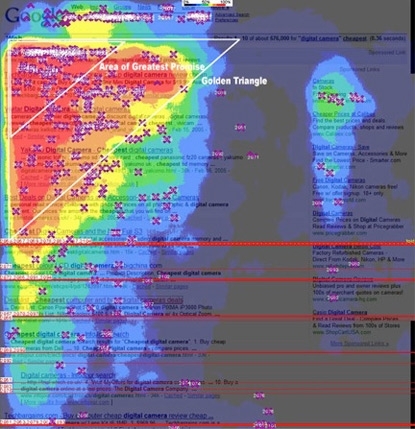
In conducting online searches, where we land on information is known variously as the “area of greatest promise,” the “golden triangle,” or the “F-scan diagram.”
However you wish to name it, it generally looks like this on a Google search engine results page (SERP):
It’s easy to see how the “area of greatest promise” exists. We generally look for information by scanning down the beginning of the first listings on a page, and then continue viewing to the right if something seems to be a good match for our information needs, ultimately resulting in a clickthrough if our suspicions are correct.
Heat maps also show that quick judgments of information relevance on a SERP occur within this same “F-scan” zone; if we determine nothing is particularly relevant, we’re off to do a different keyword search.
This is why it’s so important for websites to appear within the top 5-7 organic listings on a SERP – or within the top 1-3 paid search results in the right-hand column of Google’s SERP.
In recent years, Google and other search engines have been offering enhancements to the traditional SERP, ranging from showing images across the top of the page to presenting geographic information, including maps.
To what degree is this changing the “conditioning” of people who are seeking out information today compared to before?
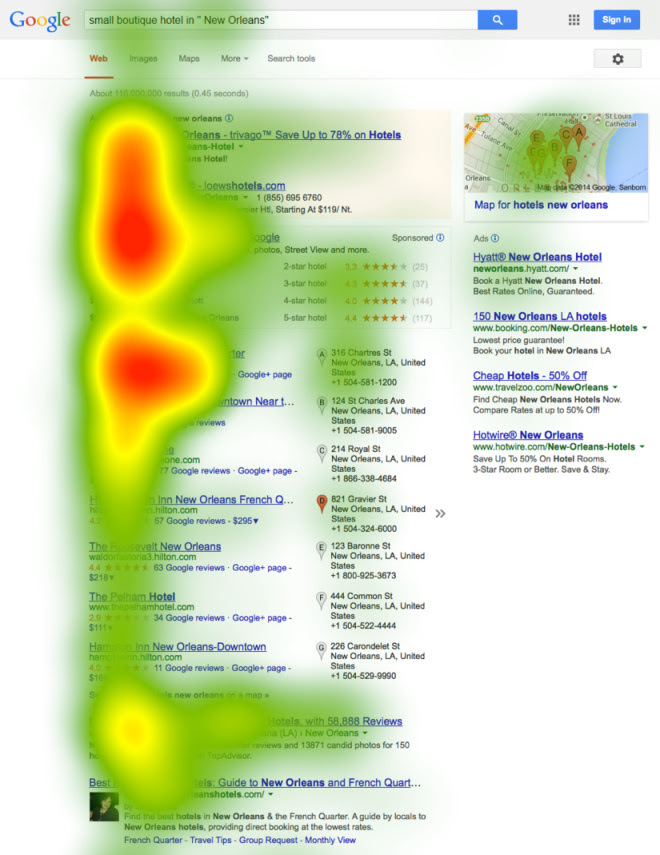
What new eye-tracking and heat maps are showing is that we’re evolving to looking at “chunks” of information first for clues as to the promising areas of results. But then within those areas, we revert to the same “F-scan” behaviors.
Here’s one example:
And there’s more: The same eye-tracking and heat map studies are showing that this two-step process is actually more time-efficient than before.
We’re covering more of the page (at least on the first scan), but are also able to zero in on the most promising information bits on the page. Once we find them, we’re quicker to click on the result, too.
So while Google and other search engines may be “conditioning” us to change time-honored information-viewing habits, it’s just as much that we’re “conditioning” Google to organize their SERPs in ways that are easiest and most beneficial to us in the way be seek out and find relevant information.
Bottom line, it’s continuity among the chaos. And it proves yet again that the same “prime positioning” on the page favored for decades by advertisers and users alike – above the fold and to the left – still holds true today.
I’ve been blogging about Google Glass forever, it seems — or at least as far back as 2009 when the early conception of the product, then known as “Google Goggles,” was in its preliminary stage of development.
The Google Glass product was “soft-launched” in 2012, but it’s only become available to the broader consumer marketplace since the spring of this year — at about $1,500 a pair.
So … how has Google Glass done so far?
“Underwhelming” might be one way of putting it.
As it turns out, there are a number of key factors that are hindering consumer acceptance of this new piece of electronic gadgetry. Consider these points:
Substandard quality of images and video compared to a ~$200 smartphone: oversaturated colors, lack of depth and dimension and all.
Battery life in normal use that is far less than promised: only about three hours instead of a full day.
Although somewhat streamlined compared to the beta versions of the product, it remains a somewhat “clunky” wearable device — or as Forbes magazine puts it, a “fashion failure.”
The general “creep-out factor” of constant surveillance remains a psychological barrier to many consumers.
Indeed, the jokes haven’t abated about the kind of people who make up the cadre of Google Glass “early adopters.”
“Glassholes” is one of the not-so-nice monikers they’re being called.
Going forward, Google Glass faces even more competition in the “wearables” category as computer power migrates into watches, jewelry and clothing in addition to eyeglasses. Even as these concepts become more mainstream, I suspect that Google Glass will continue to lag behind other products which seem to be harnessing the “high-tech-meets-high-fashion” concept more effectively.
Whereas Google has taken a “brute force” approach in the technological aspects of Google Glass (with design playing second fiddle), Apple has taken its technological innovation and packaged it in a way that resonates with the marketplace at a more visceral level.
If you glance quickly at someone wearing Apple’s watch, you’d be hard-pressed to think it’s anything much different from an analog version. If Google hopes to have the same kind of success that Apple is poised to have, it needs to start thinking along those lines, too.
But one wonders if Google is “hard-wired” that way …
In recent years, the focus on “content marketing” has become stronger than ever: the notion of attracting traffic via the inherent relevance of the content contained on a website rather than through other means.
It seems eminently logical. But content marketing is also relatively labor-intensive to build and to maintain. So there’s always been an effort to drive web traffic through “quicker and easier” methods as well.
But the newest findings on web traffic really do demonstrate how fundamental good content is to meeting the challenge of generating web traffic.
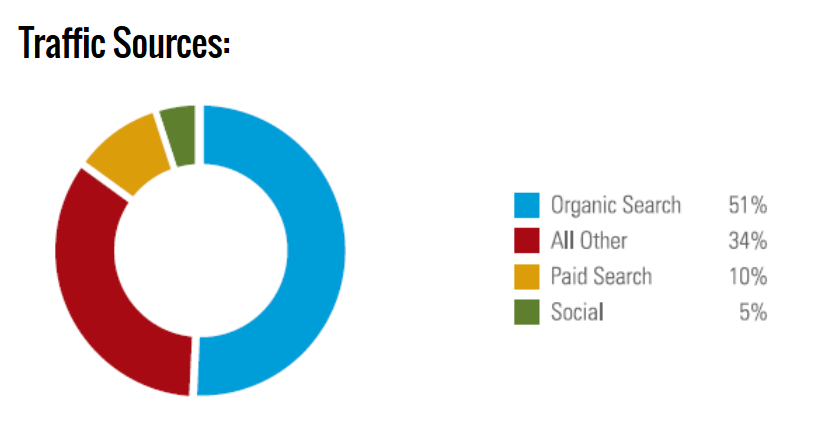
An analysis by web analytics and measurement firm BrightEdge reveals that organic search (SEO) drives over half of all traffic to websites (both business-to-business and business-to-consumer).
By contrast, paid search (SEM) accounts for only one-fifth of SEO’s result, and social is lower still:
Organic search: Generates ~51% of all web traffic
Paid search: ~10%
Social media: ~5%
All other methods (e.g., display advertising, e-mail and referred): ~34%
Source: BrightEdge, 2014.
In other words, all forms of advertising put together don’t drive as much traffic as organic search.
The BrightEdge statistics also remind us that social media, however popular it may be to millions of people, isn’t a highly effective traffic generator like search. Here are some of the key reasons why:
Social shares are fleeting and can get drowned out easily.
Most users don’t go on a social platform, only then to click on different links that take them away from social.
Not everyone uses social media, whereas everyone uses a search engine of some kind when they’re in “investigative” mode.
That’s the thing: People use SEO when they’re seeking answers and solutions — often in the form of a product or a service. Unlike in social or online display advertising, there’s no need to “disrupt” the user’s intended activity.
And if you’re in the B-to-B realm, organic search even more prevalent: Organic search drives ~73% of all web traffic there.
Even consumer categories like retail, entertainment and hospitality find that organic search is responsible for attracting 40% or more of all web traffic.
The takeaway for companies is that any marketing strategy that doesn’t adopt “content development” as a core tactic instead of an “ornamentation” is probably destined to fall well-short of its full potential.
Here’s an interesting finding about social media: The overwhelming majority of posts on the major social media sites engender no engagement.
As in “none at all.”
And this goes for posts uploaded by marketers and publishers as well as one from “ordinary” users.
This finding comes from SocialFlow, a social media software and content dissemination firm which analyzed ~1.6 million organic posts on Twitter, Facebook and Google+ that reached a total of ~361 million people.
What the SocialFlow research found was that ~95% of those posts results in no engagement at all.
By contrast, only ~1% of the posts produced really strong engagement — defined as 20,000 interactions or higher per post. Many of those posts are uploaded by big entertainment and media companies and dealt with — you guessed it — celebrity gossip and so forth.
Other findings from the SocialFlow research show that higher engagement rates tend to happen for “data-driven” posts — ones that are targeted to certain audience segments based on predictive algorithms pertaining to those segments’ behaviors.
Not surprisingly, posts that tend to attract higher engagement are more likely to be on “trending” topics. But high-engagement posts about breaking news or celebrity reporting deliver little benefit for marketer of brands beyond the ones involved in entertainment and media companies.
Technology, healthcare and not-for-profits, by contrast, aren’t very good fits for such news, even if the posts themselves attract more engagement and interaction.
The SocialFlow research underscores yet again that, despite the continuing evolution of “interactivity” in marketing, the 90-9-1 rule still generally applies.
That’s the notion that for every piece of content seen, 90 people “look and lurk” only … 9 people may choose to engage with the content … and only 1 person is responsible for creating the content to begin with.
They’re all important factors to keep in mind when considering social revolution and its implications.
With big changes happening every day in the way that consumers are interacting with brands and products, a big question is how quickly they’re changing their habits when it comes to the use of coupons.
Perhaps surprisingly, the results of a new 2014 Simmons National Consumer Study conducted by Experian show that “traditional” couponing activities remain far and away the most prevalent consumer activity.
First of all, the proportion of U.S. households that uses coupons of any sort is right around three-fourths (~74% according to the recent Simmons survey).
And we all know the single biggest reason why people use coupons: to save money. That rationale dwarfed any other among the survey respondents:
I use coupons to save money: ~64% of respondents mentioned
I use coupons to try new products: ~23%
Coupons incent me to try new stores: ~7%
But then the data points begin to deviate from where marketers may think their consumers’ minds are at (or where they might wish them to be).
Consider how many of the following popular couponing practices are distinctly “old school”:
I use coupons from in-store/on-shelf coupon machines: ~55% of respondents cited
I take advantage of rebates on products: ~50%
I use free-standing inserts from newspapers: ~46%
I use on-package coupons: ~37%
Compare that to the far-lower engagement levels with “new school” couponing practices:
I use coupons delivered by Internet or e-mail: ~30% of respondents cited
I use my smartphone to redeem coupons at the store: ~17%
I have used a smartphone coupon app in the last 30 days: ~9%
These results show that if companies decide to embrace coupons as part of their marketing effort, they’ll need to pay as much attention (if not more) to traditional couponing methods than to newer practices.

 Most of us have a few “pet peeves” when it comes to the advertising and promotional tactics we find obtrusive or just plain irritating.












 Nones Notes