Get Ready for Internet Sales Taxes

Are sales taxes finally coming to the Internet?

Taxes on the InternetAfter years of fruitless attempts, it would seem so.

On July 15th, five senators introduced legislation on a bipartisan basis to make taxation of purchases made over the Internet a reality.

The legislation is called the Marketplace and Internet Tax Freedom Act, and it combines the efforts of two initiatives that had been separate before:  The Marketplace Fairness Act and the Internet Tax Freedom Act.

On the one hand, the legislation would keep access to the Internet tax-free by limiting what state and local governments can do to impose Internet access fees – at least for the coming decade.

On the other hand, it gives states the unambiguous ability to enforce their sales tax laws on businesses selling to buyers located within their borders – including if those purchases are made online.

In other words, the 44 states that currently have sales tax laws on their books will be able to collect online sales taxes.

Not surprisingly, the National Retail Federation and other trade groups that represent brick-and-mortar retailing are lauding the actions of the five senators in introducing the legislation.

David French, the NRF’s senior vice president for government relations, noted that it’s high time “for Congress to eliminate the sales tax disparity, which disproportionally impacts community and independent retailers.”

Unlike in prior years when Senate and House lawmakers seemed incapable of coming together in support of sales tax legislation, this time appears different.

Why?

I think part of the reason is the sense that, at the end of the day, it just isn’t fair for offline retailers to shoulder the burden of collecting taxes – along with being at a competitive disadvantage – versus online retailers who benefit from being able to offer lower the same products at a lower overall cost, while also benefiting from lower overhead costs in most cases.

The fact that the current legislative bill is being introduced by senators from across the political spectrum as well as a diverse geography (the Northeast, South and Midwest) — tells me that the legislation will go through — and that the days of tax-free online shopping are numbered.

It will be interesting to see what the ramifications might be if and when the legislation passes.  Will 24/7 armchair convenience trump the sudden 5%-7% higher cost to online consumers?

Those consumers can be notoriously price-sensitive … but they’re also creatures of habit and great lovers of convenience.

My prediction is that the new regulations will turn out to have little or no impact on the broader retail buying behaviors.  If you concur — or if you have a different opinion — please share your thoughts with other readers here.

The hybrid car sizzle is fast becoming the hybrid car fizzle.

Well, that sure didn’t last long.

Hybrid autos:  Already riding off into the sunset?
Hybrid autos: Already riding off into the sunset?

News reports this week are stating that the market share of hybrid vehicles is now on the decline.

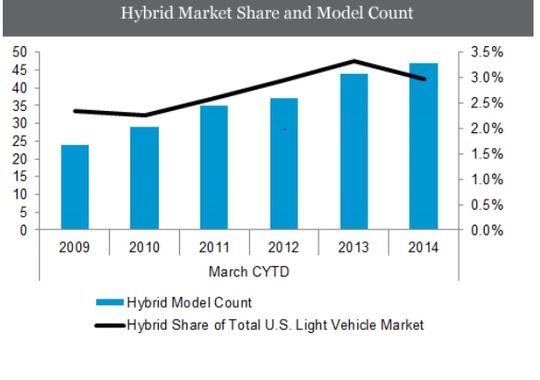
That is correct:  As of 1st Quarter 2014, hybrids only make up around 3% of the total car and light truck market in America.

Rather than an increase, that represents a pretty significant drop from nearly a 3.5% share of market just one year ago.

Here are the trend stats in graphic detail, courtesy of automotive statistics and intelligence firm IHS/Polk:

Hybrid Vehicle Stat ChartActually, the number of new hybrid car models being offered is still on the increase — now there are 47 different choices compared to around 25 in 2009, with Toyota’s five Prius models collected representing ~40% of the total hybrid market.  (The Prius share is down from ~55% in 2011, by the way.)

New model offerings or not … it’s pretty clear that the public’s interest in hybrid vehicles isn’t going up commensurately.  And the litany of reasons is all-too-familiar:

  • High car sticker price
  • Costly and complex batteries
  • Improved gas mileage and energy efficiency of conventional vehicles

Looking at the year-over-year trends, I think it’s doubtful that hybrid vehicles will ever achieve the high hopes the EPA and other federal officials have had for their adoption.

How embarrassing for them.

Instead, it seems more likely that the market will gravitate from the internal combustion engine straight to all-electric vehicles.  None of this “automotive hermaphrodite” stuff in between.

The more interesting question is this:  When will that shift occur?

To that one … not many people seem to have a definitive answer.

Memo to web users with “Do Not Track” enabled: You’re being tracked anyway.

do not trackFor anyone who thinks he or she is circumventing web tracking via enabling Do Not Track (DNT) functionality … think again.

A recently released study from researchers at KU Leuven-iMinds, a Dutch-based university think tank, shows that nearly 150 of the world’s leading websites have ditched tracking cookies in favor of “device fingerprinting” (or “browser fingerprinting” as it’s sometimes called).

What’s that?  It’s the practice of evaluating selected properties of desktop computers, tablets and smartphone to build a unique user identifier.  These properties include seemingly innocuous details found on each device, such as:

  • Versions of installed software and plugins
  • Screen size
  • A listing of installed fonts

An analysis by the Electronic Frontier Foundation (EFF) has shown that for the majority of browsers, the combination of these properties creates a unique ID – thereby allowing a user to be tracked without the perpetrator needing to rely on cookies — or having to deal with pesky legal restrictions pertaining to the restriction of cookies’ use.

Overwhelmingly, browser fingerprinting targets popular and commonly used JavaScript or Flash functions, so that nearly every person who accesses the web is a target – without their knowledge or consent.

According to the Leuven-iMinds analysis, the use of JavaScript-based fingerprinting allows websites to track non-Flash mobile phones and devices.  So it’s cold comfort thinking that the iPad platform will offer protection against this form of “non-cookie tracking.”

Is there anything good about device fingerprinting?  Perhaps … in that it can be used for some justifiable security-related activities such as protection against account hijacking, fraud detection, plus anti-bot and anti-scraping services.

But the accompanying bad news is this:  It can also be used for analytics and marketing purposes via the fingerprinting scripts hidden behind banner advertising.

How to fight back, if one is so-inclined?  The Leuven-iMinds researchers have developed a free tool that analyzes websites for suspicious scripts.  Known as FPDetective, it’s being made available to other researchers to conduct their own investigations.

So you’re able to identify the offenders.  But then what — short of never visiting their websites again?

Americans fall out of love … again.

The thrill has gone, to linger on would spoil it anyhow … for the party’s over now.

— Noël Coward

Presidential Approval

The chart above isn’t the descent of the Matterhorn … it’s the downward trajectory of Barack Obama’s approval ratings in the Gallup Poll since his reelection last year.

Descent of the Matterhorn (Edward Whymper)
No good end: Explorer Edward Whymper’s climbing team shortly after reaching the summit of the Matterhorn (1865).

So it is a descent of sorts.  And it’s beginning to look eerily similar to what befell George W. Bush and his poll numbers at roughly the same period in his presidency, as this comparative graph prepared by the Pew Research Center illustrates:

Presidential poll comparisonsOne can point to specific events during each administration that could be inflection points in the public’s changing perception of presidential performance:  The Iraq War surge … Hurricane Katrina … the Affordable Care Act rollout … the Benghazi Consulate attack … the NSA eavesdropping scandal and so forth.

But I wonder if it’s actually those elements … or is it more that we fickle Americans are prone to tire of our presidents after about the fifth year or so.

Hearing one speech or one press conference too many … or perhaps hearing a statement or two by the administration that doesn’t ring quite true.  It’s not a big step to go from those unpleasant interactions to simply tuning out.

Whatever it is, we’re probably in the midst of witnessing a break between the public and the Obama administration that’s here to stay for the remainder of the President’s term.

Of course, the chart above also reminds us that second term presidential popularity trends looked somewhat different if we dip back in history 15 years or further.

What are your thoughts on today’s developments?  Is this the “new normal” for Americans in our “instant gratification” age?  Or do you see the dynamics differently?  Feel free to share your comments with other readers here.

Is it time to change daylight savings time – and time zones – once and for all?

changing the timeEach time we Americans need to change our clocks, it’s accompanied by an undercurrent of grumbling about how disruptive it can be to our daily routines.

Indeed, in certain states that are in close physical proximity to time zone boundaries, the issue can be controversial enough to affect the popularity of elected officials, as has happened in Indiana and Arizona.

Daylight savings time, an innovation that became popular in the 1970s, continues to be a nettlesome issue because of when it is in effect in the United States – nearly a month earlier and a month later than before … and no longer in sync with other countries (if they even observe DST — and many of them don’t).

Daylight savings time is supposed to be more energy-efficient.  But it turns out the energy savings are minimal if any.  Uncoordinated time changes could very well undermine economic efficiency far more than any positive impact in energy savings.

A case in point:  Lack of synchronization with European time changes is estimated to cost the airline industry nearly $150 million in travel disruptions each year.

Moreover, some investigations have found that daylight savings time may actually cause worker productivity to be lower.

Does the current time zone structure have to be cast in stone?  Of course not.  The history of “time” is actually one of pretty constant change, dating all the way back to when time zones were first implemented in the 1880s.

Before then, each city and town had its own local time which was established by calculating the solar time in the local location using sundials.  Effectively, this meant that there were more than 300 different time zones in the U.S.A.

The American railroads were more streamlined:  They operated with only about 100 time zones.

Clearly, introducing four time zones for the continental U.S. was a way to introduce simplicity while compromising only a little regarding human biorhythms.

Of course, it took awhile for the time zone system to be adopted worldwide, but eventually it happened.

The economic and commercial landscape looks far different today than in the late 19th Century.  We are no longer bound by the physical limitations of geography in terms of how we do business.

As a result, some economists are suggesting that it’s time to overhaul the time zone structure and to move to a system that is even simpler and less disruptive to people’s lives.

One economist, Allison Schrager, has come up with the most radical solution I’ve seen yet.  Drawing from economic models plus her own experiences working across multiple time zones, Dr. Schrager has put forward the following recommendations:

  • Scrap daylight savings time altogether
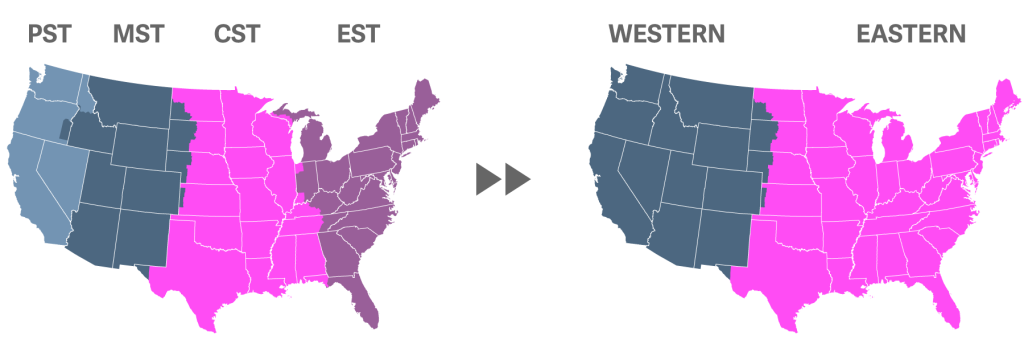
  • Consolidate and reduce the four current continental U.S. time zones (Eastern, Central, Mountain, Pacific) to just two (Eastern, Western)

Under the Schrager scenario, the new time zone map for the continental United States would look like this:

simplified time zone mapDr. Schrager points out that, while a fewer number of larger time zone geographies would seem to remove some people further from their “true” time zone, the realities of global commerce are already doing that anyway.

By contrast, she sees the benefits as more major.  For example, frequent travel between time zones under today’s four zones causes jet lag, robbing employees of productive work time.

With just a one-hour time difference between New York and California, bi-coastal travel would become almost effortless in that regard, Schrager maintains.

As for the disruption such a change might cause to international business coordination, Dr. Schrager contends that just as it took one or two countries to start things off in the 1880s, someone needs to step up to the plate today to start a new trend.

She says:  “… America won’t line up with the time zones of countries directly north and south unless this catches on as a global trend.  But the discontinuity ship already sailed when rich Western countries haphazardly adopted daylight savings time and most other countries didn’t.  Time is already arbitrary; why not make it work in our favor?”

Does Dr. Schrager raise some good points?  Would simplifying the time zone map and ditching daylight savings time be a “net positive” or not?

Some of her arguments seem to make sense to me.  What do you think?  Please share your thoughts with other readers if you’re so inclined.

The sober reflection on the healthcare.gov website is … really sobering.

superman brandBy now, nearly everyone has read or heard news reports about the “slow-motion train wreck” that is the newly minted Federal healthcare exchange.

It’s not only late-night comedians who are piling on.  It’s people like a senior technology officer at one of the major social media sites who texted, “It was a uniquely incompetent team that worked on their website.”

“Uniquely incompetent”:  Now there’s a sound-bite for you.

Those two words may do more to bury the notion that government-managed healthcare is a good thing than all of the political opposiion’s ideological arguments put together.

But as I often do with domestic policy challenges, I turn to my brother, Nelson Nones, who has lived and worked overseas for years – for an outsider’s perspective.

Here’s what Nelson wrote to me:

healthcare.gov landing pageFrom what I’m seeing, it’s going to be a long, long time before the Federal healthcare exchange website (healthcare.gov) works properly.

To see why, take a look at this article just published by Forbes magazine: http://www.forbes.com/sites/anthonykosner/2013/10/21/obamacares-website-is-crashing-because-backend-was-doomed-in-the-requirements-stage/.

If the article’s diagnosis is true, then the entire back-end may need to be re-architected.

That’s not something one can do quickly with a “tech surge” of “the best and brightest from both inside and outside government to scrub in with the team and help improve healthcare.gov,” as the Department of Health & Human Services put it on Sunday and President Obama reiterated on Monday.

According to the various news articles I’ve seen, the cost of designing and developing the website was initially estimated at $94 million and had risen to $292 million by last May. This seems like a lot of money, but you have to put things in perspective.

A personal observation:  I was recently involved in the testing of an enterprise resources planning (ERP) and manufacturing execution system implementation for a large multinational manufacturing company.  The total cost of this project was slightly north of $200 million.  This was the price-tag for an application used by about 6,000 people at a single manufacturing site (albeit a large one).

It, too, was plagued with problems when we went live, and it took almost a year to fix the problems – in fact these problems and their impact on supply chain performance warranted a note in the company’s annual report.  

Just like in what the Forbes article reported, the great majority of the problems traced back to the requirements stage – as I warned the senior management at this company (repeatedly) during the design phase.

For the healthcare.gov website, it seems to me that even $292 million is a low-ball figure considering the site has to support tens of millions of users (not 6,000) in a whole country (not just a single manufacturing site).  The Forbes article suggests that the $292 million was invested primarily on the front end, without attempting to consolidate the databases that sit on the back end.

This implies that the back-end design and development were woefully shortchanged — and as a result the front end doesn’t work.

Perhaps things would have gone better if $1 billion had been invested properly the first time around.

Unfortunately, from (painful) experience I can tell you that it’s almost impossible to invest wisely in architectural improvements while you’re in the middle of a crisis, so I’d bet the final price tag is likelier to hit $2 billion.

And … because that $2 billion won’t be invested wisely either, the problems will take longer to fix.

My prediction?  Two years.

In distilling all of this down to its essence, you can’t do much better than the famous words of Michael Dukakis, former governor of Massachusetts and one-time presidential candidate:

“It’s not about ideology.  It’s about competence.”

Here’s a Big Book on Big Data

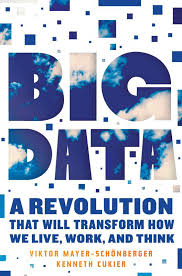
Big Data: A Revolution that will Transform how we Live, Work and Think by Mayer-Schonberger and Cukier“Big data” is definitely one of the more commonly heard business buzz terms these days.

But beyond the general impression that “big data” represents the ability to collect and analyze lots and lots of information in some efficient manner, most people have a difficult time explaining with any specificity what the term really means.

Moreover, for some people “big data” isn’t very far removed from “big brother” – and for that reason, there’s some real ambivalence about the concept.  Consider these recent “man on the street” comments about big data found online:

  • “Big data:  Now they can crawl all the way up your *ss.”
  • “The scary thing about big data is knowing [that] Big Brother can know every single thing you do – and realizing your life is too unimportant for Big Brother to even bother.”
  • “Big data is what you get after you take a big laxative.”

But now we have a recently-published book that attempts to demystify the concept.  It’s titled Big Data:  A Revolution that will Transform How We Live, Work and Think, and it’s authored by two leading business specialists – Viktor Mayer-Schönberger, a professor of internet governance and regulation at Oxford University and Kenneth Cukier, a data editor at The Economist magazine.

The book explores the potential for creating, mining and analyzing massive information sets while also pointing out the potential pitfalls and dangers, which the authors characterize as the “dark side of big data.”

The book also exposes the limitations of “sampling” as we’ve come understand it and work with it over the past decades.

Authors Viktor Mayer-Schonberger (l) and Kenneth Cukier (r).

Cukier and Mayer note that sampling works is fine for basic questions, but is far less reliable or useful for more “granular” evaluation of behavioral intent.  That’s where “big data” comes into play big-time.

The authors are quick to note that advancements in data collection tend to come along, shake things up, and then quickly become routine.

Mayer calls this “datafication,” and describes how it works in practice:

“At first, we think it is impossible to render something in data form.  Then somebody comes up with a nifty and cost-efficient idea to do so, and we are amazed by the applications that this will enable – and then we come to accept it as the ‘new normal.’  A few years ago, this happened with geo-location, and before it was with web browsing data gleaned through ‘cookies.’  It is a sign of the continuing progress of datafication.”

Causality is another aspect that may be changing how we go about treating the data we collect.

According to Cukier and Mayer, making the most of big data means “shedding some of the obsession for causality in exchange for simple correlations: not knowing why but only what.”

So then, we may have less instances when we come up with a hypothesis and then test it … but rather just use the data to determine what is important and act on whatever information is revealed in the process.

Retail DisplayOne example of this practice that’s cited in the book is how Wal-Mart determined that Kellogg’s® Pop-Tarts® should be positioned at the front of the store in selected regions of the country during hurricane season to stimulate product sales.

It wasn’t something anyone had thought about in advance and then decided to verify; it was something the retailer discovered by mining product purchase data and simply “connecting the dots.”

Author Mayer explains further:

“There is a value in having conveniently placed Pop-Tarts, and it isn’t just that Wal-Mart is making more money.  It is also that shoppers find faster what they are likely looking for.  Sometimes ‘big data’ gets badly mischaracterized as just a tool to create more targeted advertising … but UPS uses ‘big data’ to save millions of gallons of fuel – and thus improve both its bottom line and the environment.”

One area of concern covered by the authors is the potential for using “big data predictions” to single out people based on their propensity to commit certain behaviors, rather than after-the-fact.  In other words, to treat all sorts of conditions or possibilities in the same manner we treat sex offender lists today.

Author Kenneth Cukier believes that the implications of a practice like this – focusing on the use of data as much as the collection of the data – is “sadly missing from the debate.”

This book fills a yawning gap in the business literature.  And for that, we should give Dr. Mayer-Schönberger and Mr. Cukier fair dues.  If any readers have become acquainted with the book and would care to weigh in with observations, please share your thoughts here.

Chalk one up for the taxpayers: Government travel-related spending declines significantly.

dollarcutsCan it be possible that widespread public revulsion at the level of federal government conference and travel expenditures has actually had a positive impact?

It seems so, if new financial reporting is to be believed.

According to recent reports filed by the General Services Administration, federal travel card spending has declined ~17% so far in FY 2013 compared with the same period last year. 

That’s for the GSA’s SmartPay charge card program which covers more than 2.5 million cardholders.  And it’s the second year in a row that we’ve seen a drop in expenditures:

  • FY 2011:  $9.6 billion
  • FY 2012:  $8.9 billion
  • FY 2013 (YTD):  $6.0 billionGSA conference follies

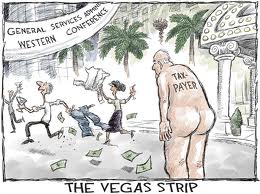
According to GSA officials, the decline in travel-related spending has happened because of “aggressive steps” taken to cut conference spending in the wake of embarrassing revelations that a single GSA conference in Las Vegas in 2010 had cost American taxpayers nearly $825,000. 

The fact that this meeting included paying clowns and mindreaders to lead group discussions added an absurd twist on the entire affair.

clownIn May 2012, the Office of Management and Budget issued a memo directing federal agencies to reduce their travel-related spending by 30% compared to 2010 levels – and to maintain those levels through FY 2016.

Another directive required agencies to report spending on any conference that exceeds $100,000.

Looking out over the government agency landscape, it appears that most agencies have made some pretty big strides towards meeting the new standards. 

Comparative travel expense figures released by the GSA for FY 2013 through July against FY 2012 over the same period show these declines:

  • General Services Administration:  -62%
  • Veterans Administration:  -31%
  • Treasury:  -30%
  • Energy:  -25%
  • Commerce:  -23%
  • Labor:  -23%
  • Environmental Protection Administration:  -21%
  • Housing & Urban Development:  -21%
  • Defense:  -19%
  • Justice:  -19%
  • Transportation:  -18%
  • State:  -16%
  • Interior:  -12%

A few agencies did show increased travel expenditures.  Most significantly, the Small Business Administration doubled its expenses due to Hurricane Sandy and other natural disasters that required additional travel associated with putting manpower on location to provide financial assistance to homeowners, renters and businesses.

But taken as a whole, these expenditure drops are unprecedented. 

I wonder how many people would have predicted it – even though most people I know figure that there’s plenty of “fat” to cut within these agencies without hurting the programs.

It’s just that … we so rarely hear of reports like this in government.

And of course, there’s plenty of grousing to go around about the new realities.  One Department of Defense official who requested anonymity was quoted as saying, “When someone craps their pants, we all have to wear diapers.  This is hardly the way to run the DOD efficiently.”

And then there’s this:  Lest you think that we’ve put a lid on excess travel-related expenditures for good, the GSA has just announced that it will be unfreezing per diem rates for FY 2014.

That is correct:  The GSA is now increasing the lodging, meal and incidental allowances that federal employees are reimbursed for expenses incurred while on official travel.  It’s going up to $129 in most markets within the 48 contiguous states.

Maybe they think people won’t notice …