The “Snowden Effect”: The U.S. cloud computing industry is getting hammered.

cloud computing securityI’ve blogged before about the fallout from the Edward Snowden affair and its effects on the U.S. cloud computing industry.

In fact, back in the summer of 2013 I read an interesting thought piece published by my brother, Nelson Nones, Chairman of Geoprise Technologies.  His experiences as an IT specialist who has lived and worked outside the United States for two decades has made him particularly sensitive to what the international implications of the Snowden revelations may be.

In his 2013 analysis, he claimed that the NSA spying revelations would likely have serious consequences for the cloud computing industry.  As he wrote at the time:

“… these threats will be perceived to be so serious that many businesses could decide to abandon the use of cloud computing services going forward — or refuse to consider cloud computing at all — because they bear full responsibility for compliance yet now realize that they have little or no ability to control the attendant non-compliance risks when utilizing major cloud services providers.  

Out front: Geoprise Technologies' Nelson Nones was among the first to warn about the negative consequences of NSA surveillance programs on the U.S. cloud computing industry.
Out front: Geoprise Technologies’ Nelson Nones was among the first to warn about the negative consequences of NSA surveillance programs on the U.S. cloud computing industry.


In view of recent revelations, the tantalizing cost savings and efficiencies from cloud computing may be overwhelmed by the financial, business continuity and reputational risks.”

And his prediction as to what would likely happen as a result if these concerns played out in the market was even more chilling:

“Revenues and profits of U.S.-based service providers will suffer to the extent that businesses of every nationality abandon the public cloud computing services they are now using, or refuse to consider public cloud computing services offered by U.S.-based providers, in response to the heightened customer risks that have now been revealed.”

itif_logoShortly thereafter, I began to notice similar writings back here in the United States – in particular those by members of the Information Technology & Innovation Foundation (ITIF), a DC-based think tank focusing on technology policies.  It projected that the U.S. cloud computing industry would forfeit somewhere between $22 billion and $35 billion in lost business as a result of the NSA-related revelations.

For anyone keeping score, that’s between 10% and 20% of the worldwide cloud computing market.

New-America-Foundation-logoAnd now, one year later, the full scope of the impact is being realized.   New America Foundation, a not-for-profit, non-partisan organization focusing on public policy issues, released a report this past week which outlines the impact of Snowden’s NSA revelations.

Here are just two examples of the findings it published:

  • Within days of the first NSA revelations, cloud computing services such as Dropbox and Amazon Web Services reported measurable sales declines.
  • Qualcomm, IBM, Microsoft, HP, Cisco and others have reported sales declines in China – as much as a 10% drop in overall revenue.

Not only that, foreign governments are giving U.S. tech firms wide berth when it comes to contracting for a range of products and services that go well-beyond cloud computing.

Among the casualties:  The German government ended its contract with Verizon as of June … while the Brazilian government selected Swedish-based Saab over Boeing in a contract to replace fighter jets.

In the current environment of security jitters, it’s much easier for foreign competitors to portray themselves as “NSA-proof” — and the “safer choice” for protecting sensitive information.

Hans-Peter Friedrich

And unambiguous comments like this one made by Germany’s Interior Minister Hans-Peter Friedrich just add fuel to the fire:

“Whoever fears their communication is being monitored in any way should use services that don’t go through American servers.”

Even more ominous, a number of countries are debating – and indeed close to enacting – new legislation that would require companies doing business within their local to use local data centers.

Sure, some of the countries – Vietnam, Brunei, Greece – aren’t overly significant players in the grand scheme of things.  But others certainly are; Brazil and India aren’t inconsequential markets by any measure.

In all, the New America Foundation report forecasts that the fallout from the NSA’s PRISM program will cost cloud-computing companies multiple billions in lost revenues – from $20 billion on the low end to nearly $200 billion on the high end.

This, plus the collateral damage of lost contracts involving ancillary and even unrelated tech services and manufactured products, may result in a contraction of the U.S. tech industry’s growth by as much as 4% — not to mention seriously undermining the United States’ credibility around the world.

Isn’t that just what America needs to have right now:  international credibility problems not only in the political sphere, but also in the economic one.

Unfortunately, what I wrote in my blog post a year ago still stands true today:  “OK, U.S. government and administration officials:  Have fun unscrambling this egg!”

Get Ready for Internet Sales Taxes

Are sales taxes finally coming to the Internet?

Taxes on the InternetAfter years of fruitless attempts, it would seem so.

On July 15th, five senators introduced legislation on a bipartisan basis to make taxation of purchases made over the Internet a reality.

The legislation is called the Marketplace and Internet Tax Freedom Act, and it combines the efforts of two initiatives that had been separate before:  The Marketplace Fairness Act and the Internet Tax Freedom Act.

On the one hand, the legislation would keep access to the Internet tax-free by limiting what state and local governments can do to impose Internet access fees – at least for the coming decade.

On the other hand, it gives states the unambiguous ability to enforce their sales tax laws on businesses selling to buyers located within their borders – including if those purchases are made online.

In other words, the 44 states that currently have sales tax laws on their books will be able to collect online sales taxes.

Not surprisingly, the National Retail Federation and other trade groups that represent brick-and-mortar retailing are lauding the actions of the five senators in introducing the legislation.

David French, the NRF’s senior vice president for government relations, noted that it’s high time “for Congress to eliminate the sales tax disparity, which disproportionally impacts community and independent retailers.”

Unlike in prior years when Senate and House lawmakers seemed incapable of coming together in support of sales tax legislation, this time appears different.

Why?

I think part of the reason is the sense that, at the end of the day, it just isn’t fair for offline retailers to shoulder the burden of collecting taxes – along with being at a competitive disadvantage – versus online retailers who benefit from being able to offer lower the same products at a lower overall cost, while also benefiting from lower overhead costs in most cases.

The fact that the current legislative bill is being introduced by senators from across the political spectrum as well as a diverse geography (the Northeast, South and Midwest) — tells me that the legislation will go through — and that the days of tax-free online shopping are numbered.

It will be interesting to see what the ramifications might be if and when the legislation passes.  Will 24/7 armchair convenience trump the sudden 5%-7% higher cost to online consumers?

Those consumers can be notoriously price-sensitive … but they’re also creatures of habit and great lovers of convenience.

My prediction is that the new regulations will turn out to have little or no impact on the broader retail buying behaviors.  If you concur — or if you have a different opinion — please share your thoughts with other readers here.

Are Company Growth Strategies Behind the Curve?

Business StrategyMost businesspeople recognize the value of planning and implementing long-term growth strategies.

So it may be a surprise to learn that only a minority of companies are actually doing anything extensive along those lines.

That’s what the results from a January 2014 survey of ~825 senior executives seem to be saying.  The research was carried out by business strategy consulting firm Innosight, and included respondents active in 20 industry segments ranging from manufacturing and consumer goods to financial, healthcare and telecommunications firms.

There is near-unanimous agreement among the execs in the survey that their organizations need to be continually chang their core offerings, or their business models, in response to rapidly changing market dynamics.

As to whether those changes are actually happening — well, that’s another matter.

In fact, only ~42% of the respondents expressed confidence that their companies are setting the table for any sort of “transformation” at all within a 5- or 10-year horizon.

And here’s an interesting twist the research revealed.  One would typically think that the smaller the company, the less confident those execs would be about sufficient planning for future growth.

But the Innosight survey found exactly the opposite finding.  The confidence level is actually lower among those respondents who work at the largest companies in the research sample:  Only about one-third of respondents with $1-billion revenue companies expressed confidence.

The problem is that many companies are changing at a slower pace than the markets in which they operate.

Or at least that’s the perception.  About 40% of the survey respondents feel that their organizations are changing at a rate that’s slower than the market’s evolution.  (It’s the case with roughly half of the large company respondents.)

Tied to this concern is another finding that the Innosight research uncovered:  Only about one in ten of the respondents reported that their companies have formal growth strategies covering at least a 5-year horizon.

The rest have either no formal growth strategy at all, or one that’s extremely short-term and mainly tactical in character.

The reason for this lack of growth planning is the sense that markets are way too unpredictable in today’s business environment.  Long-term strategizing in such an environment seems more like a theoretical exercise and less of a practical use of time to many of the execs in the survey.

On top of that, pressing issues that crop up on a daily basis are prone to suck most of the planning oxygen out of the room.

Scott D. Anthony Innosight
Scott D. Anthony

As part of its report, Innosight managing partner Scott D. Anthony pointed out that despite its shortcomings, transformational innovation has an important role to play, even though it takes time to pay off — sometimes as long as five or ten years.

“Companies that invest in planning methods that help align senior leaders on long-term growth strategies are probably at a real advantage to develop new business models and open new growth markets,” Anthony contends.

And this:

“If you have a long-term strategy, you don’t have many competitors — a good thing — because most companies want a return on investment within three years.  In other words, a switch in timeline can e a real competitive advantage.”

By contrast, companies that are always working in the “here and now,” are usually facing multiple market players and a much more competitive environment.

You can review further survey findings in an executive summary of the Innosight report here.

Frequent flyer programs: No longer going the distance.

What took so long?

frequent flyer programsDelta and United Airlines have announced what they hope will be an industry-pacesetting change in the way frequent flyer programs are administered by the world’s biggest airlines.

The two air passenger carriers are shifting away from awarding points based on flight distance, and instead will award points based on the actual airfare paid by the traveler.

The change in procedures will become effective in 2015 (in January for Delta and in March for United).

In retrospect, one wonders why it took so long for the big airlines to make this move.

After all, the very nature of loyalty programs is to reward a company’s best and most profitable customers.

Business travelers who book a flight a few days ahead – not to mention people who prefer to travel first class – are far more valuable to an airline than someone who books the “Cheapy Charlie” web-only fare months in advance.

Besides, prominent low-cost air carriers like JetBlue, Southwest and Virgin have been using revenue-based methods of calculating their frequent-flier points for a good while now.

As for which types of travelers will come out winners vs. losers in the frequent flyer program changes, it’s exactly who you’d expect:

  • Big Winners:  Business passengers traveling internationally and on refundable-fare domestic flights + first-class passengers.
  • Big Losers:  Leisure fliers in coach class + business flyers who travel on cheap fares.
  • In-Betweeners:  Business passengers who travel using a mix of business and economy fares.

The recent announcements by Delta and United leave only American Airlines as the last big U.S.-based global carrier that still maintains the traditional distance-based calculation for earning miles.

I wonder how much longer they’ll hold out?

Only a matter of months, I’m guessing.

What are your opinions about the changing policies?  Are there particular frequent flyer programs you love?  … Or love to hate?  Feel free to share your thoughts with other readers.

The hybrid car sizzle is fast becoming the hybrid car fizzle.

Well, that sure didn’t last long.

Hybrid autos:  Already riding off into the sunset?
Hybrid autos: Already riding off into the sunset?

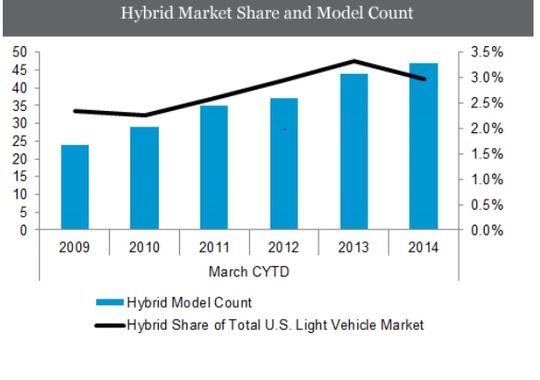
News reports this week are stating that the market share of hybrid vehicles is now on the decline.

That is correct:  As of 1st Quarter 2014, hybrids only make up around 3% of the total car and light truck market in America.

Rather than an increase, that represents a pretty significant drop from nearly a 3.5% share of market just one year ago.

Here are the trend stats in graphic detail, courtesy of automotive statistics and intelligence firm IHS/Polk:

Hybrid Vehicle Stat ChartActually, the number of new hybrid car models being offered is still on the increase — now there are 47 different choices compared to around 25 in 2009, with Toyota’s five Prius models collected representing ~40% of the total hybrid market.  (The Prius share is down from ~55% in 2011, by the way.)

New model offerings or not … it’s pretty clear that the public’s interest in hybrid vehicles isn’t going up commensurately.  And the litany of reasons is all-too-familiar:

  • High car sticker price
  • Costly and complex batteries
  • Improved gas mileage and energy efficiency of conventional vehicles

Looking at the year-over-year trends, I think it’s doubtful that hybrid vehicles will ever achieve the high hopes the EPA and other federal officials have had for their adoption.

How embarrassing for them.

Instead, it seems more likely that the market will gravitate from the internal combustion engine straight to all-electric vehicles.  None of this “automotive hermaphrodite” stuff in between.

The more interesting question is this:  When will that shift occur?

To that one … not many people seem to have a definitive answer.

Patent Trolls: Is a Day of Reckoning Finally at Hand?

When the banks get involved … watch out.

patent holding companiesIn recent weeks, I’ve begun reading more news items about legislation being passed to limit the damage so-called “patent trolls” can do to unsuspecting businesses.

These are the bottom-feeding firms which exist only to collect royalty payments and fines from companies due to supposed infringement on patents the firms have purchased.

Many of the victims of these schemes are smaller businesses with fewer than $10 million in annual revenues.

The reasons they’re targeted are pretty obvious:  smaller companies are less able to defend themselves against such charges, and it’s often easier and less expensive to settle out of court — and avoid all the hassles that accompany litigation as well.

But the cumulative impact is pretty enormous.  Patent risk specialist RPX Corporation estimates that it’s nearly $13 billion in legal fees, settlements or judgments.

The University of California’s Hastings College of the Law has also been studying the numbers.  It finds that patent infringement claims against the portfolio companies of venture-capital firms cost an average of $100,000 each to settle.

Predictably, only a smidgeon of the monies collected by these patent-holding companies actually makes it back to the inventors.  The rest goes right in the deep pockets of the people trolling the business world for easy money.

And then …

come down hardThen some patent trolls made the mistake of sending demand notifications to banking firms, related to things like the software used in ATMs.

Oops.  Bad move.

Once the banking institutions got sensitized to the issue,  a lot of legislators did, too.  Funny how that works.

The results are now beginning to show.  In recent months, more states have enacted legislation curbing the ability of patent trolls to make “bad faith” assertions of patent claims.

What is a questionable patent claim?  It’s a claim that isn’t based on any clear evidence of infringement — but instead on vague accusations.

(In other words, these questionable claims represent the vast majority of the notifications delivered to the unsuspecting victims.)

States jumping on the “put the trolls on trial” bandwagon range from New York, Vermont to Oklahoma and Minnesota.  Twelve so far, and the tally will surely increase in the coming months.

One of the interesting twists is the fact that most of new legislation also allows targeted companies to strike back in state courts with their own litigation … against the patent-holding companies themselves.

I guess turnabout is fair play.

Another twist …

Here’s an interesting case where financial institutions – an industry not particularly loved in many quarters – is helping to rout a particularly pernicious and avaricious bunch of businesspeople.

This sort of activity, based not only on any sense of commercial fair play but instead on playing mercantile “gotcha” games, is reprehensible and gives “the business of business” a bad name.

Too, it has to have had a chilling effect on the activities of smaller businesses in particular – especially those who rely on established technologies to create and commercialize new products.

Constantly looking over one’s shoulder to make sure no one is coming after you for something as innocuous as using an e-mail tool on a FAX machine is hardly the kind of environment that fosters innovation.

So let the cheering begin … and no stopping until these trolls are banished back under the bridge.

Ipsos Reid Poll: Female Execs Gauge Their Advances

women managers and executivesAn interesting Ipsos Reid poll of female executives conducted late last year sheds light on what the perceived career holdbacks are for women in the workforce these days.

The results of the online survey, which queried ~500 American women working in managerial or executive roles, suggest that women continue to face obstacles in advancing their careers to upper-level management and executive positions … although the disparities are less today – and hopefully continuing the trend toward parity.

An example of one perception which continues to show a big divide between women and men is this:  While ~37% the survey respondents feel that physical appearance and personal image are factors in career progression for men, nearly all (~90%) believe that they are for women.

On the other hand, the perceived differences are less stark when it comes to opportunities for career progression based on the gender of a female employee’s immediate superior.  When asked how gender affects the chances for women to obtain a managerial position, here’s how the respondents answered:

If the superior is a woman …

  • 26% better chance for advancement
  • 30% worse chance for advancement
  • 44% no difference

If the superior is a man …

  • 26% better chance for advancement
  • 25% worse chance for advancement
  • 49% no difference

… Which translates into trust levels that aren’t so very different at all:

  • ~22% would trust a man more for help with career advancement
  • ~18% would trust a woman more for help with career advancement
  • ~60% express no difference in trust levels

Positive Work Attributes

The Ipsos/Reid survey also found that nearly two-thirds of the respondents consider women to be better leaders than men, primarily for these five reasons:

  • Women are better communicators
  • They are more organized
  • They are more empathetic
  • They have a better understanding of the needs of their employees
  • They are more open to changing their approach

For the record, two attributes that respondents do not attribute to women over men are:

  • Women have better instincts than men
  • They are more invested in an organization’s success compared to men.

With a confident self-image and backed by positive work habits, what do these respondents see as the biggest continuing challenges to their career growth?  Here’s what the Ipsos Reid survey found:

  • The requirement for women to work harder and put in longer hours to prove themselves: ~77%
  • Managing work and family balance: ~61%
  • External factors (economic climate/job loss): ~56%
  • Being welcomed into an established senior management team:  ~48%
  • Dealing with outdated perceptions of women in managerial and executive roles: ~48%
  • Lack of female mentors: ~47%

Moreover, ~78% of respondents discern a “noticeable” different in salaries between men and women.

Asked what a company might “fear” about promoting women to senior managerial and executive posts, the respondents cited several probable factors:  the fear that an executive might want to start and maintain a family … and the fear of too many absences from work due to family obligations.

Bottom line, the Ipsos Reid survey reveals some continuing obstacles for women in the executive-level work force.  But there’s positive news, too.  Additional survey findings can be found here.

If you have additional observations or perspectives on this topic, please share them with other readers here.

Gallup: A prestigious college isn’t a clear ticket to career happiness or personal fulfillment.

collegesThe latest shoe to drop in the growing notion that a college education may not be all it’s cracked up to be comes in the form of a Gallup survey released this month that reveals that attending a prestigious institution of higher learning won’t make a person any happier in life or work when compared to graduating from a less selective one.

The Gallup survey of nearly 30,000 college graduates in all age groups, which was conducted in concert with researchers from Purdue University, asked respondents how they were doing in life across a range of factors such as income and “engagement” in their jobs.

Interestingly, the Gallup research was advocated by former Indiana Governor Mitch Daniels, now the president of Purdue University, who reported to The Wall Street Journal that he had encountered a lack of benchmarked data to measure the value of a college degree.

“There is a lot we don’t know about higher education, and there is a sense it’s skating on its reputation,” Mr. Daniels remarked.  “We needed to know with more rigor how well the experience is serving people.”

The resulting survey conducted by the Gallup organization found that fewer than 40% of the college graduates surveyed feel “engaged at work” — in that they enjoy what they do on a daily basis and are intellectually and emotionally connected to their work.

An even lower percentage – just 11% – thought of themselves as “thriving” in all of the major aspects of their lives such as financial stability, having a strong social network, and feeling a sense of purpose.

And how do graduates of the most “selective” institutions fare against others?  According to Gallup, there’s no discernable difference at all.

That is correct:  The survey found that graduating from a Top 100 school has no bearing on the level of future happiness or fulfillment in work or in life.

college debtWhat does have a big impact — in a negative way — is college debt.  Only about 2% of respondents who reported between $20,000 and $40,000 in student loan debt reported that they are “thriving.”

On the positive side of the ledger, what does seem to correlate with greater happiness and fulfillment is having had the experience of a professor take an interest in the student.  These teachers served as a mentor or helped make the learning experience exciting for the student.

The Gallup survey found that those kinds of experiences tend to translate into more optimism, curiosity and engagement in later life and careers — leading to greater fulfillment.

I have immediate family members who have attended all types of higher educational institutions — from Ivy League schools and “New Ivies” to private colleges, public universities and even community colleges.  Time and again, I’ve seen this phenomenon play out just as the Gallup survey suggests.

The fact is … broadly speaking, American higher education is quite good.  One can receive a good education almost anywhere, provided a student studies hard and takes advantage of the opportunities that are available (internships, work-study programs, exchange programs and and so forth).

It wasn’t so true a generation ago.  Back then, the prestigious schools had clear advantages in terms of their top educational staffs, great libraries, and worldwide connections in the educational and business communities.

Today, thanks to the Internet, distance learning and more people with PhDs, even the less selective schools have quality staffing, access to unlimited “virtual” library resources, and similarly stronger connections worldwide.

There continues to be a difference between the prestigious schools and the rest of the pack, of course.  At a place like Amherst or Williams, essentially all of the students are smart as a whip and highly motivated, whereas that’s not going to be the case at a state university.

But at all of the schools, the best students are actually very similar across the board … and they have similar opportunities available to apply to their advantage.

On top of this, there are many fields of study where the “best” education you can get isn’t going to be at an Ivy League school.  Think about the ag degrees at Iowa State University (Ames) or the structural engineering coursework at the Missouri University of Science & Technology (Rolla) as just two examples.

Bottom line, here’s where things stand:  If students want to learn and are willing to study hard … they can get a good education at pretty much any school they choose to attend in America.  And it will lead to a fulfilling professional and personal life later.  “Prestige” has very little to do with it.

Gallup Confirms It: Kids are Costly

childAnyone who has children – present company included – knows intuitively that raising them isn’t an inexpensive proposition.

The education expenses alone are enough to make some people blanch white at the prospects of child-rearing.

And now we have even more proof of the high cost of having kids. The Gallup organization has just completed a telephone survey of a large sample of American adults age 18 and over – more than 172,000 of them, in fact.

When Gallup asked these respondents how much they spent on purchases “yesterday” (excluding normal household bills and major purchases), it discovered that those without kids under age 18 reported average daily spending of ~$80.

For those with children under the age of 18? They spent ~$110 on average.

So it’s a pretty significant difference of 35%+ more.

Gallup found similar dynamics at work even when comparing adults within the same income groups.

In every income segment, average daily spending levels were lower for adults with no children … spiked for those with kids under 18 … and then dropped back again when children are over the age of 18.

The reasons for the added spending aren’t difficult to figure out, of course. In addition to basic necessities like food and clothing, there are entire categories of spending that come into play for families raising children: extracurricular activities, athletics and sports, entertainment, toys and so forth.

Gallup also discovered similar “bell curve dynamics“ at work when comparing adults within the same age groups. Whether you’re younger or older, your daily spending rises when you have kids under age 18, then drops back down again.

The bottom line: Having kids is costly.  But they sure do make life interesting, don’t they?

For more Gallup survey results, click here.

To understand changes in U.S. demographics … check right at home first.

American HouseholdsJust because the housing bubble of the mid-2000s resulted in foreclosures, a down economy, and more young people moving back in with Mom and Dad … don’t believe that more fundamental demographic changes aren’t continuing to have a long-term effect as well.

This is underscored by newly published data on American households issued by the U.S. Bureau of Census, which breaks down statistics on the more than 121 million households in the United States.

As of 2012, the average size of the U.S. household stood at 2.55 people.  That’s a decline of about one person per household since 1950.

What’s contributed the most to the decline of this average has been the increase in single-person households.  According to the Census Bureau, those households now account for more than a quarter of all households in the country:

  • One-person households:  ~27% of total U.S. households
  • Two-person HHs:  ~34%
  • Three-person HHs:  ~16%
  • Four-person HHs:  ~13%
  • Five-person HHs:  ~6%
  • Six-person HHs:  ~2%
  • Seven or more persons per household:  ~1%

In fact, the number of single-person households has gone up five-fold since 1960.  A major part of the reason is the large percentage of older Americans (age 75+) who live alone – more than half.

That compares to only a quarter of households headed by people under the age of 30.

Other interesting factoids from the Census Bureau stats reflect some of the changing social mores in American society:

  • There are nearly 8 million unmarried couples living together – more than double the figure less than a decade ago.  (It was ~2.9 million in 1996).
  • Married households now make up fewer than half of all households.  (In 1970, that percentage was over 70%.)

But one demographic statistic does seem to reflect the consequences of the recent economic recession and the contraction in the American labor force:  As of 2012, only ~52% of married couples have both spouses in the labor force, which is down from ~56% reported in 2000.

United States Bureau of CensusThese new stats come from the U.S. Census Bureau’s latest Annual Social & Economic Supplement to the Current Population Survey, the data for which was collected  in March and April 2012 from a nationwide sample of approximately 100,000 addresses.

You can view additional findings here.