Marketing Fail? Too Many Mobile Apps are Deleted within Days of Downloading

Mobile appsHere’s an interesting statistic offered up by marketing consultant Rich MeyerThree-fourths of mobile apps are deleted within three weeks of being downloaded by their users.

How can the attrition rate be so high?

According to Meyer, it’s because people decide they don’t really have a need for the apps … or they find them too difficult to use and master.

I suspect the percentage may also be so high because marketers fail to query their target audiences prior to developing apps to determine now much of a need it will be satisfying.

… Or to put it another way, to avoid falling into the trap of developing a cure for something that isn’t a disease.

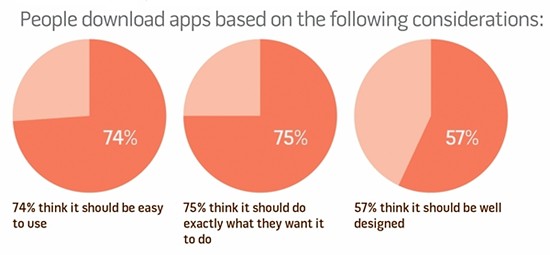
Mobile App Preferences
Sources: MarketingProfs; Harris Interactive and EffectiveUI field survey, 2010.

Meyer believes part of the dynamic at work is a knee-jerk “bias for action” as the marketing playing field shifts endlessly.

“It’s called ‘do it’ because everyone else is doing it, and it results in not only bad marketing, but in turned off consumers and customers,” he maintains.

Questions as simple as “What would you like to see in a mobile app?” … or testing an app concept with a sample of potential users before spending the effort and energy to produce it would be good places to start.

Marketers can use the research findings to adjust the proposed design of an app — or to trash it altogether and come up with an alternative one that actually meets a need.

If more companies did this, perhaps the 75% deletion rate for mobile apps would cease to be so flat-out dismal.

Twitter’s “Potemkin Village Problem” Isn’t Getting Any Better

“Millions of fake accounts dog Twitter.”

“Twitter dogged by bogus accounts.”

social-media-inflated-statsI’ve blogged before about the scads of Twitter accounts that are accounts in name only.

It’s been a problem for years.

But now, it takes on even greater significance as the market valuation of Twitter is being measured in the tens of billions as the company issues publicly traded stock in its IPO.

To this end, I found a recent Wall Street Journal article penned by technology reporter Jeff Elder particularly interesting in that it pulls together various pieces of evidence that have been building … and which together showcase the extent of Twitter’s “Potemkin Village” problem.  (Note the headlines from this article displayed above.)

Essentially, the problem is a plethora of “faux” Twitter accounts being created by an underground network of sellers – including 20 or so major operations scattered around the world – that then offer these accounts for sale to companies and brands wishing to “juice” their Twitter follower statistics to appear more consequential than they actually are.

Consider these points from Mr. Elder’s article:

  • Faux accounts abound on Twitter because users aren’t limited to having a single account – nor are they required to use their real names.
  • In securities filings, Twitter claims that “fake” accounts represent fewer than 5% of its active user accounts.
  • But this past summer, security researchers Andrea Stroppa and Carlo de Micheli reportedly uncovered more than 20 million fake accounts for sale on Twitter – which is closer to 10% of Twitter’s active account base.  (Twitter had no comment on this report.)
  • Stroppa and de Micheli also unearthed the existence of software programs that allow spammers to create unlimited fake accounts on Twitter.  (Twitter had no comment on this report.)

Evidently, Twitter has taken stabs at reducing fakery among its account base — however sporadically.

About a year ago, the company reportedly worked with a team of researchers from UC Berkeley and George Mason University to identify fake Twitter accounts and minimize “robot” activity.  This was done by actually purchasing fake Twitter accounts on the black market and then identifying their common characteristics.

A filter subsequently developed was then able to block ~95% of such accounts – but it was only a matter of days before the underground market figured out ways to get around the new filters.

Within two short weeks, the filters were successfully blocking only about 50% of new fake Twitter accounts, and that percentage has continued to decline further since then.

And these faux accounts are available for a ridiculously small amount of money.  For instance, this past November one marketer purchased 1,000 accounts from an online vendor located in Pakistan … for a whopping $58.

This marketer then programmed them to “follow” the Twitter account of a rap artist client who was interested in boosting his standing on the social network.

In addition, those same accounts have been used to retweet the rapper’s own tweets, thereby giving them greater exposure on Twitter.

And believe it or not, this sort of ruse often works, because prominence on Twitter can lead to legitimate attention by an unwitting press and other “influencers.”

But it’s all blue smoke and mirrors, of course.

The downside?  As more of these stories get reported and shine a light on the seedy underside of the Twittersphere, it can’t help but have a negative impact on the social platform’s reputation.

… Beginning with people like you and me.

When Google Glass clashes with reality … watch out for shards.

Google Glass Groupies on the prowl.

Like self-driving cars, Google Glass devices – those intriguing contraptions that allow users to be “online connected” at all times – appear to be one of those innovations that spark a thousand “what if?” scenarios.

And it’s not at all clear what all the implications of Google Glass may be.  But we’re beginning to get some clues as to what’s in store for users.

For starters, Google Glass owners have been sternly warned against using them in locker rooms, movie theaters, casinos … and even restaurants.

And earlier this month, attorney Paul Alan Levy of Public Citizen, a consumer advocacy group, claimed that Google Glass wearers in some states could potentially face prosecution for recording people without their explicit consent.

Public Citizen logoIn a recent online column, Mr. Levy wrote:

“Many states require the consent of all parties in a conversation – at least, conversations not occurring in public situations – and provide both criminal penalties and a civil cause of action for participants.”

While such laws are on the books in just 12 states at the moment, collectively those jurisdictions represent more than a third of the American population (including the all-important states of California, Florida, Pennsylvania and Illinois).

So far, there doesn’t appear to be any record of prosecutions pertaining to using a Google Glass device to record someone without his or her consent.  But since these devices are such a rarity yet, that seems hardly surprising.

Too, there’s the possibility that the courts will rule that people are giving the wearer of a Google Glass device implicit consent to record them.  However, there’s something to the notion that many people would be basically clueless about whether they’re being recorded because of their unfamiliarity with the device and the technology.

And as if that angle isn’t enough, now there’s a company (FacialNetwork) that has developed a real-time facial recognition app for Google Glass.   With this app, called NameTag, people can snap a photo and search for more information online about the image – all in one action.

With new technology like this, finding a mate (or just a good-time girl or guy) will never be the same again.

Nor will the inevitable charges of invasion of privacy or stalking that follow.

Of course, to hear how the folks at FacialNetwork characterize it, you’d never think there were any potential negative consequences.  Instead, it’s all sweetness and light.  As NameTag co-creator Kevin Tussy puts it:

“It’s not about invading anyone’s privacy; it’s about connecting people that want to be connected.  We will even allow users to have one profile that is seen during business hours, and another that is only seen in social situations.”

Whatever.

And now … let the legal wrangling begin.

JWT’s Annual Forecast of Key Trends for Upcoming Year: “All About Me”

JWT (J Walter Thompson)For the past decade or so, marketing communications firm JWT Worldwide (for the tradition-minded, the alternate name for J. Walter Thompson) has issued an annual forecast of key trends for the upcoming year.

For 2014, JWT has identified certain key trends it believes will “shape our world” in the upcoming year and beyond.  They’re pretty interesting – and it’s hard to argue with most of them.

Here are four trends that struck me as the most interesting and significant:

  • The Age of Impatience – With the mainstreaming of the on-demand economy and an “always-on” culture, consumers want what they want now – or yesterday preferably!
  • The End of Anonymity – The NSA surveillance revelations were the icing on the cake here:  Unless you’re a monk on Mount Athos, it’s no longer possible to remain unobserved or untracked by corporations and governments – and you might not even be able to fly below radar on Mt. Athos.
  • Rage Against the Machine – In the inevitable backlash against the “end of anonymity,” many consumers resent or fear technology, even as they embrace it.  But like that second dark chocolate truffle, it’s the classic conundrum of hating the very thing you can’t resist.
  • Remixing Tradition – Taking cherished traditions and recasting them in a new light – whatever “feels right” today.  The burgeoning support for gay marriage is just one manifestation of this trend.

In order to develop its annual key trends forecast, JWT engages in a combination of qualitative and quantitative research and analysis.  For this year’s report, that included an online survey of ~1,000 adults in the U.S. and U.K., along with input from ~70 JWT planners and researchers across numerous markets.

The JWT forecast includes a total of ten trends.  The 2014 JWT report outlines all ten of them.  Are there any you particular agree with — or disagree perhaps?

Customer testimonials and user reviews: Social media takes a time-honored marketing tactic … and puts it on steroids.

product and service ratingsThere’s no question that most people value hearing the opinions of others when deciding whether to purchase a new product.

But in the fast-evolving world of social media where there’s been an exponential increase in testimonials, ratings and recommendations about various products and services, what types of recommendations resonate most?

We may have some answers to that question in results from a recent survey sponsored by marketing firm Social Media Link, which was issued in October to all members within the company’s Smiley360 community brand activation program.

Dubbed the “Social Recommendation Index,” the 20-question online survey was answered by more than 10,300 respondents.

The survey isn’t exactly a true cross-section of American consumers in that the vast majority of the respondents were women.  Moreover, most respondents were between the ages of 25 and 45.  Still, the results are certainly worth a look.

For starters, three-fourths of the respondents stated that fewer than 10 reviews are all that they need to make a purchase decision.

Moreover, the most valuable reviews tend to be the ones that include personal stories, rather than a laundry list of product benefits.

By contrast, “star” ratings are the least influential type of review by far:  Only ~15% of respondents report that those ratings are the most important way to influencing their purchase decisions.

The degree of impact of a product review also depends on who’s doing the reviewing:

  • 86% cite reviews by friends and family members as having the  biggest impact
  • 39% are influenced by blogger reviews 
  • Only 11% report that celebrity reviews have the most impact

I’m not at all surprised about the paltry figure for celebrities.  Celebrity endorsements in general are far less influential than many marketers would like to admit – a topic I’ve blogged about in the past.

"It's OK.  Your cousin Merlin also likes the product!"
“It’s OK. Your cousin Merlin also likes the product!”

Considering that “friends and family” are the most influential reviewers, it also comes as little surprise that survey respondents view Facebook as the most trusted of all the major social platforms:

  • Facebook:  ~68% consider highly trustworthy
  • Pinterest:  ~56%
  • YouTube:  ~51%
  • Twitter:  ~41%

Commenting on the research conclusions, Social Media Link’s CEO Susan Frech stated this:  “The survey found that people don’t need hundreds of recommendations and reviews to entice purchase; it’s really about receiving a quality message from a trusted source.”

Click here to view an infographic summarizing the Social Recommendation Index key findings.

What about you?  Is your view different from what’s been reported in this study?  If so, please share your observations with other readers here.

What’s the Future of E-Mail Marketing?

e-mail communicationsOver the past several years, I’ve begun to hear increasing rumblings about how e-mail is a now-mature communications method that’ll eventually go the way of the FAX machine. 

But I’m not at all sure I believe that.  I think it’s more likely that e-mail’s future will look … a lot like it does today. 

No doubt, texting and direct messaging have cut into some of the bread-and-butter aspects of e-mail communications.  But what about e-mail marketing?  Could we see a similar phenomenon happening?

Recently, I read the comments of e-communications specialist Loren McDonald on this very topic.  McDonald, who is vice president of industry relations at digital marketing technology firm Silverpop, makes an important point concerning the “building blocks” that have to be in place before e-mail marketing will be seriously threatened by alternative MarComm means.

McDonald speaks about the challenge of an “addressable audience” when it comes to alternative channels:  “Regardless of a competing channel’s popularity, marketers must be able to deliver a comparable or replacement message to an individual.  This is where many channels fall short,” he contends.

Loren McDonald
Loren McDonald

McDonald notes that most marketers possess vastly more permission-based e-mail addresses than they do mobile phone numbers with permission to text.  It’s the same story when comparing e-mail addresses to the percentage of their database that have liked their company’s Facebook page.

And there’s more:  For mobile apps, what portion of the typical company’s database has downloaded it and authorized notifications?  The inevitable response:  How low can you go?

McDonald’s point is that for these alternative channels to gain true significance, they need to achieve a certain critical mass in terms of adoption rates – thereby allowing marketers to reach their customers and prospects in a comparable manner as they can via e-mail (as well as at a comparable cost).

Looking into his own crystal ball, McDonald feels fairly confident making three predictions concerning the future of e-mail marketing:

  • He predicts that content-focused newsletters will remain relevant and popular, particularly for B-to-B companies and publishers.  That’s because marketers can push multiple newsletter articles within a single marketing touch, while publishers can attract ads and sponsorships for their e-newsletters (i.e. they’re moneymakers for them).
  • For broadcast/promotional messages, most consumers will continue to prefer e-mail delivery.  “Will mobile app users [really] want their smartphones to ping them all day long whenever a message arrives — and then have to click attain to view it?”, he asks rhetorically.
  • Transactional and triggered messages will be e-mail’s primary challengers in McDonald’s view – especially for bulletin-type messages such as breaking news headlines, weather alerts, flight delay announcements, “flash” promotions and sales, and order confirmations linked to in-app landing pages.

And even on this third prediction, McDonald doesn’t see the transition happening all that quickly.

I find myself in general agreement with Loren McDonald’s prognostications.  Do you have some differing views?  If so, please share them with other readers here.

Marketing clichés are all around us.

no buzzwordsMarketing can be many things.  But marketing without originality isn’t much of anything.

That’s why there’s a desire among marketers to avoid clichés and buzz terminology in sales and marketing content whenever possible.

Still, it’s easy to fall into the cliché trap – and it happens to the best of us.

This is particularly true when the “next new thing” in business comes along every few months and people grasp for shorthand ways to communicate those concepts.

[There:  Perhaps “next new thing” qualifies as a marketing cliché itself!]

Brian Morrissey
Brian Morrissey

Recently, communications specialist and editor-in-chief of vertical media company Digiday, Brian Morrissey, came up with a list of 25 marketing clichés which he feels should be avoided if at all possible.

I’ve gone through Morrissey’s list and have selected ten that I think are particularly baneful – especially in the world of B-to-B marketing.  See if you agree:

Putting the customer at the center.  Isn’t it obvious that companies and brands would be committed to this?  And if not … where was the customer located before?

Having an “authentic” conversation with customers.  Inauthenticity isn’t cool.  Inauthenticity is also what we’ve been trying to avoid for years – or should have been.  There’s really no news in this statement, is there?

We fail fast.  Perhaps it comes from reading too many issues of Fast Company … but what companies do you know that want to slowly jettison a failed strategy?

Blue-sky thinking.  The “sky’s the limit” when it comes to “out-of-the-box thinking.”  Ugh.

Nab the low-hanging fruit.  This cliché has been around so long, there can’t be any low-hanging fruit left!

Dipping our toe in the water.  Trying to put a positive spin on a lack of depth or heft isn’t fooling anyone.

Open the kimono.  Any buzz phrase that conjures mental imageries of a flasher can’t be what we want to communicate.

Curated experiences.  A fancy way of admitting that content isn’t ours.  Besides, the term “curator” hardly sounds contemporary.  Instead, it connotes images of museums, galleries and other places that deal with the dusty past.

Surprising and delighting our customers.  Morrissey contends that this whopper makes brands come off like clowns … and that clowns are silly, scary or creepy – take your pick.

Tentpole idea.  Continuing with the clown analogy, no doubt … but whether it’s a circus or a tent revival, the mental imagery this elicits isn’t particularly apropos.

… And these are just ten terms on Morrissey’s list of 25 marketing clichés.

What about you?  Do you have any buzz phrases that you find particularly annoying – perhaps “thought leadership” or maybe “exceeding our customers’ expectations”?

Please share your nominations with other readers here.

What Will Retail Look Like in Five Years?

retailIt’s a question many people are asking:  To what extent is the digital revolution fundamentally changing shopping habits? 

A new report from Forrester Research titled “U.S. Cross-Channel Retail Forecast, 2012 to 2017” attempts to answer this question.

Its prediction:  just over 10% of total U.S. retail sales will be online purchase in five years’ time.

By comparison, in 2012, e-commerce accounted for about 5% of total U.S. retail spending, so Forrester is projecting a doubling of e-commerce volume.

Forrester also projects that by 2017, ~60% of retail sales in the United States will involve the Internet – either as a direct commercial transaction or as part of buyers’ pre-purchase research on laptops, tablets or smartphones.

The sectors most likely to be influenced by online research are grocery, apparel, home improvement and consumer electronics – no doubt abetted by the ability to access customer reviews and comparison prices during shopping excursions, Forrester reports.

These findings and more are included in Forrester’s report which can be found here (it’s a for-purchase study).

Samsung gets its marketing knuckles wrapped – twice.

Samsung logoTech manufacturing giant Samsung’s “questionable” marketing activities have been in the news this past week – again.

This time, it’s reported that the company has been fined a $340,000 penalty for paying people to post trash-talk comments about competitor HTC’s products in customer online forums in Taiwan.

Back in April, the Fair Trade Commission in Taiwan opened an investigation into allegations that Samsung had recruited certain employees along with freelance writers from the outside to flack the shortcomings of its competitors’ products.

In addition to the company being held culpable, two of Samsung’s outside marketing firms were fined for their part in the marketing shenanigans masquerading as natural content.

This is pretty big news in the world of smartphones.  HTC and Samsung are major competitors in this highly competitive marketplace, and both companies offer products that operate on the Android platform.

But Samsung’s fortunes have risen dramatically over the past year as its global smartphone market share jumped from ~19% to ~30%.

By contrast, HTC’s share declined from ~9% to slightly less than ~5% over the same period.

Evidently, Samsung couldn’t resist the temptation to kick a competitor when it was already on the ropes.

Chalk it up to the “take no prisoners” atmosphere in the cutthroat competitive world of mobile technology – the “New York Garment District mentality” writ large.

“Astro-turfing” isn’t new, of course.  But the practice is usually the province of smaller companies with fewer scruples … or marketing people who are simply unaware of proper marketing etiquette (and often backed by legal opinion).

Amateur hour
“Amateur hour” at Samsung’s marketing department makes the company look just … silly.

For a company as large and as sophisticated at Samsung, it does seem a little … odd.  And certainly not in good form.

But as it turns out, this isn’t the first time Samsung’s gotten caught with its marketing pants down.

Just a few months ago, the company was discovered bribing various people to “talk up” its development activities – and “talk down” their competitors – during the Samsung Smart App Challenge competition.

Android developer Delyan Kratunov went public with ongoing correspondence in which a viral marketing company working for Samsung offered him $500 to cite positive mentions on the Stack Overflow online community.

The instructions were specific:  Mr. Kratunov would need to ask a series of “casual and organic” questions about Samsung’s app challenge over a month-long period.

Later, the marketing company attempted to distance itself from the egregious behavior — but not before the incident had been exposed.

My response to Samsung is this:  You’re already winning.  There’s no need to engage in “adolescent business behavior” of this kind.

It’s in very bad form … and sooner or later it’ll come back to bite you.

Stuff like this always does eventually.

Getting Bunky with Retail Marketing

digital circularsAre the days of the lowly printed sales circular numbered?

Judging from the flurry of newfangled activity by key retail marketers, it would seem so.

This past week, CVS Pharmacy announced a complete makeover of its weekly circular.  The new digital version, dubbed myWeekly Ad, incorporates customized promotions focused on the products that are deemed of greatest interest to individual consumers.

The personalized sale items are determined from scanning the trove of customer buying behavior information housed in CVS’s ExtraCare Rewards database, which now numbers more than 70 million active users.

The myWeekly Ad circular determines which items to feature based on the products that each targeted consumer buys most frequently, along with showcasing deals on other products in related categories that may also be of interest based on the purchase history of each customer.

CVS’s digital circular provides other user-friendly options as well:

  • Consumers can scan the savings and rewards currently available to them, and print coupons or digitally send special offers to their card before visiting a CVS store. 
  • Shopping lists can be created, shared and sent to mobile devices. 
  • Shoppers can view their own purchase history showing all products bought at CVS previously going back 18 months.

And CVS is hardly alone in digitizing its MarComm materials.  Thanks to the continuing evolution of rewards cards and the voluminous customer data they can collect, new personalized circular announcements are coming with regularity now.

Here are some of the latest new developments:

  • Shoplocal is a Gannett-owned print and digital circular publisher.  It has gotten together with personalized video firm Eyeview to create a new digital ad promo piece known as V-circular.  This vehicle allows retailers and major brands to target customers on a local level based on geographic, demographic and behavioral data – along with factoring in “real-time” conditions like the weather.
  • National coupon clearinghouse Valpak has introduced a novel “augmented reality” feature for its digital circulars.  Simply pointing a smartphone toward the horizon will enable shoppers to see which nearby businesses are offering coupons.
  • Direct mail media and marketing services firm Valassis has unveiled Geo-Commerce Retail Zone, a new ad-targeting capability that applies transaction and behavior data from consumers to local store trading areas, enabling targeted advertising to be delivered cross-platform.

No one questions the fact that more and more information on individual consumers is being collected, archived and applied on an individualized basis.  Anonymity is fast becoming a quaint notion of the past.

Of course, this couldn’t happen without the cooperation and willing engagement of consumers. 

Considering the benefits – special discounts and even freebies on goods and services – is it any wonder that these programs have been able to grow in size and comprehensiveness over time?

What are your thoughts about the tradeoffs?  Feel free to add your thoughts to the discussion.