Conundrum Corner: Europe, Google and “The Right to be Forgotten”

file and forgetThis past week, The Wall Street Journal published an article which reported on the fallout from the European Court of Justice’s 2014 ruling that Google is required to remove links in European search results for individuals whose reputations are harmed by them.

In practice, it’s turned out to be quite a conundrum.  Since the ruling went into effect, Google has had to field requests to remove nearly 950,000 links from European search results.

Each request is deliberated on a case-by-case basis by a panel of specialists.  Reportedly, Google has dozens of attorneys, paralegals and engineers assigned to the task, which is based at its European headquarters facilities in Dublin, Ireland.

So far, approximately one-third of the links in question have been removed while about half were deemed acceptable to continue displaying in search results.  The remaining cases – the gnarliest ones – are still under review.

Unfortunately, the European Court of Justice hasn’t been very specific on the standards to apply when evaluating each request – other than to assert that search results should be removed that include links to information that is:

  • Irrelevant
  • Inadequate
  • Excessive
  • Harmful
  • Outdated

Which, of course, could encompass practically anything.  But the broader standard the Court has sought to uphold is “the right to be forgotten.”

Google hasn’t exactly been a willing participant in these mini-dramas.  Peter Fleischer, Google’s global privacy counsel, contends that Google has been compelled “to play a role we never asked to play – and don’t want to play.”

Lisa Fleisher and Sam Schechner, the authors of the Wall Street Journal article, noted several examples of criteria that Google appears to be using when evaluating individual requests for removal.

More likely to be removed are search entries pertaining to crimes committed long ago and expunged from criminal records … nude or other revealing photos published without the permission of the subjects … and arrest records for petty infractions.

Less likely to be removed:  stories about public figures.

As for the “group dynamics” involved in the decision-making, Fleischer reports that the committee’s votes are normally “a large majority in favor of one decision or the other.”

Looking ahead, as the experiment in parsing web search results to remove certain links while retaining others continues, it’s sure to have implications worldwide.

One reason is that, for now at least, Google has been removing search results only from European domains such as google.it or google.es, but not from the far-more-ubiquitous U.S.-based google.com – even when accessed from Europe.

This means that the “offending” search results can continue to be viewed, retrieved and opened easily.

That fact isn’t sitting well with EU privacy regulators.  In fact, they’ve already issued an opinion contending that Google’s actions are insufficient, and they are seeking wider compliance.  The potential price for not doing so is – you guessed it – legal action.

As time goes on, it will be interesting to see what ends up leeching into the American sphere when it comes to the ability of people to have erroneous or unflattering information about them that is currently so readily visible removed from view.

Clearly there are competing principals at work:  freedom of information versus reputation protection.

paper documents on fileCourt documents and similar documentation have always been public-access information, of course.  But up until a few years ago, anyone interested in trolling for “dirt” on an individual or a company had to do costly, proactive searching through reams of paper-based documents.

Not only was it a labor-intensive process that might or might not result in anything of substance, the source information itself was scattered among thousands of county seats all across America.

That alone was enough to guarantee that most documents were effectively far away from public view.

But in today’s everything-digitized world, court documents – many dating back decades – have been optically scanned and can now be keyword-searched within an ounce of your life.

digitized docsWhat used to take months and cost plenty can now be researched in a matter of minutes.

And beyond court or government documentation is the press, which can get things very wrong (or simply premature) when reporting on controversial or titillating news items.

It affects companies as well as individuals.  I recall one such example in Baltimore from a number of years ago.  The local business press reported on a lawsuit brought by a disgruntled creditor against another company.  (I’m not naming the companies in question in deference to their reputations.)

The press reporting focused on the plaintiff’s petition to force the company into bankruptcy by virtue of the alleged “unpaid debt.”  The fact that the substance of the suit was found wanting and the defendant firm cleared of wrongdoing made little difference when it came to the reputation of the company and its principals;  the original news reports continue to have a life online, years later.

As the CEO the defendant company wrote to the publication involved,

“We now live in an age where digital documents take on a life of their own, and where it is no longer sufficient to consider whether someone might read a newspaper article on a given page on a given day.  Now, with the press of a button articles are stored in massive servers and retrieved by anyone around the world, leaving innocent people branded forever by erroneous words and faulty assumptions. 

It is your ethical responsibility to avoid causing undue harm to innocent parties by prematurely publishing information that others will negative construe and act upon.  Waiting a little longer to clarify the facts and determine the truth is sensible public policy and only makes your paper’s articles more trustworthy and fair, thereby avoiding the journalistic equivalent of shouting ‘fire’ in a crowded theater.”

It seems to me that we’re just starting down a road with this issue, and we don’t really know where it’s going to end up.

Considering everything – the European Court of Justice, Google and the global nature of “search and destroy,” I’d be interested in hearing what readers think about the situation, the competing issues, and the ultimate destination.


CPR for Marketers? Marketing principles expand well beyond the 4 Ps.

4PsIn the world of business, we do like our checklists and bullet points.

It’s part of an impulse to distill ideas and principles down to their essence … and to promote efficiency in whatever we do.

It’s no different in the MarComm discipline.  Nearly everyone knows about the “4 Ps” of marketing: Product, Place, Price and Promotion.  The principle has been with us for nearly a century.

5CsThese days, however, the 4Ps of marketing seem inadequate. Stepping in to fill the void are additional attributes and angles that have been put out there by marketing specialists.

Several of these newer paradigms — one coined by Robert Lauterborn, a professor of advertising at the University of North Carolina, and another from technology marketing specialist Paul Dunay — consist of a group of marketing “Cs” ranging from five to seven in number: Consumer, Cost, Convenience, Content, Connection, Communication and Conversion.

Űber-marketing specialist Jennifer Howard has taken a different approach; she’s added to the original “4 Ps” by tacking on five new “Ps” covering the sphere of digital marketing.

Those new digital marketing attributes are Pulse, Pace, Precision, Performance and Participation.  They go a long way toward filling in the yawning gaps in the original list of attributes.

Beyond the notion that anyone who can manage to come up with five additional attributes that begin with the letter “P” deserves a medal of sorts, Howard’s new terms happen to be worthwhile additions that help bring the principles into the interactive era:

  • Pulse – active listening and attention to customer, brand and competitor insights.
  • Pace – the speed at which marketing campaigns are carried out.
  • Precision – assuring that marketing messages are delivered correctly.
  • Participation – creating conversations with customers that enable them to “join the conversation.”
  • Performance – meeting expectations for results via measurable and accountable MarComm tactics.

If you’re thinking now that we can’t go much further than the “Ps” or “Cs” of marketing … not so fast!

In fact, we now have yet another set of marketing attributes being brought to the table – this time by database marketing specialist Nick Necsulescu.

4 RsNecsulescu focuses his approach on customer segmentation – namely, interpreting data and converting insights into customer-centric solutions.  Recently, he’s been talking up the “4 Rs” of Marketing at various marketing trade events.  For the record, the “4 Rs” of are these:

  • Right Customer
  • Right Message
  • Right Channel
  • Right Time

More broadly, Necsulescu sees the “4 Rs” as “personalization redefined.”  He contends, “Of all the potential, new-age replacements for the four Ps of marketing, this set of ‘rights,’ in my opinion, is the most accurate.”

Necsulescu is particularly keen on three major customer expectations:

  • Customers expect instant gratification
  • Customers want to feel empowered
  • Customers are interested in self-service

In order to meet these new kinds of expectations, Necsulescu figures that marketers need to learn as many insights as possible on individual needs – the kind of information that determines what type of an offer should be presented and the message surrounding that offer. Also, to make sure the timing of the offer is well-targeted and that the offer is being presented through the most preferred channel.

That’s where robust CRM systems and databases come into play, with true 1-to-1 marketing tactics employed.  The challenge is daunting … but in Necsulescu’s view, he doesn’t think companies have much choice in the matter.

So there we have it:  We’re now dealing with Marketing Cs, Ps and Rs.  A veritable alphabet soup of attributes — and all the implementation challenges that come along for the ride.

We may need a little CPR for marketing professionals, too!

Promo emails: What’s the right length … What’s too long?

email lengthI’m sure all of us receive some promotional e-mails with content that just seems to go on forever.

There’s no way that’s accomplishing the company’s marketing and sales goals.

But just what exactly is the right length of content in a promotional e-mail communiqué?

Assuming that “the wisdom of crowds” can get us pretty close to whatever that sweet spot is, looking at findings helpfully collected and aggregated by research firm and direct mail archive Who’s Mailing What! provide some pretty good clues.

WMW! tracks nearly 225 business categories, looking at the word count of e-mail messages deployed by companies active within each of them.

The average e-mail length for nearly all of the categories that WMW! tracks is substantially below 300 words.

[To compare, that’s shorter than the length of this blog post, which is around 300 words.]

And there are very few exceptions – fewer than ten, according to WMW.  In those seven categories, customers and prospects are used to encountering more verbiage in order to remain interested in the message.

The few business categories with the highest average content length (350 or more words on average) turn out to be the following:

  • Business/financial magazines
  • Newsletters
  • Political fundraising
  • Religious magazines
  • Seminars and conferences
  • Social action fundraising
  • Special interest magazines

Incidentally, the two categories with the absolutely highest number of words are social action fundraising (nearly 650 words) and seminars/conferences (around 620 words).

… Which for those two categories makes complete sense.  Donor prospects are going to need to read a good deal about a cause before opening their pocketbooks.  And people are going to need details about a seminar’s content and quality before agreeing to pay the typically high fees charged to attend.

But for everyone else, short e-mail promos are clearly the name of the game.  If word counts go much above 200, it’s probably getting a tad too long.

What are the latest trends in the popularity of different marketing communications channel tactics?

The DMA’s 2015 Response Rate Report provides answers.

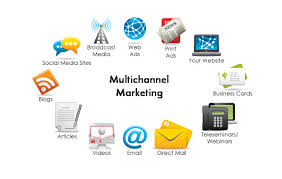
marketing channelsPeriodically, the Direct Marketing Association conducts field research to take the pulse of marketers and the various channels they’re employing to support their marketing campaigns.

In the DMA’s most recent survey, conducted online this past December and January, marketers were asked which one of seven channels they utilize in their campaigns.  The seven choices listed were the following:

  • Direct mail marketing
  • E-mail marketing
  • Mobile marketing
  • Online display advertising
  • Paid search advertising
  • Social media advertising
  • Telemarketing

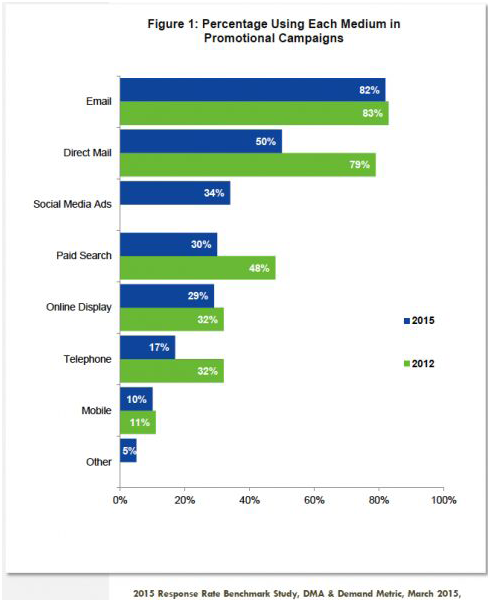
The results of the survey show that e-mail marketing remains King of the Hill when it comes to its popularity as a MarComm channel, with more than four in five marketers including the tactic as part of their promotional campaigns:

  • E-mail: ~82% use as a medium in promotional campaigns
  • Direct mail: ~50% use
  • Social media advertising:  ~34% use
  • Paid search: ~30% use
  • Online display advertising:  ~29% use
  • Telemarketing: ~17% use
  • Mobile marketing: ~10% use

Clearly, the research findings show that marketers are using multiple channels in their campaigns:  Two-thirds of the survey respondents use more than one channel, and around 45% of them reported that they’re using three or more channels in their promotional campaigns.

Social media advertising is a new entrant on the list in the DMA research.  It wasn’t even included in the DMA’s 2012 survey, yet today appears to be an important part of the channel mix.

On the other hand, mobile marketing remains a channel that isn’t being utilized by very many marketers — at least not yet.  In a similar survey conducted by the DMA in 2012, its adoption rate was similar to what the 2015 survey has found.

The graph below compares 2015 and 2012 survey results.  Aside from the lack of movement with mobile marketing, another interesting trend is the significant decline in the utilization of direct mail marketing.  Back in 2012, it rivaled e-mail marketing in popularity.  Today, only half of the marketers surveyed continue to use it as a marketing channel.

And a third big trend is the utter collapse of telemarketing as a popular MarComm channel — likely happening under the twin weight of high costs and massive phone message filtering.

DMA chart

In terms of future anticipated usage, the DMA research found that marketers are, in fact, warming to mobile marketing.  It and social media advertising are the two channels that have the best prospects for new adoption, based on the future intentions reported by these respondents.

The 2015 DMA report is available for purchase here.

Banking on Facebook: The social media giant makes its first moves into the credit-card payments business.

untitledRecently, I blogged about how Google’s efforts to expand its business activities beyond pay-per-click advertising — thereby diversifying its revenue stream — haven’t borne much fruit.

In 2011, ~96% of Google’s revenues came from PPC advertising.  In 2014, it’s ~97%.

But Google isn’t the only behemoth whose income is completely tied to advertising.  Over at Facebook, ~93% of the company’s more than ~12 billion in revenues come from advertising as well.

Compared to Google, Facebook is a relative newcomer to the advertising game.  But once it got in on the action, its growth was very robust.

In 2014 alone, Facebook’s advertising revenues were up 58% over the previous year.

But … there’s a bit of a problem.  In a world where advertising revenues are tied to “eyeballs,“ Facebook’s user growth isn’t on the right trajectory.  When the network has nearly 1.5 billion active users already, there’s not a lot of room for expansion.

This is reflected in Facebook’s Q4 year-over-year percentage growth stats as published by Mediassociates, a media planning and buying agency:

  • 2009: ~260% year-over-year growth
  • 2010: ~69% growth
  • 2011: ~39% growth
  • 2012: ~25% growth
  • 2013: ~16% growth
  • 2014: ~13% growth

One can easily imagine 2015’s growth figure dipping into the single digits, giving Facebook all the hallmarks of being a mature company in a maturing market.

But the always-enterprising folks at Facebook have had something up their sleeve which they’re rolling out to the market now:  getting into the multi-billion credit-card payments business.

Facebook send money appThey’re starting small:  introducing a “send-friends-money” functionality to Facebook’s Messenger app.  But this rather innocuous addition hardly does justice to Facebook’s end-game strategy.

When you think about it, Facebook’s aims make a lot of sense.  With nearly 1.5 billion active users around the world, Facebook’s accounts make PayPal’s ~162 million active accounts seem pretty paltry by comparison.

But revenue from PayPal’s transaction tolls isn’t chump change at all:  nearly $8 billion last year alone.

Without doubt, Facebook is also looking at the huge amount of business done by American Express and VISA; think of the billions of dollars those companies earn by charging merchants between 2% and 3.5% on the value of each credit-card transaction.

Facebook’s entry into the business can be facilitated neatly through its Messenger mobile app, making it just as easy (or easier) to pay for goods and services as with a credit card.

Considering that Facebook’s users with mobile phones are already spending time on the network an average of an hour per day, it’s pretty easy to see how people could make the transition from traditional credit and debit card payments to using their Facebook app for precisely the same purposes.

And Facebook could sweeten the pot by working with retailers and marketers to offer real cash loads that would likely juice participation even more – sort of a cash rebate in advance of the purchase rather than afterward.

So we shouldn’t think of Facebook’s new “send-friends-money” feature as a one-off function.

Instead, it’s just the tip of the iceberg.  If I were a manager at VISA or AmEx, I’d be thinking long and hard about the real motivations – and real implications – of Facebook’s latest moves.

Google and the multi-billion dollar pay-per-click money tree.

moneyIt’s no secret that Google has been trying to diversify its revenue stream away from clickthrough advertising, which historically has accounted for the overwhelming majority of its income.

How else to explain Google’s shopping spree over the past decade, scooping up a veritable smorgasbord of industry players like these:

  • AdMob (mobile)
  • Adometry (attribution)
  • Channel Intelligence (product feeds)
  • DoubleClick (display)
  • Invite Media (programmatic creative and media buying)
  • Teracent (programmatic creative and media buying)
  • YouTube (video)
  • Wildfire (social)

So the next question is, “How much have these acquisitions and investments done to diversify Google’s sources of revenue?”

The answer:  Hardly anything.

Consider this statistic:  In 2011, nearly all of Google’s revenue came from online pay-per-click advertising, as reported by SEO firm WordStream.

Now let’s look at 2014 figures:  WordStream reports that the percentage of Google revenues from pay-per-click advertising is actually higher than in 2011, at 97%.

So much for the “diversifying effects of diversity.”

Within PPC advertising, a number of keyword terms are continuing to haul in the big bucks for Google.  A few years back, the priciest keyword term of all was mesothelioma, at more than $100 a click.

Mesothelioma continues to attract a lot of ad dollars, but it’s no longer commanding $100 a pop as it once did.  In fact, it’s no longer on the Top 10 most expensive keywords list.

That list looks like this now (in descending order of bid pricing, starting at over $50 per click and dropping to “only” around $45 for the #10 keyword):

  • Insurance
  • Loans
  • Mortgage
  • Attorney
  • Credit
  • Lawyer
  • Donate
  • Degree
  • Hosting
  • Claim

In developing the ranking, WordStream determined which keywords reside in the stratosphere by compiling data from its own large keyword dataset and the Google Keyword Tool (over a 90-day period) to determine the 10,000 most expensive keywords.

These were then organized into categories like “credit” and “insurance” by weighting the number of keywords in each category, estimating the monthly search volume as well as the average cost-per-click for each keyword.

Notice the preponderance of financial and legal terms – both of them key to sectors that attract and manage a ton of money.

The word degree is right up there, too, underscoring how important the educational complex has become to the ad business.

It must be pretty unappealing to be active in these industries and have to pony up such big dollars to participate in the pay-per-click advertising space.  But how else do we think Google racks up annual advertising revenues that are north of $32 billion?

How does the market sort out which keywords are worthy of commanding $40 or $50 per click?  Essentially, it boils down to this:  Invariably, the most expensive niches paying for the most costly keywords are ones with very high lifetime customer value – where the customer pay-off is high.

Think about it:  The amount of money an insurance company gets from an individual signing up for coverage makes the high cost-per-click rates – even at $50 a pop — worth it.

Business observers point to long-range trends that may make search engine marketing increasingly irrelevant as the growth of multichannel, multi-device marketing picks up steam.

But don’t hold your breath; Google will likely be earning billions off of pay-per-click advertising for years to come.

So Many Marketing Channels … So Many Vendors …

Managing multiple vendors has become nearly a full-time job for some marketers.

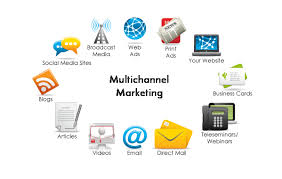
marketing channelsManaging channel communications isn’t very easy for marketers these days, that’s for sure.  It’s because so many companies are using multiple outbound channels to connect with their customers.

Illustrating this point, at the Direct Marketing Association’s 2014 annual conference, some 250 marketers were surveyed by Yes Lifecycle Marketing about their activities.

The results of that survey revealed that more than half of the marketers are using at least six outbound channels to connect with customers.  And another 20% use more than ten channels.

Guess what this means?  Nearly 30% of these marketers report that they’re managing (or more likely juggling) seven or more technology vendors and service providers as part of their MarComm duties.

More to the point, many marketers are devoting huge chunks of their week just coordinating all of these tech and service providers.

For an unlucky ~20% of the respondents, the time commitment is upwards of 15 hours each week – more than a third of the time that makes up a 40-hour week.  (“What’s a 40-hour week in marketing?” one might ask, of course.)

Even for marketers who are using a smaller number of vendors to support their media and communications channel efforts, the involvement of various internal stakeholders is high – more than seven, on average, during the vendor selection process.  So the coordination responsibilities just keep adding up.

What this means … 

The Yes Lifecycle Marketing Survey found a correlation between the “choreography” demands of managing multiple vendors and the fact that other marketing activities suffer as a result — namely, market strategizing, business operations and customer relationship-building.

And even with those duties getting shorter shrift, the marketers surveyed still complained about having too many vendors to coordinate … significant challenges with properly integrating the various functions … insufficient budgets … and above all, a lack of adequate staffing.

To top it off, the typical tenure of a Chief Marketing Officer at a company isn’t exactly lengthy — ~45 months at last count.  It’s enough to make one wonder if a job in marketing is worth it.

The answer to that question can be summed up this way (with credit to Oscar Wilde and apologies for the riff):  “The only thing worse than being busy is … not being busy.”

What’s the Latest Forecast on U.S. Ad Spending?

ad forecastingMost observers agree that 2015 will be a decent-or-better year for ad spending.  But how will it break down by media segment?

Industry and market forecasting firm Strategy Analytics has just released its latest U.S. advertising spend forecast, which it expects to total almost $190 billion.  That’s about a 3% increase over 2014.

But there are wide variations in the growth expectations depending on the media type.

Digital advertising leads the pack, with an expected growth increase in double digits, while at the other end of the scale, print advertising is forecast to drop by approximately 8%:

  • Digital advertising: 13.0% increase in 2015 U.S. ad spend
  • Outdoor advertising: +4.8%
  • Cinema advertising: +3.4%
  • Radio advertising: +1.8%
  • TV advertising: +1.7%
  • Print advertising: -7.9%

Of course, “digital advertising” is a broad category, and within it Strategy Analytics expects certain sub-categories to grow at a faster clip:  Social media advertising looks to be the star in 2015 (+31%), followed by video advertising (+29%) and mobile advertising (+20%).

Even with these lucrative growth expectations, search advertising (SEM) will continue to represent the lion’s share of digital ad revenues – around 45%.

Also, despite the dramatic growth of digital, the segment isn’t expected to break 30% of all U.S. advertising in 2015.  The more traditional TV ad segment continues to lead all others, although it has fallen below the 50% share of all advertising in recent years.

Here’s what Strategy Analytics is forecasting for ad expenditures by media segment for 2015:

  • TV advertising: ~$79 billion in 2015 U.S. ad spending
  • Digital advertising: ~$53 billion
  • Print advertising: ~$28 billion
  • Radio advertising: ~$18 billion
  • Outdoor advertising: ~$9 billion
  • Cinema advertising: ~$1 billion

Strategy AnalyticsLeika Kawasaki, a digital media analyst and one of the Strategy Analytics Advertising Forecast report’s co-authors, notes that  looking ahead to 2018, TV’s share of advertising revenue is expected to fall further to ~40%, while digital advertising’s share will reach ~35%.

However, it’s not that TV’s volume will be declining — it’s more that digital will be robbing more funds from other segments (particularly radio and print).

Additional details on the 2015 forecast can be viewed here — if you wish to shell out $7,000 for the report, that is.

Social media and marketing: Is the honeymoon over?

social mediaIt’s no secret that companies large and small have been putting significant energy into social media marketing and networking in recent years.

It’s happened for a variety of reasons – not least as a defensive strategy to keep from losing out over competitors who might be quicker to adopt social media strategies and leverage them for their business.

And yet …

Now that the businesses have a good half-decade of social media marketing under their belt, it’s pretty safe to say that social tactics aren’t very meaningful sales drivers.

That’s not just me talking.  It’s also Forrester Research, which as far back as 2011 and 2012 concluded this after analyzing the primary sales drivers for e-commerce.  Forrester found that less than 1% was driven by social media.

And in subsequent years, it’s gotten no better.

A case in point:  IBM Smarter Commerce, which tracks sales generated by 500 leading retail sites, has reported that Facebook, LinkedIn, YouTube and Twitter combined represent less than 0.5% of the sales generated on Black Friday in the United States.

Those dismal results aren’t to say that social media doesn’t have its benefits.  Generating “buzz” and building social influence certainly have their place and value.

But considering what some businesses have put into social media in terms of their MarComm resources, a channel that contributes less than 1% of sales revenues seems like a pretty paltry result – and very likely a negative ROI, too.

Going forward, it would seem that more companies should pursue social media marketing less out of a fear of losing out to competitors, and more based on whether it proves itself as an effective marketing tactic for them.

Consider the points listed below.  They’ve been true all along, but they’re becoming even more apparent with the passage of time:

1.  Buying “likes” isn’t worth much beyond the most basic tactical “bragging rights” aspects, because “likes” have little intrinsic value and can’t be tied directly to an increased revenue stream.

2.  A great social media presence doesn’t trump having good products and service; even dynamite social media can’t camouflage shortcomings of this kind for long.

3.  Audiences tend to “discount” the value of content that comes directly from a company.  This means publishing compelling content that clears that hurdle requires more skill and expertise than many companies have been willing to allocate to social media content creation.

Calibrating the way they look at social media is the first step companies can take to establish the correct balance between social media marketing activities and expected results.  Instead of treating social media as the connection with customers, view it as a tool to connect with customers.

It’s really just a new link in the same chain of engagement that successful companies have forged with their customers for decades.  In working with my clients, I’ve seen this scenario play out the same basic way time and again; it matters very little what type of business or markets they serve.

What about you?  Have your social media experiences been similar to this — or different?  I welcome hearing your perspectives.

World brands: Who’s up … Who’s down?

brand finance logoEach year, the brand valuation consulting firm Brand Finance produces a report on the strength of the world’s Top 500 brands.

It’s an interesting study in that Brand Finance calculates the values of brands using the so-called “royalty relief” approach – calculating a royalty rate that would be charged for the use of the brand name if it weren’t already owned by the company.

In the 2015 report, just issued, Apple remains the world’s most valuable brand based on this criterion.  The Top 10 listing of world brands is as follows:

brand finance global 500 2015#1  Apple

#2  Samsung

#3  Google

#4  Microsoft

#5  Verizon

#6  AT&T

#7  Amazon

#8  GE

#9  China Mobile

#10 Walmart

Of these, all but China Mobile were in the Top 10 listing in Brand Finance’s 2014 rankings.  Of the others, all maintained their rank except for AT&T and Amazon, which rose, and GE and Walmart, which fell.

The most valuable brands differ by region, however.  In fact, Apple is tops only in North America:

Most valuable brand in North America:  Apple

… in Europe:  BMW

… in Asia/Pacific:  Samsung

… in the Middle East:  Emirates Air

… in Africa:  MTN (M-Cell)

… in South America:  Banco Bradesco

As for which brand’s value is growing the fastest, top honors goes to … Twitter?

That is correct:  According to Brand Finance, Twitter’s value has mushroomed from $1.5 billion in early 2014 to nearly $4.5 billion now.

Other social platform firms that have experienced big growth are Facebook (up nearly 150%) and the Chinese-based Baidu (up over 160%).

What about in non-tech or social media sectors?  There, Chipotle racked up the biggest growth in brand value:  nearly 125%.  At the other end of the scale, the McDonald’s brand has lost about $4 billion in value over the past year.

Most Powerful Brands 

In addition to its brand value analysis, Brand Finance also publishes a ranking of most powerful brands based on its “brand strength index” (BSI).  This index focuses on factors more easily influenced by marketing and brand management activities — namely, marketing investment and brand equity/goodwill.

In this analysis, Brand Finance comes up with a very different set of “top brands” – led by Lego:

Lego logo#1  Lego:  BSI = 93.4

#2  PWC (PricewaterhouseCoopers):  91.8

#3  Red Bull:  91.1

#4 (tie)  McKinsey:  90.1

#4 (tie)  Unilever:  90.1

#6 (tie)  Burberry:  89.7

#6 (tie)  L’Oréal:  89.7

#6 (tie)  Rolex:  89.7

#9 (tie)  Coca-Cola:  89.6

#9 (tie)  Ferrari:  89.6

#9 (tie)  Nike:  89.6

#12 (tie) Walt Disney:  89.5

According to Brand Finance, Lego’s brand power stems from it being a “creative, hands-on toy that encourages creativity in kids and nostalgia in their parents, resulting in a strong cross-generational appeal.”  Lego also has a big consumer marketing presence, thanks to its brand activities in film, TV and comics.

Last year’s top brand was Ferrari, which has now slipped in the rankings.  Brand Finance cited the brand’s 1990s-era “sheen of glory” as wearing a bit thin 20 years on.

For more details on these brands and other aspects of the 2015 evaluation, you can review Brand Finance’s 2015 report here.

Do any of the results come as a surprise to you?  Please share your observations with other readers as to why certain specific brands are coming on strong while others may be fading.