Raspberry Chorus: Yahoo’s Newest E-Mail Interface

If you use Yahoo’s e-mail platform and can’t stand its new interface (actually there have been two of them within the past year, with the second one even more irritatingly clunky than the first), raise your hand.

Yahoo's e-mail interface failIf you did, you’re among the scads of people who are unimpressed, irritated or even angry about the changes.

As it turns out, even Yahoo’s own employees are in a negative frame of mind about using Yahoo’s e-mail (or its search tool).

That fact was inadvertently revealed to the world in November when an internal company memo was leaked.  In the memo, Yahoo senior vice president of communications Jeff Bonforte and chief information officer Randy Roumillat wrote:

“Earlier this year we asked you to move to Yahoo Mail for your corporate email account.  25 percent of you made the switch (thank you).  But even if we used the most generous of grading curves … we have clearly failed in our goal to move our co-workers to Yahoo Mail. 

“It’s time for the remaining 75 percent to make the switch.  Beyond the practical benefits of giving feedback to your colleagues on the Mail team, as a company it’s a matter of principle to use the products we make.  (BTW, same for Search.)

Messrs. Bonforte and Roumillat seem to forget that this is America of the 21st Century — not the Soviet Union of the 1960s. 

If three-fourths of a company’s employees won’t use its own products, those products can’t be very good.  And the notion of coercion seems only destined to backfire – witness the leaking of the company memo. 

That’s Raspberry #1.

It doesn’t help that the two principals chose as their e-mail subject line this little bon mot:  “Windows 95 called and they want their mail app back.”

Implying that your recipients are mindless rubes isn’t a way to foster much in the way of cooperation and goodwill …

That’s Raspberry #2.

If Yahoo’s top brass were smart, they’d spend less time trying to pressure their employees – who must know a thing or two about the (de)merits of the interface. 

Instead, they should listen to the millions of Yahoo e-mail account holders who are none-too-pleased with the company’s latest “innovations.” 

That would be Raspberries #3 through #500,000 or so.  And yes, I’m in that category.

Consider comments like these that have been appearing all over cyberspace:

  • “The new Yahoo Mail is awful.  At least Yahoo Classic worked.  I’ll be moving everything I can from Yahoo.  Ugh.”
  • “Yahoo Mail seems as slow as treacle after the recent ‘forced march’ out of Yahoo Classic.  If it doesn’t get better soon, they are not going to have any users left.”
  • “I get buttonholed almost everywhere I go by [Yahoo email] users – including prominent techies – who complain about the new version.”
  • “Yahoo email and search are horrible … Yahoo email needs to be thrown out and rebuilt from scratch.  They need to also get someone who has a clue to create a spam filter.  The ‘stickiness’ of Yahoo email, search and other products sucks, plain and simple.”

This last comment also refers to a related issue.  As Wall Street Journal writer Kara Swisher noted in a story published in the industry website AllThingsD:

“A relentless and vocal group of Yahoo Mail users have been complaining vociferously after the Silicon Valley Internet giant drastically revamped its popular email service in October.  The ire includes a lot of distress over the removal of its tabs function and the addition of a multi-tasking feature in its place.”

As for me, I’d been struggling with the latest e-mail interface for awhile, thinking I might eventually come to like it (or at least to tolerate it).  After a few weeks, I came to the realization that this was never going to happen. 

That’s when I decided to figure out if there was to get the old interface back. 

The good news – at least for now – is this:  You can restore Yahoo Classic email. 

Yahoo doesn’t make it obvious, but by following the steps below, you can get yourself back out of e-mail purgatory:

  • After you open your Yahoo email, click on the small steamboat wheel located at the top right corner and select “Settings” from the dropdown menu.
  • Click on “Viewing Email” … then click on the box at the bottom labeled “Basic” and your screen will update to the classic version of Yahoo email.
  • Click on your browser’s “Back” button, and you will be returned to the original Mail Plus version of Yahoo (with the tabs).

These procedures should work with all of the major browsers (IE, Firefox and Safari).  But you may need to repeat these steps whenever you refresh your browser, or close mail and reopen. 

Even so, that’s way better than having to struggle with the new Yahoo interface.

What are your thoughts?  Do you agree or disagree that the new Yahoo email interface is a “huge leap backwards” in terms of user-friendly functionality?  Please share your comments pro or con with other readers here.

What’s the Future of E-Mail Marketing?

e-mail communicationsOver the past several years, I’ve begun to hear increasing rumblings about how e-mail is a now-mature communications method that’ll eventually go the way of the FAX machine. 

But I’m not at all sure I believe that.  I think it’s more likely that e-mail’s future will look … a lot like it does today. 

No doubt, texting and direct messaging have cut into some of the bread-and-butter aspects of e-mail communications.  But what about e-mail marketing?  Could we see a similar phenomenon happening?

Recently, I read the comments of e-communications specialist Loren McDonald on this very topic.  McDonald, who is vice president of industry relations at digital marketing technology firm Silverpop, makes an important point concerning the “building blocks” that have to be in place before e-mail marketing will be seriously threatened by alternative MarComm means.

McDonald speaks about the challenge of an “addressable audience” when it comes to alternative channels:  “Regardless of a competing channel’s popularity, marketers must be able to deliver a comparable or replacement message to an individual.  This is where many channels fall short,” he contends.

Loren McDonald
Loren McDonald

McDonald notes that most marketers possess vastly more permission-based e-mail addresses than they do mobile phone numbers with permission to text.  It’s the same story when comparing e-mail addresses to the percentage of their database that have liked their company’s Facebook page.

And there’s more:  For mobile apps, what portion of the typical company’s database has downloaded it and authorized notifications?  The inevitable response:  How low can you go?

McDonald’s point is that for these alternative channels to gain true significance, they need to achieve a certain critical mass in terms of adoption rates – thereby allowing marketers to reach their customers and prospects in a comparable manner as they can via e-mail (as well as at a comparable cost).

Looking into his own crystal ball, McDonald feels fairly confident making three predictions concerning the future of e-mail marketing:

  • He predicts that content-focused newsletters will remain relevant and popular, particularly for B-to-B companies and publishers.  That’s because marketers can push multiple newsletter articles within a single marketing touch, while publishers can attract ads and sponsorships for their e-newsletters (i.e. they’re moneymakers for them).
  • For broadcast/promotional messages, most consumers will continue to prefer e-mail delivery.  “Will mobile app users [really] want their smartphones to ping them all day long whenever a message arrives — and then have to click attain to view it?”, he asks rhetorically.
  • Transactional and triggered messages will be e-mail’s primary challengers in McDonald’s view – especially for bulletin-type messages such as breaking news headlines, weather alerts, flight delay announcements, “flash” promotions and sales, and order confirmations linked to in-app landing pages.

And even on this third prediction, McDonald doesn’t see the transition happening all that quickly.

I find myself in general agreement with Loren McDonald’s prognostications.  Do you have some differing views?  If so, please share them with other readers here.

How Low Can You Go: U.S. Banking Institutions are at their Lowest Tally Since the 1930s

Banking industryIt’s been more than 35 years since I began my post-collegiate working career in the commercial banking business.  At that time, there were well more than 17,000 federally chartered banking institutions in the United States.

The reasons for the high tally were clear.  Most states didn’t allow commercial branch banking across state lines.  And quite a few others – mainly in the Midwest and Plains regions – put severe restrictions on state branch banking as well.

That’s why states like Illinois and several others could have as many as 1,500 or more independent banking institutions each.

Of course, this hardly meant that these banks were operating in a vacuum.  Not only were there efficient automated clearing houses to process interbank transactions, there were also robust correspondent banking networks interlinking smaller and larger banks.

These networks enabled community banks to offer many of the same deposit, lending and cash management services provided by the larger institutions.

“Bigger is Better …”

Beginning in the late 1980s and early 1990s, many of the regulatory barriers began to fall.  States relaxed prohibitions on branch banking, while branching across state lines became common.  It wasn’t long before a string of acquisitions created large, consolidated banks.  The banking system began to look a lot more like Europe and Canada and a lot less like … well, the United States.

And it wasn’t just the small banking institutions that got swallowed up during this era of consolidation.  Many of the most venerable names in regional banking ceased to exist – institutions like National Bank of Detroit, Marine Midland, Maryland National Bank, Girard Bank and United Bank of Denver.

But then a countervailing trend developed, and it wasn’t the proverbial “dead-cat bounce.”  Consolidation caused voids in local banking coverage in many regions.  As a result, some businesses and consumers sought a return to banking institutions where ownership and management were part of the community, and where decision-making was based on a more intimate knowledge of the local economy.

So the commercial banking industry actually witnessed an uptick in the number of institutions during the late 1990s and early 2000s.

… Until the Great Recession of 2008/09 hit.

Today, the number of federally chartered U.S. banking institutions now stands at its lowest level since the Great Depression.

The stark facts are these:  A sluggish economy, low interest rates and ever-more complex regulations have diminished the number of federally chartered institutions to below 6,900.  The tally, according to FDIC stats, had never fallen below 7,000 since the mid-1930s.

Almost entirely, the recent numerical decline has come among smaller institutions – those with fewer than $100 million in assets.  And of the more than 10,000 banks that are now gone, it isn’t only because of mergers and consolidations.  Nearly 20% of them simply collapsed.

We’re not simply dealing with a reduction in banking charters; the number of physical bank locations is also declining – by about 3% since late 2009, thanks in part to the rise of online banking in addition to institutional consolidation.

John Barlow, Barlow Research and Iowa Falls State Bank
John Barlow

I asked banking industry specialist John Barlow for his thoughts on the latest bank figures.  Not only is this expert head of Minneapolis-based Barlow Research, Inc., a nationally recognized financial services industry market research and consulting firm that counts the largest U.S. institutions among its client base, Barlow is also chairman of Iowa Falls State Bank, a family-owned institution that could be characterized as the quintessential “local bank.”  (He’s also a former boss of mine back when I was working in the banking industry during the 1970s.)

Barlow noted an additional point about small banks:  “By their very nature, community banks are typically closely held – often family-owned enterprises.  A significant headwind for continued ownership is the transition of the business to a younger generation.  The Baby Boomers had smaller households, and their children are more likely to move away from the business – mentally as well as geographically.”

… or Is it Not Better?

There may be something of a silver lining in the recent trends, however.  Actual bank deposits have continued to grow, and consolidations have helped alleviate concerns that an abundance of separate banks leads to lower efficiencies in the financial system and more difficulties in conducting regulatory oversight.

… But only to a degree.  “It remains to be seen where the economies of scale exist in banking.  According to our studies at Barlow Research, larger banks do appear to be more efficient at generating income.  But that’s because they’re more aggressive at charging fees, not because of lower costs,” Barlow reports.

David Kemper, CEO of Missouri-based Commerce Bancshares, may have a point when he notes, “There’s no reason why we need [so] many banks, especially if those smaller banks have a much lower return on capital.  The small banks’ bread-and-butter is just not there anymore.”

[To that point, Barlow contends that one of the reasons smaller banks have a lower return on capital is that they have too much capital.]

Smaller banking institutionsThere’s an important counter-argument to the “consolidation is better” view.  It goes like this:  Community banks remain critically important to the economy because they are the ones more likely to engage in small-business lending.

Barlow Research’s statistical studies show that the small businesses that deal with community banks are more likely to be able to secure a loan.  And the average size of that loan will be larger than one obtained from a large institution.

The Most Startling Trend?

Another FDIC statistic might be the most startling trend of all.  Over the decades, each year has witnessed new bank startups – ranging from at least a handful to the low hundreds in any given year.  But that’s all changed since the Great Recession.

In fact, there has been just one new federally approved bank charter issued since 2010.

That institution, the Bank of Bird-in-Hand (located in Lancaster County, Pennsylvania), was able to raise approximately $17 million in investment capital.  But it also had to expend nearly $1 million in consulting and legal fees to properly prepare its application for a new charter — including spelling out policies and procedures detailing its systems to guard against cyber-attacks and other security risks.

“Intense” doesn’t tell the half of it when describing the effort needed to obtain a new Federal bank charter.

Considering those hurdles, what made the Bird-in-Hand investors think they could run a profitable banking operation in today’s economic and business climate?  It’s because they see an opportunity in serving a local community heavily populated by Amish and other rural/farming families.  Banking-wise, it’s an underserved community.

There once was a local independent bank, of course … but that one was acquired by a larger entity in 2003.  The new bank’s investors believe  they can provide services that are better suited to the needs of the local community – which, in turn, will make their new bank successful.

John Barlow adds this observation about community banking:  “A well-managed community bank is one of the best investments you can make, as long as you do not make bad loans.  Do that, and it’s all over in a couple years.”

And about the degree of governmental regulation in the industry, he remarks:  “I grew up in a banking family.  My grandfather and father complained about regulators all the time.  Banks are regulated businesses:  What’s new about that?”

Barlow and the Bird-in-Hand bank investors may well be right about the prospects for smaller banks in America.  Still … one wonders how many new banking institutions will be starting up in the current economic and regulatory environment.

… Or that the prospective investors will determine that it’s even worth the effort.

Is AdTrap the answer to our prayers when it comes to blocking online advertising?

ad blocking deviceYou may have heard of AdTrap … or maybe you haven’t.

AdTrap is a newly developed device that intercepts online ads before they reach any devices that access a person’s Internet connection.

That basic action means that people are able to surf the web – including viewing videos – without the onslaught of online advertisements that seem to become more and more pervasive with every passing month.

The fundamental promise that the developers of AdTrap are making is a return to the “good ol’ days” of web surfing.

You know, back when most web pages you downloaded contained text and pictures – and virtually no advertising.

AdTrap’s motto is a simple and powerful one:  The Internet is yours again.”

Not surprisingly, there’s a good deal of excitement surrounding this new product.  In fact, interest has been so great that the invention attracted more than $200,000 in funding — raised in a 30-day Kickstarter campaign in early 2013.

Those funds are now being used to manufacture the first AdTrap units for shipment to “early adopter” consumers across the country.

How New an Idea Is This?

advertisingIn actuality, there have been a plethora of (often-free) software and browser plug-ins offered to consumers that can block online advertisements. 

But most of them have significant limitations because they’ve been designed to work only with specific browsers or on specific devices.

Free is good, of course.  But the developers of AdTrap are banking on the willingness of consumers to shell out $139 for their product – a rectangular box that looks a lot like a wireless router and that intercepts advertisements before they reach a laptop, tablet or mobile device.

The beauty of AdTrap is that it will work on every device connected to a person’s network.  Situated between the modem and router, it takes just a few minutes to set up.  

CNN technology correspondent Dan Simon reports that AdTrap does an effective job blocking advertising content.  But not perfectly; ads still appear on Hulu content, for example. 

But the developers of AdTrap report that they’re working on ways to block even more content going forward, including ads on Hulu.

Is this Bigger than Merely Blocking Ads?

Beyond the collective sigh of relief you’re likely hearing from those reading this blog post … what are the larger implications if AdTrap and similar devices are adopted by consumers on a large scale?

One not-so-positive implication may be that websites will no longer offer be able to offer content without charge, since so many publishers’ business models rely on advertising content to help pay most of the bills.

If advertising isn’t appearing thanks to AdTrap, people aren’t getting paid.

So let’s think about this for a minute:  It’s true that the Internet was blissfully free of wall-to-wall advertising 15 years ago compared to today. 

But cyberspace was also far less robust in terms of the quantity and quality of the informational and entertainment content available to us.

So yes … having a device to block 80% or more of the ads served to us is a very attractive proposition.  But if it means that some of our favorite sites move to pay-walls as a result, it might be that making a $139 investment in an AdTrap device isn’t such a “no-brainer” choice in the final analysis.

What do you think of this development — pro or con?  Please share your thoughts with other readers here.

“Public pronouncements” versus “private predilections”: What we say isn’t always what we actually believe.

Public versus private thinkingThere’s an intriguing new research report out from Young & Rubicam that lays bare the contradictions of what people say they like and want … and what they secretly think.

The findings are outlined in a new research study Y&R has dubbed Secrets & Lies … and it’s based on research conducted in September 2013 among adults over age 18 in the United States, Brazil and China.

The bottom line?  The Y&R research finds that many people hold views that are diametrically opposed to what they reveal to others publicly.

That kind of a result would be difficult to measure using traditional survey research.  So Y&R chose to meld the conventional survey approach with a second methodology known as “Implicit Association Testing.”

IAT helps reveal sub-conscious or unconscious motivations that lie outside of our standard awareness.

So, what contradictions and correlations did the research uncover? 

Let’s start with the study’s global findings.  When asked to rank-order a group of 16 “values,” here’s a listing of the top five values as cited by the survey respondents in all three countries:

  • #1.  Finding meaning in life
  • #2.  Choosing my own path
  • #3.  Helpfulness
  • #4.  Environmentalism
  • #5.  Success

Now … compare that to the “Top 5” list that was revealed with these same respondents were evaluated using implicit association:

  • #1.  Sexual fulfillment
  • #2.  Respect for tradition
  • #3.  Maintaining security
  • #4.  Environmentalism
  • #5.  Building wealth

Wow.

We  see just one value appearing on both lists … and there are some pretty big differences in the values that reside on each of them.

Did American respondents differ from their counterparts in China and Brazil?  Like the global results, the values were quite different between conscious responses and implicit association. 

U.S. respondents named helpfulness as their highest-ranked value, followed by choosing my own path and finding meaning in life.

But what did the implicit association testing reveal among these same American respondents?

Far from being at the top of the list, “helpfulness” came in dead last:  16th place out of 16 values rated.  Instead, the top three “subconscious” values are actually these:

  • #1.  Maintaining security
  • #2.  Sexual fulfillment
  • #3.  Honoring tradition

As the Y&R study pointedly opines, America’s top conscious values sound like political correctness reminiscent of the Oprah Show … whereas our unconscious values sound more like a return to the Eisenhower era.

These seeming disconnects between “public pronouncements” and “private predilections” manifest themselves in brand image as well.

As it turns out, consumers say they like the “popular kids” on the branding block a lot more than they actually do subconsciously.

Here’s a list of top brands researched and how they come out in conscious rating versus IAT evaluation:

  • Alignment between public and secret likes:  Amazon, Target, Whole Foods
  • Alignment between public and secret dislikes:  AT&T, K-Mart, Playboy
  • Liked less in secret:  Google, Microsoft, Starbucks
  • Liked more in secret:  Exxon, Facebook, National Inquirer

When I scan this list, it’s pretty evident what’s going on.  Certain brands are popular whipping boys in the “popular media” and on certain cable news channels, where one rarely hears positive word uttered about them. 

Not surprisingly, it’s precisely those brands that get a “public thumbs-down” from the respondents.

But in secret — away from the klieg lights and the admonitions of the culture’s PC denizens — it’s quite a different ballgame.

Of course, no one would want their brand to be in AT&T’s or K-Mart’s unenviable position – because that’s where people dislike those companies publicly as well as in their private thoughts!

Sprawl & Crawl: Are work commutes actually worse than you think?

DC traffic
It turns out politics isn’t the only kind of gridlock in Washington, DC. It also has more traffic gridlock than anywhere else in the country.

This past weekend, The Wall Street Journal published a feature story in its “Personal Journal” section that profiled how businesspeople cope with their daily work commutes

It turns out that the average daily work commute in the United States takes about 25 minutes

Another interesting statistic from the article is the amount of time car commuters in larger cities spend stuck in traffic:  52 hours annually, or about an extra hour per week.

The WSJ story profiled several people who access mass transportation for their work commutes, as well as one businessman who relocated from the Washington, DC Metropolitan area to Metro Cincinnati, substantially reducing his daily commute time and hassle in the process.

As someone who lives not far from the DC Metro area and who contemplates any drive through the region with a mixture of disdain and dread, this got me to wondering:  Just what is the worst geographic market for commuting?

Helpfully, there’s a recently completed study that answers this very question.  The Transportation Institute at Texas A&M University has applied a calculation tool called the Planning Time Index (PTI) to compare drive times in heavy traffic (i.e., rush hour) against travel times when the same highways are clear.

The way the PTI calculation works is this:  A PTI of 2.00 means that a “normal” drive will take twice as long in heavy traffic. 

Using that PTI=2.00 example, a drive that may ordinarily take ~20 minutes will take ~40 minutes instead.

My suspicions about the DC Metro area turned out to be right on the money.  Here are the most “challenging” metro markets for work commutes based on their PTI indices:

  • Washington DC:  5.72 PTI index
  • Los Angeles:  4.95
  • New York-Newark:  4.44
  • Boston:  4.25
  • Dallas-Ft. Worth-Arlington:  4.00
  • Seattle:  3.99
  • Chicago:  3.95
  • San Francisco-Oakland:  3.74
  • Atlanta:  3.71
  • Houston:  3.67

How do these PTI indices translate into actual drive times?  Shockingly, a DC-area commute that ordinarily takes 20 minutes translates into almost two hours in heavy traffic. 

And among all of the other “top ten” worst markets, that normally 20-minute commute  will take 1.2 hours or longer in rush-hour traffic.

Interestingly, when one scans the “Top Ten” list, the only Midwest urban area that shows up on it is Chicagoland.  So if you wish to avoid the hassle of long commutes, consider relocating to urban markets in the Midwest like St. Louis, Minneapolis-St. Paul, Cleveland, Milwaukee or Kansas City.

But what’s the absolutely easiest metro market for commuting?  According to the Texas A&M study, it would be Pensacola in Florida.  It has a PTI of just 1.31. 

… Which means only about six extra minutes in rush traffic compared to the ordinary 20-minute commute.

Come to think of it … Pensacola has great beaches and nice sea breezes as well.  Perhaps dealing with the occasional hurricane is worth it, all hassles considered!

Are small businesses under increasing risk of cyber-attacks?

cyberWhen it comes to cyber-security, high-visibility data breaches get all the press, which is understandable.

But small businesses are also victims of cyber-attacks.  And sometimes those events can be financially devastating.

Now a newly published survey quantifies the extent to which small businesses are at risk.  The National Small Business Association polled nearly 850 U.S. small business owners (most with annual revenues between $500,000 and $25 million) in August 2013).  The NSBA survey found that nearly 45% of the respondents’ businesses had been the victim of cyber attacks such as malware, spyware or banking Trojans.

The average cost of these cyber attacks was reportedly nearly $9,000 – with some dollar amounts going much higher.

Separately, another study shows that a record number of cyber attacks targeted small businesses in 2012.  Verizon’s Data Breach Investigations Report examined 855 data breaches and found that over 70% of them involved victim companies with fewer than 100 employees.

Verizon’s 2013 report is showing a continuing increase in cyber attacks on small business, meaning that 2012 was no fluke.

What’s going on here?

According to the Verizon study’s conclusions as well as comments from security experts like Vikas Bhatia, small and medium-sized businesses could be doing a better job of “offensive defense.”

Among the mistakes commonly observed in small businesses are these:

  • Lack of conducting regular backups of business data
  • Neglecting to store backed up data offsite
  • Failing to test data restore functions on a periodic basis
  • Neglecting to keep antivirus software up to date, including software patches and updates
  • Practicing sloppy password protection behaviors (using plain-language passwords … using identical passwords across multiple accounts, etc.)
  • Not understanding cloud-based data storage and what outsourced providers’ liabilities are (and are not) for protecting data

There’s no question that cyber-security continues to be a big challenge – and probably a growing one – for many companies.

But it’s also pretty evident that many businesses could be doing more to protect themselves from the heartburn (and financial fallout) along the way.

The Continuing Evolution of Consumer Healthcare Information-Gathering Practices

health informationWith the interminable discussion and disagreement about the (so-called) Affordable Care Act we’ve been having lately, it’s easy to lose sight of some of the other important developments in health care and related behavioral trends.

One of them is how people are evolving in the way they obtain their health information.  A new consumer survey helps provide insights.

The survey, conducted among nearly 1,100 Americans age 18 or older by healthcare communications consulting firms Makovsky Health and Kelton Global, shows that U.S. adults visit a physician three times per year, on average.  That’s not much different from what previous research shows.

At the same time, however, American consumers now spend an average of over 50 hours per year researching health information on the Internet.  And they’re accessing such information all over the place – from health-oriented websites to social media. 

WebMD continues to have pride of place among healthcare online resources:

  • WebMD:  ~53% of adults access during the year
  • Wikipedia:  ~22%
  • Health magazine websites:  ~19%
  • Advocacy group websites:  ~16%
  • YouTube videos:  ~10%
  • Facebook:  ~10%
  • Blogs:  ~10%
  • Pharmaceutical company websites:  ~9%

Because health subject matters can be rather complicated or detailed, one would suspect that most people might do their research using a PC rather than devices with less screen-viewing or printing capabilities.  And this research bears that out:

  • ~83% use PCs the most to find health information online
  • ~11% use tablets the most
  • ~6% use smartphones the most

[However, tablet usage has grown from just 4% in the 2012 survey, while PCs have declined by a similar margin.]

The influence of consumers’ own doctors remains as strong as ever.  When asked what would motivate consumers to visit a pharmaceutical company’s website for information, the survey respondents cited physicians over any other motivational influence:

  • Physicians:  ~42% of respondents would be motivated by this source
  • News articles:  ~33% would be motivated
  • TV advertising:  ~25%
  • Drug discount card:  ~14%
  • Magazine advertising:  ~13%
  • Web/online advertising:  ~11%
  • Newspaper advertising:  ~9%
  • Radio advertising:  ~9%

… All of which leads one to wonder if most of the dollars being spent by pharma companies on radio, TV, magazine and web advertising are simply wasted. 

Really, this type of pharmaceutical advertising would appear to be “spray and pray” … on steroids.

Here’s a final piece of information from the Makovsky/Kelton survey that was quite revealing — perhaps even startling:  With all of the talk about the Affordable Care Act, as of the time of this survey a few months back, one-third of respondents reported that they had never spent any time researching the reforms and how they might affect them. 

… And another third indicated that they had spent less than one hour total researching the topic.

What’s wrong with that picture?

Spotify hits the spot in its business valuation: $5.3 billion.

bullhornThere’s no question that Spotify has been an up-and-comer in the music streaming business.  Speaking anecdotally, over time more and more of my friends and family members have been signing up for the service.

And now, Spotify is pushing forward with an even more aggressive growth strategy … and it’s not aiming low at all.

In fact, the company is seeking backers at an eye-popping valuation level of $5.3 billion.

And to top it off, the company’s co-founders (Daniel Ek and Martin Lorentzon) intend to raise the funds not through equity investment, but through loans.

It seems neither person wishes to give up any more of the company to investors than has already happened.

What makes the $5.3 billion valuation so startling is not just the amount – big though it is.  It’s because that the last business valuation of Spotify, done less than 12 months ago, pegged the company’s value at just $3 billion.

That time around, a number of institutional investors stepped up to the plate (including Coca Cola, Fidelity and Goldman Sachs).  But don’t look for more institutional investment in this round of funding.

In the case of Spotify, being second or third in the music streaming market segment has turned out to be a good thing.  Pandora and others were the pioneers, laboring in the vineyards for many long years before proving out the business model. 

Then along comes Spotify and cleans up in a market space that people now understand fully.

At the moment, Spotify has around 6 million paying users in 28 countries — along with several times that number of people who use Spotify’s free, ad-funded services.  Spotify streams music across desktops and mobile devices along with other music gear.

The company reports that it pays approximately 70% of total revenues back to music rights-holders.  It’s not profitable yet … but how many years was Pandora bleeding red ink?  The better part of a decade, certainly.

There continues to be some low-level grumbling about how Spotify handles payouts to the “bigger name” performers in the music industry. 

According to some reports, Spotify pays only about $0.005 per stream.  That means only big stars (the likes of Beyoncé and others) can make any meaningful money from the service.

But for anyone who thinks that $5 billion+ is a tad rich when it comes to the valuation of a business property like Spotify … remember that Skype was sold to Microsoft for $8.5 billion in 2011, after having been valued at just $2.75 billion two short years before. 

So maybe the whole thing isn’t so far-fetched after all.

Chalk one up for the taxpayers: Government travel-related spending declines significantly.

dollarcutsCan it be possible that widespread public revulsion at the level of federal government conference and travel expenditures has actually had a positive impact?

It seems so, if new financial reporting is to be believed.

According to recent reports filed by the General Services Administration, federal travel card spending has declined ~17% so far in FY 2013 compared with the same period last year. 

That’s for the GSA’s SmartPay charge card program which covers more than 2.5 million cardholders.  And it’s the second year in a row that we’ve seen a drop in expenditures:

  • FY 2011:  $9.6 billion
  • FY 2012:  $8.9 billion
  • FY 2013 (YTD):  $6.0 billionGSA conference follies

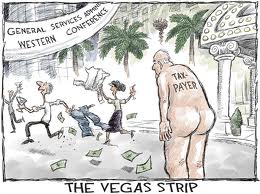
According to GSA officials, the decline in travel-related spending has happened because of “aggressive steps” taken to cut conference spending in the wake of embarrassing revelations that a single GSA conference in Las Vegas in 2010 had cost American taxpayers nearly $825,000. 

The fact that this meeting included paying clowns and mindreaders to lead group discussions added an absurd twist on the entire affair.

clownIn May 2012, the Office of Management and Budget issued a memo directing federal agencies to reduce their travel-related spending by 30% compared to 2010 levels – and to maintain those levels through FY 2016.

Another directive required agencies to report spending on any conference that exceeds $100,000.

Looking out over the government agency landscape, it appears that most agencies have made some pretty big strides towards meeting the new standards. 

Comparative travel expense figures released by the GSA for FY 2013 through July against FY 2012 over the same period show these declines:

  • General Services Administration:  -62%
  • Veterans Administration:  -31%
  • Treasury:  -30%
  • Energy:  -25%
  • Commerce:  -23%
  • Labor:  -23%
  • Environmental Protection Administration:  -21%
  • Housing & Urban Development:  -21%
  • Defense:  -19%
  • Justice:  -19%
  • Transportation:  -18%
  • State:  -16%
  • Interior:  -12%

A few agencies did show increased travel expenditures.  Most significantly, the Small Business Administration doubled its expenses due to Hurricane Sandy and other natural disasters that required additional travel associated with putting manpower on location to provide financial assistance to homeowners, renters and businesses.

But taken as a whole, these expenditure drops are unprecedented. 

I wonder how many people would have predicted it – even though most people I know figure that there’s plenty of “fat” to cut within these agencies without hurting the programs.

It’s just that … we so rarely hear of reports like this in government.

And of course, there’s plenty of grousing to go around about the new realities.  One Department of Defense official who requested anonymity was quoted as saying, “When someone craps their pants, we all have to wear diapers.  This is hardly the way to run the DOD efficiently.”

And then there’s this:  Lest you think that we’ve put a lid on excess travel-related expenditures for good, the GSA has just announced that it will be unfreezing per diem rates for FY 2014.

That is correct:  The GSA is now increasing the lodging, meal and incidental allowances that federal employees are reimbursed for expenses incurred while on official travel.  It’s going up to $129 in most markets within the 48 contiguous states.

Maybe they think people won’t notice …