Fake online product reviews: How pervasive are they?

Fake reviewsThink about those reviews that mean so much to you when considering whether to purchase a particular product or a service …

It could be that the comments you’re reading are bogus – or at least not based on the reviewer’s first-hand experience.

An online survey of nearly 1,200 U.S. adults age 18 and older, conducted by marketing research firm YouGov in January 2014, found that more than one in five respondents admitted to having posted online reviews about products or services they hadn’t actually bought or used.

The percentage is somewhat higher for men (~23%) than it is for women (~17%).

Why do people post reviews or comments on products and services they haven’t tried?  Here’s what the survey respondents reported:

  • “Just felt like it”:  ~32% gave this reason
  • “Didn’t like the idea of the product”:  ~22%
  • “Didn’t like the manufacturer”:  ~19%

These stats might suggest that there are more “negative” reviews being posted online than what reflects the actual experience with the product or service.

But the YouGov survey also found that far more people leave good reviews than bad ones:

  • ~57% have left a mixed review
  • ~54% have left a good review
  • Only ~21% have ever left a bad review

What drives someone to leave a bad review?  The #1 reason is obvious … but the #2 reason might surprise you.  And the #3 reason is just mercenary:

  • ~88% want to warn others about a disappointing product or service
  • ~23% believe that venting their frustrations will leave them feeling less angry
  • ~21% are hoping to get a refund or some other monetary consideration from the company in question

The veracity of online reviews is important because the vast majority of adult consumers check them before deciding to purchase a product or service.

This YouGov survey is no different:  It found that ~79% consult reviews at least sometimes … and ~26% reported that they “always” check reviews before buying a product or service.

FakeryThe YouGov report comes hard on the heels of a Virginia lawsuit wherein a carpet cleaning service charged online review website Yelp with publishing negative reviews posted by people who had never been customers of the store.  The cleaning service claimed that the negative reviews had hurt its business.

In that case, a judge ordered Yelp to reveal the identities of the seven “anonymous” reviewers — who I’m sure never thought their “unidentified antics” would ultimately be revealed for all the world to see.

It may just be that posting a “faux” review has now become a little riskier.

People may think twice now before engaging in their little mischief.  I’m sure most of them can think of a lot better things to do than to be hauled into court for an alleged infraction like that — or at the very least, having their name brought into the legal proceedings.


Boston Consulting Group predicts “the end of consumer marketing as we have long known it.”

Boston Consulting Group recently conducted a survey of American consumers to see how their spending habits and approach to brands differs by age group.

Millennials GenXers Baby BoomersThe results give us a quantifiable measure of the differences in outlook between three major age groups:  Millennials (age 18 to 34), Gen-Xers (age 35 to 49), and Baby Boomers and older consumers (age 50 and up).

The survey findings led BCG researchers to declare that Millennials’ perspectives are characterized by a “reciprocity principle.”  By this, they mean that these younger consumers expect “mutual relationships” with companies and their brands.

This isn’t so very surprising considering the ability of the Internet and social media platforms to provide an easy platform for airing their opinions.

A positive brand experience may prompt consumers to take favorable “public” action on behalf of the brand.

A disappointing experience most assuredly will prompt vocal criticism via product or service reviews, social media, blog posts, and leaving comments.

digital-multitaskingAnd the juicier the commentary, the more likely it is to go viral.

The BCG survey found that younger consumers are far more prone to participate in the world of “reciprocity.”

The differences were pretty dramatic when asking respondents in the different age groups whether they agreed with certain statements:

“Brands identify who I am, and my values.”

  • Millennials:  ~44% agree
  • Gen-Xers:  ~38%
  • Boomers and older:  ~33%

“People seek me for knowledge and brand opinion.”

  • Millennials:  ~51% agree
  • Gen-Xers:  ~42%
  • Boomers and older:  ~34%

“I’m willing to share my brand preferences online or on social media.”

  • Millennials:  ~55% agree
  • Gen-Xers:  ~43%
  • Boomers and older:  ~28%

Evaluating the survey findings, the BCG report posits that Millennials are “the leading indicators of large-scale changes in consumer behavior.”

Rather dramatically, BCG also concludes that this particular generational transition is “ushering in the end of consumer marketing as we have long known it,” and that the linear framework companies have used for decades to manage brand image and engagement is headed out the window.

“… Marketers must embrace the reality that marketing is an ecosystem of multidirectional engagement rather than a process that is controlled and pushed by the company,” the BCG report states.

My personal view is that the Boston Consulting Group’s conclusions are probably on-target … but the question is the degree.

I don’t think many major brands are going to simply cede control of their marketing and messaging to the cyberspace or the social cloud.  They’ve worked too long and too hard on their brand image and identity to give up that easily.

For more on the survey findings and conclusions, here’s BCG’s summary article.

Take Your Pick: One Super Bowl Ad Spot … or 14 Billion Facebook Ad Impressions

Super Bowl Ad Cost


This year a single 30-second ad spot during the Super Bowl TV broadcast will cost a cool $4 million.

And that’s just for the placement alone — not the dollars that go into producing the ad.

The high cost of advertising is directly related to Super Bowl viewership, of course, which is predicted to be north of 100 million people this year.

Still, $4 million is a really hefty sum, even for major brand advertisers.  Just how big is underscored in some comparative figures put together by Jack Marshall, a reporter at marketing e-zine Digiday.

Jack Marshall
Digiday’s Jack Marshall

In lieu of spending $4 million on a single ad spot, here’s how Marshall reported that the promotional money could be spent in alternative ways:

  • 14 billion Facebook Ad Impressions – According to digital marketing software firm Kenshoo, right-hand column “marketplace” ads on Facebook averaged 27 cents per thousand impressions during 2013.  This means that for $4 million, an advertiser could run a Facebook marketplace ad every second of every day for the next 469 years.
  • 3 billion Banner Ad Impressions – In 2013, average online display ad CPMs were running just shy of $1.30, looking globally.  Applying that figure to the U.S. market translates into 3 billion display ad impressions for your $4 million spend.
  • 160 million Sponsored Content Views – The typical charge is ~$25 to distribute sponsored content to 1,000 readers.  At that rate, $4 million would give you 160 million impressions (provided a publisher could actually deliver that many!).
  • 10.8 million Paid Search Clicks – With an overall average cost-per-click of 37 cents in 2013, $4 million would cover just shy of 11 million clicks.  That may be one-tenth the size of the Super Bowl viewing audience … but at least your audience would be actually searching for your product or service instead of heading to the kitchen for more corn chips and queso dip.

These are just some of the comparative figures outlined by Jack Marshall in his article.  You can read the others here.

SoLoMo: The Newest Buzz Term in Marketing Communications

solomoEvery few years or so, we start hearing a pithy (and sometimes obnoxious) new buzz term in marketing communications.

The most recent entry into the lexicon is SoLoMo – a cutesy amalgam of three terms:  Social Media, Location, and Mobile Devices.

SoLoMo purports to convey the convergence of these three elements into a powerful new driver for marketing:  sparking audience engagement and brand usage via the use of social media, and targeting consumers via their mobile devices when they are locationally proximate.

businesspersonBeyond the inevitable “wink-wink, nudge-nudge” aspects of this term and the “oh-so relevant” connotation it has for those who choose to name-drop it in casual conversation, another drawback I see is the term’s emphasis on tactics rather than on the true meaning of today’s always-connected customers and the potential this offers for relationship-building.

Right now, there are more than a few company and brand marketers who are trying to figure out the best way to have their customers do all sorts of things that will benefit a product’s acceptance and position in the market — things like checking in to a physical location, then taking a mobile picture and uploading it to an Instagram or Facebook page.

This over-reliance on “shiny new object tactics” is what gets marketers to the same place as designing a new and novel app that doesn’t actually fill a true need – and hence becomes an inglorious failure.

Here’s what’s actually going on with consumers today:

  • They have more digital connections available to them than ever before.
  • Because of the pervasiveness of interactivity, consumers expect information to be available to them at any time – and on any device.

The good news is that marketers can establish just these sorts of connections with consumers, simply by using the very same social platforms.  The bigger challenge is making those connections meaningful and relevant.  That’s where effectiveness so often falls by the roadside.

Social media is an “ism” to many marketers … whereas to regular people, they hardly think of it that way.  For them, it’s just another way to engage in their relationships with friends, acquaintances, industry colleagues, fellow hobbyist … and favorite brands.  Other than the digital aspect of the communication, there’s really very little difference from the connections people have established and maintained for years the old-fashioned way.

Location is much more than simply where someone happens to be.  It’s the context of understanding when — and what — the person is doing at or near that location.  Knowing that makes for a more relevant – and potentially profitable — interactions.

Today’s focus on Mobile everything has become almost as myopic as marketers’ tunnel-focus on desktops was a few years back.  Today, we’re dealing with consumers who are perpetually connected.  As for which device, it simply depends on what’s handy at the moment – desktops, laptops, tablets, smartphones.  So, strategies and tactics that focus on one or two of these to the exclusion of the others will fall short of the mark.

While we can give an acknowledging nod to the SoLoMo buzz term, the key is to recognize that it’s actually about today’s perpetually connected consumers — and all of the expectations that come along with that.

In other words, marketers need to be people-focused … but tactics-agnostic.

Cue up the e-mail Rogues’ Gallery: Here’s what people are purging from their inboxes.

e-mail rogues galleryAnyone who’s had an e-mail account for any length of time likely faces ever-increasing inbox volumes.

And trying to keep those groaning inboxes in check can be a never-ending task.  Now a recent report gives us clues as to what e-mails are being purged most frequently by recipients.

It’s been released by Unroll.Me, a service that scans users’ e-mail accounts for all of the lists to which they are subscribed — knowingly or not.  It then gives people the opportunity to unsubscribe, or to consolidate groups of e-mails into a single regular update.

It turns out, many people are unwittingly “subscribed” to receive e-mails from vendors based on something as benign as making a single online purchase.  So Unroll.Me finds a substantial incidence of people taking unsubscribe actions when given the chance.

Unroll.Me’s report claims that it prevented more than 1 billion e-mails, offers and updates from reaching inboxes last year via its service.

Of particular interest than the overall volume is the list of e-marketers that have been dissed the most by customers.

Leading the list is 1-800-Flowers.  A whopping ~53% of Unroll.Me users had those e-mails stopped during 2013.

[A personal note about 1-800-Flowers:  Over the past five years, our family has used this service to order flowers twice a year (Christmas and birthday) to exactly one person.  For those twice-a-year transactions, I estimate conservatively that we receive more than 200 e-mail solicitations each year — most with breathless offers promising deep discounts on orders.  Do those offers make us more inclined to purchase from them?  Hardly.]

According ton Unroll.Me, other e-marketers that experienced high unsubscribe rates in 2013 include:

  • Ticketweb:  ~48% unsubscribe rate
  • ProFlowers:  ~45%
  • Expedia:  ~45%
  • Active.com:  ~45%
  • Oriental Trading: ~44%

At the other end of the scale are companies and services that remain subscribed to by two-thirds or more of those who received their e-mails.

This “Star Gallery” is made up of Facebook, Google+, Twitter and LinkedIn.  What these e-mailers share in common is that they are social platforms, with engagement and interest levels higher because of the topics involved (friends, acquaintances, contacts and shared interests).

In other words, it’s the people they know, not the things companies want to sell them.

Now, back to the purging …

Mobile advertising doesn’t work so well … but why?

Lack of advertising engagementOne of the complaints marketers have had about mobile advertising is that the engagement levels are so pitifully low.

But is this really so surprising? … seeing as how clickthrough rates on online banner ads have been in the dumper for years now – well before the explosion of tablet and smartphone usage.

Helpfully, a research study conducted by Praveen Kopalle, a Dartmouth marketing professor, gives us insights as to why mobile ad engagement is so low.  Here are the reasons cited most often in that survey:

  • Mobile screens are too small – 72% of respondents cited this as a reason why they steer clear of mobile ads.
  • Too busy for ads – 70% claimed they don’t have time for ads when they’re on-the-go.
  • Can’t return easily to the content originally being viewed – 69% found this aspect irritating enough to avoid taking action on an ad.
  • Ads take too long to load – 53% cited this factor, which is clearly dependent on the type of mobile device or service available.
  • Not in the mood for ads – 42% identified this as a factor (some things never change).

Other findings in Dr. Kopalle’s survey underscore the fact that mobile advertising needs cut to the chase, because mobile device owners are generally not in “browse” mode while using them.  Consider these contrasting findings between mobile device users and people using desktop or laptop computers:

  • The typical mobile consumer is on his or her smartphone or tablet eight times a day for approximately 15 minutes per session.
  • Desktop and laptops users are more likely to be engaged only once or twice per day – but spend around two hours per session.

Moreover, when mobile devices users are performing information-seeking tasks, nearly half of them reported that ads “do not register” with them. 

The takeaway message for marketers:  In addition to targeting ads to the right audiences, the advertising messages themselves better be super-compelling, because mobile users won’t be paying attention for very long – if at all.

Americans’ Personal Outlook for 2014: The “Blahs” Have It

economic pessimismThe U.S. stock market may have achieved record-high performance in 2013, but a December 2013 poll of American consumers, conducted by Harris Interactive, is painting a decidedly different picture when it comes to the outlook for the New Year.

The degree of pessimism manifests itself in a higher percentage of adults believing that the economy will get worse (~32%) compared to those who feel it will get better (~27%).

The most optimistic contingent are Baby Boomers (age 49 to 67), where nearly 30% feel the economy will improve in 2014.  The opposite is true with the very youngest group (age 18 to 36), where only ~23% think the American economy will improve this year.

And the most pessimistic group when it comes to believing the economy will get worse?  That would be the oldest contingent (people age 68 and older), ~40% of whom share this opinion.

The message Americans seem to be sending is this:  “We may be in the fifth year of a recovery … but we’re still waiting for it to hit us.”

Comparing these Harris figures to what the pollsters recorded a year earlier, it’s interesting that the percentage of people who envision the economy “staying the same” has grown by ~11 percentage points.  So, treading water appears to be the order of the day.

How Americans are responding in their own personal lives to their views of the economy correlate to their level of general optimism or pessimism.  Here’s what the survey found in terms of their intentions for the year:

  • Cut back on my household spending:  ~45%
  • Save more in the year ahead:  ~40%
  • Pay down my debt level:  ~40%
  • Save more for retirement:  ~23%
  • Get rid of one or more credit card:  ~15%

Broadly speaking, the Harris poll findings point to a distinctly blasé environment.  And it helps explain the mediocre holiday shopping season we just witnessed – more than inclement weather and a shorter shopping days calendar can explain.

More Harris Interactive poll result details are available here.

Memo to web users with “Do Not Track” enabled: You’re being tracked anyway.

do not trackFor anyone who thinks he or she is circumventing web tracking via enabling Do Not Track (DNT) functionality … think again.

A recently released study from researchers at KU Leuven-iMinds, a Dutch-based university think tank, shows that nearly 150 of the world’s leading websites have ditched tracking cookies in favor of “device fingerprinting” (or “browser fingerprinting” as it’s sometimes called).

What’s that?  It’s the practice of evaluating selected properties of desktop computers, tablets and smartphone to build a unique user identifier.  These properties include seemingly innocuous details found on each device, such as:

  • Versions of installed software and plugins
  • Screen size
  • A listing of installed fonts

An analysis by the Electronic Frontier Foundation (EFF) has shown that for the majority of browsers, the combination of these properties creates a unique ID – thereby allowing a user to be tracked without the perpetrator needing to rely on cookies — or having to deal with pesky legal restrictions pertaining to the restriction of cookies’ use.

Overwhelmingly, browser fingerprinting targets popular and commonly used JavaScript or Flash functions, so that nearly every person who accesses the web is a target – without their knowledge or consent.

According to the Leuven-iMinds analysis, the use of JavaScript-based fingerprinting allows websites to track non-Flash mobile phones and devices.  So it’s cold comfort thinking that the iPad platform will offer protection against this form of “non-cookie tracking.”

Is there anything good about device fingerprinting?  Perhaps … in that it can be used for some justifiable security-related activities such as protection against account hijacking, fraud detection, plus anti-bot and anti-scraping services.

But the accompanying bad news is this:  It can also be used for analytics and marketing purposes via the fingerprinting scripts hidden behind banner advertising.

How to fight back, if one is so-inclined?  The Leuven-iMinds researchers have developed a free tool that analyzes websites for suspicious scripts.  Known as FPDetective, it’s being made available to other researchers to conduct their own investigations.

So you’re able to identify the offenders.  But then what — short of never visiting their websites again?

More on Mobile Apps Marketing: Acquisition Costs are Higher than Ever

Mobile appsRight after publishing my blog post about the high attrition rates of mobile app usage, I heard from one of my loyal readers about another interesting development on the app front.

Now that there are millions of mobile apps being offered to consumers, it’s becoming much more costly for developers to market new ones to their mobile audiences.

Fiksu, a mobile app marketing firm, reports that the cost to acquire a “loyal app user” – that is, a person who opens an app three or more times – increased by nearly a third in 2012.

According to Fiksu, the average acquisition cost for a loyal user is now $1.62, compared to $1.30 in 2011.

This isn’t to say that app downloads have declined as a result.  Quite the contrary:  They achieved record-breaking volume in 2012.  But the growth rate has been slowing, in part due the larger download basis.

As for the implications raising costs and higher competition for the consumer’s attention, Sarah Perez of TechCrunch warns that “… in 2014, we might see more of the newer, younger companies trying darker shades of ‘growth hacking’ as a way to find initial traction.

Marketing Fail? Too Many Mobile Apps are Deleted within Days of Downloading

Mobile appsHere’s an interesting statistic offered up by marketing consultant Rich MeyerThree-fourths of mobile apps are deleted within three weeks of being downloaded by their users.

How can the attrition rate be so high?

According to Meyer, it’s because people decide they don’t really have a need for the apps … or they find them too difficult to use and master.

I suspect the percentage may also be so high because marketers fail to query their target audiences prior to developing apps to determine now much of a need it will be satisfying.

… Or to put it another way, to avoid falling into the trap of developing a cure for something that isn’t a disease.

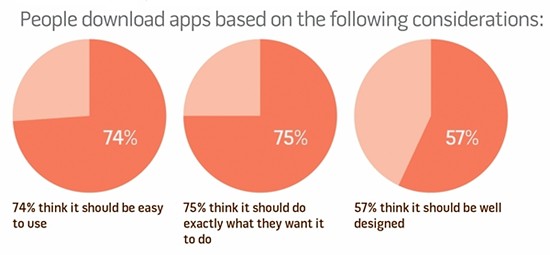
Mobile App Preferences
Sources: MarketingProfs; Harris Interactive and EffectiveUI field survey, 2010.

Meyer believes part of the dynamic at work is a knee-jerk “bias for action” as the marketing playing field shifts endlessly.

“It’s called ‘do it’ because everyone else is doing it, and it results in not only bad marketing, but in turned off consumers and customers,” he maintains.

Questions as simple as “What would you like to see in a mobile app?” … or testing an app concept with a sample of potential users before spending the effort and energy to produce it would be good places to start.

Marketers can use the research findings to adjust the proposed design of an app — or to trash it altogether and come up with an alternative one that actually meets a need.

If more companies did this, perhaps the 75% deletion rate for mobile apps would cease to be so flat-out dismal.