TV’s Disappearing Act

Television viewing among 18- to 24-year-olds reaches its lowest level yet. 

TV watchingThe latest figures from Nielsen are quite telling:  The decline in TV watching by younger viewers is continuing – and it’s doing so at an accelerating pace.

Looking at year-over-year numbers and taking an average of the four quarters in each year since 2011, we see that the average number of hours younger viewers (age 18-24) spend watching television has been slipping quite dramatically:

  • 2011: ~24.8 hours spent watching TV weekly
  • 2012: ~22.9 hours
  • 2013: ~22.0 hours
  • 2014: ~19.0 hours

It’s nearly a 25% decline over just four years.  More significantly, the most recent yearly decline has been at a much faster clip than Nielsen has recorded before:

  • 2011-12 change: -7.7%
  • 2012-13 change: -3.9%
  • 2013-14 change: -13.6% 

So far this year, the trend doesn’t appear to be changing.  1st quarter figures from Nielsen peg weekly TV viewing by younger viewers at approximately 18 hours.  If this level of decline continues for the balance of the year, watching TV among younger viewers will be off by an even bigger margin than last year.

There’s no question that the “great disappearing television audience” is due mainly because of the younger generation of viewers.  By contrast, people over the age of 50 surveyed by Nielsen watch an average of 47.2 hours of television per week — nearly three times higher.

picLest you think that the time saved by younger viewers is going into outdoor activities or other recreational pursuits and interests, that’s certainly not the case.  They’re spending as much time using digital devices (smartphones, tablets and/or PCs) as they are watching TV.

So, it’s a classic case of shifting within the category (media consumption), rather than moving out of it.

I don’t think very many people are surprised.

… And then there were two: Facebook is nipping at YouTube’s heels.

Facebook “grows up great” to challenge YouTube for video supremacy online.

FB vs YTOnly few years ago, YouTube was pretty much the only game in town when it came to online video.  And Facebook wasn’t even in the picture.

Today, the online video landscape looks far different.

In fact, Facebook is on track to deliver more than two-thirds as many video views as YouTube this year.  And both services have a comparable number of monthly users overall.

Recently, market forecasting firm Ampere Analysis surveyed ~10,000 consumers in North America and Europe.  Approximately 15% of them had watched at least one video clip on Facebook within the past month.

While Facebook hasn’t exactly caught up with YouTube, its rise has been pretty stunning — especially when you consider the massive head-start YouTube had.  More than five years, in fact, which is a lifetime in the cyberworld.

Undoubtedly, one reason for Facebook’s success in video is its “autoplay” feature which snags viewers who might otherwise scroll by video postings.  Facebook reports that it has experienced a ~10% increase in engagement as a result of adding this functionality.

And there’s another big advantage for advertisers that Facebook possesses.  Since its viewers are always logged in, Facebook has the potential to collect far more demographic and behavioral data on its viewers that advertisers can tap into to target specific demographics.

For now at least, Facebook doesn’t offer the option for ads to run before video clips begin playing (the ads appear after the content).  Also, Facebook’s ad charges kick in after just three seconds of the ad being shown, compared to YouTube which sets the bar higher for ad charges to take effect.

[Incidentally, Twitter has the same 3-second policy as Facebook, whereas Hulu charges only for ads viewed all the way through.]

Another difference is that Facebook charges for every ad view, so if a viewer watches a video twice — even if it’s the same video in the same viewer session — Facebook counts it as two views.  On YouTube, that would be considered one view, regardless of how many times the video is watched.

Of course, these kinds of differences can be adjusted — and there’s no reason to think that Facebook won’t do just that if it determines that making those changes are in their best business interest.

Besides, advertising rates are already similar between the two platforms, which suggests that advertisers have come to place a high value on Facebook’s robust audience targeting.

Autoplay features have raised some questions as to what constitutes a true video “view.”  If video ads are being autoplayed, views are easier to get, but are they worthwhile?  Also, the fact that autoplay videos are running without sound until such time as the viewer chooses to engage is causing some advertisers to create content that “make sense” even on mute.

But the bottom line on Facebook’s foray into video seems to be that the demographic and psychographic audience targeting Facebook can deliver is of important value to advertisers.

Add the fact that YouTube is no longer the only major online video platform, and it’s easy to see how significant competition from Facebook risks the loss of advertising dollars for YouTube, along with damaging YouTube’s growth prospects over time.

This is getting interesting …

The Ideal Privacy Policy?

policyRecently, I came upon a column written by software entrepreneur and business author Cyndie Shaffstall in which she proposes the following policy for any company to adopt that truly cares about its customers’ privacy:

The Ideal Privacy Policy:

1.  We have on file only your first name, last name, and e-mail address.

2.  We ask for nothing else.

3.  We send you only e-mails you request.

4.  We have nothing to share with others – and wouldn’t if they asked.

5.  We won’t change this policy without prior notice – ever. 

Thank you for being our customer, 

~ Your Grateful Vendor 

Cyndie Shaffstall
Cyndie Shaffstall

As Shaffstall herself acknowledges, she’s never actually seen a policy like this.

But if a company actually adopted such a policy, it would certainly make people more comfortable about purchasing its products — particularly things like phones, wearables and other products that capture and process user-specific data as part of their functionality.

Unfortunately, Shaffstall is correct in asserting that few if any companies would actually adopt such a privacy policy.  Because if they did, they’d be voluntarily walking away from so much of what makes the online world such a lucrative business proposition.

But think for a moment:  Wouldn’t it be absolutely wonderful if we didn’t have to consider such privacy policies “too good to be true”?

Do you know any real-live examples of companies whose privacy policies come close to this ideal?  If so, please share them with readers here.

Going up against Goliath: The latest privacy tussle with Facebook.

Is that Maria Callas?  Check with Facebook -- they'll know.
Is that Maria Callas? Check with Facebook — they’ll know.

It had to happen eventually:  Facebook’s “faceprints” database activities are now the target of a lawsuit.

The suit, which has been filed in the state of Illinois, alleges that Facebook’s use of its automatic photo-tagging capability to identify people in images is a violation of Illinois’ state law regarding biometric data.

Facebook has been compiling faceprint data since 2010, and while people may choose to opt out of having their images identified in such a way, not surprisingly, that option is buried deep within the Facebook “settings” area where most people won’t notice it.

Moreover, the “default” setting is for Facebook to apply the automatic photo-tagging feature to all users.

Carlo Licata, the lead individual in the class-action complaint filed in Illinois, contends that Facebook’s practices are in direct conflict with the Illinois Biometric Information Privacy Act.  That legislation, enacted in 2008, requires companies to obtain written authorization from persons before collecting any sort of “face geometry” or related biometric data.

The Illinois law goes further by requiring the companies gathering biometric data to notify people about the practice, as well as to publish a schedule for destroying the information.

Here’s how the lawsuit states its contention:

“Facebook doesn’t disclose its wholesale biometrics data collection practices in its privacy policies, nor does it even ask users to acknowledge them.  With millions of users in the dark about the true nature of this technology, Facebook [has] secretly amassed the world’s largest privately held database of consumer biometrics data.”

The response from Facebook has been swift – and predictable.  It contends the lawsuit is without merit.

As much as I’m all for of individual privacy, I suspect that Facebook may be correct in this particular case.

<em>Brave New World:</em>  Biometrics
Brave New World: Biometrics

For one thing, the Illinois law doesn’t reference social networks at all.  Instead, it focuses on the use of biometrics in business and security screening activities — citing examples like finger-scan technologies.

As Eric Goldman, a professor of law at Santa Clara University notes, the Illinois law is “a niche statute, enacted to solve a particular problem.  Seven years later, it’s being applied to a very different set of circumstances.”

And there’s this, too:  The Illinois law deals with people who don’t know they’re giving data to a company.  In the case of Facebook, it’s commonly understood user data is submitted with consent.

That may not be a particularly appealing notion … but it’s the price of gaining access to the fabulous networking functionality that Facebook offers its users – all at no expense to them.

And of course, millions of people have made that bargain.

That being said, there’s one nagging doubt that I’m sure more than a few people have about the situation:  The folks at Facebook now aren’t the same people who will be there in the future.  The use of faceprint information collected on people may seem quite benign today, but what about tomorrow?

The fact is, ultimately we don’t have control over what becomes the “tower of power” or who resides there.  And that’s a sobering thought, indeed.

What’s your own perspective?  Please share your thoughts with other readers here.

What are the latest trends in the popularity of different marketing communications channel tactics?

The DMA’s 2015 Response Rate Report provides answers.

marketing channelsPeriodically, the Direct Marketing Association conducts field research to take the pulse of marketers and the various channels they’re employing to support their marketing campaigns.

In the DMA’s most recent survey, conducted online this past December and January, marketers were asked which one of seven channels they utilize in their campaigns.  The seven choices listed were the following:

  • Direct mail marketing
  • E-mail marketing
  • Mobile marketing
  • Online display advertising
  • Paid search advertising
  • Social media advertising
  • Telemarketing

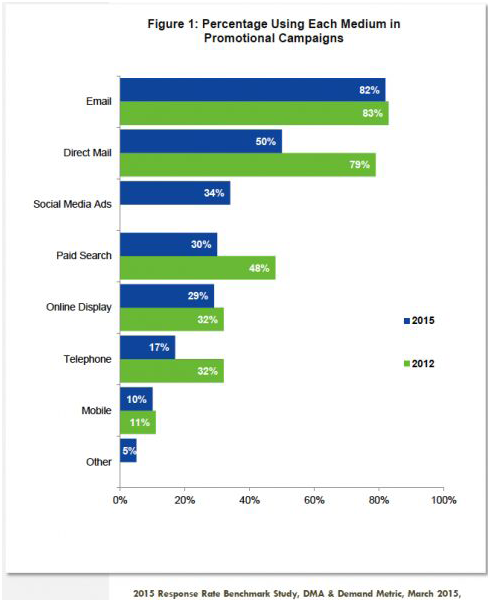
The results of the survey show that e-mail marketing remains King of the Hill when it comes to its popularity as a MarComm channel, with more than four in five marketers including the tactic as part of their promotional campaigns:

  • E-mail: ~82% use as a medium in promotional campaigns
  • Direct mail: ~50% use
  • Social media advertising:  ~34% use
  • Paid search: ~30% use
  • Online display advertising:  ~29% use
  • Telemarketing: ~17% use
  • Mobile marketing: ~10% use

Clearly, the research findings show that marketers are using multiple channels in their campaigns:  Two-thirds of the survey respondents use more than one channel, and around 45% of them reported that they’re using three or more channels in their promotional campaigns.

Social media advertising is a new entrant on the list in the DMA research.  It wasn’t even included in the DMA’s 2012 survey, yet today appears to be an important part of the channel mix.

On the other hand, mobile marketing remains a channel that isn’t being utilized by very many marketers — at least not yet.  In a similar survey conducted by the DMA in 2012, its adoption rate was similar to what the 2015 survey has found.

The graph below compares 2015 and 2012 survey results.  Aside from the lack of movement with mobile marketing, another interesting trend is the significant decline in the utilization of direct mail marketing.  Back in 2012, it rivaled e-mail marketing in popularity.  Today, only half of the marketers surveyed continue to use it as a marketing channel.

And a third big trend is the utter collapse of telemarketing as a popular MarComm channel — likely happening under the twin weight of high costs and massive phone message filtering.

DMA chart

In terms of future anticipated usage, the DMA research found that marketers are, in fact, warming to mobile marketing.  It and social media advertising are the two channels that have the best prospects for new adoption, based on the future intentions reported by these respondents.

The 2015 DMA report is available for purchase here.

Hotel brands and social media: Leading and following at the same time?

If you want to see an industry that’s using social media to best advantage, you needn’t look any further than the hotel trade.

hotels on FBMore than any other industry segment, hotel brands seem to have gotten a very good handle on the whole “local/global” concept.

Hotel properties that are part of a large chain or group originate from the main brand, of course.  And yet, the nature of the business means that they are individual entities as well, across the country and around the world.

For this reason, many local hotels that are part of larger chains have established their own individual social profiles.  That’s turned out to be a great way to attract more consumer engagement compared to social pages that are focused on global hotel branding.

Moreover, the social profiles of hotel properties are the perfect vehicle for promoting programs aimed at generating more bookings via local special offers, vacation deals and the like.

Recently, social media analytics firm Socialbakers researched some of the world’s largest hotel brand groups to determine the extent of their social media presence by looking at the seven most important platforms (Facebook, Twitter, Instagram, Google+, Tumblr, Pinterest and LinkedIn).

hilton logoAs it turns out, seven hotel brand groups have at least 1,000 separate social profiles on these platforms.  In the case of Hilton, it’s nearly 2,000:

  • Hilton Worldwide: ~1,850 separate profiles across the top seven social networks
  • InterContinental Hotels Group:  ~1,550 profiles
  • Marriott International:  ~1,300
  • Starwood Hotels & Resorts Worldwide: ~1,250
  • Wyndham Hotel Group: ~1,250
  • Accor: ~1,200
  • Best Western International:  ~1,000

In looking deeper at the extent of the social profiles these giant brands, Socialbakers found some interesting details that may point to certain individual strategic differences.  Among the findings were these:

.  Facebook is the most popular social platform for everyone – no question – with at least 50% of each brands’ social profiles housed there.

.  Twitter is the next most popular network, with profiles there representing between 20% and 40% of all social profiles for each brand.

.  Starwood Hotels and Accor are somewhat less Facebook-centric than the others – and they also have a more significant presence on Instagram and LinkedIn than the other brands.

.  Pinterest appears to be the least attractive major social platform for individual hotel profiles.

.  Hilton and Marriott have the largest number of social profiles in North America. 

It would seem that the big hotel brands are both leading and following when it comes to their social media presence.

While they may be ahead of the curve compared to many other industries, they are also following the lead of their own consumers – so many of whom rely on conducting their own online research and consulting user reviews to determine where they want to stay – not to mention the best room rates and deals they can find in order to do so.

How about you?  Like me, do you follow certain individual hotel properties on social media, or instead do you focus on hotel brands more broadly?  Please share your perspectives with other readers here.

Online customer care: Is retailer responsiveness going in opposite directions at once?

waiting for a responseAn interesting shift is happening in online customer care:  Response times are improving on social media while they’re getting worse in e-mail communications.

That’s what a new analysis by customer interactive software provider Eptica, as outlined in its 2015 Multichannel Customer Experience Study, is showing.

What Eptica has found is that retailers’ response times to answer customer queries posted on Twitter have improved dramatically in the past year.

Today, a customer query is being answered in an average time of a little over 4 hours.

That’s more than twice fast as in Eptica’s 2014 study, when the average response time clocked in at just over 13 hours.

In addition, the number of tweets successfully handled by retailers stands at around 43%, which is a full ten percentage points higher than what Eptica found in its 2014 study.

While more improvement is needed, the trend line is looking pretty good.  And it makes sense, since the “immediacy” of social media platforms is where many people believe a quick response should be forthcoming.

Crossing Lines

lines crossingBut while customer care response times via social media are improving, the opposite appears to be the case in e-mail customer service – and startlingly so.

Eptica’s evaluation shows that the average time it takes to respond to customer service queries submitted via e-mail is significantly longer than just a year ago.

Then, the average response time was ~36 hours.  Now, it’s nearly 44 hours – or nearly two days.

And while more e-mail customer service queries are successfully handled via e-mail when compared to tweets (~58% versus ~43%), that figure is worsening as well.  Last year, the percentage of e-queries successfully handled was ~63%.

More broadly, there continues to be a pretty significant disconnect between the “ideal” and the “reality” when it comes to online customer care and service.

Nearly all retailers provide an e-mail channel through which consumers may contact them.  But … less than three-fourths of them actually answer the e-mail messages they receive.  Moreover, the responses they provide – often automatically generated – don’t answer the customer’s question.

For a consumer with an issue or a concern, there’s little difference between getting no answer at all and receiving one that’s a “non-response response” in answer to a specific query.  Both seem to convey this message, “We don’t much care, because your issue just isn’t that important to us.”

Turning to social media, nearly 90% of major retailers have a presence on Twitter.  There, the “ignore” factor is even bigger than with e-mail:  ~45% don’t respond to their customers’ queries.

So while the social media figures certainly look better now than they did a year ago, it turns out there’s still a good ways needed to go.

Burgeoning social activity is no reason for retailers to take their foot off the gas pedal when it comes to supporting their customers via e-mail.  E-mail may not be the most exciting channel, but it’s the way millions of consumers prefer to communicate with retailers, companies and brands.  It’s counterproductive and foolish to diss them or treat them like second-class citizens.

In my own personal experience I’ve experienced the exact dynamics as described by Eptica at work – and I’m not afraid to name names.  TruGreen® Lawn Care did a stellar job of avoiding responding to my e-mail and phone queries … but it took less than two hours to get a response from someone at the firm after I posted a not-so-happy tweet about the company’s (lack of) responsiveness.

For me, the “public shaming” aspects of Twitter turned out to be far more of a squeaky wheel than the “private pleading” of an e-mail or phone message.

Do you have personal anecdotes of your own about the dynamics of online customer care?  Please share your thoughts and experiences with other readers here.

Banking on Facebook: The social media giant makes its first moves into the credit-card payments business.

untitledRecently, I blogged about how Google’s efforts to expand its business activities beyond pay-per-click advertising — thereby diversifying its revenue stream — haven’t borne much fruit.

In 2011, ~96% of Google’s revenues came from PPC advertising.  In 2014, it’s ~97%.

But Google isn’t the only behemoth whose income is completely tied to advertising.  Over at Facebook, ~93% of the company’s more than ~12 billion in revenues come from advertising as well.

Compared to Google, Facebook is a relative newcomer to the advertising game.  But once it got in on the action, its growth was very robust.

In 2014 alone, Facebook’s advertising revenues were up 58% over the previous year.

But … there’s a bit of a problem.  In a world where advertising revenues are tied to “eyeballs,“ Facebook’s user growth isn’t on the right trajectory.  When the network has nearly 1.5 billion active users already, there’s not a lot of room for expansion.

This is reflected in Facebook’s Q4 year-over-year percentage growth stats as published by Mediassociates, a media planning and buying agency:

  • 2009: ~260% year-over-year growth
  • 2010: ~69% growth
  • 2011: ~39% growth
  • 2012: ~25% growth
  • 2013: ~16% growth
  • 2014: ~13% growth

One can easily imagine 2015’s growth figure dipping into the single digits, giving Facebook all the hallmarks of being a mature company in a maturing market.

But the always-enterprising folks at Facebook have had something up their sleeve which they’re rolling out to the market now:  getting into the multi-billion credit-card payments business.

Facebook send money appThey’re starting small:  introducing a “send-friends-money” functionality to Facebook’s Messenger app.  But this rather innocuous addition hardly does justice to Facebook’s end-game strategy.

When you think about it, Facebook’s aims make a lot of sense.  With nearly 1.5 billion active users around the world, Facebook’s accounts make PayPal’s ~162 million active accounts seem pretty paltry by comparison.

But revenue from PayPal’s transaction tolls isn’t chump change at all:  nearly $8 billion last year alone.

Without doubt, Facebook is also looking at the huge amount of business done by American Express and VISA; think of the billions of dollars those companies earn by charging merchants between 2% and 3.5% on the value of each credit-card transaction.

Facebook’s entry into the business can be facilitated neatly through its Messenger mobile app, making it just as easy (or easier) to pay for goods and services as with a credit card.

Considering that Facebook’s users with mobile phones are already spending time on the network an average of an hour per day, it’s pretty easy to see how people could make the transition from traditional credit and debit card payments to using their Facebook app for precisely the same purposes.

And Facebook could sweeten the pot by working with retailers and marketers to offer real cash loads that would likely juice participation even more – sort of a cash rebate in advance of the purchase rather than afterward.

So we shouldn’t think of Facebook’s new “send-friends-money” feature as a one-off function.

Instead, it’s just the tip of the iceberg.  If I were a manager at VISA or AmEx, I’d be thinking long and hard about the real motivations – and real implications – of Facebook’s latest moves.

Bird dropping: Instagram overtakes Twitter in the social media derby.

Instagram logo

It seems like the jockeying for position among social networks is never-ending.

The latest case in point:  Instagram, which is presently the fastest growing social media network in the United States.

According to the latest figures released by digital market research company eMarketer, as of February 2015 Instagram now has over 64 million users in America.

That’s a ~60% increase in just one year, and it puts Instagram in third place among all social networks, surpassing Twitter for the first time.

Not only that, eMarketer forecasts that Instagram will add more than 10 million additional users in the United States this year:

  • Facebook: ~157 million U.S. users forecast in 2015
  • LinkedIn: ~115 million
  • Instagram: ~78 million
  • Twitter: ~53 million
  • Pinterest: ~47 million
  • Tumblr: ~20 million

       (Source:  eMarketer and LinkedIn, February 2015.)

eMarketer also forecasts that Twitter will continue to fall further behind Instagram in the upcoming years, since Twitter’s annual growth is expected to be in only the single digits throughout the rest of the decade.

Based on the overall American population, Instagram has now a market penetration of nearly 25%.  Of course, that’s well behind Facebook, which has nearly 50% penetration.

Untitled-1But Instagram’s user base is skewed heavily towards teens and millennials – people between the ages of 12 and 34.  This makes Instagram a bit more of a threat to LinkedIn and even Facebook than you might think at first.

Facebook’s user base has been skewing older in recent years.  If those trends continue, we could see a measurable drop-off in Facebook’s share of users, with a corresponding rise in Instagram’s penetration.

Of course, we mustn’t forget that Facebook was the social media network of choice for younger people at one time, too.  After all, it got its start on college campuses.  But now that Facebook has solid adoption among older Americans (age 40 and over), no longer does it seem like a “cool” network for some millennials and teens.

So it would be foolish to assume that Instagram is a slam-dunk to continue to be the “network of choice” for younger people in the years hence.  One never knows what new network might suddenly appear on the horizon and capture their hearts.

Still, Instagram’s rise has been noteworthy.  And it certainly puts the lie to the notion that there wasn’t room for a new network to enter the increasingly crowded social media space and make a big splash.

Personally as an “aging boomer,” I don’t have an Instagram account, and neither do most of my acquaintances.  What about your own personal experience or professional experiences with this network?

What’s the Latest Forecast on U.S. Ad Spending?

ad forecastingMost observers agree that 2015 will be a decent-or-better year for ad spending.  But how will it break down by media segment?

Industry and market forecasting firm Strategy Analytics has just released its latest U.S. advertising spend forecast, which it expects to total almost $190 billion.  That’s about a 3% increase over 2014.

But there are wide variations in the growth expectations depending on the media type.

Digital advertising leads the pack, with an expected growth increase in double digits, while at the other end of the scale, print advertising is forecast to drop by approximately 8%:

  • Digital advertising: 13.0% increase in 2015 U.S. ad spend
  • Outdoor advertising: +4.8%
  • Cinema advertising: +3.4%
  • Radio advertising: +1.8%
  • TV advertising: +1.7%
  • Print advertising: -7.9%

Of course, “digital advertising” is a broad category, and within it Strategy Analytics expects certain sub-categories to grow at a faster clip:  Social media advertising looks to be the star in 2015 (+31%), followed by video advertising (+29%) and mobile advertising (+20%).

Even with these lucrative growth expectations, search advertising (SEM) will continue to represent the lion’s share of digital ad revenues – around 45%.

Also, despite the dramatic growth of digital, the segment isn’t expected to break 30% of all U.S. advertising in 2015.  The more traditional TV ad segment continues to lead all others, although it has fallen below the 50% share of all advertising in recent years.

Here’s what Strategy Analytics is forecasting for ad expenditures by media segment for 2015:

  • TV advertising: ~$79 billion in 2015 U.S. ad spending
  • Digital advertising: ~$53 billion
  • Print advertising: ~$28 billion
  • Radio advertising: ~$18 billion
  • Outdoor advertising: ~$9 billion
  • Cinema advertising: ~$1 billion

Strategy AnalyticsLeika Kawasaki, a digital media analyst and one of the Strategy Analytics Advertising Forecast report’s co-authors, notes that  looking ahead to 2018, TV’s share of advertising revenue is expected to fall further to ~40%, while digital advertising’s share will reach ~35%.

However, it’s not that TV’s volume will be declining — it’s more that digital will be robbing more funds from other segments (particularly radio and print).

Additional details on the 2015 forecast can be viewed here — if you wish to shell out $7,000 for the report, that is.