Amazon’s (Somewhat) Surprising Shopping Stats

Shoppin on AmazonOver the years, Amazon has branched out greatly from its original focus on books and other media to offer all sorts of other merchandise.

In fact, these days people can buy pretty much anything on Amazon — assuming it’s legal.

Even so, I was somewhat surprised to read the tea leaves on some new findings released by Chicago-based Consumer Intelligence Research Partners.  This research firm surveyed ~1,100 Amazon customers, asking them about their most recent purchases on Amazon.

Categorizing the responses by type of merchandise, CIRP found that books are no longer the most popular products sold on Amazon.

Instead, pride of place now goes to top-ranked electronics products, with ~33% of the survey respondents reporting that those types of products were their most recent purchase on the site.

Books still maintain their high ranking; the category comes in second at ~20% of respondents.  (Incidentally, approximately one-third of those book purchases are e-books.)

Amazon’s Fresh service, which delivers groceries within 24 hours of ordering, has been operating in select West Coast cities for some time now — and it appears that the company has latched onto a winning formula.

In fact, the grocery category ranked third in the survey.

This surprised me:  Call me old school, but I still prefer to select my fresh meats and produce on my own, instead of relying on some anonymous “picker” to do it for me.

What were the bottom three merchandise categories found in the CIRP survey?  Sports-related purchases were low  … and music purchases were lower still (about half of them being music downloads, by the way).

Dead last is the automotive category.  No real surprise here, I don’t think.

Personally, I don’t know anyone who would feel comfortable purchasing a car online.  And since the vast majority of consumers don’t work on their cars either, it seems natural that most of them will continue to rely on their repair shops to procure the replacement parts and consumables they need for servicing their vehicles.

If you have particular merchandise you like to buy through Amazon — or if there is something really unusual that you’ve purchased from the site, please share your experiences with other readers here.

Software and security flaws: Even mighty Google isn’t immune.

Here’s a bit of news that doesn’t make one feel very reassured about cyber-security.

Gmail email accounts compromisedIt turns out that a major flaw has existed in the security of Google’s Gmail service for an extended period of time.

And that flaw could have been exploited to extract millions of Gmail addresses – potentially every single one of them, in fact.

What’s even more unnerving is that this flaw wasn’t uncovered by Google’s own engineers, but instead by security researchers in Israel who were kind enough to bring it to the company’s attention.

Thankfully, it was the “good guys” rather than the “bad” who made the discovery.

Evidently, the flaw resided in the sharing feature of Gmail that allows each user to delegate access to his or her Gmail account.

By “tweaking” the web address, the security researchers were able to reveal a random user’s e-mail address.

Once this procedure was proved out, scaling the hack was relatively easy.  By automating character changes using a software tool called DirBuster, the researchers were able to harvest approximately 37,000 Gmail address inside of two hours.

Oren Hafif, one of the security researchers involved in the exercise, blogged recently about the potential scope of the flaw:

“I brute-forced a token in a Gmail URL to extract all of the e-mail addresses hosted on Google.  I could have done this potentially endlessly.  I have every reason to believe every Gmail address could have been mined.” 

While the hack would not have exposed passwords explcitly, it could have left email accounts open to password-guessing attacks — not to mention unwanted spam mail or phishing.

Potentially, the breach could have affected not only personal users, but also businesses that use Google to host their email platforms.

Helpfully, the Israeli security researchers decided to inform Google of their discovery, preferring to be part of the solution rather than let the company twist in the wind.

So … are you ready for the kicker?

Reportedly, it took Google one full month to fix the software bug after being informed about it.

For a core service like email that is so central to the entire Google experience, one wonders why it took one of the world’s largest and most powerful companies weeks rather than just days to fix the problem.

If you’re looking for a redeeming or staisfying finale to this story … there really isn’t one.

Why?  Because in its infinite generosity, Google decided to reward Mr. Hafif for bringing the software flaw to its attention, in the form of a cash award.

One that really, really expressed thanks and appreciation for what he did.

Reportedly, the award amounted to US$500.

The hybrid car sizzle is fast becoming the hybrid car fizzle.

Well, that sure didn’t last long.

Hybrid autos:  Already riding off into the sunset?
Hybrid autos: Already riding off into the sunset?

News reports this week are stating that the market share of hybrid vehicles is now on the decline.

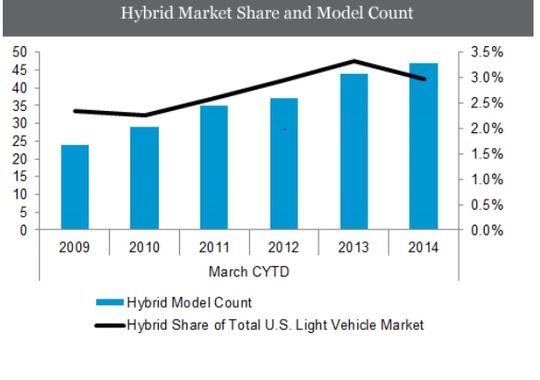
That is correct:  As of 1st Quarter 2014, hybrids only make up around 3% of the total car and light truck market in America.

Rather than an increase, that represents a pretty significant drop from nearly a 3.5% share of market just one year ago.

Here are the trend stats in graphic detail, courtesy of automotive statistics and intelligence firm IHS/Polk:

Hybrid Vehicle Stat ChartActually, the number of new hybrid car models being offered is still on the increase — now there are 47 different choices compared to around 25 in 2009, with Toyota’s five Prius models collected representing ~40% of the total hybrid market.  (The Prius share is down from ~55% in 2011, by the way.)

New model offerings or not … it’s pretty clear that the public’s interest in hybrid vehicles isn’t going up commensurately.  And the litany of reasons is all-too-familiar:

  • High car sticker price
  • Costly and complex batteries
  • Improved gas mileage and energy efficiency of conventional vehicles

Looking at the year-over-year trends, I think it’s doubtful that hybrid vehicles will ever achieve the high hopes the EPA and other federal officials have had for their adoption.

How embarrassing for them.

Instead, it seems more likely that the market will gravitate from the internal combustion engine straight to all-electric vehicles.  None of this “automotive hermaphrodite” stuff in between.

The more interesting question is this:  When will that shift occur?

To that one … not many people seem to have a definitive answer.

Living Life in Pictures

PhotographyYou know the old adage:  A picture is worth a thousand words.

Well, with the plethora of images being uploaded these days … we’re talking billions and billions of images and words.

Recently, Yahoo estimated that the number of images uploaded to the web is nearing 900 billion, which translates to nearly 125 photos for every person on the planet.

Facebook reports that it’s seeing more than 6 billion photos uploaded each month, on average.

And Instagram?  It’s reporting that nearly 28,000 photos are uploaded every minute.

Clearly, we love our photos.  And since digital technology makes it so easy to take good-quality photos and post them instantly, it seems people can’t get enough of doing so.

It’s an interesting twist — in a sense, taking us back to the cavemen days and illustrations on the walls.

Over the centuries, words and language have made it faster and easier to communicate, even as drawing, painting or developing photos using analog (film) technology was difficult and/or time-consuming.

In more recent times, Polaroid® photos gave us a more “instant” experience with images … but sharing them was no easlier than before.  (Plus, let’s be honest:  Most Polaroid shots were pretty lame in the quality department.)

Now that digital photography is as effortless as it is … it seems everyone is rushing back to pictures.

We’re even seeing it in the world of books.  Take Amity Shlaes’ book The Forgotten Man, about the Great Depression.  It came out in conventional form in 2008.

The Forgotten Man (Graphic Edition)But now, it’s being released in a picture book version:  The entire book has been re-imagined as an elaborate comic book, replete with illustrations by veteran graphic artist Paul Rivoche.

And based on the early indications, it looks like the new graphic version is going to outsell the original.

Is all of this some kind of regression to an earlier stage — a return to a sort of “collective adolescence writ large”?

I think not.  It’s more a function of “doing what’s possible.”

I think human beings have always gravitated to pictorial portrayals — which explains the immediate embrace of movies and television when those innovations came on the scene.

So when photography becomes so easy to produce and to share, it’s only natural that we’re going to have billions and billions of images swirling around as a result.

And why not?  Life’s all the richer because of it.

Time spent online daily: 2.5 hours and growing.

Lots of time spent onlineIf you’re wondering what happened to all of the community volunteer activities people used to do – not to mention the popularity of participating in group social or recreational activities like softball or bowling leagues … you might look at the time Americans are spending online as one possible explanation.

The evidence comes in the form of research the Interactive Advertising Bureau did when they contracted with GfK Research to conduct an extensive online survey as part of a larger behavioral analysis of American adults.

Fielded in late 2013 with participation from ~5,000 adults between the ages of 18 and 65, the IAB/GfK survey revealed that Americans are spending an average of 2.5 hours of every day online.

Add that on to the average ~5 hours per day spent watching TV – a figure that’s hardly budged in years – and it’s little wonder that the Jaycees, Shriners’ and other service organizations are finding it more difficult to recruit new members … or that “old faithful” group social and recreational activities are in danger of becoming less relevant.

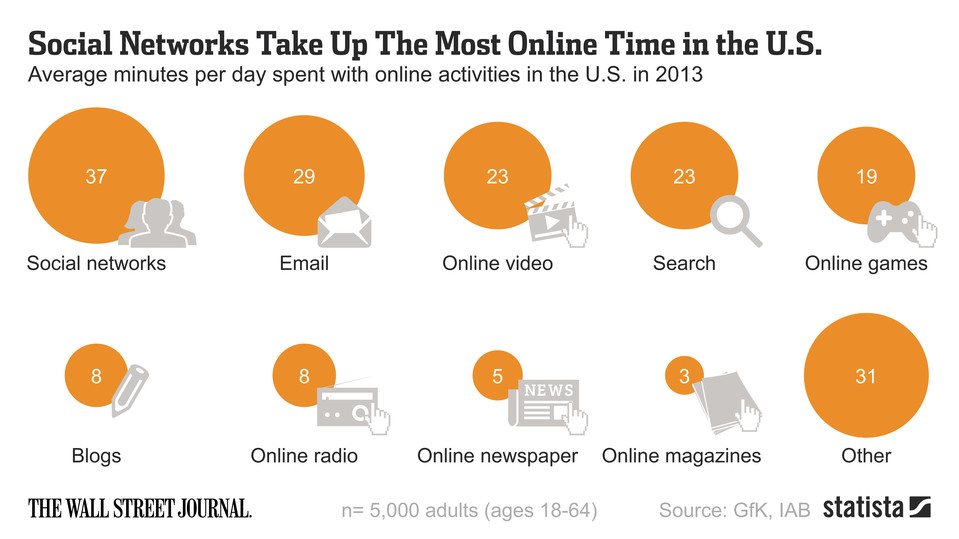
The IAB/GfK survey also revealed which types of online activities are engaged in the most.  The chart below, created by Statista from the IAB/GfK report’s data and published in The Wall Street Journal, gives us the lowdown:

Online Time (average per day)


I wasn’t surprised to discover that social networks chew up the most online minutes per day.  Online video viewing and search time seem about as expected, too.  And who doesn’t enjoy a nice game of Spider Solitaire or Internet Spades to wind down after a long day?

But at ~30 minutes per day, the e-mail average seems on the high side.  People must really be struggling with managing personal inboxes stuffed with marketing e-mails.  (But if work-related e-mails are part of the equation, the half-hour figure seems more expected.)

Comparing these results to similar research done in prior years, the most recent survey charts an increase in online video watching; it’s doubled over the past four years.

Other activities that are on the rise include online gaming, and listening to online radio.

Adding it all up, total time spent online is continuing its inexorable rise thanks to mobile connectivity and the “always-on” digital environment in which Americans now live.

Perhaps the way to stem reduced interest in group social activities and volunteerism lies in giving people free reign to “multitask” even as they participate in the local bowling league or Ruritan Club meetings …

What are your thoughts on the time people are spending online – and if it’s crowding out other forms of daily activities?  Please share your thoughts with other readers here.

Ipsos Reid Poll: Female Execs Gauge Their Advances

women managers and executivesAn interesting Ipsos Reid poll of female executives conducted late last year sheds light on what the perceived career holdbacks are for women in the workforce these days.

The results of the online survey, which queried ~500 American women working in managerial or executive roles, suggest that women continue to face obstacles in advancing their careers to upper-level management and executive positions … although the disparities are less today – and hopefully continuing the trend toward parity.

An example of one perception which continues to show a big divide between women and men is this:  While ~37% the survey respondents feel that physical appearance and personal image are factors in career progression for men, nearly all (~90%) believe that they are for women.

On the other hand, the perceived differences are less stark when it comes to opportunities for career progression based on the gender of a female employee’s immediate superior.  When asked how gender affects the chances for women to obtain a managerial position, here’s how the respondents answered:

If the superior is a woman …

  • 26% better chance for advancement
  • 30% worse chance for advancement
  • 44% no difference

If the superior is a man …

  • 26% better chance for advancement
  • 25% worse chance for advancement
  • 49% no difference

… Which translates into trust levels that aren’t so very different at all:

  • ~22% would trust a man more for help with career advancement
  • ~18% would trust a woman more for help with career advancement
  • ~60% express no difference in trust levels

Positive Work Attributes

The Ipsos/Reid survey also found that nearly two-thirds of the respondents consider women to be better leaders than men, primarily for these five reasons:

  • Women are better communicators
  • They are more organized
  • They are more empathetic
  • They have a better understanding of the needs of their employees
  • They are more open to changing their approach

For the record, two attributes that respondents do not attribute to women over men are:

  • Women have better instincts than men
  • They are more invested in an organization’s success compared to men.

With a confident self-image and backed by positive work habits, what do these respondents see as the biggest continuing challenges to their career growth?  Here’s what the Ipsos Reid survey found:

  • The requirement for women to work harder and put in longer hours to prove themselves: ~77%
  • Managing work and family balance: ~61%
  • External factors (economic climate/job loss): ~56%
  • Being welcomed into an established senior management team:  ~48%
  • Dealing with outdated perceptions of women in managerial and executive roles: ~48%
  • Lack of female mentors: ~47%

Moreover, ~78% of respondents discern a “noticeable” different in salaries between men and women.

Asked what a company might “fear” about promoting women to senior managerial and executive posts, the respondents cited several probable factors:  the fear that an executive might want to start and maintain a family … and the fear of too many absences from work due to family obligations.

Bottom line, the Ipsos Reid survey reveals some continuing obstacles for women in the executive-level work force.  But there’s positive news, too.  Additional survey findings can be found here.

If you have additional observations or perspectives on this topic, please share them with other readers here.

LinkedIn: The “Other” Social Network Makes its Move

linkedinWe may be reading quite a few news reports these days about Facebook and Twitter facing a plateau in usage … but LinkedIn’s fortunes continue to be on the upswing (financial losses notwithstanding).

In late April, the social network reported that it now has more than 300 million active members throughout the world, which is up more than 35% since the beginning of the year.

Too, the gender gap in membership is narrowing, albeit more slowly:  Today, ~44% of LinkedIn members are women, up from ~39% in 2009.

Even more impressive for a network that has the lofty goal of “creating economic opportunity for every one of the 3.3 billion people in the global workforce,” is the fact that two-thirds of LinkedIn’s active members are located outside the United States.

This is underscored by the top three countries represented  in LinkedIn’s membership, which are the U.S. (#1), India (#2) and Brazil (#3).

worldwide membersLinkedIn’s latest international push is into China, where it seeks to add more than 140 million Chinese professionals to its membership rolls.

Mobile Movement

The increased use of “smart” mobile units has affected the ways users interact with LinkedIn as well; mobile traffic is expected to overtake desktop access later this year.

[In fact, that’s already happened in markets like the United Kingdom, Singapore and Sweden.]

Here are a few “factoids” that illustrate how significant mobile has become for LinkedIn operating as the world’s mobile employment bazaar:

  • Average number of LinkedIn profiles viewed daily via mobile devices:  ~15 million
  • Average number of job position openings viewed daily via mobile:  ~1.5 million
  • Average number of job applications submitted daily via mobile:  ~44,000

Despite these healthy usage figures, a continuing challenge for LinkedIn is the degree to which it has been able to “monetize” its membership.  Among U.S. members, the average revenue-per-user is hovering around $11.30.

That’s much better than the ~$3.75 average revenue-per-user amount for members overseas.  But it’s still well below the revenue-per-member figures being charted by Facebook, which helps explain LinkedIn’s continuing revenue and profit challenges.

Still, when you consider that LinkedIn is becoming the de facto “Help Wanted” public square for the professional world, it’s hard to criticize its business model as the “go-to resource” for human resources professionals involved in personnel recruitment.

And now that the platform has a an active membership north of 300 million people, it’s hard seeing how that dynamic is going to change going forward; LinkedIn really is in the catbird seat when it comes to recruitment.

Speaking personally, I’m glad LinkedIn is resisting going the route of Facebook and Twitter in their evolving “all advertising, all the time” revenue models.  If LinkedIn can continue to derive a large chunk of its revenue stream from recruitment solutions instead of relying on display advertising or sponsored posts that are too often distracting or irritating, so much the better for us.

Gallup: A prestigious college isn’t a clear ticket to career happiness or personal fulfillment.

collegesThe latest shoe to drop in the growing notion that a college education may not be all it’s cracked up to be comes in the form of a Gallup survey released this month that reveals that attending a prestigious institution of higher learning won’t make a person any happier in life or work when compared to graduating from a less selective one.

The Gallup survey of nearly 30,000 college graduates in all age groups, which was conducted in concert with researchers from Purdue University, asked respondents how they were doing in life across a range of factors such as income and “engagement” in their jobs.

Interestingly, the Gallup research was advocated by former Indiana Governor Mitch Daniels, now the president of Purdue University, who reported to The Wall Street Journal that he had encountered a lack of benchmarked data to measure the value of a college degree.

“There is a lot we don’t know about higher education, and there is a sense it’s skating on its reputation,” Mr. Daniels remarked.  “We needed to know with more rigor how well the experience is serving people.”

The resulting survey conducted by the Gallup organization found that fewer than 40% of the college graduates surveyed feel “engaged at work” — in that they enjoy what they do on a daily basis and are intellectually and emotionally connected to their work.

An even lower percentage – just 11% – thought of themselves as “thriving” in all of the major aspects of their lives such as financial stability, having a strong social network, and feeling a sense of purpose.

And how do graduates of the most “selective” institutions fare against others?  According to Gallup, there’s no discernable difference at all.

That is correct:  The survey found that graduating from a Top 100 school has no bearing on the level of future happiness or fulfillment in work or in life.

college debtWhat does have a big impact — in a negative way — is college debt.  Only about 2% of respondents who reported between $20,000 and $40,000 in student loan debt reported that they are “thriving.”

On the positive side of the ledger, what does seem to correlate with greater happiness and fulfillment is having had the experience of a professor take an interest in the student.  These teachers served as a mentor or helped make the learning experience exciting for the student.

The Gallup survey found that those kinds of experiences tend to translate into more optimism, curiosity and engagement in later life and careers — leading to greater fulfillment.

I have immediate family members who have attended all types of higher educational institutions — from Ivy League schools and “New Ivies” to private colleges, public universities and even community colleges.  Time and again, I’ve seen this phenomenon play out just as the Gallup survey suggests.

The fact is … broadly speaking, American higher education is quite good.  One can receive a good education almost anywhere, provided a student studies hard and takes advantage of the opportunities that are available (internships, work-study programs, exchange programs and and so forth).

It wasn’t so true a generation ago.  Back then, the prestigious schools had clear advantages in terms of their top educational staffs, great libraries, and worldwide connections in the educational and business communities.

Today, thanks to the Internet, distance learning and more people with PhDs, even the less selective schools have quality staffing, access to unlimited “virtual” library resources, and similarly stronger connections worldwide.

There continues to be a difference between the prestigious schools and the rest of the pack, of course.  At a place like Amherst or Williams, essentially all of the students are smart as a whip and highly motivated, whereas that’s not going to be the case at a state university.

But at all of the schools, the best students are actually very similar across the board … and they have similar opportunities available to apply to their advantage.

On top of this, there are many fields of study where the “best” education you can get isn’t going to be at an Ivy League school.  Think about the ag degrees at Iowa State University (Ames) or the structural engineering coursework at the Missouri University of Science & Technology (Rolla) as just two examples.

Bottom line, here’s where things stand:  If students want to learn and are willing to study hard … they can get a good education at pretty much any school they choose to attend in America.  And it will lead to a fulfilling professional and personal life later.  “Prestige” has very little to do with it.

Twitter: The social platform that’s less important today than it was yesterday.

Twitter losing lusterTwitter hasn’t mattered to very many people for a very long time.

Of course, for some it hasn’t mattered even from its inception. But when we start reading about Twitter’s most avid users and how they’ve begun to drift away from using the social platform like they’ve done in the past … you know that more than just the atmospherics are changing.

A case in point about this evolution is an article that was published in late April by The Atlantic titled “A Eulogy for Twitter.

The article’s authors, Adrienne LaFrance and Robinson Meyer, begin their piece by writing:

“We’ve been trying to figure out the moment Twitter turned, retracing tweets to see whether there was something specific that soured the platform.  

“Something is wrong on Twitter. And people are noticing. Or at least, the kind of people we hang around with on Twitter are noticing … audience-obsessed, curious, newsy … The thing is, its users are less active than they once were. Twitter says these changes reflect a more streamlined experience, but we have a different theory: Twitter is entering its twilight.”

Those are strong words. But the authors back up their assertions by noting that while people may still be using Twitter, many of them are no longer “hanging out” there. And that’s because there’s less “there there” to sustain once highly-engaged Twitter users.

The perceptions of Twitter’s value have been changing because of three key precepts which are now being proven out as “fictions,” according to LaFrance and Meyer.

What are those “fictions”?

  • The belief that other people in the “Twitterverse” are actually paying attention — or at least that a decent portion of one’s followers are seeing the tweets. 
  • The belief that competent and compelling tweeting will increase a person’s Twitter follower base. 
  • The confidence of knowing that there is a useful potential audience beyond current followers, so that the time and energy spent on the platform will pay dividends. 

None of these premises has turned out to be correct in the long-haul. Instead, the following stark realities fly in the face of all the hope (or hype):

  • Twitter is positively stuffed with “spam” accounts. In fact, the median number of followers for a Twitter account is … exactly one. Even if a few of those accounts are actually “legit,” of what value are they to anyone? 
  • Twitter’s year-over-year growth rate has fallen significantly since 2011.

And here’s another clear indication of how Twitter has morphed into something quite different from its original character. Today, Twitter is more likely to be merely a place to promote content published someplace else in cyberspace, simply providing quick links over to that content.

Whereas in the past, journalists and celebs and others were posting statements and opinions — and replying to or retweeting the posts of others — now it’s more likely to be canned promotion and little more.

… Which sets up a downward spiral, because followers aren’t seeing anything particularly new or interesting that they’re not already encountering elsewhere. So interest wanes … leading to reduced participation … leading to even less consideration of Twitter’s “worth” as a social platform.

This phenomenon of “professionalized accounts” means little more than being a bulletin board of scheduled tweets and broadcast links, resulting in collective yawns all over the place.

Of course, there’s one aspect of Twitter than continues its joyride unabated: hate speech and profanity. But that’s the sort of content many people would just as soon avoid encountering.

LaFrance and Meyer conclude that the world may have “outgrown” Twitter. They’re not happy by that turn of events, writing:

“For a platform that was once so special, it would be sad and a little condescending to conclude that Twitter is simply something we’ve outgrown. After all, the platform has always been shaped by the people who congregate there. So if it’s no longer any fun, surely we’re at least partly to blame.”

The authors go on to note:

“Twitter has done for social publishing what AOL did for e-mail. But nobody has AOL accounts anymore … [Today,] Twitter feels closed off — choked — in a way that makes us want to explore somewhere else for a while.”

It may not be time for Twitter’s eulogy. But there are many who don’t see much of a second act for the social platform, either.

By the way … where are those “somewhere elses” in social media that LaFrance and Meyer allude to? Try Snapchat, Instagram … even LinkedIn.  That’s where the interesting action is happening these days.

The VW Van Rides into History

T1 Type 2 VW Van
“T1 Type 2” VW van, manufactured by Volkswagen from 1950 to 1967.

Last week, a front-page article in The Wall Street Journal profiled the continuing attraction of ca. 1970s vans, decked out with all sorts of custom accessories and wild paint jobs.

It turns out, the vans are still so popular with a certain (aging?) segment of the American population, annual van rallies around the country attract thousands of participants.

But the article reminds us that, after more than 60 years of production and 10 million made, the very last VW vans came off the assembly line at the end of last year. That’s when Volkswagen’s Transporter van plant in metro São Paulo, Brazil shut down production.

Reportedly, production stopped because of new air bag and anti-lock braking system requirements for 2014 that were impossible to incorporate into the VW van’s design.

Brazil was the last place on earth where the iconic VW “bus” was being manufactured.  A plant in Mexico stopped producing the classic version of the van in 1995. European production had already been halted as far back as 1979 because the VW no longer met the minimum vehicle safety requirements on that continent.

But the true glory days of the VW van stretch back even further … to when the vehicle was synonymous with laid-back “hippie” lifestyles in the 1960s and early 1970s in the United States.

VW Type 2 Van
“T2 Type 2” VW van, manufactured by Volkswagen from 1968 to 1979.

Known by all sorts of nicknames (the Shaggin’ Wagon and Sin Bin are two of my favorites), the van served as “rolling homes” for many people.

It so reflected the popular culture of the day, the vehicle was featured on pop music album covers for the Beach Boys, Bob Dylan and others.

Bob Dylan album coverDamon Ristau, who directed a documentary film about the VW bus, said this about its mystique:

“It has a magic and charm lacking in other vehicles. It’s about the open road, about bringing smiles to peoples’ faces when they see an old WV van rolling along.”

For many Americans, the vision of a VW van transporting young, bronzed dudes and their surfboards to the California beaches is an iconic image. But the VW van’s brand identity is not at all like that in other parts of the world.

In places like Africa and Latin America, the vans were pressed into more mundane service — serving as mini-school buses, transporting troops, hauling merchandise or construction materials – even moving the mail.

In Brazil, the VW van is known as the “Kombi,” which is short-hand for the German term “Kombinations-fahrzeug” – or “combination transport vehicle.”

Over the years, the van developed a reputation for being breakdown-prone. But the flipside of this problem was that the VW’s simple engine design made it easy to repair.  So it was very popular with its owners — in a sort of ironic twist.

As one Brazilian van owner was quoted saying recently, “Driving a Kombi with your face up against the windshield is a thrilling experience … There is no other van that is so easy and inexpensive to maintain. Anyone with a minimum amount of knowledge about engines and a few tools can fix a Kombi.”

So it seems that no matter whether the VW van has been used for business or for pleasure, it has engendered similar feelings of attachment and affection.

The last VW van may have rolled off the assembly line and into history. But I suspect that many of the vehicles will be with us for decades to come – just like the 1950s American “fin” cars that continue to ply the streets of Havana five or six decades on.

Indeed, as long as there are people with a sense of wanderlust and the lure of the open road to beckon them, the VW bus will remain part of the cultural and emotional landscape in America.