Ipsos Reid Poll: Female Execs Gauge Their Advances

women managers and executivesAn interesting Ipsos Reid poll of female executives conducted late last year sheds light on what the perceived career holdbacks are for women in the workforce these days.

The results of the online survey, which queried ~500 American women working in managerial or executive roles, suggest that women continue to face obstacles in advancing their careers to upper-level management and executive positions … although the disparities are less today – and hopefully continuing the trend toward parity.

An example of one perception which continues to show a big divide between women and men is this:  While ~37% the survey respondents feel that physical appearance and personal image are factors in career progression for men, nearly all (~90%) believe that they are for women.

On the other hand, the perceived differences are less stark when it comes to opportunities for career progression based on the gender of a female employee’s immediate superior.  When asked how gender affects the chances for women to obtain a managerial position, here’s how the respondents answered:

If the superior is a woman …

  • 26% better chance for advancement
  • 30% worse chance for advancement
  • 44% no difference

If the superior is a man …

  • 26% better chance for advancement
  • 25% worse chance for advancement
  • 49% no difference

… Which translates into trust levels that aren’t so very different at all:

  • ~22% would trust a man more for help with career advancement
  • ~18% would trust a woman more for help with career advancement
  • ~60% express no difference in trust levels

Positive Work Attributes

The Ipsos/Reid survey also found that nearly two-thirds of the respondents consider women to be better leaders than men, primarily for these five reasons:

  • Women are better communicators
  • They are more organized
  • They are more empathetic
  • They have a better understanding of the needs of their employees
  • They are more open to changing their approach

For the record, two attributes that respondents do not attribute to women over men are:

  • Women have better instincts than men
  • They are more invested in an organization’s success compared to men.

With a confident self-image and backed by positive work habits, what do these respondents see as the biggest continuing challenges to their career growth?  Here’s what the Ipsos Reid survey found:

  • The requirement for women to work harder and put in longer hours to prove themselves: ~77%
  • Managing work and family balance: ~61%
  • External factors (economic climate/job loss): ~56%
  • Being welcomed into an established senior management team:  ~48%
  • Dealing with outdated perceptions of women in managerial and executive roles: ~48%
  • Lack of female mentors: ~47%

Moreover, ~78% of respondents discern a “noticeable” different in salaries between men and women.

Asked what a company might “fear” about promoting women to senior managerial and executive posts, the respondents cited several probable factors:  the fear that an executive might want to start and maintain a family … and the fear of too many absences from work due to family obligations.

Bottom line, the Ipsos Reid survey reveals some continuing obstacles for women in the executive-level work force.  But there’s positive news, too.  Additional survey findings can be found here.

If you have additional observations or perspectives on this topic, please share them with other readers here.

LinkedIn: The “Other” Social Network Makes its Move

linkedinWe may be reading quite a few news reports these days about Facebook and Twitter facing a plateau in usage … but LinkedIn’s fortunes continue to be on the upswing (financial losses notwithstanding).

In late April, the social network reported that it now has more than 300 million active members throughout the world, which is up more than 35% since the beginning of the year.

Too, the gender gap in membership is narrowing, albeit more slowly:  Today, ~44% of LinkedIn members are women, up from ~39% in 2009.

Even more impressive for a network that has the lofty goal of “creating economic opportunity for every one of the 3.3 billion people in the global workforce,” is the fact that two-thirds of LinkedIn’s active members are located outside the United States.

This is underscored by the top three countries represented  in LinkedIn’s membership, which are the U.S. (#1), India (#2) and Brazil (#3).

worldwide membersLinkedIn’s latest international push is into China, where it seeks to add more than 140 million Chinese professionals to its membership rolls.

Mobile Movement

The increased use of “smart” mobile units has affected the ways users interact with LinkedIn as well; mobile traffic is expected to overtake desktop access later this year.

[In fact, that’s already happened in markets like the United Kingdom, Singapore and Sweden.]

Here are a few “factoids” that illustrate how significant mobile has become for LinkedIn operating as the world’s mobile employment bazaar:

  • Average number of LinkedIn profiles viewed daily via mobile devices:  ~15 million
  • Average number of job position openings viewed daily via mobile:  ~1.5 million
  • Average number of job applications submitted daily via mobile:  ~44,000

Despite these healthy usage figures, a continuing challenge for LinkedIn is the degree to which it has been able to “monetize” its membership.  Among U.S. members, the average revenue-per-user is hovering around $11.30.

That’s much better than the ~$3.75 average revenue-per-user amount for members overseas.  But it’s still well below the revenue-per-member figures being charted by Facebook, which helps explain LinkedIn’s continuing revenue and profit challenges.

Still, when you consider that LinkedIn is becoming the de facto “Help Wanted” public square for the professional world, it’s hard to criticize its business model as the “go-to resource” for human resources professionals involved in personnel recruitment.

And now that the platform has a an active membership north of 300 million people, it’s hard seeing how that dynamic is going to change going forward; LinkedIn really is in the catbird seat when it comes to recruitment.

Speaking personally, I’m glad LinkedIn is resisting going the route of Facebook and Twitter in their evolving “all advertising, all the time” revenue models.  If LinkedIn can continue to derive a large chunk of its revenue stream from recruitment solutions instead of relying on display advertising or sponsored posts that are too often distracting or irritating, so much the better for us.

Gallup: A prestigious college isn’t a clear ticket to career happiness or personal fulfillment.

collegesThe latest shoe to drop in the growing notion that a college education may not be all it’s cracked up to be comes in the form of a Gallup survey released this month that reveals that attending a prestigious institution of higher learning won’t make a person any happier in life or work when compared to graduating from a less selective one.

The Gallup survey of nearly 30,000 college graduates in all age groups, which was conducted in concert with researchers from Purdue University, asked respondents how they were doing in life across a range of factors such as income and “engagement” in their jobs.

Interestingly, the Gallup research was advocated by former Indiana Governor Mitch Daniels, now the president of Purdue University, who reported to The Wall Street Journal that he had encountered a lack of benchmarked data to measure the value of a college degree.

“There is a lot we don’t know about higher education, and there is a sense it’s skating on its reputation,” Mr. Daniels remarked.  “We needed to know with more rigor how well the experience is serving people.”

The resulting survey conducted by the Gallup organization found that fewer than 40% of the college graduates surveyed feel “engaged at work” — in that they enjoy what they do on a daily basis and are intellectually and emotionally connected to their work.

An even lower percentage – just 11% – thought of themselves as “thriving” in all of the major aspects of their lives such as financial stability, having a strong social network, and feeling a sense of purpose.

And how do graduates of the most “selective” institutions fare against others?  According to Gallup, there’s no discernable difference at all.

That is correct:  The survey found that graduating from a Top 100 school has no bearing on the level of future happiness or fulfillment in work or in life.

college debtWhat does have a big impact — in a negative way — is college debt.  Only about 2% of respondents who reported between $20,000 and $40,000 in student loan debt reported that they are “thriving.”

On the positive side of the ledger, what does seem to correlate with greater happiness and fulfillment is having had the experience of a professor take an interest in the student.  These teachers served as a mentor or helped make the learning experience exciting for the student.

The Gallup survey found that those kinds of experiences tend to translate into more optimism, curiosity and engagement in later life and careers — leading to greater fulfillment.

I have immediate family members who have attended all types of higher educational institutions — from Ivy League schools and “New Ivies” to private colleges, public universities and even community colleges.  Time and again, I’ve seen this phenomenon play out just as the Gallup survey suggests.

The fact is … broadly speaking, American higher education is quite good.  One can receive a good education almost anywhere, provided a student studies hard and takes advantage of the opportunities that are available (internships, work-study programs, exchange programs and and so forth).

It wasn’t so true a generation ago.  Back then, the prestigious schools had clear advantages in terms of their top educational staffs, great libraries, and worldwide connections in the educational and business communities.

Today, thanks to the Internet, distance learning and more people with PhDs, even the less selective schools have quality staffing, access to unlimited “virtual” library resources, and similarly stronger connections worldwide.

There continues to be a difference between the prestigious schools and the rest of the pack, of course.  At a place like Amherst or Williams, essentially all of the students are smart as a whip and highly motivated, whereas that’s not going to be the case at a state university.

But at all of the schools, the best students are actually very similar across the board … and they have similar opportunities available to apply to their advantage.

On top of this, there are many fields of study where the “best” education you can get isn’t going to be at an Ivy League school.  Think about the ag degrees at Iowa State University (Ames) or the structural engineering coursework at the Missouri University of Science & Technology (Rolla) as just two examples.

Bottom line, here’s where things stand:  If students want to learn and are willing to study hard … they can get a good education at pretty much any school they choose to attend in America.  And it will lead to a fulfilling professional and personal life later.  “Prestige” has very little to do with it.

Marketers Give Themselves Only Middling Grades on Understanding ROI

Marketing frustrationIt turns out that even the practitioners in the marketing field don’t think they’re doing a very good job of understanding the return on investment on key marketing tactics.

That’s a major takeaway fnding from the most recent State of Search Marketing survey conducted by digital marketing information clearinghouse Econsultancy in conjunction with the Search Engine Marketing Professional Organization (SEMPO).

This survey of industry professionals is conducted annually.  The 2013 research cycle queried ~400 industry and marketing/communications agency professionals.

One would think that in an evolving field like digital marketing, the degree of collective skill in the discipline would be rising over time.  But the opposite appears to be the case – at least in terms of the professionals’ own self-assessment of their skills.

The SEMPO research report presents how marketers consider their level of understanding to be in terms of ROI factors.

What the research reveals is a pretty stark decline in self-assessment grades between the 2012 and 2013 surveys:

  • Understanding of paid search ROI:  ~47% consider their understanding to be “good” (down from ~79%)
  • Email communications ROI:  ~41% consider good (down from ~57%)
  • Digital display media ROI:  ~28% consider good (down from ~37%)
  • Social media ROI:  ~11% consider good (down from ~15%)

What’s the reason for the decline in these self-assessment ratings?

It could be ever-changing definitions of what each of these marketing tactics actually encompass.

… It may be that there is an actual decline in overall proficiency as more people are assigned these marketing tasks who have little or no relevant knowledge or prior training.

… Or if could be the rapid speed in which technology is evolving in the marketing sphere.  (Big data isn’t the half of it.)

Of the major marketing tactics addressed by the Econsultancy/SEMPO research, it’s clear that social media and mobile are the most mystifying to practitioners, judging from the percentage of survey respondents that profess to have a “poor” understanding of their ROI:

  • Social media ROI:  ~51% report having a “poor” understanding
  • Mobile marketing ROI:  ~35%
  • Search engine optimization ROI:  ~28%
  • Digital display advertising ROI:  ~26%
  • Paid search ROI:  ~19%
  • Email marketing ROI:  ~14%

Underscoring the admitted lack of understanding about ROI in social and mobile channels, the survey respondents reported that only ~11% of the digital marketing dollars in 2014 will be allocated to social media.

For mobile marketing, it’s even lower (~3% of the marketing budget).

This isn’t to imply that marketers don’t recognize the importance of these tactics.  For instance, more than eight of ten respondents consider mobile marketing to be a significant development in the field.

It’s just that many of them are having great difficulty going from Point A to Point B when it comes to quantifying the marketing payback.

[For access to the full report, which also provides interesting insights on the most popular marketing metrics, go to this page on the SEMPO website.]

Is it time to change daylight savings time – and time zones – once and for all?

changing the timeEach time we Americans need to change our clocks, it’s accompanied by an undercurrent of grumbling about how disruptive it can be to our daily routines.

Indeed, in certain states that are in close physical proximity to time zone boundaries, the issue can be controversial enough to affect the popularity of elected officials, as has happened in Indiana and Arizona.

Daylight savings time, an innovation that became popular in the 1970s, continues to be a nettlesome issue because of when it is in effect in the United States – nearly a month earlier and a month later than before … and no longer in sync with other countries (if they even observe DST — and many of them don’t).

Daylight savings time is supposed to be more energy-efficient.  But it turns out the energy savings are minimal if any.  Uncoordinated time changes could very well undermine economic efficiency far more than any positive impact in energy savings.

A case in point:  Lack of synchronization with European time changes is estimated to cost the airline industry nearly $150 million in travel disruptions each year.

Moreover, some investigations have found that daylight savings time may actually cause worker productivity to be lower.

Does the current time zone structure have to be cast in stone?  Of course not.  The history of “time” is actually one of pretty constant change, dating all the way back to when time zones were first implemented in the 1880s.

Before then, each city and town had its own local time which was established by calculating the solar time in the local location using sundials.  Effectively, this meant that there were more than 300 different time zones in the U.S.A.

The American railroads were more streamlined:  They operated with only about 100 time zones.

Clearly, introducing four time zones for the continental U.S. was a way to introduce simplicity while compromising only a little regarding human biorhythms.

Of course, it took awhile for the time zone system to be adopted worldwide, but eventually it happened.

The economic and commercial landscape looks far different today than in the late 19th Century.  We are no longer bound by the physical limitations of geography in terms of how we do business.

As a result, some economists are suggesting that it’s time to overhaul the time zone structure and to move to a system that is even simpler and less disruptive to people’s lives.

One economist, Allison Schrager, has come up with the most radical solution I’ve seen yet.  Drawing from economic models plus her own experiences working across multiple time zones, Dr. Schrager has put forward the following recommendations:

  • Scrap daylight savings time altogether
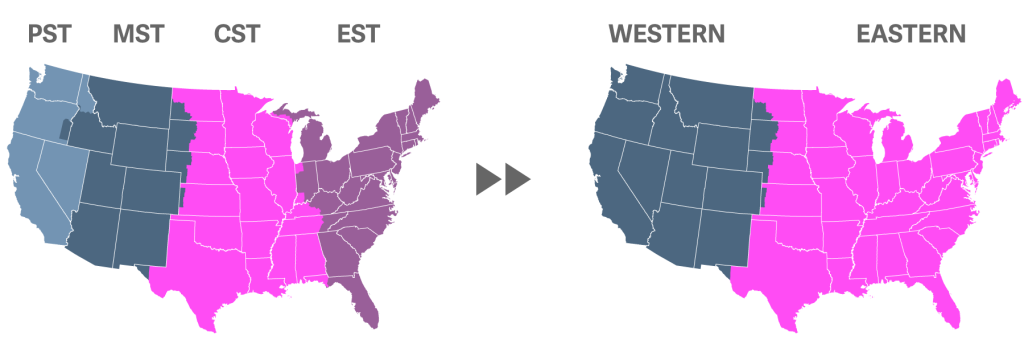
  • Consolidate and reduce the four current continental U.S. time zones (Eastern, Central, Mountain, Pacific) to just two (Eastern, Western)

Under the Schrager scenario, the new time zone map for the continental United States would look like this:

simplified time zone mapDr. Schrager points out that, while a fewer number of larger time zone geographies would seem to remove some people further from their “true” time zone, the realities of global commerce are already doing that anyway.

By contrast, she sees the benefits as more major.  For example, frequent travel between time zones under today’s four zones causes jet lag, robbing employees of productive work time.

With just a one-hour time difference between New York and California, bi-coastal travel would become almost effortless in that regard, Schrager maintains.

As for the disruption such a change might cause to international business coordination, Dr. Schrager contends that just as it took one or two countries to start things off in the 1880s, someone needs to step up to the plate today to start a new trend.

She says:  “… America won’t line up with the time zones of countries directly north and south unless this catches on as a global trend.  But the discontinuity ship already sailed when rich Western countries haphazardly adopted daylight savings time and most other countries didn’t.  Time is already arbitrary; why not make it work in our favor?”

Does Dr. Schrager raise some good points?  Would simplifying the time zone map and ditching daylight savings time be a “net positive” or not?

Some of her arguments seem to make sense to me.  What do you think?  Please share your thoughts with other readers if you’re so inclined.

The sober reflection on the healthcare.gov website is … really sobering.

superman brandBy now, nearly everyone has read or heard news reports about the “slow-motion train wreck” that is the newly minted Federal healthcare exchange.

It’s not only late-night comedians who are piling on.  It’s people like a senior technology officer at one of the major social media sites who texted, “It was a uniquely incompetent team that worked on their website.”

“Uniquely incompetent”:  Now there’s a sound-bite for you.

Those two words may do more to bury the notion that government-managed healthcare is a good thing than all of the political opposiion’s ideological arguments put together.

But as I often do with domestic policy challenges, I turn to my brother, Nelson Nones, who has lived and worked overseas for years – for an outsider’s perspective.

Here’s what Nelson wrote to me:

healthcare.gov landing pageFrom what I’m seeing, it’s going to be a long, long time before the Federal healthcare exchange website (healthcare.gov) works properly.

To see why, take a look at this article just published by Forbes magazine: http://www.forbes.com/sites/anthonykosner/2013/10/21/obamacares-website-is-crashing-because-backend-was-doomed-in-the-requirements-stage/.

If the article’s diagnosis is true, then the entire back-end may need to be re-architected.

That’s not something one can do quickly with a “tech surge” of “the best and brightest from both inside and outside government to scrub in with the team and help improve healthcare.gov,” as the Department of Health & Human Services put it on Sunday and President Obama reiterated on Monday.

According to the various news articles I’ve seen, the cost of designing and developing the website was initially estimated at $94 million and had risen to $292 million by last May. This seems like a lot of money, but you have to put things in perspective.

A personal observation:  I was recently involved in the testing of an enterprise resources planning (ERP) and manufacturing execution system implementation for a large multinational manufacturing company.  The total cost of this project was slightly north of $200 million.  This was the price-tag for an application used by about 6,000 people at a single manufacturing site (albeit a large one).

It, too, was plagued with problems when we went live, and it took almost a year to fix the problems – in fact these problems and their impact on supply chain performance warranted a note in the company’s annual report.  

Just like in what the Forbes article reported, the great majority of the problems traced back to the requirements stage – as I warned the senior management at this company (repeatedly) during the design phase.

For the healthcare.gov website, it seems to me that even $292 million is a low-ball figure considering the site has to support tens of millions of users (not 6,000) in a whole country (not just a single manufacturing site).  The Forbes article suggests that the $292 million was invested primarily on the front end, without attempting to consolidate the databases that sit on the back end.

This implies that the back-end design and development were woefully shortchanged — and as a result the front end doesn’t work.

Perhaps things would have gone better if $1 billion had been invested properly the first time around.

Unfortunately, from (painful) experience I can tell you that it’s almost impossible to invest wisely in architectural improvements while you’re in the middle of a crisis, so I’d bet the final price tag is likelier to hit $2 billion.

And … because that $2 billion won’t be invested wisely either, the problems will take longer to fix.

My prediction?  Two years.

In distilling all of this down to its essence, you can’t do much better than the famous words of Michael Dukakis, former governor of Massachusetts and one-time presidential candidate:

“It’s not about ideology.  It’s about competence.”

Sprawl & Crawl: Are work commutes actually worse than you think?

DC traffic
It turns out politics isn’t the only kind of gridlock in Washington, DC. It also has more traffic gridlock than anywhere else in the country.

This past weekend, The Wall Street Journal published a feature story in its “Personal Journal” section that profiled how businesspeople cope with their daily work commutes

It turns out that the average daily work commute in the United States takes about 25 minutes

Another interesting statistic from the article is the amount of time car commuters in larger cities spend stuck in traffic:  52 hours annually, or about an extra hour per week.

The WSJ story profiled several people who access mass transportation for their work commutes, as well as one businessman who relocated from the Washington, DC Metropolitan area to Metro Cincinnati, substantially reducing his daily commute time and hassle in the process.

As someone who lives not far from the DC Metro area and who contemplates any drive through the region with a mixture of disdain and dread, this got me to wondering:  Just what is the worst geographic market for commuting?

Helpfully, there’s a recently completed study that answers this very question.  The Transportation Institute at Texas A&M University has applied a calculation tool called the Planning Time Index (PTI) to compare drive times in heavy traffic (i.e., rush hour) against travel times when the same highways are clear.

The way the PTI calculation works is this:  A PTI of 2.00 means that a “normal” drive will take twice as long in heavy traffic. 

Using that PTI=2.00 example, a drive that may ordinarily take ~20 minutes will take ~40 minutes instead.

My suspicions about the DC Metro area turned out to be right on the money.  Here are the most “challenging” metro markets for work commutes based on their PTI indices:

  • Washington DC:  5.72 PTI index
  • Los Angeles:  4.95
  • New York-Newark:  4.44
  • Boston:  4.25
  • Dallas-Ft. Worth-Arlington:  4.00
  • Seattle:  3.99
  • Chicago:  3.95
  • San Francisco-Oakland:  3.74
  • Atlanta:  3.71
  • Houston:  3.67

How do these PTI indices translate into actual drive times?  Shockingly, a DC-area commute that ordinarily takes 20 minutes translates into almost two hours in heavy traffic. 

And among all of the other “top ten” worst markets, that normally 20-minute commute  will take 1.2 hours or longer in rush-hour traffic.

Interestingly, when one scans the “Top Ten” list, the only Midwest urban area that shows up on it is Chicagoland.  So if you wish to avoid the hassle of long commutes, consider relocating to urban markets in the Midwest like St. Louis, Minneapolis-St. Paul, Cleveland, Milwaukee or Kansas City.

But what’s the absolutely easiest metro market for commuting?  According to the Texas A&M study, it would be Pensacola in Florida.  It has a PTI of just 1.31. 

… Which means only about six extra minutes in rush traffic compared to the ordinary 20-minute commute.

Come to think of it … Pensacola has great beaches and nice sea breezes as well.  Perhaps dealing with the occasional hurricane is worth it, all hassles considered!

Chalk one up for the taxpayers: Government travel-related spending declines significantly.

dollarcutsCan it be possible that widespread public revulsion at the level of federal government conference and travel expenditures has actually had a positive impact?

It seems so, if new financial reporting is to be believed.

According to recent reports filed by the General Services Administration, federal travel card spending has declined ~17% so far in FY 2013 compared with the same period last year. 

That’s for the GSA’s SmartPay charge card program which covers more than 2.5 million cardholders.  And it’s the second year in a row that we’ve seen a drop in expenditures:

  • FY 2011:  $9.6 billion
  • FY 2012:  $8.9 billion
  • FY 2013 (YTD):  $6.0 billionGSA conference follies

According to GSA officials, the decline in travel-related spending has happened because of “aggressive steps” taken to cut conference spending in the wake of embarrassing revelations that a single GSA conference in Las Vegas in 2010 had cost American taxpayers nearly $825,000. 

The fact that this meeting included paying clowns and mindreaders to lead group discussions added an absurd twist on the entire affair.

clownIn May 2012, the Office of Management and Budget issued a memo directing federal agencies to reduce their travel-related spending by 30% compared to 2010 levels – and to maintain those levels through FY 2016.

Another directive required agencies to report spending on any conference that exceeds $100,000.

Looking out over the government agency landscape, it appears that most agencies have made some pretty big strides towards meeting the new standards. 

Comparative travel expense figures released by the GSA for FY 2013 through July against FY 2012 over the same period show these declines:

  • General Services Administration:  -62%
  • Veterans Administration:  -31%
  • Treasury:  -30%
  • Energy:  -25%
  • Commerce:  -23%
  • Labor:  -23%
  • Environmental Protection Administration:  -21%
  • Housing & Urban Development:  -21%
  • Defense:  -19%
  • Justice:  -19%
  • Transportation:  -18%
  • State:  -16%
  • Interior:  -12%

A few agencies did show increased travel expenditures.  Most significantly, the Small Business Administration doubled its expenses due to Hurricane Sandy and other natural disasters that required additional travel associated with putting manpower on location to provide financial assistance to homeowners, renters and businesses.

But taken as a whole, these expenditure drops are unprecedented. 

I wonder how many people would have predicted it – even though most people I know figure that there’s plenty of “fat” to cut within these agencies without hurting the programs.

It’s just that … we so rarely hear of reports like this in government.

And of course, there’s plenty of grousing to go around about the new realities.  One Department of Defense official who requested anonymity was quoted as saying, “When someone craps their pants, we all have to wear diapers.  This is hardly the way to run the DOD efficiently.”

And then there’s this:  Lest you think that we’ve put a lid on excess travel-related expenditures for good, the GSA has just announced that it will be unfreezing per diem rates for FY 2014.

That is correct:  The GSA is now increasing the lodging, meal and incidental allowances that federal employees are reimbursed for expenses incurred while on official travel.  It’s going up to $129 in most markets within the 48 contiguous states.

Maybe they think people won’t notice …

Manufacturing in America: It is poised for a comeback?

American Made Movie (Documentary)On Labor Day weekend, the documentary film American Made Movie opened in theatres in key cities across the country.  And for a change, this film doesn’t chronicle the decline of American manufacturing, but instead its potential for rebirth.

Directors Vincent Vittorio and Nathan McGill have produced a film that’s both realistic and optimistic – two words that aren’t often used in conjunction with one another when the topic is manufacturing.

The directors don’t shy away from the facts:  U.S. manufacturing jobs shrinking from ~$17 million to just ~$12 million in the past 20 years due to technology, global competitiveness and outsourcing.

But there are signs of recovery.  At least the anectodal evidence for it is strong.

In August, Wal-Mart organized a manufacturers’ summit which was attended by ~1,500 people including U.S. and foreign-based companies, Department of Commerce and Federal Reserve officials, and eight state governors.

At this meeting, Wal-Mart affirmed its commitment to buy $50 billion in additional American-made products over the next 10 years.  GE, Element and other companies also announced plans to boost domestic manufacturing activities.

These developments aren’t merely patriotic or altruistic — although there may be some of that factoring into the decision.

In fact, with Chinese labor costs rising 15% to 20% each year, that country’s labor cost advantage is narrowing compared to the United Sates.

Harold Sirkin of Boston Consulting Group points out that factoring in raw materials and other costs, China maintains only a ~3% lead on product costs.  Add in transportation costs from Asia, and the “Made in America” alternative takes on new validity.

“We are at an inflection point,” Sirkin has stated, noting that the United States is now competitive with China.

GE’s chief executive officer Jeff Immelt echoes these sentiments, contending that on a relative basis, America has never been more competitive thanks to technology and improved productivity.

“High transportation costs mean you want to be closer.  It’s not just pure labor arbitrage,” Immelt notes.

As for productivity, the mere three hours it takes to assemble a GE refrigerator in America makes its total cost lower than a similar Chinese or Mexican-made models destined for the American market, according to Immelt.

I like what I’m hearing about the coming resurgence in American manufacturing … but I think we’ve heard this prediction before. 

The film directors discovered this inconvenient issue when traveling the United States and visiting manufacturing plants from large cities to small towns:  There’s a sizable gap between what manufacturers need in human capital, and the ability of the labor force to meet those requirements – whether it be older workers, or young workers right out of school.

Vincent Vittorio and Nathaniel McGill, movie directors
“American Made Movie” documentary film directors Vittorio and McGill.

“We need to provide the apprenticeship training necessary for a new generation of American workers to grow as fast as our technology is changing,” the documentary movie directors contend.

That may be happening at some technical colleges and a few community colleges across America.  But it’s not happening nearly enough if, like me, you hear constant complaints from manufacturing execs about the disconnect between the lack of (even basic) job skills and (increasingly sophisticated) job requirements on the manufacturing line.

Maybe it’s time to look harder at appropriating pieces of the German/Austrian apprenticeship model, wherein talented students are plucked from high school and placed with manufacturing firms for on-the-job training in lieu of college.

In such environments, a structured program of learning and training provides the roadmap for successful transition and integration into the job force.

An apprenticeship may not seem as “classy” an accomplishment as a college diploma.  But a college diploma doesn’t mean nearly as much these days.

What once was a sure-fire ticket to a career has given way to an environment in which half of all new college graduates are unemployed, underemployed, or working jobs for which their degree is irrelevant or unnecessary.

To that half of the young labor force, the near-100% placement/success rate for apprenticeships must seem awfully attractive now.

What are your thoughts about a coming manufacturing renaissance in America?  Please share your comments here.

Google finds that in hiring practices, what’s old is new again.

Google hiring practices
Google Gone Retro: Its hiring practices look more familiar than different today.

Has Google made an about-face when it comes to the way it hires staff?

Over the years, there have been numerous articles written about Google’s unorthodox and highly selective recruitment and interviewing process

The company seemed to take a certain delight in the degree to which it subjected job candidates to mind-bending suitability tests and humiliating proctology-like HR examinations.

So I was a bit surprised to read this June 19, 2013 article in the New York Times, in which staff business reporter Adam Bryant published excerpts from an interview he had with Laszlo Bock, senior vice president of people operations at Google.

A major objective of the interview was to determine to what degree so-called “Big Data” can be used to help find the right candidates fill leadership and managerial positions in companies.

Instead of giving us all sorts of ways in which Big Data is helping to do that, Mr. Bock focused instead on the limitations.  And in the process, he revealed that Google has made attempts to harness more experiential data to come up with more effective hiring practices.  Here’s what he said:

“We’ve done some interesting things to figure out how many job candidates we should be interviewing for each position, who are better interviewers than others, and what kind of attributes tend to predict success at Google.

On the leadership side, we’re looking at what makes people successful leaders and how we can we cultivate that.”

And what about some of the more infamous Google hiring practices, such as looking at college transcripts from a million years ago or asking people to solve impossible “challenge questions” or equations?  Bock revealed these learnings:

“We found that brainteasers are a complete waste of time.  How many golf balls can you fit into an airplane?  How many gas stations in Manhattan?  A complete waste of time.  They don’t predict anything.  They serve primarily to make the interviewer feel smart.”

And about GPA stats, Bock revealed that after all of the data crunching, Google’s HR department came to this conclusion:

“GPAs are worthless as a criteria for hiring, and test scores are worthless – no correlation at all, except for brand-new college grades where there’s a slight correlation … we found that they don’t predict anything.

After two or three years, your ability to perform at Google is completely unrelated to how you performed when you were in school, because the skills you required in college are very different.  You’re also fundamentally a different person.  You learn and grow.  You think about things differently.”

So now Google has reverted to the tried-and-true formula of structured behavioral interviews, consistently applied across all applicants. 

This includes using standardized behavioral questions to listen to open-ended responses, which then makes it possible to see how candidates actually interacted in real-world situations, as well as what they consider to be “easy” or “difficult” situations in which they found themselves.

Regarding leadership qualifications, according to Bock, Google has found that these are ambiguous or amorphous characteristics:

“For leaders, it’s important that people know you are consistent and fair in how you think about making decisions, and that there’s an element of predictability.  If a leader is consistent, people on their teams experience tremendous freedom because then they know that within certain parameters, they can do whatever they want.”

Where “big data” comes in to play here is in twice-a-year employee surveys that Google conducts on all of its managers, evaluating a variety of factors. 

Those factors are the fundamental ones — things like sharing information, treating all team employees fairly, and providing clear goals and performance standards.

But Bock cautions that leadership success is highly dependent on the context; what works at one company isn’t necessarily right for another firm.  “I don’t think you’ll ever replace human judgment and human inspiration and creativity,” he notes.

I was pleased to read these comments, because I always felt that attempting to develop a radically new paradigm for job hiring, while being an interesting and novel endeavor, was also somewhat presumptuous on the part of Google. 

At the end of the day, human nature is what it is:  fickle, unpredictable, fallible.  No amount of “re-engineering” is going to change that.