Work/family gender roles are changing … even if the media portrayals of them aren’t.

Work and family nexusIt may be the year 2014, but many people continue to wander gracelessly through the gender minefield when it comes to the workplace.

We saw this in spades two weeks ago, when the Today Show’s Matt Lauer asked General Motors Chief Executive Mary Barra how she successfully balanced her role as CEO of a large corporation with that of being a Mom.

Mr. Lauer was excoriated for asking the question, with criticism coming from all quarters (left and right).  He was accused of sexist questioning.  Several commentators pointed out that he had never asked such a question of the male top executives he had interviewed earlier at GM and Chrysler.

Mr. Lauer correctly noted that Ms. Barra had addressed this very issue proactively in a magazine article, and hence he thought the line of questioning was fair game.

Still, the fact that a flurry of controversy was stirred up at all reminds us how emotionally charged questions about gender roles continue to be, several generations after the birth of the feminist movement.

In point of fact, gender roles have been evolving pretty rapidly in the past two or three decades.  Sparked by economic and employment forces as well as changes in social norms, more men than ever are choosing to stay home with family, even as the participation of women in the workforce has reached all-time highs.

And field research conducted in May 2014 by consulting firm Insights in Marketing suggests that it’s men more than women who now feel that they’re facing struggles and stigmas associated with achieving a good work/family balance.  To wit:

Among men surveyed who have children under the age of 18, ~35% report that they are “feeling more torn between work and family” … whereas with women with children under the age of 18, only ~26% report the same feelings.

Here’s another result from the same survey:  By a 57% to 41% margin, men are more likely than women to agree with the following statement:  “A man’s primary duty is to financially provide for his family.”

Those figures may not come as a surprise.

By contrast, nearly the same percentages of men (78%) and women (74%) disagree with the statement that “A woman’s primary duty is to be a full-time caretaker for her family.”

According to the research summary issued by Insights in Marketing, these findings suggest that certain gender stereotypes are no longer accurate:  Society truly accepts (and even expects) women to be a part of the workforce, while expecting men to care only about their careers.

Instead, the survey reveals much more similarities than differences in how women and men see their family and work roles:

  • ~81% of women surveyed feel that their first obligation is to their home and family … and ~75% of the men surveyed feel the same way.
  •   ~48% of men surveyed feel that their career gives their lives purpose … but ~40% of the women surveyed also reported the same feeling.

Even though real change is happening on the ground, it’ll probably take more time before we start seeing the change being reflected in popular culture — and so that Matt Lauer can ask a question without incurring the wrath of a thousand baying wolves.

Remember that, too, the next time you see a TV commercial for laundry detergent.  You know — the one where Dad is some doofus who puts way too much soap in the washing machine and then can’t figure out when to add the fabric softener …

More findings from the Insights in Marketing report are available here.

Personality and Productivity in the Workplace: When Grumpy is Good

NoWhen it comes to which characteristics people consider the most important for being successful in the working world, we hear same traits cited so often, it becomes like a litany.

A recent survey of ~500 business managers in the communications and technology fields, conducted by digital education company Hyper Island, confirms it yet again.

When the survey respondents were asked to identify which traits were most important, here were their top answers:

  • A winning personality (e.g., creative, open-minded, positive):  ~78% identified as among the most desirable traits.
  •  Cultural alignment (making decisions that reflect the values shared with their organization):  ~53% identified as among the most desirable traits.
  •  The skill-sets of the worker:  Only ~39% identified this as the most important trait.

Regarding skill-sets, it seems that despite the inexorable increase in technical expertise and acumen required of workers in nearly every business discipline, many people continue to believe that personality, attitude and a team mentality trump capabilities and expertise.

In other words, it’s the notion that it’s easier to educate someone with a positive attitude than it is to work with someone who really knows his or her stuff, but has a bad attitude, is a wet dishrag, or whatever.

unhelpful employeeWell, hold that thought.  Because now we have new research from analysts at the University of Pennsylvania and the University of Illinois which is giving us another angle to consider.

In their studies, these researchers have found that workers with “net-negative” personality traits appear to be more efficient in their jobs than those who possess “net-positive” personalities.

What’s going on?

To come to this conclusion, the university researchers had their study participants meticulously document all of their activities over a prescribed period of time, along with completing a survey that measured attitudes about their jobs, their workplace and their colleagues.

As it turns out, it’s not that one group puts in more time than the other at the office.  It’s that workers with “sunnier” dispositions are more open to performing tasks that may be outside of their comfort zone.

They’re more inclined to “have a go” at different activities, because they’re naturally more curious … and more willing to step in and support the larger work team.

… Especially if their boss requests it.

By contrast, grumpier employees are less open to novelty … more suspicious of taking on other tasks … and more likely to put up subtle (or not-so-subtle) psychological barriers when it comes to being approachable about taking on those tasks.

By their behavior and body language, they may often be successful in dissuading their superiors from even asking them to take on new and different job tasks.

And if they’re asked, they’re less likely to acquiesce.

As a result, these employees tend to spend more time on a fewer variety of tasks – the ones they already know.  Which, in turn, makes them more likely to further hone their skills in those areas.

I don’t think these new findings challenge the underlying idea that employees with a positive attitude are a strong asset to companies.

But perhaps a smidgeon more credit may be due to the employees who are on the other end of the scale.  When you find them sitting alone in the break room, or avoiding gathering around the water cooler, they may be investing more amount of time in their work tasks — and developing a higher level of skill as a result.

I guess every cloud has a silver lining …

Ipsos Reid Poll: Female Execs Gauge Their Advances

women managers and executivesAn interesting Ipsos Reid poll of female executives conducted late last year sheds light on what the perceived career holdbacks are for women in the workforce these days.

The results of the online survey, which queried ~500 American women working in managerial or executive roles, suggest that women continue to face obstacles in advancing their careers to upper-level management and executive positions … although the disparities are less today – and hopefully continuing the trend toward parity.

An example of one perception which continues to show a big divide between women and men is this:  While ~37% the survey respondents feel that physical appearance and personal image are factors in career progression for men, nearly all (~90%) believe that they are for women.

On the other hand, the perceived differences are less stark when it comes to opportunities for career progression based on the gender of a female employee’s immediate superior.  When asked how gender affects the chances for women to obtain a managerial position, here’s how the respondents answered:

If the superior is a woman …

  • 26% better chance for advancement
  • 30% worse chance for advancement
  • 44% no difference

If the superior is a man …

  • 26% better chance for advancement
  • 25% worse chance for advancement
  • 49% no difference

… Which translates into trust levels that aren’t so very different at all:

  • ~22% would trust a man more for help with career advancement
  • ~18% would trust a woman more for help with career advancement
  • ~60% express no difference in trust levels

Positive Work Attributes

The Ipsos/Reid survey also found that nearly two-thirds of the respondents consider women to be better leaders than men, primarily for these five reasons:

  • Women are better communicators
  • They are more organized
  • They are more empathetic
  • They have a better understanding of the needs of their employees
  • They are more open to changing their approach

For the record, two attributes that respondents do not attribute to women over men are:

  • Women have better instincts than men
  • They are more invested in an organization’s success compared to men.

With a confident self-image and backed by positive work habits, what do these respondents see as the biggest continuing challenges to their career growth?  Here’s what the Ipsos Reid survey found:

  • The requirement for women to work harder and put in longer hours to prove themselves: ~77%
  • Managing work and family balance: ~61%
  • External factors (economic climate/job loss): ~56%
  • Being welcomed into an established senior management team:  ~48%
  • Dealing with outdated perceptions of women in managerial and executive roles: ~48%
  • Lack of female mentors: ~47%

Moreover, ~78% of respondents discern a “noticeable” different in salaries between men and women.

Asked what a company might “fear” about promoting women to senior managerial and executive posts, the respondents cited several probable factors:  the fear that an executive might want to start and maintain a family … and the fear of too many absences from work due to family obligations.

Bottom line, the Ipsos Reid survey reveals some continuing obstacles for women in the executive-level work force.  But there’s positive news, too.  Additional survey findings can be found here.

If you have additional observations or perspectives on this topic, please share them with other readers here.

LinkedIn: The “Other” Social Network Makes its Move

linkedinWe may be reading quite a few news reports these days about Facebook and Twitter facing a plateau in usage … but LinkedIn’s fortunes continue to be on the upswing (financial losses notwithstanding).

In late April, the social network reported that it now has more than 300 million active members throughout the world, which is up more than 35% since the beginning of the year.

Too, the gender gap in membership is narrowing, albeit more slowly:  Today, ~44% of LinkedIn members are women, up from ~39% in 2009.

Even more impressive for a network that has the lofty goal of “creating economic opportunity for every one of the 3.3 billion people in the global workforce,” is the fact that two-thirds of LinkedIn’s active members are located outside the United States.

This is underscored by the top three countries represented  in LinkedIn’s membership, which are the U.S. (#1), India (#2) and Brazil (#3).

worldwide membersLinkedIn’s latest international push is into China, where it seeks to add more than 140 million Chinese professionals to its membership rolls.

Mobile Movement

The increased use of “smart” mobile units has affected the ways users interact with LinkedIn as well; mobile traffic is expected to overtake desktop access later this year.

[In fact, that’s already happened in markets like the United Kingdom, Singapore and Sweden.]

Here are a few “factoids” that illustrate how significant mobile has become for LinkedIn operating as the world’s mobile employment bazaar:

  • Average number of LinkedIn profiles viewed daily via mobile devices:  ~15 million
  • Average number of job position openings viewed daily via mobile:  ~1.5 million
  • Average number of job applications submitted daily via mobile:  ~44,000

Despite these healthy usage figures, a continuing challenge for LinkedIn is the degree to which it has been able to “monetize” its membership.  Among U.S. members, the average revenue-per-user is hovering around $11.30.

That’s much better than the ~$3.75 average revenue-per-user amount for members overseas.  But it’s still well below the revenue-per-member figures being charted by Facebook, which helps explain LinkedIn’s continuing revenue and profit challenges.

Still, when you consider that LinkedIn is becoming the de facto “Help Wanted” public square for the professional world, it’s hard to criticize its business model as the “go-to resource” for human resources professionals involved in personnel recruitment.

And now that the platform has a an active membership north of 300 million people, it’s hard seeing how that dynamic is going to change going forward; LinkedIn really is in the catbird seat when it comes to recruitment.

Speaking personally, I’m glad LinkedIn is resisting going the route of Facebook and Twitter in their evolving “all advertising, all the time” revenue models.  If LinkedIn can continue to derive a large chunk of its revenue stream from recruitment solutions instead of relying on display advertising or sponsored posts that are too often distracting or irritating, so much the better for us.

Gallup: A prestigious college isn’t a clear ticket to career happiness or personal fulfillment.

collegesThe latest shoe to drop in the growing notion that a college education may not be all it’s cracked up to be comes in the form of a Gallup survey released this month that reveals that attending a prestigious institution of higher learning won’t make a person any happier in life or work when compared to graduating from a less selective one.

The Gallup survey of nearly 30,000 college graduates in all age groups, which was conducted in concert with researchers from Purdue University, asked respondents how they were doing in life across a range of factors such as income and “engagement” in their jobs.

Interestingly, the Gallup research was advocated by former Indiana Governor Mitch Daniels, now the president of Purdue University, who reported to The Wall Street Journal that he had encountered a lack of benchmarked data to measure the value of a college degree.

“There is a lot we don’t know about higher education, and there is a sense it’s skating on its reputation,” Mr. Daniels remarked.  “We needed to know with more rigor how well the experience is serving people.”

The resulting survey conducted by the Gallup organization found that fewer than 40% of the college graduates surveyed feel “engaged at work” — in that they enjoy what they do on a daily basis and are intellectually and emotionally connected to their work.

An even lower percentage – just 11% – thought of themselves as “thriving” in all of the major aspects of their lives such as financial stability, having a strong social network, and feeling a sense of purpose.

And how do graduates of the most “selective” institutions fare against others?  According to Gallup, there’s no discernable difference at all.

That is correct:  The survey found that graduating from a Top 100 school has no bearing on the level of future happiness or fulfillment in work or in life.

college debtWhat does have a big impact — in a negative way — is college debt.  Only about 2% of respondents who reported between $20,000 and $40,000 in student loan debt reported that they are “thriving.”

On the positive side of the ledger, what does seem to correlate with greater happiness and fulfillment is having had the experience of a professor take an interest in the student.  These teachers served as a mentor or helped make the learning experience exciting for the student.

The Gallup survey found that those kinds of experiences tend to translate into more optimism, curiosity and engagement in later life and careers — leading to greater fulfillment.

I have immediate family members who have attended all types of higher educational institutions — from Ivy League schools and “New Ivies” to private colleges, public universities and even community colleges.  Time and again, I’ve seen this phenomenon play out just as the Gallup survey suggests.

The fact is … broadly speaking, American higher education is quite good.  One can receive a good education almost anywhere, provided a student studies hard and takes advantage of the opportunities that are available (internships, work-study programs, exchange programs and and so forth).

It wasn’t so true a generation ago.  Back then, the prestigious schools had clear advantages in terms of their top educational staffs, great libraries, and worldwide connections in the educational and business communities.

Today, thanks to the Internet, distance learning and more people with PhDs, even the less selective schools have quality staffing, access to unlimited “virtual” library resources, and similarly stronger connections worldwide.

There continues to be a difference between the prestigious schools and the rest of the pack, of course.  At a place like Amherst or Williams, essentially all of the students are smart as a whip and highly motivated, whereas that’s not going to be the case at a state university.

But at all of the schools, the best students are actually very similar across the board … and they have similar opportunities available to apply to their advantage.

On top of this, there are many fields of study where the “best” education you can get isn’t going to be at an Ivy League school.  Think about the ag degrees at Iowa State University (Ames) or the structural engineering coursework at the Missouri University of Science & Technology (Rolla) as just two examples.

Bottom line, here’s where things stand:  If students want to learn and are willing to study hard … they can get a good education at pretty much any school they choose to attend in America.  And it will lead to a fulfilling professional and personal life later.  “Prestige” has very little to do with it.

Is it time to change daylight savings time – and time zones – once and for all?

changing the timeEach time we Americans need to change our clocks, it’s accompanied by an undercurrent of grumbling about how disruptive it can be to our daily routines.

Indeed, in certain states that are in close physical proximity to time zone boundaries, the issue can be controversial enough to affect the popularity of elected officials, as has happened in Indiana and Arizona.

Daylight savings time, an innovation that became popular in the 1970s, continues to be a nettlesome issue because of when it is in effect in the United States – nearly a month earlier and a month later than before … and no longer in sync with other countries (if they even observe DST — and many of them don’t).

Daylight savings time is supposed to be more energy-efficient.  But it turns out the energy savings are minimal if any.  Uncoordinated time changes could very well undermine economic efficiency far more than any positive impact in energy savings.

A case in point:  Lack of synchronization with European time changes is estimated to cost the airline industry nearly $150 million in travel disruptions each year.

Moreover, some investigations have found that daylight savings time may actually cause worker productivity to be lower.

Does the current time zone structure have to be cast in stone?  Of course not.  The history of “time” is actually one of pretty constant change, dating all the way back to when time zones were first implemented in the 1880s.

Before then, each city and town had its own local time which was established by calculating the solar time in the local location using sundials.  Effectively, this meant that there were more than 300 different time zones in the U.S.A.

The American railroads were more streamlined:  They operated with only about 100 time zones.

Clearly, introducing four time zones for the continental U.S. was a way to introduce simplicity while compromising only a little regarding human biorhythms.

Of course, it took awhile for the time zone system to be adopted worldwide, but eventually it happened.

The economic and commercial landscape looks far different today than in the late 19th Century.  We are no longer bound by the physical limitations of geography in terms of how we do business.

As a result, some economists are suggesting that it’s time to overhaul the time zone structure and to move to a system that is even simpler and less disruptive to people’s lives.

One economist, Allison Schrager, has come up with the most radical solution I’ve seen yet.  Drawing from economic models plus her own experiences working across multiple time zones, Dr. Schrager has put forward the following recommendations:

  • Scrap daylight savings time altogether
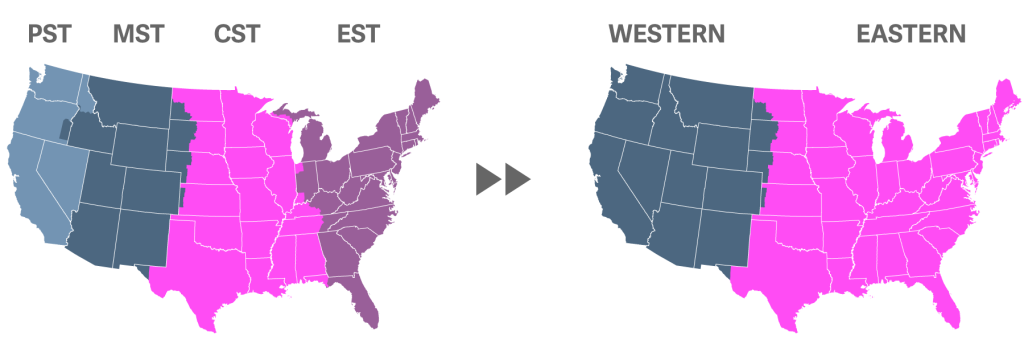
  • Consolidate and reduce the four current continental U.S. time zones (Eastern, Central, Mountain, Pacific) to just two (Eastern, Western)

Under the Schrager scenario, the new time zone map for the continental United States would look like this:

simplified time zone mapDr. Schrager points out that, while a fewer number of larger time zone geographies would seem to remove some people further from their “true” time zone, the realities of global commerce are already doing that anyway.

By contrast, she sees the benefits as more major.  For example, frequent travel between time zones under today’s four zones causes jet lag, robbing employees of productive work time.

With just a one-hour time difference between New York and California, bi-coastal travel would become almost effortless in that regard, Schrager maintains.

As for the disruption such a change might cause to international business coordination, Dr. Schrager contends that just as it took one or two countries to start things off in the 1880s, someone needs to step up to the plate today to start a new trend.

She says:  “… America won’t line up with the time zones of countries directly north and south unless this catches on as a global trend.  But the discontinuity ship already sailed when rich Western countries haphazardly adopted daylight savings time and most other countries didn’t.  Time is already arbitrary; why not make it work in our favor?”

Does Dr. Schrager raise some good points?  Would simplifying the time zone map and ditching daylight savings time be a “net positive” or not?

Some of her arguments seem to make sense to me.  What do you think?  Please share your thoughts with other readers if you’re so inclined.

Sprawl & Crawl: Are work commutes actually worse than you think?

DC traffic
It turns out politics isn’t the only kind of gridlock in Washington, DC. It also has more traffic gridlock than anywhere else in the country.

This past weekend, The Wall Street Journal published a feature story in its “Personal Journal” section that profiled how businesspeople cope with their daily work commutes

It turns out that the average daily work commute in the United States takes about 25 minutes

Another interesting statistic from the article is the amount of time car commuters in larger cities spend stuck in traffic:  52 hours annually, or about an extra hour per week.

The WSJ story profiled several people who access mass transportation for their work commutes, as well as one businessman who relocated from the Washington, DC Metropolitan area to Metro Cincinnati, substantially reducing his daily commute time and hassle in the process.

As someone who lives not far from the DC Metro area and who contemplates any drive through the region with a mixture of disdain and dread, this got me to wondering:  Just what is the worst geographic market for commuting?

Helpfully, there’s a recently completed study that answers this very question.  The Transportation Institute at Texas A&M University has applied a calculation tool called the Planning Time Index (PTI) to compare drive times in heavy traffic (i.e., rush hour) against travel times when the same highways are clear.

The way the PTI calculation works is this:  A PTI of 2.00 means that a “normal” drive will take twice as long in heavy traffic. 

Using that PTI=2.00 example, a drive that may ordinarily take ~20 minutes will take ~40 minutes instead.

My suspicions about the DC Metro area turned out to be right on the money.  Here are the most “challenging” metro markets for work commutes based on their PTI indices:

  • Washington DC:  5.72 PTI index
  • Los Angeles:  4.95
  • New York-Newark:  4.44
  • Boston:  4.25
  • Dallas-Ft. Worth-Arlington:  4.00
  • Seattle:  3.99
  • Chicago:  3.95
  • San Francisco-Oakland:  3.74
  • Atlanta:  3.71
  • Houston:  3.67

How do these PTI indices translate into actual drive times?  Shockingly, a DC-area commute that ordinarily takes 20 minutes translates into almost two hours in heavy traffic. 

And among all of the other “top ten” worst markets, that normally 20-minute commute  will take 1.2 hours or longer in rush-hour traffic.

Interestingly, when one scans the “Top Ten” list, the only Midwest urban area that shows up on it is Chicagoland.  So if you wish to avoid the hassle of long commutes, consider relocating to urban markets in the Midwest like St. Louis, Minneapolis-St. Paul, Cleveland, Milwaukee or Kansas City.

But what’s the absolutely easiest metro market for commuting?  According to the Texas A&M study, it would be Pensacola in Florida.  It has a PTI of just 1.31. 

… Which means only about six extra minutes in rush traffic compared to the ordinary 20-minute commute.

Come to think of it … Pensacola has great beaches and nice sea breezes as well.  Perhaps dealing with the occasional hurricane is worth it, all hassles considered!

Manufacturing in America: It is poised for a comeback?

American Made Movie (Documentary)On Labor Day weekend, the documentary film American Made Movie opened in theatres in key cities across the country.  And for a change, this film doesn’t chronicle the decline of American manufacturing, but instead its potential for rebirth.

Directors Vincent Vittorio and Nathan McGill have produced a film that’s both realistic and optimistic – two words that aren’t often used in conjunction with one another when the topic is manufacturing.

The directors don’t shy away from the facts:  U.S. manufacturing jobs shrinking from ~$17 million to just ~$12 million in the past 20 years due to technology, global competitiveness and outsourcing.

But there are signs of recovery.  At least the anectodal evidence for it is strong.

In August, Wal-Mart organized a manufacturers’ summit which was attended by ~1,500 people including U.S. and foreign-based companies, Department of Commerce and Federal Reserve officials, and eight state governors.

At this meeting, Wal-Mart affirmed its commitment to buy $50 billion in additional American-made products over the next 10 years.  GE, Element and other companies also announced plans to boost domestic manufacturing activities.

These developments aren’t merely patriotic or altruistic — although there may be some of that factoring into the decision.

In fact, with Chinese labor costs rising 15% to 20% each year, that country’s labor cost advantage is narrowing compared to the United Sates.

Harold Sirkin of Boston Consulting Group points out that factoring in raw materials and other costs, China maintains only a ~3% lead on product costs.  Add in transportation costs from Asia, and the “Made in America” alternative takes on new validity.

“We are at an inflection point,” Sirkin has stated, noting that the United States is now competitive with China.

GE’s chief executive officer Jeff Immelt echoes these sentiments, contending that on a relative basis, America has never been more competitive thanks to technology and improved productivity.

“High transportation costs mean you want to be closer.  It’s not just pure labor arbitrage,” Immelt notes.

As for productivity, the mere three hours it takes to assemble a GE refrigerator in America makes its total cost lower than a similar Chinese or Mexican-made models destined for the American market, according to Immelt.

I like what I’m hearing about the coming resurgence in American manufacturing … but I think we’ve heard this prediction before. 

The film directors discovered this inconvenient issue when traveling the United States and visiting manufacturing plants from large cities to small towns:  There’s a sizable gap between what manufacturers need in human capital, and the ability of the labor force to meet those requirements – whether it be older workers, or young workers right out of school.

Vincent Vittorio and Nathaniel McGill, movie directors
“American Made Movie” documentary film directors Vittorio and McGill.

“We need to provide the apprenticeship training necessary for a new generation of American workers to grow as fast as our technology is changing,” the documentary movie directors contend.

That may be happening at some technical colleges and a few community colleges across America.  But it’s not happening nearly enough if, like me, you hear constant complaints from manufacturing execs about the disconnect between the lack of (even basic) job skills and (increasingly sophisticated) job requirements on the manufacturing line.

Maybe it’s time to look harder at appropriating pieces of the German/Austrian apprenticeship model, wherein talented students are plucked from high school and placed with manufacturing firms for on-the-job training in lieu of college.

In such environments, a structured program of learning and training provides the roadmap for successful transition and integration into the job force.

An apprenticeship may not seem as “classy” an accomplishment as a college diploma.  But a college diploma doesn’t mean nearly as much these days.

What once was a sure-fire ticket to a career has given way to an environment in which half of all new college graduates are unemployed, underemployed, or working jobs for which their degree is irrelevant or unnecessary.

To that half of the young labor force, the near-100% placement/success rate for apprenticeships must seem awfully attractive now.

What are your thoughts about a coming manufacturing renaissance in America?  Please share your comments here.

Google finds that in hiring practices, what’s old is new again.

Google hiring practices
Google Gone Retro: Its hiring practices look more familiar than different today.

Has Google made an about-face when it comes to the way it hires staff?

Over the years, there have been numerous articles written about Google’s unorthodox and highly selective recruitment and interviewing process

The company seemed to take a certain delight in the degree to which it subjected job candidates to mind-bending suitability tests and humiliating proctology-like HR examinations.

So I was a bit surprised to read this June 19, 2013 article in the New York Times, in which staff business reporter Adam Bryant published excerpts from an interview he had with Laszlo Bock, senior vice president of people operations at Google.

A major objective of the interview was to determine to what degree so-called “Big Data” can be used to help find the right candidates fill leadership and managerial positions in companies.

Instead of giving us all sorts of ways in which Big Data is helping to do that, Mr. Bock focused instead on the limitations.  And in the process, he revealed that Google has made attempts to harness more experiential data to come up with more effective hiring practices.  Here’s what he said:

“We’ve done some interesting things to figure out how many job candidates we should be interviewing for each position, who are better interviewers than others, and what kind of attributes tend to predict success at Google.

On the leadership side, we’re looking at what makes people successful leaders and how we can we cultivate that.”

And what about some of the more infamous Google hiring practices, such as looking at college transcripts from a million years ago or asking people to solve impossible “challenge questions” or equations?  Bock revealed these learnings:

“We found that brainteasers are a complete waste of time.  How many golf balls can you fit into an airplane?  How many gas stations in Manhattan?  A complete waste of time.  They don’t predict anything.  They serve primarily to make the interviewer feel smart.”

And about GPA stats, Bock revealed that after all of the data crunching, Google’s HR department came to this conclusion:

“GPAs are worthless as a criteria for hiring, and test scores are worthless – no correlation at all, except for brand-new college grades where there’s a slight correlation … we found that they don’t predict anything.

After two or three years, your ability to perform at Google is completely unrelated to how you performed when you were in school, because the skills you required in college are very different.  You’re also fundamentally a different person.  You learn and grow.  You think about things differently.”

So now Google has reverted to the tried-and-true formula of structured behavioral interviews, consistently applied across all applicants. 

This includes using standardized behavioral questions to listen to open-ended responses, which then makes it possible to see how candidates actually interacted in real-world situations, as well as what they consider to be “easy” or “difficult” situations in which they found themselves.

Regarding leadership qualifications, according to Bock, Google has found that these are ambiguous or amorphous characteristics:

“For leaders, it’s important that people know you are consistent and fair in how you think about making decisions, and that there’s an element of predictability.  If a leader is consistent, people on their teams experience tremendous freedom because then they know that within certain parameters, they can do whatever they want.”

Where “big data” comes in to play here is in twice-a-year employee surveys that Google conducts on all of its managers, evaluating a variety of factors. 

Those factors are the fundamental ones — things like sharing information, treating all team employees fairly, and providing clear goals and performance standards.

But Bock cautions that leadership success is highly dependent on the context; what works at one company isn’t necessarily right for another firm.  “I don’t think you’ll ever replace human judgment and human inspiration and creativity,” he notes.

I was pleased to read these comments, because I always felt that attempting to develop a radically new paradigm for job hiring, while being an interesting and novel endeavor, was also somewhat presumptuous on the part of Google. 

At the end of the day, human nature is what it is:  fickle, unpredictable, fallible.  No amount of “re-engineering” is going to change that.

The American middle class may be squeezed … but why?

Middle class under attackIn recent years, there have been numerous analyses and articles addressing threats to the middle class in America, and who or what is to blame for what’s happening.

The latest article, The American Dream, Downsized, is written by Amy Sullivan, a writer and former editor at TIME and Washington Monthly  magazines and was published in the National Journal magazine this past week.

The statistics presented by the author – including those showing the middle class “squeeze,” a smaller proportion of Americans falling within the middle class as compared to poorer or richer segments – are indeed sobering.

But in reading the article, I also got the sense that the premise of the argument – that the economic conditions in the America of 50 years ago represented the “norm” – may be flawed.

What if the conditions today represent the “norm” and the conditions back then are the ones that were “skewed”?

I shared the article with my brother, Nelson Nones. As someone who has lived and worked outside the United States for years (in Europe and Asia), to me his thoughts on world economic matters are always worth hearing because he has the benefit of weighing issues from a global perspective instead of simply a more parochial one (like mine).

Here’s what Nelson shared with me:

I have a very no-nonsense view of what’s happening to the American middle class, and why. The American Dream was “real,” the article says, during the post-World War II prosperity of the 1950s when a “middle-class family bought a house, put a car (or two) in the driveway, and raised children who ran around a safe neighborhood and later went to college with their parents’ support.”

This characterization paints a scene that is peaceful, tranquil, secure and prosperous – but it completely misses a couple salient points:

  • The Cold War – The 1950s were also a time of fallout shelters and fighting Communism. It’s easy to forget all that.
  • The Communist and Socialist countries – two of which today are part of the “BRIC” countries (Brazil-Russia-India-China). Russia (then the Soviet Union) and China barricaded themselves and their vassal states behind the Iron and Bamboo curtains – and slowly but inexorably starved themselves to death economically. The other two, Brazil and India, barricaded themselves to a degree as well. As an example, they threw out Coca-Cola and forced the locals to drink the disgusting domestic variants Campa-Cola in Brazil and Thums Up in India, just to thumb their noses (no pun intended) at those wicked ex-Colonialists and American capitalists.

In other words, while income equality and middle class prosperity were peaking in America between 1945 and 1970, the situation at the global level was exactly the opposite.

As we all know, the political and economic barricades fell quickly in late 1980s and early 1990s. The effect is precisely what political economist Adam Smith predicted in The Wealth of Nations (1776):

“If a foreign country can supply us with a commodity cheaper than we ourselves can make it, better buy it from them with some part of the produce of our own industry, employed in a way in which we have some advantage.”

Not coincidentally, Singapore’s per capita GDP today, at US$50,800 (according to the CIA World Factbook) exceeds that of the United States, at US$48,400. Of course Singapore is a small country and it’s just one example – but it’s a telling one.

I would argue that the American Dream, or at least the ideal of it framed in the 1950s, might have been “real” at the time (people, after all, were buying real houses and cars with real money).  But it was temporary. And it could never be permanent if you believe Adam Smith.

Consider this: Many of the middle-class breadwinners were union workers. Their rising incomes were directly attributable to collective bargaining agreements that American companies could afford to enter into because they had little or no foreign competition and hence could pass rising costs on to the very consumers who benefited from those agreements.

Today, some of those same companies are bankrupting themselves just to rid themselves of unions and the unfunded pension liabilities they took on board when the good times were rolling. And why is this? Because they have to fight foreign competition just to stay alive.  (This CNBC article, published just a few days ago, says it all.)  

I would also contend that today’s “scaled back” notions of the American Dream might reflect the more realistic (less idealistic) views of the vast number of immigrants who have come to America since the barricades have fallen – many of whom fall squarely within the article’s definition of “middle class” (which I calculate to be $13,725 – $39,215 per year per capita, using the per-household figures quoted in the article divided by the current average U.S. household size).

For these immigrants, the assurance of being able to “hold on for dear life” is actually a big step up from the mayhem, extortion, hidebound traditions and general hopelessness that often run rampant in the countries or societies they’ve fled.

It astonishes me that this National Journal article hardly mentions any of the above: The word “foreign” can’t be found anywhere in the article … “immigration” appears only once in the context of how Hispanic immigration is exerting a “steady downward pull on income” … and “union” is stated only once in the context of children in the 1950s skipping college and entering the workforce with a “secure, often union-protected job.”

How could the article’s author have missed what is so obvious? I’m quite sure she’s not so ignorant … so she must have an agenda. But if that’s the case, and if I were to believe her agenda-based screed, what would that make me?

Just like author Any Sullivan, my brother Nelson has a strong point of view about the current situation of the American middle class!

As for me, I think the article’s statistics are real. But I also believe that post-war conditions in America were an anomaly borne of special circumstances. For the author to treat them as the “baseline” for evaluating the “fairness” of all that has come since … reveals a serious flaw in the underlying argument.

Besides, what’s “fair” today versus what was “fair” 50 years ago takes on a completely different complexion based on where one lives in the world!

OK, readers:  Have at it. What’s your perspective? Please share your thoughts here.