Reading the tea leaves in the U.S. population census results.

County Population Change: 2000-2010Now that the full scope of information is being released from the latest U.S. population census, many news reports about age demographics tend to focus on the composition of families in urban areaa … the impact of immigration of all stripes … as well as the occasional article about the phenomenon of large family units in “exotic” places like rural Utah and Idaho.

Most of these news reports give the impression that age demographics are getting younger.

Don’t believe it. Instead, we can turn to the U.S. Bureau of Census’ own figures which tell a different story.

In reality, there are fewer children today in most American neighborhoods. In fact, the share of population under the age of 18 declined in ~95% of the counties since 2000.

The Bureau’s stats also show that the number of American households reporting that they have children under age 18 has remained roughly static (at ~38 million) … even while the country’s total population grew by ~10% over the decade.

As a result, the share of all U.S. households with children is only about 33%, down from ~36% ten years earlier … while the share of the U.S. population under age 18 is 24%, compared to 26% ten years earlier.

These census figures and others have become grist for many researchers in recent months, with a number of intriguing reports being issued. One, released by the Brookings Institution, focuses on the changing nature of Suburban America. Alan Berube, author of the report, notes that there is a continuing blurring of the once-sharp lines that used to demarcate central cities from the suburbs.

Instead, there now appear to be more similarities between cities and their “inner core” suburbs, rather than between inner and outer suburban communities.

Urban development guru Joel Kotkin sees this development in a larger sociological context — noting that people tend to “self-select” where they live based on “like” characteristics that go beyond mere economic elements to also include psychographic aspects.

In Kotkin’s view, that trend has contributed to the vast differences we see in political and voting behavior in cities, the suburbs, and exurbs. We may have much less overt segregation based on race or ethnic background … but it’s been replaced by a self-segregation based on perspectives and attitudes.

No wonder it seems that people are “talking past each other” — rather than engaging one another — in our national dialogue about the economy and the government’s proper role in guiding it.

Don’t look for this dynamic to change anytime soon.

Dumb and Dumber: Internet Explorer Users, the Media and the AptiQuant Hoax

The AptiQuant "Dumb IE Users" Research has more than one news organization with egg on its face.
AptiQuant's "Not-so-smart IE users" research brief leaves more than one news organization with egg on its face.
You may have read the news reports a few weeks ago of a study conducted by a Canadian research company that “concluded” that Internet Explorer users have lower IQs than users of other browsers like Firebox and Safari.

The “news release” was peppered with authentic-looking charts and graphs that supposedly provided backup for the conclusions, which purportedly came from online IQ testing of ~100,000 individuals found randomly through searches and Internet advertising.

Not surprisingly, the news that IE users are somehow “dumber” than the “bright bulbs” who use the supposedly more “hip” Chrome, Opera, Safari and Firefox browsers hit the newswires like a brick.

I saw reports on the research all over the place – from the BBC and Huffington Post to Yahoo, the New York Times, Forbes and MediaPost.

… And then, a week or so after the story burst on the scene, it began to fall apart.

One intrepid BBC reporter dug into the story deeper, and discovered in the process that AptiQuant, the Vancouver-based organization billed as a “psychometric consulting company” that supposedly conducted the survey, is an entity with no traceable presence back beyond just a few weeks prior to the deployment of its research findings.

Not only that, the AptiQuant website had been set up only a few days prior … and the site’s professional-looking photos lifted wholesale from a legitimate Paris-based consulting firm.

Curious, I trolled around online to find the original research brief released by AptiQuant. It seems to me that anyone reading the study’s conclusions would smell a rat.

True, the statistical data appear impressive enough. But no research organization worth its salt is going to make comments such as the following a part of its research conclusions, and I quote:

The study showed a substantial relationship between an individual’s cognitive ability and their choice of web browser. From the test results, it is a clear indication that individuals on the lower side of the IQ scale tend to resist a change/upgrade of their browsers. This hypothesis can be extended to any software in general ….

It is common knowledge that Internet Explorer Versions 6.0 to 8.0 are highly incompatible with modern web standards. In order to make websites work properly on these browsers, web developers have to spend a lot of unnecessary effort. This results in an extra financial strain on web projects, and has over the last decade cost millions of man-hours to IT companies. Now that we have a statistical pattern on the continuous usage of incompatible browsers, better steps can be taken to eradicate this nuisance.Nuisance? I mean, really!

A few days later, the perpetrators of the phony research report came forward and admitted as much. AptiQuant’s purported CEO, a person using the moniker “Leonard Howard,” laid the cards on the table:

“The main purpose behind this hoax was to create awareness about the incompatibilities of IE6 and how it is pulling back innovation. So, if you are still using IE6, please update to a newer browser. We got this idea when adding some features to our comparison shopping site … we found out that IE6 was highly incompatible with web standards. IE 7.0 and 8.0, though better than 6.0, are still incompatible with not only the standards, but with each other, too.”

It was also noted that “telltale signs that should have uncovered the hoax in less than five minutes” included the following red flags:

• The AptiQuant domain was registered only on July 14, 2011

• The IQ test that was referenced in the report (Wechsler Adult Intelligence Scale IV test) is copyrighted and cannot be administered online

• The company address listed on the report does not exist

• Much of the content on the website was ripped from other sites – including the photo images

• The website was developed using the WordPress platform, which would be highly unusual for any credible consulting firmBeyond the fact that “Mr. Howard & Co.” must have had way too much spare time on their hands … I think it’s interesting – and sobering – to witness how many reputable news organizations took this report and ran with it without so much as a minute of fact-checking – or even picking up the phone to get an additional quote from an AptiQuant company spokesperson.

… Especially since the topic and the conclusions drawn – namely, that some people are dumber than others – were bound to be controversial.

In the “old days,” a story like this would be lucky to be published in single outlet, if at all. But in today’s “brave new world” of online news, it took mere hours for the news to bound about the Internet and show up on dozens of legitimate news sites … thereby enabling the story to take on a “legitimate” life of its own.

I wonder what’ll be next. Because it’s sure to happen again.

Getting a Read on Viewer Engagement with Online Advertising

Online advertising effectiveness -- findings from Casale Media (2011)One of the great aspects of online advertising is that every jot and tittle of users’ experiences can be tracked and analyzed.

Much of the findings confirm what we might already suspect in terms of the ways people interact with online advertising … but having confirmation and quantification helps in planning and carrying out advertising program tactics.

Take new research conducted by Casale Media, a Canadian-based online advertising network which specializes in promoting brands via banner, rectangle, tower, hover and pop-up ads. The company analyzed nearly 2 billion ad impressions generated during the first quarter of 2011.

Based on this research, Casale has come to three key conclusions:

 Online display ads appearing “above the fold” – in other words, in the area that’s visible before the user starts scrolling the page – are nearly seven times more effective in generating clickthroughs compared to ads appearing below the fold.

 Viewers are three times more likely to “act” on an ad if it is the first or second one they encounter during their web session.

 The more times someone sees a particular ad, the more likely he or she will be to click through and take action. Casale finds that ads served five times to a user are 12 to 14 times more effective than ads shown less frequently.

The Casale conclusions support the findings of other studies utilizing eye-tracking data, where it’s been found that site visitors spend the vast majority of their time looking at information positioned within the web page’s initially viewable zone.

As for the finding that ads served to users later in their browsing session are much less likely to get attention and be acted upon … industry practitioners refer to this as “banner blindness.” It’s a phenomenon that has an antecedent in the print magazine world, where “far forward” positions were often the place everyone wanted to be.

And as for greater ad frequency generating more viewer actions, this also mirrors the offline advertising world, where multiple ad exposures are needed to achieve a degree of familiarity and to “register” with users.

Awareness and familiarity are the first steps in generating action. Of course, too much frequency can be counterproductive – but again, the tracking capabilities of online advertising enable marketers to experiment with different exposure levels to determine the optimum frequency that’ll generate the best level of engagement.

ICANN’s Brand-Named Internet Domain Scheme Encounters Strong Resistance

The ANA and others are trying to stop ICANN from implementing its new brand-named Internet domain plan.In late June, I blogged about the proposed new initiative by the Internet Corporation for Assigned Names and Numbers (ICANN) to broaden top-level domain names to include the use of company- or brand-name suffixes.

The idea is that famous brands could begin using their well-known monikers to further distinguish their activities on the Internet. ICANN’s spokespeople are on record claiming that the new guidelines will “usher in a new Internet age.”

Well … not so fast. The more people have been looking into this scheme, the less they like it. One of the biggest issues is the “pay to play” aspect. Unlike the days when people could purchase a domain name for just a few dollars … then squat on it until someone was willing to pay hundreds of thousands to use it, the cost to secure a new domain suffix like .pepsi or .hyundai will start at ~$185,000 … and go up from there.

That’s not chump change. But here’s the thing: For securing a famous brand name as a top-level domain name, it still represents a dandy opportunity for someone with funding (or a group of investors) to nab the “best brands” early on … then hold out to resell then name for a smart sum far greater than what they paid.

Which puts the onus back on the large companies who will feel compelled to pay the $185,000+ right off the bat – even if they have no intention of using the top-level domain name now or ever.

So it’s a very nice revenue stream to ICANN, ponied up by major international companies who don’t want the risk of having their names “hijacked” by someone bent on extortion – or worse, nefarious brand doings.

The concern is so great that the Association of National Advertisers, an organization made up of large national/international brand marketers, has issued an official communication to ICANN, warning that its scheme could have “potentially disastrous consequences” for marketers if the plan is implemented as proposed.

The letter also states that the ICANN scheme is likely to cause “irreparable harm and damage” to marketers, even as it “contravenes the legal rights of brand owners” and “jeopardizes the safety of consumers.”

Bob Liodice, president of ANA, has gone further in criticism of the ICANN proposal. “The decision to go forward with the program also violates sound public policy and contravenes ICANN’s Code of Conduct and its undertaking with the United States Department of Commerce,” he emphasizes.

Liodice contends that if the ICANN plan moves forward, it would create an ugly free-for-all environment in which many brand marketers would need to divert legal, financial and technical resources to applying for, managing and protecting their top-level domains … or risk the consequences.

“They are essentially being forced to buy their own brands from ICANN at an initial price of $185,000,” Liodice points out.

The sharp criticism of the plan ensures that these issues aren’t anywhere close to being resolved – and it probably puts ICANN’s anticipated January program launch date in question.

Stay tuned … ’cause it’s going to be a wild ride over the next few months!

Amazon continues to push the envelope … while pushing books right off the table.

Amazon Kindle continues to push the envelope in book publishingIt’s hard to deny that the growth and success of Amazon has had a huge impact on the book industry. The liquidation of Borders Books is just the latest evidence of that.

But other market moves by Amazon demonstrate that the company has set its sights on far more than just owning the traditional retail book and recorded music segments. The introduction of the Kindle e-reader and release of subsequent newer, cheaper models proves that Amazon seeks to dominate the “information” space no matter what form it takes.

Two recent developments show how this is continuing to happen. First, the company announced that it is launching a new public-library feature that gives the Kindle the same library-borrowing abilities as competing e-reader devices like the Nook offer.

Public libraries have taken notice of the announcement, because Kindle so dominates the e-reader market. According to Forrester Research, an estimated 7.5 million Kindles are being used in America; that’s about two-thirds of all e-readers in the country.

Already, large public library systems such as those in Chicago and New York offer free digital-book lending. A trip to the library is not needed. Instead, patrons simply use their library card ID numbers to download books from the library’s website.

As with conventional “paper and glue” books (I love that new term!), there are “lending periods” for e-books usually ranging 2-3 weeks. Libraries purchase the e-books from publishers as they do bound books, and only one borrower can check out an e-title at a time.

How are Amazon’s latest e-lending developments affecting book publishers? For one thing, e-books never wear out, which means publishers (and authors) can’t benefit from reorders of popular titles due to book wear. Partially for this reason, several major publishers such as Simon & Schuster and Macmillan don’t sell their digital works to libraries … yet.

Adam Rothberg, senior vice president and director of corporate communications at Simon & Schuster, commented, “We value libraries for their work of encouraging literacy and the habit of reading, but we haven’t yet found a business model we’re comfortable with.”

Another publisher, HarperCollins, decided to set a checkout limit for each title of 26 times, after which a library would need to repurchase the book in order to continue lending it out.

Not surprisingly, that policy has been greeted with hoots and catcalls by the library industry.

Regardless of the selling policies under consideration, one wonders how much longer the major publishers can continue to hold out, as the entry of market-dominant Kindle should significantly raise consumer demand for library e-titles.

And in another move that is sure to shake up another segment of the book world – educational textbooks – Amazon announced several weeks ago that it has opened up a “textbook store” for the Kindle platform. That store is already offering thousands of textbook titles for rental, with many more in the offing.

Here’s how it works: Amazon will allow buyers to acquire textbooks at a deep-discount off of the standard print pricing. The charge will be based on the amount of time the student plans to hold the book – with a minimum rental period of 30 days (which can be extended, if desired).

And to further sweeten the pot, borrowers will be able to access any “notes” and “highlights” they’ve made to their texts even after they’ve “returned” the textbooks.

I’ve blogged before about the college textbook publishing segment — a niche some see as an unholy alliance between book publishers and college bookstores that more resembles a “racket” than a fair business model.

Charging ridiculously high textbook prices along with releasing suspiciously frequent “updated” new editions that change perhaps 2% or less of a book’s content have been all too common.

Moves by Amazon – along with similar programs introduced by smaller providers like Chegg, Inkling and Kno – may finally usher in an end to the indefensibly high prices of textbooks that have long been the bane of students (and their parents). And no one is mourning that.

Move over, energy costs … Here come higher food prices.

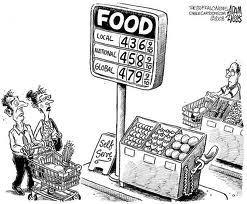
Higher food prices like higher energy pricesIf it seems as if food prices have been increasing at a faster clip in recent months, you’re not dreaming.

Despite an overall inflation rate that seems low (although the federal government’s controversial exclusion of certain key components like gasoline makes its stats suspicious at best), we now have solid evidence that worldwide food cost increases are happening across the board.

Here’s a list of some of the most dramatic cost increases for key foodstuffs recorded since May 2010:

 Coconut oil: +134%
 Corn/maize: +111%
 Wheat: +75%
 Coffee: +70%
 Sugar: +55%
 Soybeans: +45%
 Palm oil: +42%
 Orange juice: +35%
 Beef and pork: +20%

Considering that this represents a time period of just a little over a year, these increases are some the largest recorded in decades.

What caused it to happen? Poor weather and bad harvests are two of the reasons. But high demand from developing countries – particularly China – is another important factor.

“This is a pretty sustainable increase … A number of factors have been building over time in terms of the commodity increase: world economic growth, rising crude oil prices, increased Chinese import demand have all conspired,” is how Bill Lapp, president of commodity analytical company Advanced Economic Solutions, puts it.

Unfortunately, the problem promises to persist, since many of the items above are ingredients that go into other prepared food items. Initially, packaged food makers that had locked in purchases for some items over certain time periods were able to delay delay passing on cost increases because of those hedges. But the bulk of those contracts have run their course by now.

So, even if commodity prices don’t go any higher, we’re likely to see the ripple effects in pass-along price increases all throughout the “food chain” in the months to come.

This isn’t news anyone wants to hear, considering how fragile (non-existent?) the economic recovery is here in the U.S. and in many other countries as well.

The sober truth is, high food costs coupled with increased energy prices have a chokehold on the world economy that is more consequential than many would care to admit.

Fasten your seatbelts, folks. We may be in for yet another wild ride on the economic roller-coaster …

The Twitter Machine: Keeping Hype Alive

Americans' Twitter usage isn't getting anywhere near Facebook'sI’ve blogged before about Twitter’s seeming inability to break out of its “niche” position in communications. We now have enough time under our belt with Twitter to begin to draw some conclusions rather than simply engage in speculation.

Endlessly hyped (although sometimes correctly labeled as a revolutionary communications tool – see the North African freedom movements) the fact is that Twitter hasn’t been adopted by the masses like we’ve witnessed with Facebook.

The Pew Research Center’s Internet & American Life Project estimates that fewer than 10% of American adults who are online are Twitter users. That equates to about 15 million Americans, which is vastly lower than Twitter’s own claims of ~65 million users.

But whether you choose to believe the 15 million or the 65 million figure, it’s a far cry from the 150+ million Americans who are on Facebook – which represents about half of the entire American population.

You can find a big reason for Pew’s discrepancy by snooping around on Twitter a bit. It won’t take you long to find countless Twitter accounts that are bereft of any tweet activity at all. People may have set their acount up at one time, but long ago lost interest in using the platform – if indeed they ever had any real Twitter zeal beyond “follow-the-leader.” (“Everybody’s going on Twitter … shouldn’t I sign up, too?”)

This is the purest essence of hype: generating a flurry of interest that quickly dissipates as the true value (or lack thereof) is discerned by users.

Of course, Twitter does have its place. Some brands find the platform to be a good venue for announcing new products and sales deals. And it doesn’t take long for the best of those deals promoted on Twitter to leech their way into the rest of the online world.

Other companies – although far fewer – are using Twitter as a kind of customer service discussion board.

And as we all know, celebrities l-o-v-e their Twitter accounts. What a great, easy way to generate an endless stream of sound-bite information about their favorite topic: themselves.

Analyses of active Twitter accounts have shown that a sizable chunk of the activity is made up of media properties and brands tweeting each other … a lot of inside-the-park baseball.

What’s missing from the equation is the level of “real people” engagement one can find on Facebook in abundance … and maybe soon on Google+ as well. That’s real social interaction – in spades.

Actually, you mightn’t be too far off the mark if you deduced that Twitter is the digital equivalent of a bunch of industry insiders at a cocktail party … saying little of real importance while trying to appear “impressive” and “hip” at the same time.

But who’s being fooled by that?

Home Ownership as an Investment Comes Under Fire

Home ownership isn't quite the financial investment many think it is.
Home ownership as a foolproof way to financial well-being? Think again.
Here’s an interesting statistic: Market observers including Deloitte and Oxford Economics estimate that there are ~10.5 million households in the United States that have a net worth of $1 million or more. (The number is calculated including the primary home.)

I for one was a bit surprised by the number, figuring it might be higher.

But here’s another interesting number – and one that explains a lot: There were ~12.7 million such “millionaire households” in America back in 2006.

The difference? Housing property values, of course. They’ve declined by ~15% since 2006 … which makes it little surprise that the number of millionaire households in the country has dropped by a similar percentage.

Over past several years we’ve witnessed millions of homeowners become upside down in their home mortgages. For this reason alone, it would be nice if more people’s net worth wasn’t so tied up in houses.

It’s as if we’re all farmers, the ultimate “land poor” demographic group.

Many people have an aversion to other types of investment, pointing to a stock market that has seen little net upward movement over the past decade. Others simply prefer a solid asset like owning property – or maybe gold.

But if the past few years have taught us anything, it’s that home ownership isn’t always the road to financial well-being.

In fact, real estate specialist and Wall Street Journal editor David Crook wrote an article recently (“Why Your Home Isn’t the Investment You Think It Is“) which spells out a pretty convincing argument that home ownership doesn’t work as the best investment vehicle.

And that’s not just by looking over the past few years … but over the past several decades.

It’s a thought-provoking article that’s well worth a read.

What do consumers think of America’s corporations?

Corporate Trust ... Corporate ReputationWith the budget negotiations in full swing – and high dudgeon – on Capital Hill, naturally the public’s critical eye is trained on our political figures. And Congress is most assuredly taking a beating in the political polls, with approval ratings plunging astonishly below the 20% figure.

[Of course, is that really so surprising? After all, Congress is pretty evenly matched between the two parties … so partisans see much to criticize on both sides.]

The focus of attention on Washington has taken the spotlight off of corporate America – at least in terms of media attention. But that doesn’t mean that “John Q. Public” is giving companies much of a break.

I’ve blogged before about corporate reputations — most recently commenting on a field survey conducted early this year by Harris Interactive that measured the appeal of 60 of the “most visible” American corporate brands. That survey showed an uptick in positive opinions about those firms when compared to prior-year results.

But a May 2011 survey by GfK Custom Research North America shows otherwise. The findings from GfK’s online field survey of ~1,000 U.S. consumers include this doozy: Two-thirds of respondents believe that it’s harder today for American companies to be trusted than it was three years ago.

Furthermore, ~55% say it will be harder for companies to gain their trust in the years to come.

What’s bothering people about U.S. corporations? In order of significance, here are the key concerns:

 The perception that CEOs and other senior executives of corporations are overpaid.

 Corruption in senior management circles.

 Companies make up lost earnings at the expense of their customers.

 More products than ever are being manufactured overseas.

Interestingly, there’s less concern about declining product or service quality as a reason for lower levels of trust. And as has been found in other studies, the public’s view of technology companies is somewhat higher than its trust for companies in other industry segments.

But back to the rather grim overall findings … fewer than one in five survey respondents anticipate that corporate corruption will become better over time – a result that’s substantially lower than what was found in similar field research conducted by GfK a few years ago.

This survey underscores the fact that corporate America has a long way to go to change the sharply negative impressions consumers have of the world of business. Clearly, the financial crisis of 2008 continues to extend its long shadow more than two years later.

And it looms over everyone – public and private sector alike.

This helps explain the generally sour mood people are in these days.

Celebrating American Pioneers of Industrial Design

USPS Pioneers of American Industrial Design Postage Stamp Set

Russel Wright American Modern dinnerware: Water Pitchers
Russel Wright American Modern dinnerware: Water pitchers from outer space.
The U.S. Postal Service has just issued its newest series of commemorative stamps, and it’s a marvelous set. Instead of honoring yet another crop of political leaders, sports figures or performing arts stars, these postage stamps commemorate 12 American pioneers of industrial design.

Names like Norman Bel Geddes, Gilbert Rohde, Russel Wright and Dave Chapman may not be known to many people today, but they were among a rarefied group of forward thinkers who revolutionized the way we think about design.

In part a reaction against the delicate fussiness of the beaux arts and art nouveau styles, these visionaries sought simplicity in form, celebrating the “utilitarian” aspects of the products they designed while eschewing any purely decorative elements.

From the clock radios of Norman Bel Geddes to the rotary telephone of Henry Dreyfuss, these designs placed “function” front and center. And they were indeed eyebrow-raising – in some cases shocking – to American consumers of the 1940s and 1950s.

But unlike the often ugly, relentlessly boring steel-and-glass boxes that came to symbolize modern architectural style, the items these industrial designers created possessed a style and elegance all their own – and many went on to become icons of design in their respective product categories.

In my youth, our household was one of many that owned a set of American Modern dinnerware, designed by Russel Wright and manufactured by Steubenville Pottery. These dishes were the epitome of “functional simplicity” – used and abused in kitchens and dining rooms during the 1940s, 1950s and 1960s.

And yet, despite all of their simplicity, they had a style that was so distinct, no one who lived with them could ever forget them. “Vegetable bowls from outer space,” a friend of mine remarked once.

But Russel Wright and his fellow designers were doing far more than just paring down to the essentials; they aimed to simplify daily life itself. As a parallel to designing tableware, furniture and decorative objects, Russel Wright and his wife, Mary Wright, published a book titled The Guide to Easier Living.

Aiming to sweep away the last vestiges of the “old order,” when the well-heeled and bourgeois alike relied on “the help” to carry out elaborate dinner parties and other social functions, this book was a veritable how-to guide for the modern 1950s family.

How to organize and decorate the home … how to go about daily living … how to entertain without all of the fussy trappings: This and more were spelled out in suggestions and step-by-step instructions.

Originally published in 1950, the book was an instant success. Amazingly, it would be re-released in 2003 in its original form – without any editorial updates or adjustments – its content remaining surprisingly up-to-date.

The same timeless quality characterizes the work of the other 11 industrial designers featured in the USPS commemorative postage stamp series as well. Time and time again, people have returned to the work of these designers for inspiration.

Indeed, some of today’s most talked-about products, such as Target’s Michael Graves series of teapots or the new Dyson line of bladeless fans, trace their design inspiration straight back to the work of these pioneers – revolutionary in their day, but true classics now.