In case you’re wondering … consumers don’t really care about brands all that much.

branding“I don’t want a ‘relationship’ with my brands.  I want the best products at the best price.” — Jane Q. Public

In the era of interactive marketing and social media, there’s often a good deal of talk about how certain brands are successfully engaging their customers and creating an environment of “brand love” — or at least “brand stickiness.”

It’s not only consumer brands like Chipotle and Under Armour, but also B-to-B and hybrid brands like Intel, Apple and Uber.

As a person who’s been involved in marketing and advertising for well over a quarter-century, I tend to treat these pronouncements with a little less open-mouthed awe than others.

I get how when a brand is particularly admired, it becomes the “go-to” one when people are in the market for those particular products and services.

But the idea that there’s real “brand love” going on — in a sense similar to people forging close relationships with the people in their lives — to me that’s more far-fetched.

The marketing research I’ve encountered appears to refute the notion as well.

Case in point: In an annual index of “meaningful brands” published by the Havas MarComm agency, the research finds that very few consumers cite brands they “can’t live without.”

The 2015 edition of the Havas Meaningful Brands Index has now been released … and the results are true to form. Among U.S. consumers, only about 5% of the 1,000 brands evaluated by Havas across a dozen industries would be truly missed if they were no longer available.

It’s a big survey, too:  Havas queried ~300,000 people across 34 countries in order to build the 2015 index. Broadly speaking, the strength of brands is higher in countries outside the United States, reflecting the fact that trust levels for leading brands in general are higher elsewhere — very likely because lesser known brands or “generics” have a greater tendency to be subpar in their performance.

But even considering the brand scores globally, three out of four consumers wouldn’t miss any brands if they suddenly disappeared from the market.

What are the exceptions? Looking at the brands that scored highest gives us clues as to what it takes to be a brand that people truly care about in their lives.

Samsung is ranked the #1 brand globally. To me, it makes perfect sense that the manufacturer of the most widely sold mobile device on the planet would generate a strong semblance of “brand love.”

Even in the remotest corners of the world, Samsung has made the lives of countless people easier and better by placing a powerful computer in their pocket. It’s only logical that Samsung is a brand many people would sorely miss if it disappeared tomorrow.

The second strongest brand in the Havis index is Google. No surprise there as well, because Google enables people to research and find answers on pretty much anything that ever crosses their minds. Again, it’s a brand that most people wouldn’t want to do without.

But beyond these, it’s plain to see that nearly all brands just aren’t that consequential to people’s lives.

With this in mind, are companies and brands spending too much energy and resources attempting to get customers to “care” about them more than simply to have a buying preference when the time comes to purchase products and services?
Brand-LoyaltyRelated to that, is adding more “meaning” to a brand the answer to getting more people to express brand love? Or does it have far more to do with having products that meet a need … work better than competitors’ offerings … and are priced within the means of more people to purchase?

Havas — and common sense — suggests it’s the latter.

Do that stuff right, and a company will earn brand loyalty.

All the rest is just froth on the beer … icing on the cake … good for the psychological bennies.


Big, brawny behemoth: Google’s Gmail email service reaches 900 million active users.

Google GMailIt’s been several years since Google gave us an official report on Gmail’s user base.

But now we have a new announcement from one of Google’s senior vice presidents,  reporting that Google’s Gmail service has now reached a new milestone of 900 million active users.

Three years ago — the last time Google commented officially on the Gmail active user base — the company had reported ~425 million users.

… Which means that in the past three years alone, Gmail’s active user base has more than doubled — and doubled from an already strong baseline figure.

In fact, Gmail had already become the most popular email service in America by 2012.

Despite the fact that most other email services have failed to report newer stats since then, it’s a safe bet that Google remains King of the Hill when it comes to the number of active users of its Gmail email service.

[Related to this, the same Google spokesperson is also reporting that three out of four active Gmail service users are accessing their accounts on mobile devices.  I’m sure this doesn’t come as a surprise to anyone.]

The continued robust growth in Gmail users may explain why Google hasn’t been making significant changes to the service or the user interface.  Any service that’s the largest one out there can’t risk irritating or alienating large swaths of its users.

Indeed, even when an email service isn’t the biggest or most important one in the market, making changes can still be a risky move.  Just recall the howls of protest from users (and even some of Yahoo’s own employees) when Yahoo made sweeping changes to its e-mail service about 18 months ago.

No doubt, Yahoo has lost a certain number of subscribers who simply couldn’t abide the changes.

Google InboxIn Google’s case, what it’s doing is using Inbox, which Gmail users see on top of the Gmail platform, as an area to experiment with new email features and such — without upsetting satisfied Gmail users who may have little appetite for those changes.

Inbox is an email app by Google for Android and iOS, along with web browsers Chrome, Firefox, and Safari.  In a hint at things to come, Google has now made Inbox open to all users.

Google claims that its Gmail and Inbox services serve different functions and needs, and that it will continue to work on enhancements and updates for both.

But it’s pretty clear that Inbox is where the bulk of Google’s developmental effort and energy are being directed these days.

Conundrum Corner: Europe, Google and “The Right to be Forgotten”

file and forgetThis past week, The Wall Street Journal published an article which reported on the fallout from the European Court of Justice’s 2014 ruling that Google is required to remove links in European search results for individuals whose reputations are harmed by them.

In practice, it’s turned out to be quite a conundrum.  Since the ruling went into effect, Google has had to field requests to remove nearly 950,000 links from European search results.

Each request is deliberated on a case-by-case basis by a panel of specialists.  Reportedly, Google has dozens of attorneys, paralegals and engineers assigned to the task, which is based at its European headquarters facilities in Dublin, Ireland.

So far, approximately one-third of the links in question have been removed while about half were deemed acceptable to continue displaying in search results.  The remaining cases – the gnarliest ones – are still under review.

Unfortunately, the European Court of Justice hasn’t been very specific on the standards to apply when evaluating each request – other than to assert that search results should be removed that include links to information that is:

  • Irrelevant
  • Inadequate
  • Excessive
  • Harmful
  • Outdated

Which, of course, could encompass practically anything.  But the broader standard the Court has sought to uphold is “the right to be forgotten.”

Google hasn’t exactly been a willing participant in these mini-dramas.  Peter Fleischer, Google’s global privacy counsel, contends that Google has been compelled “to play a role we never asked to play – and don’t want to play.”

Lisa Fleisher and Sam Schechner, the authors of the Wall Street Journal article, noted several examples of criteria that Google appears to be using when evaluating individual requests for removal.

More likely to be removed are search entries pertaining to crimes committed long ago and expunged from criminal records … nude or other revealing photos published without the permission of the subjects … and arrest records for petty infractions.

Less likely to be removed:  stories about public figures.

As for the “group dynamics” involved in the decision-making, Fleischer reports that the committee’s votes are normally “a large majority in favor of one decision or the other.”

Looking ahead, as the experiment in parsing web search results to remove certain links while retaining others continues, it’s sure to have implications worldwide.

One reason is that, for now at least, Google has been removing search results only from European domains such as google.it or google.es, but not from the far-more-ubiquitous U.S.-based google.com – even when accessed from Europe.

This means that the “offending” search results can continue to be viewed, retrieved and opened easily.

That fact isn’t sitting well with EU privacy regulators.  In fact, they’ve already issued an opinion contending that Google’s actions are insufficient, and they are seeking wider compliance.  The potential price for not doing so is – you guessed it – legal action.

As time goes on, it will be interesting to see what ends up leeching into the American sphere when it comes to the ability of people to have erroneous or unflattering information about them that is currently so readily visible removed from view.

Clearly there are competing principals at work:  freedom of information versus reputation protection.

paper documents on fileCourt documents and similar documentation have always been public-access information, of course.  But up until a few years ago, anyone interested in trolling for “dirt” on an individual or a company had to do costly, proactive searching through reams of paper-based documents.

Not only was it a labor-intensive process that might or might not result in anything of substance, the source information itself was scattered among thousands of county seats all across America.

That alone was enough to guarantee that most documents were effectively far away from public view.

But in today’s everything-digitized world, court documents – many dating back decades – have been optically scanned and can now be keyword-searched within an ounce of your life.

digitized docsWhat used to take months and cost plenty can now be researched in a matter of minutes.

And beyond court or government documentation is the press, which can get things very wrong (or simply premature) when reporting on controversial or titillating news items.

It affects companies as well as individuals.  I recall one such example in Baltimore from a number of years ago.  The local business press reported on a lawsuit brought by a disgruntled creditor against another company.  (I’m not naming the companies in question in deference to their reputations.)

The press reporting focused on the plaintiff’s petition to force the company into bankruptcy by virtue of the alleged “unpaid debt.”  The fact that the substance of the suit was found wanting and the defendant firm cleared of wrongdoing made little difference when it came to the reputation of the company and its principals;  the original news reports continue to have a life online, years later.

As the CEO the defendant company wrote to the publication involved,

“We now live in an age where digital documents take on a life of their own, and where it is no longer sufficient to consider whether someone might read a newspaper article on a given page on a given day.  Now, with the press of a button articles are stored in massive servers and retrieved by anyone around the world, leaving innocent people branded forever by erroneous words and faulty assumptions. 

It is your ethical responsibility to avoid causing undue harm to innocent parties by prematurely publishing information that others will negative construe and act upon.  Waiting a little longer to clarify the facts and determine the truth is sensible public policy and only makes your paper’s articles more trustworthy and fair, thereby avoiding the journalistic equivalent of shouting ‘fire’ in a crowded theater.”

It seems to me that we’re just starting down a road with this issue, and we don’t really know where it’s going to end up.

Considering everything – the European Court of Justice, Google and the global nature of “search and destroy,” I’d be interested in hearing what readers think about the situation, the competing issues, and the ultimate destination.

Google and the multi-billion dollar pay-per-click money tree.

moneyIt’s no secret that Google has been trying to diversify its revenue stream away from clickthrough advertising, which historically has accounted for the overwhelming majority of its income.

How else to explain Google’s shopping spree over the past decade, scooping up a veritable smorgasbord of industry players like these:

  • AdMob (mobile)
  • Adometry (attribution)
  • Channel Intelligence (product feeds)
  • DoubleClick (display)
  • Invite Media (programmatic creative and media buying)
  • Teracent (programmatic creative and media buying)
  • YouTube (video)
  • Wildfire (social)

So the next question is, “How much have these acquisitions and investments done to diversify Google’s sources of revenue?”

The answer:  Hardly anything.

Consider this statistic:  In 2011, nearly all of Google’s revenue came from online pay-per-click advertising, as reported by SEO firm WordStream.

Now let’s look at 2014 figures:  WordStream reports that the percentage of Google revenues from pay-per-click advertising is actually higher than in 2011, at 97%.

So much for the “diversifying effects of diversity.”

Within PPC advertising, a number of keyword terms are continuing to haul in the big bucks for Google.  A few years back, the priciest keyword term of all was mesothelioma, at more than $100 a click.

Mesothelioma continues to attract a lot of ad dollars, but it’s no longer commanding $100 a pop as it once did.  In fact, it’s no longer on the Top 10 most expensive keywords list.

That list looks like this now (in descending order of bid pricing, starting at over $50 per click and dropping to “only” around $45 for the #10 keyword):

  • Insurance
  • Loans
  • Mortgage
  • Attorney
  • Credit
  • Lawyer
  • Donate
  • Degree
  • Hosting
  • Claim

In developing the ranking, WordStream determined which keywords reside in the stratosphere by compiling data from its own large keyword dataset and the Google Keyword Tool (over a 90-day period) to determine the 10,000 most expensive keywords.

These were then organized into categories like “credit” and “insurance” by weighting the number of keywords in each category, estimating the monthly search volume as well as the average cost-per-click for each keyword.

Notice the preponderance of financial and legal terms – both of them key to sectors that attract and manage a ton of money.

The word degree is right up there, too, underscoring how important the educational complex has become to the ad business.

It must be pretty unappealing to be active in these industries and have to pony up such big dollars to participate in the pay-per-click advertising space.  But how else do we think Google racks up annual advertising revenues that are north of $32 billion?

How does the market sort out which keywords are worthy of commanding $40 or $50 per click?  Essentially, it boils down to this:  Invariably, the most expensive niches paying for the most costly keywords are ones with very high lifetime customer value – where the customer pay-off is high.

Think about it:  The amount of money an insurance company gets from an individual signing up for coverage makes the high cost-per-click rates – even at $50 a pop — worth it.

Business observers point to long-range trends that may make search engine marketing increasingly irrelevant as the growth of multichannel, multi-device marketing picks up steam.

But don’t hold your breath; Google will likely be earning billions off of pay-per-click advertising for years to come.

World brands: Who’s up … Who’s down?

brand finance logoEach year, the brand valuation consulting firm Brand Finance produces a report on the strength of the world’s Top 500 brands.

It’s an interesting study in that Brand Finance calculates the values of brands using the so-called “royalty relief” approach – calculating a royalty rate that would be charged for the use of the brand name if it weren’t already owned by the company.

In the 2015 report, just issued, Apple remains the world’s most valuable brand based on this criterion.  The Top 10 listing of world brands is as follows:

brand finance global 500 2015#1  Apple

#2  Samsung

#3  Google

#4  Microsoft

#5  Verizon

#6  AT&T

#7  Amazon

#8  GE

#9  China Mobile

#10 Walmart

Of these, all but China Mobile were in the Top 10 listing in Brand Finance’s 2014 rankings.  Of the others, all maintained their rank except for AT&T and Amazon, which rose, and GE and Walmart, which fell.

The most valuable brands differ by region, however.  In fact, Apple is tops only in North America:

Most valuable brand in North America:  Apple

… in Europe:  BMW

… in Asia/Pacific:  Samsung

… in the Middle East:  Emirates Air

… in Africa:  MTN (M-Cell)

… in South America:  Banco Bradesco

As for which brand’s value is growing the fastest, top honors goes to … Twitter?

That is correct:  According to Brand Finance, Twitter’s value has mushroomed from $1.5 billion in early 2014 to nearly $4.5 billion now.

Other social platform firms that have experienced big growth are Facebook (up nearly 150%) and the Chinese-based Baidu (up over 160%).

What about in non-tech or social media sectors?  There, Chipotle racked up the biggest growth in brand value:  nearly 125%.  At the other end of the scale, the McDonald’s brand has lost about $4 billion in value over the past year.

Most Powerful Brands 

In addition to its brand value analysis, Brand Finance also publishes a ranking of most powerful brands based on its “brand strength index” (BSI).  This index focuses on factors more easily influenced by marketing and brand management activities — namely, marketing investment and brand equity/goodwill.

In this analysis, Brand Finance comes up with a very different set of “top brands” – led by Lego:

Lego logo#1  Lego:  BSI = 93.4

#2  PWC (PricewaterhouseCoopers):  91.8

#3  Red Bull:  91.1

#4 (tie)  McKinsey:  90.1

#4 (tie)  Unilever:  90.1

#6 (tie)  Burberry:  89.7

#6 (tie)  L’Oréal:  89.7

#6 (tie)  Rolex:  89.7

#9 (tie)  Coca-Cola:  89.6

#9 (tie)  Ferrari:  89.6

#9 (tie)  Nike:  89.6

#12 (tie) Walt Disney:  89.5

According to Brand Finance, Lego’s brand power stems from it being a “creative, hands-on toy that encourages creativity in kids and nostalgia in their parents, resulting in a strong cross-generational appeal.”  Lego also has a big consumer marketing presence, thanks to its brand activities in film, TV and comics.

Last year’s top brand was Ferrari, which has now slipped in the rankings.  Brand Finance cited the brand’s 1990s-era “sheen of glory” as wearing a bit thin 20 years on.

For more details on these brands and other aspects of the 2015 evaluation, you can review Brand Finance’s 2015 report here.

Do any of the results come as a surprise to you?  Please share your observations with other readers as to why certain specific brands are coming on strong while others may be fading.

Google Comes Clean on Ad Viewability (or Non-Viewability?)

clear view or no clear viewThere have been quite a few reports in recent times pointing to the lack of viewability of online display advertising, and I’ve blogged about this topic before.

And now, we have the $55-billion “advertising vacuum-cleaner company” Google itself admitting as much.

It comes in a study that Google has just released.  The report presents findings from its analysis of display ad programs using its “active view” technology (like DoubleClick) to determine which factors are affecting the viewability of ads.

The results aren’t pretty; more on that below.

But first … why is Google doing this?

I suspect it’s because more advertisers are now insisting on paying only for their ads that have been actually viewed, as compared to those simply served.

Now, to what Google is reporting.  It turns out that fewer than half of all ad impressions served on Google’s display platforms are ever seen, because they’re served outside of the viewer’s browser window.

That is correct:  A huge chunk of Google’s billions in ad revenues that it collects come from ads that no one ever saw.

What digital advertising platforms love to remind us is that their programs are superior to “bad old television and radio advertising” because of their sophisticated targeting capabilities and their superior measurement metrics.

That may be.  But how is it all that different for TV viewers to miss an ad because they took a kitchen or bathroom break, compared to people who never even had the opportunity to see an ad that was “served” in a dead zone?

The next question is, “What can advertisers do to help minimize the incidence of phantom online advertising?”

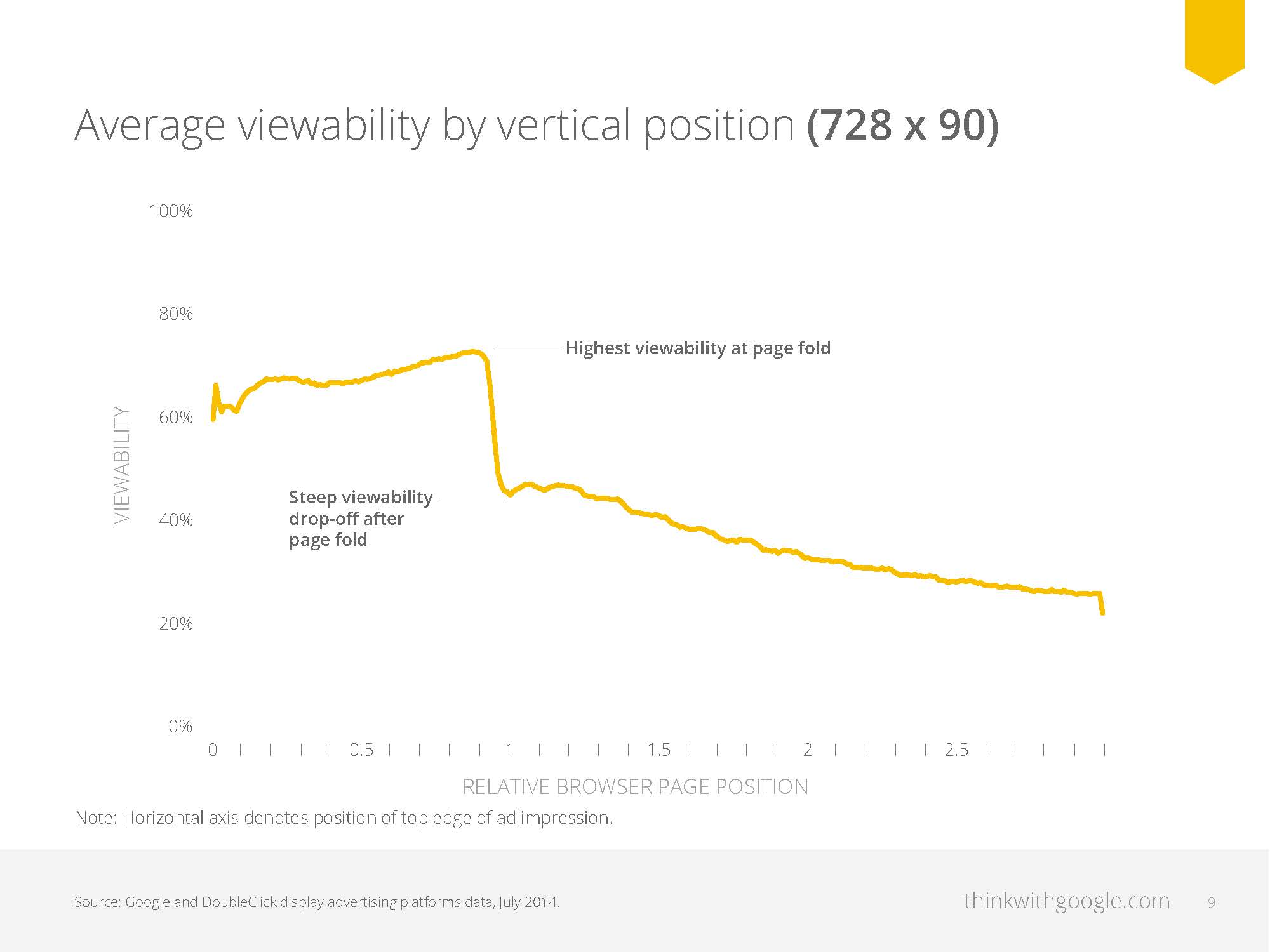
Helpfully, Google provides some clues in its report.  For instance, the highest viewability for ads is immediately above the “fold” – in other words, at the point where the viewer must begin to scroll down to see the rest of the page.

Surprisingly, viewability right above the fold is slightly higher than at the very top of the page.  But it’s massively less so just below that magic spot.  Google pressented five charts in its report to illustrate this drop-off phenomenon; the one reproduced below shows viewability of vertical position ads sized 728 x 90 pixels:

Average viewability by vertical position on online ads


Less surprising, perhaps, is the fact that vertical ads have higher viewability than horizontal or block ads, for the simple reason that they stay on the page longer:

Most viewable online display ad sizes


By publishing this data, Google purports to want to help their advertisers understand high- and low-value inventory better so they can target their campaigns more appropriately and effectively.

Google is also encouraging publishers to strive for delivering viewability rates in excess of 50% by offering ad inventory that will perform more effectively in its respective positions.

My only question is … why has it taken Google so long to set these standards and to publicize them in the first instance?

Sure, Google’s only the middleman between publishers and their viewers.  But it’s a pivotally important one.

Information, advertising and eye-tracking: Continuity among the chaos.

digital eyeIn the Western world, humans have been viewing and processing information in the same basic ways for hundreds of years. It’s a subconscious process that entails expending the most judicious use of time and effort to forage for information.

Because of how we Westerners read and write – left-to-right and top-to-bottom – the way we’ve evolved searching for information mirrors the same sort of behavior.

And today we have eye-scanning research and mouse click studies that prove the point.

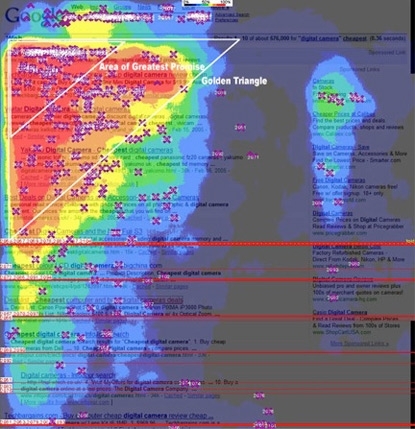
In conducting online searches, where we land on information is known variously as the “area of greatest promise,” the “golden triangle,” or the “F-scan diagram.”

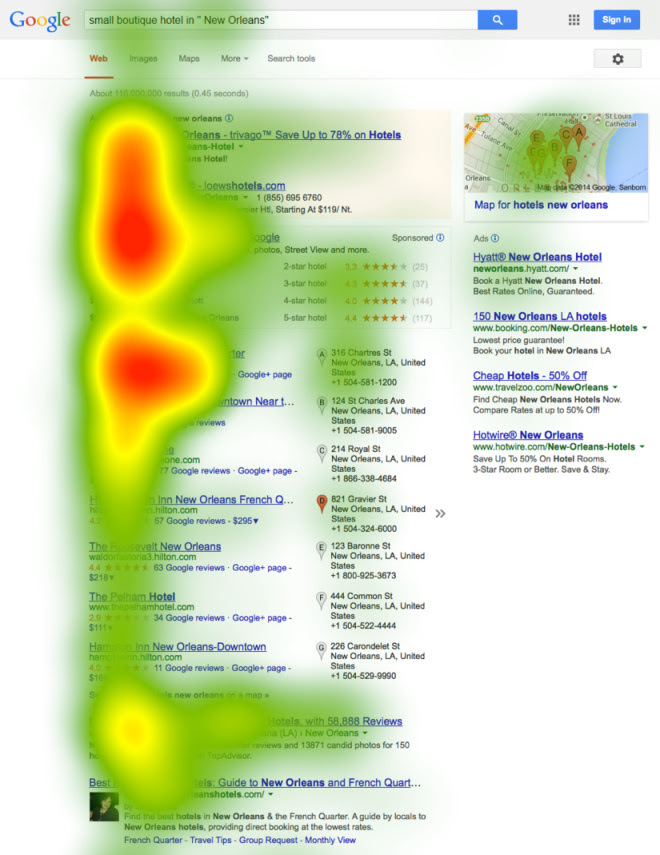
However you wish to name it, it generally looks like this on a Google search engine results page (SERP):

F-scan diagram

It’s easy to see how the “area of greatest promise” exists. We generally look for information by scanning down the beginning of the first listings on a page, and then continue viewing to the right if something seems to be a good match for our information needs, ultimately resulting in a clickthrough if our suspicions are correct.

Heat maps also show that quick judgments of information relevance on a SERP occur within this same “F-scan” zone; if we determine nothing is particularly relevant, we’re off to do a different keyword search.

This is why it’s so important for websites to appear within the top 5-7 organic listings on a SERP – or within the top 1-3 paid search results in the right-hand column of Google’s SERP.

In recent years, Google and other search engines have been offering enhancements to the traditional SERP, ranging from showing images across the top of the page to presenting geographic information, including maps.

To what degree is this changing the “conditioning” of people who are seeking out information today compared to before?

What new eye-tracking and heat maps are showing is that we’re evolving to looking at “chunks” of information first for clues as to the promising areas of results. But then within those areas, we revert to the same “F-scan” behaviors.

Here’s one example:

Eye-tracking Update

And there’s more:  The same eye-tracking and heat map studies are showing that this two-step process is actually more time-efficient than before.

We’re covering more of the page (at least on the first scan), but are also able to zero in on the most promising information bits on the page.  Once we find them, we’re quicker to click on the result, too.

So while Google and other search engines may be “conditioning” us to change time-honored information-viewing habits, it’s just as much that we’re “conditioning” Google to organize their SERPs in ways that are easiest and most beneficial to us in the way be seek out and find relevant information.

Bottom line, it’s continuity among the chaos. And it proves yet again that the same “prime positioning” on the page favored for decades by advertisers and users alike – above the fold and to the left – still holds true today.

Google Glass: Far-sighted … or fuzzy?

Google Glass fashionI’ve been blogging about Google Glass forever, it seems — or at least as far back as 2009 when the early conception of the product, then known as “Google Goggles,” was in its preliminary stage of development.

The Google Glass product was “soft-launched” in 2012, but it’s only become available to the broader consumer marketplace since the spring of this year — at about $1,500 a pair.

So … how has Google Glass done so far?

“Underwhelming” might be one way of putting it.

As it turns out, there are a number of key factors that are hindering consumer acceptance of this new piece of electronic gadgetry. Consider these points:

  • Substandard quality of images and video compared to a ~$200 smartphone:  oversaturated colors, lack of depth and dimension and all.
  • Battery life in normal use that is far less than promised: only about three hours instead of a full day.
  • Although somewhat streamlined compared to the beta versions of the product, it remains a somewhat “clunky” wearable device — or as Forbes magazine puts it, a “fashion failure.”
  • The general “creep-out factor” of constant surveillance remains a psychological barrier to many consumers.

Indeed, the jokes haven’t abated about the kind of people who make up the cadre of Google Glass “early adopters.”

“Glassholes” is one of the not-so-nice monikers they’re being called.

Going forward, Google Glass faces even more competition in the “wearables” category as computer power migrates into watches, jewelry and clothing in addition to eyeglasses. Even as these concepts become more mainstream, I suspect that Google Glass will continue to lag behind other products which seem to be harnessing the “high-tech-meets-high-fashion” concept more effectively.

We saw clear evidence of that this past week with the introduction of the Apple Watch.

Whereas Google has taken a “brute force” approach in the technological aspects of Google Glass (with design playing second fiddle), Apple has taken its technological innovation and packaged it in a way that resonates with the marketplace at a more visceral level.

If you glance quickly at someone wearing Apple’s watch, you’d be hard-pressed to think it’s anything much different from an analog version.  If Google hopes to have the same kind of success that Apple is poised to have, it needs to start thinking along those lines, too.

But one wonders if Google is “hard-wired” that way …

Software and security flaws: Even mighty Google isn’t immune.

Here’s a bit of news that doesn’t make one feel very reassured about cyber-security.

Gmail email accounts compromisedIt turns out that a major flaw has existed in the security of Google’s Gmail service for an extended period of time.

And that flaw could have been exploited to extract millions of Gmail addresses – potentially every single one of them, in fact.

What’s even more unnerving is that this flaw wasn’t uncovered by Google’s own engineers, but instead by security researchers in Israel who were kind enough to bring it to the company’s attention.

Thankfully, it was the “good guys” rather than the “bad” who made the discovery.

Evidently, the flaw resided in the sharing feature of Gmail that allows each user to delegate access to his or her Gmail account.

By “tweaking” the web address, the security researchers were able to reveal a random user’s e-mail address.

Once this procedure was proved out, scaling the hack was relatively easy.  By automating character changes using a software tool called DirBuster, the researchers were able to harvest approximately 37,000 Gmail address inside of two hours.

Oren Hafif, one of the security researchers involved in the exercise, blogged recently about the potential scope of the flaw:

“I brute-forced a token in a Gmail URL to extract all of the e-mail addresses hosted on Google.  I could have done this potentially endlessly.  I have every reason to believe every Gmail address could have been mined.” 

While the hack would not have exposed passwords explcitly, it could have left email accounts open to password-guessing attacks — not to mention unwanted spam mail or phishing.

Potentially, the breach could have affected not only personal users, but also businesses that use Google to host their email platforms.

Helpfully, the Israeli security researchers decided to inform Google of their discovery, preferring to be part of the solution rather than let the company twist in the wind.

So … are you ready for the kicker?

Reportedly, it took Google one full month to fix the software bug after being informed about it.

For a core service like email that is so central to the entire Google experience, one wonders why it took one of the world’s largest and most powerful companies weeks rather than just days to fix the problem.

If you’re looking for a redeeming or staisfying finale to this story … there really isn’t one.

Why?  Because in its infinite generosity, Google decided to reward Mr. Hafif for bringing the software flaw to its attention, in the form of a cash award.

One that really, really expressed thanks and appreciation for what he did.

Reportedly, the award amounted to US$500.

When Google Glass clashes with reality … watch out for shards.

Google Glass Groupies on the prowl.

Like self-driving cars, Google Glass devices – those intriguing contraptions that allow users to be “online connected” at all times – appear to be one of those innovations that spark a thousand “what if?” scenarios.

And it’s not at all clear what all the implications of Google Glass may be.  But we’re beginning to get some clues as to what’s in store for users.

For starters, Google Glass owners have been sternly warned against using them in locker rooms, movie theaters, casinos … and even restaurants.

And earlier this month, attorney Paul Alan Levy of Public Citizen, a consumer advocacy group, claimed that Google Glass wearers in some states could potentially face prosecution for recording people without their explicit consent.

Public Citizen logoIn a recent online column, Mr. Levy wrote:

“Many states require the consent of all parties in a conversation – at least, conversations not occurring in public situations – and provide both criminal penalties and a civil cause of action for participants.”

While such laws are on the books in just 12 states at the moment, collectively those jurisdictions represent more than a third of the American population (including the all-important states of California, Florida, Pennsylvania and Illinois).

So far, there doesn’t appear to be any record of prosecutions pertaining to using a Google Glass device to record someone without his or her consent.  But since these devices are such a rarity yet, that seems hardly surprising.

Too, there’s the possibility that the courts will rule that people are giving the wearer of a Google Glass device implicit consent to record them.  However, there’s something to the notion that many people would be basically clueless about whether they’re being recorded because of their unfamiliarity with the device and the technology.

And as if that angle isn’t enough, now there’s a company (FacialNetwork) that has developed a real-time facial recognition app for Google Glass.   With this app, called NameTag, people can snap a photo and search for more information online about the image – all in one action.

With new technology like this, finding a mate (or just a good-time girl or guy) will never be the same again.

Nor will the inevitable charges of invasion of privacy or stalking that follow.

Of course, to hear how the folks at FacialNetwork characterize it, you’d never think there were any potential negative consequences.  Instead, it’s all sweetness and light.  As NameTag co-creator Kevin Tussy puts it:

“It’s not about invading anyone’s privacy; it’s about connecting people that want to be connected.  We will even allow users to have one profile that is seen during business hours, and another that is only seen in social situations.”

Whatever.

And now … let the legal wrangling begin.