HubSpot’s Marketing Predictions: Hits and Misses

soothsayingOne of the things I like about SaaS inbound marketing firm HubSpot is the steady stream articles and white papers the company publishes on varied facets of marketing and communications. 

They’re often quite meaty and beneficial as informational resources.

Moreover, HubSpot isn’t afraid to go out on a limb and render a pretty strong “point of view” about various factors and trends in the fast-evolving marketing world.

The risk is that some of those perspectives can end up being “off” – or looking even a bit silly – in retrospect. 

But more often than not, HubSpot’s trendspotting is on the money.

Marketing Prediction Hits & Misses (HubSpot)Here’s a case in point:  HubSpot’s team of analysts made a number of marketing predictions for the year 2013.  Recently, it revisited those predictions to judge whether they’d turned out to be on the mark or not.

These are HubSpot’s 2013 marketing predictions that it feels were on target: 

  • Content and social will matter even more for search engine optimization.
  • Stop-and-start campaigns will fade, and real-time will be ‘in.’
  • E-mail will live on.
  • Inbound marketing will spread enterprise-wide.

At the same time, four other marketing predictions for 2013 didn’t pan out so well, as underscored by HubSpot’s own cheeky editorial commentary about them:

  • Mobile or bust … “Not so hot.”
  • Marketing becomes accountable for revenue generation … “Meh.”
  • ‘Big data’ becomes real for businesses … “Nope.”
  • Print is dead … “Not even close.”

HubSpot’s post-mortem discussion points on these “misses” are interesting.  Quoting from its report:

  • Mobile or bust:  “Customers pay attention to multiple screens … and smart marketers capture attention by adding value wherever a consumer pays attention  … we need to be prepared, not by targeting just [mobile] but by embracing them all according to our specific customers and data.”
  • Marketing becomes accountable for revenue generation:  “The biggest challenge … has been proving ROI.       Even more frustrating … has been the lack of sales and marketing alignment in many companies.  Tracking can also get tricky, thanks to trying to reach fragmented digital audiences against so many channels … As much as lots of us really want this prediction to be a hit, it’s still largely aspirational.”
  • ‘Big data’ becomes real:  “Big data remains mainly a buzzword to many companies and markets — and continues to be more of a prediction than a reality …”
  • Print is dead:  “Saying ‘print is dead’ has lost pretty much all of its roots in reality … nor will it die in the next few years.”

Ever intrepid, HubSpot isn’t shying aware from new forecasts for 2014.  Looking forward, what do its analysts predict for this year?

  • Podcasting will continue to grow substantially.
  • Marketing departments will become more like engineering departments.
  • Social listening tools will gain context and get smarter.
  • The economy will become highly collaborative.
  • Marketers will become more holistic and less channel-focused.

And one more HubSpot prediction that’s a particular favorite of mine:

We’ll check back again a year from now to see how well HubSpot’s prognosticators fared this time around.

Marketers Give Themselves Only Middling Grades on Understanding ROI

Marketing frustrationIt turns out that even the practitioners in the marketing field don’t think they’re doing a very good job of understanding the return on investment on key marketing tactics.

That’s a major takeaway fnding from the most recent State of Search Marketing survey conducted by digital marketing information clearinghouse Econsultancy in conjunction with the Search Engine Marketing Professional Organization (SEMPO).

This survey of industry professionals is conducted annually.  The 2013 research cycle queried ~400 industry and marketing/communications agency professionals.

One would think that in an evolving field like digital marketing, the degree of collective skill in the discipline would be rising over time.  But the opposite appears to be the case – at least in terms of the professionals’ own self-assessment of their skills.

The SEMPO research report presents how marketers consider their level of understanding to be in terms of ROI factors.

What the research reveals is a pretty stark decline in self-assessment grades between the 2012 and 2013 surveys:

  • Understanding of paid search ROI:  ~47% consider their understanding to be “good” (down from ~79%)
  • Email communications ROI:  ~41% consider good (down from ~57%)
  • Digital display media ROI:  ~28% consider good (down from ~37%)
  • Social media ROI:  ~11% consider good (down from ~15%)

What’s the reason for the decline in these self-assessment ratings?

It could be ever-changing definitions of what each of these marketing tactics actually encompass.

… It may be that there is an actual decline in overall proficiency as more people are assigned these marketing tasks who have little or no relevant knowledge or prior training.

… Or if could be the rapid speed in which technology is evolving in the marketing sphere.  (Big data isn’t the half of it.)

Of the major marketing tactics addressed by the Econsultancy/SEMPO research, it’s clear that social media and mobile are the most mystifying to practitioners, judging from the percentage of survey respondents that profess to have a “poor” understanding of their ROI:

  • Social media ROI:  ~51% report having a “poor” understanding
  • Mobile marketing ROI:  ~35%
  • Search engine optimization ROI:  ~28%
  • Digital display advertising ROI:  ~26%
  • Paid search ROI:  ~19%
  • Email marketing ROI:  ~14%

Underscoring the admitted lack of understanding about ROI in social and mobile channels, the survey respondents reported that only ~11% of the digital marketing dollars in 2014 will be allocated to social media.

For mobile marketing, it’s even lower (~3% of the marketing budget).

This isn’t to imply that marketers don’t recognize the importance of these tactics.  For instance, more than eight of ten respondents consider mobile marketing to be a significant development in the field.

It’s just that many of them are having great difficulty going from Point A to Point B when it comes to quantifying the marketing payback.

[For access to the full report, which also provides interesting insights on the most popular marketing metrics, go to this page on the SEMPO website.]

Cue up the e-mail Rogues’ Gallery: Here’s what people are purging from their inboxes.

e-mail rogues galleryAnyone who’s had an e-mail account for any length of time likely faces ever-increasing inbox volumes.

And trying to keep those groaning inboxes in check can be a never-ending task.  Now a recent report gives us clues as to what e-mails are being purged most frequently by recipients.

It’s been released by Unroll.Me, a service that scans users’ e-mail accounts for all of the lists to which they are subscribed — knowingly or not.  It then gives people the opportunity to unsubscribe, or to consolidate groups of e-mails into a single regular update.

It turns out, many people are unwittingly “subscribed” to receive e-mails from vendors based on something as benign as making a single online purchase.  So Unroll.Me finds a substantial incidence of people taking unsubscribe actions when given the chance.

Unroll.Me’s report claims that it prevented more than 1 billion e-mails, offers and updates from reaching inboxes last year via its service.

Of particular interest than the overall volume is the list of e-marketers that have been dissed the most by customers.

Leading the list is 1-800-Flowers.  A whopping ~53% of Unroll.Me users had those e-mails stopped during 2013.

[A personal note about 1-800-Flowers:  Over the past five years, our family has used this service to order flowers twice a year (Christmas and birthday) to exactly one person.  For those twice-a-year transactions, I estimate conservatively that we receive more than 200 e-mail solicitations each year — most with breathless offers promising deep discounts on orders.  Do those offers make us more inclined to purchase from them?  Hardly.]

According ton Unroll.Me, other e-marketers that experienced high unsubscribe rates in 2013 include:

  • Ticketweb:  ~48% unsubscribe rate
  • ProFlowers:  ~45%
  • Expedia:  ~45%
  • Active.com:  ~45%
  • Oriental Trading: ~44%

At the other end of the scale are companies and services that remain subscribed to by two-thirds or more of those who received their e-mails.

This “Star Gallery” is made up of Facebook, Google+, Twitter and LinkedIn.  What these e-mailers share in common is that they are social platforms, with engagement and interest levels higher because of the topics involved (friends, acquaintances, contacts and shared interests).

In other words, it’s the people they know, not the things companies want to sell them.

Now, back to the purging …

What’s the Future of E-Mail Marketing?

e-mail communicationsOver the past several years, I’ve begun to hear increasing rumblings about how e-mail is a now-mature communications method that’ll eventually go the way of the FAX machine. 

But I’m not at all sure I believe that.  I think it’s more likely that e-mail’s future will look … a lot like it does today. 

No doubt, texting and direct messaging have cut into some of the bread-and-butter aspects of e-mail communications.  But what about e-mail marketing?  Could we see a similar phenomenon happening?

Recently, I read the comments of e-communications specialist Loren McDonald on this very topic.  McDonald, who is vice president of industry relations at digital marketing technology firm Silverpop, makes an important point concerning the “building blocks” that have to be in place before e-mail marketing will be seriously threatened by alternative MarComm means.

McDonald speaks about the challenge of an “addressable audience” when it comes to alternative channels:  “Regardless of a competing channel’s popularity, marketers must be able to deliver a comparable or replacement message to an individual.  This is where many channels fall short,” he contends.

Loren McDonald
Loren McDonald

McDonald notes that most marketers possess vastly more permission-based e-mail addresses than they do mobile phone numbers with permission to text.  It’s the same story when comparing e-mail addresses to the percentage of their database that have liked their company’s Facebook page.

And there’s more:  For mobile apps, what portion of the typical company’s database has downloaded it and authorized notifications?  The inevitable response:  How low can you go?

McDonald’s point is that for these alternative channels to gain true significance, they need to achieve a certain critical mass in terms of adoption rates – thereby allowing marketers to reach their customers and prospects in a comparable manner as they can via e-mail (as well as at a comparable cost).

Looking into his own crystal ball, McDonald feels fairly confident making three predictions concerning the future of e-mail marketing:

  • He predicts that content-focused newsletters will remain relevant and popular, particularly for B-to-B companies and publishers.  That’s because marketers can push multiple newsletter articles within a single marketing touch, while publishers can attract ads and sponsorships for their e-newsletters (i.e. they’re moneymakers for them).
  • For broadcast/promotional messages, most consumers will continue to prefer e-mail delivery.  “Will mobile app users [really] want their smartphones to ping them all day long whenever a message arrives — and then have to click attain to view it?”, he asks rhetorically.
  • Transactional and triggered messages will be e-mail’s primary challengers in McDonald’s view – especially for bulletin-type messages such as breaking news headlines, weather alerts, flight delay announcements, “flash” promotions and sales, and order confirmations linked to in-app landing pages.

And even on this third prediction, McDonald doesn’t see the transition happening all that quickly.

I find myself in general agreement with Loren McDonald’s prognostications.  Do you have some differing views?  If so, please share them with other readers here.

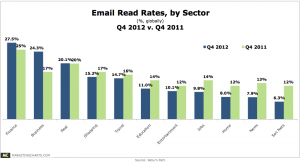
Charting e-mail read rates. (Correction: non-read rates.)

E-Mail Read Rates (Open Rates), Return Path, 4th Quarter 2012One of the great things about e-mail marketing is the ability to track nearly everything about its success (or lack thereof).

A recent Return Path Intelligence Report on e-mail statistics covering the 4th Quarter of 2012 is a case in point. Return Path conducts these studies by monitoring data from thousands of e-mail campaigns that utilize its delivery platforms.

Specifically, the  study tracks the inbox, blocking and filtering rates for more than 400,000 campaigns that use Return Path’s Monitor and Email Client Monitor suites, along with panel data from the company’s Inbox Insight program.

For the 4th study, Return Path reviewed nearly 250 ISPs in North and South America, Europe, Asia and Australia.

And what does its most recent study find? Fewer than one in five e-mails (17%) were opened. And that rate is slightly lower than what was recorded in the 2011 4th Quarter study.

However, some business sectors performed substantially better than the average:

  • Finance sector: ~28% open (read) rate
  • Business sector: ~24%
  • Real estate sector: ~20%

Shopping e-mails fared less well, with a read rate of ~15% (down from ~17% the previous year).

E-mail open rates in the education (~11%) and entertainment (~10%) fields were lower still.

And the worst sectors? News sector e-mails had an average open rate of only ~8%, while social networking e-mails fared even worse at ~6%.

Moreover, both of these bouncing-in-the-basement sectors experienced very significant drop-offs from the previous year, underscoring how they continue to struggle in their efforts to be interesting and relevant to readers.

For those who wish to view additional results and analysis, the Return Path report is available here.  It’s a free download.

B-to-B e-mail marketing: From sleepy to creepy?

Unwanted e-mails from businesses and brandsThe amount of information that companies know about the behavior of their customers has been growing, thanks to the “digital footprints” people leave all over the place when interacting with companies and brands via web surfing, e-mail and e-commerce.

Still, up until now, there’s been a polite dance wherein the companies don’t acknowledge the degree of that knowledge. Call it a sort of digital politeness.

But that seems to be changing, as the stakes have grown higher for engaging with customers via online, social and e-mail communications rather than traditional advertising.

Take Pitney Bowes in the B-to-B world, for example. In recent months, its marketing staff has sent out e-mail communiqués to their opt-in customers containing messages like, “We notice it’s been a while since you opened an email from us.”

That creepy little missive is as impertinent as it is likely false. Considering the wide swath of people who use the Microsoft Outlook e-mail platform – and many of those use preview panes and have set their default preferences to block images – in reality Pitney Bowes doesn’t actually know if its customers have been reading its e-mail messages or not.

It’s also unclear whether Pitney Bowes really wants its opt-in recipients to go away rather than just browbeating people into engaging with their e-mails more.

This has manifested itself in e-mail messages sent asking if customers are still interested in receiving e-mails so they can “continue receiving the latest from PB.” But despite this implicit threat to be dropped from Pitney Bowes’ e-mail database, ignoring those e-mails doesn’t seem to result in that actually happening.

Rather, it’s just a continuation of more borderline-creepy e-mails with messages chiding the recipient for potentially missing out on “valuable information about supplies, offers, discounts, new products and thought leadership pieces.”

Thought leadership pieces? The leaders of Pitney Bowes may think quite highly about their company and its “vaunted” position in industry … but self-describing itself as being the fount of industry-leading knowledge is a surefire way to get laughed out of town.

Just like the obnoxious teacher’s pet in school or the crashing bore at a cocktail party, no one enjoys interacting with a know-it-all who just can’t wait to corner you and tell you all about his or her latest feats of accomplishment.

In a world where most businesses are spending more effort than ever trying to collect e-mail addresses for ongoing engagement with customers and prospects, here’s a little reminder to them: Try disseminating content that is actually of value to people … which is what will get them to engage with you.

More often than not, that content won’t be about their products and services.

What does e-mail engagement mean to consumers? Getting a discount.

e-mail engagement is all about providing discounts to customersIf you suspect that most people opt in to receive commercial e-mails so that they can receive discounts on the products want … you’re absolutely right.

The latest proof of this is in a survey of ~1,000 consumers conducted earlier this year by BlueHornet, a San Diego-based e-mail marketing services company.

That survey found that the percentage of consumers signing up to receive commercial e-mails in order to receive discounts is a whopping 95%.

So while marketers may want to believe that “engagement” with consumers is all about brand affinity and excitement … all that is much less important to them than simply getting a good deal on the product or service.

There will always be a desire for companies to nurture personalized, relevant conversations with customers via their e-mail communications.

After all, a highly engaged customer base that sees a brand as tops in its field … perhaps leader in innovation and technology … and above all, a brand that makes a true difference in the customer’s personal or business life.

All of these objectives represent Holy Grail of marketing. By all means, marketers can and should strive for this level of brand engagement – however hard to attain it may be.

But to make it a whole lot easier easier, offer a coupon or discount as well.  Preferably big.

Sometimes “permission slips” aren’t enough when it comes to e-mail deliverability.

Bounced-emails-undelivered-emailsIn case you’ve been wondering how much marketing e-mail actually reaches its intended targets, a recently released benchmark report from e-mail scoring and certification services provider Return Path has some answers. It finds that only about 75% of “permissioned” e-mails are actually making their way through.

That means one in every four e-mails are either hitting a spam or junk folder, or are being blocked by ISP-level filtering.

The report was based on analysis of data from Return Path’s Mailbox Monitor service, which tracks the delivery, filtering and blocking rates for more than 600,000 e-mail campaigns.

Interestingly, the delivery stats for business-to-business marketing e-mail aren’t much lower than for business-to-consumer e-mail. This was considered somewhat surprising because of company-level filtering systems like Postini, MessageLabs and Symantec that are installed at many large corporations. Presumably, they do a more thorough job of filtering e-correspondence.

The Return Path report also included a few cautionary notes for marketers:

 Many e-mailers believe that whatever gets deployed and doesn’t bounce must be reaching inboxes. But senders are notified only when the e-mail is a hard bounce – not if it has ended up in a spam or junk folder.

 Relying on rented e-mail files in the B-to-B world can be dangerous, as those files can be riddled with spam traps. Commercial entities are always on the search for new prospects and leads … but merging a good in-house list with a few of these bad boy rental lists can result in compromising the entire database.

 In the consumer sector, many marketers aren’t paying close enough attention to inbox placement rates. For example, data about Gmail shows that while many marketers are ostensibly achieving a 90%+ deliverability rate, fewer than one in five of those emails are actually being directed to the “priority” inboxes within Gmail as designated by the recipients. And you can bet that precious few of the other ~80% are getting any sort of attention at all from consumers.

More details about the Return Path report can be found here – well-worth checking out.

Shopping in the Internet Age: Let’s Make a Deal

Consumers love their online dealsI hear the complaint often that e-mail has become the preserve of “deal a day” promotions and communications from brands that have devolved into little more than breathless announcements about discounts that are “too good to pass up,” coupled with the obligatory “free shipping” pot-sweetener.

And then the next day, another deal shows up that’s practically the same as the last one …

But how surprising is this, really? Let’s not forget that daily newspaper advertising – the equivalent antecedent to e-mail marketing, has always had a similar focus on price, sales and deals.

It’s just that with e-mail, it seems more ubiquitous because they’re being pitched to us hourly on any number of digital platforms and mobile devices, rather than just once a day with the newspaper delivery.

And there’s no doubt that the sheer volume of deal activity is growing – the low cost of e-mail marketing makes sure of that. Not only is seemingly every consumer brand out there working the e-mail channel like they did catalogues and newspaper advertising in the past, there’s also the bevy of coupon marketers like LivingSocial, Groupon, Yipit and Gilt City, to name just the top few.

Some have discerned a decline in the “quality” of the information that is being provided; whereas there may have once been some educational, informative or “cool” content included along with the special deals, now it’s often devolved into nothing but “price, price, price” and “savings, savings, savings.”

The extent of consumer interaction with “deal-a-day” websites and e-mail offerings was quantified recently in consumer research conducted by Yahoo and Ipsos OTX MediaCT. The survey, fielded in February 2011, discovered that U.S. adults who are on the Internet subscribe to an average of three daily or weekly shopping e-mails or e-newsletters. (And more than half subscribe to two or more.)

How often are people reading these e-communiqués? With daily regularly, it turns out.

Nearly two-thirds of the respondents who subscribe to at least two of these “daily deal” e-mails or e-newsletters report that they read all of the messages that are sent. Here’s how reading frequency breaks out:

 Read several times per day: ~22% of respondents
 … Once per day: ~38%
 … A few times per week: ~23%

 Read once per week: ~7%
 … A few times per month: ~5%
 … Once per month or less: ~5%

The same Yahoo/Ipsos survey measured the degree of pass-along activity, which is one of the most potent aspects of e-mail marketing. Most recipients reported doing this – about 45% doing so on a weekly basis or more frequently:

 Forwarding deals to friends or family several times per week: ~17%
 … Several times per day: ~12%
 … Once per day: ~10%
 … Once per week: ~6%

 Forwarding once per month or less frequently: ~19%
 … Never doing so: ~22%

Despite the complaint commonly heard about groaning e-mail inboxes, the Yahoo/Ipsos survey gives little indication that consumers are in reality becoming all that tired of the onslaught of daily deal promos. In fact, over six in ten respondents in the survey reported that they subscribe to more of them today compared to last year.

Moreover, nearly half of the survey respondents reported that they’re excited to receive them … and that they “can’t wait” to see the latest deals being offered each time.

There’s another way we know that these deals are retaining their relevance: Three-fourths of the respondents reported that these types of e-mails come to their main inbox rather than to a separate account they’ve set up to receive such offers. So there’s little doubt that when people say that these deals are desirable, they actually mean it.

We consumers do like our deals, don’t we? And if you think that the popularity of deals and discounts is due to the recession, that’s belied by the fact that even America’s super-affluent are on the deal bandwagon. Unity Marketing’s recent survey of the wealthiest 2% of Americans — those earning $250,000+ per year — finds that value-priced Amazon is the top shopping destination for ~45% of them. Not only that, ~10% use Groupon for coupons and ~8% use Craigslist.

No, it seems bargain-hunting is the thing for practically everyone.