Raspberry Chorus: Yahoo’s Newest E-Mail Interface

If you use Yahoo’s e-mail platform and can’t stand its new interface (actually there have been two of them within the past year, with the second one even more irritatingly clunky than the first), raise your hand.
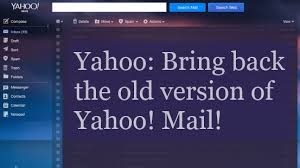
Yahoo's e-mail interface failIf you did, you’re among the scads of people who are unimpressed, irritated or even angry about the changes.

As it turns out, even Yahoo’s own employees are in a negative frame of mind about using Yahoo’s e-mail (or its search tool).

That fact was inadvertently revealed to the world in November when an internal company memo was leaked.  In the memo, Yahoo senior vice president of communications Jeff Bonforte and chief information officer Randy Roumillat wrote:

“Earlier this year we asked you to move to Yahoo Mail for your corporate email account.  25 percent of you made the switch (thank you).  But even if we used the most generous of grading curves … we have clearly failed in our goal to move our co-workers to Yahoo Mail. 

“It’s time for the remaining 75 percent to make the switch.  Beyond the practical benefits of giving feedback to your colleagues on the Mail team, as a company it’s a matter of principle to use the products we make.  (BTW, same for Search.)

Messrs. Bonforte and Roumillat seem to forget that this is America of the 21st Century — not the Soviet Union of the 1960s. 

If three-fourths of a company’s employees won’t use its own products, those products can’t be very good.  And the notion of coercion seems only destined to backfire – witness the leaking of the company memo. 

That’s Raspberry #1.

It doesn’t help that the two principals chose as their e-mail subject line this little bon mot:  “Windows 95 called and they want their mail app back.”

Implying that your recipients are mindless rubes isn’t a way to foster much in the way of cooperation and goodwill …

That’s Raspberry #2.

If Yahoo’s top brass were smart, they’d spend less time trying to pressure their employees – who must know a thing or two about the (de)merits of the interface. 

Instead, they should listen to the millions of Yahoo e-mail account holders who are none-too-pleased with the company’s latest “innovations.” 

That would be Raspberries #3 through #500,000 or so.  And yes, I’m in that category.

Consider comments like these that have been appearing all over cyberspace:

  • “The new Yahoo Mail is awful.  At least Yahoo Classic worked.  I’ll be moving everything I can from Yahoo.  Ugh.”
  • “Yahoo Mail seems as slow as treacle after the recent ‘forced march’ out of Yahoo Classic.  If it doesn’t get better soon, they are not going to have any users left.”
  • “I get buttonholed almost everywhere I go by [Yahoo email] users – including prominent techies – who complain about the new version.”
  • “Yahoo email and search are horrible … Yahoo email needs to be thrown out and rebuilt from scratch.  They need to also get someone who has a clue to create a spam filter.  The ‘stickiness’ of Yahoo email, search and other products sucks, plain and simple.”

This last comment also refers to a related issue.  As Wall Street Journal writer Kara Swisher noted in a story published in the industry website AllThingsD:

“A relentless and vocal group of Yahoo Mail users have been complaining vociferously after the Silicon Valley Internet giant drastically revamped its popular email service in October.  The ire includes a lot of distress over the removal of its tabs function and the addition of a multi-tasking feature in its place.”

As for me, I’d been struggling with the latest e-mail interface for awhile, thinking I might eventually come to like it (or at least to tolerate it).  After a few weeks, I came to the realization that this was never going to happen. 

That’s when I decided to figure out if there was to get the old interface back. 

The good news – at least for now – is this:  You can restore Yahoo Classic email. 

Yahoo doesn’t make it obvious, but by following the steps below, you can get yourself back out of e-mail purgatory:

  • After you open your Yahoo email, click on the small steamboat wheel located at the top right corner and select “Settings” from the dropdown menu.
  • Click on “Viewing Email” … then click on the box at the bottom labeled “Basic” and your screen will update to the classic version of Yahoo email.
  • Click on your browser’s “Back” button, and you will be returned to the original Mail Plus version of Yahoo (with the tabs).

These procedures should work with all of the major browsers (IE, Firefox and Safari).  But you may need to repeat these steps whenever you refresh your browser, or close mail and reopen. 

Even so, that’s way better than having to struggle with the new Yahoo interface.

What are your thoughts?  Do you agree or disagree that the new Yahoo email interface is a “huge leap backwards” in terms of user-friendly functionality?  Please share your comments pro or con with other readers here.

What’s the Future of E-Mail Marketing?

e-mail communicationsOver the past several years, I’ve begun to hear increasing rumblings about how e-mail is a now-mature communications method that’ll eventually go the way of the FAX machine. 

But I’m not at all sure I believe that.  I think it’s more likely that e-mail’s future will look … a lot like it does today. 

No doubt, texting and direct messaging have cut into some of the bread-and-butter aspects of e-mail communications.  But what about e-mail marketing?  Could we see a similar phenomenon happening?

Recently, I read the comments of e-communications specialist Loren McDonald on this very topic.  McDonald, who is vice president of industry relations at digital marketing technology firm Silverpop, makes an important point concerning the “building blocks” that have to be in place before e-mail marketing will be seriously threatened by alternative MarComm means.

McDonald speaks about the challenge of an “addressable audience” when it comes to alternative channels:  “Regardless of a competing channel’s popularity, marketers must be able to deliver a comparable or replacement message to an individual.  This is where many channels fall short,” he contends.

Loren McDonald
Loren McDonald

McDonald notes that most marketers possess vastly more permission-based e-mail addresses than they do mobile phone numbers with permission to text.  It’s the same story when comparing e-mail addresses to the percentage of their database that have liked their company’s Facebook page.

And there’s more:  For mobile apps, what portion of the typical company’s database has downloaded it and authorized notifications?  The inevitable response:  How low can you go?

McDonald’s point is that for these alternative channels to gain true significance, they need to achieve a certain critical mass in terms of adoption rates – thereby allowing marketers to reach their customers and prospects in a comparable manner as they can via e-mail (as well as at a comparable cost).

Looking into his own crystal ball, McDonald feels fairly confident making three predictions concerning the future of e-mail marketing:

  • He predicts that content-focused newsletters will remain relevant and popular, particularly for B-to-B companies and publishers.  That’s because marketers can push multiple newsletter articles within a single marketing touch, while publishers can attract ads and sponsorships for their e-newsletters (i.e. they’re moneymakers for them).
  • For broadcast/promotional messages, most consumers will continue to prefer e-mail delivery.  “Will mobile app users [really] want their smartphones to ping them all day long whenever a message arrives — and then have to click attain to view it?”, he asks rhetorically.
  • Transactional and triggered messages will be e-mail’s primary challengers in McDonald’s view – especially for bulletin-type messages such as breaking news headlines, weather alerts, flight delay announcements, “flash” promotions and sales, and order confirmations linked to in-app landing pages.

And even on this third prediction, McDonald doesn’t see the transition happening all that quickly.

I find myself in general agreement with Loren McDonald’s prognostications.  Do you have some differing views?  If so, please share them with other readers here.

Marketing clichés are all around us.

no buzzwordsMarketing can be many things.  But marketing without originality isn’t much of anything.

That’s why there’s a desire among marketers to avoid clichés and buzz terminology in sales and marketing content whenever possible.

Still, it’s easy to fall into the cliché trap – and it happens to the best of us.

This is particularly true when the “next new thing” in business comes along every few months and people grasp for shorthand ways to communicate those concepts.

[There:  Perhaps “next new thing” qualifies as a marketing cliché itself!]

Brian Morrissey
Brian Morrissey

Recently, communications specialist and editor-in-chief of vertical media company Digiday, Brian Morrissey, came up with a list of 25 marketing clichés which he feels should be avoided if at all possible.

I’ve gone through Morrissey’s list and have selected ten that I think are particularly baneful – especially in the world of B-to-B marketing.  See if you agree:

Putting the customer at the center.  Isn’t it obvious that companies and brands would be committed to this?  And if not … where was the customer located before?

Having an “authentic” conversation with customers.  Inauthenticity isn’t cool.  Inauthenticity is also what we’ve been trying to avoid for years – or should have been.  There’s really no news in this statement, is there?

We fail fast.  Perhaps it comes from reading too many issues of Fast Company … but what companies do you know that want to slowly jettison a failed strategy?

Blue-sky thinking.  The “sky’s the limit” when it comes to “out-of-the-box thinking.”  Ugh.

Nab the low-hanging fruit.  This cliché has been around so long, there can’t be any low-hanging fruit left!

Dipping our toe in the water.  Trying to put a positive spin on a lack of depth or heft isn’t fooling anyone.

Open the kimono.  Any buzz phrase that conjures mental imageries of a flasher can’t be what we want to communicate.

Curated experiences.  A fancy way of admitting that content isn’t ours.  Besides, the term “curator” hardly sounds contemporary.  Instead, it connotes images of museums, galleries and other places that deal with the dusty past.

Surprising and delighting our customers.  Morrissey contends that this whopper makes brands come off like clowns … and that clowns are silly, scary or creepy – take your pick.

Tentpole idea.  Continuing with the clown analogy, no doubt … but whether it’s a circus or a tent revival, the mental imagery this elicits isn’t particularly apropos.

… And these are just ten terms on Morrissey’s list of 25 marketing clichés.

What about you?  Do you have any buzz phrases that you find particularly annoying – perhaps “thought leadership” or maybe “exceeding our customers’ expectations”?

Please share your nominations with other readers here.

Spotify hits the spot in its business valuation: $5.3 billion.

bullhornThere’s no question that Spotify has been an up-and-comer in the music streaming business.  Speaking anecdotally, over time more and more of my friends and family members have been signing up for the service.

And now, Spotify is pushing forward with an even more aggressive growth strategy … and it’s not aiming low at all.

In fact, the company is seeking backers at an eye-popping valuation level of $5.3 billion.

And to top it off, the company’s co-founders (Daniel Ek and Martin Lorentzon) intend to raise the funds not through equity investment, but through loans.

It seems neither person wishes to give up any more of the company to investors than has already happened.

What makes the $5.3 billion valuation so startling is not just the amount – big though it is.  It’s because that the last business valuation of Spotify, done less than 12 months ago, pegged the company’s value at just $3 billion.

That time around, a number of institutional investors stepped up to the plate (including Coca Cola, Fidelity and Goldman Sachs).  But don’t look for more institutional investment in this round of funding.

In the case of Spotify, being second or third in the music streaming market segment has turned out to be a good thing.  Pandora and others were the pioneers, laboring in the vineyards for many long years before proving out the business model. 

Then along comes Spotify and cleans up in a market space that people now understand fully.

At the moment, Spotify has around 6 million paying users in 28 countries — along with several times that number of people who use Spotify’s free, ad-funded services.  Spotify streams music across desktops and mobile devices along with other music gear.

The company reports that it pays approximately 70% of total revenues back to music rights-holders.  It’s not profitable yet … but how many years was Pandora bleeding red ink?  The better part of a decade, certainly.

There continues to be some low-level grumbling about how Spotify handles payouts to the “bigger name” performers in the music industry. 

According to some reports, Spotify pays only about $0.005 per stream.  That means only big stars (the likes of Beyoncé and others) can make any meaningful money from the service.

But for anyone who thinks that $5 billion+ is a tad rich when it comes to the valuation of a business property like Spotify … remember that Skype was sold to Microsoft for $8.5 billion in 2011, after having been valued at just $2.75 billion two short years before. 

So maybe the whole thing isn’t so far-fetched after all.

Social Marketers Behaving Badly …

Social marketers behaving badlyEx-Cong. and New York City mayoral candidate Anthony Weiner hasn’t been the only one misbehaving on social media.

Chipotle Mexican Grill also gets a time-out to sit in the corner for its social media hi-jinks. 

It turns out that a supposed hacking of Chipotle’s Twitter account in mid-July was nothing more than a ploy to grab attention and gain more Twitter followers.

For those who haven’t heard, Chipotle’s Twitter stream appeared to have been hacked as a series of bizarre and nonsensical tweets were posted over the span of several hours – until the company claimed to have solved the problem.

As it turned out … the whole thing was completely manufactured – all of those crazy tweets published by the company itself.

A few days later, a Chipotle spokesperson came clean, admitting that the whole episode was actually a carefully orchestrated effort to gain more Twitter followers, in concert with the company’s 20th anniversary.

Did it work?  Evidently yes … because Chipotle had ~4,000 more Twitter followers at the end of the campaign than it did at the beginning.

But some marketing professionals were critical of the ploy.  Here are a few representative comments:

  • Chipotle is a brand about honesty and authenticity; faking a hack if off-brand.”  (Rick Liebling, Y&R Creative Culturalist)
  • “Most of these stunts … strike me as being pretty lazy.  It’s like making your CEO do a press conference drunk and then apologizing for it once he sobers up.”  (Ian Schafer, Deep Focus CEO)
  • Chipotle’s pico de gallo was more ‘weak sauce’ than ‘muy caliente.’”  (Saya Weissman, Digiday Editor)

On second thought, perhaps it’s not such a good idea to “mess with the market” when upside is a few additional social media contacts (that probably won’t stick around), and the downside is brand irritation or even humiliation.

After all, Chipotle’s net gain in Twitter followers represented an uptick of just 1.7%

That seems a bit paltry considering the potential blowback and reputation risk.

“Social Media Stress Syndrome”: Real or Fake?

Social Media Stress SyndromeThere’s no denying the benefits of social media in enabling people to make new friendships, reconnect with old acquaintances, and nurture existing relationships.

Facebook and other social platforms make it easier than ever to maintain “in the moment” connections with people the world over. 

Speaking for myself, my immediate relatives who live in foreign lands seem so much closer because of social media.

Plus, thanks to social media, I’ve met other relatives from several different countries for the very first time.  This would never have happened in the pre-Facebook era.

But there are downsides to social media, too – and I’ve written about them on this blog on occasion; for example, whether social media is a platform for narcissists.

Other negative consequences of social media have been noted by numerous observers of consumer online behaviors, including Canadian digital marketing company Mediative’s Senior Vice President and online marketing über-specialist Gord Hotchkiss.

Gord Hotchkiss
Gord Hotchkiss

In a recently published column by Hotchkiss headlined “The Stress of Hyper-Success,” he posits that self-regard and personal perspectives of “success” are relative.  Here’s a critical passage from what he writes:

“We can only judge it [success] by looking at others.  This creates a problem, because increasingly, we’re looking at extreme outliers as our baseline for expectations.”

Hotchkiss’ contention is that social media engenders feelings of stress in many people that would not occur otherwise.

Pinterest is a example.  A recent survey of ~7,000 U.S. mothers conducted by Today.com found that ~42% of respondents suffer from this social media-induced stress; it’s the notion that they can’t live up to the ideal suggested by the images of domestic bliss posted on the female-dominated Pinterest social network.

Facebook causes a similar reaction in many; Hotchkiss reports on a survey showing that one-third of Facebook users “feel worse” after visiting the site.

It may not be hard to figure out why, either, as visitors are often confronted with too-good-to-be-true photo galleries chronicling friends’ lavish vacations, social gatherings, over-the-top wedding ceremonies, etc.

Social Media EnvyIt’s only natural for people to focus their attention on the “extraordinary” posts of this type … and to discount the humdrum posts focusing on the mundane aspects of daily life. 

Just like in the national or local news, people tend to focus on personal news items that are exceptional – the activities that are set far apart from the average.

Wall Street Journal report Meghan McBride Kelly has come up with a pretty interesting way to address social media stress:  She quit Facebook earlier this year after a nine-year run.  McBride contends that “Aristotle wouldn’t ‘friend’ you on Facebook,” writing:

“Aristotle wrote that friendship involves a degree of love.  If we were to ask ourselves whether all of our Facebook friends were those we loved, we’d certainly answer that they’re not.  These days, we devote equal if not more time to tracking the people we have had very limited interaction with than to those whom we truly love.”

Likewise, Hotchkiss tries to head us off at the social media pass:

“Somewhere, a resetting of expectations is required before we self-destruct because of hyper-competitiveness in trying to reach an unreachable goal.  To end on a gratuitous pop culture quote, courtesy of Sheryl Crow:  ‘It’s not having what you want.  It’s wanting what you got.”

What are your thoughts about “social media stress disorder”?  Please share your observations with other readers here.

Optify takes the pulse of B-to-B paid search programs.

Optify logoI’ve been highlighting the key findings of Optify’s annual benchmark report charting the state of B-to-B online marketing. You can read my earlier posts on major findings from Optify’s most recent benchmarking here and here.

In this post, I focus on the paid search activities of business-to-business firms.

Interestingly, Optify finds that pay-per-click programs have been undertaken by fewer firms in 2012 compared to the previous year.

And the decline isn’t tiny, either:  Some 13% fewer companies ran paid search programs in 2012 compared to 2011, based on the aggregate data Optify studied from 600+ small and medium-sized B-to-B websites.

However, those companies who did elect to run pay-per-click advertising programs in 2012 achieved decent results for their efforts.

The median company included in the Optify evaluation attracted nearly 550 visits per month via paid search, with a conversion rate just shy of 2%, or ~45 leads per month.

[For purposes of the Optify analysis, a lead is defined as the visitor taking an action such as filling out a query form.]

Leads from paid search programs represented an important segment of all leads, too – between 10% and 15% each month.

The above figures represent the median statistics compiled by Optify. It also published results for the lower 25th percentile of B-to-B firms in its study. Among these, the results aren’t nearly so robust: only around ~60 visits per month from paid search that translated into 6 leads.

Since the Optify report covers only statistics generated from visitor and lead tracking activity, it doesn’t attempt to explain the reasons behind the decrease in the proportion of B-to-B firms that are engaged in paid search programs.

But I think one plausible explanation is the steadily rising cost of clicks. They broke the $2 barrier a long time ago and see no signs of letting up. For some companies, those kinds of costs are a bridge too far.

I’ll address one final topic from the Optify report in a subsequent blog post: B-to-B social media activities. Stay tuned to see if your preconceptions about engagement levels with social media are confirmed – or not!

Is Social Media a Platform for Narcissists?

Narcissism on social mediaOver time, I’ve been seeing more articles and blog posts cropping up that broach the topic of social media and narcissism.  Here’s just one of the latest examples.

The issue boils down to this:

  • Do social media platforms cause people to become narcissistic?
  • Or is social media merely a conduit by which people who already possess narcissistic tendencies get to indulge in “self-referential behavior” on steroids?

One could probably start at the very beginning:  Is Mark Zuckerberg a narcissist?”    (Don’t answer that question!)

My own view is somewhat conflicted.  I see evidence of some people who cheerfully relish the bullhorn – and attention – that social media appears to give them.

But social media can be deceiving in that a “personal environment” can be built that seems like the whole world is watching and listening – but in reality it’s just a constructed edifice more akin to a Potemkin village.

How many people are actually reading anyone’s Twitter posts?    (Don’t answer that question!)

But I can also see clear evidence of some of the more “Type B” people I know who have made quite an impact on social media by virtue of some very impressive contributions – written information, videos, photography, etc.

In those cases, social media has been a way to extend influence well beyond a small circle of friends or colleagues – and far more than could ever be possible before.

How about you?  What are your thoughts on this topic and what have you observed?  Please share them here if you’re so inclined.

(Don’t worry, we won’t accuse you of narcissism!)

The corporate resource commitment to social media: Plenty of talk … but how much action?

Social media staffing prospects for 2013 are no better than they were in 2012.With social media activity seemingly bursting at the seams, it’s also risen near the top of many marketing departments’ punch lists of tactics to reach, engage with and influence their customers and prospects.

But when it comes to putting serious resources behind that effort, how much of a commitment is really there?

A recent Ragan Communications/NASDAQ OMX Corporate Solutions survey suggests that the commitment to social media may be a lot of “talk” … and a lot less “walk.”

The November 2012 survey of ~2,700 social media professionals found that two-thirds of the respondents perform their social media tasks above and beyond their regular marketing duties:

  • Social media tasks are on top of current responsibilities: ~65% of respondents
  • Have established a team for social media activities: ~27%
  • Use an in-house team along with an outside social media agency or planner: ~5%
  • Outsource all social media efforts: ~3%

For the distinct minority of companies that have seen fit to devote some degree of dedicated personnel to their social media program, nearly 85% of them have created teams of three people or fewer … and in more than 40% of the cases, it’s just a single individual instead of a team.

What departments within companies are involved in social media activities?  No surprise here:  It’s the usual suspects (marketing and public relations) with a variety of other departments having their toe in the water as well:

  • Marketing: ~70% of departments are involved in social media activities
  • Public relations: ~69%
  • Corporate communications: ~49%
  • Advertising: ~26%
  • Customer service: ~19%
  • Information technology: ~17%
  • Legal personnel: ~14%

As to whether we’re on the cusp of something much bigger in terms of resourcing social media activities, this isn’t evident much at all from the future plans of the businesses surveyed by Ragan.

Let’s begin with budgets. Excluding salaries and benefits, half of the companies surveyed have social media budgets of $10,000 or less – and one-quarter have essentially no dollars at all earmarked for social media:

  • Annual social media budget $1,000 or less: ~23% of respondents
  • $1,000 to $5,000: ~14%
  • $5,000 to $10,000: ~13%
  • $10,000 – $50,000: ~22%
  • $50,000+: ~26%

When asked whether companies had expanded their social media personnel assignments during 2012, fewer than one-third of the respondents answered affirmatively.

… And the trend doesn’t look much different for 2013, with more than three-fourths of the respondents reporting that there aren’t any plans to hire additional social media practitioners this year.

What about interns, that fallback position for cheap and easy labor?

Fewer than one-fourth of the respondents reported that interns are employed by their companies for social media tasks. Most others believe that using typically inexperienced interns for the potentially sensitive customer engagement aspects of social media is a “non-starter,” as they consider those sensitivities to be a disqualifying factor.

And in the cases where interns do help out in social media efforts, the vast majority of their activity is confined to Facebook and Twitter, as compared to LinkedIn, blogging,creating online “thought leadership” articles and the like.

How satisfied are companies with how they’re doing in the social media realm? According to this study, there’s rampant dissatisfaction with the degree to which companies feel able to measure the impact of social media on their sales and their businesses.

The tracking mechanisms put in place by companies range the gamut, but it’s not clear how convinced practitioners are that the information is accurate or actionable.

  • Track interaction and engagement (e.g., followers, fans, likes): ~86% of respondents
  • Track web traffic: ~74%
  • Track brand reputation: ~58%
  • Track customer service and customer satisfaction: ~41%
  • Track new lead generation: ~40%
  • Track new sales revenues: ~31%

The vast bulk of tracking activity happens using in-house mechanisms or free measurement tools (~59% use those), although the paid measurement tools offered by HootSuite and Radian6 do have their share of users.

The takeaway from the Ragan/NASDAQ research is this:  Company staffing and resource allocations have a ways to go to catch up with all the talk about social media.

Chances are, those resources will be easier to allocate once proof of social media’s payback potential can be shown.  But that might take substantially more time to prove than some people would like.

As if to underscore this notion, statistics compiled by IBM researchers covering the past holiday season found that less than 1% of all online purchases on Black Friday emanated from Facebook.  The percentage of purchases from Twitter was even lower — undetectable, in fact.

And similarly paltry results were charted for the rest of the 2012 holiday season.

As long as social media marketing continues to contribute such pitiful sales revenues, get used to seeing scant social media budgets and near-zero increases in dedicated human resources.

As direct marketing specialist and raconteur Denny Hatch has so pointedly remarked:

“Social media marketing is an oxymoron.  You cannot monetize a giant cocktail party.”

What do you think?  Is Mr. Hatch onto something … or is he just reaching for dramatic effect?  Share your own thoughts if you’d like.

Right on Cue: More insights into e-mail engagement.

Groaning e-mail inboxes
According to Cue’s 2012 user statistics, on average, people receive more than six e-mail messages for every one that they send.

As if we needed any more proof that people are getting more and more e-mails — and reading fewer and fewer of them — along comes some aggregated data that confirm our beliefs.

Cue (formerly known as Greplin) is a mobile app for organizing and searching online data across a variety of functions such as e-mail, cloud storage and online calendars.

Because of the large number of people who use the app, Cue has amassed huge amount of data when it comes to knowing users’ online activities.

Earlier this month, Cue released some anonymized aggregate data gleaned from a cross-selection of app users. Some of the interesting findings from that study, which covered all of 2012, include these “factoids”:

  • Average number of e-mail words written per person: ~41,400
  • Average number of e-mail messages sent: ~870
  • Average number of e-mail messages received: ~5,600

With over six times the number of e-mail messages received compared to sent, it’s no wonder people are busily trashing e-mails right and left with nary a glimpse at them.

Not only that, users are becoming slower in responding to the e-mails that they do read. In 2012, the average length of time for response was ~2.5 days, compared to ~2.2 days in 2011.

But more than half of all e-mail responses happened within the first hour – and nearly 90% within 24 hours. This means that the other ones were responded to a really long time afterward in order to result in the 2.5-day average.

There were some other interesting tidbits Cue gleaned from its user analysis. For instance, “dogs” topped the list of most-mentioned animals; they were mentioned 38% of the time versus 32% for cats and just 19% for fish.

And in terms of swear words – what everyone wants to know even if they won’t admit it – the “S” word outscored the “F” word by ~43% to ~39%, with the “D” word bringing up the rear at just ~18%.

[Come to think of it, wouldn’t it have been more apropos if the “S” word was bringing up the rear?]