Advertising that’s really on a roll.

Toilet Paper Roll Advertising
Here’s advertising that’s really on a roll — in more ways than one.

One definition of good advertising is how effectively it reaches the most people and engages its audience for longer periods of time.

According to that definition, placing advertisements on toilet paper rolls is a brilliant move that should “wipe away” competing promotional tactics, correct?

[On the other hand, you might think this advertising idea “stinks.”] 

But it’s just what two young entrepreneurial brothers are up to. They’ve formed a business – Star Toilet Paper – that supplies toilet paper to public bathrooms.  And the TP features advertisements printed right on the roll.

According to brothers Bryan and Jordan Silverman, Star’s toilet paper is made from environmentally friendly materials, with coupons and ads printed on them using a soy-based ink.

Their company sells space on the rolls for a half-penny per ad.  Coupons printed on the TP can be redeemed through the company’s own website.

Reportedly, some big-name advertisers like Ben & Jerry’s ice cream have signed on … as have some smaller businesses like physicians offices.  (No word on whether the doctors specialize in gastroenterological medicine.)

How are the Silverman brothers enticing restaurants, bars and other venues to stock their toilet paper? They’re providing the ad-filled rolls to these establishments at no charge.

Not surprisingly, this idea came to the brothers while they were students in college.

After patenting the concept in 2010, they’ve since formed their company, developed a business plan, and have already lined up approximately 50 advertisers.

How successful is the endeavor so far? No official word on whether the brothers are “cleaning up” in the business and “flush” with cash yet.

But Jordan Silverman notes that bathroom stall visitors are the very definition of a captive audience. “It’s an unmatched active audience. A person looks at the average advertisement for two to five seconds. People will look at ours for a lot longer,” he notes.

One of the customer segments considered to be highly lucrative for the company is movie theaters.

Come to think of it, this newfangled TP would be perfectly suited for the next Star Trek movie.

… You know, the one where the Starship Enterprise circles Uranus and wipes out the Klingons …

America’s “Summer of Funk”

Consumers are in a funk in the Summer of 2012.

How much do American consumers spend in an average day? According to a July 2012 Gallup Poll, they spend about $70 per day in stores, gas stations, restaurants and online. (Housing, utility costs and vehicle purchases are extra.)

It turns out that this figure is a pretty big drop from the average daily spend of $104 Gallup found in 2008.

That meme we’re hearing on the campaign trail about people’s livelihoods having shrunk over the past three or four years? Evidently, it’s a fact.

And Gallup is also finding that upper-income Americans have undergone the same degree of spending reduction as everyone else. Their spending is now down to about $116 per day.

Evidently, confidence in the U.S. economy and the stock market’s uneven performance have taken their toll on the psyche of even the affluent classes in America. And Gallup isn’t the only organization charting this. Ipsos MediaCT is finding a similar story in its surveys.

Last week, Stephen Kraus, an Ipsos senior vice president and author of several books on the upper-income sector of society, wrote: “Widespread uncertainty plays a role in a fundamental fact of today’s “affluent” marketplace. For the most part, affluents today simply don’t feel affluent.”

Krauss continues, “This feeling isn’t new; for most, it is part of the lingering hangover of The Great Recession. But it is particularly pronounced in the summer of uncertainty.

Krauss concludes his remarks with this rather gloomy observation: “It’s a summer of uncertainty indeed – about the economy, about the future, and even about one’s own standing in today’s financial hierarchy.”

Reading these very latest reports on the level of uncertainty – even resignation – that people have about the economy, it underscores the collective funk the American people seem to be in as the 2012 presidential campaign grinds on inexorably to its conclusion.

Perhaps once Election Day has come and gone, Americans will “snap out of it” and begin to feel brighter about the future.

Perhaps. But don’t hold your breath. 

Rude Awakening: Google to Cut Jobs

Google is cutting 4,000 jobs at MotorolaNow here’s some interesting news: Google is downsizing – the first time it’s ever done so.

More precisely, it’s cutting ~20% of the workforce of its Motorola subsidiary, which it acquired earlier this year. And most of those job cuts are happening in the United States.

While Google is known for being a money machine, the fate of its Motorola subsidiary has been far less stellar. In fact, Motorola hasn’t turned a profit in 14 of its last 16 quarters.

Motorola proves how dicey the world of hardware is compared to the search advertising realm where Google makes more than 90% of its revenues and profits.

The fact is, despite Motorola’s strong lineup of smartphone models like the Droid RAZR and RAZR HD, it’s just very difficult to turn a profit on the hardware side — especially in the entry-level mass market where Motorola has also attempted to compete.

But more to the point: Motorola’s subsidiary is one industry sector where Google isn’t in the driver’s seat. By contrast, it’s easy to be a veritable profit machine when you control 65%+ of the billions that make up the search marketing world.

Recently, it’s clear that Google has been sniffing around to add other products and services and not be so dependent on one silver-bullet business category.

The big question is … what does Motorola’s experience portend for future forays by Google into new segments where the company doesn’t command an overwhelming advantage?  Or, will it spend more of its capital on search-related acquisitions, like the just-announced absorption of Frommer’s travel-related media properties?

Welcome to the real-world competition, Google.

Radio audiences: “Stickier” than you might think.

Radio audiences:  Stickier than you might realize.It’s a pretty common belief that when commercial breaks come on the radio, the audience scatters to the four winds.

And that view isn’t just held by laymen … those in the broadcast industry itself tend to believe that.

A study conducted by Arbitron, Media Monitors and Coleman Insights, released about six months ago, discovered that ad agency personnel believe that the typical radio audience is one-third lower during commercial breaks than during the lead-in.

Among radio industry personnel, those feelings are only slightlycloser to reality; they believe that the radio audience is about one-fourth lower during commercial breaks than during the lead-in.

In fact, a parallel study conducted by the same researchers found that these industry perceptions are way wide of the mark. Their evaluation, which covered nearly 18 million commercial breaks and ~62 million minutes of ads airing over a 12-month span on ~865 radio stations, revealed these interesting findings:

  • The average radio station aired 2.6 commercial breaks comprising nearly 9.0 minutes of advertising per hour.
  • The average break was ~3.5 minutes in duration.
  • On average, more than 93% of the lead-in audience stuck with the station during commercial breaks.
  • Longer spot breaks (4 to 6 minutes) still delivered ~90% of the lead-in radio audience.

These figures are significantly higher than the perception of industry observers. But one perception did turn out to comport with reality – the fact that older radio listeners are more apt to stay listening through the commercials than are younger listeners (~98% versus ~90%).

The study also determined that listening behaviors don’t differ at all between the different seasons of the year. But the audience for music stations is somewhat more prone to “wander off the reservation” compared to listeners of radio stations with spoken-word formats:  Fully 99% of the news-format radio audience stays on the station during commercials, while only ~88% of music format station listeners have the patience to stick around through the advertising.

The bottom line on the study’s findings is that radio is delivering audiences for commercials at levels that far exceed advertisers’ expectations.

So, the radio industry’s job is two-fold: Change the erroneous perceptions about audience levels … and also convince advertisers that the audience is actually listening and learning during the advertising breaks, not tuning out. 

This last bit may well be a lot harder to accomplish!

You can read more findings from the radio audience research here.

Washington Mutual’s Big Gamble that Backfired

The Lost Bank, Washington Mutual's CollapseDo we need another book about bank failures? In the case of Seattle-based, Washington Mutual, I think so. After all, it represents the largest bank failure in U.S. history.

A new book has just been published about WaMu: The Lost Bank, by Kirsten Grind. Ms. Grind is a reporter for The Wall Street Journal and a former writer for the Washington State’s Puget Sound Business Journal. Having reported about WaMu for years, she brings a trove of knowledge and context to a story that goes well beyond the proceedings from Capitol Hill hearings.

In fact, one of the major reasons to read this book is the peek behind the curtain it provides … so that we can begin to understand “why” things happened, not just “what” happened.

Washington Mutual represents an ugly off-note in the oh-so-harmonious corporate world of Seattle — home to vaunted progressive organizations such as Starbucks, Boeing and Microsoft. And for decades, the financial institution was just another regional banking entity, making safe loans and turning in a decent financial performance at the end of each year.

What happened?

The trajectory of WaMu’s brief, dramatic ascent into the stratosphere – and subsequent disastrous plunge – was set when the institution, no longer the closely held institution it had once been, gambled on growth by acquiring Long Beach Mortgage in 1999. Unlike WaMu, LBM was a leading participant in the sub-prime mortgage lending market, with a national presence.

Ms. Grind notes that some of the impetus for acquiring Long Beach Mortgage came from a desire to be in accord with Congressional aims to expand home mortgage lending to people who had traditionally not been able to participate in the housing market due to low incomes, poor credit, or a lack of credit history.

Herein begins yet another example of the old adage: “The road to hell is paved with good intentions.”

And in fact, it wasn’t long before WaMu started expanding its loan offerings to include adjustable rate mortgages and other “innovations” designed to increase loans and commensurate deposits.

It was all too easy. Then the greed set in. As long as home values continued to climb, WaMu found it could continue to originate mortgage loans, collect fees, sell the loans, and continue to grow its lending business, deposits and earnings.

The bank set aggressive goals to become one of the nation’s top two or three mortgage lenders, even as it came to possess a 2,000+ branch network.

But by 2007, barely eight years after the run-up began, the bank’s own officers began to realize major problems with the sub-prime division, leading to its collapse barely a years later and the fire-sale takeover of its assets by J.P. Morgan.

The legacy of WaMu’s bad lending practices has been bedeviling J.P. Morgan ever since. After initially marking down WaMu’s portfolio of mortgage loans by some $31 billion, J.P. Morgan has had to set aside an additional ~$6 billion because of further deterioration of the portfolio.  The fallout from WaMu’s collapse will continue to reverberate in the coming years.

The Lost Bank is a good read even for people who aren’t well-versed in the financial side of business. Unlike other books I’ve encountered on banking topics that seem to be “long on tedium,” this one definitely keeps your interest from first page to last.

I find this book on par with two others that brought their corporate subjects to light in a similarly real way – and also well-worth reading:

  • Liars Poker by Michael Lewis (about Salomon Brothers and the Wall Street investment crisis of the late 1980s)

Feel free to share your own thoughts about these three books. Do you recommend them to others as well?

Reasons Why the Facebook IPO Bombed

Facebook IPO failureShare prices of Facebook stock have been distinctly underwhelming since the first day of trading — to the tune of ~30% off its original offer price. And everyone seems to have an explanation as to why.

I’m partial to a list of reasons put out by Dan Janal, president of PRLeadPlus.com and author of the business book Reporters Are Looking for You.

Mr. Janal has come up with a dozen reasons for the Facebook IPO failure. The ones that struck me as most compelling are these:

  • The public is not as dumb as Wall Street thinks. Chalk it up to too many other dot.com “can’t miss” opportunities that whiffed big-time.
  • Who has excess money to throw around? Small investors are struggling with underwater mortgages and mountainous debt … so how do they have extra funds to throw at an IPO? Get real. (And the institutional investors stayed away because they were clearly “in the know” about how unrealistic Facebook’s IPO share pricing really was.)
  • Who goes on Facebook to actually buy things? Precious few, that’s who. And if buyers aren’t on Facebook … then advertisers won’t be there either. And with that, there goes a big part of Facebook’s business rationale down the toilet. (GM backed out of its Facebook advertising program – very publicly – just days before the IPO. That timing suggests they were trying to tell the market something!)
  • Friends aren’t really “friends.” Indeed, many Facebook friends are more like acquaintances, which is a lot less compelling when it comes to word-of-mouth influencing. (LinkedIn connections are far more “honest” in terms of being “all about business.”) When Facebook contends that friend networks will influence more buyers, investors look at their own friend networks … and they don’t buy the hype.
  • There’s a huge gulf between Facebook “friendships” and actual “engagement.” And if friends don’t engage, a big piece of what makes the Facebook power matrix potentially so potent falls away.

Mr. Janal maintains that the characteristics that make the Facebook platform what it is aren’t the same ones that’ll launch “a million new millionaires.”

Sure, the early investors who acquired stock options early in the game came out big winners. But precious little of that largesse turns out to be in the cards for the rest of the investors.

Bombs away.

Facebook’s Interesting Week

Facebook's_first_day_of_tradingBy now most people have heard all of the news reports about Facebook’s initial public offering, and how the world now has a new crop of instant millionaires and billionaires.

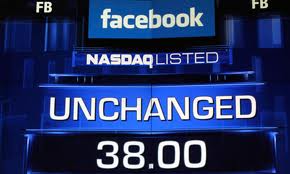
But the news last week wasn’t all roses for Facebook. For one thing, it became clear as Day 1 of trading ground on that Facebook shares weren’t going to increase in value. Indeed, it took the underwriters stepping in with institutional buying to keep the share price (barely) above the initial offering price of $38 per share.

And there was the news of GM dissing Facebook by announcing that it is dropping its paid advertising program with the social network … evidently due to Facebook’s failure to convince GM marketing execs of the effectiveness of its program.

But there was even more. Consider this news report: Facebook was hit with a $15 billion privacy lawsuit on the very first day of public trading. Filed on behalf of a number of Facebook’s users, the class action suit claims that Facebook invaded personal privacy by tracking users’ web usage.

The lawsuit cites a bevy of case law and regulations as part of the briefing documentation, including the Federal Wiretap Act, the Computer Fraud & Abuse Act, the Stored Communications Act, and various California statutes.

Consider the implications if this suit is at all successful:  Now that it is a public company, Facebook is under increased pressure to increase its advertising revenues rapidly – which means collecting yet more user data to help it target paid advertising effectively and thus command premium pricing.

But if the lawsuit is successful, it could prevent Facebook from collecting the very data it uses to serve up advertising based on relevant audience targets.

On the other hand, similar cases brought against Facebook in recent years have been thrown out of court because browser cookies haven’t been viewed as “wiretaps.” Moreover, plaintiffs have had difficulty in proving any “harm” as a result.

Of course, there was some additional very good news this past week for Facebook – at least for CEO Mark Zuckerberg: He got married.

… Which in the end may turn out to deliver far more happiness and fulfillment than all the money in the world ever could do.

Good marriages are like that … so let’s all hope for the very best for Mr. Zuckerberg.

More Interest in Pinterest …

While it pales in comparison to the $1 billion+ Facebook public offering today, social bulletin board Pinterest, the topic of a recent blog post of mine, has snagged its own financial windfall this week.  It comes in the form of a $100 million investment led by Rakuten, Inc., a Japanese conglomerate of Internet-oriented businesses.

With this filing, Pinterest is now valued at approximately $1.5 billion.

Why is Rakuten making the investment?  Very likely because one of the key components of the conglomerat is e-Commerce Marketplace, which is Japan’s leading electronic commerce player. 

Michael Jaconi, an executive officer at Rakuten, is quoted as saying that “Pinterest recognizes Rakuten as a global Internet player and they want to leverage some of the skill set in the growing business world.”

With 77 million members in Japan already, Rakuten has ambitious plans to become “the top global internet service company,” according to Mr. Jaconi.

But why choose Pinterest instead of Facebook or Twitter for such a major financial investment? 

The answer to that question isn’t necessarily “either/or,” actually.  “We want to continue investing in technology that is as innovative as Pinterest,” Jaconi notes.  “If we need to buy and invest to bring us closer to that source of innovation, we will.”

Stay tuned, obviously.

What people say: More believable than what brands say.

Word of mouth and review/ratings sites trump branding activityWord of mouth has always been a powerful influencer over the success or failure of a product in the market. So when surveys show that consumers value the opinion of their friends most when it comes to the value of a product, there’s nothing particularly unusual about that news.

But consider the explosion in the popularity of review sites like Angie’s List and Yelp, plus other sources of information and opinion in cyberspace over the past few years. These have made it possible to access the opinions of significantly more people than ever before.

Nielsen’s most recent Global Trust in Advertising Survey, which queried ~28,000 consumers around the world in late 2011, found that ~92% of respondents trust word-of-mouth recommendations from friends and family members.

Interestingly, that percentage is actually up from 2007, when Nielsen found ~75% of respondents trusting their friends as a good source of information.

What about online consumer reviews written by complete strangers? Consumers’ trust levels in those information sources has also gone up; it’s ~70% today compared to ~55% back in 2007.

The picture is different with branding and advertising, however. Trust in traditional advertising (TV, radio, magazines and newspapers) has dropped in recent years. Today, only about 47% of Nielsen survey respondents say they trust those sources of information.

Online advertising has actually improved its standing with consumers, but trust levels are still mired in the 30s: 36% trust online video ads … ~33% trust online banner ads … ~39% trust paid search engine advertising.

And when it comes to branded content like company websites, consumer trust in these “owned media” is running below 60%, while e-mail communiqués are scoring even lower on the trust scale (around 50%).

The Nielsen survey results underscore why developing a robust social media presence has become such an important strategy for so many brands. Clearly, recommendations and reviews from friends and strangers alike is having the strongest impact on the purchase decisions that are being made.

Of course, building a social media presence is only half the battle: Whether the content is positive, neutral or negative has huge implications as well. A few negative reviews or ratings can stop a purchaser dead in his or her tracks. Just ask anyone in the hospitality industry, whose establishments are in some senses almost held hostage by TripAdvisor and other rating sites.

U.S. Government Driving Pecan Growers and Pecan Buyers Nuts

Pecan harvestingThose who contend that the Federal government has no business managing the nation’s healthcare system because it can’t even manage its way out of a paper bag got fresh ammunition this past week.

The Wall Street Journal published an article chronicling how incorrect government data has wreaked havoc in the pecan industry. Evidently, the government vastly overstated the amount of pecan exports to Asian countries and other destinations in 2010 and 2011.

The relatively small size of the U.S. pecan industry (just shy of $700 million production) means that there isn’t a futures market for the crop. Instead, pecan buyers look at trade statistics to determine whether demand will be strong or weak – and lock in purchase contracts accordingly.

When U.S. trade stats purported to show heavy overseas shipments – and with the Chinese market ramping up purchases for the Lunar New Year celebrations – pecan buyers locked in their purchases early. And pecan growers in the Eastern U.S., where the crop is harvested first, did well with supplying the product at these lucrative prices.

But when the “phantom demand” from overseas failed to materialize, pecan prices tumbled. Growers in the Midwest and West found themselves facing pecan prices nearly half the levels of just a few weeks earlier.

The culprit? The Federal government, which published the completely bogus trade figures based on “a computer malfunction” at the Census Bureau’s foreign trade division.

“There were internal processing errors,” division chief Nick Orsini reported.

When and how did the government find this out? Not until one of the industry’s buying firms questioned the figures and reported its concerns to the agency.

The foreign trade division’s “internal processing errors” have since been fixed. But in its wake is a trail of debris that reaches into every corner of the pecan industry.

Some buyers are miffed because they were led to lock in purchases when the market was at its peak, wasting hundreds of thousand of dollars on high-priced buying.

Midwestern and Western growers who harvest later in the season found themselves having to sell their crop at a deep loss, the market having crashed. So they’re not happy campers, either.

One thing’s for certain: Everyone in the pecan industry now knows what it’s like to be burned. And because it’s the government … there’s nothing anyone can do about it.

Oh sure, the National Pecan Shellers Association sent an official letter to Federal officials outlining its concens with the faulty data … but that promises to have as much impact as a pecan tree falling in the forest.

And from the Federal officials’ point of view, what’s the big whoop, anyway? What sort of political clout to these people have?

After all, it’s just a ~$680 million industry.

About on par with Solyndra.