It’s common knowledge that the business model for newspapers started going awry in a major way with the decline in newspaper classified advertising.
Craigslist played a huge role in that development, as the online classifieds site went about methodically entering one urban market after another across the United States.
And now we have quantification of just how impactful Craigslist’s role was. It comes in the form of a May 2013 study authored by Robert Seamans of New York University’s Stern School of Business and Feng Zhu of the University of Southern California.
Titled Responses to Entry in Multi-Sided Markets: The Impact of Craigslist on Local Newspapers, the study explored the dynamics at play over the period 2000-2007, focusing on newspapers’ degree of reliance on classifieds at the time of Craigslist’s entry into their markets.
What the researchers found was that those newspapers that relied heavily on classified ads for revenue experienced more than a 20% decline in classified advertising rates following Craigslist’s entry into their markets.
But that isn’t all: The outmigration of classified advertising to Craigslist was accompanied by other negative trend lines — an increase of subscription prices (up 3%+) and lowering circulation figures (down nearly 5%).
Even newspaper display advertising rates fell by approximately 3%.
Were these developments “cause” or “effect”? The study’s authors posit that fewer classified ads may have diminished the incentive for people to purchase the newspapers. Also, display advertising rates tend to track circulation figures, so once the “decline cycle” started, it was bound to continue.
The study concludes that by offering buyers and sellers a free classified ad alternative to paid listings in newspapers, Craigslist saved users approximately $5 billion over the seven-year period.
Those dollars came right out of the hides of the newspapers, of course … and changed the print newspaper industry for good.
But here’s the thing: The experience of the newspaper industry has relevance beyond just them. “The boundaries between media industries are blurred and advertisers are able to reach consumers through a variety of platforms such as TV, the Internet and mobile devices,” the authors write.
The unmistakable message to others in the media is this: It could happen to you, too.
My brother, Nelson Nones, has lived and worked outside the United States for years. From his vantage point “outside looking in,” I find that his perspectives on U.S. socio-political developments are often somewhat different from the conventional thinking here at home.
This was clearly evident when the news broke In early June about the National Security Agency (NSA) surveillance of e-mail and other digital content. Within just a couple days, Nelson had penned a thought piece on the implications of these revelations on the cloud computing industry.
In his view, the NSA revelations are likely to have numerous serious implications. As he states in his analysis:
“… these threats will be perceived to be so serious that many businesses could decide to abandon the use of cloud computing services going forward — or refuse to consider cloud computing at all — because they bear full responsibility for compliance yet now realize that they have little or no ability to control the attendant non-compliance risks when utilizing major cloud services providers.
In view of recent revelations, the tantalizing cost savings and efficiencies from cloud computing may be overwhelmed by the financial, business continuity and reputational risks.”
Out front: Geoprise Technologies was among the first to warn about the negative consequences of NSA surveillance programs on the U.S. cloud computing industry.
I wondered how long it would take for these views to gain traction here in the United States.
It didn’t take long at all. In fact, the Information Technology & Innovation Foundation, a Washington, DC-based think tank focusing on technology policies, released a report a few days ago in which it projects the U.S. cloud computing industry to forfeit between $22 billion and $35 billion in lost business as a result of the revelations about the NSA’s electronic surveillance programs.
That represents between 10% and 20% of a cloud computing market that is expected to be a $207 billion industry by 2016 – revenues which are likely to be sucked up by European and Asian companies instead.
The ITIF report warns that the NSA’s surveillance programs “will likely have an immediate and lasting impact on the competitiveness of the U.S. cloud computing industry if foreign customers decide the risks of storing data with a U.S. company outweighs the benefit.”
The implications are huge because up until now, the United States has been the acknowledged leader in cloud computing usage and innovation, even as other countries have tried to play catch-up.
The ITIF report has garnered the attention of the business press — big time. The Guardian has published a story as has the Financial Times. The story has leached into general news and opinion sites as well, such as The Daily Kos — and others are sure to follow suit.
All of this is a pretty major deal because the cloud computing industry represents one of the fastest growing sectors of the digital communications market. Global spending on cloud computing is anticipated to grow by 100% between 2012 and 2016.
That compares to growth of only about 3% for the global IT market as a whole.
And in case people are thinking that the ITIF report might be unduly alarmist … it appears that the giant sucking sound of cloud computing business going elsewhere has already begun to happen.
Some U.S. tech companies are reporting that they’ve already lost customers, as concerns mount over the NSA’s PRISM program that lets the federal government tap into user information and e-mails held by Internet companies.
The Cloud Security Alliance, a coalition of industry practitioners, corporations, associations and other key stakeholders whose mission is to promote the use of best practices in providing security assurance within cloud computing field, conducted a survey in June and July of companies located outside the U.S. That survey found that ~56% of the responding companies are now less likely to use a U.S.-based cloud computing service, thanks to the NSA’s spying program.
One out of ten respondents reported that they have already canceled contracts with U.S. companies. And that’s only within the past few weeks.
Meanwhile, non-U.S. players in the cloud computing market must surely be laughing all the way to the bank. For example, Artmotion, the largest hosting company in Switzerland, reported a ~45% increase in revenue within just the first month after Edward Snowden’s release of details about the PRISM program.
To be sure, Europeans are wasting no time weighing in on the messy situation the American cloud computing industry suddenly faces. Neelie Kroes, European Commissioner for Digital Affairs, had this to say:
“If European cloud customers cannot trust the United States government, then maybe they won’t trust U.S. cloud providers either. If I am right, there are multibillion-euro consequences for American companies. If I were an American cloud provider, I would be quite frustrated with my government right now.”
Germany’s Interior Minister Hans-Peter Friedrich was even more blunt:
“Whoever fears their communication is being monitored in any way should use services that don’t go through American servers.”
What are the companies that fear their communications are being monitored, as Mr. Friedrich posits? Pretty much all of the bigger ones, I’d think.
OK, U.S. government and administration officials: Have fun unscrambling this egg!
The company seemed to take a certain delight in the degree to which it subjected job candidates to mind-bending suitability tests and humiliating proctology-like HR examinations.
So I was a bit surprised to read this June 19, 2013 article in the New York Times, in which staff business reporter Adam Bryant published excerpts from an interview he had with Laszlo Bock, senior vice president of people operations at Google.
A major objective of the interview was to determine to what degree so-called “Big Data” can be used to help find the right candidates fill leadership and managerial positions in companies.
Instead of giving us all sorts of ways in which Big Data is helping to do that, Mr. Bock focused instead on the limitations. And in the process, he revealed that Google has made attempts to harness more experiential data to come up with more effective hiring practices. Here’s what he said:
“We’ve done some interesting things to figure out how many job candidates we should be interviewing for each position, who are better interviewers than others, and what kind of attributes tend to predict success at Google.
On the leadership side, we’re looking at what makes people successful leaders and how we can we cultivate that.”
“We found that brainteasers are a complete waste of time. How many golf balls can you fit into an airplane? How many gas stations in Manhattan? A complete waste of time. They don’t predict anything. They serve primarily to make the interviewer feel smart.”
And about GPA stats, Bock revealed that after all of the data crunching, Google’s HR department came to this conclusion:
“GPAs are worthless as a criteria for hiring, and test scores are worthless – no correlation at all, except for brand-new college grades where there’s a slight correlation … we found that they don’t predict anything.
After two or three years, your ability to perform at Google is completely unrelated to how you performed when you were in school, because the skills you required in college are very different. You’re also fundamentally a different person. You learn and grow. You think about things differently.”
So now Google has reverted to the tried-and-true formula of structured behavioral interviews, consistently applied across all applicants.
This includes using standardized behavioral questions to listen to open-ended responses, which then makes it possible to see how candidates actually interacted in real-world situations, as well as what they consider to be “easy” or “difficult” situations in which they found themselves.
Regarding leadership qualifications, according to Bock, Google has found that these are ambiguous or amorphous characteristics:
“For leaders, it’s important that people know you are consistent and fair in how you think about making decisions, and that there’s an element of predictability. If a leader is consistent, people on their teams experience tremendous freedom because then they know that within certain parameters, they can do whatever they want.”
Where “big data” comes in to play here is in twice-a-year employee surveys that Google conducts on all of its managers, evaluating a variety of factors.
Those factors are the fundamental ones — things like sharing information, treating all team employees fairly, and providing clear goals and performance standards.
But Bock cautions that leadership success is highly dependent on the context; what works at one company isn’t necessarily right for another firm. “I don’t think you’ll ever replace human judgment and human inspiration and creativity,” he notes.
I was pleased to read these comments, because I always felt that attempting to develop a radically new paradigm for job hiring, while being an interesting and novel endeavor, was also somewhat presumptuous on the part of Google.
At the end of the day, human nature is what it is: fickle, unpredictable, fallible. No amount of “re-engineering” is going to change that.
According to J. D. Power, hotel guest satisfaction ratings in North America are up for the first time in years.
One of the industry segments that took the biggest beating in customer satisfaction during the recent recession was the hotel sector.
Annual surveys conducted by J. D. Power charted a continuing decline in satisfaction rates. In everything from reservations and the check-in process to the cost of stay, hotel customers have been giving “thumbs down” for the past half-decade.
Until now.
Marketing information services company J. D. Power & Associates, part of McGraw Hill, has just released the results of its latest annual survey, based on responses from more than 68,700 hotel guests in the United States and Canada collected between July 2012 and May 2013.
J.D. Power has conducted these hotel industry surveys annually for the past 17 years.
According to the 2013 North America Hotel Guest Satisfaction Index Study, the overall guest satisfaction rating index is 77.7 on a 100-point scale.
That may seem like a “Gentleman’s C,” but it’s an increase from last year’s 75.7 score.
More to the point, it’s the first time in quite a few years in which the aggregate rating has gone up.
Where has satisfaction increased? Pretty much in every category surveyed, with the largest gains coming in the reservations process, check-in/check-out procedures, and hotel costs and fees.
Other categories included in the study were guest room satisfaction, food and beverage service, other hotels services, and hotel faciliites.
The largest area of continuing discontent is in Internet usage. Customer complaints are all across the board — ranging from spotting connectivity and slow speeds to usage charges.
Other areas where improvements are sought are in HVAC comfort and controlling noise levels.
What about customer reaction to rising hotel rates? After all, they’ve gone up by about 5% over the past two years.
But the J. D. Power survey found little concern about rate increases. Rick Garlick, director of the survey, suggests that pulling out of the economic downturn might explain this lack of concern. “The economy may be playing a part in price satisfaction because people have a little more to spend,” he noted.
The people who appear to be the least satisfied with their stay experience are the ones who chose to stay at a hotel based on price alone. It’s like the adage says: “You get what you pay for.”
On the other hand, the most satisfied guests weren’t necessarily people who stayed at 5-star properties. Instead, they’re ones who evaluated hotels carefully beforehand using online tools such as third-party hotel reviews and ratings. The “eyes wide open” strategy, as it were.
Such evaluation tools have made it easier to know what to expect from a hotel stay, contributing to overall satisfaction ratings because there’s less likelihood of a “rude awakening.”
The J. D. Power surveys also ask respondents to rate hotel brands. I was interested to see which hotels scored highest in the various different categories in this year’s survey:
Luxury category:Ritz-Carlton
Upscale:Hyatt
Midscale Full Service:Holiday Inn
Midscale:Drury
Economy/Budget:Microtel (Wyndham)
Extended Stay:TownePlace Suites
Come to think of it, none of these results is particularly surprising. In fact, three of the brands (Ritz-Carlton, Holiday Inn and Drury) have been tops in their category for three or more consecutive years of the J. D. Powers studies.
Who hasn’t ever interviewed someone and known within the first minute or so that the meeting was going to be a complete waste of time?
[Then the fun part was having to make inconsequential small talk for the rest of the interview just to appear civil!]
Unfortunately, this scenario happens more often than we’d care to admit. And considering the effort involved in planning and conducting phone or in-person interviews, it’s a major waste of time and resources.
But now a company has come along that harnesses the Internet and camera technology to offer a different approach that I find pretty intriguing.
It’s as simple as posing a few questions on the Ziggeo site … then providing a Ziggeo link to the interested parties for them to respond.
Job candidates simply click on the link to receive the questions. They respond with short video recordings, which the HR manager can view at his or her convenience. It’s an efficient and inexpensive way to prescreen job candidates in the very first stage of the interview process.
Since most people have video capabilities embedded in their digital devices these days, they can respond easily without being impeded by a lack of technical tools. And if candidates balk at participating … chances are those people wouldn’t have ended up on the short-list of finalists anyway.
Ziggeo has also incorporated a simple “rating” functionality into its system to make it easy to grade the quality of video responses, which would come in handy for people who are evaluating a large number of candidates.
I think this is a great way to separate the “wheat from the chaff” when it comes to people selection. Plus, we get to see how people are responding to our own specific questions … not having to rely just on resumes, covers letters and the like.
While job applicants are probably the biggest potential uses, there are numerous other applications of the Ziggeo approach. I can see it being used to screen all manner of people:
Interns
Casting calls
Babysitters
Adult/senior caretaking
Roommates and apartment mates
Ziggeo can also serve as a quick, easy and affordable method to “vet” video testimonials and media interviews.
Like so many other web-based offerings, Ziggeo offers different usage plans based on the level of need. There’s a free plan that allows for video clips up to 20 seconds in length, as well as a “personal” paid plan that allows clips up to two minutes long.
The Ziggeo Pro premium-level service levels goes a lot further than that, allowing for hundreds of videos up to 15-minutes in length plus multiple screening rooms, which should prove most popular with hiring practitioners and human resources departments at large companies.
I don’t have personal experience with this tool myself, but it seems like its positive attributes as a “first sort” for personnel selection would far outweigh any negative aspects.
What experience have readers had with Ziggeo or similar video screening services? Would you recommend using them, or are there drawbacks? Please share your comments here.
To hear the politicians in Washington talk, the American people are either looking for government to solve society’s ills … or they want government to butt out completely.
Such black-and-white perspectives rarely turn out to be accurate … and now we have additional proof in the form of a May 2013 telephone survey of ~1,600 adults living in the United States, conducted by Princeton Survey Research Associates for the Public Affairs Council, a leading professional organization for public affairs executives (nonpartisan).
Among the key takeaways of the 2013 Public Affairs Pulse survey research:
Trust in business: Three out of four respondents feel that major companies generally do a good job of “providing useful goods and services,” and two-thirds also believe they’re doing a good job of serving their customers. But by similar margins, they also believe that companies should take on more responsibility in providing community services like quality education, affordable healthcare, and food banks.
Government regulations: Opinions are split; a slight majority (~52%) feels that government regulation of business “usually does more harm than good” … but ~44% believe that “regulation is necessary to protect the public interest.”
Trust in government declines with age (and familiarity?): A majority of Millennials give the federal government favorable scores, compared to ~44% of Gen Xers and just 35% of Baby Boomers.
Another figure stands out, too: Only around 37% of the respondents express “a lot” or “some” trust and confidence in the government’s ability to fix the country’s problems. This finding appears to support the notion that the government is not a panacea for the nation’s problems.
Political analyst Michael Barone first espoused the idea of the “50/50 nation” following the 2000 U.S. presidential election.
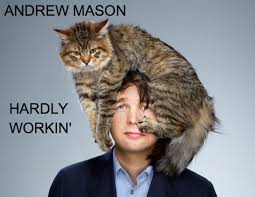
Groupon’s ex-CEO Andrew Mason is releasing a music album titled — appropriately enough — “Hardly Workin’.”
I’ve blogged before about the tribulations of Groupon and its “daily deal” couponing business.
The company has found it incredibly difficult to develop a sustaining business model, what with increased competition and the propensity for vendors to cease their participation after one or two deals due to disappointing program results.
With Groupon taking 50% of every deal plus a credit-card handling fee, far too many vendors found that they couldn’t make money on “daily deal” promotions, and often, “repeat business” from the ultra-price-savvy consumers who tend to participate in such schemes never materialized
Groupon founder and former CEO Andrew Mason was hardly the typical head of a dotcom business. His business background was rather thin, despite having started a Saturday morning bagel delivery service in suburban Pittsburgh when he was just 15 years old.
Instead, Mason graduated from Northwestern University in 2003 with a degree in music, signaling where his interests truly lie. After having worked at several Chicago-area tech companies, Mason managed to snag some seed money from Chicago entrepreneur Eric Lefkofsky, and Groupon was born in 2008.
By 2010, Groupon was the latest star in the constellation of online businesses, with annual revenues of ~$800 million. In December of that year, Groupon was offered $6 billion to sell to Google, but Mason and his company board foolishly declined the offer.
But within two years, Groupon’s fortunes had turned dramatically for the worse. Herb Greenberg of CNBC named Mason the “Worst CEO of the Year” in 2012, writing:
“Mason’s goofball antics, which can come off more like a big kid than company leader, almost make a mockery of corporate leadership – especially for a company with a market value of more than $3 billion. It would be excusable, even endearing, if the company were doing well … but it’s not.”
After one too many missed quarterly goals, Groupon’s board of directors ousted Mason on February 28, 2013. On the day of his dismissal, Mason wrote to his employees:
“After four and a half intense and wonderful years as CEO of Groupon, I’ve decided that I’d like to spend more time with my family. Just kidding – I was fired today. If you’re wondering why … you haven’t been paying attention.”
But now Mason is back – just not in the same way. This time, it’s as a musician. The former punk band keyboardist (and also husband of pop singer Jenny Gillespie) is releasing an album titled “Hardly Workin’” that contains seven songs. It was produced by Don Gehman, who has also worked with R.E.M. and John Mellencamp, among others.
Here’s what Mason has to say about his latest project:
“I managed over 12,000 people at Groupon, most under the age of 25. One thing that surprised me was that many would arrive at orientation with minimal understanding of basic business wisdom.”
This album pulls some of the most important learnings from my years at the helm of one of the fastest-growing businesses in history, and packages them as music. Executives, mid-level management and front-line employees are all sure to find valuable takeaways.”
* * * * *
“If you’re seeking business wisdom, you don’t need no MBA — look no further than the beauty that surrounds us every day …”
* * * * *
With lyrics like these, one wonders if Andrew Mason isn’t talking so much about 12,000 employees, but instead about himself!
For most marketing professionals over the age of 30, the purchase funnel was one of the fundamental staples of their business training.
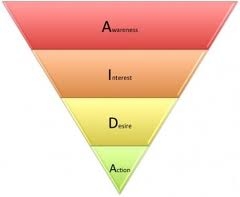
In fact, the famous “AIDA” model – which stands for awareness, interest, desire and action – was first posited as far back as 1898 by Elias St. Elmo Lewis, an American sales and advertising professional and business writer.
“AIDA” was also the inspiration behind the classic purchase funnel – an orderly, simple path consumers take on the way to selecting and purchasing a product or service.
AIDA has had a good run, because for more than a century, the AIDA purchase funnel has meshed neatly with the various advertising and MarComm tactics that have come along the pike – print advertising, direct mail marketing, radio, television – and even the Internet.
While some people might contend that the advent of the Internet disrupted traditional buying processes, the greater reality is that it brought certain aspects of the buying process into sharper relief. Search engine optimization and search engine marketing stepped in to play nicely within the “interest, desire and action” steps.
Even better, Internet marketing made ineffective “soft” attitudinal metrics less important; all of a sudden, it became much easier to make educated decisions about sales and marketing programs based on hard evidence.
But with social media taking center stage, everything is now scrambled. The tidy “linear” purchase process just doesn’t reflect what’s happening now that “interactivity all over the place” is the thing.
But what exactly is the new “thing” when it comes to the purchase process? There’s a lot of discussion … lots of thinking … but not much in the way of conclusions.
McKinsey’s new model has been described as a “purchase cycle,” a “customer journey,” and various other alternative explanations — you can take your pick.
But what exactly is that? When you look at how McKinsey attempts to graph it … it may be the proverbial “big ol’ mess.” I’ve pictured it here so you can try and have some fun with it.
The “McKinsey Whatever” may be hard to grasp pictorially, but there’s one thing’s about it: it’s surely not linear.
There are two circles (kind of). Consumers can go around within the circles forwards or backwards. They can also go sideways between the two (sort of).
Truth be told, the “McKinsey Thingamabob” is fairly difficult to untangle. At least that’s the claim of some business observers such as Jon Bond, a marketing specialist and cofounder of branding agency Kirschenbaum Bond Senecal. He writes this:
“I’ve been in 20 meetings where the ‘McKinsey Frankenfunnel’ has come up , and not once has anyone had the courage to admit that they didn’t have a clue what to do with it.”
Bond goes on to posit that introducing this new model was a masterstroke on the part of McKinsey (wittingly or unwittingly) because it’s become a boon to its consulting business: Companies have to hire McKinsey so the consulting firm can explain it, he notes wryly.
Whether it’s the McKinsey diagram or any other one that’s been proffered recently in an attempt to illustrate the new purchasing paradigm (one being a Google model with the eyebrow-raising acronym “ACID”) – what’s clear is that the purchase process is more complex then ever before. And in that process, the number of touchpoints has also grown dramatically.
Perhaps the best thing to do is to jump out of the funnel (or box, or circles, or whatever the purchase cycle is today). Instead of focusing on impressions or touchpoints, let’s remember the big thing that interactivity has placed in the hands of purchasers: far more opportunity to see and hear what trusted influencers are saying about products, services and brands.
It’s like going back to traditional, pre-1900 word-of-mouth advertising — and putting it on steriods.
Jon Bond contends that this new riff on WOM may be the smarter way of looking at the purchase journey a customer takes today. Instead of the “old AIDA” or the “new interactivity,” he suggests focusing more on three degrees of “trust“:
Before trust: Even if the brand is known, it’s not yet trusted because no credible third party has validated the brand in the eyes of the buyer.
Trust exists: An interaction happens with a trusted influencer who recommends the brand or has positive things to say about it.
Advocacy: Nirvana for companies, wherein a highly satisfied customer also becomes a brand advocate, providing third-party validation and attracting additional new customers because of the resulting brand credibility.
Incidentally, the above scenario is particularly effective in the B-to-B world, where credibility and the “CYA” impulse have always played big roles in guiding business buyers to make purchase decisions they won’t regret later.
Consider it the IBM principle, writ large: You’ve probably heard the adage that “nobody ever got fired for recommending IBM.” Now, in the “Age of Interactivity,” that principle can apply across the board.
In my most recent blog post, I reported on equity analysis firm 24/7 Wall Street and its take on the “most damaged” brands in the United States.
While there was pretty universal agreement among readers on most of the nine brands that had the dubious honor to make it on the list, there were several cases where some readers disagreed — Apple and J.P. Morgan Chase in particular.
Of the 100 major brands included in the Ipsos survey and rated by respondents, here are the ten brands cited as most influential in the 2013 survey (in descending order of score):
Google
Amazon
Apple
Microsoft
Facebook
VISA
Wal-Mart
Yahoo!
Proctor & Gamble
eBay
Google leads the pack – and it’s hardly a surprise. But an important (and perhaps surprising) thing we notice is how pervasive technology, media and web-based brands are on the list.
Clearly, these are the types of companies that are increasingly influential in the lives of everyday Americans.
In fact, just three brands in the “Top 10 Most Influential” predate the personal computer era: VISA, Wal-Mart and Proctor & Gamble. And they rank relatively low on the list at #6, #7 and #9.
Moreover, let’s not forget that all three of these more “legacy-type” brands have actually been quite active in online and social media activities. Clearly, their senior management personnel realize that a good measure of future brand health lies in the same space where the other leading brands are active.
Another interesting point that jumps out is when we compare the Ipsos “most influential” with the 24/7 Wall Street “most damaged” rankings. One brand stands out on both lists: Apple.
How can this be?
But on second thought, is it reall all so surprising? The 24/7 Wall Street inclusion was based on stock analysts’ reading of the company’s recent missteps and related share price declines … whereas the Ipsos list is based on the findings from a survey of “ordinary Americans.”
Applying the same comparative measures, I’m pretty sure the public’s view of General Motors stayed right up there long after the financial analysts had fled the stock and relegated GM’s brand reputation to the basement.
But in the end, public opinion eventually followed the analysts, in part because GM’s efforts to turn around company performance proved spectacularly ineffective. It just took more time for that knowledge to seep into the collective consciousness.
For Apple, the big question is: Will its future actions mean that it stabilizes its brand reputation? Or, will its effort fall short, leading to a loss of consumer confidence?
Let’s check in again after 18-24 months and find out.
If you were to ask people to identify the brands that they view in negative terms, chances each one would readily name at least one.
The reasons why a brand loses its reputation can be varied: a botched product introduction … bad corporate leadership … a poor response to a crisis.
But the net effect is usually the same: The damage takes only a short time to occur, and it can take years for the brand to recover (if ever).
Which brands are viewed as the “most damaged” in the United States right now? Recently, the staff at equity analysis firm 24/7 Wall Street put their collective heads together and came up with a group of nine brands that they feel qualify for the dubious “top honors.” They are:
Apple
Best Buy
Blackberry/Research in Motion
Boeing
Groupon
Hyundai
JCPenney
J.P. Morgan Chase
Martha Stewart
I find this list pretty much spot on. Most of them would probably be on anyone’s list:
Best Buy – Its big box stores function well as a place to “showroom” appliances and electronics for consumers … who then head home to purchase the same products online at lower prices.
Blackberry– Speaking personally as an owner of a Blackberry smartphone, is there any brand whose products have been more disappointing to its loyal users than this one? I doubt it.
Boeing – The highly touted Dreamliner 787 passenger jet has been delayed for years. Many consumers appear to be nervous about the model’s design, and recent developments portend … more delays.
Groupon– Groupon’s place in business history may be as the ultimate example of a dotcom-era “glorious failure.” Its business model, wherein merchants sign up for a scheme that’s guaranteed to lose them money, had to be “too bad to be true.”
JCPenney– I’ve blogged before about the predicament of this department store brand. In a stunning series of missteps, attempting to attract a completely different demographic of shopper while simultaneously dissing its loyal customer base turned out to be a sure recipe for damaging the Penneys brand – possibly irreparably. The odds are better than 50/50 that this store chain will now follow Montgomery Wards into retail oblivion.
Martha Stewart– Take an iconic business celebrity and send her to prison for insider trading. Meanwhile, her lifestyle media company is hammered by social media (Pinterest and all the rest), while television programming is splintering into more and more micro-segments thanks to the Internet and an explosion of new programming options for viewers. Is this brand even relevant anymore?
The remaining brands – Apple, Hyundai, J.P. Morgan – are ones that I feel have more inherent strengths and should be able to bounce back from recent setbacks. Provided, of course, that they make all the right moves and avoid any new pitfalls.
What are your thoughts? Would you nominate any other “damaged” brands for inclusion on the 24/7 Wall Street list? (I thought of Sears for one …) Feel free to share your thoughts here.

 It’s common knowledge that the business model for newspapers started going awry in a major way with the decline in newspaper classified advertising.
















 Nones Notes