Living Life in Pictures

PhotographyYou know the old adage:  A picture is worth a thousand words.

Well, with the plethora of images being uploaded these days … we’re talking billions and billions of images and words.

Recently, Yahoo estimated that the number of images uploaded to the web is nearing 900 billion, which translates to nearly 125 photos for every person on the planet.

Facebook reports that it’s seeing more than 6 billion photos uploaded each month, on average.

And Instagram?  It’s reporting that nearly 28,000 photos are uploaded every minute.

Clearly, we love our photos.  And since digital technology makes it so easy to take good-quality photos and post them instantly, it seems people can’t get enough of doing so.

It’s an interesting twist — in a sense, taking us back to the cavemen days and illustrations on the walls.

Over the centuries, words and language have made it faster and easier to communicate, even as drawing, painting or developing photos using analog (film) technology was difficult and/or time-consuming.

In more recent times, Polaroid® photos gave us a more “instant” experience with images … but sharing them was no easlier than before.  (Plus, let’s be honest:  Most Polaroid shots were pretty lame in the quality department.)

Now that digital photography is as effortless as it is … it seems everyone is rushing back to pictures.

We’re even seeing it in the world of books.  Take Amity Shlaes’ book The Forgotten Man, about the Great Depression.  It came out in conventional form in 2008.

The Forgotten Man (Graphic Edition)But now, it’s being released in a picture book version:  The entire book has been re-imagined as an elaborate comic book, replete with illustrations by veteran graphic artist Paul Rivoche.

And based on the early indications, it looks like the new graphic version is going to outsell the original.

Is all of this some kind of regression to an earlier stage — a return to a sort of “collective adolescence writ large”?

I think not.  It’s more a function of “doing what’s possible.”

I think human beings have always gravitated to pictorial portrayals — which explains the immediate embrace of movies and television when those innovations came on the scene.

So when photography becomes so easy to produce and to share, it’s only natural that we’re going to have billions and billions of images swirling around as a result.

And why not?  Life’s all the richer because of it.

Time spent online daily: 2.5 hours and growing.

Lots of time spent onlineIf you’re wondering what happened to all of the community volunteer activities people used to do – not to mention the popularity of participating in group social or recreational activities like softball or bowling leagues … you might look at the time Americans are spending online as one possible explanation.

The evidence comes in the form of research the Interactive Advertising Bureau did when they contracted with GfK Research to conduct an extensive online survey as part of a larger behavioral analysis of American adults.

Fielded in late 2013 with participation from ~5,000 adults between the ages of 18 and 65, the IAB/GfK survey revealed that Americans are spending an average of 2.5 hours of every day online.

Add that on to the average ~5 hours per day spent watching TV – a figure that’s hardly budged in years – and it’s little wonder that the Jaycees, Shriners’ and other service organizations are finding it more difficult to recruit new members … or that “old faithful” group social and recreational activities are in danger of becoming less relevant.

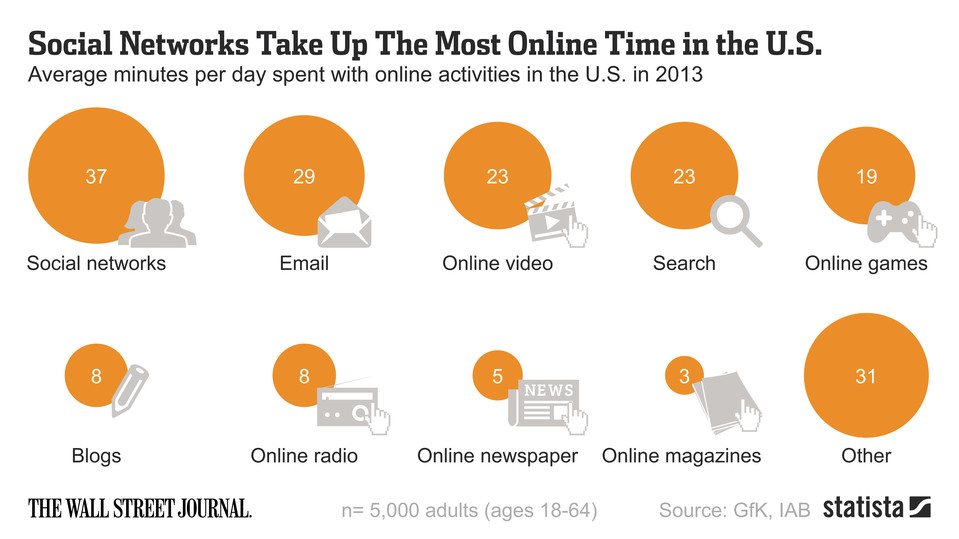
The IAB/GfK survey also revealed which types of online activities are engaged in the most.  The chart below, created by Statista from the IAB/GfK report’s data and published in The Wall Street Journal, gives us the lowdown:

Online Time (average per day)


I wasn’t surprised to discover that social networks chew up the most online minutes per day.  Online video viewing and search time seem about as expected, too.  And who doesn’t enjoy a nice game of Spider Solitaire or Internet Spades to wind down after a long day?

But at ~30 minutes per day, the e-mail average seems on the high side.  People must really be struggling with managing personal inboxes stuffed with marketing e-mails.  (But if work-related e-mails are part of the equation, the half-hour figure seems more expected.)

Comparing these results to similar research done in prior years, the most recent survey charts an increase in online video watching; it’s doubled over the past four years.

Other activities that are on the rise include online gaming, and listening to online radio.

Adding it all up, total time spent online is continuing its inexorable rise thanks to mobile connectivity and the “always-on” digital environment in which Americans now live.

Perhaps the way to stem reduced interest in group social activities and volunteerism lies in giving people free reign to “multitask” even as they participate in the local bowling league or Ruritan Club meetings …

What are your thoughts on the time people are spending online – and if it’s crowding out other forms of daily activities?  Please share your thoughts with other readers here.

Twitter: The social platform that’s less important today than it was yesterday.

Twitter losing lusterTwitter hasn’t mattered to very many people for a very long time.

Of course, for some it hasn’t mattered even from its inception. But when we start reading about Twitter’s most avid users and how they’ve begun to drift away from using the social platform like they’ve done in the past … you know that more than just the atmospherics are changing.

A case in point about this evolution is an article that was published in late April by The Atlantic titled “A Eulogy for Twitter.

The article’s authors, Adrienne LaFrance and Robinson Meyer, begin their piece by writing:

“We’ve been trying to figure out the moment Twitter turned, retracing tweets to see whether there was something specific that soured the platform.  

“Something is wrong on Twitter. And people are noticing. Or at least, the kind of people we hang around with on Twitter are noticing … audience-obsessed, curious, newsy … The thing is, its users are less active than they once were. Twitter says these changes reflect a more streamlined experience, but we have a different theory: Twitter is entering its twilight.”

Those are strong words. But the authors back up their assertions by noting that while people may still be using Twitter, many of them are no longer “hanging out” there. And that’s because there’s less “there there” to sustain once highly-engaged Twitter users.

The perceptions of Twitter’s value have been changing because of three key precepts which are now being proven out as “fictions,” according to LaFrance and Meyer.

What are those “fictions”?

  • The belief that other people in the “Twitterverse” are actually paying attention — or at least that a decent portion of one’s followers are seeing the tweets. 
  • The belief that competent and compelling tweeting will increase a person’s Twitter follower base. 
  • The confidence of knowing that there is a useful potential audience beyond current followers, so that the time and energy spent on the platform will pay dividends. 

None of these premises has turned out to be correct in the long-haul. Instead, the following stark realities fly in the face of all the hope (or hype):

  • Twitter is positively stuffed with “spam” accounts. In fact, the median number of followers for a Twitter account is … exactly one. Even if a few of those accounts are actually “legit,” of what value are they to anyone? 
  • Twitter’s year-over-year growth rate has fallen significantly since 2011.

And here’s another clear indication of how Twitter has morphed into something quite different from its original character. Today, Twitter is more likely to be merely a place to promote content published someplace else in cyberspace, simply providing quick links over to that content.

Whereas in the past, journalists and celebs and others were posting statements and opinions — and replying to or retweeting the posts of others — now it’s more likely to be canned promotion and little more.

… Which sets up a downward spiral, because followers aren’t seeing anything particularly new or interesting that they’re not already encountering elsewhere. So interest wanes … leading to reduced participation … leading to even less consideration of Twitter’s “worth” as a social platform.

This phenomenon of “professionalized accounts” means little more than being a bulletin board of scheduled tweets and broadcast links, resulting in collective yawns all over the place.

Of course, there’s one aspect of Twitter than continues its joyride unabated: hate speech and profanity. But that’s the sort of content many people would just as soon avoid encountering.

LaFrance and Meyer conclude that the world may have “outgrown” Twitter. They’re not happy by that turn of events, writing:

“For a platform that was once so special, it would be sad and a little condescending to conclude that Twitter is simply something we’ve outgrown. After all, the platform has always been shaped by the people who congregate there. So if it’s no longer any fun, surely we’re at least partly to blame.”

The authors go on to note:

“Twitter has done for social publishing what AOL did for e-mail. But nobody has AOL accounts anymore … [Today,] Twitter feels closed off — choked — in a way that makes us want to explore somewhere else for a while.”

It may not be time for Twitter’s eulogy. But there are many who don’t see much of a second act for the social platform, either.

By the way … where are those “somewhere elses” in social media that LaFrance and Meyer allude to? Try Snapchat, Instagram … even LinkedIn.  That’s where the interesting action is happening these days.

Less is less? What’s happening with customer loyalty programs.

CustomersWhen it comes to customer loyalty programs, here’s a sobering statistic: Only about 15% of consumers redeem loyalty rewards.

This finding comes from a report by Forrester Research, based on results from an in-depth survey it conducted last fall of 50 member companies of Loyalty360, a major loyalty marketing association.

What Forrester found is that fewer than half of the surveyed companies’ customers are enrolled in their loyalty programs. And of those customers, only about 35% of them are actually redeeming their loyalty awards.

Hence the 15% “effective” participation rate.

At first blush, the paltry participation makes one wonder what all the fuss is about when it comes to loyalty marketing.  But more than half of the companies surveyed by Forrester reported that they view their loyalty program as a strategic priority, not merely a marketing afterthought..

Clearly, there seems to be a bit of a “disconnect” between those lofty aims and the not-so-airborne reality. The question is how companies can encourage greater participation in their loyalty programs, thereby using them to improve consumer brand loyalty in addition to retaining customers over time.

Forrester offered several recommendations in its report:

1. Use advances in analytics to act on customer insights, rather than just relying on the purchase transactional history of loyalty program members. 

2. Balance the “reward mix” with personalized offers that present rewards program customers with unique experiences that are different from simply offering “more of the same.” (In many cases, offering discounts on more of the same merchandise a customer has already purchased won’t qualify as anything particularly special.) 

3. Break out from the traditional e-mail/web portal/call center communication vehicles to embrace more social media channels featuring two-way interaction. (Surprisingly, only about half of Forrester’s survey respondents reported that social media is an important part of their loyalty programs’ methods of communication.)

Speaking personally, I’m not particularly surprised at the relatively low engagement levels reported in this study. Many companies and brands have reached out to me over the years with offers to join loyalty programs, using various incentives – often purchase discounts or sign-on points as an incentive for joining.

apathyFor me, it’s a matter of “time” and “mindshare” as to which of these programs qualify for my participation. If a brand isn’t that important to me in terms of how I live my daily life, it – and its loyalty program – isn’t ever going to be big on my radar screen.

I suspect there are quite a few other consumers like me. But if you have different take, leave a comment and share your perspective with other readers.


What do B-to-B buyers really want in a website?

Hint:  Forget social media.

btob web surfingAs online communications continues to evolve, B-to-B marketers have more options than ever to interface with prospects and suspects.

In fact, it’s pretty easy to get distracted by the latest “shiny objects” in marketing … and we sometimes see a lack of focus — and “prioritization all over the map” — as a result.

With company websites serving as the “hub” of marketing communications, it’s only natural to try to align the information provided to prospective customers with what they’re seeking.

A recent survey of several hundred B-to-B companies conducted by DH Communications and KoMarketing Associates sought to determine what business-to-business buyers are doing once they land on a vendor website. Which elements on the site increase a vendor’s credibility … and at the other end of the scale, what causes visitors to leave?

The results of this survey confirm what many have suspected. In a nutshell:

  • Buyers come to a vendor’s website with one thought foremost in mind: to qualify the company in order to begin the process of moving towards a purchase.

And this:

  • Buyers believe the vendor qualification process should be simple and straightforward, and they don’t have time to deal with it any other way.

This mission manifests itself in the following typical behaviors when landing on a website:

  1. The first place visitors go is straight to the products and services pages.
  2. They want to see technical information … and published pricing information, too.
  3. They look for testimonials or case examples to see how others have solved their problems using the products or services.
  4. If they don’t already know the company, they check out the “about us” pages to gauge its credibility as a supplier – but only after they’ve determined that its products or services are aligned with their needs.
  5. They have little interest in social media – and hence mostly ignore those elements.

Website Must-Haves

The survey asked respondents which informational content elements are “must-haves” for a B-to-B website. It found that these elements are of greatest importance:

  • Contact information: ~68% consider a “must-have”
  • Pricing information: ~43%
  • Technical information: ~38%
  • Case studies/white papers/articles: ~38%
  • Shipping information: ~37%

The first item on the list above may seem like a given. But it turns out that many websites don’t offer visitors the most preferred methods of contact: an e-mail address (~81% want this option) and/or a phone number (~57% want this).

What about “Contact Us” forms? It turns out that quite a few visitors don’t like them at all. It makes sense to offer them … but also to provide other contact options. Otherwise, some visitors will leave the site without any further engagement — or so they claim.

Axing the Distractions

Because most visitors come to vendor websites to gather information and research products in preparation for making a buying decision, things that detract from those objectives are viewed as an interruption and a distraction.

Some elements are so irritating, they’ll compel visitors to leave the website altogether.  What are those? Video and/or audio clips that play automatically, animated web designs and other visual hijinks, plus pop-up messages are the worst offenders.

Basically, anything that interrupts the visitor’s train of thought reduces the vendor’s credibility and helps the push the company further down the buyer’s list of prioritized vendors.

What’s Missing from Vendor Websites

The survey also asked respondents to cite what they feel is lacking on many vendor sites. Their responses to this question could be considered an indictment of B-to-B websites the world over!

  • Case studies/white papers/articles: ~54% say these are most lacking on websites
  • Pricing information: ~50%
  • Product reviews: ~42%
  • Technical support details: ~42%
  • Testimonials/client list: ~31%

Social Media?

To consider the social media attitudes revealed in this survey of B-to-B buyers is to wonder what all the fuss has been about over the past five years. In citing how impactful social media is on the buying process … it’s clear that the impact isn’t great at all:

  • Social media isn’t a factor: ~37%
  • Neutral feelings about social media: ~26%
  • Social media is a factor, but not a “deal-breaker”: ~30%
  • Social media is a big factor: ~6%

The takeaway?  If B-to-B web content managers spent less time on social media and more time on pricing information, case study testimonials and robust technical data, it would be a more valuable use of their energies.

I’ve summarized some of the key survey results above – but there are more research findings available in a 32-page report summary just published by KoMarketing Associates. You can download it here.

The Day-to-Day Things Bothering B-to-B Marketers

Marketing Executives Group (LinkedIn)The discussion boards on LinkedIn are often good places to capture the pulse of what’s happening “on the ground” in the marketing field.

A case in point is a discussion started recently on the Marketing Executives Group on LinkedIn by Carson Honeycutt, an account executive at marketing research firm Mintel.

Honeycutt’s question was, “What are the biggest day-to-day issues for marketing execs?”

He was interested in getting input to help him speak to needs and offer solutions when interfacing with his customers and prospects – even if those solutions meant referring them to other vendors.

According to Honeycutt, he often hears responses like, “Too busy to talk. I’m swamped and we have no budget anyway.”

His query generated some interesting feedback. Comments ranged from the succinct (“sounds like you’re getting the brush-off”) to ones that were more helpful and useful.

The OfficeOne response I liked particularly well came from Brent Parker David, a marketing strategist at CRE8EGY. His listing of the day-to-day issues for marketing execs were to-the-point:

  • Too many meetings;
  • Lack of experienced creative thinking;
  • Personal and political agendas overshadowing the mission and the marketing objectives;
  • Too many “experts” who have never truly accomplished anything — but are very comfortable telling others what to do or how to behave.

I think most of us involved the marketing field for any length of time will be nodding knowingly at the above points …

Another response — more nuanced — came from Matt Smith, a marketing strategist in the consumer packaged goods  field. Here’s what he contributed:

“When Marketing doesn’t provide deep insights and a strategy to leverage them, price discounting takes over. This gives Sales the lead, as they are the executors. Growing sales, no matter how it’s done, is taken as progress. Sales is the hero, even though margins [may] have eroded.

“The byproduct of this is increasing their trade spend budgets — and by extension, their political clout. Conversely, Marketing loses clout as they don’t have an answer that drives sales AND margins. In the zero-sum budget game, the increased trade spend comes out of the advertising/promotion/innovation budget.”

Smith went on to add that “marketing is only stifled by bean-counters if they don’t know their customers and [can’t] devise a creative strategy to get them to buy more at higher margins.”

What are your own thoughts about the biggest day-to-day challenges facing marketing execs? Please share your thoughts with other readers here.


Online Marketplaces: The Brightest Stars in the e-Commerce Galaxy?

online commerceGiven a choice between buying a branded product from Amazon and a similarly priced one from an e-commerce store on the brand’s own website, which purchase option do most people choose?

In most cases, people opt for Amazon.

And why wouldn’t they? Online marketplaces like Amazon devote the vast bulk of their energies to removing the obstacles to purchasing products and improving the overall buyer experience.

The e-commerce stores on most company or brand websites don’t get nearly the same degree of laser-focused attention.

So it comes as little surprise that as online e-commerce continues to evolve, marketplaces like Amazon, eBay and Grainger are outpacing general e-commerce websites in terms of their growth and popularity.

Let’s face it, compared to most standard e-commerce sites, e-marketplace sites do a superior job dealing with the four major customer drivers:  selection, value, convenience and user confidence.

It shows in the growth statistics. Looking back over the past decade, Amazon’s yearly growth has averaged around 32%.  Compare those stats to standard sites … and there isn’t much of a comparison.

If anything, the future looks even brighter for marketplaces. With the increased adoption of mobile devices for online shopping, dedicated mobile apps from marketplaces like eBay and Amazon are making buying by phone easier and more convenient than ever.

Their mobile apps iron out the “payment kinks and concerns” that have bothered some mobile purchasers. These apps solve the potential security problem of having to input payment or address/shipping information into the phone when the purchase is made.

The rise of online marketplaces isn’t limited to just Amazon and eBay, either. Numerous other robust e-commerce marketplaces in both the B-to-C and B-to-B realm are thriving, too – not just in the United States but in the developing world also.

The global aspect is quite important, actually. Marketplace e-commerce may represent only about one-third of total online sales in the U.S. … but in China, such marketplaces are capturing closer to 80% of the online business.

It helps that these marketplaces offer many PayPal-like payment options. This solves the problems of payment when fewer people overseas use credit cards for purchases. (In China, less than 5% of online customers pay via credit card.)

These developments don’t presage the end of “conventional” e-commerce sites, of course. But they do suggest that companies should seriously consider online marketplaces as a prime channel for getting their products into the hands of end-users.

After all, it’s only natural that customers are going to take the “path of least resistance” – making the buying process as effortless as possible.

Online marketplaces have that game down to a science. No one does it better.

Affluent consumers around the world: More similar than different.

Moods and mindsets converge.

worldwide affluent consumers

As the world becomes more interconnected, it’s having an impact on the mindsets of marketplaces. A confluence of perspectives appears to be happening.

A good case in point is affluent consumers. The idea that rich or affluent people are something of a homogeneous segment was put forth about 10 years ago in Robert Frank’s book Richistan.

The author contended that affluent consumers are united by shared characteristics and shared experiences that are becoming progressively more distinct from middle-class consumers.

In fact, he posited that Affluents had implicitly become their own country (“Richistan”).

Since then, we’ve had a global recession or two … along with social unrest on nearly every continent. Have the sociological trend lines changed?

A recent analysis of results from an Ipsos MediaCT survey of affluent consumers in ~50 countries suggests not.

Commenting on the research findings, author  and journalist Stephen Kraus writes, “Affluents continue to form a globally coherent segment marked by cross-border similarities in attitudes, lifestyles and marketplace preferences … this analysis also finds a remarkably consistent demographic, psychographic and media profile among Affluents around the world.”

Regarding the consumption of media, Ipsos found that affluent consumers are using mobile devices and digital media far more than before – not at all surprising since this segment is also noted for being early adopters of new technologies and products.

But even with the big growth of mobile and digital, Affluents’ use of traditional media has declined only modestly. Overall, the segment is more engaged in media than ever before, with the newer forms of media usage “layered” on top of older ones.

For companies that market “high-end” products and services to the affluent segment, it’s actually becoming easier to apply the same messaging and marketing across multiple countries and cultures – with allowances for language differences being made, of course.

Despite all the convergence that’s happened, some attitudinal qualities of affluent consumes continue to distinguish themselves between different cultures, however. For example, the Ipsos survey found these differing characteristics:

  • Growth in luxury purchases is strongest among affluent consumers in the Asia-Pacific region.
  • Latin American affluent consumers are particularly enthusiastic users of social media – and international media in general.
  • American affluent consumers are strong in spending on recreational activities such as golf, tennis and skiing.

And European Affluents?  Well, they’re more subdued in their economic optimism – and their spending – at the moment.


Fast Fade: Unpaid brand posts on Facebook are getting rarer by the day.

Lower ReachIt was just a matter of time.

Once Facebook ramped up its advertising program in order to monetize its platform and mollify its investors, unpaid posts by companies and brands were sure to be the collateral damage.

Sure enough, the recent monthly stats show that the “organic reach” of unpaid content published on company and brand pages on Facebook has been cut in half from where it was just a short time ago.

To illustrate, look at these stark figures gathered in an analysis by Ogilvy of 100+ country-level brand pages measuring the average reach of unpaid posts:

  • October 2013: 12.2%
  • November 2013: 11.6%
  • December 2013: 8.8%
  • January 2014: 7.7%
  • February 2014: 6.2%

What these stats show is that within the span of less than six months, the average reach of unpaid brand posts dropped by nearly 50%

To go even further, an anonymous source familiar with Facebook’s long-term strategy is claiming that its new algorithm could ultimately reduce the reach of organic posts to 2% or less.

Actually, the reason for the squeeze is more than just Facebook’s desire to increase advertising revenue.

Here’s a dynamic that’s also significant:  A Pew Research study conducted in mid-2013 found that the typical adult American Facebook user has around 340 friends.

That average is up nearly 50% from approximately 230 friends in 2010.

Of course, more friends mean more status updates eligible for feeds … and Facebook’s not going to display them all to everyone — even if it wanted to.

Also, Facebook users “like” an average of 40 company, brand, group or celebrity pages each, according to a 2013 analysis done by Socialbakers, a social media analytics firm.  That translates into an average of ~1,440 updates every month.

Compare those figures to five years ago, when the average number of page “likes” was fewer than five … yielding fewer than 25 monthly updates on average.

Clearly, there’s no way Facebook is going to to be able to display all of these updates to followers.  So … the content is squeezed some more.

The final nail in the coffin is the rise in “promoted” posts – the ones that brands pay dollars to promote. It’s only natural that Facebook is going to give those posts priority treatment.

Thus, the hat-trick combination of more friends, more likes and more promoted posts is what’s causing “organic” brand posts to go the way of the dodo bird.

In retrospect, it was only a matter of time before a major social platform like Facebook would seek to monetize its program in a big way.

In some respects, it’s amazing that the free ride lasted as long as it actually did …

The Continuing Ambivalence about Twitter

Or is it more a division of the house?

ambivalenceOf all of the social media platforms that have taken root, the one that seems to cause the most divided opinions among the marketing and communication specialists I know is Twitter.

… And these are the folks who have been diligent about “following the script” for crafting tweets that are interesting, informative, and get noticed.

Each social platform has its strong and weak attributes, of course … but I hear far more mixed views about Twitter than I do about Pinterest, Facebook and LinkedIn.

This is amply illustrated in a recent discussion that was started on LinkedIn’s B2B Marketing Group, of which I’m a member.

Joel Harrison, Editor-in-Chief of B2BMarketing.net, posed this question to the group’s members:

“If Twitter ceased to exist tomorrow, would we all be better off?”

This rather provocative query elicited a range of reactions pro and con – which was to be expected.

However, I was a little surprised that the comments were weighted roughly two-thirds negative about Twitter versus positive.

Remember, this is a discussion group made up of marketing professionals — people you’d expect to be keen on pretty much any established social platform that has an extensive following for marketing purposes.

… Which, even if you discount the ~30% of accounts that “fake, faux and farcical” – still makes Twitter qualify as one of the leading social media platforms.

But consider these comments about Twitter posted by members of the B2B Marketing Group on LinkedIn:

“16 characters solve this dilemma: ‘Don’t take part.’”

 “I once read a tweet that said, ‘This is the generation that had nothing to say, and said it.’ Sums it up pretty well.”

 “My target audiences … have not mentioned that they prefer to communicate on that channel, so until that happens, there isn’t much going on.”

 “I like the old BBC mission: ‘Entertain, inform and educate.’ If you don’t do any of that, I ain’t following.”

 “Useful as an additional channel for customer service and sharing experiences – if the customer wants it.”

 “It depends on the industry and the target audience.”

 “As a marketer, it’s useful.  On a personal level, it annoys the hell out of me.”

These statements don’t sound like a ringing endorsement of the platform, do they?

Of course, they were posted on a business-to-business discussion board, so presumably people were commenting based on their B-to-B perspective; consumer marketing opinions are likely somewhat different.

What are your opinions about Twitter? Based on your own experience, how important and how effective has Twitter been to your marketing efforts?  Is it a critical component … or is it just one more ornament on the MarComm tree? Please share your comments for the benefit of other readers.