“Harbingers of Failure”: When Early Adopters Spell Doom Rather than Boon for a New Product

shop

There’s an interesting new perspective about certain early adopters of new products:  Rather than being a predictor of success, they could well be a harbinger of failure.

Four researchers – Eric Anderson of Northwestern University along with Duncan Simester, Song Lin and Catherine Tucker from MIT – have come to this conclusion after analyzing actual purchase transaction data collected from consumers.

Their findings were published in the January 2015 edition of the American Marketing Association’s Journal of Marketing Research.

Specifically, the researchers mined a comprehensive dataset of purchase transaction information collected by a large retail chain that sells consumer packaged goods.

What the four researchers discovered was that there are certain customers whose decisions to adopt a new product are a signal that the product will likely fail rather than succeed.

Moreover, their analysis revealed that because these early adopters have preferences that aren’t representative of other consumers in the market, these adoption patterns can be isolated from those of other customers, enabling a company to predict the propensity of a new product to succeed or fail.

These “harbingers of failure,” as the researchers dub them, are consumers who fall into two categories:

  • They purchase products that are “flops” – the ones that end up failing and being removed from the market.
  • They purchase products that, while remaining available in the market, are “niche” offerings that few other customers buy.

Either way, the consumers exhibit purchase behaviors that are an “unrepresentative” subset of purchasers.

The study suggests caution when looking at aggregate positive sales figures in product test markets. Instead of considering sales figures in the aggregate, companies should drill down and study the characteristics of the buyers – whether they are ones who typically back winners or losers.

The report draws ties to several “historical” brand introductions in which purchasers of the Swiffer® mop correlated with Arizona Iced Tea® – both winning product introductions – as compared to purchasers of Diet Crystal Pepsi® and Frito-LayTM Lemonade – both of which bombed.

According to the researchers, the success of the second product (Arizona Iced Tea) could have been foretold by analyzing the sales behavior of the first (Swiffer).

Similarly, the failure of Frito Lay Lemonade could have been foretold by looking at the disappointing sales behavior of the first (Diet Crystal Pepsi).

Because of the extensive database of transactions tied to individuals that is available today thanks to bar-code scanning, loyalty programs and the like, many large consumer product firms have access to a wealth of granular data. The study contends that more people should use these data to improve their share of product introduction successes.

The full report, including research methodology and statistical analysis, can be viewed here.
What’s happening with the Apple Watch these days?

Not all that much, it turns out.

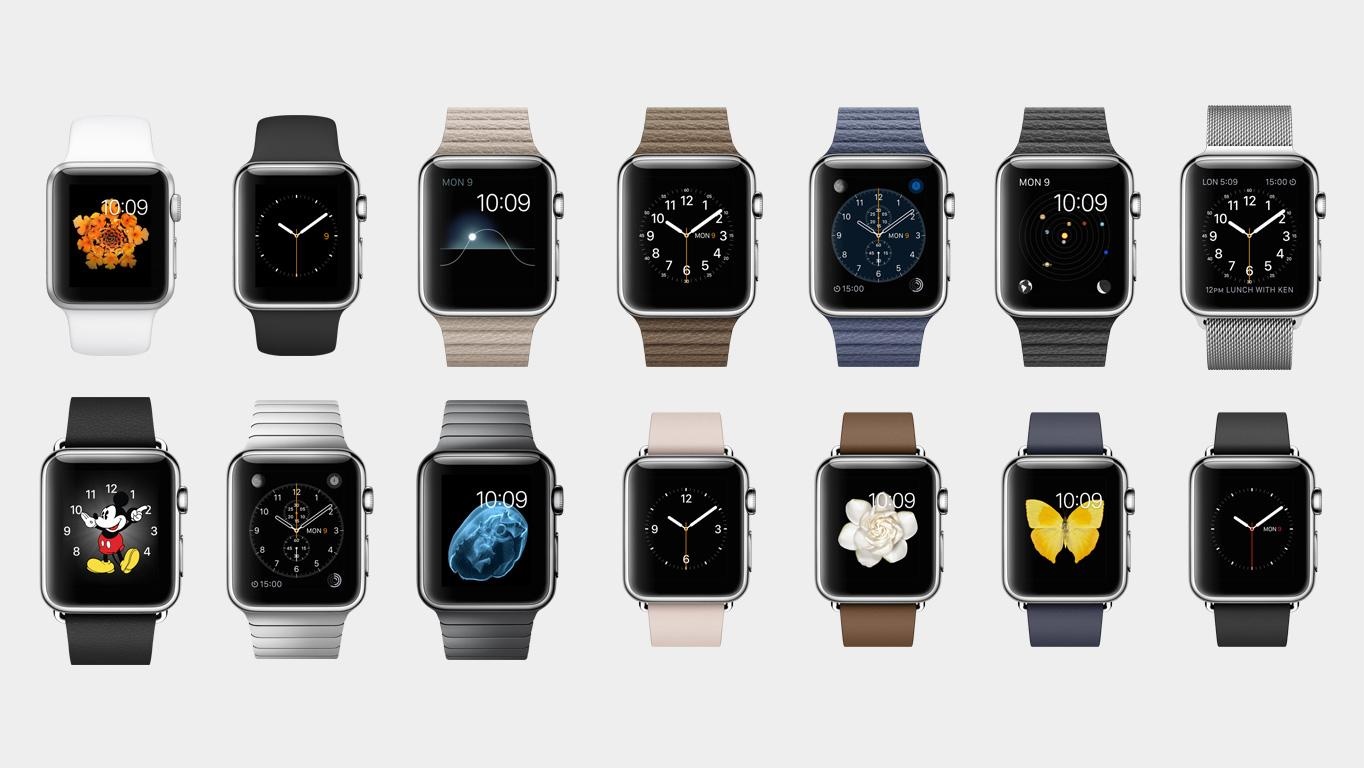
Apple Watch LineWhen is the last time you heard about a product introduction where initial sales were off by 90% barely three months after coming on the market?

If you’re thinking the Blackberry 10 … you’re wrong.

It’s the Apple Watch. Its introduction in April was made with a big amount of fanfare, promoted before and after the launch by PR, TV and online advertising, and even outdoor billboards.

But the hard truth is that aside from the tech community, few people are buying the Apple Watch.

According to Slide Intelligence, weekly Apple Watch sales have plummeted from around 200,000 per day at launch to fewer than 20,000 per day now. Moreover, most sales have been of the least expensive Sport model ($349).

Even worse, of those who have purchased an Apple Watch, fewer than four in ten would recommend the device to others.

You know there’s a problem when a new product engenders ridicule such as this brief, highly dismissive video review.

It may be too soon to write off the Apple Watch introduction as an abject failure. But I know one thing: The market’s (lack of) receptivity so far can’t be what Apple execs were hoping for.

It must be quite a comedown for a company that experienced the dizzying popularity of the iPod, iPhone and iPad right out of the box — and where those product sales continued to climb at an increasing rate for months or years after their debut.

google-glass-fashionSome people are comparing the Apple Watch introduction to what happened to Google Glass – likewise the victim of tepid sales to the point where Google quietly removed the product from the market after making a go of it for about two years.

Actually, I’m not quite sure the comparison is completely apt.

For starters, Google Glass didn’t come on the market backed by a ginormous PR and advertising campaign. In fact, it wasn’t really presented as a full-blown product – but more like a project with a beta test component.

Also, it was never made available in wide release; some people I know who wanted to “kick the tires” with Google Glass had difficulty finding out how they could do so.

But besides the very different rollout strategies, another factor might explain a more fundamental difference – and which has hugely negative potential impact on the Apple Watch.

Whereas Google Glass offered its wearers some truly new functionality, what does the Apple Watch deliver besides being merely a miniature version of an iPhone?

When something is less user-friendly (too miniature for many) … doesn’t offer any new functionality over alternative products … and is pretty expensive to boot, is it any wonder that the Apple Watch’s debut has had all the pizzazz of a cold mashed potato sandwich?

Speaking personally, I don’t consider a multipurpose device about an inch square in size as a “must-have” gadget, and I’m pretty sure others would agree with me.

Technology writer and CRM specialist Gene Marks cautions that the Apple Watch’s future isn’t likely to be much brighter than its less-than-impressive performance to date because of this fundamental liability: “The Apple Watch is not making people or companies quicker, better or wiser,” he contends.

In the world of technology and gadgets, that’s not recipe for success. Just ask Blackberry.

Now … let’s hear from Apple Watch users.  What’s your take?

Copywriting by computer: Wave of the future? … or wild-ass pipe dream?

persado logoIn recent years, computers have upended many a job category.  And they include quite a few positions involving “language” – from foreign language translators to medical transcriptionists.

And now, it looks like copywriting itself may be the next domino to fall.

Earlier this year, The Wall Street Journal published a story about Persado, a company which has developed a software algorithm that enables it to write copy without the human element.

David Atlas, the company’s chief marketing officer, refers to it as “algorithmic copywriting.”  The process creates sentences with a maximum length of 600 characters that are used for e-mail subject lines and other short persuasive copy.

Persado builds the copy by sending thousands of different e-mail subject lines to the e-databases of its clients, which include large retailers and financial services firms such as Overstock.com, AMEX and Neiman Marcus.  Response rates are measured and used to refine the subject lines to narrow them down to just the most effective.

Company PR spokesperson Kirsten McKenna explains the Persado edge further:

“Typical A/B testing will send out only a few messages – then go with the one that gives the best response.  Persado can send out thousands of permutations of the same message to determine which would be the most successful.”

Alex Vratskides
“We have never lost to a human.” — Alex Vratskides of Persado

Comparing Persado’s machine-generated results with traditional copywriting, “We have never lost to a human,” Alex Vratskides, the company’s president, claimed to The Wall Street Journal.

Those results would suggest that Persado is doing things right.  And here’s another positive indicator of success:  The company raised over $20 million in venture capital earlier this year.

The bigger question is whether Persado will be able to scale its simple and short-sentence copywriting into persuasive copy for longer-form marketing materials such as sales letters and brochures – which would make it an even bigger threat and seriously threaten to upend the traditional copywriting field.

For the answer to that question, I’d never want to take issue with the views of veteran copywriter Bob Bly, whose perspectives I respect a great deal.  In writing on this topic, he states:

Bob Bly
Bob Bly

“I do think that either already or very soon, software will equal or surpass the performance of human writers in both simple content and short copy.  We have to prepare for the eventuality that computers may someday beat human direct response copywriters in long-form copy, just as Deep Blue beat Kasparov in chess and Watson clobbered Ken Jennings in Jeopardy.  Ouch.”

What do you think?  Is computer copywriting the wave of the future?  Let’s hear your own perspectives.

What’s driving innovation in consumer packaged goods these days?

Consumer packaged goodsWith the steady rise in the number (and variety) of consumer packaged goods offerings, one might wonder if the factors that drive CPG innovation are the same today as they’ve been in the past.

There’s no dearth of research to help give us clues to the answer.  In the first half of this year alone, major CPG research results have been published by the likes of Accenture, Deloitte, Forrester, IRI and Kantar – and that just covers the first half of the alphabet!

The broad takeaway from these reports is that there are six major trends driving innovation in the industry.  Three of them are just as important as they’ve ever been, and three additional ones are becoming more significant as time goes on.

The three “classic” trends that drive CPG innovation as much as ever are convenience, value, and specialization.

They’re fundamental, they’re significant, and they haven’t lost their importance based on what’s happening in the larger marketplace or the economy:

Convenience is a major driver because consumers are always looking to get what they need faster and with less effort than before.  If a product saves time and delivers multi-benefit solutions, consumers will respond.

Value is always perennially important.  When the perceived value of a product goes down because of price pressures or a lack of differentiating benefits, brand loyalty is adversely affected.

Specialization – Product formulation and packaging can affect the way consumers feel about products.  The more that can be provided in the way of a “just-for-me” solution as opposed to “one-size-fits all,” the better.

If they concentrate on these three trends, most CPG brands do pretty well.  But there are three additional trends that appear to be gaining momentum.  Add them to the repertoire, and an additional competitive edge can be established:

Portability – As consumers’ lives have become more mobile than ever, a premium is placed on brand that can deliver on-the-go offerings.

Environmental Impact – It’s been a long time coming, but this trend finally appears to be reaching some semblance of critical mass. More consumers are considering environmental factors — not just as attributes for products that are “nice to possess,” but actually necessary for making a responsible choice. It’s more than the product itself; it’s also sourcing, manufacturing, distribution and disposal.

Health Impact – The days of CPG products being big on convenience but bad on health are numbered. Thanks to better education and more out-of-pocket medical-related cost responsibilities, health awareness among consumers has never been higher. It may not be translating yet into improved health metrics like lower obesity rates, but there’s pretty clear evidence that more people understand health risks and are taking more responsibility for their own personal health and that of their family members.  Products that can credibly claim to “healthy” benefits stand to gain in the competitive landscape.

Do you feel that there are other trends besides these six that that are influencing the development of consumer packaged goods today?  Perhaps ones associated with cultural diversity … or something else?  If so, please share your thoughts with other readers here.

Which brands are America’s most “patriotic”?

patriotismWith the 4th of July holiday nearly upon us, sharing the results of a recent brand study seems particularly apropos.

Since 2013, Brand Keys, a branding consulting firm, has conducted an annual evaluation of famous American brands to determine which ones are considered by consumers to be the most “patriotic.”

In order to discover those attitudes, Brand Keys surveyed nearly 5,500 consumers between the ages of 16 and 65, asking them to evaluate American brands on a collection of 35 cross-category values – one of which was “patriotism.”  (The number of brands included in the evaluation has varied somewhat from year to year, ranging between 195 and 225.)

Of course “patriotism” is a hyper-qualitative measure that’s based as much on emotion and each individual person’s own point of reference as on anything else.

Brand familiarity and longstanding engagement in the marketplace helps, too.

So it’s not surprising that the American brands scoring highest on the patriotism meter are some of the best-known, iconic names.

For the record, listed below are the “Top 10” most patriotic American brands based on Brand Keys’ most recent survey – the ones that scored 91% or higher on the patriotism scale (out of a possible 100 percentage points):

  • Jeep (98%)
  • Coca-Cola (97%)
  • Disney (96%)
  • Ralph Lauren (95%)
  • Levi Strauss (94%)
  • Ford Motor (93%)
  • Jack Daniels (93%)
  • Harley Davidson (92%)
  • Gillette (92%)
  • Apple (91%)
  • Coors (91%)

The next highest group of ten patriotic brands scored between 85% and 90% on the survey:

  • American Express (90%)
  • Wrigley’s (90%)
  • Gatorade (89%)
  • Zippo (89%)
  • Amazon (88%)
  • Hershey’s (87%)
  • Walmart (87%)
  • Colgate (86%)
  • Coach (85%)
  • New Balance (85%)

[As an aside … the only entity to score a perfect patriotism rating of 100% was the U.S. Armed Services.]

To be sure, “rational” aspects like being an American-based company whose products are actually made in the United States affect the patriotism rating of individual brands.

But other attributes — such as nationally directed customer-service activities and highly publicized involvement in sponsorships and causes that tie to the American experience — are attributes that add to a general image of being patriotic.

Robert Passikoff, Brand Keys’ president, expanded on the idea, stating,

“Today, when it comes to engaging consumers, waving an American flag and actually having an authentic foundation for being able to wave the flag are two entirely different things — and the consumer knows it. 

“If you want to differentiate via brand values – especially one this emotional – if there is believability, good marketing just gets better.” 

This is the third annual report issued by Brand Keys that’s been focused on brand patriotism – one of 35 brand values comparatively surveyed.  Over the three years, there’s been some change in the patriotism rankings, with Colgate, Wrigley’s and Zippo falling out of the Top Ten and being replaced by Jack Daniels, Gillette, Apple and Coors in 2015.

What I find intriguing about the findings is that there isn’t a very strong correlation between the perceived patriotism of specific American brands and whether or not most of their products are made in the United States versus offshore.   Of course, foreign production is more the norm than ever in the global economy.  What’s important is how the consumer reacts to that reality.

jeep patriotismWith that point in mind … what about Jeep?  Now that it is part of the global Fiat organization, should Jeep no longer be considered an American brand?  Whether it is or not, the brand has the distinction of achieving the highest patriotism score outside of the U.S. Armed Services.

The bottom line is this:  Brands, what they “mean” and what they stand for are based on the emotional as well as the rational – with the emotional aspect being the trump card with consumers.

Jeep, with all of its associations with winning  wartime campaigns (particularly World War II), likely will always be a beloved “patriotic” U.S. brand, regardless of its recent Italian parent company ownership.

Are there brands not listed above that you would consider to be “highly patriotic”?  If so, please share your thoughts with other readers here.

Are young marketers now the “smartest people in the room”?

Deanie Elsner
Deanie Elsner

Recently I read about some interesting remarks made by Deanie Elsner, who is the former executive vice president and chief marketing officer of Kraft Foods.

Ms. Elsner made them as the keynote speaker at the Tapad Unify Tech 2015 cross-screen technology conference held in mid-June.  The gist of her argument was that senior-level marketers and heads of companies are most often the ones who are the “ball and chain” in a company when it comes to following effective marketing practices.

The way Elsner sees it, too few of these officials understand digital marketing as an integrated program that commingles data with a coordinated brand strategy:

“When you ask marketers to define digital strategy, they will give you ‘random acts of digital’ rather than an holistic strategy informed by data, with KPSs and data points that prove success.”

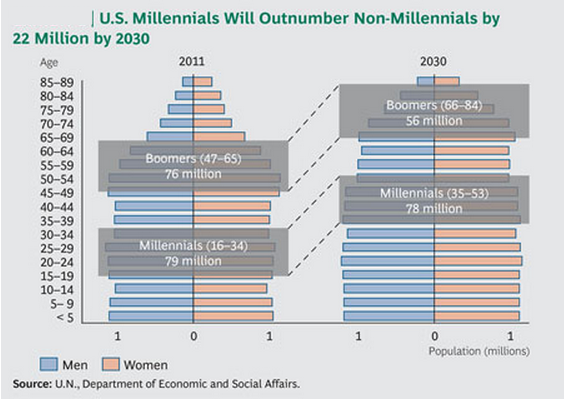
It doesn’t help that most upper-level managers are part of the Baby Boomer generation or just slightly younger, whereas most of the big developments in marketing technology and the communications landscape are being driven by Millennials.

[An aside:  recently we learned that Millennials, at 87 million strong, are now this country’s largest age cohort — ~14% larger than Baby Boomers.  And they’ll only grow more important in the coming decade or two as the Boomer generation passes into retirement and then into history.]

Millennials-vs-Boomers

In Elsner’s view, Millennial employees understand something that their older counterparts generally don’t see, which is that the “one-way communications” perspective on advertising and promotion is no longer so important — or even relevant.

I can see her point.  Consumers today are the ones determining the conversation and the agenda.  It’s up to marketers to figure out the best ways to follow that agenda and to use the best tools to make it happen.

But then Elsner makes this bold statement that I’m not sure is totally accurate:

“Your smartest person is your most junior talent.  The most dangerous, potentially, is the current CEO, because what they know doesn’t exist anymore.”

I don’t disagree that junior talent “gets” the modern communications environment more inherently than older employees.  However … younger talent is prone to the opposite extreme:  making assumptions based the latest trends for the youngest audiences.

When that happens, people can misread how industry changes affect consumers of all age levels, other demographics and psychographics.

In fact, in my work with numerous corporate clients, often the “smartest person in the room” is the one who’s over the age of 65.  And why not?  The reality is that irrespective of the seismic changes in marketing, there’s a lot to be said for 20 or 30 years of life experience to truly understand what makes human beings “tick” … why people are often so different … and what makes them choose to do the things that they do.

So the bottom line is actually this:  Both younger and older marketers are important and can bring a lot to the table, and there’s more than enough respect to go around.