Take Your Pick: One Super Bowl Ad Spot … or 14 Billion Facebook Ad Impressions

Super Bowl Ad Cost


This year a single 30-second ad spot during the Super Bowl TV broadcast will cost a cool $4 million.

And that’s just for the placement alone — not the dollars that go into producing the ad.

The high cost of advertising is directly related to Super Bowl viewership, of course, which is predicted to be north of 100 million people this year.

Still, $4 million is a really hefty sum, even for major brand advertisers.  Just how big is underscored in some comparative figures put together by Jack Marshall, a reporter at marketing e-zine Digiday.

Jack Marshall
Digiday’s Jack Marshall

In lieu of spending $4 million on a single ad spot, here’s how Marshall reported that the promotional money could be spent in alternative ways:

  • 14 billion Facebook Ad Impressions – According to digital marketing software firm Kenshoo, right-hand column “marketplace” ads on Facebook averaged 27 cents per thousand impressions during 2013.  This means that for $4 million, an advertiser could run a Facebook marketplace ad every second of every day for the next 469 years.
  • 3 billion Banner Ad Impressions – In 2013, average online display ad CPMs were running just shy of $1.30, looking globally.  Applying that figure to the U.S. market translates into 3 billion display ad impressions for your $4 million spend.
  • 160 million Sponsored Content Views – The typical charge is ~$25 to distribute sponsored content to 1,000 readers.  At that rate, $4 million would give you 160 million impressions (provided a publisher could actually deliver that many!).
  • 10.8 million Paid Search Clicks – With an overall average cost-per-click of 37 cents in 2013, $4 million would cover just shy of 11 million clicks.  That may be one-tenth the size of the Super Bowl viewing audience … but at least your audience would be actually searching for your product or service instead of heading to the kitchen for more corn chips and queso dip.

These are just some of the comparative figures outlined by Jack Marshall in his article.  You can read the others here.

SoLoMo: The Newest Buzz Term in Marketing Communications

solomoEvery few years or so, we start hearing a pithy (and sometimes obnoxious) new buzz term in marketing communications.

The most recent entry into the lexicon is SoLoMo – a cutesy amalgam of three terms:  Social Media, Location, and Mobile Devices.

SoLoMo purports to convey the convergence of these three elements into a powerful new driver for marketing:  sparking audience engagement and brand usage via the use of social media, and targeting consumers via their mobile devices when they are locationally proximate.

businesspersonBeyond the inevitable “wink-wink, nudge-nudge” aspects of this term and the “oh-so relevant” connotation it has for those who choose to name-drop it in casual conversation, another drawback I see is the term’s emphasis on tactics rather than on the true meaning of today’s always-connected customers and the potential this offers for relationship-building.

Right now, there are more than a few company and brand marketers who are trying to figure out the best way to have their customers do all sorts of things that will benefit a product’s acceptance and position in the market — things like checking in to a physical location, then taking a mobile picture and uploading it to an Instagram or Facebook page.

This over-reliance on “shiny new object tactics” is what gets marketers to the same place as designing a new and novel app that doesn’t actually fill a true need – and hence becomes an inglorious failure.

Here’s what’s actually going on with consumers today:

  • They have more digital connections available to them than ever before.
  • Because of the pervasiveness of interactivity, consumers expect information to be available to them at any time – and on any device.

The good news is that marketers can establish just these sorts of connections with consumers, simply by using the very same social platforms.  The bigger challenge is making those connections meaningful and relevant.  That’s where effectiveness so often falls by the roadside.

Social media is an “ism” to many marketers … whereas to regular people, they hardly think of it that way.  For them, it’s just another way to engage in their relationships with friends, acquaintances, industry colleagues, fellow hobbyist … and favorite brands.  Other than the digital aspect of the communication, there’s really very little difference from the connections people have established and maintained for years the old-fashioned way.

Location is much more than simply where someone happens to be.  It’s the context of understanding when — and what — the person is doing at or near that location.  Knowing that makes for a more relevant – and potentially profitable — interactions.

Today’s focus on Mobile everything has become almost as myopic as marketers’ tunnel-focus on desktops was a few years back.  Today, we’re dealing with consumers who are perpetually connected.  As for which device, it simply depends on what’s handy at the moment – desktops, laptops, tablets, smartphones.  So, strategies and tactics that focus on one or two of these to the exclusion of the others will fall short of the mark.

While we can give an acknowledging nod to the SoLoMo buzz term, the key is to recognize that it’s actually about today’s perpetually connected consumers — and all of the expectations that come along with that.

In other words, marketers need to be people-focused … but tactics-agnostic.

Cue up the e-mail Rogues’ Gallery: Here’s what people are purging from their inboxes.

e-mail rogues galleryAnyone who’s had an e-mail account for any length of time likely faces ever-increasing inbox volumes.

And trying to keep those groaning inboxes in check can be a never-ending task.  Now a recent report gives us clues as to what e-mails are being purged most frequently by recipients.

It’s been released by Unroll.Me, a service that scans users’ e-mail accounts for all of the lists to which they are subscribed — knowingly or not.  It then gives people the opportunity to unsubscribe, or to consolidate groups of e-mails into a single regular update.

It turns out, many people are unwittingly “subscribed” to receive e-mails from vendors based on something as benign as making a single online purchase.  So Unroll.Me finds a substantial incidence of people taking unsubscribe actions when given the chance.

Unroll.Me’s report claims that it prevented more than 1 billion e-mails, offers and updates from reaching inboxes last year via its service.

Of particular interest than the overall volume is the list of e-marketers that have been dissed the most by customers.

Leading the list is 1-800-Flowers.  A whopping ~53% of Unroll.Me users had those e-mails stopped during 2013.

[A personal note about 1-800-Flowers:  Over the past five years, our family has used this service to order flowers twice a year (Christmas and birthday) to exactly one person.  For those twice-a-year transactions, I estimate conservatively that we receive more than 200 e-mail solicitations each year — most with breathless offers promising deep discounts on orders.  Do those offers make us more inclined to purchase from them?  Hardly.]

According ton Unroll.Me, other e-marketers that experienced high unsubscribe rates in 2013 include:

  • Ticketweb:  ~48% unsubscribe rate
  • ProFlowers:  ~45%
  • Expedia:  ~45%
  • Active.com:  ~45%
  • Oriental Trading: ~44%

At the other end of the scale are companies and services that remain subscribed to by two-thirds or more of those who received their e-mails.

This “Star Gallery” is made up of Facebook, Google+, Twitter and LinkedIn.  What these e-mailers share in common is that they are social platforms, with engagement and interest levels higher because of the topics involved (friends, acquaintances, contacts and shared interests).

In other words, it’s the people they know, not the things companies want to sell them.

Now, back to the purging …

More on Mobile Apps Marketing: Acquisition Costs are Higher than Ever

Mobile appsRight after publishing my blog post about the high attrition rates of mobile app usage, I heard from one of my loyal readers about another interesting development on the app front.

Now that there are millions of mobile apps being offered to consumers, it’s becoming much more costly for developers to market new ones to their mobile audiences.

Fiksu, a mobile app marketing firm, reports that the cost to acquire a “loyal app user” – that is, a person who opens an app three or more times – increased by nearly a third in 2012.

According to Fiksu, the average acquisition cost for a loyal user is now $1.62, compared to $1.30 in 2011.

This isn’t to say that app downloads have declined as a result.  Quite the contrary:  They achieved record-breaking volume in 2012.  But the growth rate has been slowing, in part due the larger download basis.

As for the implications raising costs and higher competition for the consumer’s attention, Sarah Perez of TechCrunch warns that “… in 2014, we might see more of the newer, younger companies trying darker shades of ‘growth hacking’ as a way to find initial traction.

Marketing Fail? Too Many Mobile Apps are Deleted within Days of Downloading

Mobile appsHere’s an interesting statistic offered up by marketing consultant Rich MeyerThree-fourths of mobile apps are deleted within three weeks of being downloaded by their users.

How can the attrition rate be so high?

According to Meyer, it’s because people decide they don’t really have a need for the apps … or they find them too difficult to use and master.

I suspect the percentage may also be so high because marketers fail to query their target audiences prior to developing apps to determine now much of a need it will be satisfying.

… Or to put it another way, to avoid falling into the trap of developing a cure for something that isn’t a disease.

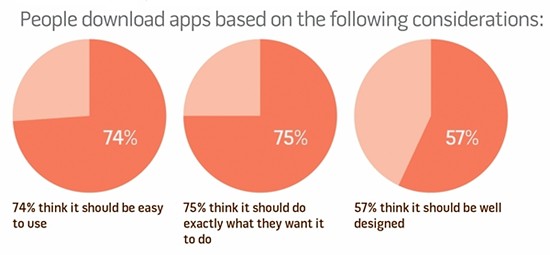
Mobile App Preferences
Sources: MarketingProfs; Harris Interactive and EffectiveUI field survey, 2010.

Meyer believes part of the dynamic at work is a knee-jerk “bias for action” as the marketing playing field shifts endlessly.

“It’s called ‘do it’ because everyone else is doing it, and it results in not only bad marketing, but in turned off consumers and customers,” he maintains.

Questions as simple as “What would you like to see in a mobile app?” … or testing an app concept with a sample of potential users before spending the effort and energy to produce it would be good places to start.

Marketers can use the research findings to adjust the proposed design of an app — or to trash it altogether and come up with an alternative one that actually meets a need.

If more companies did this, perhaps the 75% deletion rate for mobile apps would cease to be so flat-out dismal.

Twitter’s “Potemkin Village Problem” Isn’t Getting Any Better

“Millions of fake accounts dog Twitter.”

“Twitter dogged by bogus accounts.”

social-media-inflated-statsI’ve blogged before about the scads of Twitter accounts that are accounts in name only.

It’s been a problem for years.

But now, it takes on even greater significance as the market valuation of Twitter is being measured in the tens of billions as the company issues publicly traded stock in its IPO.

To this end, I found a recent Wall Street Journal article penned by technology reporter Jeff Elder particularly interesting in that it pulls together various pieces of evidence that have been building … and which together showcase the extent of Twitter’s “Potemkin Village” problem.  (Note the headlines from this article displayed above.)

Essentially, the problem is a plethora of “faux” Twitter accounts being created by an underground network of sellers – including 20 or so major operations scattered around the world – that then offer these accounts for sale to companies and brands wishing to “juice” their Twitter follower statistics to appear more consequential than they actually are.

Consider these points from Mr. Elder’s article:

  • Faux accounts abound on Twitter because users aren’t limited to having a single account – nor are they required to use their real names.
  • In securities filings, Twitter claims that “fake” accounts represent fewer than 5% of its active user accounts.
  • But this past summer, security researchers Andrea Stroppa and Carlo de Micheli reportedly uncovered more than 20 million fake accounts for sale on Twitter – which is closer to 10% of Twitter’s active account base.  (Twitter had no comment on this report.)
  • Stroppa and de Micheli also unearthed the existence of software programs that allow spammers to create unlimited fake accounts on Twitter.  (Twitter had no comment on this report.)

Evidently, Twitter has taken stabs at reducing fakery among its account base — however sporadically.

About a year ago, the company reportedly worked with a team of researchers from UC Berkeley and George Mason University to identify fake Twitter accounts and minimize “robot” activity.  This was done by actually purchasing fake Twitter accounts on the black market and then identifying their common characteristics.

A filter subsequently developed was then able to block ~95% of such accounts – but it was only a matter of days before the underground market figured out ways to get around the new filters.

Within two short weeks, the filters were successfully blocking only about 50% of new fake Twitter accounts, and that percentage has continued to decline further since then.

And these faux accounts are available for a ridiculously small amount of money.  For instance, this past November one marketer purchased 1,000 accounts from an online vendor located in Pakistan … for a whopping $58.

This marketer then programmed them to “follow” the Twitter account of a rap artist client who was interested in boosting his standing on the social network.

In addition, those same accounts have been used to retweet the rapper’s own tweets, thereby giving them greater exposure on Twitter.

And believe it or not, this sort of ruse often works, because prominence on Twitter can lead to legitimate attention by an unwitting press and other “influencers.”

But it’s all blue smoke and mirrors, of course.

The downside?  As more of these stories get reported and shine a light on the seedy underside of the Twittersphere, it can’t help but have a negative impact on the social platform’s reputation.

… Beginning with people like you and me.

Marketing clichés are all around us.

no buzzwordsMarketing can be many things.  But marketing without originality isn’t much of anything.

That’s why there’s a desire among marketers to avoid clichés and buzz terminology in sales and marketing content whenever possible.

Still, it’s easy to fall into the cliché trap – and it happens to the best of us.

This is particularly true when the “next new thing” in business comes along every few months and people grasp for shorthand ways to communicate those concepts.

[There:  Perhaps “next new thing” qualifies as a marketing cliché itself!]

Brian Morrissey
Brian Morrissey

Recently, communications specialist and editor-in-chief of vertical media company Digiday, Brian Morrissey, came up with a list of 25 marketing clichés which he feels should be avoided if at all possible.

I’ve gone through Morrissey’s list and have selected ten that I think are particularly baneful – especially in the world of B-to-B marketing.  See if you agree:

Putting the customer at the center.  Isn’t it obvious that companies and brands would be committed to this?  And if not … where was the customer located before?

Having an “authentic” conversation with customers.  Inauthenticity isn’t cool.  Inauthenticity is also what we’ve been trying to avoid for years – or should have been.  There’s really no news in this statement, is there?

We fail fast.  Perhaps it comes from reading too many issues of Fast Company … but what companies do you know that want to slowly jettison a failed strategy?

Blue-sky thinking.  The “sky’s the limit” when it comes to “out-of-the-box thinking.”  Ugh.

Nab the low-hanging fruit.  This cliché has been around so long, there can’t be any low-hanging fruit left!

Dipping our toe in the water.  Trying to put a positive spin on a lack of depth or heft isn’t fooling anyone.

Open the kimono.  Any buzz phrase that conjures mental imageries of a flasher can’t be what we want to communicate.

Curated experiences.  A fancy way of admitting that content isn’t ours.  Besides, the term “curator” hardly sounds contemporary.  Instead, it connotes images of museums, galleries and other places that deal with the dusty past.

Surprising and delighting our customers.  Morrissey contends that this whopper makes brands come off like clowns … and that clowns are silly, scary or creepy – take your pick.

Tentpole idea.  Continuing with the clown analogy, no doubt … but whether it’s a circus or a tent revival, the mental imagery this elicits isn’t particularly apropos.

… And these are just ten terms on Morrissey’s list of 25 marketing clichés.

What about you?  Do you have any buzz phrases that you find particularly annoying – perhaps “thought leadership” or maybe “exceeding our customers’ expectations”?

Please share your nominations with other readers here.

Samsung gets its marketing knuckles wrapped – twice.

Samsung logoTech manufacturing giant Samsung’s “questionable” marketing activities have been in the news this past week – again.

This time, it’s reported that the company has been fined a $340,000 penalty for paying people to post trash-talk comments about competitor HTC’s products in customer online forums in Taiwan.

Back in April, the Fair Trade Commission in Taiwan opened an investigation into allegations that Samsung had recruited certain employees along with freelance writers from the outside to flack the shortcomings of its competitors’ products.

In addition to the company being held culpable, two of Samsung’s outside marketing firms were fined for their part in the marketing shenanigans masquerading as natural content.

This is pretty big news in the world of smartphones.  HTC and Samsung are major competitors in this highly competitive marketplace, and both companies offer products that operate on the Android platform.

But Samsung’s fortunes have risen dramatically over the past year as its global smartphone market share jumped from ~19% to ~30%.

By contrast, HTC’s share declined from ~9% to slightly less than ~5% over the same period.

Evidently, Samsung couldn’t resist the temptation to kick a competitor when it was already on the ropes.

Chalk it up to the “take no prisoners” atmosphere in the cutthroat competitive world of mobile technology – the “New York Garment District mentality” writ large.

“Astro-turfing” isn’t new, of course.  But the practice is usually the province of smaller companies with fewer scruples … or marketing people who are simply unaware of proper marketing etiquette (and often backed by legal opinion).

Amateur hour
“Amateur hour” at Samsung’s marketing department makes the company look just … silly.

For a company as large and as sophisticated at Samsung, it does seem a little … odd.  And certainly not in good form.

But as it turns out, this isn’t the first time Samsung’s gotten caught with its marketing pants down.

Just a few months ago, the company was discovered bribing various people to “talk up” its development activities – and “talk down” their competitors – during the Samsung Smart App Challenge competition.

Android developer Delyan Kratunov went public with ongoing correspondence in which a viral marketing company working for Samsung offered him $500 to cite positive mentions on the Stack Overflow online community.

The instructions were specific:  Mr. Kratunov would need to ask a series of “casual and organic” questions about Samsung’s app challenge over a month-long period.

Later, the marketing company attempted to distance itself from the egregious behavior — but not before the incident had been exposed.

My response to Samsung is this:  You’re already winning.  There’s no need to engage in “adolescent business behavior” of this kind.

It’s in very bad form … and sooner or later it’ll come back to bite you.

Stuff like this always does eventually.

Getting Bunky with Retail Marketing

digital circularsAre the days of the lowly printed sales circular numbered?

Judging from the flurry of newfangled activity by key retail marketers, it would seem so.

This past week, CVS Pharmacy announced a complete makeover of its weekly circular.  The new digital version, dubbed myWeekly Ad, incorporates customized promotions focused on the products that are deemed of greatest interest to individual consumers.

The personalized sale items are determined from scanning the trove of customer buying behavior information housed in CVS’s ExtraCare Rewards database, which now numbers more than 70 million active users.

The myWeekly Ad circular determines which items to feature based on the products that each targeted consumer buys most frequently, along with showcasing deals on other products in related categories that may also be of interest based on the purchase history of each customer.

CVS’s digital circular provides other user-friendly options as well:

  • Consumers can scan the savings and rewards currently available to them, and print coupons or digitally send special offers to their card before visiting a CVS store. 
  • Shopping lists can be created, shared and sent to mobile devices. 
  • Shoppers can view their own purchase history showing all products bought at CVS previously going back 18 months.

And CVS is hardly alone in digitizing its MarComm materials.  Thanks to the continuing evolution of rewards cards and the voluminous customer data they can collect, new personalized circular announcements are coming with regularity now.

Here are some of the latest new developments:

  • Shoplocal is a Gannett-owned print and digital circular publisher.  It has gotten together with personalized video firm Eyeview to create a new digital ad promo piece known as V-circular.  This vehicle allows retailers and major brands to target customers on a local level based on geographic, demographic and behavioral data – along with factoring in “real-time” conditions like the weather.
  • National coupon clearinghouse Valpak has introduced a novel “augmented reality” feature for its digital circulars.  Simply pointing a smartphone toward the horizon will enable shoppers to see which nearby businesses are offering coupons.
  • Direct mail media and marketing services firm Valassis has unveiled Geo-Commerce Retail Zone, a new ad-targeting capability that applies transaction and behavior data from consumers to local store trading areas, enabling targeted advertising to be delivered cross-platform.

No one questions the fact that more and more information on individual consumers is being collected, archived and applied on an individualized basis.  Anonymity is fast becoming a quaint notion of the past.

Of course, this couldn’t happen without the cooperation and willing engagement of consumers. 

Considering the benefits – special discounts and even freebies on goods and services – is it any wonder that these programs have been able to grow in size and comprehensiveness over time?

What are your thoughts about the tradeoffs?  Feel free to add your thoughts to the discussion.

“Public pronouncements” versus “private predilections”: What we say isn’t always what we actually believe.

Public versus private thinkingThere’s an intriguing new research report out from Young & Rubicam that lays bare the contradictions of what people say they like and want … and what they secretly think.

The findings are outlined in a new research study Y&R has dubbed Secrets & Lies … and it’s based on research conducted in September 2013 among adults over age 18 in the United States, Brazil and China.

The bottom line?  The Y&R research finds that many people hold views that are diametrically opposed to what they reveal to others publicly.

That kind of a result would be difficult to measure using traditional survey research.  So Y&R chose to meld the conventional survey approach with a second methodology known as “Implicit Association Testing.”

IAT helps reveal sub-conscious or unconscious motivations that lie outside of our standard awareness.

So, what contradictions and correlations did the research uncover? 

Let’s start with the study’s global findings.  When asked to rank-order a group of 16 “values,” here’s a listing of the top five values as cited by the survey respondents in all three countries:

  • #1.  Finding meaning in life
  • #2.  Choosing my own path
  • #3.  Helpfulness
  • #4.  Environmentalism
  • #5.  Success

Now … compare that to the “Top 5” list that was revealed with these same respondents were evaluated using implicit association:

  • #1.  Sexual fulfillment
  • #2.  Respect for tradition
  • #3.  Maintaining security
  • #4.  Environmentalism
  • #5.  Building wealth

Wow.

We  see just one value appearing on both lists … and there are some pretty big differences in the values that reside on each of them.

Did American respondents differ from their counterparts in China and Brazil?  Like the global results, the values were quite different between conscious responses and implicit association. 

U.S. respondents named helpfulness as their highest-ranked value, followed by choosing my own path and finding meaning in life.

But what did the implicit association testing reveal among these same American respondents?

Far from being at the top of the list, “helpfulness” came in dead last:  16th place out of 16 values rated.  Instead, the top three “subconscious” values are actually these:

  • #1.  Maintaining security
  • #2.  Sexual fulfillment
  • #3.  Honoring tradition

As the Y&R study pointedly opines, America’s top conscious values sound like political correctness reminiscent of the Oprah Show … whereas our unconscious values sound more like a return to the Eisenhower era.

These seeming disconnects between “public pronouncements” and “private predilections” manifest themselves in brand image as well.

As it turns out, consumers say they like the “popular kids” on the branding block a lot more than they actually do subconsciously.

Here’s a list of top brands researched and how they come out in conscious rating versus IAT evaluation:

  • Alignment between public and secret likes:  Amazon, Target, Whole Foods
  • Alignment between public and secret dislikes:  AT&T, K-Mart, Playboy
  • Liked less in secret:  Google, Microsoft, Starbucks
  • Liked more in secret:  Exxon, Facebook, National Inquirer

When I scan this list, it’s pretty evident what’s going on.  Certain brands are popular whipping boys in the “popular media” and on certain cable news channels, where one rarely hears positive word uttered about them. 

Not surprisingly, it’s precisely those brands that get a “public thumbs-down” from the respondents.

But in secret — away from the klieg lights and the admonitions of the culture’s PC denizens — it’s quite a different ballgame.

Of course, no one would want their brand to be in AT&T’s or K-Mart’s unenviable position – because that’s where people dislike those companies publicly as well as in their private thoughts!