The VW Van Rides into History

T1 Type 2 VW Van
“T1 Type 2” VW van, manufactured by Volkswagen from 1950 to 1967.

Last week, a front-page article in The Wall Street Journal profiled the continuing attraction of ca. 1970s vans, decked out with all sorts of custom accessories and wild paint jobs.

It turns out, the vans are still so popular with a certain (aging?) segment of the American population, annual van rallies around the country attract thousands of participants.

But the article reminds us that, after more than 60 years of production and 10 million made, the very last VW vans came off the assembly line at the end of last year. That’s when Volkswagen’s Transporter van plant in metro São Paulo, Brazil shut down production.

Reportedly, production stopped because of new air bag and anti-lock braking system requirements for 2014 that were impossible to incorporate into the VW van’s design.

Brazil was the last place on earth where the iconic VW “bus” was being manufactured.  A plant in Mexico stopped producing the classic version of the van in 1995. European production had already been halted as far back as 1979 because the VW no longer met the minimum vehicle safety requirements on that continent.

But the true glory days of the VW van stretch back even further … to when the vehicle was synonymous with laid-back “hippie” lifestyles in the 1960s and early 1970s in the United States.

VW Type 2 Van
“T2 Type 2” VW van, manufactured by Volkswagen from 1968 to 1979.

Known by all sorts of nicknames (the Shaggin’ Wagon and Sin Bin are two of my favorites), the van served as “rolling homes” for many people.

It so reflected the popular culture of the day, the vehicle was featured on pop music album covers for the Beach Boys, Bob Dylan and others.

Bob Dylan album coverDamon Ristau, who directed a documentary film about the VW bus, said this about its mystique:

“It has a magic and charm lacking in other vehicles. It’s about the open road, about bringing smiles to peoples’ faces when they see an old WV van rolling along.”

For many Americans, the vision of a VW van transporting young, bronzed dudes and their surfboards to the California beaches is an iconic image. But the VW van’s brand identity is not at all like that in other parts of the world.

In places like Africa and Latin America, the vans were pressed into more mundane service — serving as mini-school buses, transporting troops, hauling merchandise or construction materials – even moving the mail.

In Brazil, the VW van is known as the “Kombi,” which is short-hand for the German term “Kombinations-fahrzeug” – or “combination transport vehicle.”

Over the years, the van developed a reputation for being breakdown-prone. But the flipside of this problem was that the VW’s simple engine design made it easy to repair.  So it was very popular with its owners — in a sort of ironic twist.

As one Brazilian van owner was quoted saying recently, “Driving a Kombi with your face up against the windshield is a thrilling experience … There is no other van that is so easy and inexpensive to maintain. Anyone with a minimum amount of knowledge about engines and a few tools can fix a Kombi.”

So it seems that no matter whether the VW van has been used for business or for pleasure, it has engendered similar feelings of attachment and affection.

The last VW van may have rolled off the assembly line and into history. But I suspect that many of the vehicles will be with us for decades to come – just like the 1950s American “fin” cars that continue to ply the streets of Havana five or six decades on.

Indeed, as long as there are people with a sense of wanderlust and the lure of the open road to beckon them, the VW bus will remain part of the cultural and emotional landscape in America.

Less is less? What’s happening with customer loyalty programs.

CustomersWhen it comes to customer loyalty programs, here’s a sobering statistic: Only about 15% of consumers redeem loyalty rewards.

This finding comes from a report by Forrester Research, based on results from an in-depth survey it conducted last fall of 50 member companies of Loyalty360, a major loyalty marketing association.

What Forrester found is that fewer than half of the surveyed companies’ customers are enrolled in their loyalty programs. And of those customers, only about 35% of them are actually redeeming their loyalty awards.

Hence the 15% “effective” participation rate.

At first blush, the paltry participation makes one wonder what all the fuss is about when it comes to loyalty marketing.  But more than half of the companies surveyed by Forrester reported that they view their loyalty program as a strategic priority, not merely a marketing afterthought..

Clearly, there seems to be a bit of a “disconnect” between those lofty aims and the not-so-airborne reality. The question is how companies can encourage greater participation in their loyalty programs, thereby using them to improve consumer brand loyalty in addition to retaining customers over time.

Forrester offered several recommendations in its report:

1. Use advances in analytics to act on customer insights, rather than just relying on the purchase transactional history of loyalty program members. 

2. Balance the “reward mix” with personalized offers that present rewards program customers with unique experiences that are different from simply offering “more of the same.” (In many cases, offering discounts on more of the same merchandise a customer has already purchased won’t qualify as anything particularly special.) 

3. Break out from the traditional e-mail/web portal/call center communication vehicles to embrace more social media channels featuring two-way interaction. (Surprisingly, only about half of Forrester’s survey respondents reported that social media is an important part of their loyalty programs’ methods of communication.)

Speaking personally, I’m not particularly surprised at the relatively low engagement levels reported in this study. Many companies and brands have reached out to me over the years with offers to join loyalty programs, using various incentives – often purchase discounts or sign-on points as an incentive for joining.

apathyFor me, it’s a matter of “time” and “mindshare” as to which of these programs qualify for my participation. If a brand isn’t that important to me in terms of how I live my daily life, it – and its loyalty program – isn’t ever going to be big on my radar screen.

I suspect there are quite a few other consumers like me. But if you have different take, leave a comment and share your perspective with other readers.


Fast Fade: Unpaid brand posts on Facebook are getting rarer by the day.

Lower ReachIt was just a matter of time.

Once Facebook ramped up its advertising program in order to monetize its platform and mollify its investors, unpaid posts by companies and brands were sure to be the collateral damage.

Sure enough, the recent monthly stats show that the “organic reach” of unpaid content published on company and brand pages on Facebook has been cut in half from where it was just a short time ago.

To illustrate, look at these stark figures gathered in an analysis by Ogilvy of 100+ country-level brand pages measuring the average reach of unpaid posts:

  • October 2013: 12.2%
  • November 2013: 11.6%
  • December 2013: 8.8%
  • January 2014: 7.7%
  • February 2014: 6.2%

What these stats show is that within the span of less than six months, the average reach of unpaid brand posts dropped by nearly 50%

To go even further, an anonymous source familiar with Facebook’s long-term strategy is claiming that its new algorithm could ultimately reduce the reach of organic posts to 2% or less.

Actually, the reason for the squeeze is more than just Facebook’s desire to increase advertising revenue.

Here’s a dynamic that’s also significant:  A Pew Research study conducted in mid-2013 found that the typical adult American Facebook user has around 340 friends.

That average is up nearly 50% from approximately 230 friends in 2010.

Of course, more friends mean more status updates eligible for feeds … and Facebook’s not going to display them all to everyone — even if it wanted to.

Also, Facebook users “like” an average of 40 company, brand, group or celebrity pages each, according to a 2013 analysis done by Socialbakers, a social media analytics firm.  That translates into an average of ~1,440 updates every month.

Compare those figures to five years ago, when the average number of page “likes” was fewer than five … yielding fewer than 25 monthly updates on average.

Clearly, there’s no way Facebook is going to to be able to display all of these updates to followers.  So … the content is squeezed some more.

The final nail in the coffin is the rise in “promoted” posts – the ones that brands pay dollars to promote. It’s only natural that Facebook is going to give those posts priority treatment.

Thus, the hat-trick combination of more friends, more likes and more promoted posts is what’s causing “organic” brand posts to go the way of the dodo bird.

In retrospect, it was only a matter of time before a major social platform like Facebook would seek to monetize its program in a big way.

In some respects, it’s amazing that the free ride lasted as long as it actually did …

Advertising and MarComm: So often ineffective … yet so often necessary.

Ineffective MarketingIn a column published in late 2013 titled “Why Does Most Marketing Stink?”, Forbes BrandVoice writer Michael Brenner (who is also a marketing executive at SAP) reminds us how the marketplace is tuning out the advertising and marketing messages being pitched to it.

We’ve heard these stats before, but it’s sobering to think of them in the aggregate.  Here are the figures that Brenner reported:

  • On any given day, consumers encounter more than 5,000 marketing messages (which is up significantly from approximately 2,000 messages only a few years ago).
  • ~85% of consumers skip TV ads that appear on their screen.
  • ~45% of direct mail goes straight to the trash without ever being opened.
  • Two-thirds of American adults have placed themselves on the “Do Not Call” Registry to avoid telemarketing pitches.
  • Nine out of ten e-mails are never opened.
  • 99.5% of e-mails receive no clicks.
  • 0.1% (or fewer) of banner ads receive clicks.
  • Eye-tracking studies show that most people have near-complete “banner blindness” when visiting web pages.

Seeing these stats presented all in one place is almost enough to make one swear off of advertising for good!

Except for one thing:  Some sort of promotion is essential for the success of nearly every enterprise.  It’s hard to think of any company or organization that has been successful without engaging in advertising or promotion of some kind, at some point in its evolution.

Of course, the hottest new approach in a MarComm field hungry for more effective strategies and tactics is “content marketing.”

But how new is that concept, exactly?

After all, let’s remember that advertising guru David Ogilvy preached that very gospel for decades, exhorting companies to concentrate on the content of their advertising, not its form.

Michael Brenner suggests that companies “publish content that informs and entertains customers through a content strategy that holistically considers audience content and channel needs.”

… Which is a fancy way of saying that companies need to think beyond the obvious traditional marketing channels.

Plus, they should focus on creating content that provides insights and answers, not the standard feature/benefit information about their products or services.

Let’s see how successful companies can be in leading with content marketing.  Surely, the results couldn’t be worse than the grim MarComm stats quoted in the Forbes BrandVoice column.

Social Branding: Reality-Check Time

social brandingWith all of the attention marketers have been paying to social media, it’s always helpful to look and re-look at information that gives us clues as to how customers are actually interfacing with brands in the social sphere.

Statistics published in a just-released report titled Digital Brand Interactions Survey, based on research conducted by web content management company Kentico Software, gives us a reality check on just how [non-]essential social media actually is in the greater branding picture.

The Kentico research queried approximately 300 American consumers age 18 or older via an online survey administered in February 2014.  Let’s start with the most basic finding:  the degree to which consumers “like” or “follow” brands on social networks such as Twitter, Facebook and Instagram:

  • No brands followed on social media:  ~40%
  • 1 to 10 brands followed:  ~39%
  • 11 to 20 brands followed:  ~7%
  • 21 to 30 brands followed:  ~6%

Considering how many different brands the typical consumer encounters in his or her daily life (dozens? … hundreds?), following ten or fewer brands on social media represents only a very small proportion of them.

Yet that’s exactly where four in five consumers are when it comes to social branding.

So … how do companies get into that rarefied group of brands that are, in fact, followed by consumers?  Here’s what the Kentico survey discovered:

  • Already interested in the brand and wanted to stay informed:  ~40%
  • Followed on social media to receive special offers:  ~39%
  • Followed because of a recommendation from a friend or family member:  ~12%
  • Didn’t really know the brand before, but wanted to learn more about it:  ~8%

These results suggest that the notion that social branding is an easy way to attract new customers may be flawed.  Instead, social branding is better-suited to deepening brand engagement with existing customers.

Money talks as well (discounts or other special offers) – and be sure to offer them often.

kentico logoIn another piece of evidence that points to social branding’s relatively weak ability to drive incremental sales … Kentico found that ~72% of its survey respondents “never” or “hardly ever” purchase a product after hearing about it on a social network.

An equal percentage of respondents have “never” or “hardly ever” had brand encounters online that altered their already-existing perception of those brands.

So it would seem that much of the “heat” generated by social branding may be adding up to very little “light.”

On the other hand, there is also some good news for brands in the social realm:  The incidence of people “unliking” or “unfollowing” brands is quite low:  Only about 5% of the survey respondents reported such actions.

When that does happen, it’s often because a brand has been publishing too many social posts – or the content of the posts themselves is uninteresting.

The biggest takeaway notion from the Kentico research is to remind us to maintain a degree of skepticism about the impact of social branding – and to understand that in most cases, social media activities are going to remain the “ornaments” on the marketing tree rather than be the “tree” itself.

In fact, that’s probably the case even more now — as consumers become bombarded with ever-more marketing messages from ever-more brands with every passing day.

The [dis]connect between content “quality” and online advertising.

Jack Marshall
Digiday’s Jack Marshall

I really appreciate the work of Jack Marshall, a reporter at marketing e-zine Digiday, who is helping to expose and explain the “brave new world” of online display advertising and how it has evolved into something that’s rife with problems.

ad exchangesConsider a recent column of Marshall’s titled “Is this the worst site on the Internet?”

In it, he notes that for “legitimate” online publishers that rely on advertising as their revenue model, that model is becoming a more daunting proposition with each passing day.

And a big reason is the emergence of other websites that are “gaming” the online system – not to mention the ad tech middlemen that are their willing accomplices.

Essentially, what’s happening is that ad dollars are being siphoned away from websites that provide professionally produced content and are going to sites that are explicitly constructed to serve up as many ad impressions as possible.

These sites contain little or no original content.

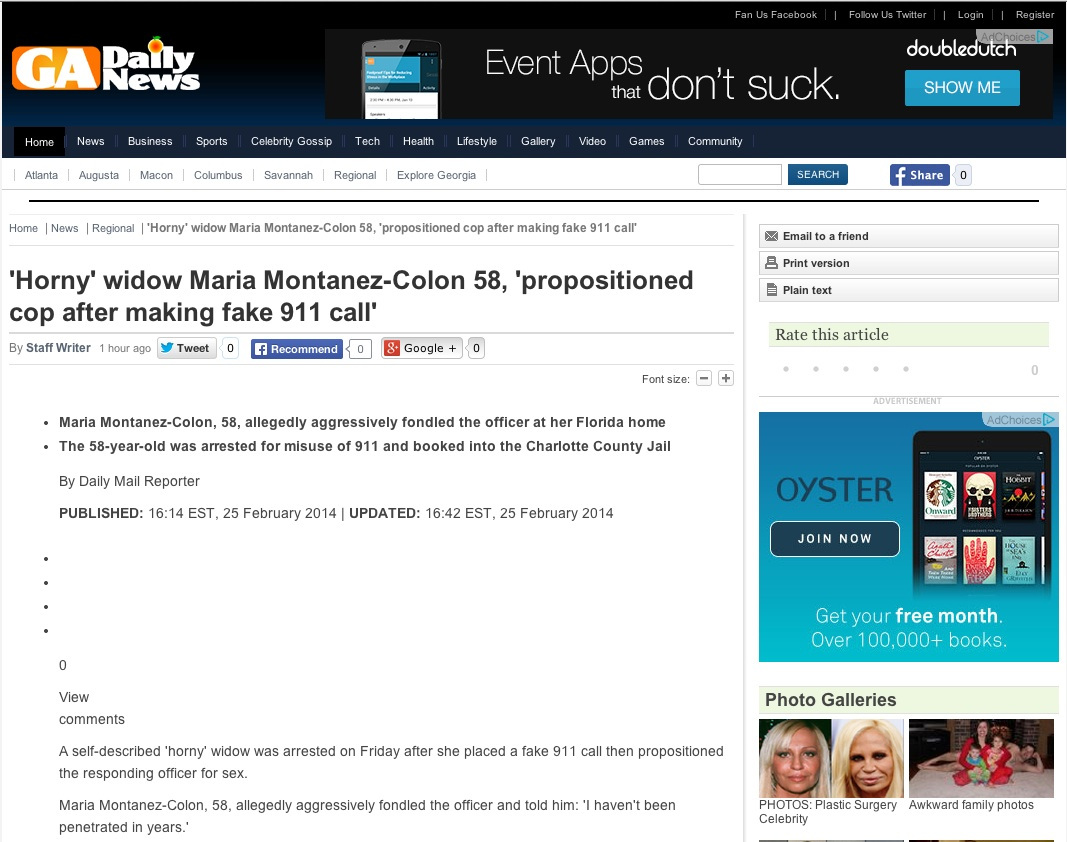
Marshall’s “Exhibit A” is Georgia Daily News, a website which purports to cover “news, traffic, sports, politics, entertainment, gossip and local events in Atlanta.”

As Marshall contends, “What it actually features is content ‘curated’ from elsewhere on the web, and some it has simply stolen from other major news sites” such as the Daily Mail.

Sizable chunks of the website’s content have nothing to do with Atlanta.

GADailyNews home pageConsidering the type of general news site it purports to be, GADailyNews.com doesn’t attract very much traffic at all.  And why would it? — since it contains precious little information of value or interest to anyone who is actually “seeking news about Atlanta.”

But it sure does generate a lot of ad impressions.  According to Marshall, each article page on the site features seven display ad units – all of which refresh every 20 seconds or so.

In the two-minute span of time it took him to read an article about Katy Perry and John Mayer (content copied from an Australian news site), Marshall was served more than 40 ad impressions.

Marshall continues:

“One page has served me nearly 500 ads in just 20 minutes – and I couldn’t stop refreshing them even if I wanted to.”

[And these ads aren’t for B-list advertisers, either.  They’re for brands like American Airlines, Hilton Hotels, Charles Schwaab and others.]

What’s happening here, of course, is that websites and ad tech middlemen have figured out that the algorithms of even the “quality” ad vendors like Google, AdRoll, and Bizo can be gamed pretty easily to serve ads on a low-quality site like Georgia Daily News, which is owned by a single-person entity called Integrated News Media Corporation.

It’s hardly the type of media vehicle that big-brand advertisers would normally wish to use for advertising.  But thanks to the vagaries and complexity of the ad exchange landscape, they are.

For every Georgia Daily News site, there are hundreds of others like it that cobble together seemingly valuable content with a passably convincing set of audience characteristics.

Put it together, and it adds up to problems on two levels.

First, advertisers are paying for impressions that are near-worthless.

Second, since there are finite ad dollars available, legitimate online publishers are losing out on those funds, which are far more important to their well-being than they are for sites that don’t engage in any true journalism at all.

As Jack Marshall concludes:

“Thanks to fraudulent traffic, dubious sites and middlemen with low quality standards, life is only getting harder for those publishers with expensive content teams to support.”

At Times Square, it’s “location-location-location” when it comes to advertising.

The building at 1 Times Square in New York City is nearly 100% vacant.

One Times Square Building (2010).

But if you’re the owner of the building, why should you even care?

That’s because the building takes in a reported near-$25 million per year in advertising revenues – thanks to the digital signage on the building being rented to top brands like Anheuser-Busch, Dunkin’ Donuts and Sony (among others).

Media, Sports & Entertainment Marketing Officer Blaise D’Sylva of Anheuser-Busch keeps it pithy:

“There’s a statement we make in being there – and we think the placement we’ve got is outstanding.”

Of course, there’s more to it than simply “making a statement.”  According to the Times Square Alliance, each year more than 100 million pedestrians pass through Times Square.

Moreover, foot traffic volume is running ~90% higher compared to 1996.

I’m quite sure these traffic volumes are central to any go/no-go advertising decisions being made by the big brands.

Where night is day:  Times Square advertising.
Where the night is as bright as day: Times Square advertising.

The Wall Street Journal reports that billboard signage in Times Square is actually the priciest outdoor advertising in the world.

Considering its location at the intersection of “high traffic” and “high trend,” marketers think it’s an investment worth making — and the rates they’re willing to pay proves the point.

What types of word terms perform best in social media?

Words that sell in social mediaEver since the rise of social media platforms, marketers have wondered if the terms and phrases that generate the best response in direct marketing also perform as well in the social arena.

One reason why:  There have been plenty of experts emphasizing how consumers don’t wish to be “sold” in their social interactions, but instead prefer to develop a relationship of give-and-take with brands.

Dan Zarrella, Social Media Scientist at HubSpot

Now we have some empirical analysis to guide us, conducted by Dan Zarrella, a social media scientist at SaaS inbound marketing firm HubSpot based on reviewing ~200,000 links containing tweets.

Mr. Zarrella found that the tweets that contain more verbs and adverbs experience higher clickthrough rates than noun- and adjective-heavy tweets.

Zarrella’s research also found that when social media posts ask for an explicit action on the part of the recipient, that tends to increase clicks and engagement.

For instance, retweets are three times more likely to happen when people are specifically requested to do so.

Interestingly, the most “retweetable” words in the HubSpot analysis turn out to be the same terms that do well in e-mail marketing and other forms of direct marketing:

  • You
  • Please
  • Post
  • Blog / Blog Post
  • Free
  • Media
  • Help
  • Great
  • How To
  • Top
  • Check Out

In a parallel research endeavor, a recent evaluation of blog posts by writer and software analytics specialist Iris Shoor reveals how much a post’s title impacts on the volume of “opens.”

In her analysis, Ms. Shoor studied posts on 100 separate blogs, using an evaluation technique that rank-sorted blog posts from the most read to the least shared.

What were the words that resulted in the most opens?  Shoor calls them the “blood in the water” terms:

  • bleeds leadsKill
  • Fear
  • Dark
  • Bleeding
  • War
  • Dead
  • Fantasy

Translation?  Negative terms are more powerful for shares than more ordinary terms (e.g., positive ones).

It’s very much like the old adage in the newspaper world:  “If it bleeds, it leads.”

That’s another takeaway from the most recent research:  What’s worked in the offline world over the years appears to be working very much the same way in the online space today.

Plus ça change, plus c’est la même chose …

Fake online product reviews: How pervasive are they?

Fake reviewsThink about those reviews that mean so much to you when considering whether to purchase a particular product or a service …

It could be that the comments you’re reading are bogus – or at least not based on the reviewer’s first-hand experience.

An online survey of nearly 1,200 U.S. adults age 18 and older, conducted by marketing research firm YouGov in January 2014, found that more than one in five respondents admitted to having posted online reviews about products or services they hadn’t actually bought or used.

The percentage is somewhat higher for men (~23%) than it is for women (~17%).

Why do people post reviews or comments on products and services they haven’t tried?  Here’s what the survey respondents reported:

  • “Just felt like it”:  ~32% gave this reason
  • “Didn’t like the idea of the product”:  ~22%
  • “Didn’t like the manufacturer”:  ~19%

These stats might suggest that there are more “negative” reviews being posted online than what reflects the actual experience with the product or service.

But the YouGov survey also found that far more people leave good reviews than bad ones:

  • ~57% have left a mixed review
  • ~54% have left a good review
  • Only ~21% have ever left a bad review

What drives someone to leave a bad review?  The #1 reason is obvious … but the #2 reason might surprise you.  And the #3 reason is just mercenary:

  • ~88% want to warn others about a disappointing product or service
  • ~23% believe that venting their frustrations will leave them feeling less angry
  • ~21% are hoping to get a refund or some other monetary consideration from the company in question

The veracity of online reviews is important because the vast majority of adult consumers check them before deciding to purchase a product or service.

This YouGov survey is no different:  It found that ~79% consult reviews at least sometimes … and ~26% reported that they “always” check reviews before buying a product or service.

FakeryThe YouGov report comes hard on the heels of a Virginia lawsuit wherein a carpet cleaning service charged online review website Yelp with publishing negative reviews posted by people who had never been customers of the store.  The cleaning service claimed that the negative reviews had hurt its business.

In that case, a judge ordered Yelp to reveal the identities of the seven “anonymous” reviewers — who I’m sure never thought their “unidentified antics” would ultimately be revealed for all the world to see.

It may just be that posting a “faux” review has now become a little riskier.

People may think twice now before engaging in their little mischief.  I’m sure most of them can think of a lot better things to do than to be hauled into court for an alleged infraction like that — or at the very least, having their name brought into the legal proceedings.

Boston Consulting Group predicts “the end of consumer marketing as we have long known it.”

Boston Consulting Group recently conducted a survey of American consumers to see how their spending habits and approach to brands differs by age group.

Millennials GenXers Baby BoomersThe results give us a quantifiable measure of the differences in outlook between three major age groups:  Millennials (age 18 to 34), Gen-Xers (age 35 to 49), and Baby Boomers and older consumers (age 50 and up).

The survey findings led BCG researchers to declare that Millennials’ perspectives are characterized by a “reciprocity principle.”  By this, they mean that these younger consumers expect “mutual relationships” with companies and their brands.

This isn’t so very surprising considering the ability of the Internet and social media platforms to provide an easy platform for airing their opinions.

A positive brand experience may prompt consumers to take favorable “public” action on behalf of the brand.

A disappointing experience most assuredly will prompt vocal criticism via product or service reviews, social media, blog posts, and leaving comments.

digital-multitaskingAnd the juicier the commentary, the more likely it is to go viral.

The BCG survey found that younger consumers are far more prone to participate in the world of “reciprocity.”

The differences were pretty dramatic when asking respondents in the different age groups whether they agreed with certain statements:

“Brands identify who I am, and my values.”

  • Millennials:  ~44% agree
  • Gen-Xers:  ~38%
  • Boomers and older:  ~33%

“People seek me for knowledge and brand opinion.”

  • Millennials:  ~51% agree
  • Gen-Xers:  ~42%
  • Boomers and older:  ~34%

“I’m willing to share my brand preferences online or on social media.”

  • Millennials:  ~55% agree
  • Gen-Xers:  ~43%
  • Boomers and older:  ~28%

Evaluating the survey findings, the BCG report posits that Millennials are “the leading indicators of large-scale changes in consumer behavior.”

Rather dramatically, BCG also concludes that this particular generational transition is “ushering in the end of consumer marketing as we have long known it,” and that the linear framework companies have used for decades to manage brand image and engagement is headed out the window.

“… Marketers must embrace the reality that marketing is an ecosystem of multidirectional engagement rather than a process that is controlled and pushed by the company,” the BCG report states.

My personal view is that the Boston Consulting Group’s conclusions are probably on-target … but the question is the degree.

I don’t think many major brands are going to simply cede control of their marketing and messaging to the cyberspace or the social cloud.  They’ve worked too long and too hard on their brand image and identity to give up that easily.

For more on the survey findings and conclusions, here’s BCG’s summary article.